
Line Load Calculation of balancing loads ballasts tearing
Line. Load Calculation of balancing loads (ballasts), tearing forces, affecting attachment fittings of wires, cables Use left mouse click and navigation buttons to navigate the presentation
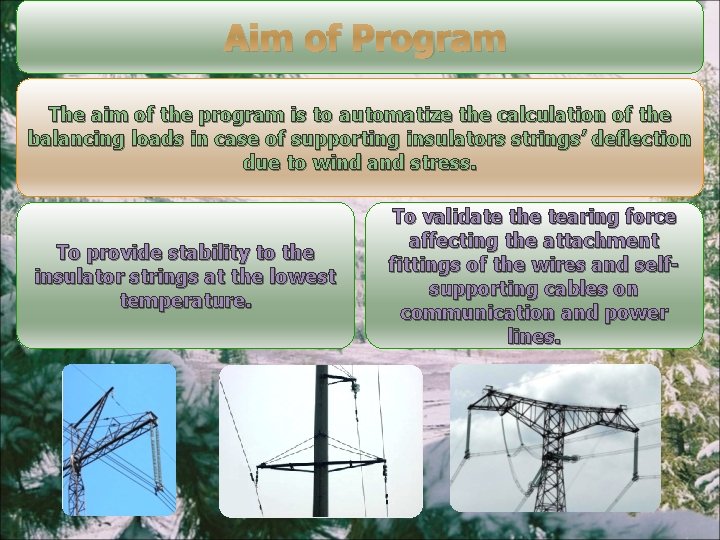
Aim of Program The aim of the program is to automatize the calculation of the balancing loads in case of supporting insulators strings’ deflection due to wind and stress. To provide stability to the insulator strings at the lowest temperature. To validate the tearing force affecting the attachment fittings of the wires and selfsupporting cables on communication and power lines.

Define the weight of the balancing load, the largest of two calculation results for intermediate and angle-intermediate supports of power lines: - to compensate dangerous deflection of supporting insulator strings due to wind and stress; - to provide stability to supporting insulator strings at the lowest temperatures.
Purposes of Program Implementation Define the tearing force influencing the supporting attachment of self-supporting communication cables, both for FOCL and FOCLOHL. Define the could be torn supports. tearing force influencing pin-type insulators, that away from the pins; tearing force influencing the Decide on the necessity of using higher supports, moving the supports around, lower the stress on a line route sector. Make a decision on changing an intermediate support of an overhead line to a strain support. Mounting a FOC cable higher on an OL support. Replacing the intermediate supporting attachment fitting of a self-supporting communication cable to a strain fitting, which is possible in some cases.
Limitations The calculation of the clearances is performed for the settled stress mode. One file of the source data with the supports under research could be created only for unchanged climatic conditions. According to EIR it is necessary to take the most disadvantageous combinations of climatic conditions.
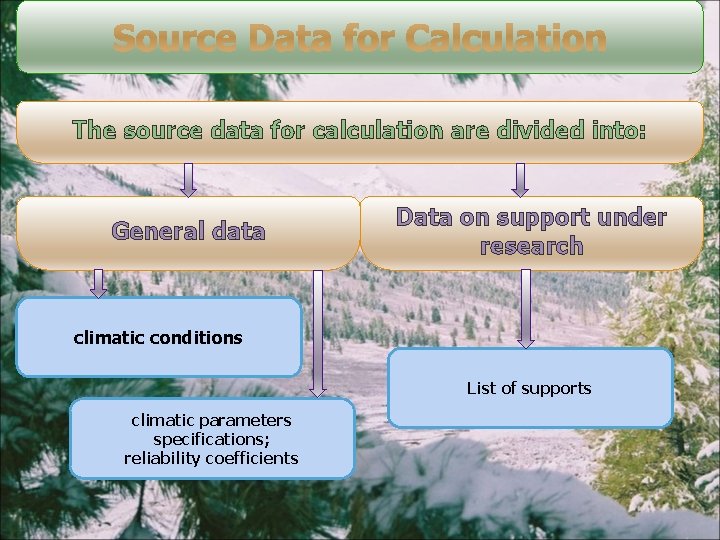
The source data for calculation are divided into: General data Data on support under research climatic conditions List of supports climatic parameters specifications; reliability coefficients
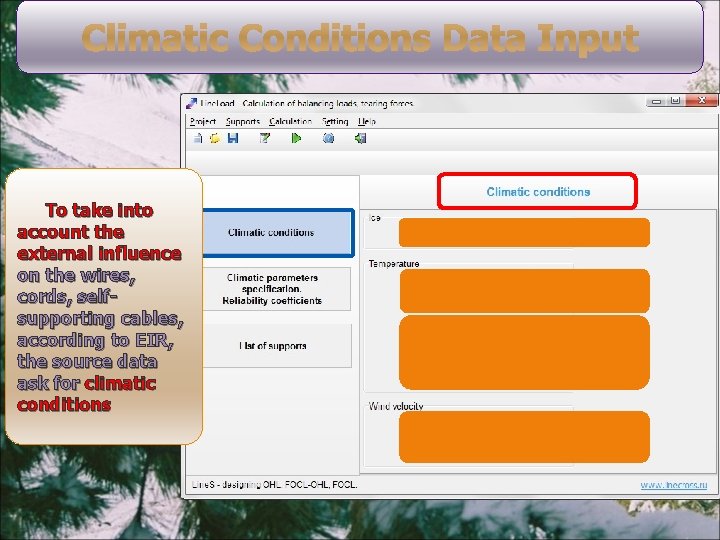
To take into account the external influence on the wires, cords, selfsupporting cables, according to EIR, the source data ask for climatic conditions
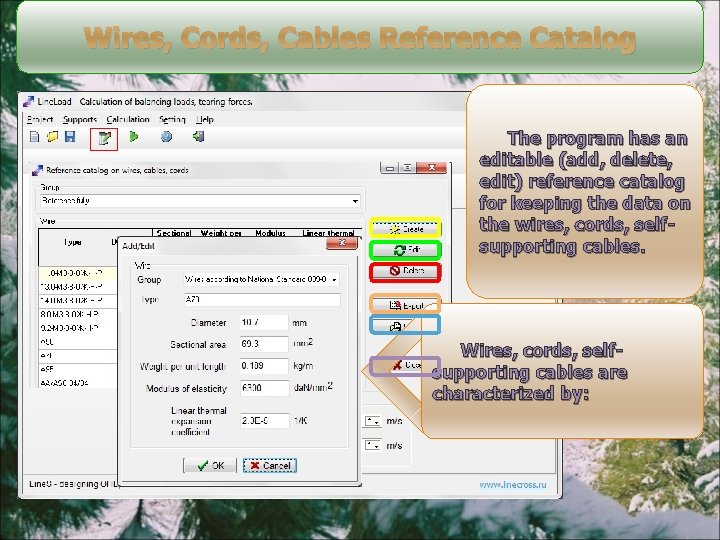
Wires, Cords, Cables Reference Catalog The program has an editable (add, delete, edit) reference catalog for keeping the data on the wires, cords, selfsupporting cables. Wires, cords, selfsupporting cables are characterized by:
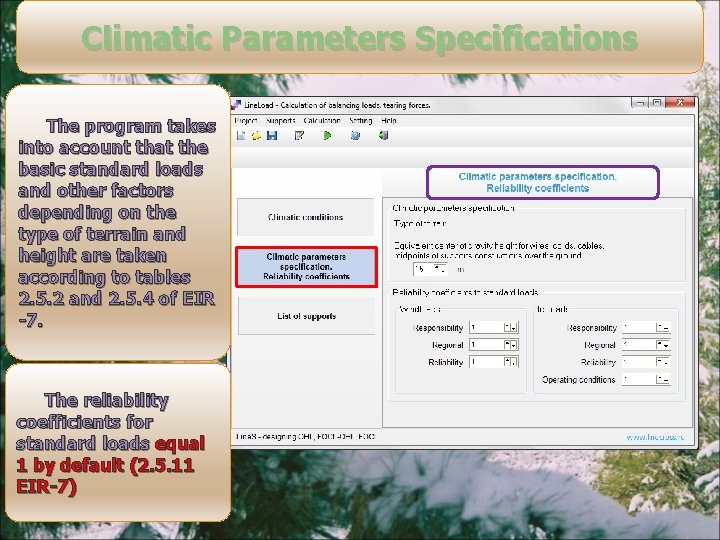
Climatic Parameters Specifications The program takes into account that the basic standard loads and other factors depending on the type of terrain and height are taken according to tables 2. 5. 2 and 2. 5. 4 of EIR -7. The reliability coefficients for standard loads equal 1 by default (2. 5. 11 EIR-7)
Source Data for Calculation The support under research, as a rule, is situated lower when the neighboring supports on the left and on the right, especially, if it is supposed that the lowest points of wires’, cables’ sagging are outside the spans. In this case, there are forces at the points of wires’ attachment that are directed upwards. The forces directed upwards affect the stability of supporting insulator strings, lifting them up of could cause a crossing between the wire and the support’s body, cross-arm.
Source Data for Calculation In case of an overhead line with the pin-type insulators, a considerable force could tear the insulators from their pins, tear out the supports. In case of self-supporting cables, their attachment fittings could be placed horizontally so that the cable could be damaged when touching the construction of the supports. The deflection is inversely proportional to the balance between the weight of the wire and the insulator string and the force directed upwards. If the force directed upwards is low or balanced by the weight of the wires, approaching the body of the support could be caused by wind deflecting the supporting insulator string from its vertical position.
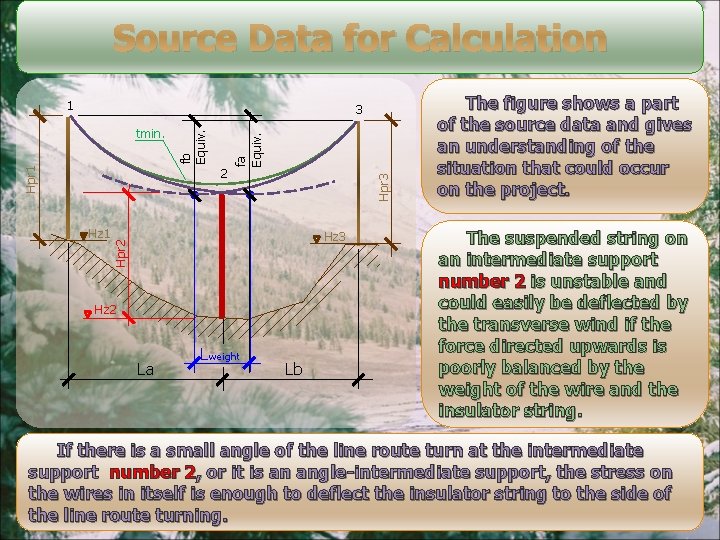
Source Data for Calculation 1 Hz 3 Hpr 2 Hz 1 Hpr 3 Hpr 1 2 fa Equiv. tmin. fb Equiv. 3 Hz 2 La Lweight Lb The figure shows a part of the source data and gives an understanding of the situation that could occur on the project. The suspended string on an intermediate support number 2 is unstable and could easily be deflected by the transverse wind if the force directed upwards is poorly balanced by the weight of the wire and the insulator string. If there is a small angle of the line route turn at the intermediate support number 2, or it is an angle-intermediate support, the stress on the wires in itself is enough to deflect the insulator string to the side of the line route turning.
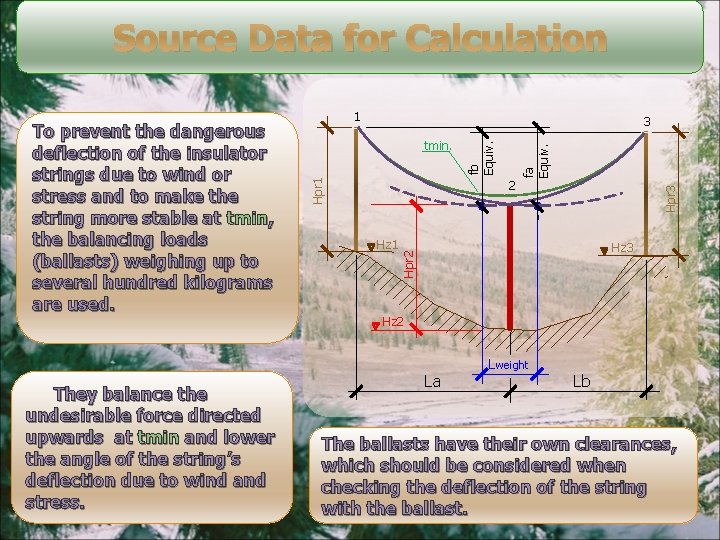
Source Data for Calculation They balance the undesirable force directed upwards at tmin and lower the angle of the string’s deflection due to wind and stress. Hz 3 Hpr 2 Hz 1 Hpr 3 2 fa Equiv. tmin. fb Equiv. 3 Hpr 1 To prevent the dangerous deflection of the insulator strings due to wind or stress and to make the string more stable at tmin, the balancing loads (ballasts) weighing up to several hundred kilograms are used. 1 Hz 2 La Lweight Lb The ballasts have their own clearances, which should be considered when checking the deflection of the string with the ballast.
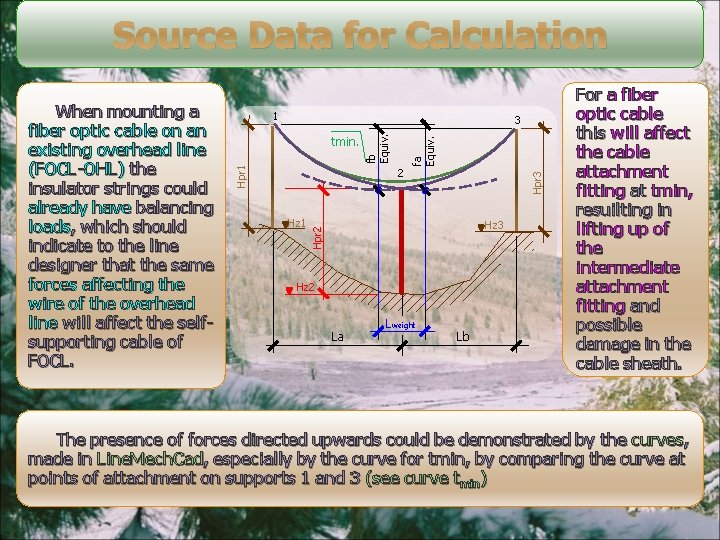
Source Data for Calculation 1 fa Equiv. tmin. fb Equiv. 3 Hpr 1 Hz 1 Hpr 3 2 Hz 3 Hpr 2 When mounting a fiber optic cable on an existing overhead line (FOCL-OHL) the insulator strings could already have balancing loads, which should indicate to the line designer that the same forces affecting the wire of the overhead line will affect the selfsupporting cable of FOCL. Hz 2 La Lweight Lb For a fiber optic cable this will affect the cable attachment fitting at tmin, resuilting in lifting up of the intermediate attachment fitting and possible damage in the cable sheath. The presence of forces directed upwards could be demonstrated by the curves, made in Line. Mech. Cad, especially by the curve for tmin, by comparing the curve at points of attachment on supports 1 and 3 (see curve tmin)
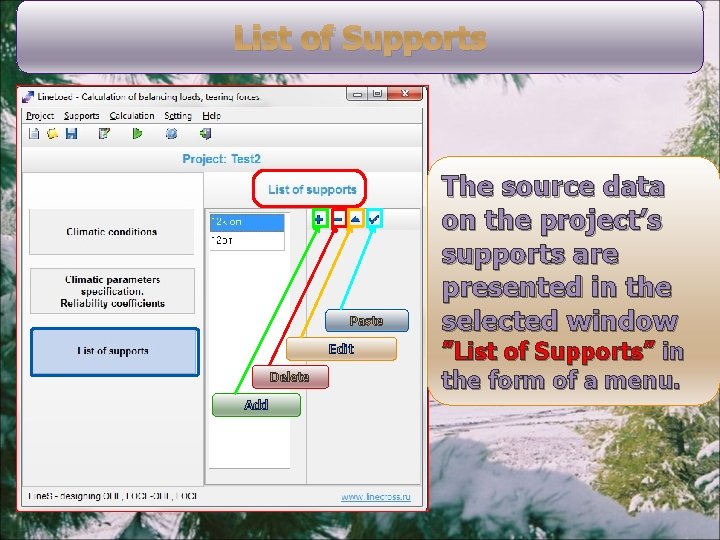
List of Supports Paste Edit Delete Add The source data on the project’s supports are presented in the selected window ”List of Supports” in the form of a menu.
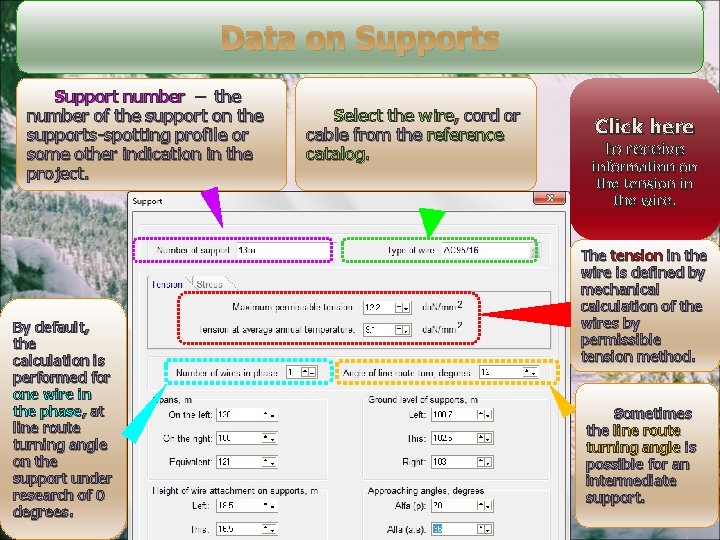
Data on Supports Support number – the number of the support on the supports-spotting profile or some other indication in the project. By default, the calculation is performed for one wire in the phase, at line route turning angle on the support under research of 0 degrees. Select the wire, cord or cable from the reference catalog. Click here to receive information on the tension in the wire. The tension in the wire is defined by mechanical calculation of the wires by permissible tension method. Sometimes the line route turning angle is possible for an intermediate support.
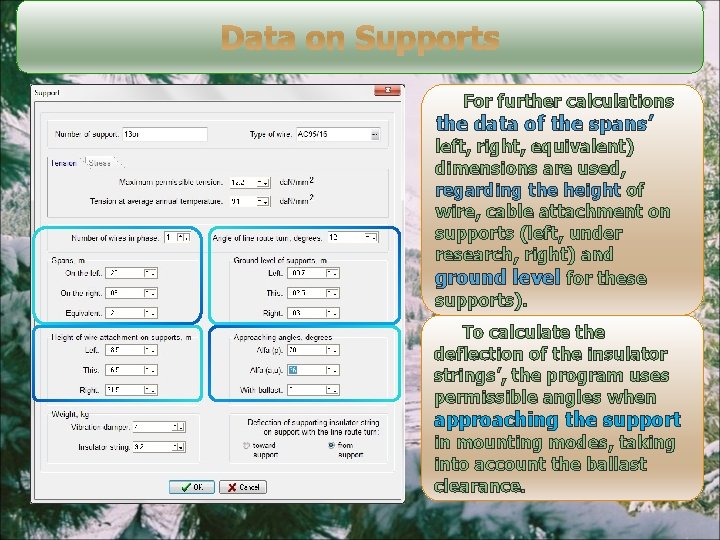
For further calculations the data of the spans’ left, right, equivalent) dimensions are used, regarding the height of wire, cable attachment on supports (left, under research, right) and ground level for these supports). To calculate the deflection of the insulator strings’, the program uses permissible angles when approaching the support in mounting modes, taking into account the ballast clearance.
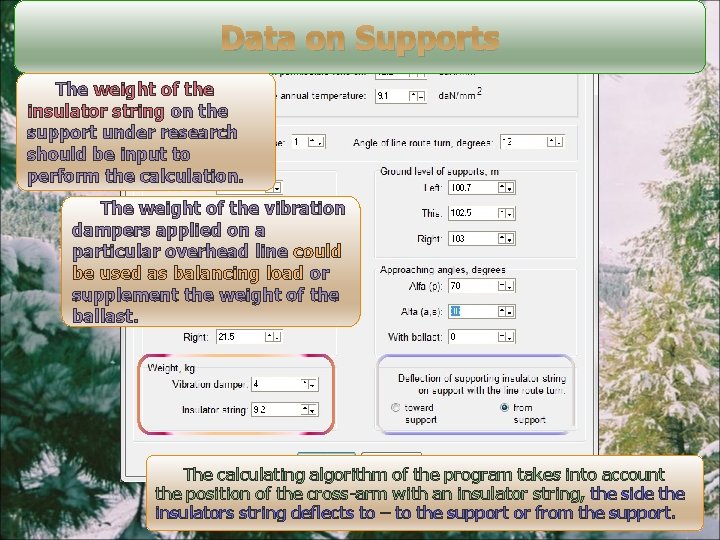
Data on Supports The weight of the insulator string on the support under research should be input to perform the calculation. The weight of the vibration dampers applied on a particular overhead line could be used as balancing load or supplement the weight of the ballast. The calculating algorithm of the program takes into account the position of the cross-arm with an insulator string, the side the insulators string deflects to – to the support or from the support.
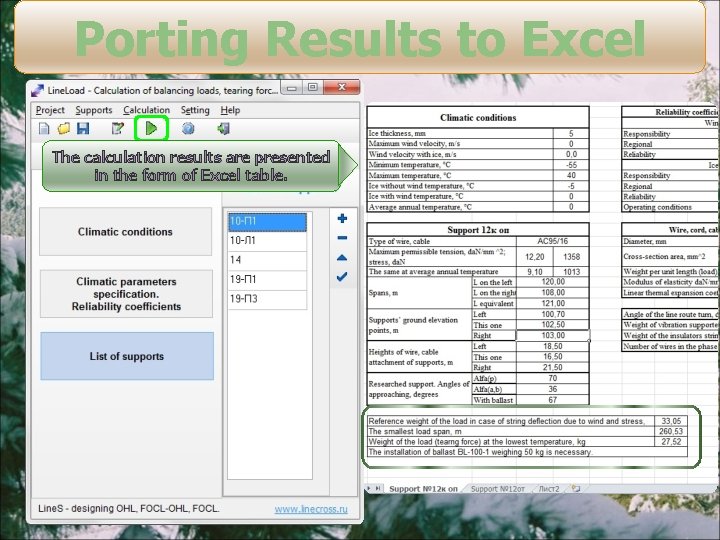
Porting Results to Excel The calculation results are presented in the form of Excel table.
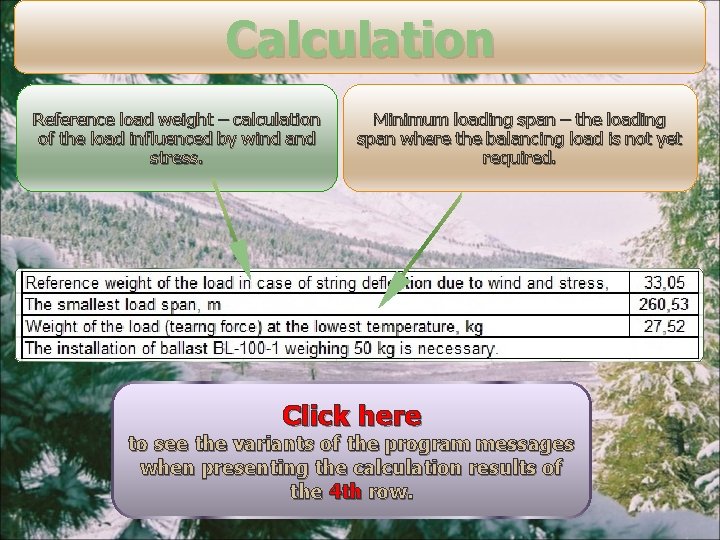
Calculation Reference load weight – calculation of the load influenced by wind and stress. Minimum loading span – the loading span where the balancing load is not yet required. Click here to see the variants of the program messages when presenting the calculation results of the 4 th row.
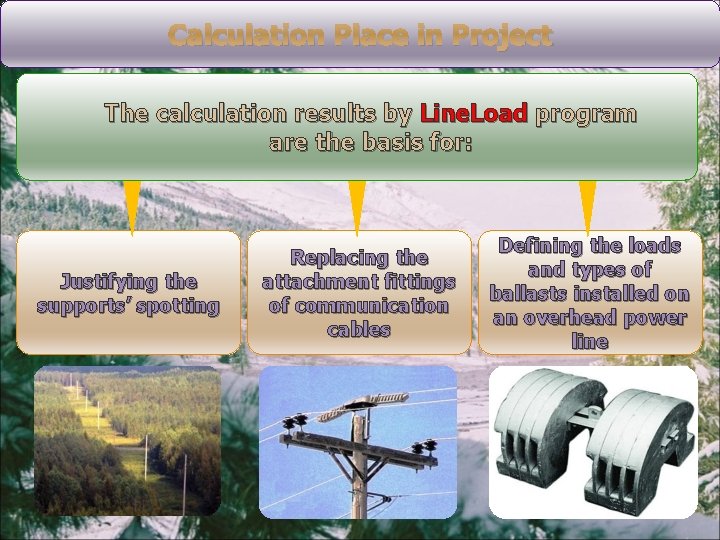
Calculation Place in Project The calculation results by Line. Load program are the basis for: Justifying the supports’ spotting Replacing the attachment fittings of communication cables Defining the loads and types of ballasts installed on an overhead power line
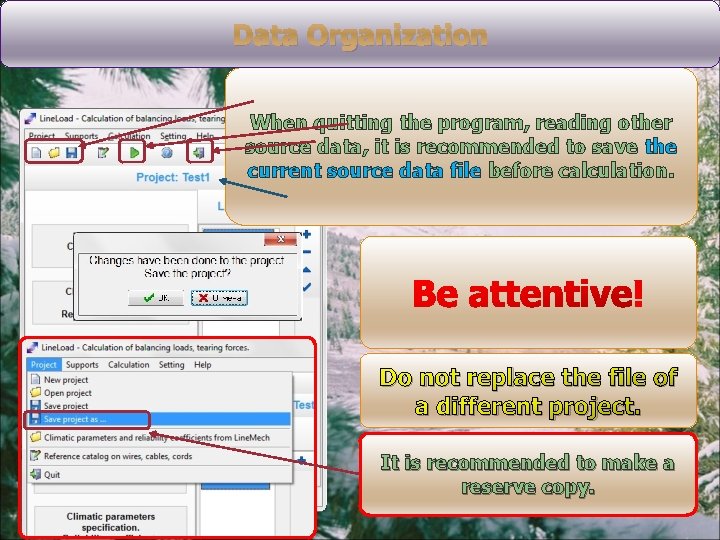
Data Organization When quitting the program, reading other source data, it is recommended to save the current source data file before calculation. Do not replace the file of a different project. It is recommended to make a reserve copy.

The rights owner of Line. Load is Pro. Energo. Soft Ltd. Ayteya Group of Companies Novosibirsk Tel. /tax: (383) 231 -12 -12 E-mail: support@linecross. ru (383) 231 -02 -13 aist@linecross. ru (383) 231 -21 -22 (383) 218 -81 -40 Website: www. linecross. ru

The program’s author is Ivanov Nikolai Pavlovich tel. /fax: 8(383) 231 -12 -12 E-mail: support@linecross. ru Leading programmer: Kornilov Mikhail Vladimirovich
- Slides: 24