
LINE DEFECTS Dislocations are line defects cause slip
- Slides: 6
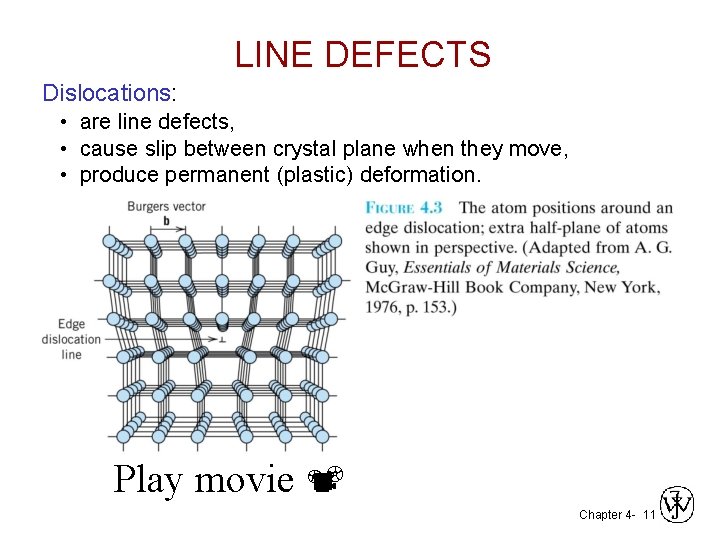
LINE DEFECTS Dislocations: • are line defects, • cause slip between crystal plane when they move, • produce permanent (plastic) deformation. Play movie Chapter 4 - 11
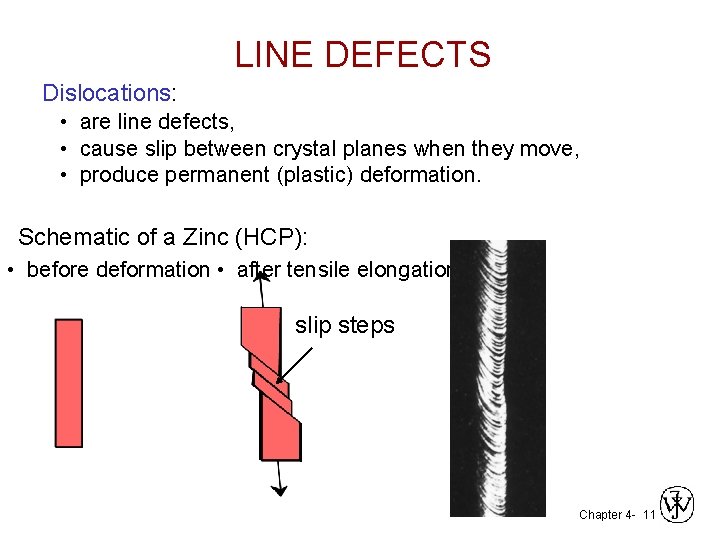
LINE DEFECTS Dislocations: • are line defects, • cause slip between crystal planes when they move, • produce permanent (plastic) deformation. Schematic of a Zinc (HCP): • before deformation • after tensile elongation slip steps Chapter 4 - 11
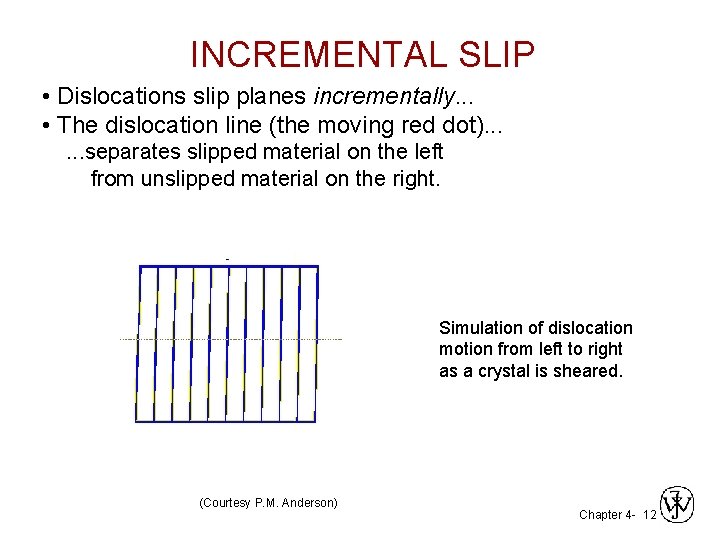
INCREMENTAL SLIP • Dislocations slip planes incrementally. . . • The dislocation line (the moving red dot). . . separates slipped material on the left from unslipped material on the right. Simulation of dislocation motion from left to right as a crystal is sheared. (Courtesy P. M. Anderson) Chapter 4 - 12
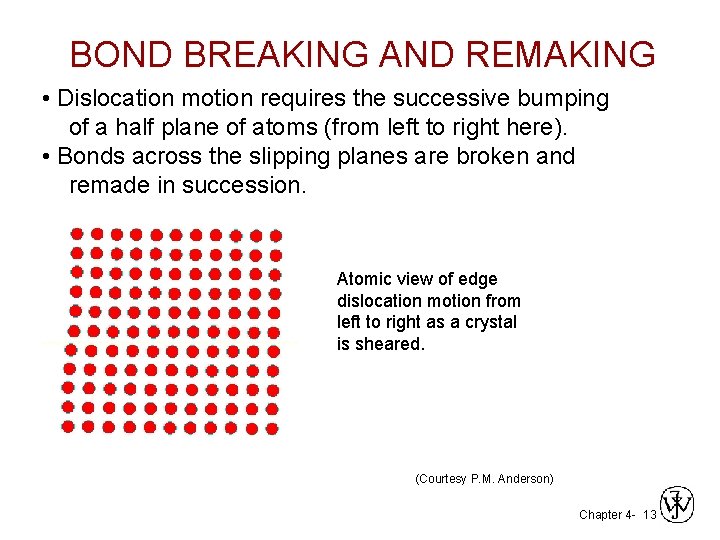
BOND BREAKING AND REMAKING • Dislocation motion requires the successive bumping of a half plane of atoms (from left to right here). • Bonds across the slipping planes are broken and remade in succession. Atomic view of edge dislocation motion from left to right as a crystal is sheared. (Courtesy P. M. Anderson) Chapter 4 - 13
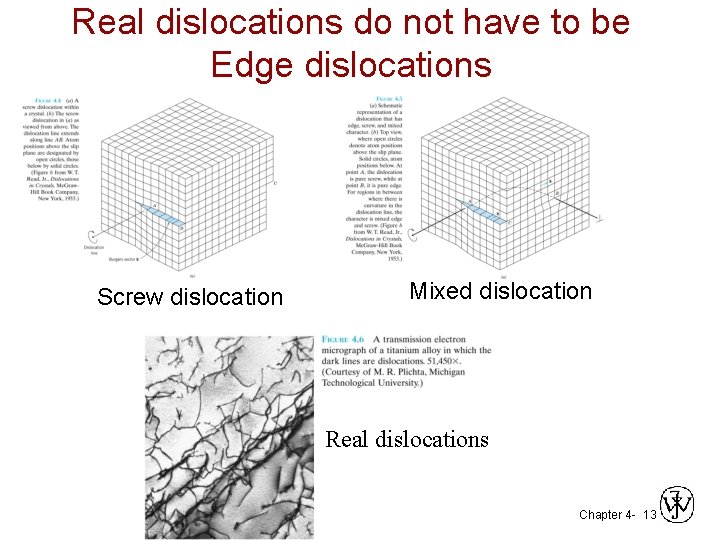
Real dislocations do not have to be Edge dislocations Screw dislocation Mixed dislocation Real dislocations Chapter 4 - 13
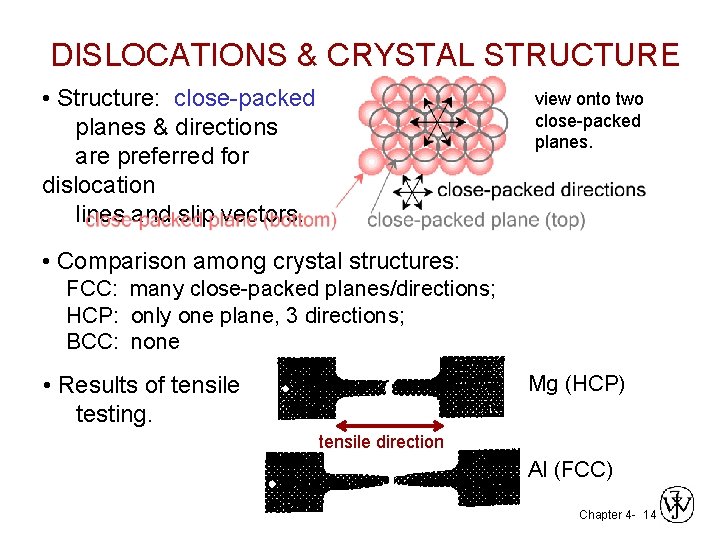
DISLOCATIONS & CRYSTAL STRUCTURE • Structure: close-packed planes & directions are preferred for dislocation lines and slip vectors. view onto two close-packed planes. • Comparison among crystal structures: FCC: many close-packed planes/directions; HCP: only one plane, 3 directions; BCC: none Mg (HCP) • Results of tensile testing. tensile direction Al (FCC) Chapter 4 - 14