
Linda Coordination Language Presented by Tae Ki Kim
Linda Coordination Language Presented by Tae Ki Kim Tae@udel. edu
Outline • Linda • C-Linda • Java Space
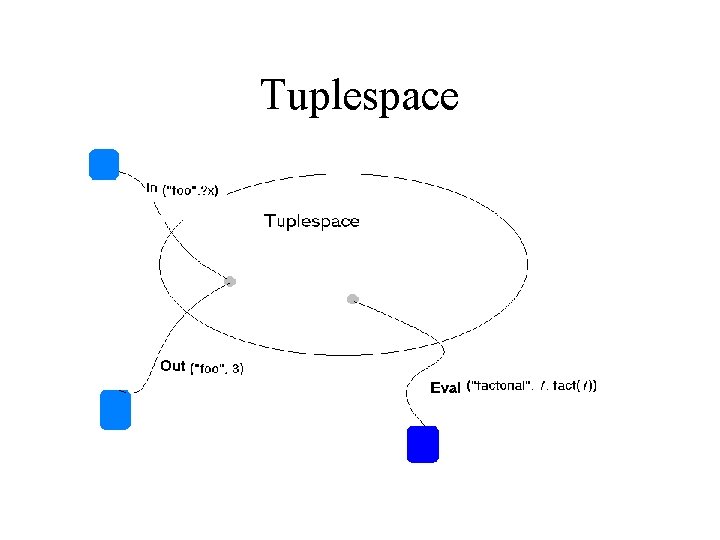
Linda • Parallel coordination language • Virtual shared memory system on heterogeneous networks • Associative addressing through efficient hashing • Simple language primitives allow minimal code rewriting: v. In(), Out() moves “tuples” to/from Tuple. Space v. Eval() spawns processes in Tuplespace v. Rd() does non-destructive reads in T. S. v. Inp(), Rdp() are non-blocking versions of In() and Rd()
Tuplespace
C-Linda Language • The C-Linda programming language is the combination of the C and the Linda language. • The C-Linda is one realization of the Linda model. • The C-Linda supports six Linda functions.
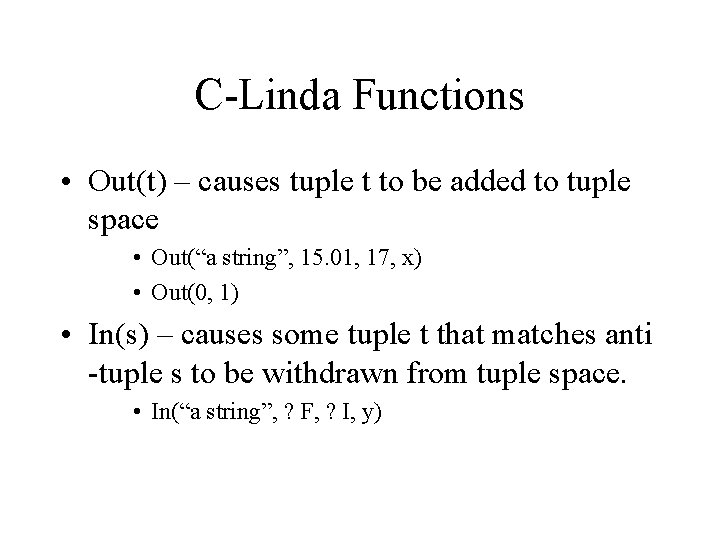
C-Linda Functions • Out(t) – causes tuple t to be added to tuple space • Out(“a string”, 15. 01, 17, x) • Out(0, 1) • In(s) – causes some tuple t that matches anti -tuple s to be withdrawn from tuple space. • In(“a string”, ? F, ? I, y)
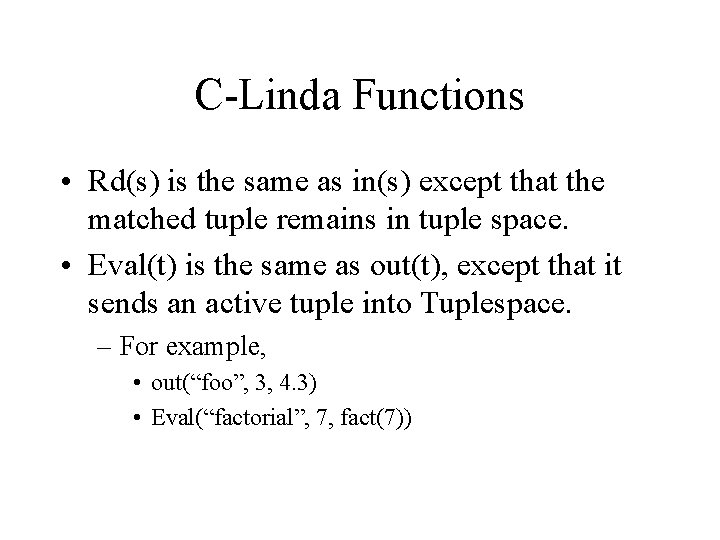
C-Linda Functions • Rd(s) is the same as in(s) except that the matched tuple remains in tuple space. • Eval(t) is the same as out(t), except that it sends an active tuple into Tuplespace. – For example, • out(“foo”, 3, 4. 3) • Eval(“factorial”, 7, fact(7))
C-Linda Functions • Inp and Rdp – predicate versions of in and rd, attempt to locate a matching tuple and return 0 if they fail; otherwise they return 1.
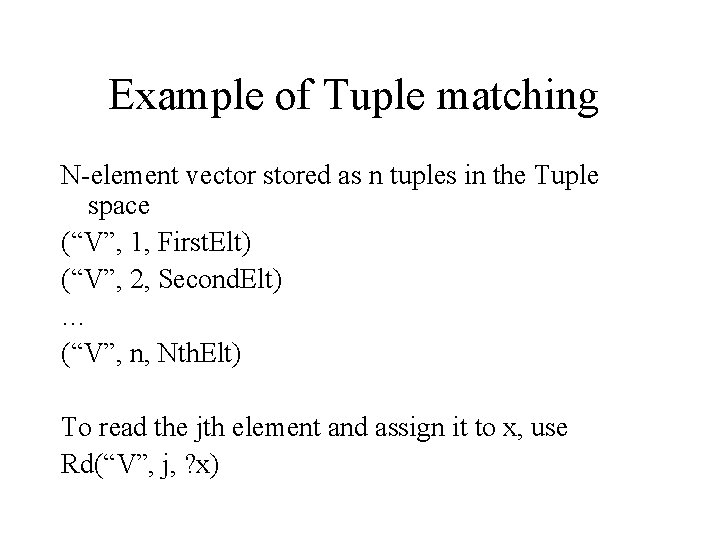
Example of Tuple matching N-element vector stored as n tuples in the Tuple space (“V”, 1, First. Elt) (“V”, 2, Second. Elt) … (“V”, n, Nth. Elt) To read the jth element and assign it to x, use Rd(“V”, j, ? x)
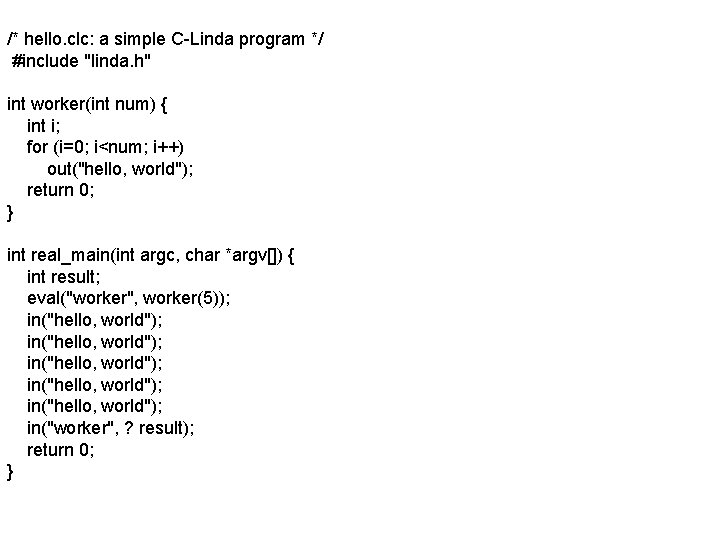
/* hello. clc: a simple C-Linda program */ #include "linda. h" int worker(int num) { int i; for (i=0; i<num; i++) out("hello, world"); return 0; } int real_main(int argc, char *argv[]) { int result; eval("worker", worker(5)); in("hello, world"); in("hello, world"); in("worker", ? result); return 0; }
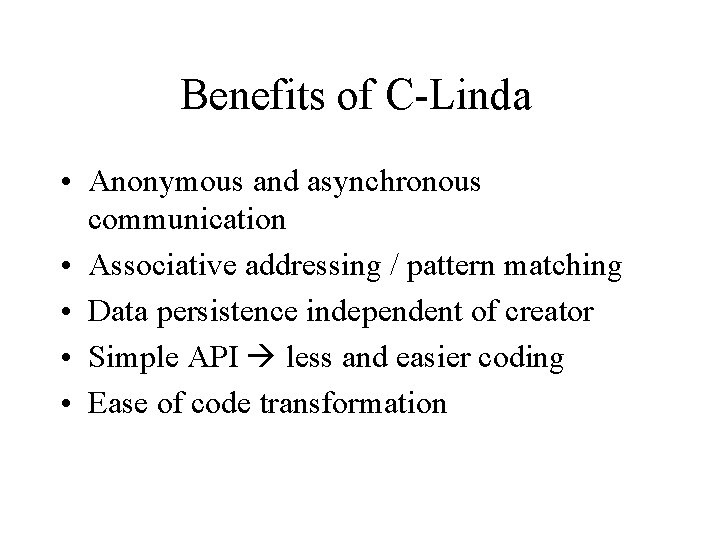
Benefits of C-Linda • Anonymous and asynchronous communication • Associative addressing / pattern matching • Data persistence independent of creator • Simple API less and easier coding • Ease of code transformation
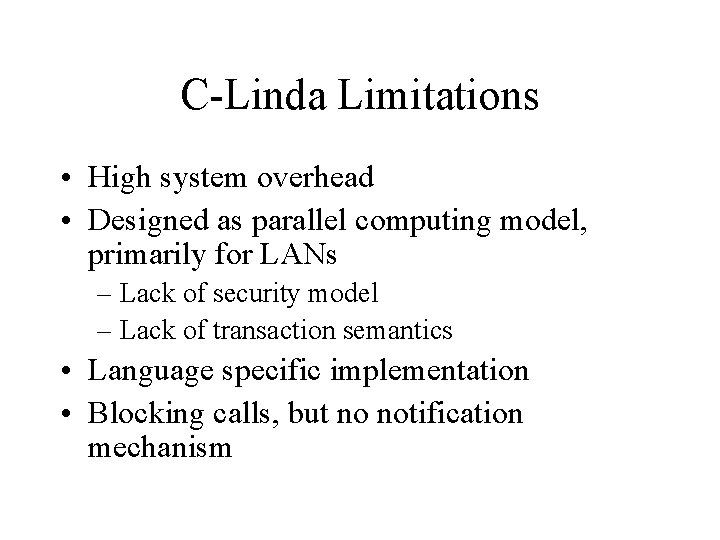
C-Linda Limitations • High system overhead • Designed as parallel computing model, primarily for LANs – Lack of security model – Lack of transaction semantics • Language specific implementation • Blocking calls, but no notification mechanism
Java. Spaces (Sun Micro) • Lightweight infrastructure for network applications • Distributed functionality implemented through RMI • Entries written to/from Java. Space with “write, read” • “notify” notifies client of incoming entries w/ timeout
Java. Space • Pattern Matching done to templates with class type comparisons, no comparison of literals. • Transaction mechanism with a two phase commit model • Entries are writtern with a “lease”, so limited persistence with time-outs.
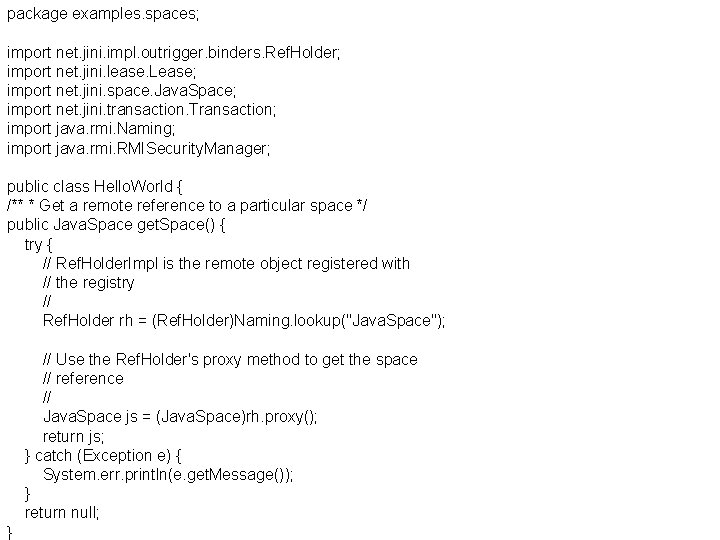
package examples. spaces; import net. jini. impl. outrigger. binders. Ref. Holder; import net. jini. lease. Lease; import net. jini. space. Java. Space; import net. jini. transaction. Transaction; import java. rmi. Naming; import java. rmi. RMISecurity. Manager; public class Hello. World { /** * Get a remote reference to a particular space */ public Java. Space get. Space() { try { // Ref. Holder. Impl is the remote object registered with // the registry // Ref. Holder rh = (Ref. Holder)Naming. lookup("Java. Space"); // Use the Ref. Holder's proxy method to get the space // reference // Java. Space js = (Java. Space)rh. proxy(); return js; } catch (Exception e) { System. err. println(e. get. Message()); } return null; }
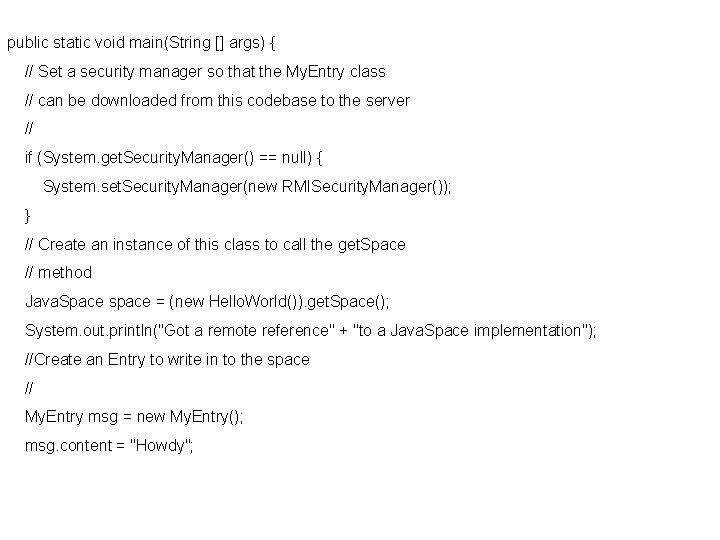
public static void main(String [] args) { // Set a security manager so that the My. Entry class // can be downloaded from this codebase to the server // if (System. get. Security. Manager() == null) { System. set. Security. Manager(new RMISecurity. Manager()); } // Create an instance of this class to call the get. Space // method Java. Space space = (new Hello. World()). get. Space(); System. out. println("Got a remote reference" + "to a Java. Space implementation"); //Create an Entry to write in to the space // My. Entry msg = new My. Entry(); msg. content = "Howdy";
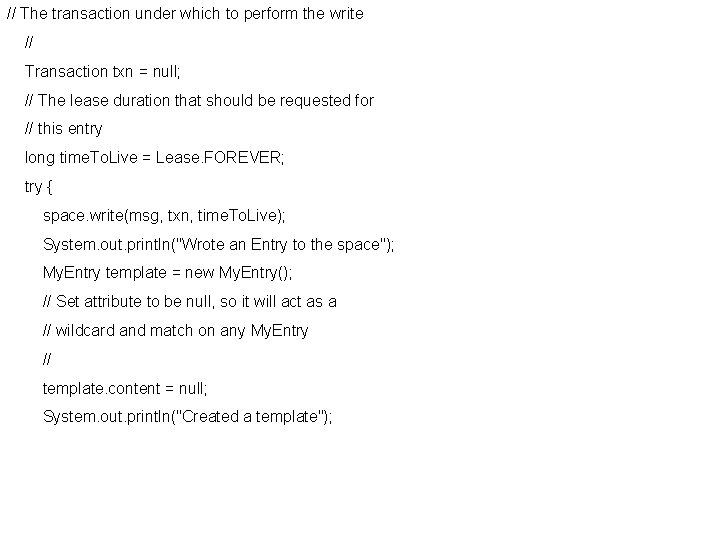
// The transaction under which to perform the write // Transaction txn = null; // The lease duration that should be requested for // this entry long time. To. Live = Lease. FOREVER; try { space. write(msg, txn, time. To. Live); System. out. println("Wrote an Entry to the space"); My. Entry template = new My. Entry(); // Set attribute to be null, so it will act as a // wildcard and match on any My. Entry // template. content = null; System. out. println("Created a template");
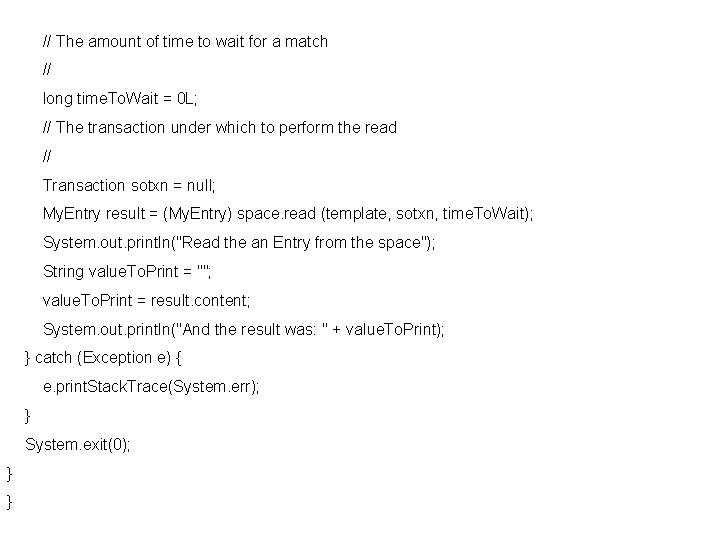
// The amount of time to wait for a match // long time. To. Wait = 0 L; // The transaction under which to perform the read // Transaction sotxn = null; My. Entry result = (My. Entry) space. read (template, sotxn, time. To. Wait); System. out. println("Read the an Entry from the space"); String value. To. Print = ""; value. To. Print = result. content; System. out. println("And the result was: " + value. To. Print); } catch (Exception e) { e. print. Stack. Trace(System. err); } System. exit(0); } }
Java. Space Limitations • Simplicity of or lack of security model • Java RMI = performance bottleneck • Currently only a specification exists, but no implementation
More Tuple Space Implemetations • Java Messaging Service(JMS), a Message. Oriented Middleware (MOM) layer API, shares many of the same architectural strengths of Java. Spaces while offering some added benefits. • Tspaces (IBM Almaden) • Page. Space and JADA • LIME • XML Dataspaces • Mobile Agent Reactive Space(MARS)
Conclusion • "Space-based" architectures are extremely flexible, providing most of the core infrastructure necessary to support distributed, mobile, and intelligent software agents. • The language is although intuitive, but minimal Security. • Linda is not fault-tolerant
- Slides: 21