
Linac Coherent Light Source LCLS Cavity Beam Position
Linac Coherent Light Source LCLS Cavity Beam Position Monitor Steve Smith BPM Workshop CERN 16 January 2012
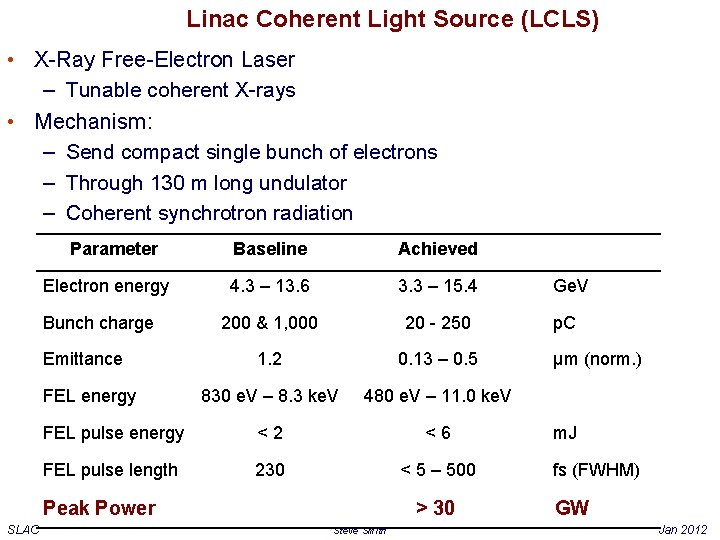
Linac Coherent Light Source (LCLS) • X-Ray Free-Electron Laser – Tunable coherent X-rays • Mechanism: – Send compact single bunch of electrons – Through 130 m long undulator – Coherent synchrotron radiation Parameter Baseline Achieved 4. 3 – 13. 6 3. 3 – 15. 4 200 & 1, 000 20 - 250 1. 2 0. 13 – 0. 5 830 e. V – 8. 3 ke. V 480 e. V – 11. 0 ke. V FEL pulse energy <2 <6 FEL pulse length 230 < 5 – 500 Repetition rate Peak Power 120 >120 30 Electron energy Bunch charge Emittance FEL energy SLAC Steve Smith Ge. V p. C µm (norm. ) m. J fs (FWHM) Hz GW Jan 2012
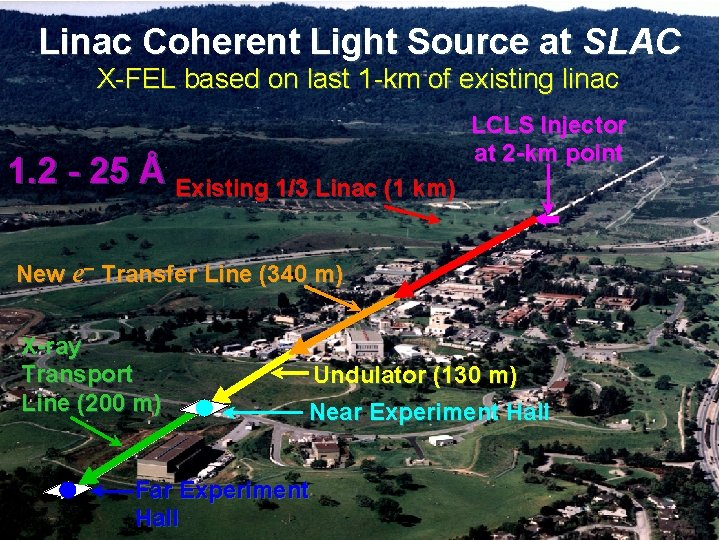
Linac Coherent Light Source at SLAC X-FEL based on last 1 -km of existing linac 1. 2 - 25 Å Existing 1/3 Linac (1 km) LCLS Injector at 2 -km point New e- Transfer Line (340 m) X-ray Transport Line (200 m) SLAC Undulator (130 m) Near Experiment Hall Far Experiment Hall Steve Smith Jan 2012
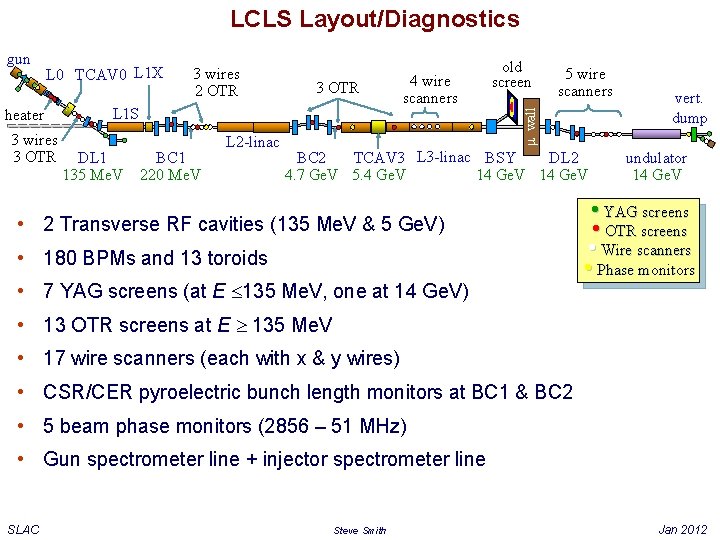
LCLS Layout/Diagnostics L 0 TCAV 0 L 1 X heater 3 wires 3 OTR 3 wires 2 OTR 3 OTR L 1 S DL 1 135 Me. V BC 1 220 Me. V L 2 -linac 4 wire scanners old screen 5 wire scanners m wall gun BC 2 TCAV 3 L 3 -linac BSY DL 2 4. 7 Ge. V 5. 4 Ge. V 14 Ge. V • 2 Transverse RF cavities (135 Me. V & 5 Ge. V) • 180 BPMs and 13 toroids • 7 YAG screens (at E 135 Me. V, one at 14 Ge. V) vert. dump undulator 14 Ge. V • YAG screens • OTR screens • Wire scanners • Phase monitors • 13 OTR screens at E 135 Me. V • 17 wire scanners (each with x & y wires) • CSR/CER pyroelectric bunch length monitors at BC 1 & BC 2 • 5 beam phase monitors (2856 – 51 MHz) • Gun spectrometer line + injector spectrometer line SLAC Steve Smith Jan 2012
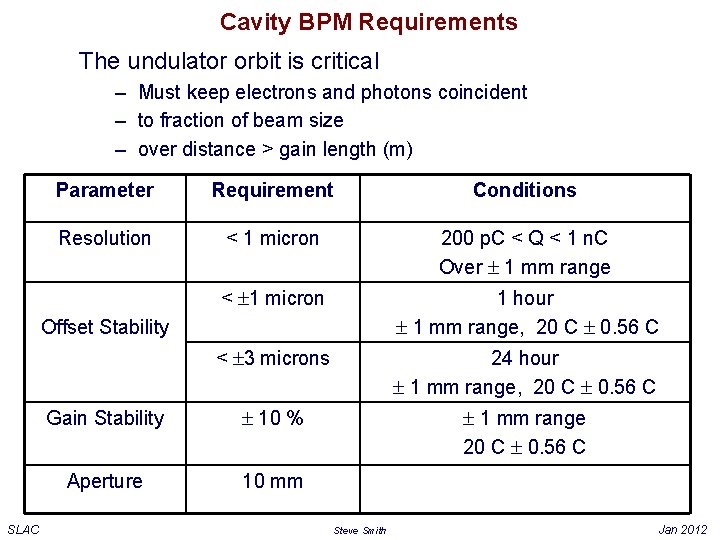
Cavity BPM Requirements The undulator orbit is critical – Must keep electrons and photons coincident – to fraction of beam size – over distance > gain length (m) Parameter Requirement Conditions Resolution < 1 micron 200 p. C < Q < 1 n. C Over 1 mm range < 1 micron 1 hour 1 mm range, 20 C 0. 56 C < 3 microns 24 hour 1 mm range, 20 C 0. 56 C Gain Stability 10 % 1 mm range 20 C 0. 56 C Aperture 10 mm Offset Stability SLAC Steve Smith Jan 2012
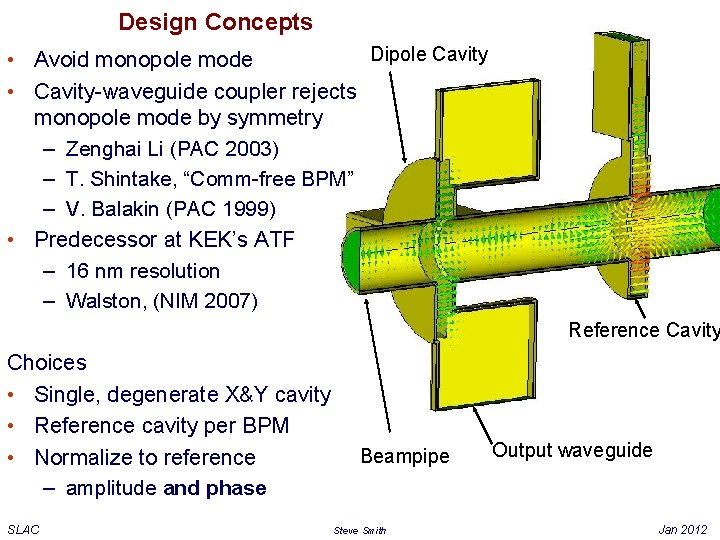
Design Concepts Dipole Cavity • Avoid monopole mode • Cavity-waveguide coupler rejects monopole mode by symmetry – Zenghai Li (PAC 2003) – T. Shintake, “Comm-free BPM” – V. Balakin (PAC 1999) • Predecessor at KEK’s ATF – 16 nm resolution – Walston, (NIM 2007) Reference Cavity Choices • Single, degenerate X&Y cavity • Reference cavity per BPM • Normalize to reference – amplitude and phase SLAC Beampipe Steve Smith Output waveguide Jan 2012
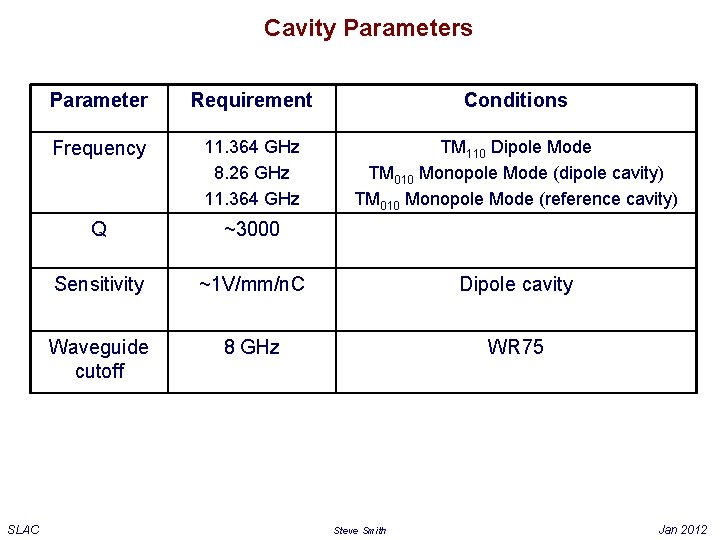
Cavity Parameters SLAC Parameter Requirement Conditions Frequency 11. 364 GHz 8. 26 GHz 11. 364 GHz TM 110 Dipole Mode TM 010 Monopole Mode (dipole cavity) TM 010 Monopole Mode (reference cavity) Q ~3000 Sensitivity ~1 V/mm/n. C Dipole cavity Waveguide cutoff 8 GHz WR 75 Steve Smith Jan 2012
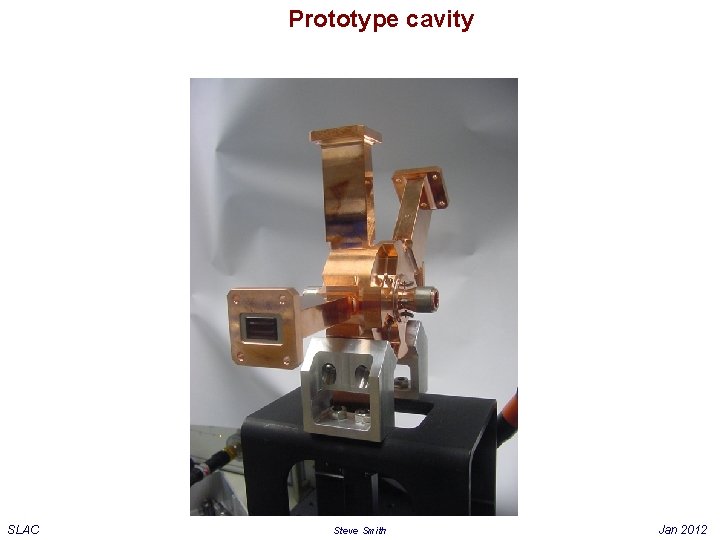
Prototype cavity SLAC Steve Smith Jan 2012
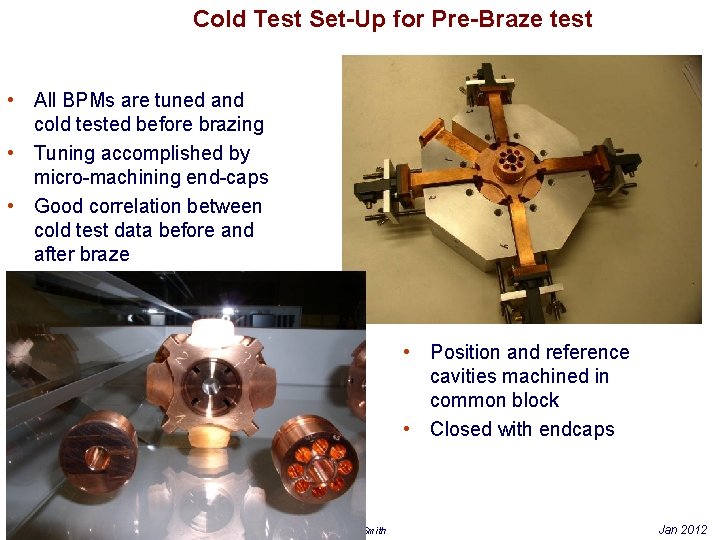
Cold Test Set-Up for Pre-Braze test • All BPMs are tuned and cold tested before brazing • Tuning accomplished by micro-machining end-caps • Good correlation between cold test data before and after braze • Position and reference cavities machined in common block • Closed with endcaps SLAC Steve Smith Jan 2012
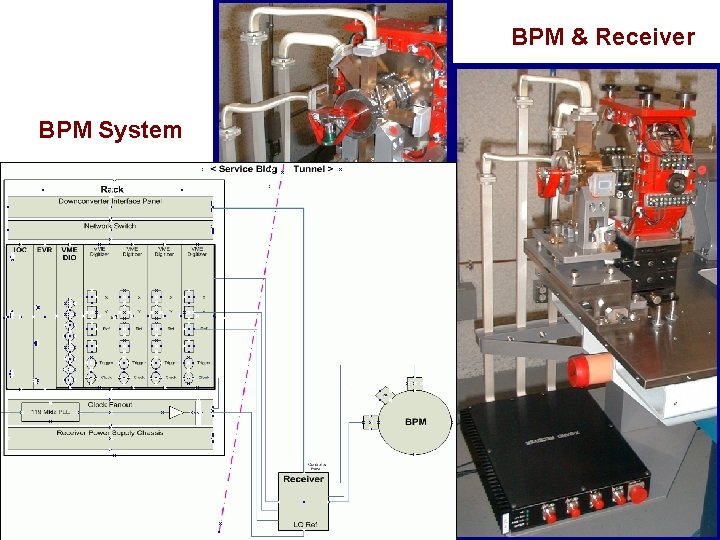
BPM & Receiver BPM System SLAC Steve Smith Jan 2012
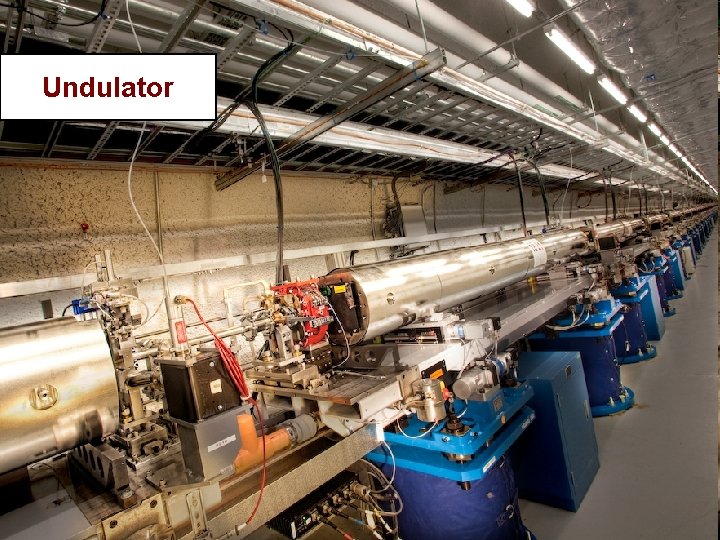
Undulator SLAC Steve Smith Jan 2012
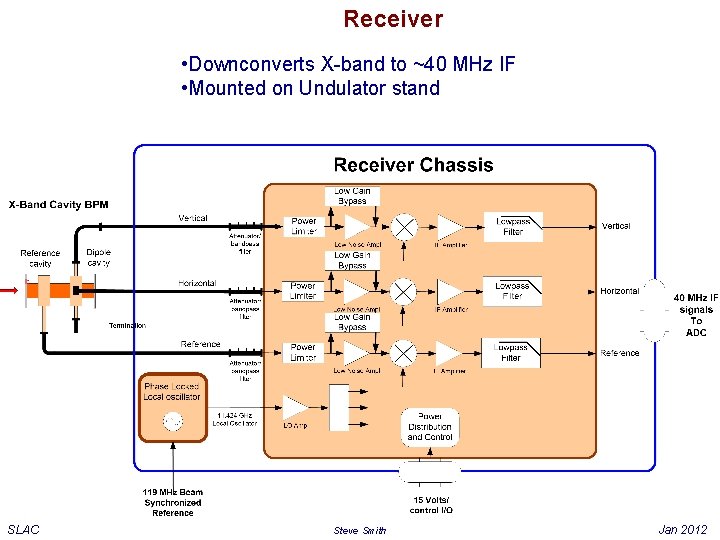
Receiver • Downconverts X-band to ~40 MHz IF • Mounted on Undulator stand SLAC Steve Smith Jan 2012
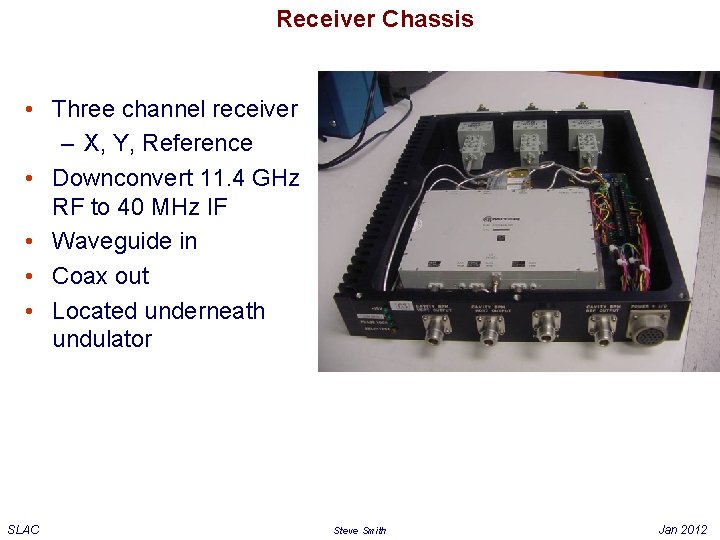
Receiver Chassis • Three channel receiver – X, Y, Reference • Downconvert 11. 4 GHz RF to 40 MHz IF • Waveguide in • Coax out • Located underneath undulator SLAC Steve Smith Jan 2012
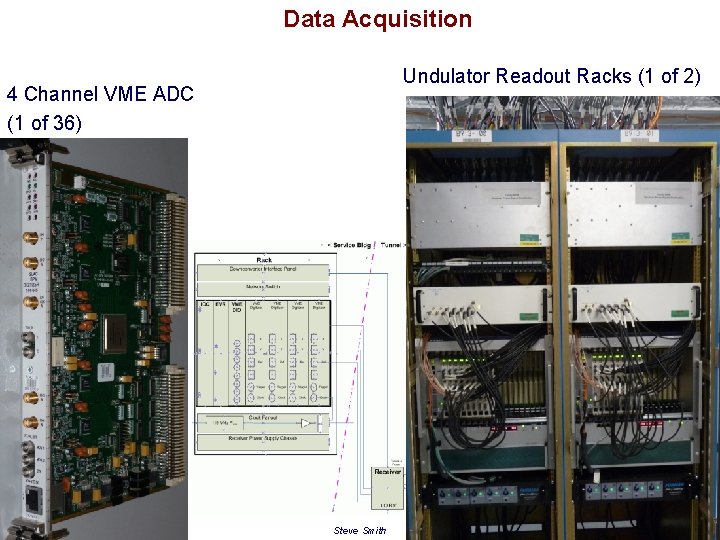
Data Acquisition Undulator Readout Racks (1 of 2) 4 Channel VME ADC (1 of 36) SLAC Steve Smith Jan 2012
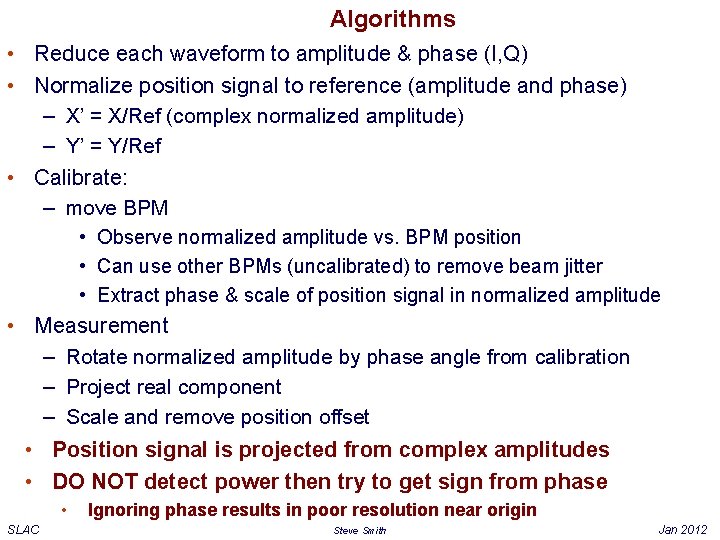
Algorithms • Reduce each waveform to amplitude & phase (I, Q) • Normalize position signal to reference (amplitude and phase) – X’ = X/Ref (complex normalized amplitude) – Y’ = Y/Ref • Calibrate: – move BPM • Observe normalized amplitude vs. BPM position • Can use other BPMs (uncalibrated) to remove beam jitter • Extract phase & scale of position signal in normalized amplitude • Measurement – Rotate normalized amplitude by phase angle from calibration – Project real component – Scale and remove position offset • Position signal is projected from complex amplitudes • DO NOT detect power then try to get sign from phase • SLAC Ignoring phase results in poor resolution near origin Steve Smith Jan 2012
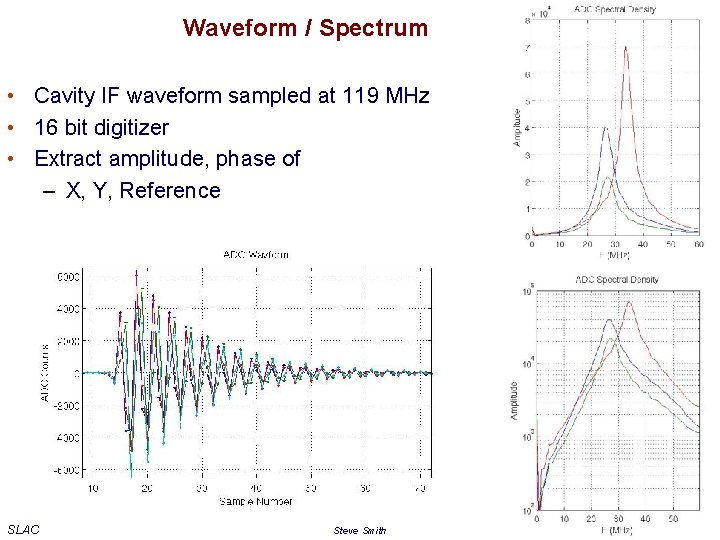
Waveform / Spectrum • Cavity IF waveform sampled at 119 MHz • 16 bit digitizer • Extract amplitude, phase of – X, Y, Reference SLAC Steve Smith Jan 2012
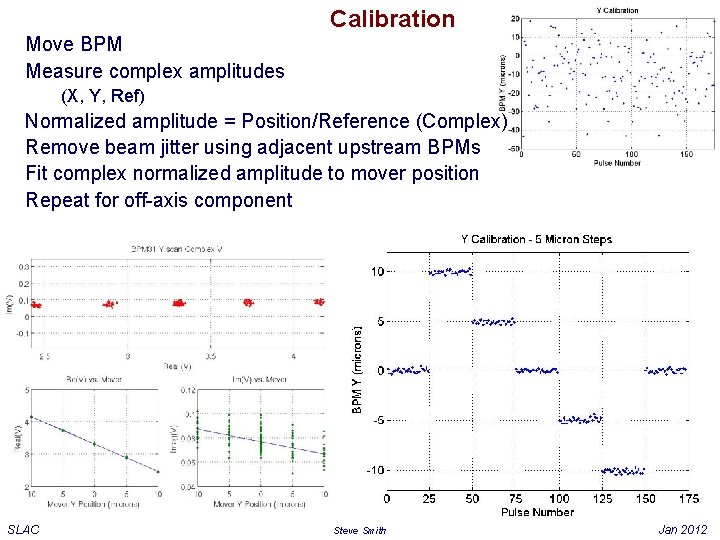
Calibration Move BPM Measure complex amplitudes (X, Y, Ref) Normalized amplitude = Position/Reference (Complex) Remove beam jitter using adjacent upstream BPMs Fit complex normalized amplitude to mover position Repeat for off-axis component SLAC Steve Smith Jan 2012
Resolution Measurement • Measure resolution via correlation between BPMs – Coherent acquisition over • Many pulses e. g. 120 pulses • Many BPMs, e. g all 36 cavity BPMs • Least-squares fit of each BPM (X, Y) – to linear combination of neighboring BPMs • Model-independent • Slightly biased estimate – underestimates resolution very slightly due to fit • Insignificant bias for Npulses >> Nbpms – Overestimates resolution slightly, assumes other BPMs noise-free • Real resolution should be better by roughly 10% • Correction would depend on beta functions SLAC Steve Smith Jan 2012
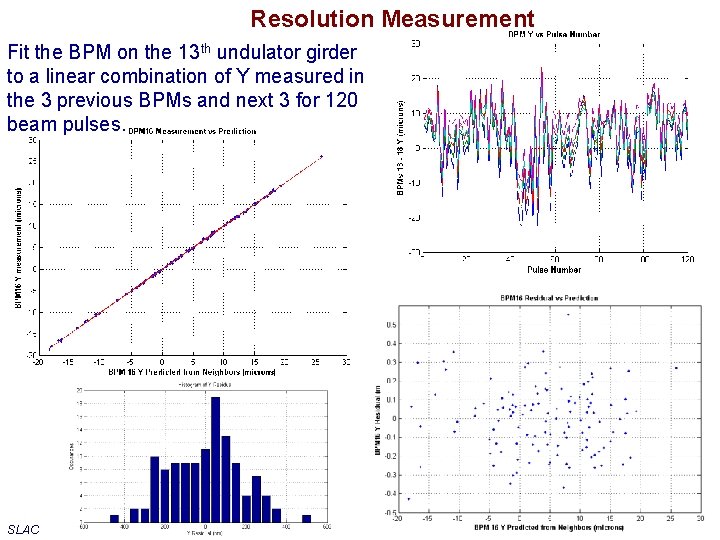
Resolution Measurement Fit the BPM on the 13 th undulator girder to a linear combination of Y measured in the 3 previous BPMs and next 3 for 120 beam pulses. SLAC Steve Smith Jan 2012
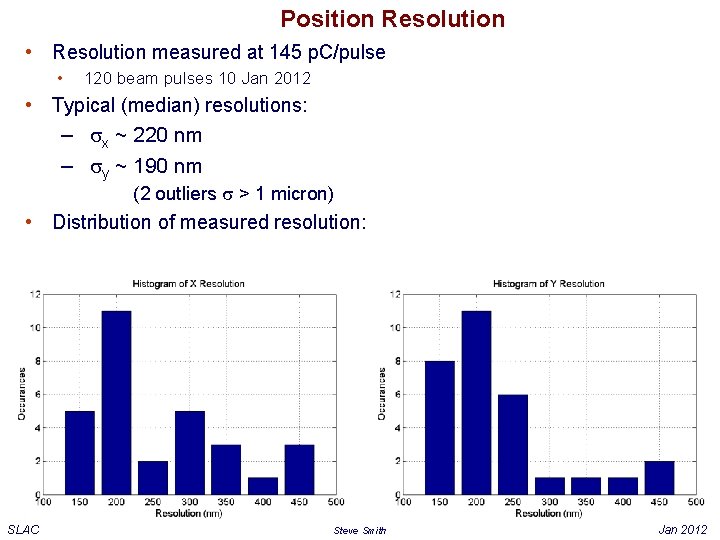
Position Resolution • Resolution measured at 145 p. C/pulse • 120 beam pulses 10 Jan 2012 • Typical (median) resolutions: – sx ~ 220 nm – sy ~ 190 nm (2 outliers s > 1 micron) • Distribution of measured resolution: SLAC Steve Smith Jan 2012
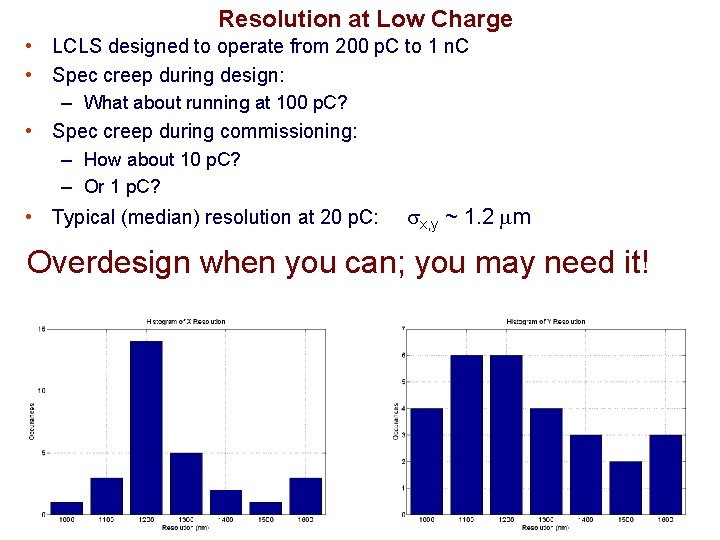
Resolution at Low Charge • LCLS designed to operate from 200 p. C to 1 n. C • Spec creep during design: – What about running at 100 p. C? • Spec creep during commissioning: – How about 10 p. C? – Or 1 p. C? • Typical (median) resolution at 20 p. C: sx, y ~ 1. 2 mm Overdesign when you can; you may need it! SLAC Steve Smith Jan 2012
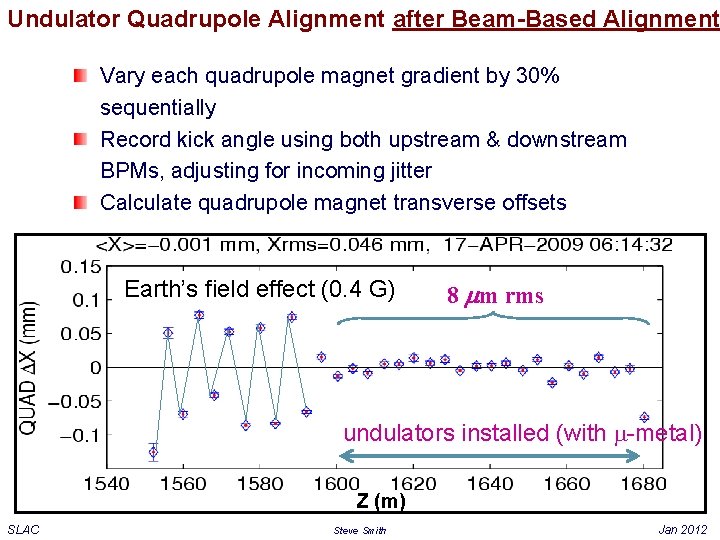
Undulator Quadrupole Alignment after Beam-Based Alignment Vary each quadrupole magnet gradient by 30% sequentially Record kick angle using both upstream & downstream BPMs, adjusting for incoming jitter Calculate quadrupole magnet transverse offsets Earth’s field effect (0. 4 G) 8 mm rms undulators installed (with m-metal) Z (m) SLAC Steve Smith Jan 2012
Measuring Stability in Presence of Beam Jitter • Accumulate data parasitic to beam operations • Take data periodically 120 shots every 20 min over 3½ days – Total >15, 000 beam pulses • Ignore first 10 girders – undulator feedback moves these to maintain launch into undulator • Ignore downstream girders – periodic mover calibration running • • Beam jitter ~10 microns at this time Beam steering sometimes > 100 microns Must remove real beam motions: Take one run (120 pulses) from middle of weekend to learn correlation between each BPM and its neighbors – Fit linear coefficients to predict: • Xn from Xn-1 and Xn+1 • Yn from Yn-1 and Yn+1 • Use these coefficients to predict Xn, Yn • Compare measurement to prediction BPMs pulse-by-pulse SLAC Steve Smith Jan 2012
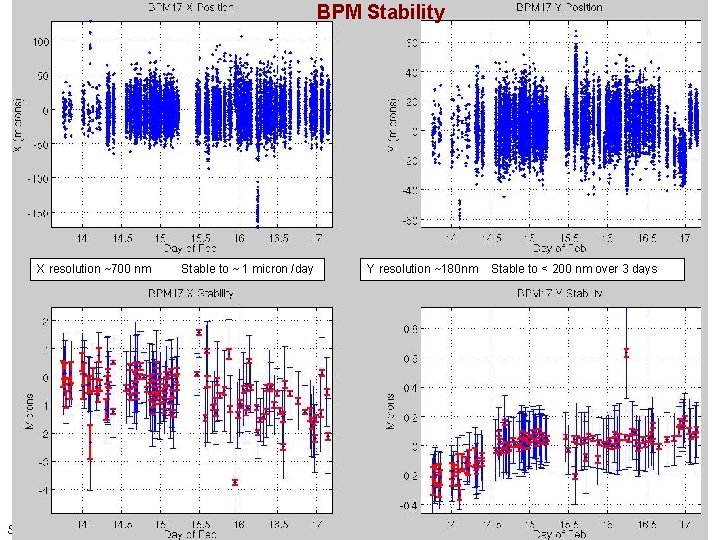
BPM Stability X resolution ~700 nm SLAC Stable to ~ 1 micron /day Y resolution ~180 nm Steve Smith Stable to < 200 nm over 3 days Jan 2012
Long Term Stability Issue • In early commissioning we found substantial gain changes in some X-band BPM receivers – Gain drifts 0. 1 d. B/week in some cases – Up to 10 d. B worst case – Frightening possibilities: • Radiation • Overvoltage • Found: – Probable hydrogen poisoning from chip packaging – Chip vendor app note says “Don’t use in hermetic packaging without hydrogen getter” • Slowly replacing LNAs as we can interrupt operation SLAC Steve Smith Jan 2012
Improvements • Lower noise figure possible – Noise figure dominated by input attenuator – Can absorb out of band power without attenuating in-band signal – Will improve resolution by up to 14 d. B in LCLS-II • Faster digitizer multibunch operation – 30 ns bunch spacing • In-line calibration – Can introduce calibration signal from opposite ports – Presently terminated • Subliminal calibration – Can calibrate with beam motion << beam jitter – Could perform continuous calibration while lasing – using with few-micron amplitude motion SLAC Steve Smith Jan 2012
- Slides: 26