
Linac and Booster Radiation Shielding Status Plans and
Linac and Booster Radiation Shielding Status, Plans and Constraints John E. Anderson Jr. Proton Source Meeting December 7, 2010

Outline • • • Shielding Assessment Beam Intensity Limits MCR Operational Intensity Limits Linac SA Intensity Limits Booster Reassessment Efforts Booster Operational Issues Proton Source Meeting December 7, 2010 2
Shielding Assessment Intensity Limits • Operating Intensity Limits – Beam intensity limit based on the FRCM • Accelerator Safety Envelope (ASE) Intensity Limits – DOE approved beam intensity limit – May or may not be equal to the Operating Intensity Limit (Currently is for Linac and Booster) – Based on a 10 mrem accident to a member of the public or an untrained worker – Exceeding limit reported to Head Office of Science Proton Source Meeting December 7, 2010 3
Shielding Assessment Intensity Limits • Both Operating and ASE Intensity Limits are defined in Appendix A of the laboratory Safety Assessment Document • Limits are approved by – Fermilab Director – DOE Fermi Site Office Manager Proton Source Meeting December 7, 2010 4
Main Control Room Operational Limits • Beam Permit – Based on ASE – Approved by Division Head • Operational Limit – Some % less than Beam Permit – Generally 5 -10% less • Warning Limit – Some % less than Operational Limit – Generally 5 -10% less Proton Source Meeting December 7, 2010 5
1993 Linac Shielding Assessment • Operating and ASE Intensity Limits – 3. 54 E 17 protons / hour – MCR Operational Limit • 3. 34 E 17 protons / hour ~-5% – MCR Warning Limit • 3. 185 E 17 protons / hour ~-5% – Current limits exceed future programmatic needs – No plans to do anything further – Continue to monitor Linac tech area offices Proton Source Meeting December 7, 2010 6
1998 Booster Shielding Assessment • Operating and ASE Intensity Limits – 1. 8 E 17 protons / hour – MCR Operational Limit • 1. 22 E 17 protons / hour ~-30% – MCR Warning Limit • 1. 09 E 17 protons / hour ~-10% – Can raise the MCR warning limit to ~1. 5 E 17 protons / hour Proton Source Meeting December 7, 2010 7
1998 Booster Shielding Assessment • “Nowhere around the Booster ring is there sufficient shielding to prevent FRCM limits from being exceeded under DC accident conditions at the intensities required to meet current programmatic goals (1. 35 E 17 protons / hour). ” • References 1991 Booster Assessment beam loss measurements at penetrations to determine current Operational Limits of 1. 8 E 17 protons / hour Proton Source Meeting December 7, 2010 8
1998 Booster Shielding Assessment • Assessment shows losses limited to long and short strait locations • Assessment based on studies to determine shower max locations • 51 interlocked detectors placed approximately at shower max locations Proton Source Meeting December 7, 2010 9

1998 Booster Shielding Assessment • Issues – Machine modifications may change loss locations thus invalidating the assessment • • Correction element upgrades Machine realignment Collimators at L 6 and L 7 Others? – With machine modifications since 1998, is the current assessment still valid? – Limited information available about penetration dose rates and studies. Proton Source Meeting December 7, 2010 10
Booster Shielding Assessment Efforts • Current reassessment efforts – Assessing for 2. 0 E 17 protons / hour • Roger Dixon Guidance – Converting Booster to Incremental Shielding Assessment Methodology • Being done to identify all penetrations, problem areas, and allow for intensity scaling – Expect assessment to be complete in January 2011 • Will need to find mitigations for problem areas Proton Source Meeting December 7, 2010 11
Booster Shielding Assessment Efforts – Labyrinth and penetration spreadsheets created • 7 labyrinths and 190 penetrations • 182 penetrations fail at 2 E 17 protons / hour • MARS models of penetrations filled with poly also fail – Can a point loss be created under a penetration? • Need technical justification if used – Can ropes and signs be used to barrier front of penetrations? • Limits access to equipment – Can sand be used to fill penetrations vs. poly? • Penetrations pass • Passive control Proton Source Meeting December 7, 2010 12
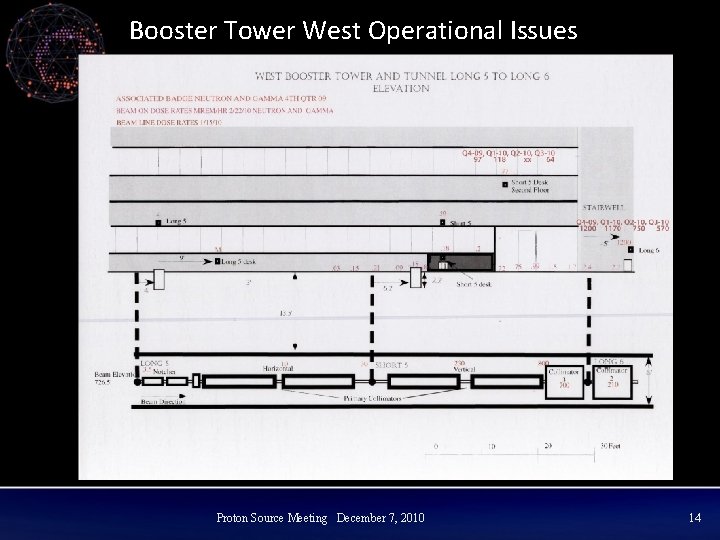
Booster Tower West Operational Issues • Booster L 6 area collimators • Routinely measure rates in the Booster Tower West Stairwell and upstairs offices BTW-201 & 202 • Need to identify source and better shield the area Proton Source Meeting December 7, 2010 13
Booster Tower West Operational Issues Proton Source Meeting December 7, 2010 14
- Slides: 14