
LIN 617 Hodge Jespersen Sapir the Linguistic Cycle
![Sapir (1921: 128) “the terms [analytic and synthetic] are more useful in defining certain](https://slidetodoc.com/presentation_image_h2/69de77c5ed0dbcabb54f9cf90812ca76/image-22.jpg "Sapir (1921: 128) “the terms [analytic and synthetic] are more useful in defining certain")
- Slides: 44
LIN 617: Hodge, Jespersen, Sapir, the Linguistic Cycle, and more April 2015
What is Historical Linguistics? What: Typical (phonological) change Why: due to language acquisition or external influence Methods: CM, IR, OED, DOE, etc Interdisciplinary: genetics, language families, migrations Greenberg, Cavalli-Sforza, Bickerton
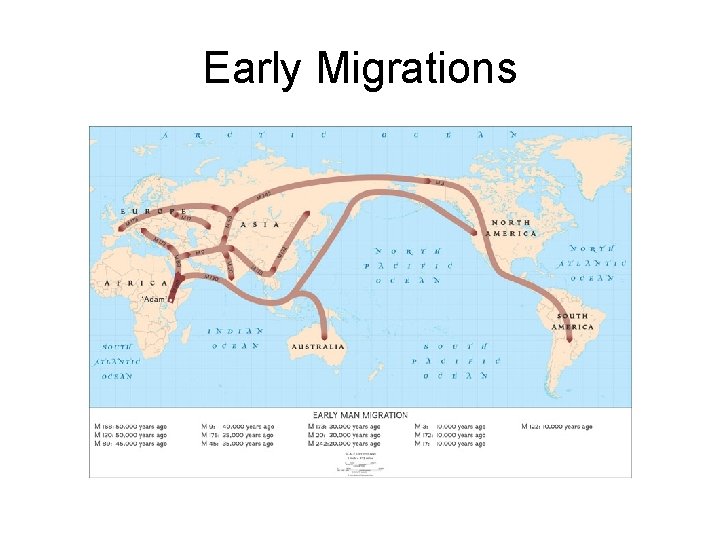
Early Migrations
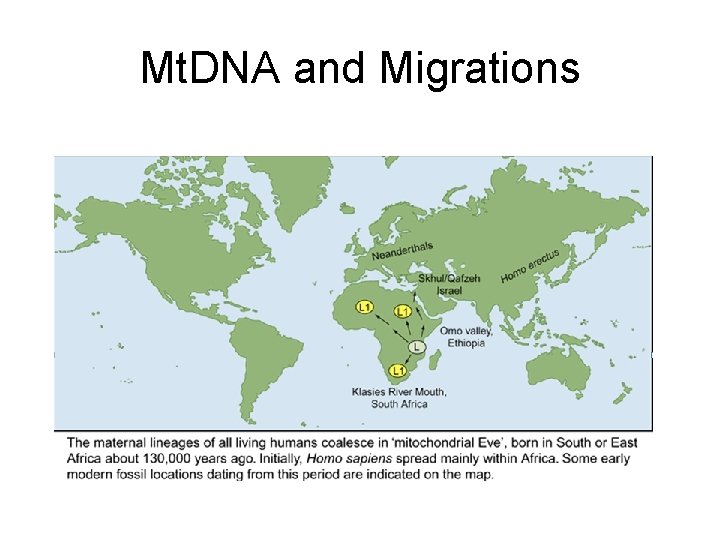
Mt. DNA and Migrations
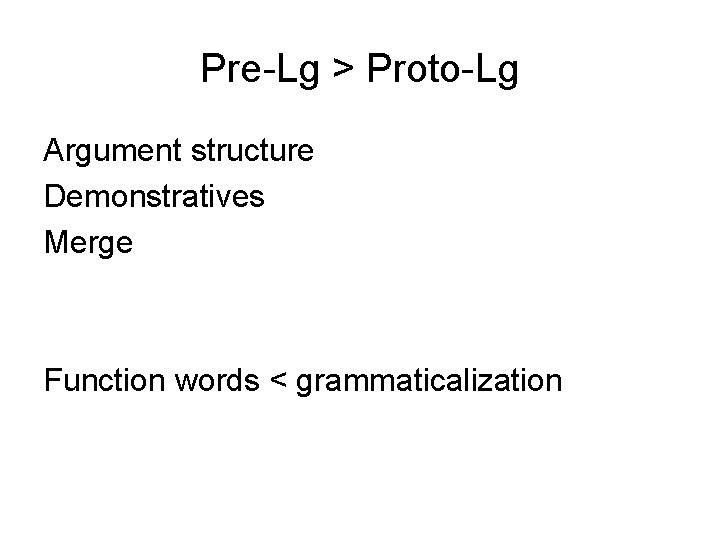
Pre-Lg > Proto-Lg Argument structure Demonstratives Merge Function words < grammaticalization
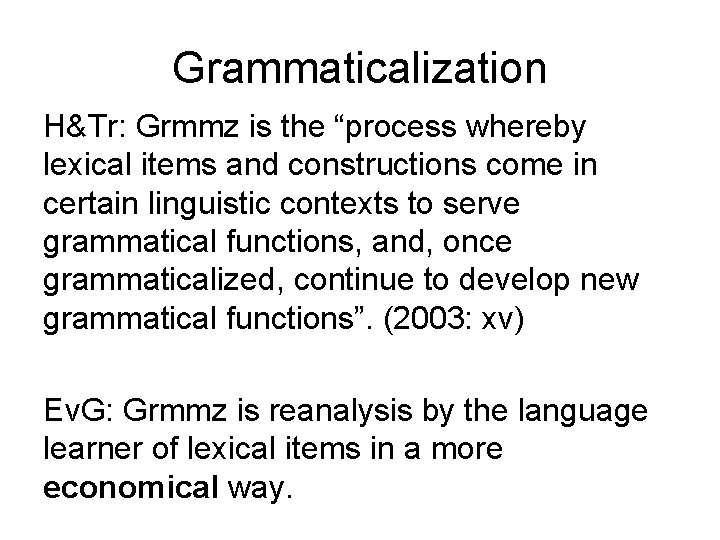
Grammaticalization H&Tr: Grmmz is the “process whereby lexical items and constructions come in certain linguistic contexts to serve grammatical functions, and, once grammaticalized, continue to develop new grammatical functions”. (2003: xv) Ev. G: Grmmz is reanalysis by the language learner of lexical items in a more economical way.
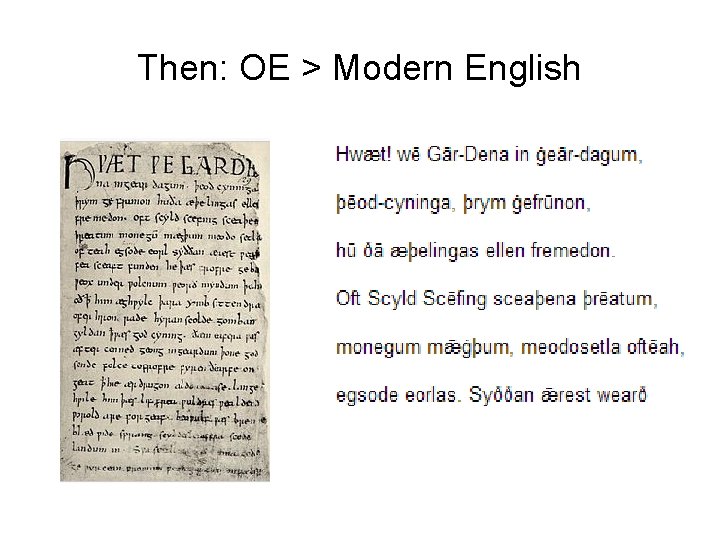
Then: OE > Modern English
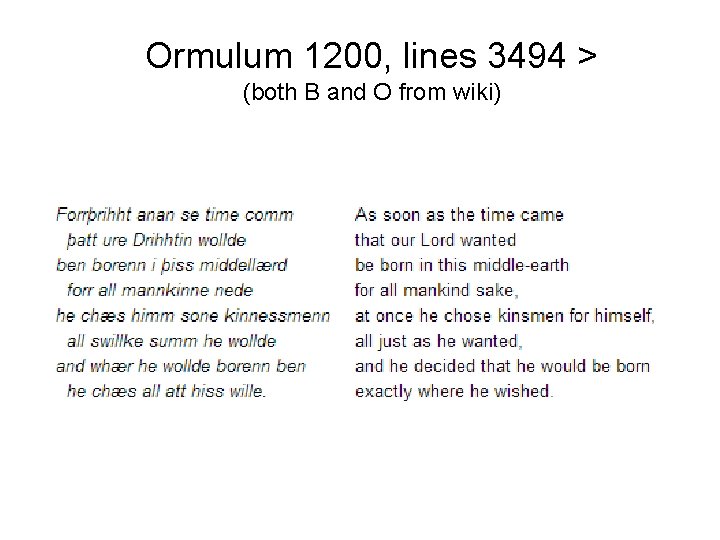
Ormulum 1200, lines 3494 > (both B and O from wiki)
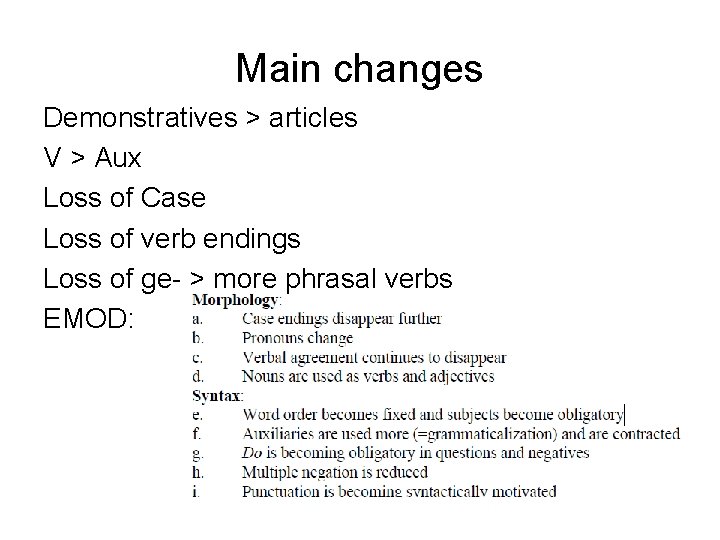
Main changes Demonstratives > articles V > Aux Loss of Case Loss of verb endings Loss of ge- > more phrasal verbs EMOD:
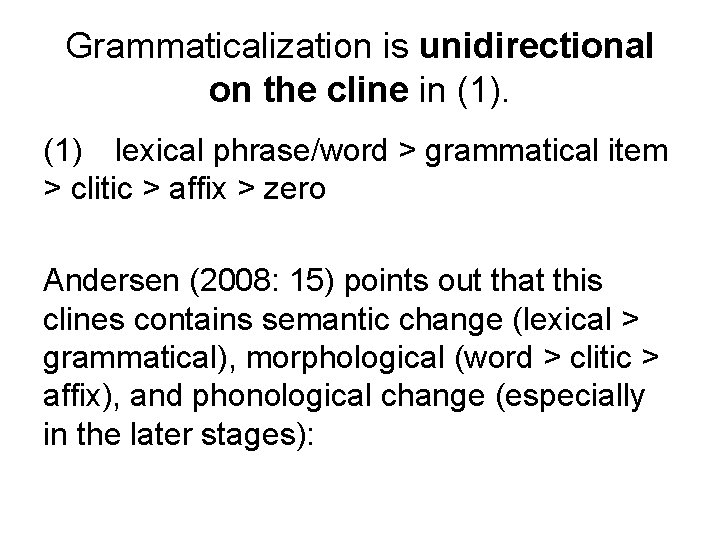
Grammaticalization is unidirectional on the cline in (1) lexical phrase/word > grammatical item > clitic > affix > zero Andersen (2008: 15) points out that this clines contains semantic change (lexical > grammatical), morphological (word > clitic > affix), and phonological change (especially in the later stages):
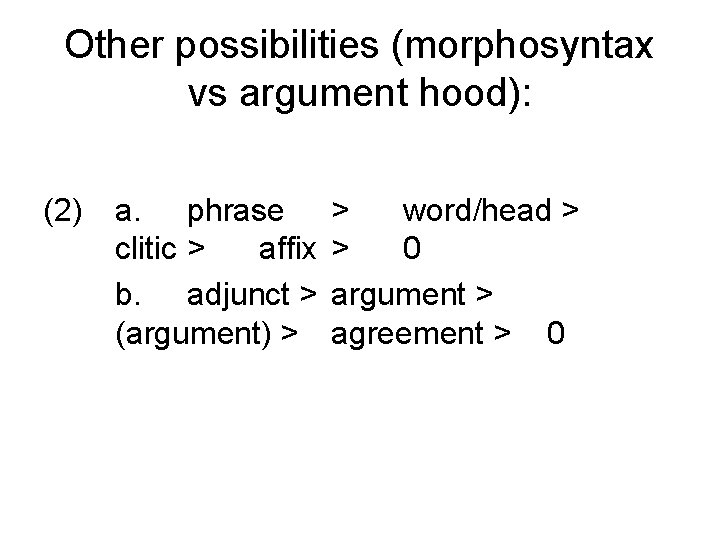
Other possibilities (morphosyntax vs argument hood): (2) a. phrase clitic > affix b. adjunct > (argument) > > word/head > > 0 argument > agreement > 0
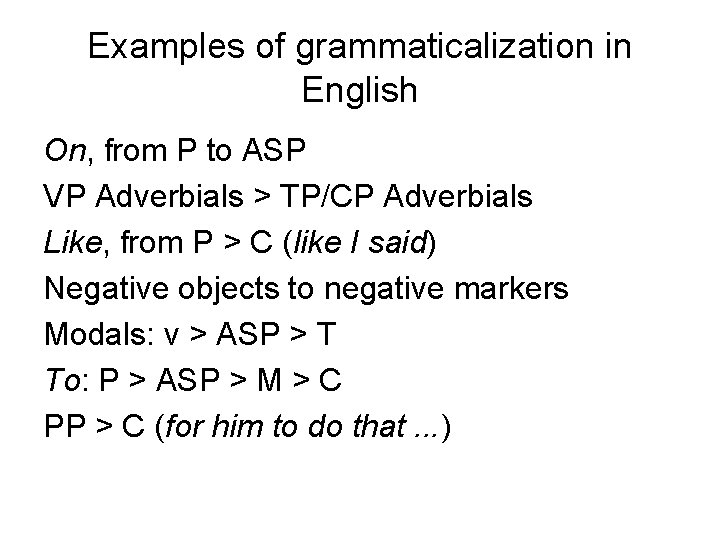
Examples of grammaticalization in English On, from P to ASP VP Adverbials > TP/CP Adverbials Like, from P > C (like I said) Negative objects to negative markers Modals: v > ASP > T To: P > ASP > M > C PP > C (for him to do that. . . )
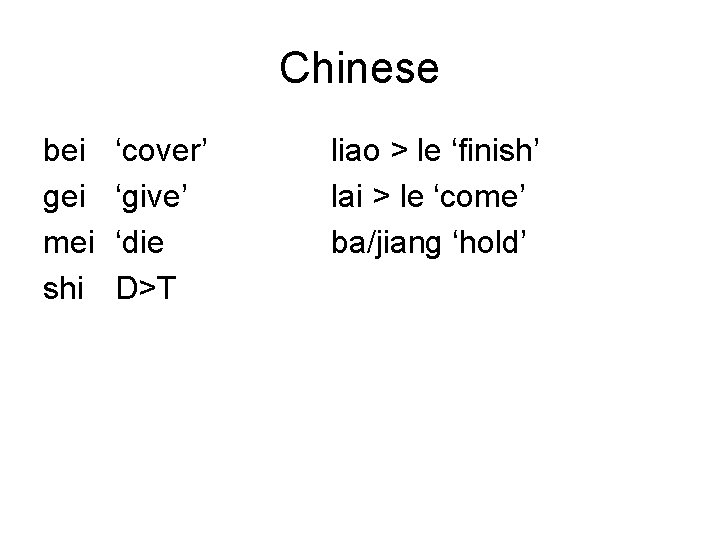
Chinese bei gei mei shi ‘cover’ ‘give’ ‘die D>T liao > le ‘finish’ lai > le ‘come’ ba/jiang ‘hold’
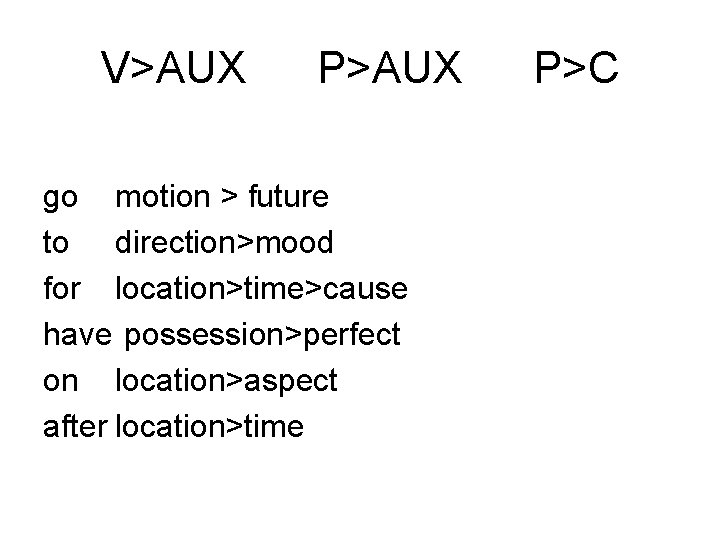
V>AUX P>AUX go motion > future to direction>mood for location>time>cause have possession>perfect on location>aspect after location>time P>C
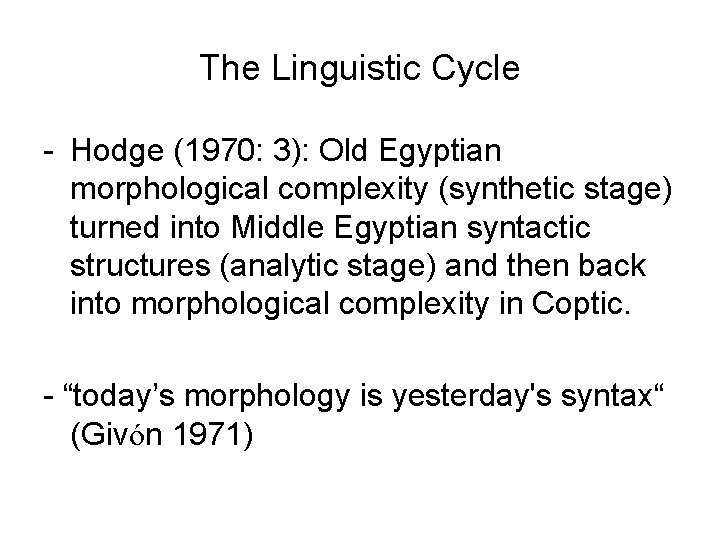
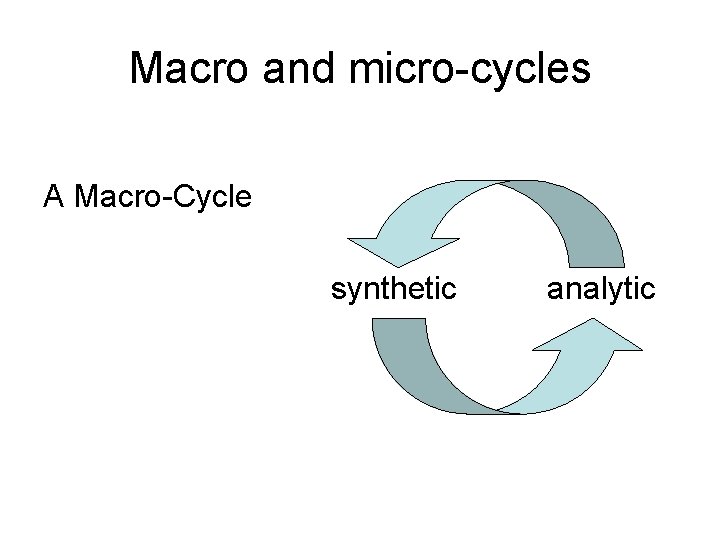
The Linguistic Cycle - Hodge (1970: 3): Old Egyptian morphological complexity (synthetic stage) turned into Middle Egyptian syntactic structures (analytic stage) and then back into morphological complexity in Coptic. - “today’s morphology is yesterday's syntax“ (Givón 1971)
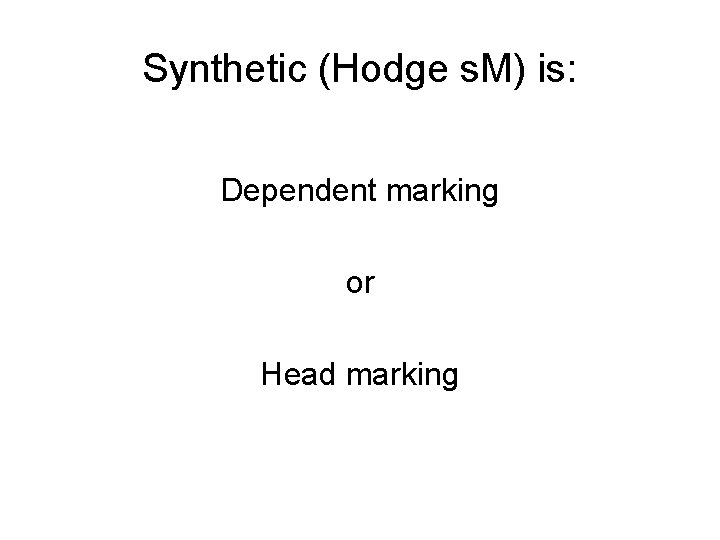
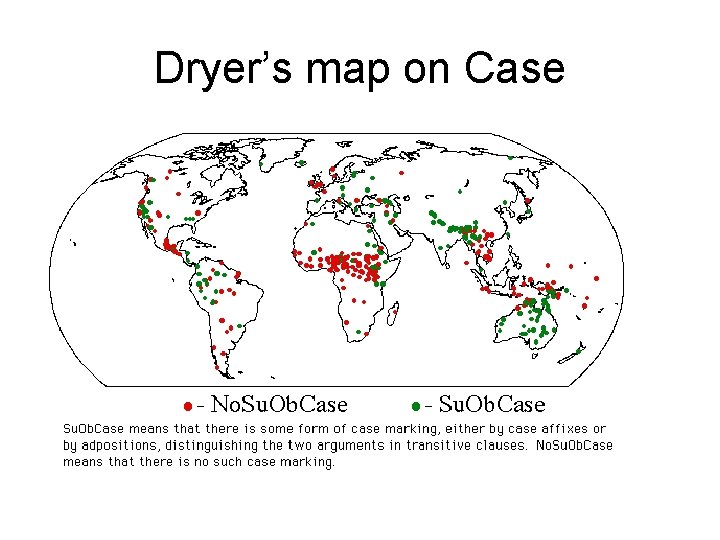
Synthetic (Hodge s. M) is: Dependent marking or Head marking
Dryer’s map on Case
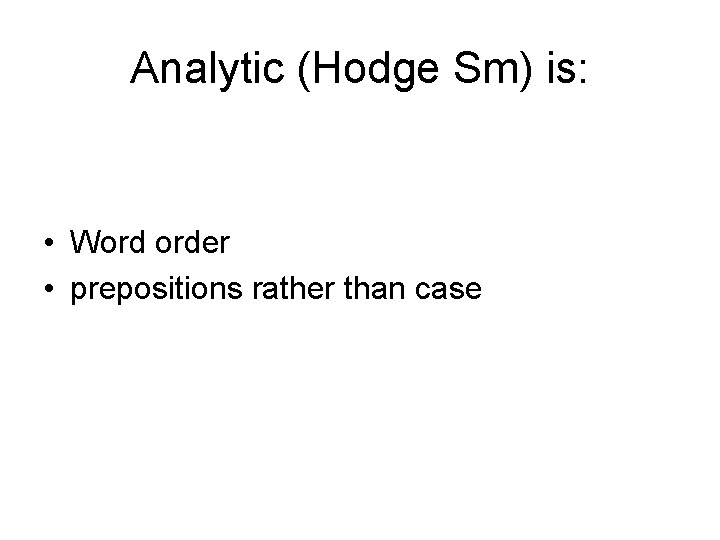
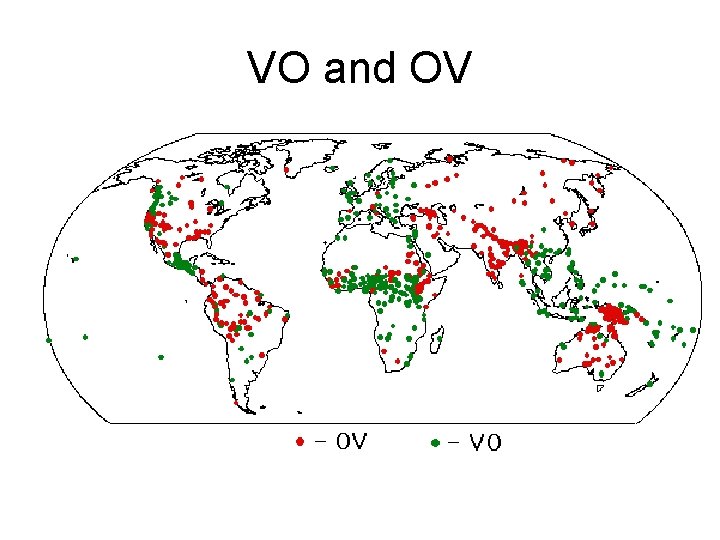
Analytic (Hodge Sm) is: • Word order • prepositions rather than case
VO and OV
Macro and micro-cycles A Macro-Cycle synthetic analytic
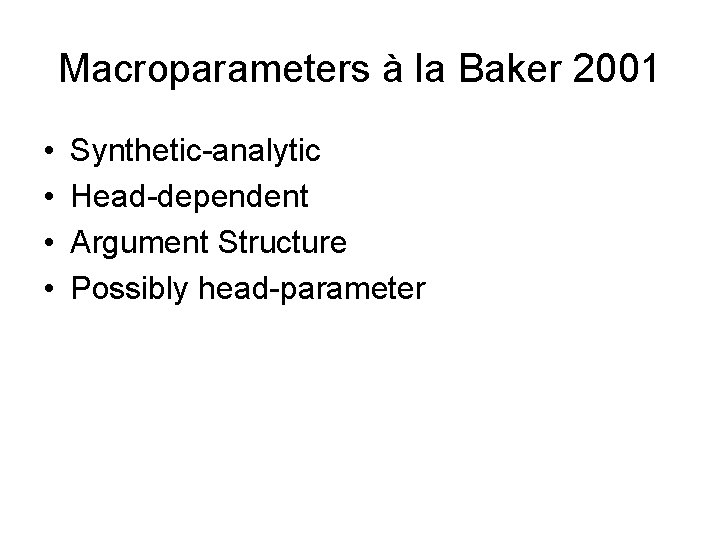
Macroparameters à la Baker 2001 • • Synthetic-analytic Head-dependent Argument Structure Possibly head-parameter
Sapir (1921: 128) “the terms [analytic and synthetic] are more useful in defining certain drifts than as absolute counters”.
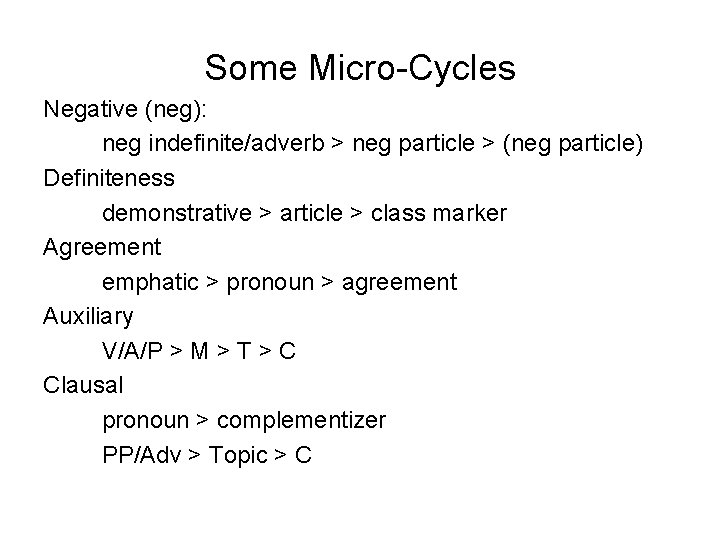
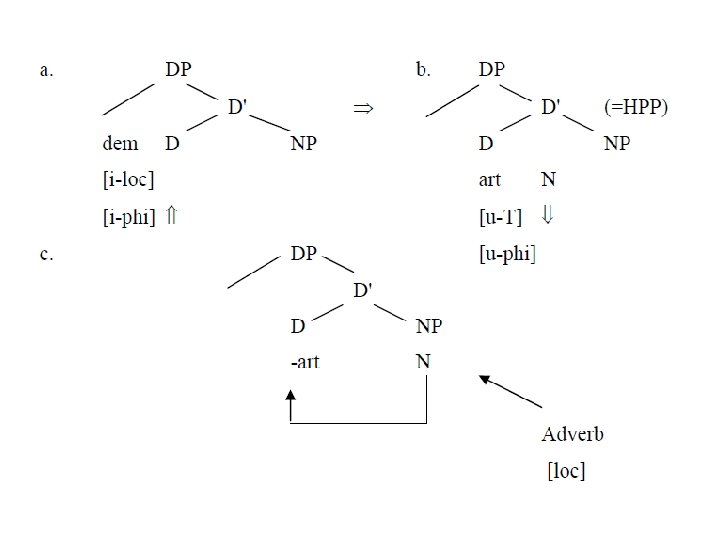
Some Micro-Cycles Negative (neg): neg indefinite/adverb > neg particle > (neg particle) Definiteness demonstrative > article > class marker Agreement emphatic > pronoun > agreement Auxiliary V/A/P > M > T > C Clausal pronoun > complementizer PP/Adv > Topic > C
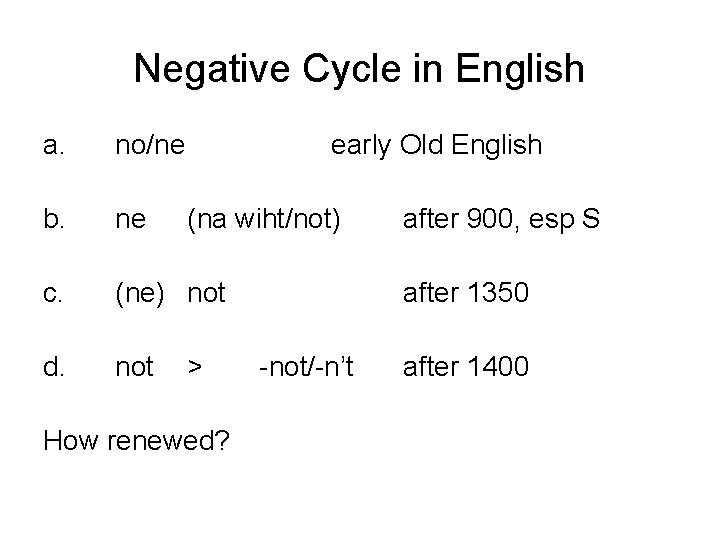
Negative Cycle in English a. no/ne early Old English b. ne c. (ne) not d. not (na wiht/not) > How renewed? after 900, esp S after 1350 -not/-n’t after 1400
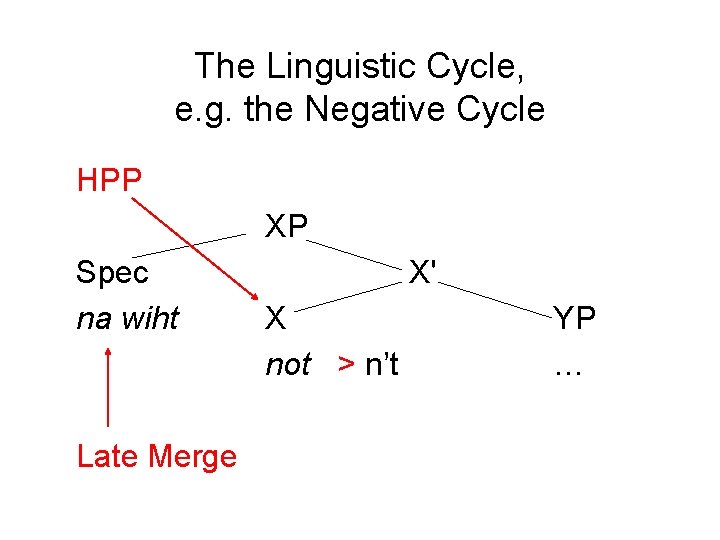
The Linguistic Cycle, e. g. the Negative Cycle HPP XP Spec na wiht Late Merge X' X not > n’t YP …
Hodge, Jespersen, and Sapir focus on macrocycles, though they do not use that term. Heine, Claudi & Hünnemeyer (1991: 246) argue that there is “more justification to apply the notion of a linguistics cycle to individual linguistic developments” rather than to changes from analytic to synthetic and back to analytic.
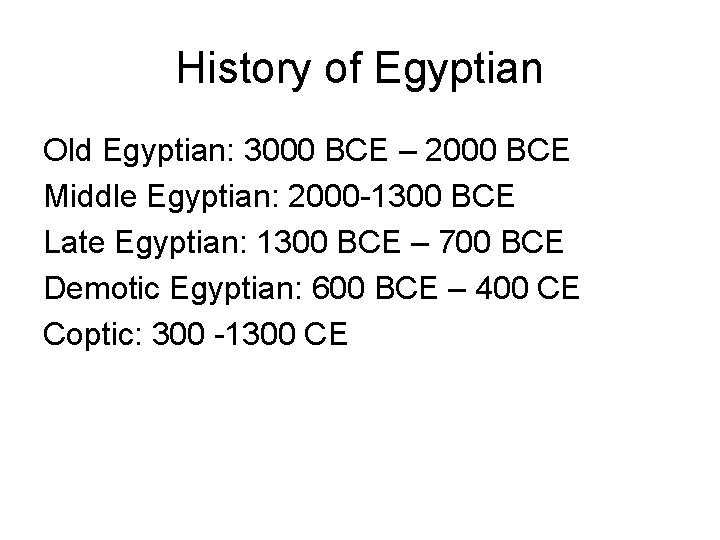
History of Egyptian Old Egyptian: 3000 BCE – 2000 BCE Middle Egyptian: 2000 -1300 BCE Late Egyptian: 1300 BCE – 700 BCE Demotic Egyptian: 600 BCE – 400 CE Coptic: 300 -1300 CE
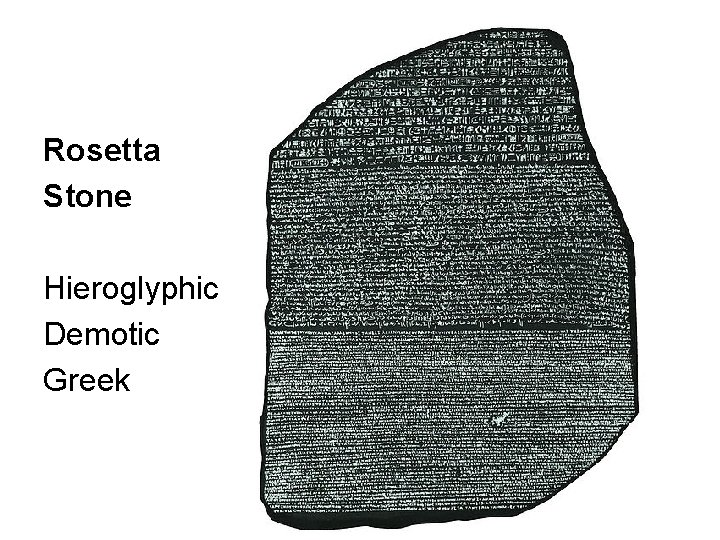
Rosetta Stone Hieroglyphic Demotic Greek
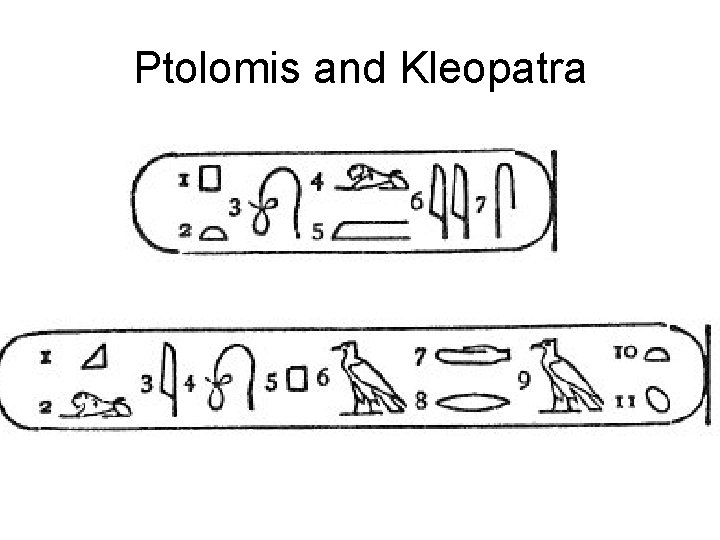
Ptolomis and Kleopatra
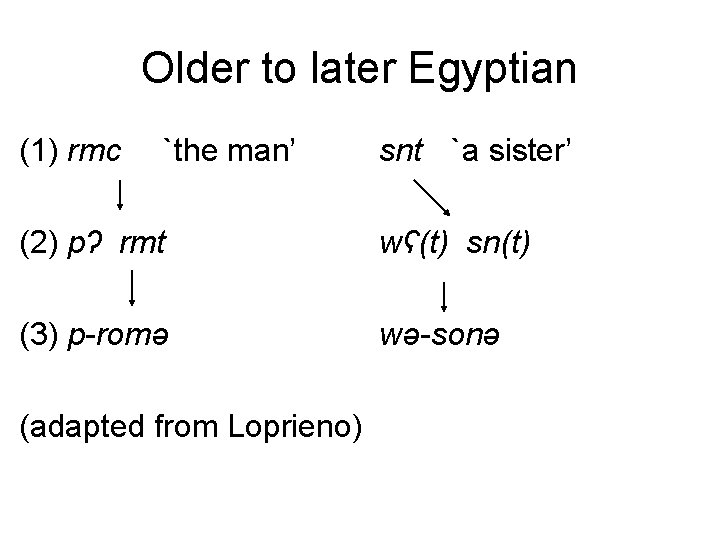
Older to later Egyptian (1) rmc `the man’ snt `a sister’ (2) pʔ rmt wʕ(t) sn(t) (3) p-romə wə-sonə (adapted from Loprieno)
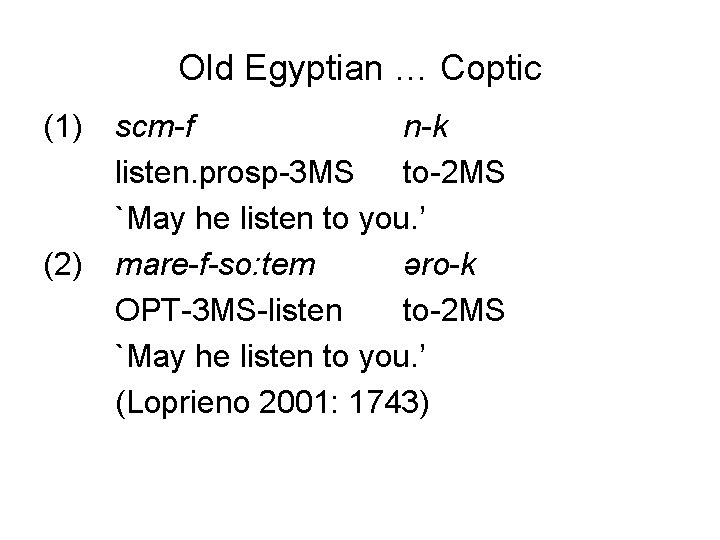
Old Egyptian … Coptic (1) (2) scm-f n-k listen. prosp-3 MS to-2 MS `May he listen to you. ’ mare-f-so: tem əro-k OPT-3 MS-listen to-2 MS `May he listen to you. ’ (Loprieno 2001: 1743)
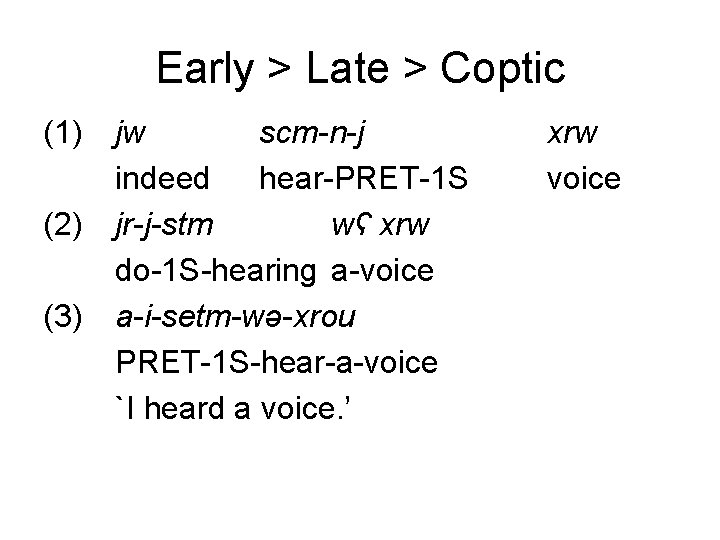
Early > Late > Coptic (1) (2) (3) jw scm-n-j indeed hear-PRET-1 S jr-j-stm wʕ xrw do-1 S-hearing a-voice a-i-setm-wə-xrou PRET-1 S-hear-a-voice `I heard a voice. ’ xrw voice
Spiral or Cycle: Spiral is another term for cycle (see von der Gabelentz 1901: 256; Hagège 1993: 147); it emphasizes the unidirectionality of the changes: languages do not reverse earlier change but may end up in a stage typologically similar to an earlier one. Jespersen (1922: chapter 21. 9) uses spirals when he criticizes the concept of cyclical change.
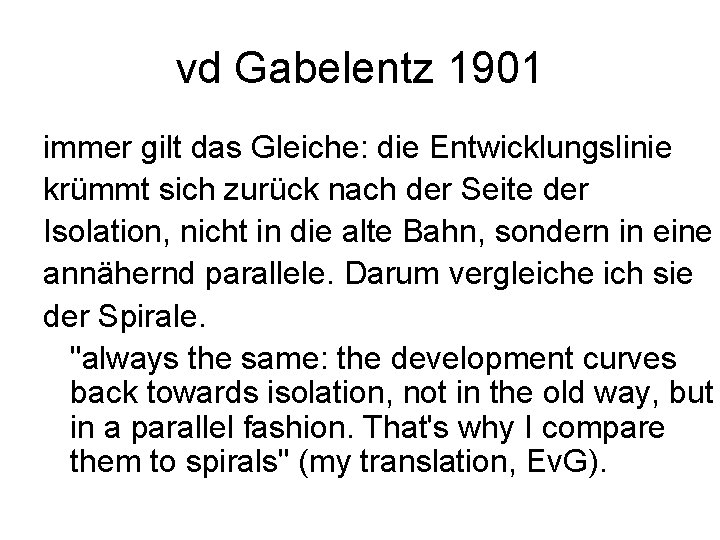
vd Gabelentz 1901 immer gilt das Gleiche: die Entwicklungslinie krümmt sich zurück nach der Seite der Isolation, nicht in die alte Bahn, sondern in eine annähernd parallele. Darum vergleiche ich sie der Spirale. "always the same: the development curves back towards isolation, not in the old way, but in a parallel fashion. That's why I compare them to spirals" (my translation, Ev. G).
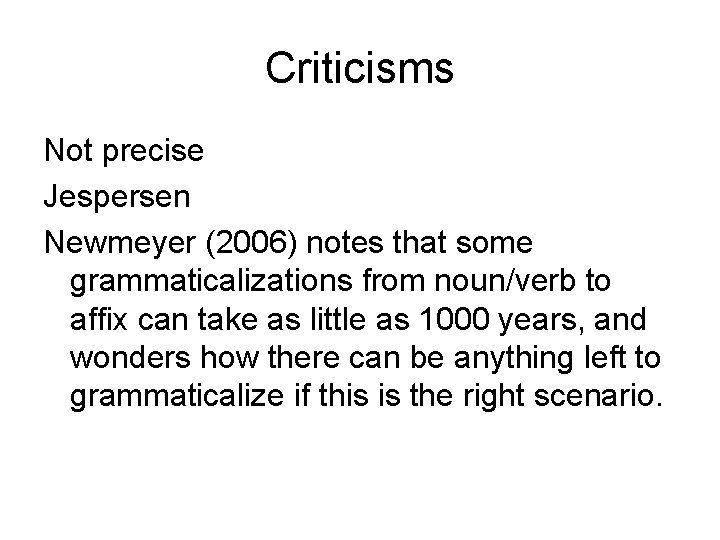
Criticisms Not precise Jespersen Newmeyer (2006) notes that some grammaticalizations from noun/verb to affix can take as little as 1000 years, and wonders how there can be anything left to grammaticalize if this is the right scenario.
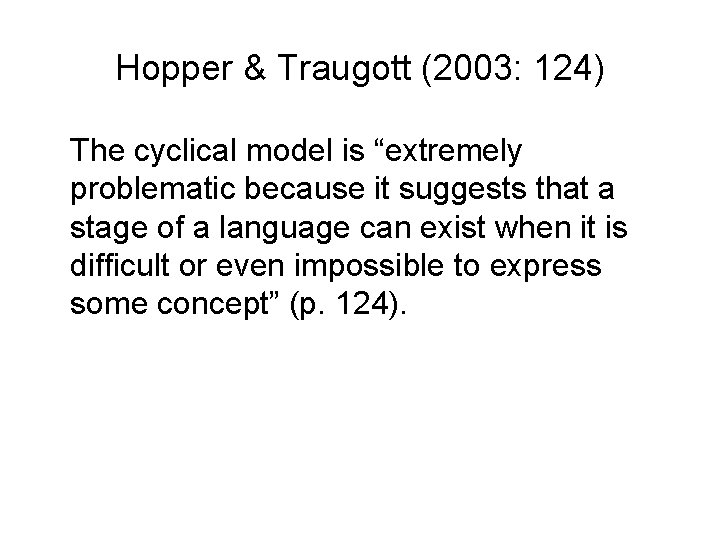
Hopper & Traugott (2003: 124) The cyclical model is “extremely problematic because it suggests that a stage of a language can exist when it is difficult or even impossible to express some concept” (p. 124).
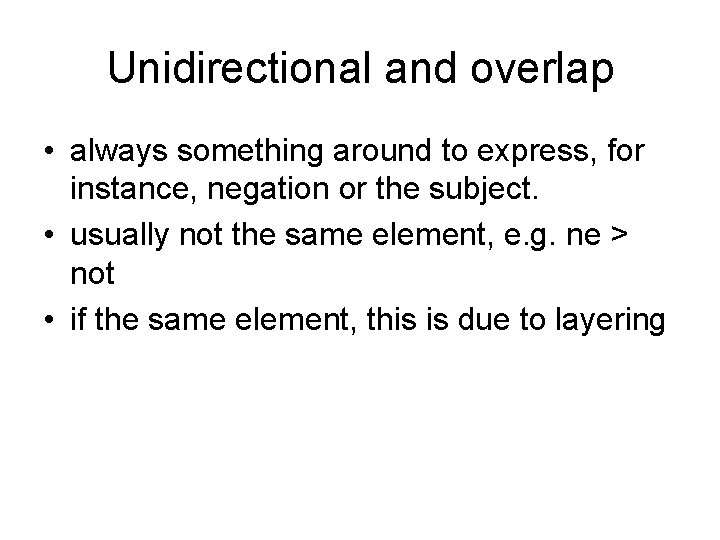
Unidirectional and overlap • always something around to express, for instance, negation or the subject. • usually not the same element, e. g. ne > not • if the same element, this is due to layering
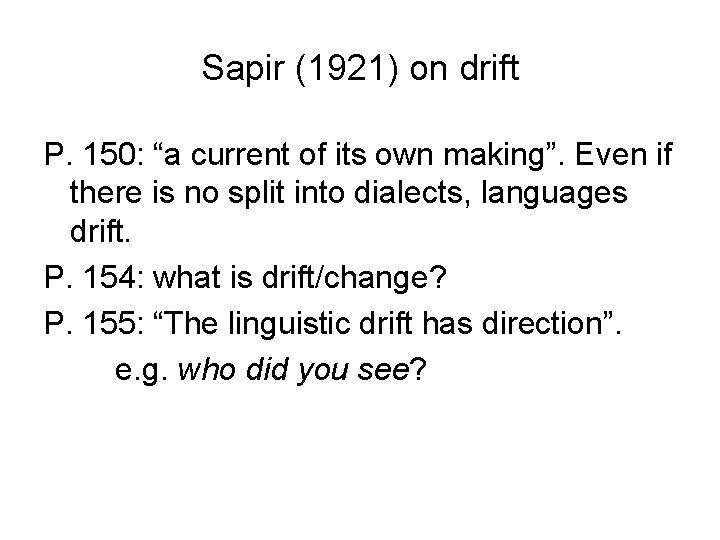
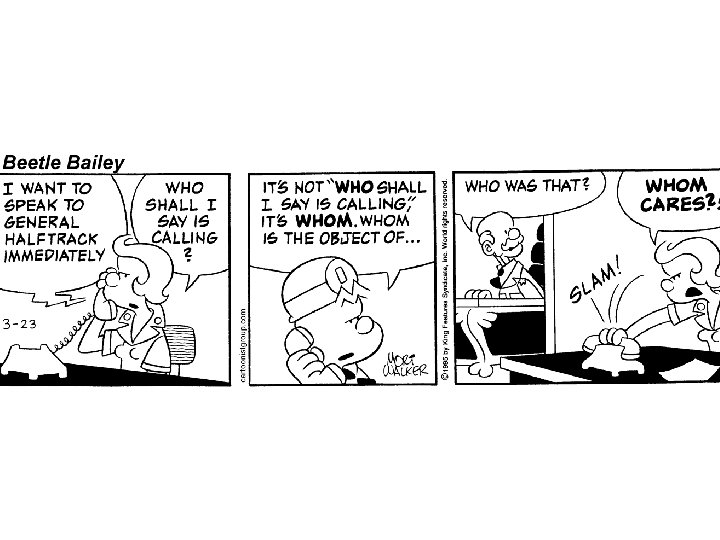
Sapir (1921) on drift P. 150: “a current of its own making”. Even if there is no split into dialects, languages drift. P. 154: what is drift/change? P. 155: “The linguistic drift has direction”. e. g. who did you see?
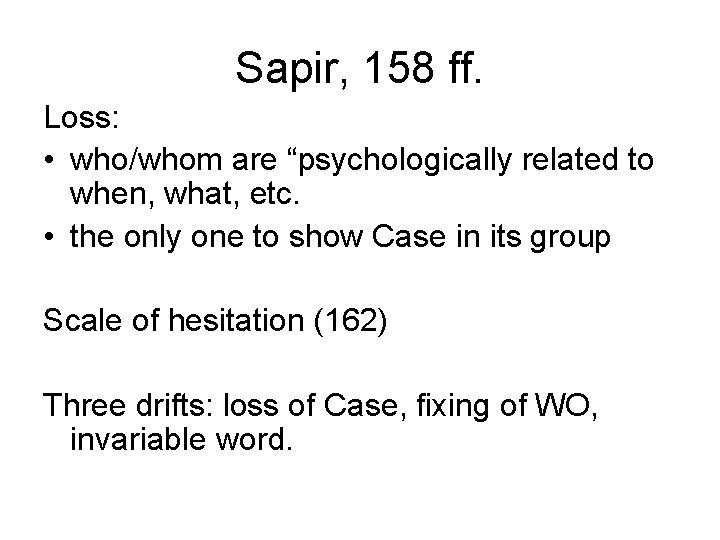
Sapir, 158 ff. Loss: • who/whom are “psychologically related to when, what, etc. • the only one to show Case in its group Scale of hesitation (162) Three drifts: loss of Case, fixing of WO, invariable word.
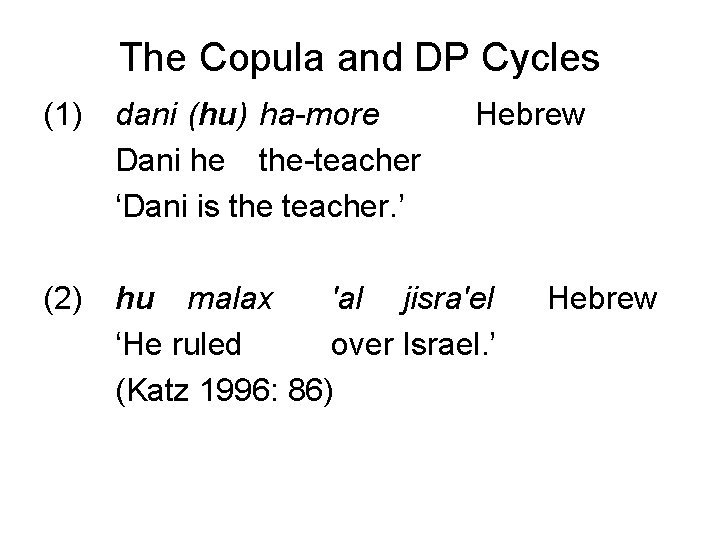
The Copula and DP Cycles (1) dani (hu) ha-more Dani he the-teacher ‘Dani is the teacher. ’ Hebrew (2) hu malax 'al jisra'el ‘He ruled over Israel. ’ (Katz 1996: 86) Hebrew
Synthetic-analytic Cycle Greenberg, Hodge, Schwegler, Haselow, Szmrecsanyi, and others. Issues: calculation word+morph/word Clitics Pronouns Derivational unmarked
HL (at ASU) Workshop. . . Possibly workshop on analytic-synthetic