
Limparfait What you will learn How to identify

- Slides: 8
L’imparfait
What you will learn How to identify l’imparfait How to form l’imparfait When to use l’imparfait 2
L’imparfait is a past tense used to describe: 1. Someone or something in the past 2. A situation, atmosphere or feeling in the past 3. Something that ‘was happening’ at a certain moment in the past (when something else happened) 4. Something that ‘used to’ happen regularly 3
1. Someone or something in the past: He was very funny. The town was very beautiful. 2. A situation, atmosphere or feeling in the past: She was very happy. The situation was very tense. 4
3. Something that ‘was happening’ at a certain moment in the past: I was watching the football match when the phone rang. 4. Something that ‘used to’ happen regularly: When I was younger I used to do Irish dancing. 5
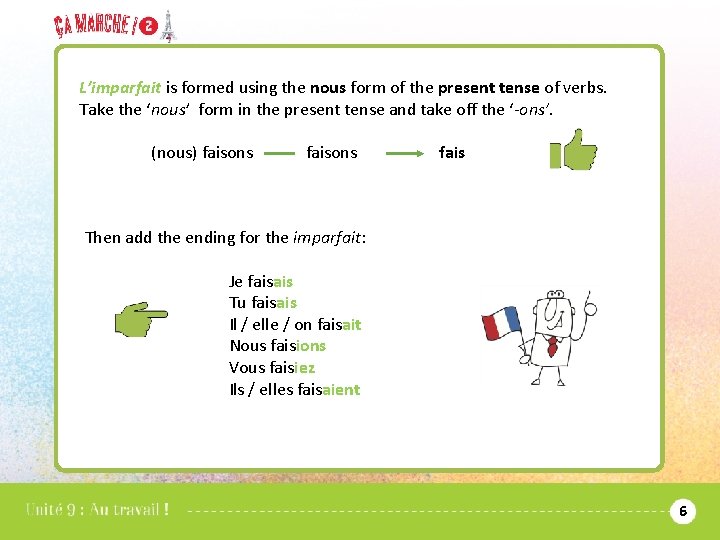
L’imparfait is formed using the nous form of the present tense of verbs. Take the ‘nous’ form in the present tense and take off the ‘-ons’. (nous) faisons fais Then add the ending for the imparfait: Je faisais Tu faisais Il / elle / on faisait Nous faisions Vous faisiez Ils / elles faisaient 6
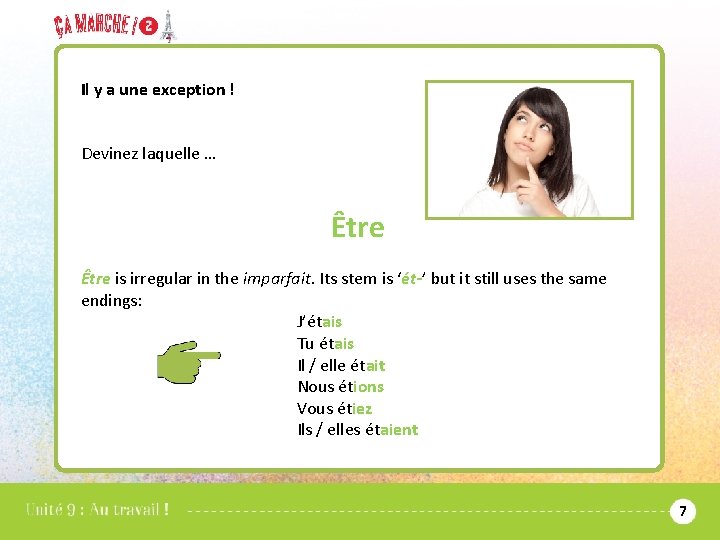
Il y a une exception ! Devinez laquelle … Être is irregular in the imparfait. Its stem is ‘ét-’ but it still uses the same endings: J’étais Tu étais Il / elle était Nous étions Vous étiez Ils / elles étaient 7
Can you … ? Identify l’imparfait Form l’imparfait Identify when you should use l’imparfait 8