
Limits of stability Halo nuclei dripline nuclei stable
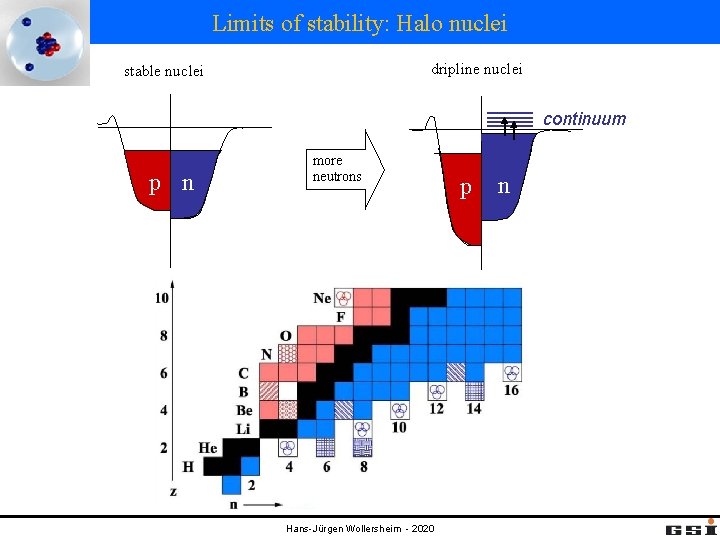
Limits of stability: Halo nuclei dripline nuclei stable nuclei continuum p n more neutrons Hans-Jürgen Wollersheim - 2020 p n
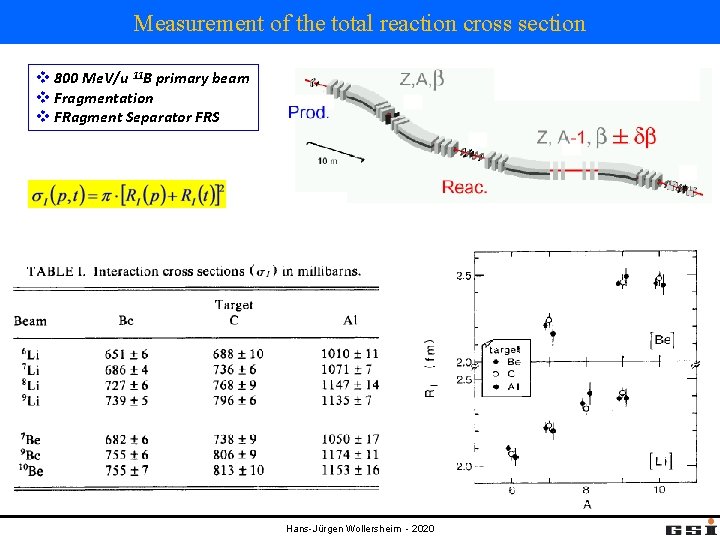
Measurement of the total reaction cross section v 800 Me. V/u 11 B primary beam v Fragmentation v FRagment Separator FRS Hans-Jürgen Wollersheim - 2020
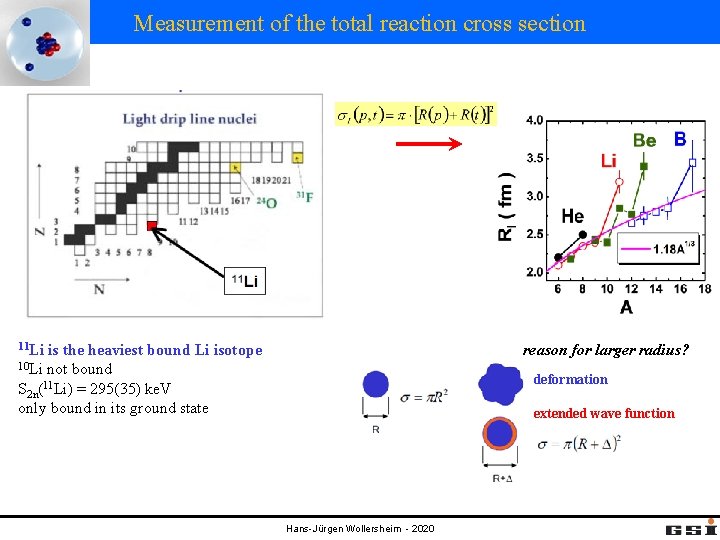
Measurement of the total reaction cross section reason for larger radius? 11 Li is the heaviest bound Li isotope 10 Li not bound S 2 n(11 Li) = 295(35) ke. V only bound in its ground state deformation extended wave function Hans-Jürgen Wollersheim - 2020
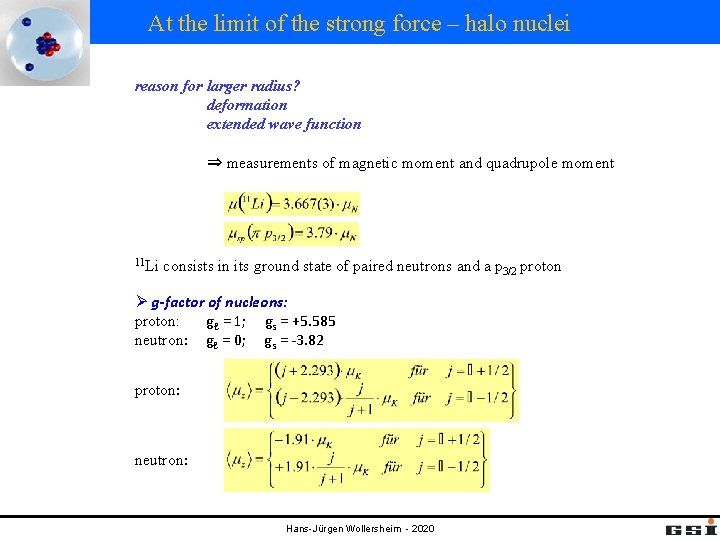
At the limit of the strong force – halo nuclei reason for larger radius? deformation extended wave function ⇒ measurements of magnetic moment and quadrupole moment 11 Li consists in its ground state of paired neutrons and a p 3/2 proton Ø g-factor of nucleons: proton: gℓ = 1; gs = +5. 585 neutron: gℓ = 0; gs = -3. 82 proton: neutron: Hans-Jürgen Wollersheim - 2020
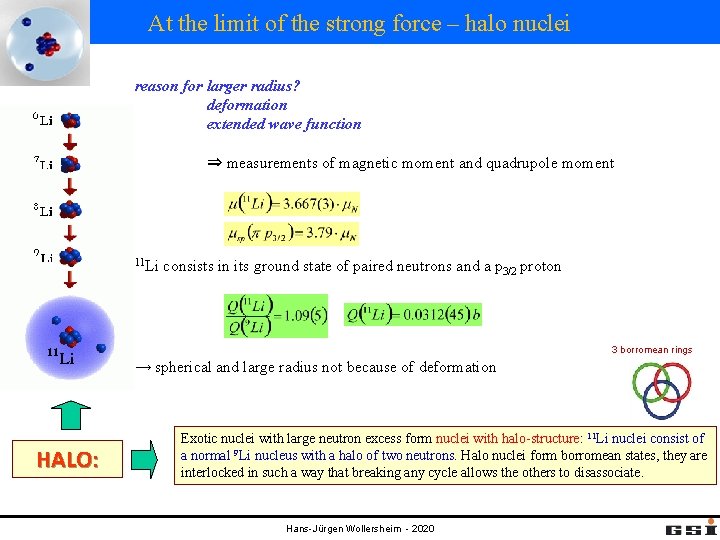
At the limit of the strong force – halo nuclei reason for larger radius? deformation extended wave function ⇒ measurements of magnetic moment and quadrupole moment 11 Li consists in its ground state of paired neutrons and a p 3/2 proton 3 borromean rings → spherical and large radius not because of deformation HALO: Exotic nuclei with large neutron excess form nuclei with halo-structure: 11 Li nuclei consist of a normal 9 Li nucleus with a halo of two neutrons. Halo nuclei form borromean states, they are interlocked in such a way that breaking any cycle allows the others to disassociate. Hans-Jürgen Wollersheim - 2020

Single particle potential outside of the square-well potential: Lösung: inside of the square-well potential: Lösung: continuity of the wave function: graphical solution of the eigenvalue problem Hans-Jürgen Wollersheim - 2020
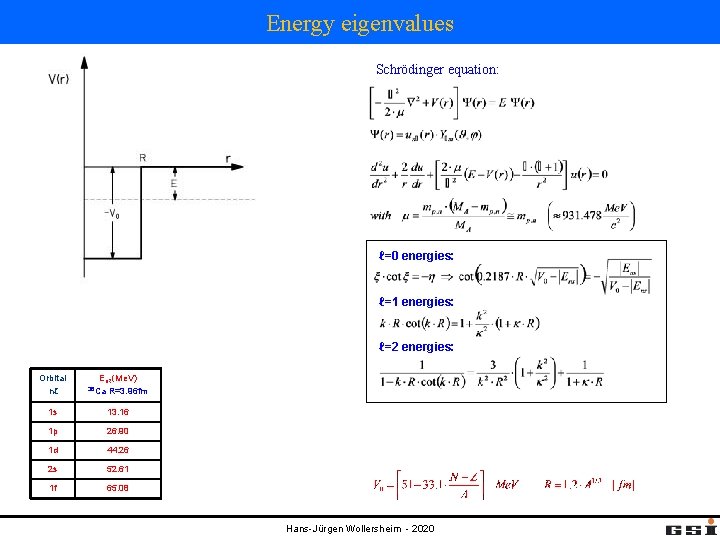
Energy eigenvalues Schrödinger equation: ℓ=0 energies: ℓ=1 energies: ℓ=2 energies: Orbital nℓ Enℓ (Me. V) 36 Ca R=3. 96 fm Enℓ (Me. V) V 0=54. 7 Me. V 1 s 13. 16 9. 75 9. 55 1 p 26. 90 19. 77 19. 31 1 d 44. 26 32. 20 31. 32 2 s 52. 61 37. 55 36. 25 1 f 65. 08 36 Ca 36 S Enℓ (Me. V) V 0=47. 3 Me. V Hans-Jürgen Wollersheim - 2020
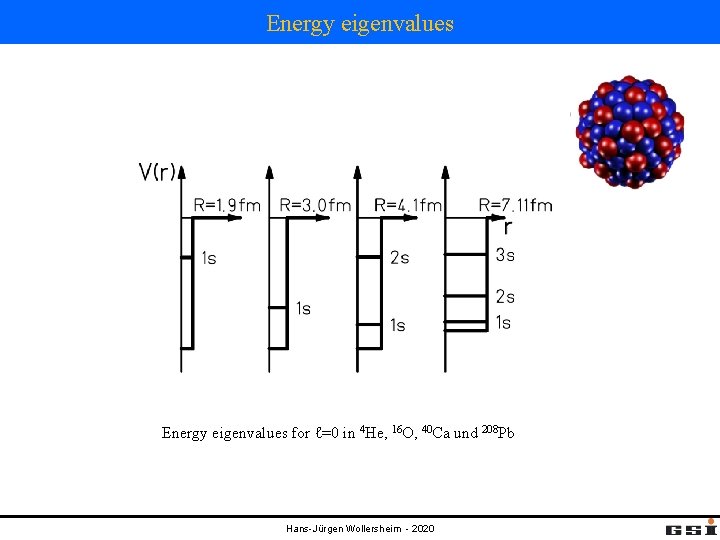
Energy eigenvalues for ℓ=0 in 4 He, 16 O, 40 Ca und 208 Pb Hans-Jürgen Wollersheim - 2020
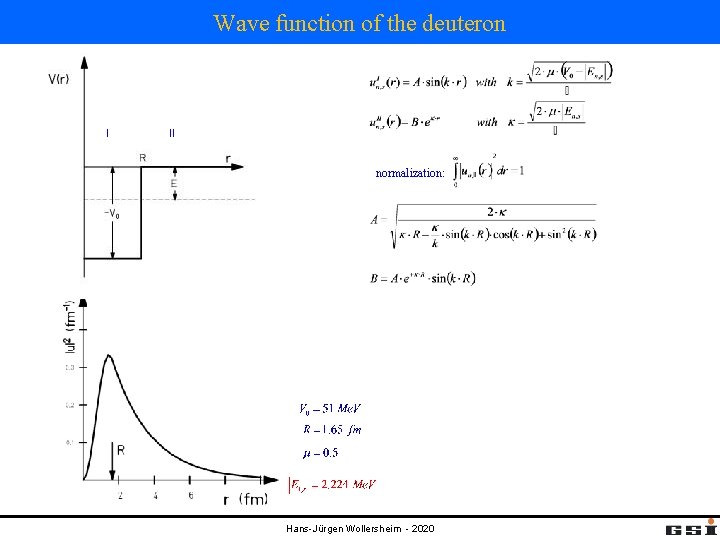
Wave function of the deuteron Ι ΙΙ normalization: Hans-Jürgen Wollersheim - 2020
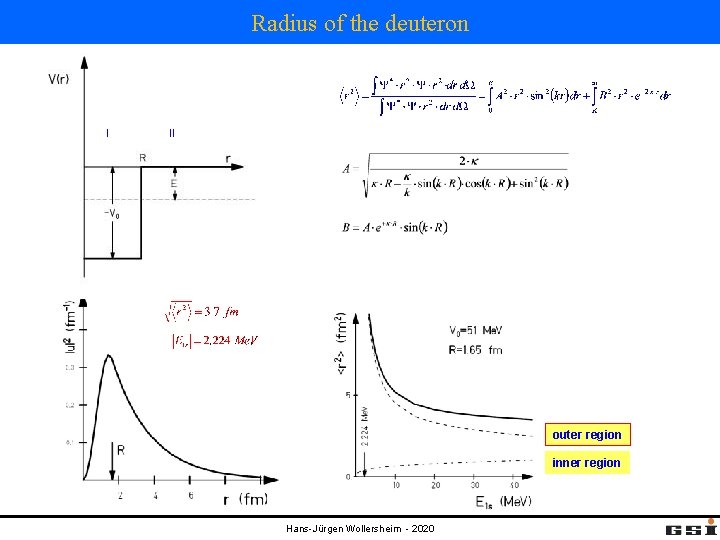
Radius of the deuteron Ι ΙΙ outer region inner region Hans-Jürgen Wollersheim - 2020
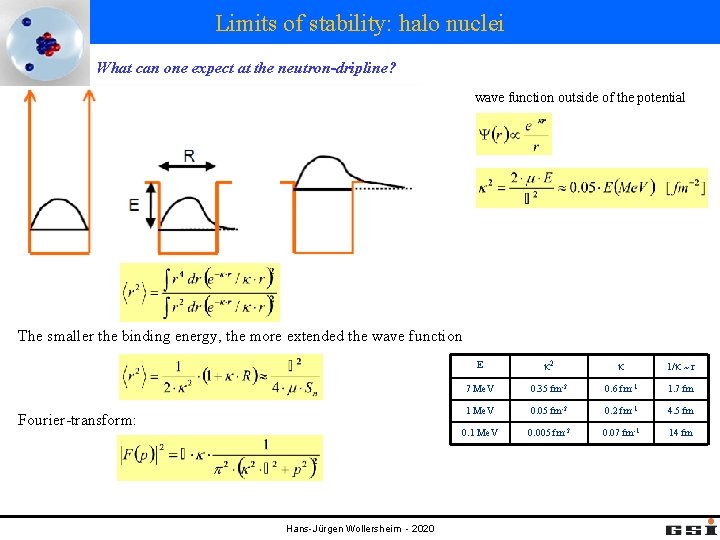
Limits of stability: halo nuclei What can one expect at the neutron-dripline? wave function outside of the potential The smaller the binding energy, the more extended the wave function Fourier-transform: Hans-Jürgen Wollersheim - 2020 E κ 2 κ 1/κ ~ r 7 Me. V 0. 35 fm-2 0. 6 fm-1 1. 7 fm 1 Me. V 0. 05 fm-2 0. 2 fm-1 4. 5 fm 0. 1 Me. V 0. 005 fm-2 0. 07 fm-1 14 fm
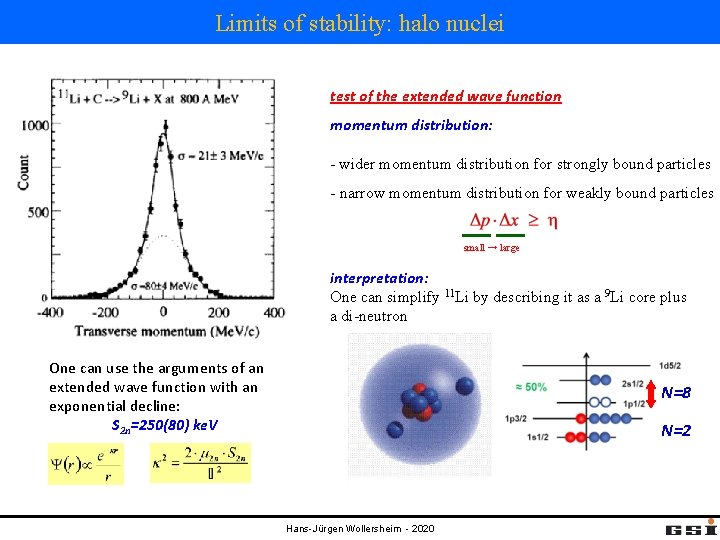
Limits of stability: halo nuclei test of the extended wave function momentum distribution: - wider momentum distribution for strongly bound particles - narrow momentum distribution for weakly bound particles small → large interpretation: One can simplify 11 Li by describing it as a 9 Li core plus a di-neutron One can use the arguments of an extended wave function with an exponential decline: S 2 n=250(80) ke. V N=8 N=2 Hans-Jürgen Wollersheim - 2020

Limits of stability - halo nuclei radii of lighter nuclei Prog. Part. Nucl. Phys. 59 (2007), 432 Hans-Jürgen Wollersheim - 2020
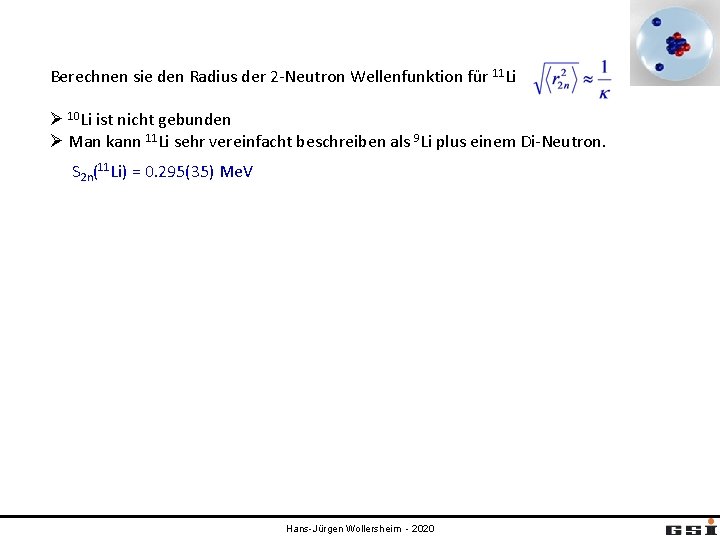
Berechnen sie den Radius der 2 -Neutron Wellenfunktion für 11 Li Ø 10 Li ist nicht gebunden Ø Man kann 11 Li sehr vereinfacht beschreiben als 9 Li plus einem Di-Neutron. S 2 n(11 Li) = 0. 295(35) Me. V Hans-Jürgen Wollersheim - 2020
- Slides: 14