
Limits Of Computing Chapter 17 121006 Hofstra University
- Slides: 27
Limits Of Computing Chapter 17 12/10/06 Hofstra University - CSC 005 1
Complexity of Software Commercial software contains errors The problem is complexity Software testing can demonstrate the presence of bugs but cannot demonstrate their absence As we find problems and fix them, we raise our confidence that the software performs as it should But we can never guarantee that all bugs have been removed 12/10/06 Hofstra University - CSC 005 2
Software Engineering Software requirements Broad, but precise, statements outlining what is to be provided by the software product Software specifications A detailed description of the function, inputs, processing, outputs, and special features of a software product 12/10/06 Hofstra University - CSC 005 3
Software Engineering A guideline for the number of errors per lines of code that can be expected Standard software: 25 bugs per 1, 000 lines of program Good software: 2 errors per 1, 000 lines Space Shuttle software: < 1 error per 10, 000 lines 12/10/06 Hofstra University - CSC 005 4
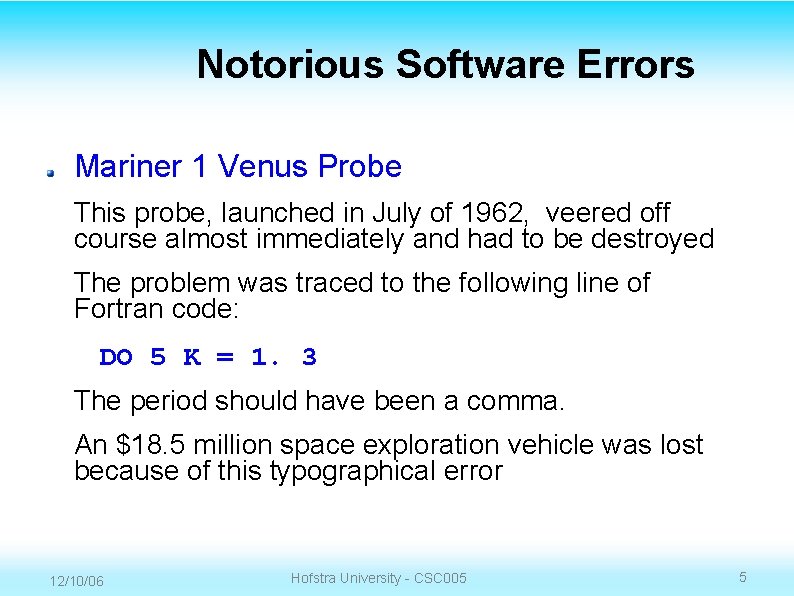
Notorious Software Errors Mariner 1 Venus Probe This probe, launched in July of 1962, veered off course almost immediately and had to be destroyed The problem was traced to the following line of Fortran code: DO 5 K = 1. 3 The period should have been a comma. An $18. 5 million space exploration vehicle was lost because of this typographical error 12/10/06 Hofstra University - CSC 005 5
Notorious Software Errors Denver baggage handling system - was so complex (involving 300 computers) that the development overrun prevented the airport from opening on time. Fixing the incredibly buggy system required an additional 50% of the original budget - nearly $200 m. The 2003 North America blackout - was triggered by a local outage that went undetected due to a race condition in General Electric Energy's XA/21 monitoring software. FBI in 2005 - $170 million FBI project to update their case management system. 12/10/06 Hofstra University - CSC 005 6
Notorious Software Errors Mars Climate Orbiter (1999) - The 125 million dollar Mars Climate Orbiter is assumed lost by officials at NASA. The failure responsible for loss of the orbiter is attributed to a failure of NASA’s system engineer process. The process did not specify the system of measurement to be used on the project. As a result, one of the development teams used Imperial measurement while the other used the metric system of measurement. When parameters from one module were passed to another during orbit navigation correct, no conversion was performed, resulting in the loss of the craft. http: //mars. jpl. nasa. gov/msp 98/orbiter/ 12/10/06 Hofstra University - CSC 005 7
Formal Verification The verification of program correctness, independent of data testing, is an important area of theoretical computer science research Formal methods have been used successfully in verifying the correctness of computer chips It is hoped that success with formal verification techniques at the hardware level can lead eventually to success at the software level 12/10/06 Hofstra University - CSC 005 8
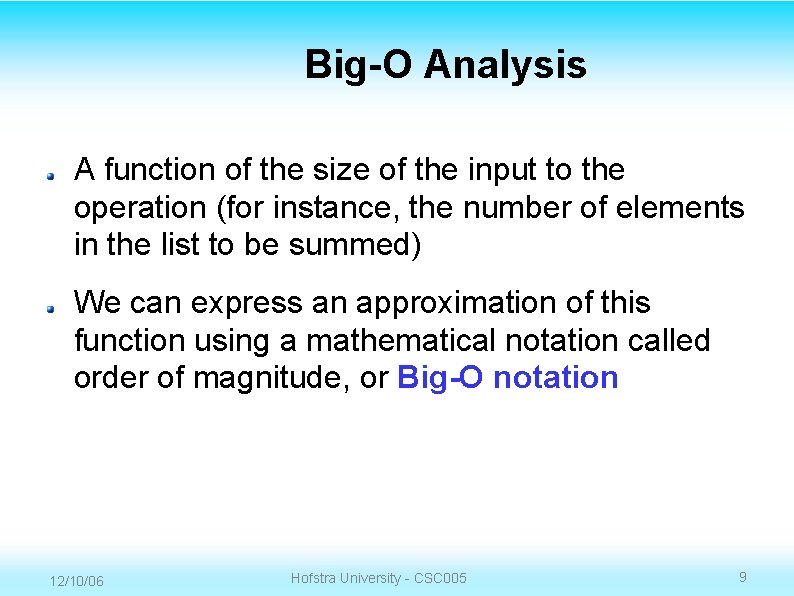
Big-O Analysis A function of the size of the input to the operation (for instance, the number of elements in the list to be summed) We can express an approximation of this function using a mathematical notation called order of magnitude, or Big-O notation 12/10/06 Hofstra University - CSC 005 9
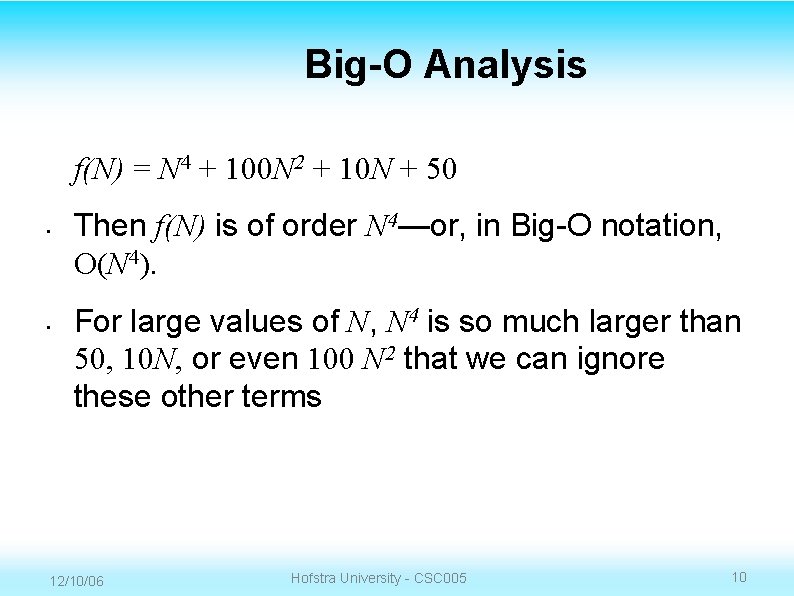
Big-O Analysis f(N) = N 4 + 100 N 2 + 10 N + 50 • • Then f(N) is of order N 4—or, in Big-O notation, O(N 4). For large values of N, N 4 is so much larger than 50, 10 N, or even 100 N 2 that we can ignore these other terms 12/10/06 Hofstra University - CSC 005 10
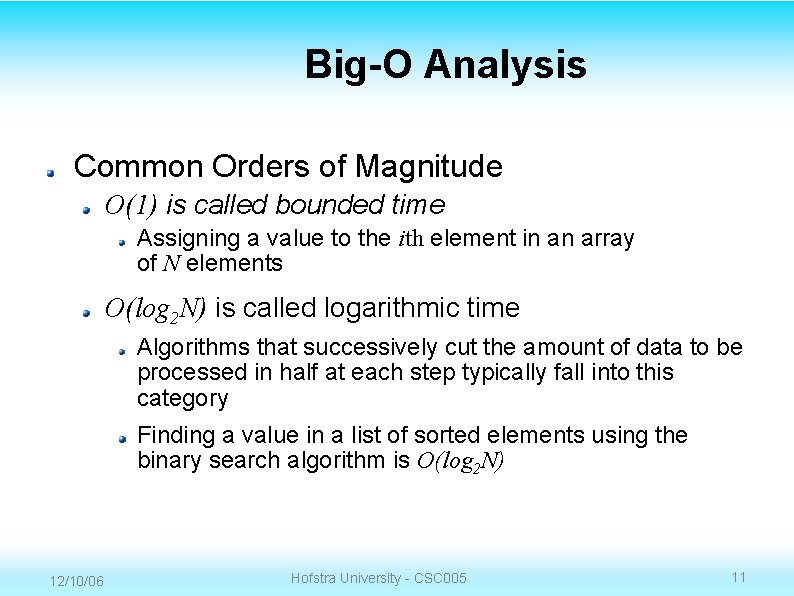
Big-O Analysis Common Orders of Magnitude O(1) is called bounded time Assigning a value to the ith element in an array of N elements O(log 2 N) is called logarithmic time Algorithms that successively cut the amount of data to be processed in half at each step typically fall into this category Finding a value in a list of sorted elements using the binary search algorithm is O(log 2 N) 12/10/06 Hofstra University - CSC 005 11
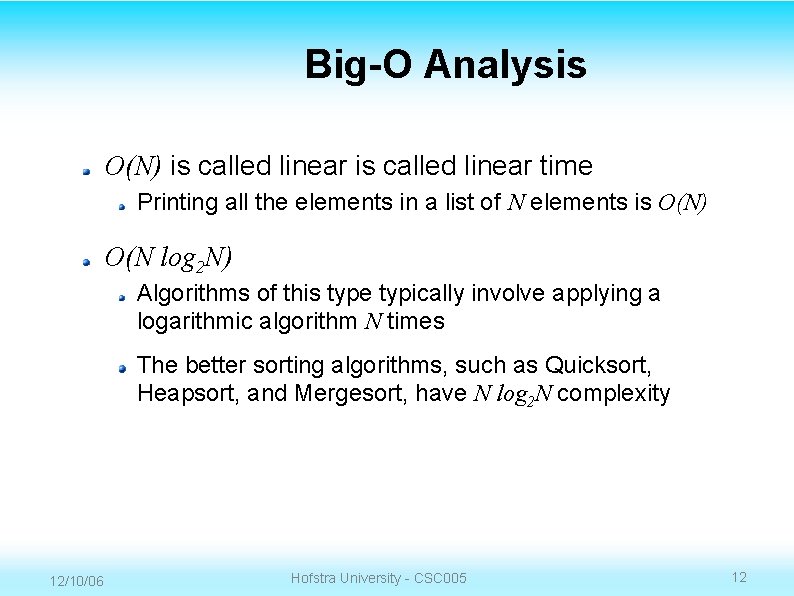
Big-O Analysis O(N) is called linear time Printing all the elements in a list of N elements is O(N) O(N log 2 N) Algorithms of this type typically involve applying a logarithmic algorithm N times The better sorting algorithms, such as Quicksort, Heapsort, and Mergesort, have N log 2 N complexity 12/10/06 Hofstra University - CSC 005 12
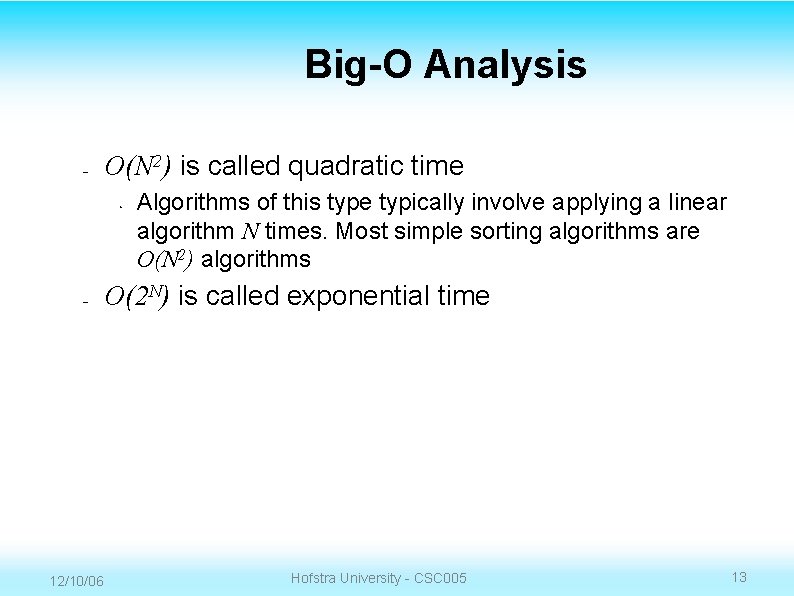
Big-O Analysis – O(N 2) is called quadratic time • – 12/10/06 Algorithms of this type typically involve applying a linear algorithm N times. Most simple sorting algorithms are O(N 2) algorithms O(2 N) is called exponential time Hofstra University - CSC 005 13
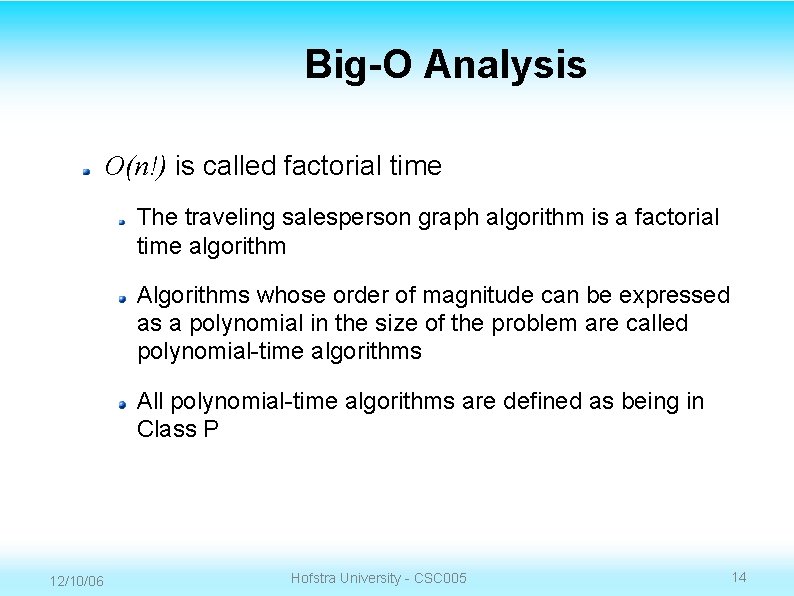
Big-O Analysis O(n!) is called factorial time The traveling salesperson graph algorithm is a factorial time algorithm Algorithms whose order of magnitude can be expressed as a polynomial in the size of the problem are called polynomial-time algorithms All polynomial-time algorithms are defined as being in Class P 12/10/06 Hofstra University - CSC 005 14
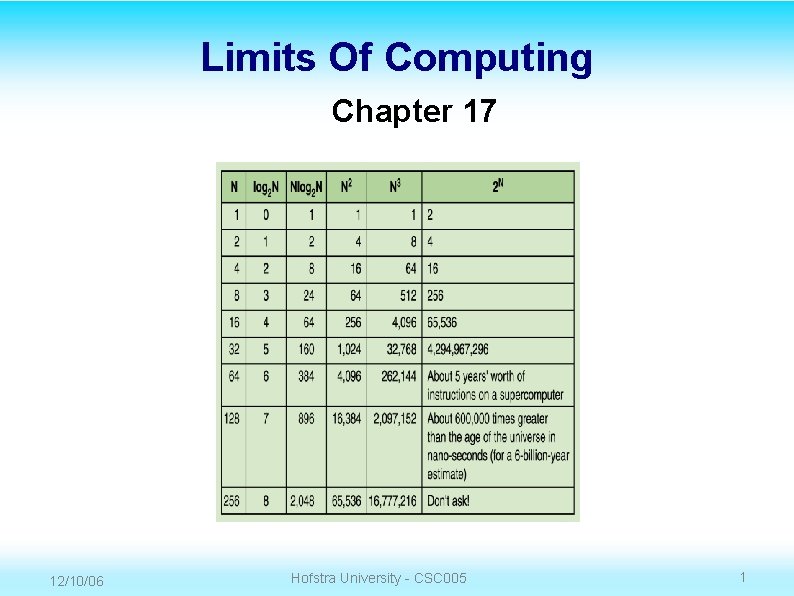
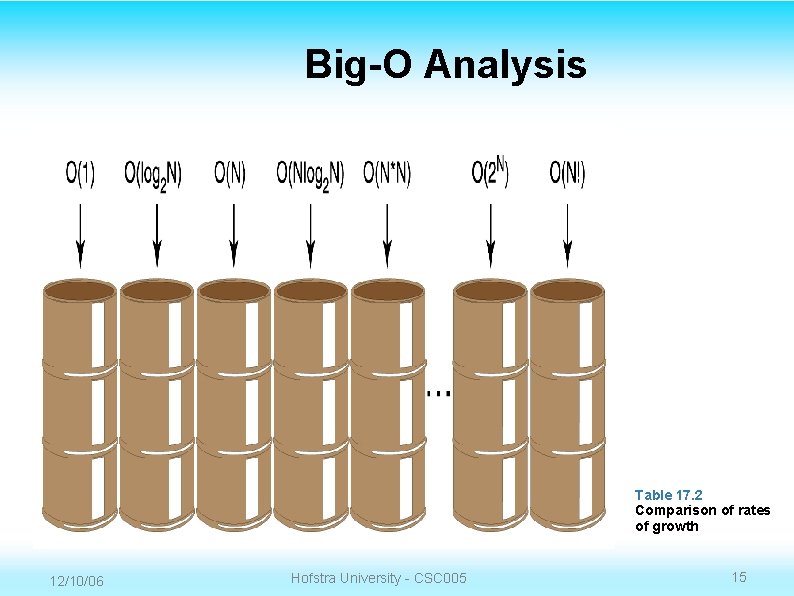
Big-O Analysis Table 17. 2 Comparison of rates of growth 12/10/06 Hofstra University - CSC 005 15
Big-O Analysis Figure 17. 3 Orders of complexity 12/10/06 Hofstra University - CSC 005 16
Turing Machines Alan Turing developed the concept of a computing machine in the 1930 s A Turing machine, as his model became known, consists of a control unit with a read/write head that can read and write symbols on an infinite tape 12/10/06 Hofstra University - CSC 005 17
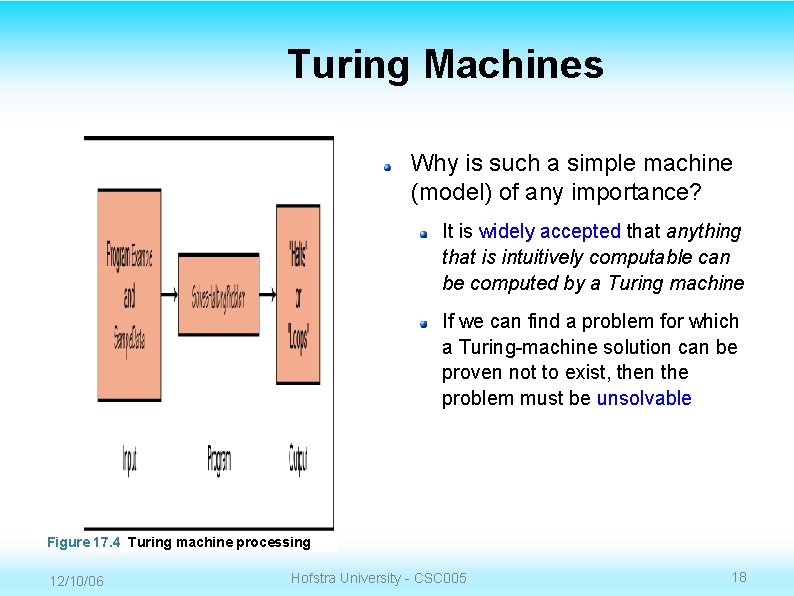
Turing Machines Why is such a simple machine (model) of any importance? It is widely accepted that anything that is intuitively computable can be computed by a Turing machine If we can find a problem for which a Turing-machine solution can be proven not to exist, then the problem must be unsolvable Figure 17. 4 Turing machine processing 12/10/06 Hofstra University - CSC 005 18
Halting Problem It is not always obvious that a computation (program) halts The Halting problem: Given a program and an input to the program, determine if the program will eventually stop with this input This problem is unsolvable 12/10/06 Hofstra University - CSC 005 19
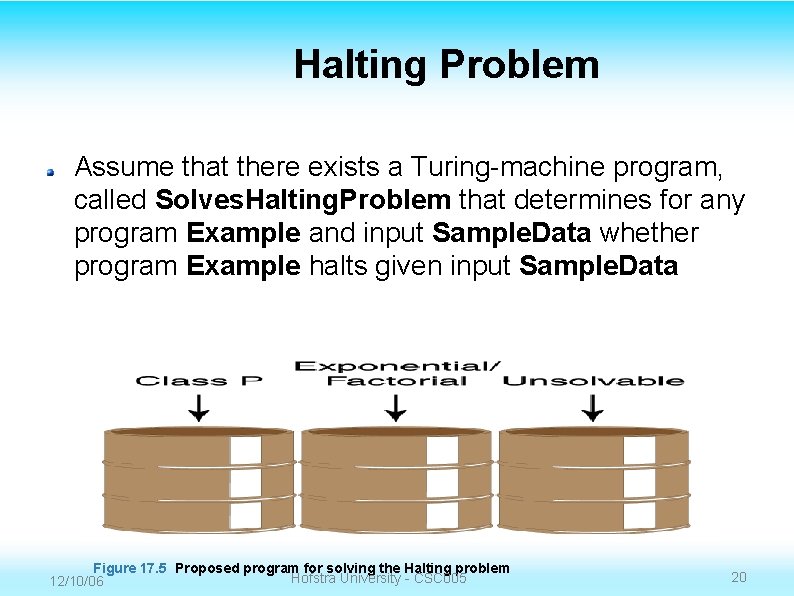
Halting Problem Assume that there exists a Turing-machine program, called Solves. Halting. Problem that determines for any program Example and input Sample. Data whether program Example halts given input Sample. Data Figure 17. 5 Proposed program for solving the Halting problem Hofstra University - CSC 005 12/10/06 20
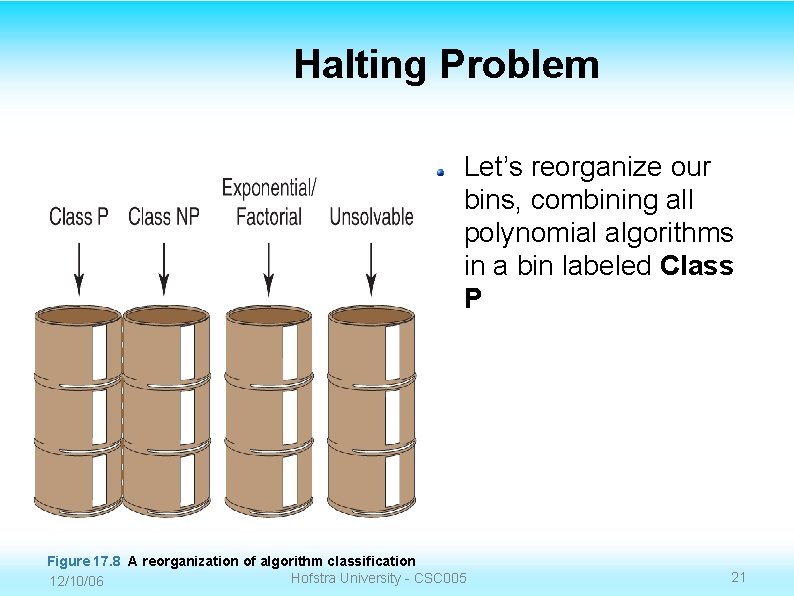
Halting Problem Let’s reorganize our bins, combining all polynomial algorithms in a bin labeled Class P Figure 17. 8 A reorganization of algorithm classification Hofstra University - CSC 005 12/10/06 21
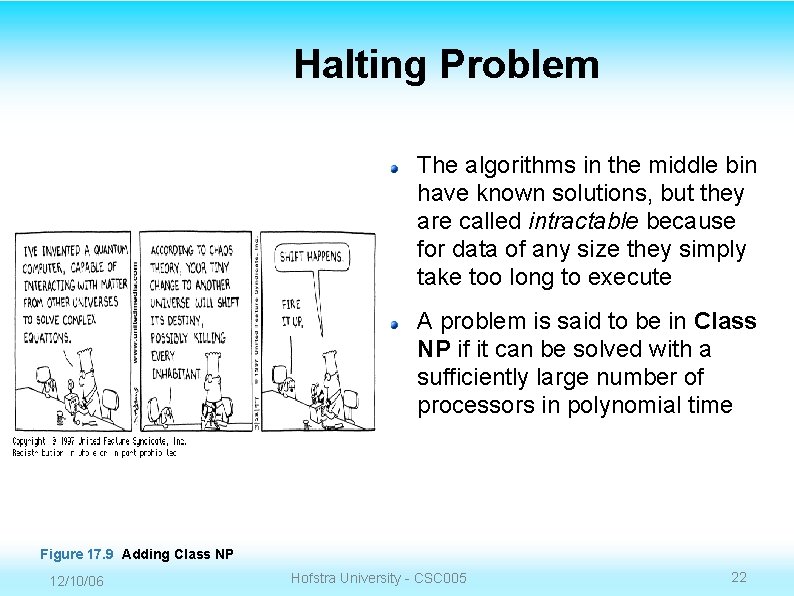
Halting Problem The algorithms in the middle bin have known solutions, but they are called intractable because for data of any size they simply take too long to execute A problem is said to be in Class NP if it can be solved with a sufficiently large number of processors in polynomial time Figure 17. 9 Adding Class NP 12/10/06 Hofstra University - CSC 005 22
The Promise. . . Quantum Computing – subatomic level; great promise for cryptography Photonic Computing – photons replace electrons; no wires! Biological Computing - use of living organisms or their components, e. g. DNA strands, to perform computing operations 12/10/06 Hofstra University - CSC 005 23
Dilbert Said It Well. . . 12/10/06 Hofstra University - CSC 005 24
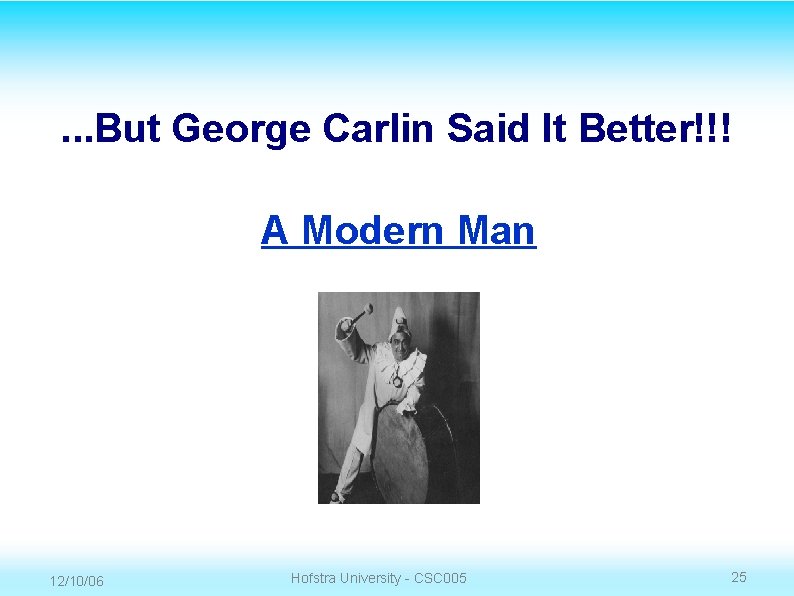
. . . But George Carlin Said It Better!!! A Modern Man 12/10/06 Hofstra University - CSC 005 25
Final Exam Take Home Exam (on web site) Six Questions – Answer All of Them Due December 18 or Earlier! Absolutely No Lateness All other assignments must be in before the 11 th Next Class – Monday, 12/11 – Short Lecture On Limitations of Computing 12/10/06 Hofstra University - CSC 005 26
La commedia e finita' … …Good Luck…Make A Difference!!! 12/10/06 Hofstra University - CSC 005 27