
Limits and an Introduction to Calculus Example 1

- Slides: 22
Limits and an Introduction to Calculus
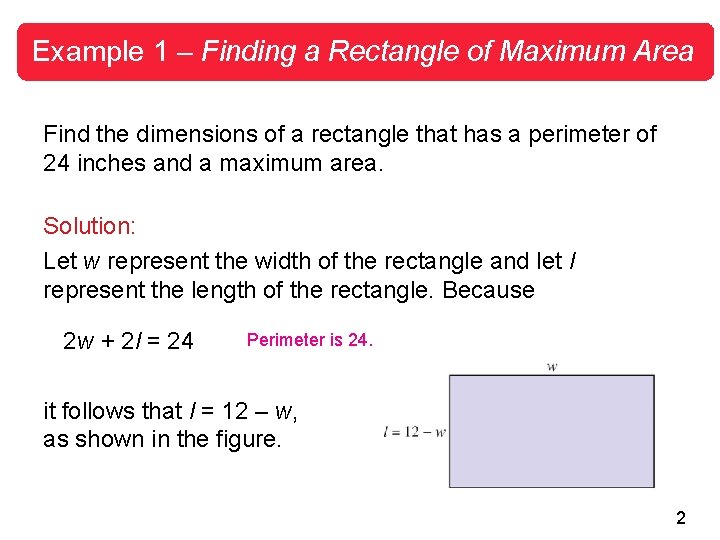
Example 1 – Finding a Rectangle of Maximum Area Find the dimensions of a rectangle that has a perimeter of 24 inches and a maximum area. Solution: Let w represent the width of the rectangle and let l represent the length of the rectangle. Because 2 w + 2 l = 24 Perimeter is 24. it follows that l = 12 – w, as shown in the figure. 2
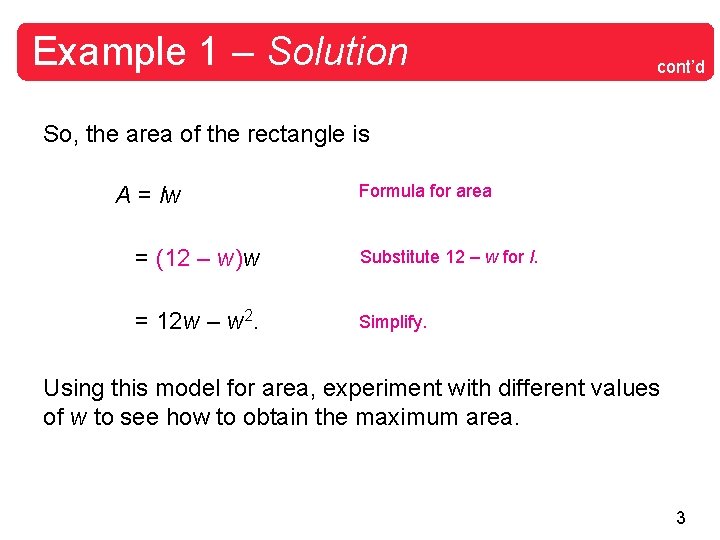
Example 1 – Solution cont’d So, the area of the rectangle is A = lw Formula for area = (12 – w)w Substitute 12 – w for l. = 12 w – w 2. Simplify. Using this model for area, experiment with different values of w to see how to obtain the maximum area. 3
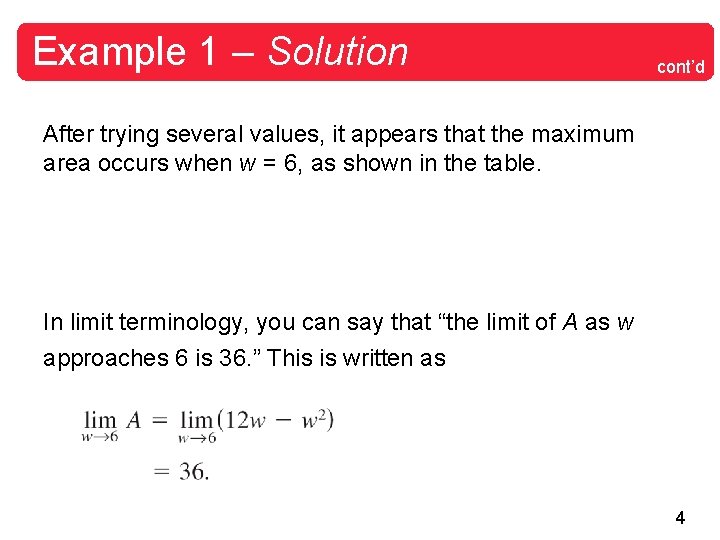
Example 1 – Solution cont’d After trying several values, it appears that the maximum area occurs when w = 6, as shown in the table. In limit terminology, you can say that “the limit of A as w approaches 6 is 36. ” This is written as 4
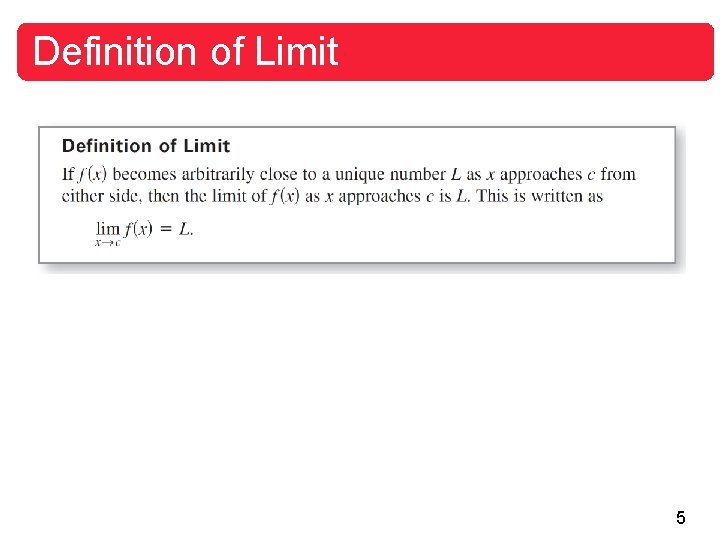
Definition of Limit 5
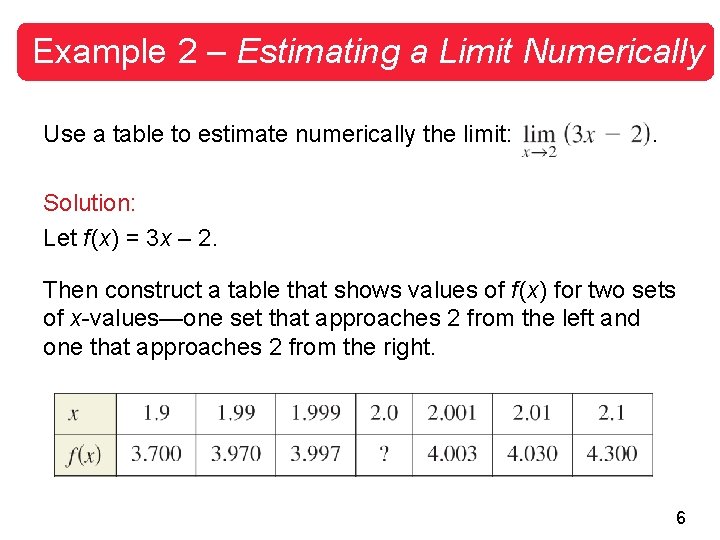
Example 2 – Estimating a Limit Numerically Use a table to estimate numerically the limit: . Solution: Let f (x) = 3 x – 2. Then construct a table that shows values of f (x) for two sets of x-values—one set that approaches 2 from the left and one that approaches 2 from the right. 6
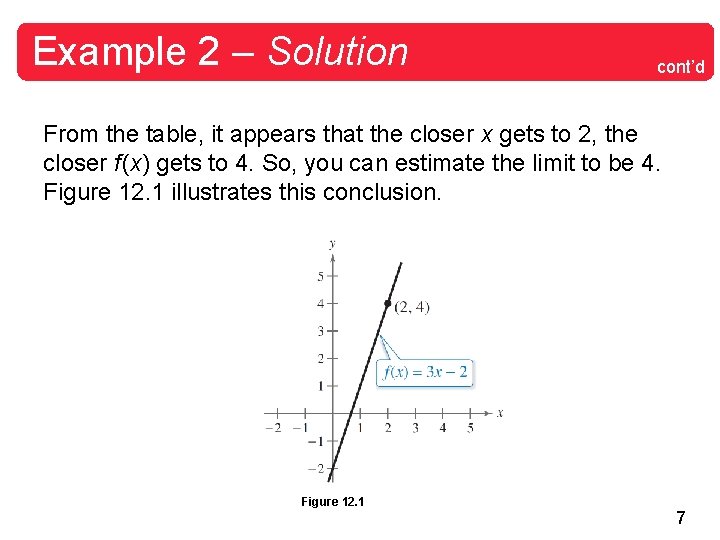
Example 2 – Solution cont’d From the table, it appears that the closer x gets to 2, the closer f (x) gets to 4. So, you can estimate the limit to be 4. Figure 12. 1 illustrates this conclusion. Figure 12. 1 7
Limits That Fail to Exist 8
Limits That Fail to Exist Next, you will examine some functions for which limits do not exist. 9
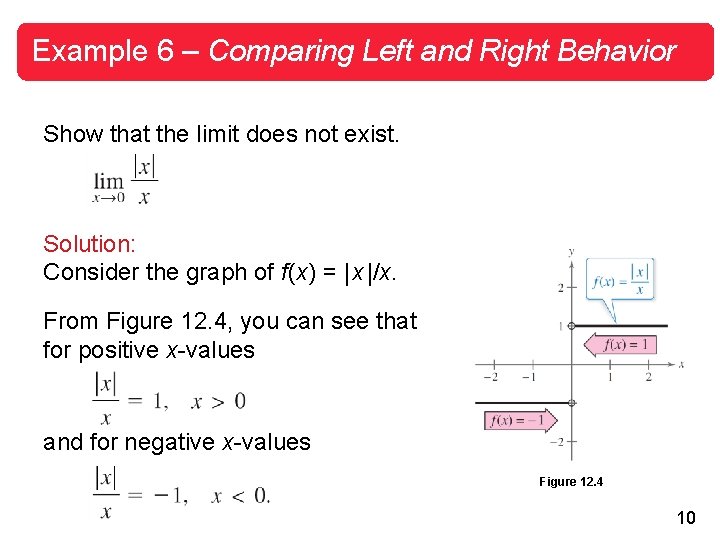
Example 6 – Comparing Left and Right Behavior Show that the limit does not exist. Solution: Consider the graph of f (x) = | x |/x. From Figure 12. 4, you can see that for positive x-values and for negative x-values Figure 12. 4 10
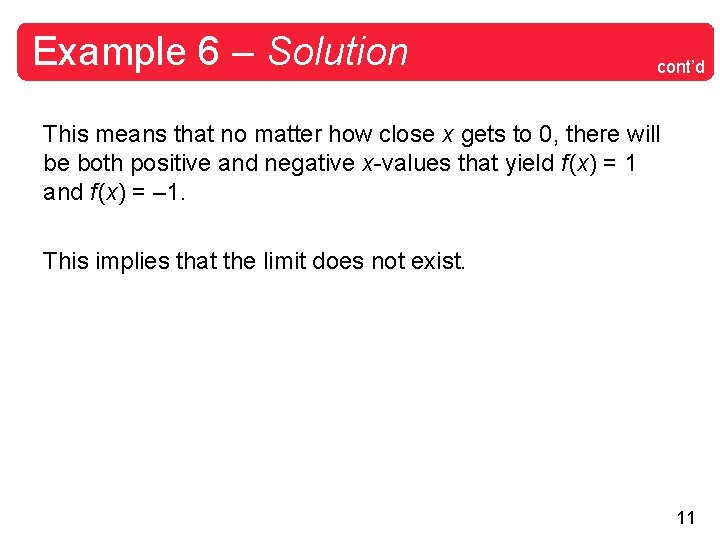
Example 6 – Solution cont’d This means that no matter how close x gets to 0, there will be both positive and negative x-values that yield f (x) = 1 and f (x) = – 1. This implies that the limit does not exist. 11
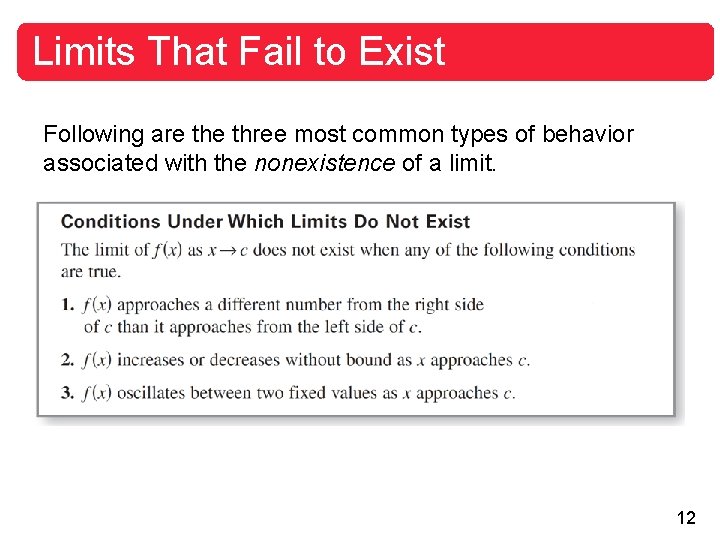
Limits That Fail to Exist Following are three most common types of behavior associated with the nonexistence of a limit. 12
Properties of Limits and Direct Substitution 13
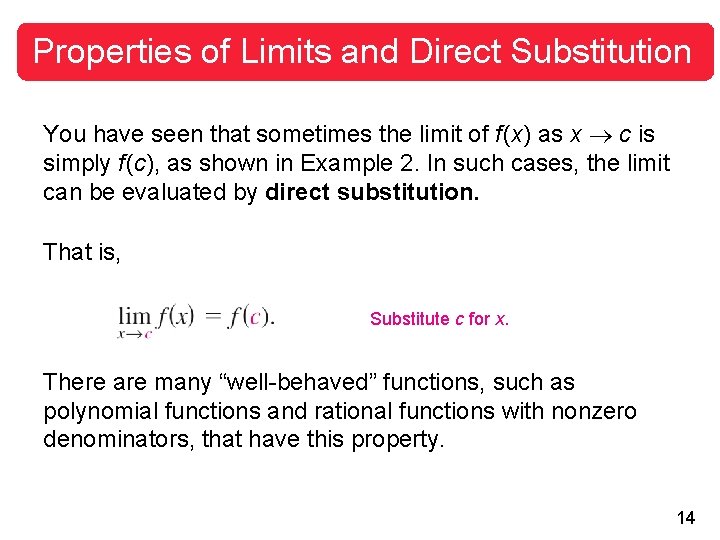
Properties of Limits and Direct Substitution You have seen that sometimes the limit of f (x) as x c is simply f (c), as shown in Example 2. In such cases, the limit can be evaluated by direct substitution. That is, Substitute c for x. There are many “well-behaved” functions, such as polynomial functions and rational functions with nonzero denominators, that have this property. 14
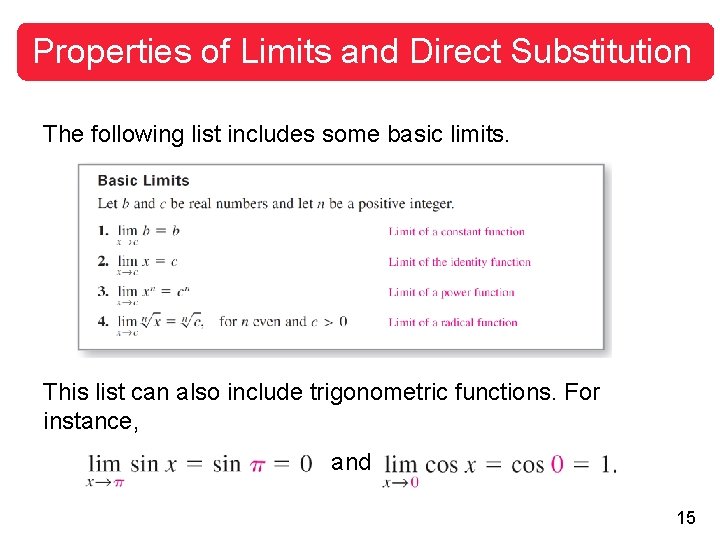
Properties of Limits and Direct Substitution The following list includes some basic limits. This list can also include trigonometric functions. For instance, and 15
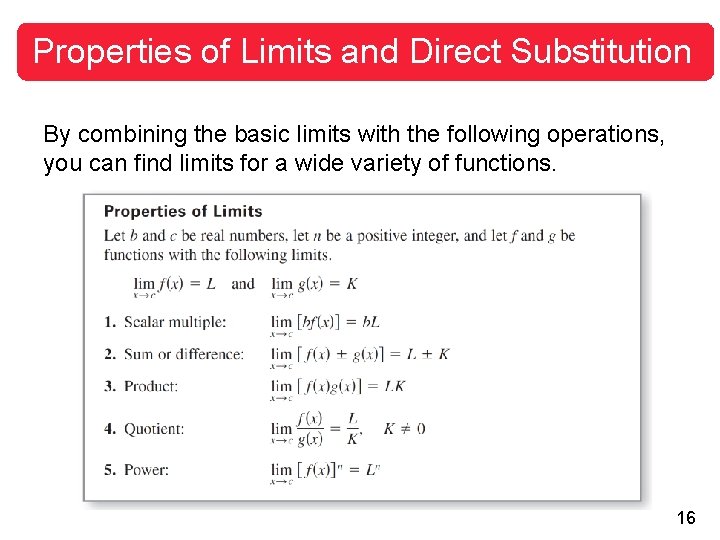
Properties of Limits and Direct Substitution By combining the basic limits with the following operations, you can find limits for a wide variety of functions. 16
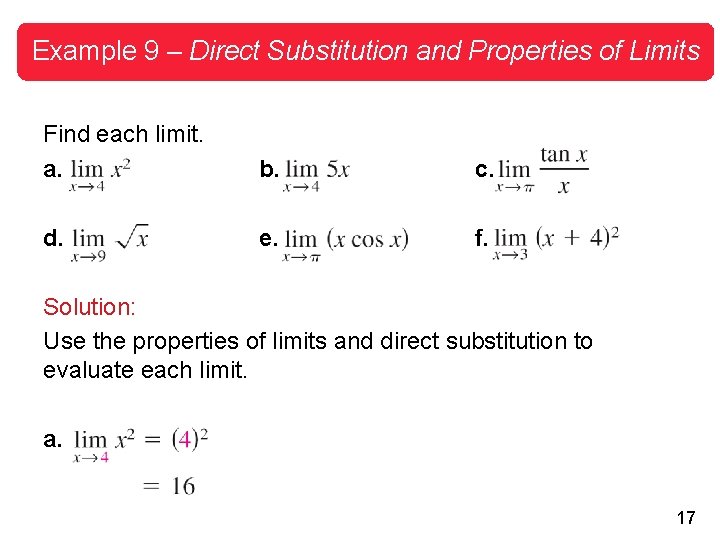
Example 9 – Direct Substitution and Properties of Limits Find each limit. a. b. c. d. e. f. Solution: Use the properties of limits and direct substitution to evaluate each limit. a. 17
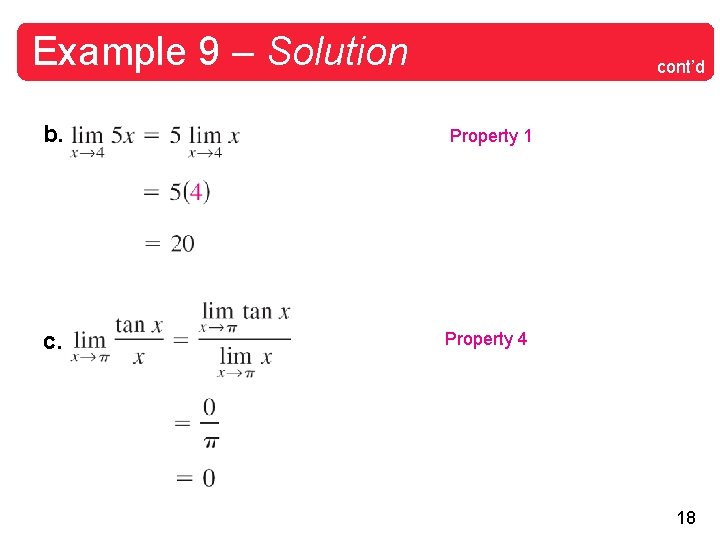
Example 9 – Solution cont’d b. Property 1 c. Property 4 18
Example 9 – Solution cont’d d. e. Property 3 f. Properties 2 and 5 19
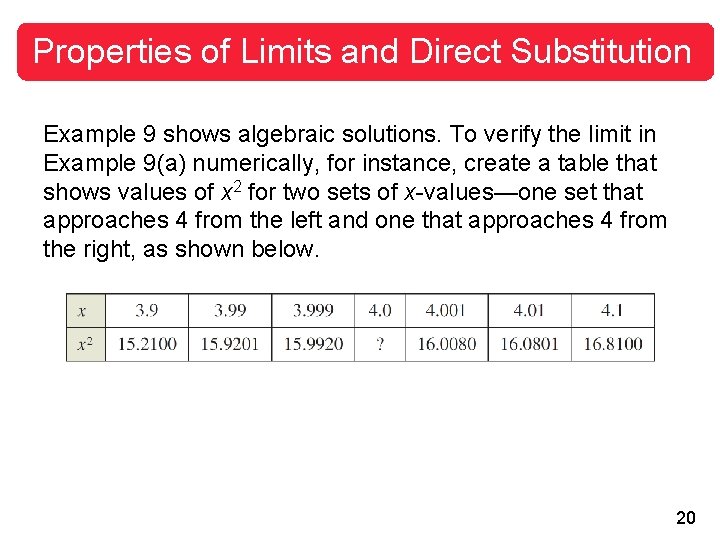
Properties of Limits and Direct Substitution Example 9 shows algebraic solutions. To verify the limit in Example 9(a) numerically, for instance, create a table that shows values of x 2 for two sets of x-values—one set that approaches 4 from the left and one that approaches 4 from the right, as shown below. 20
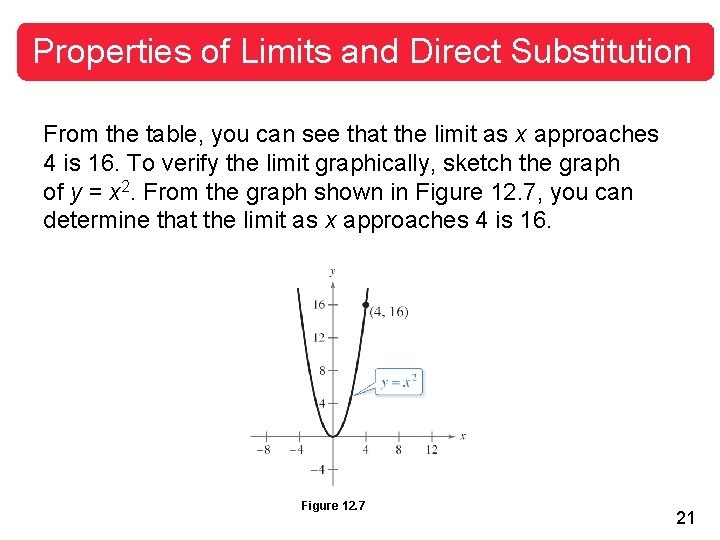
Properties of Limits and Direct Substitution From the table, you can see that the limit as x approaches 4 is 16. To verify the limit graphically, sketch the graph of y = x 2. From the graph shown in Figure 12. 7, you can determine that the limit as x approaches 4 is 16. Figure 12. 7 21
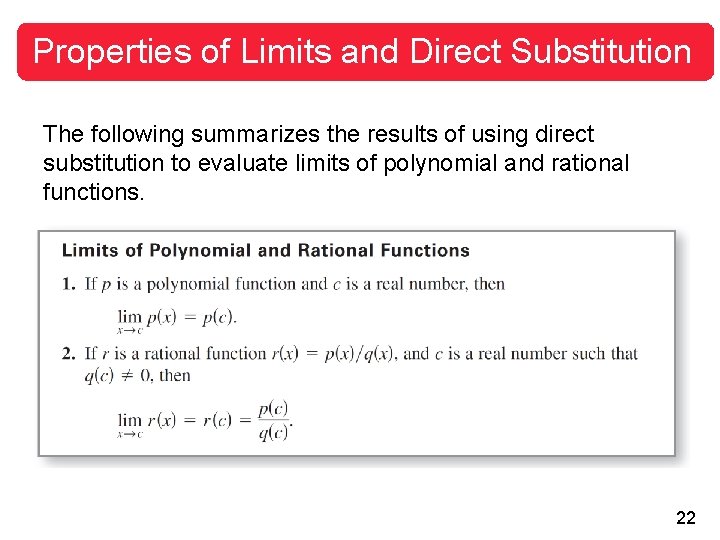
Properties of Limits and Direct Substitution The following summarizes the results of using direct substitution to evaluate limits of polynomial and rational functions. 22