
Limiting Reagent Stoichiometry So far In all our
- Slides: 21
Limiting Reagent Stoichiometry!
So far • In all our reactions, we assume both reactants get used up • We assume both reactants provided are pure • We rarely see these two. – Limiting reagents – Percent Purity – Percent Yield • So in a chemical reaction, we typically only use up one reactant and the other one is usually left over (excess)
Baking example You have 1 bag of flour 1 bag of sugar Same size You will use up your bag of flour before you can use up your bag of sugar. • So your bag of flour will be your limiting reagent • Your bag of sugar is your excess • •
Why? • We have excess amounts so that the one that is limiting will get used up – If it is too expensive, we want to use it up – If it is harmful to the environment, we want to react it to a less harmful chemical • It can also be unavoidable as we usually do have chemical that is in high quantities – Air is all around us and if the reaction involves air, it is in excess
Key Terms • Excess Reagent = reagent that is in excess, will not get used up in the reaction • Limiting Reagent = reagent that will get used up fully in the reaction • To find, we need to convert to MOLES of product. • We cannot tell just by given the mass of our reactants. • The amount of products we form will be called theoretical yield.
Simulation!
Note! • We refer to moles, not mass for limiting reagent. • Just because something has a smaller mass doesn’t mean it is limiting! • A limiting reagent question will always show enough information to get to moles for both reactants!
Steps to solve • Convert mass of both reagents to moles of reagents • Convert both moles of reagent to the moles of ONE PRODUCT! • Whichever one is less will be the limiting reagent • Whichever one is in excess will have some remaining, we can calculate what is leftover if we find the moles of excess used up and subtract from starting!
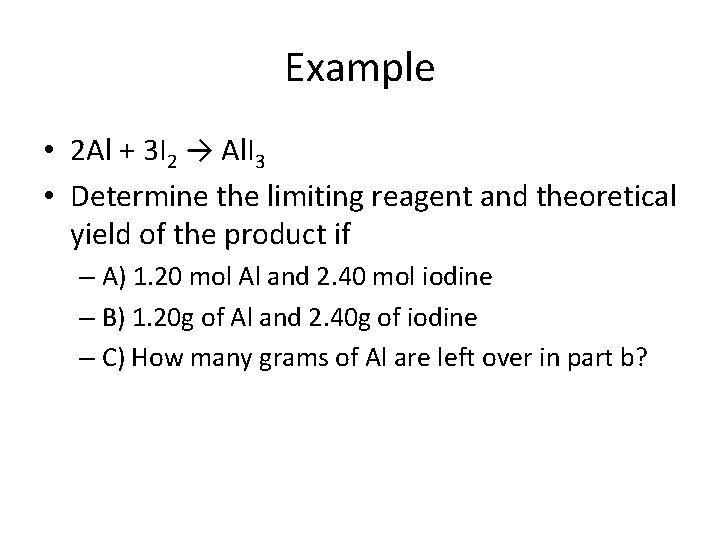
Example • 2 Al + 3 I 2 → Al. I 3 • Determine the limiting reagent and theoretical yield of the product if – A) 1. 20 mol Al and 2. 40 mol iodine – B) 1. 20 g of Al and 2. 40 g of iodine – C) How many grams of Al are left over in part b?
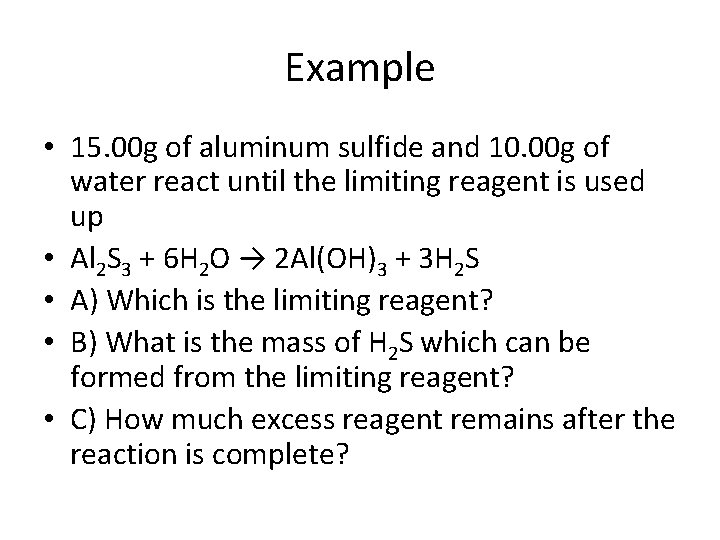
Example • 15. 00 g of aluminum sulfide and 10. 00 g of water react until the limiting reagent is used up • Al 2 S 3 + 6 H 2 O → 2 Al(OH)3 + 3 H 2 S • A) Which is the limiting reagent? • B) What is the mass of H 2 S which can be formed from the limiting reagent? • C) How much excess reagent remains after the reaction is complete?
Percentage Yield and Percentage Purity
Assumptions • It is assumed in a chemical reaction that our products are always produced 100% pure. That means whatever we started with will all turn into our pure product • So we make many assumptions • What we start with will all turn into product – Percentage yield • What we make is 100% pure – Percentage purity
Not always the case • We will get percentages of both • This is due to – Impure products – Reactants not measured exactly – Recovery of products is difficult – Human error in transfer of steps
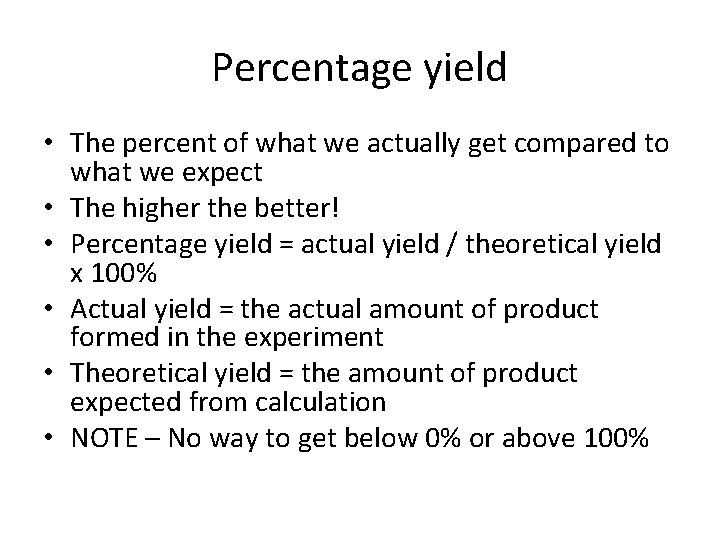
Percentage yield • The percent of what we actually get compared to what we expect • The higher the better! • Percentage yield = actual yield / theoretical yield x 100% • Actual yield = the actual amount of product formed in the experiment • Theoretical yield = the amount of product expected from calculation • NOTE – No way to get below 0% or above 100%
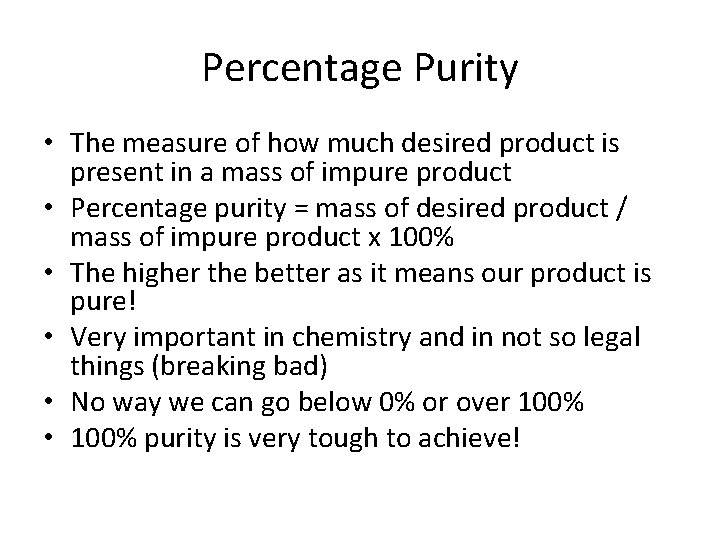
Percentage Purity • The measure of how much desired product is present in a mass of impure product • Percentage purity = mass of desired product / mass of impure product x 100% • The higher the better as it means our product is pure! • Very important in chemistry and in not so legal things (breaking bad) • No way we can go below 0% or over 100% • 100% purity is very tough to achieve!
Steps to solving • Do your calculation as if we are doing any stoichiometry calculation • Assume everything is 100% percentage • Apply the percentage yield and purity calculation at the very end.
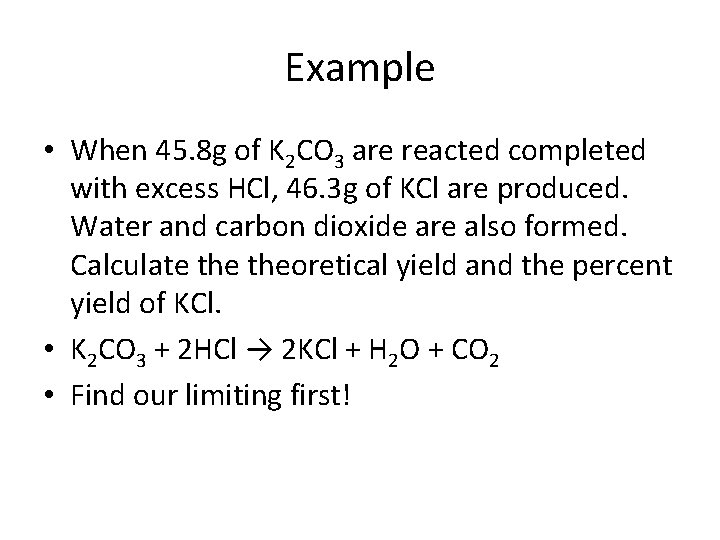
Example • When 45. 8 g of K 2 CO 3 are reacted completed with excess HCl, 46. 3 g of KCl are produced. Water and carbon dioxide are also formed. Calculate theoretical yield and the percent yield of KCl. • K 2 CO 3 + 2 HCl → 2 KCl + H 2 O + CO 2 • Find our limiting first!
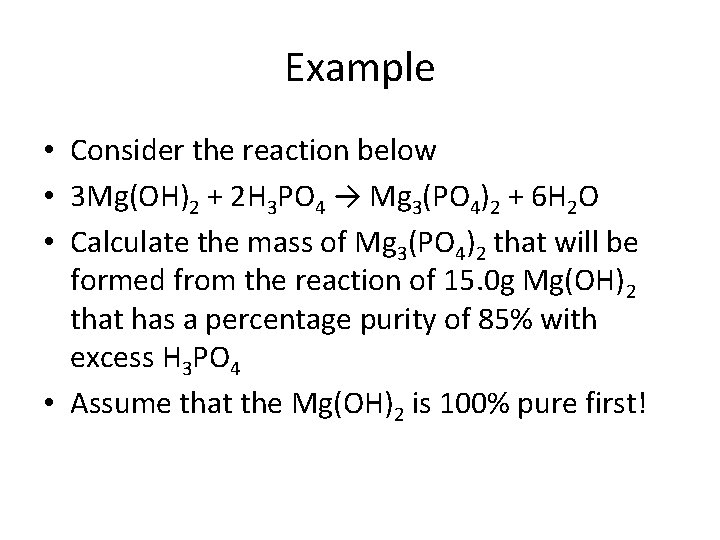
Example • Consider the reaction below • 3 Mg(OH)2 + 2 H 3 PO 4 → Mg 3(PO 4)2 + 6 H 2 O • Calculate the mass of Mg 3(PO 4)2 that will be formed from the reaction of 15. 0 g Mg(OH)2 that has a percentage purity of 85% with excess H 3 PO 4 • Assume that the Mg(OH)2 is 100% pure first!
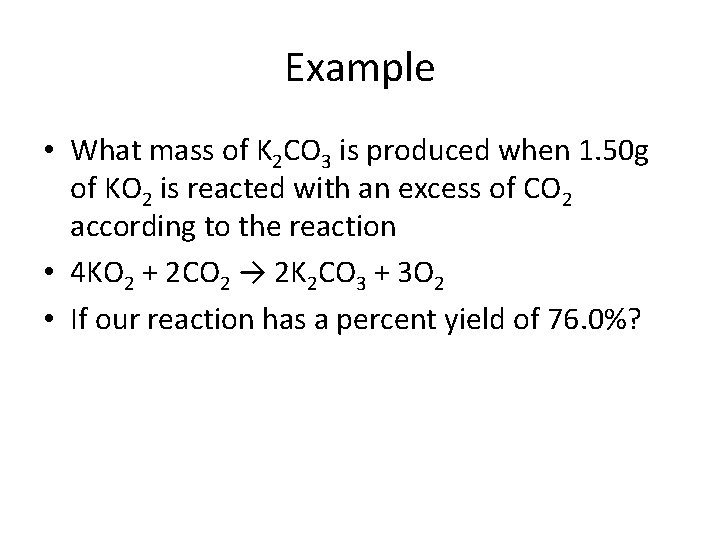
Example • What mass of K 2 CO 3 is produced when 1. 50 g of KO 2 is reacted with an excess of CO 2 according to the reaction • 4 KO 2 + 2 CO 2 → 2 K 2 CO 3 + 3 O 2 • If our reaction has a percent yield of 76. 0%?
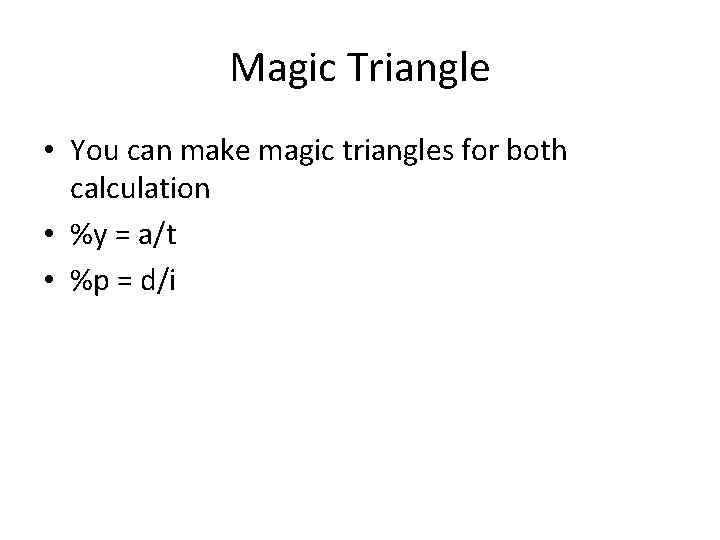
Magic Triangle • You can make magic triangles for both calculation • %y = a/t • %p = d/i
Homework • • Page 133 #26 -32 (odd) Page 137 #33 -38 (odd) Limiting reagent worksheet Stoichiometry Review worksheets