
Limiting Factors of Photosynthesis What is the ideal

- Slides: 14
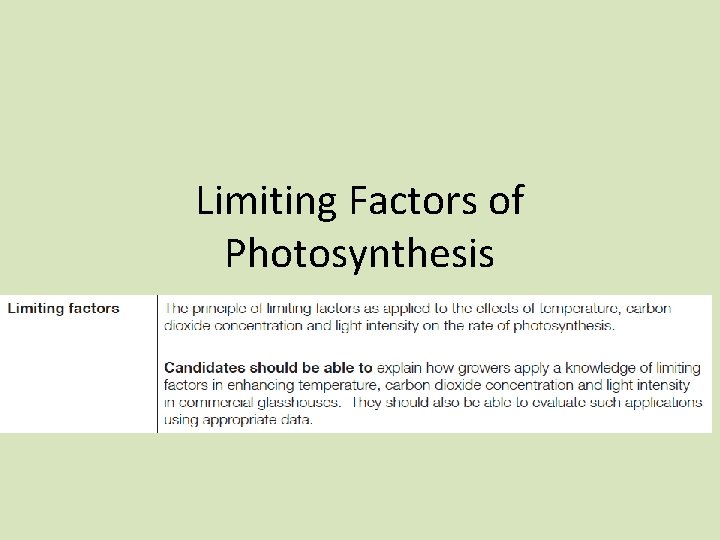
Limiting Factors of Photosynthesis
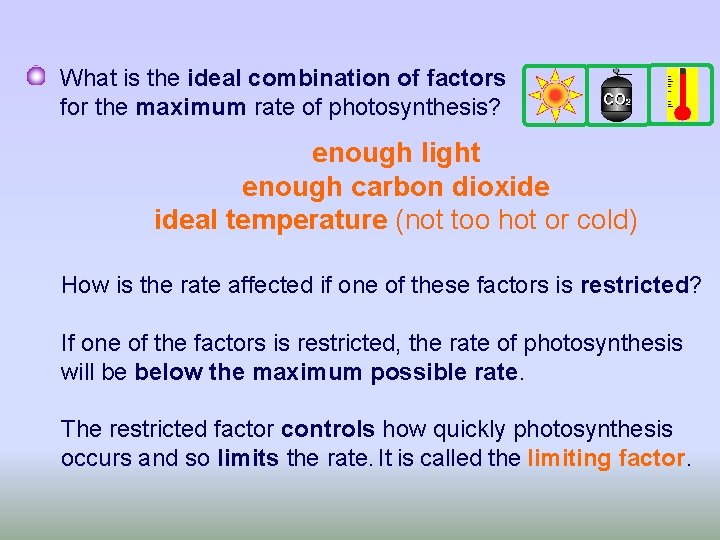
What is the ideal combination of factors for the maximum rate of photosynthesis? enough light enough carbon dioxide ideal temperature (not too hot or cold) How is the rate affected if one of these factors is restricted? If one of the factors is restricted, the rate of photosynthesis will be below the maximum possible rate. The restricted factor controls how quickly photosynthesis occurs and so limits the rate. It is called the limiting factor.
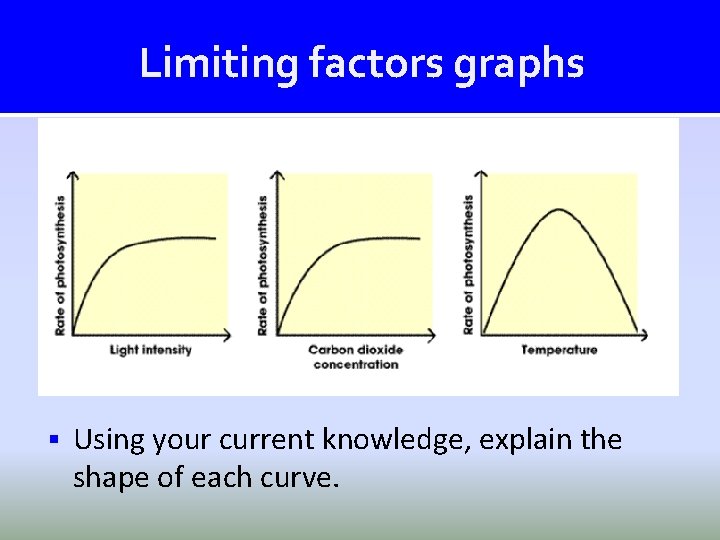
Limiting factors graphs § Using your current knowledge, explain the shape of each curve.
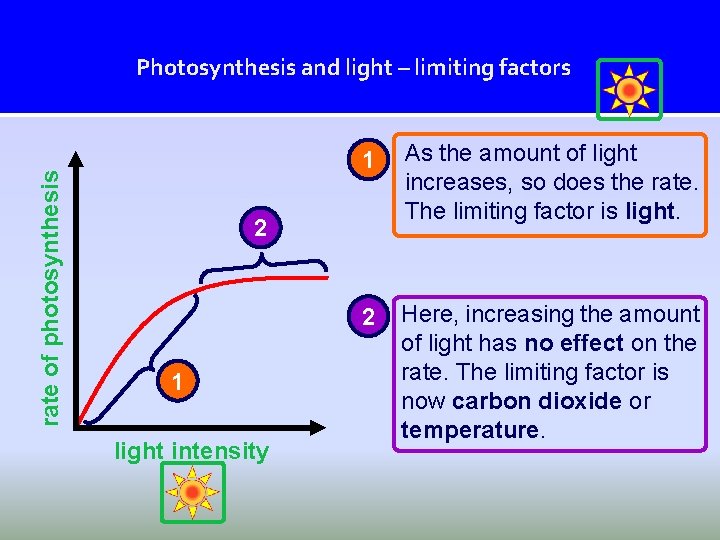
rate of photosynthesis Photosynthesis and light – limiting factors 1 As the amount of light increases, so does the rate. The limiting factor is light. 2 Here, increasing the amount of light has no effect on the rate. The limiting factor is now carbon dioxide or temperature. 2 1 light intensity
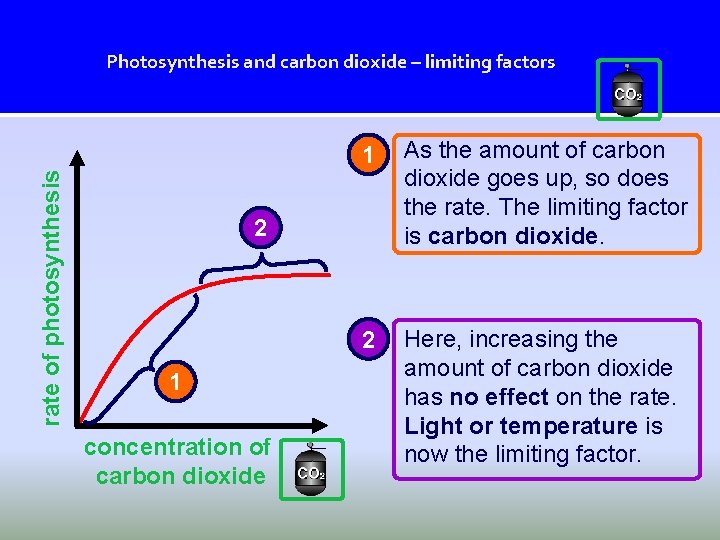
rate of photosynthesis Photosynthesis and carbon dioxide – limiting factors 1 As the amount of carbon dioxide goes up, so does the rate. The limiting factor is carbon dioxide. 2 Here, increasing the amount of carbon dioxide has no effect on the rate. Light or temperature is now the limiting factor. 2 1 concentration of carbon dioxide
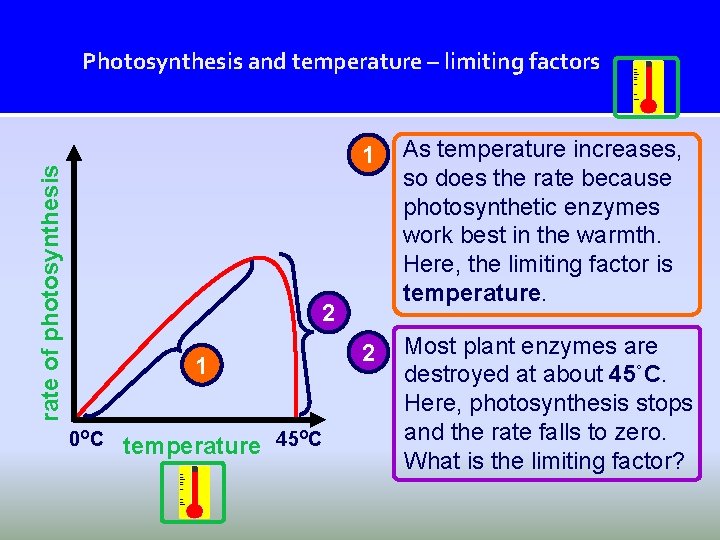
rate of photosynthesis Photosynthesis and temperature – limiting factors 2 2 1 0 o C temperature 11. As temperature increases, so does the rate because photosynthetic enzymes work best in the warmth. Here, the limiting factor is temperature. 45 o. C Most plant enzymes are destroyed at about 45˚C. Here, photosynthesis stops and the rate falls to zero. What is the limiting factor?
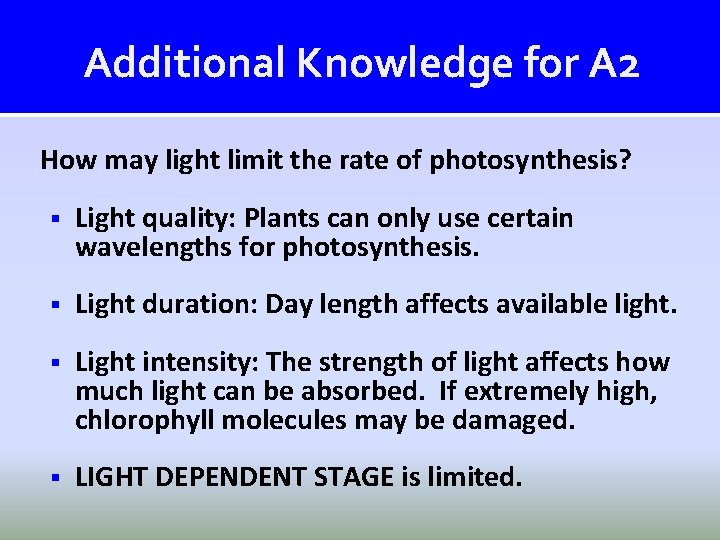
Additional Knowledge for A 2 How may light limit the rate of photosynthesis? § Light quality: Plants can only use certain wavelengths for photosynthesis. § Light duration: Day length affects available light. § Light intensity: The strength of light affects how much light can be absorbed. If extremely high, chlorophyll molecules may be damaged. § LIGHT DEPENDENT STAGE is limited.
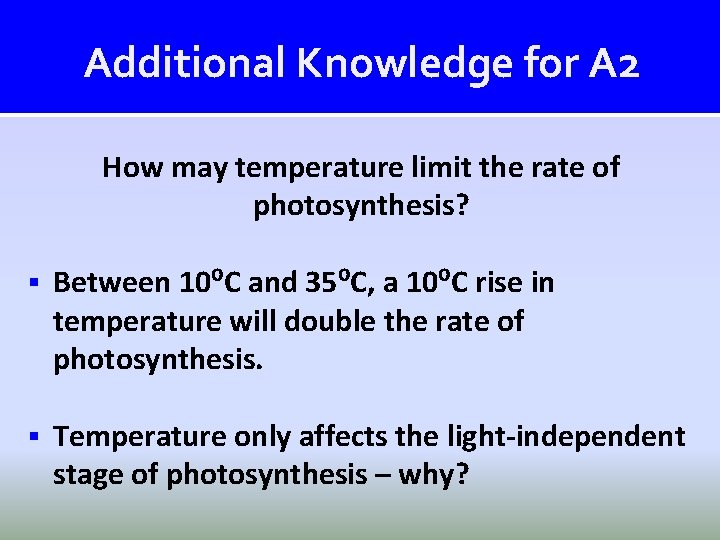
Additional Knowledge for A 2 How may temperature limit the rate of photosynthesis? § Between 10⁰C and 35⁰C, a 10⁰C rise in temperature will double the rate of photosynthesis. § Temperature only affects the light-independent stage of photosynthesis – why?
Additional Knowledge for A 2 How may CO 2 limit the rate of photosynthesis? § Carbon dioxide is the source of carbon atoms used to make the organic products of photosynthesis (light-independent stage). § Atmospheric CO 2 makes up approx. 0. 04% of atmospheric air; this is lower than the optimum requirement for most plants. § Carbon dioxide is therefore the most common limiting factor of photosynthesis.
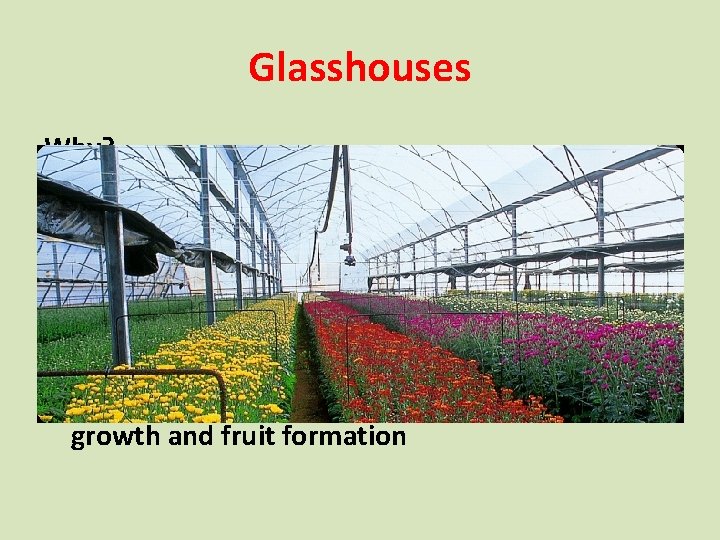
Glasshouses Why? • Better yield, crops grown out of season, grow plants in regions they would not occur naturally How? • Limiting factors controlled. Higher levels of photosynthesis allow for more carbohydrates to be produced which release energy for faster growth and fruit formation
Glasshouse Conditions • Higher concentration of CO 2 needed than just atmospheric levels. • Optimum temperatures for growth must be maintained. • At higher temperatures, water loss must be controlled. • Humidity must be monitored to prevent fungal infections. • Specific wavelengths of light are used to save money on electricity.
Greenhouse Challenge You are a farmer who owns a greenhouse and wishes to grow one of three crops. You must use the information given to decide: a) which crop to grow b) which equipment or combination of equipment to use. You should also: c) identify the limiting factor(s) affecting each crop d) complete the table to help you to answer parts a), b) and c).
Efficiency of Photosynthesis Whilst I check your answers to the Greenhouse Challenge, read pages 50 -55 of the textbook. Make notes on the efficiency of photosynthesis, including the two equations given. Answer the questions in the yellow boxes on pages 52 and 53.
Homework Revise for a test on ATP and photosynthesis. If you want your predicted grade to be higher than you got at AS, this is your chance to prove yourself! The test will be on Friday 10 th October.