
Limited Streamer Tubes for the IFR Barrel INFN
Limited Streamer Tubes for the IFR Barrel INFN: Ferrara, Frascati, Genova, Padova, Roma US: Ohio State, Oregon Princeton, SLAC, UCSD Stewart Smith Experimental Program Advisory Committee SLAC, June 12 2003 June 12, 2003 EPAC Meeting
Motivation Oct 2000: IFR flagged as major problem by Technical Review (Gilch) 4 4 Major R&D toward remediation – close but no cigar Decision to upgrade endcap with RPC’s, launch R&D for barrel upgrade. Dec 2002: IFR Barrel Replacement Review Committee (Ratcliff, Hearty chairs) analyzed role of muon and KL ID in the current BABAR physics program and in the program we foresee for the future. Committee’s report examines: 4 4 4 Solid angle coverage of IFR systems Overview of relevant physics processes Closer look at selected processes Characteristics of the current IFR barrel Simulation of new absorber configurations Recommendation of LST as new detector June 12, 2003 EPAC Meeting 2
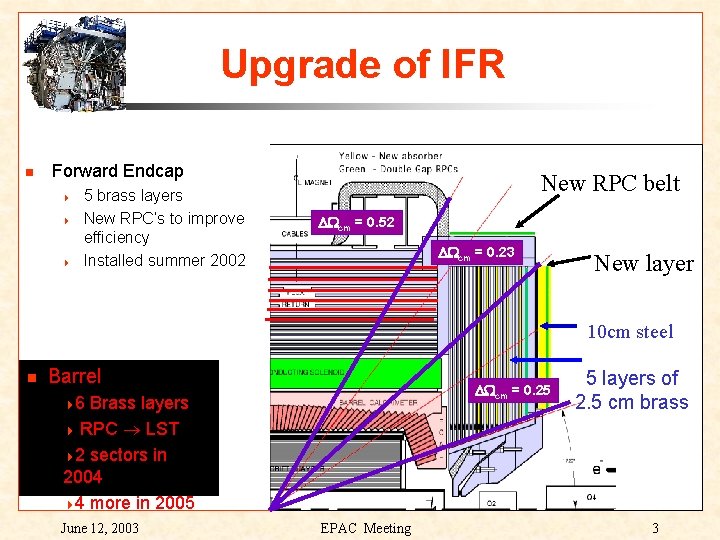
Upgrade of IFR Forward Endcap 4 4 4 5 brass layers New RPC’s to improve efficiency Installed summer 2002 New RPC belt DWcm = 0. 52 DWcm = 0. 23 New layer 10 cm steel Barrel DWcm = 0. 25 46 Brass layers 5 layers of 2. 5 cm brass 4 RPC LST 42 sectors in 2004 44 more in 2005 June 12, 2003 EPAC Meeting 3
Physics Program for the IFR Muons are critical for many analyses over the long-term Ba. Bar physics program: 4 4 4 4 Semileptonic decays Leptonic decays Electroweak penguins Processes involving J/y or y(2 S), including rare decays Lepton tagging (CP, CPT studies, mixing, certain rare decays) Reconstruction of B D*ln on one side of the event R at low energies via Initial State Radiation Unthinkable for a comprehensive B-Factory detector not to have good muon identification. 4 4 4 Taken for granted in such experiments! We need all the statistics we can get (rare decays, backgnd reduction, restricted areas of phase space, etc. ). m / e comparisons to reduce systematic errors in precision measurements. June 12, 2003 EPAC Meeting 4
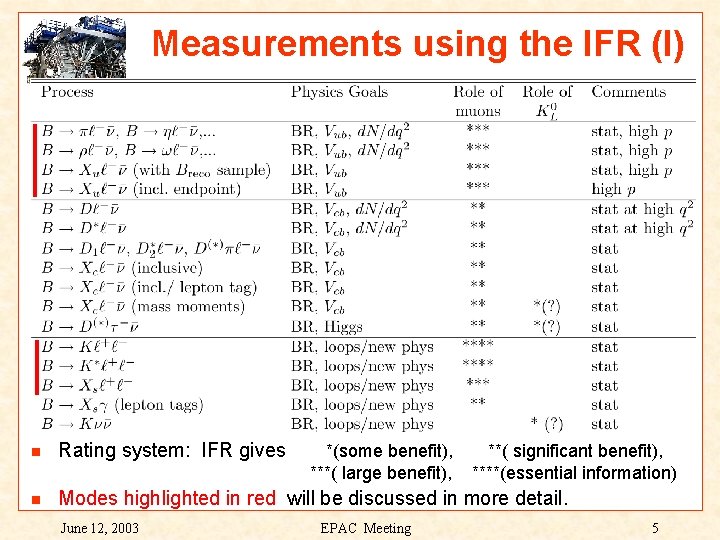
Measurements using the IFR (I) Rating system: IFR gives *(some benefit), **( significant benefit), ***( large benefit), ****(essential information) Modes highlighted in red will be discussed in more detail. June 12, 2003 EPAC Meeting 5
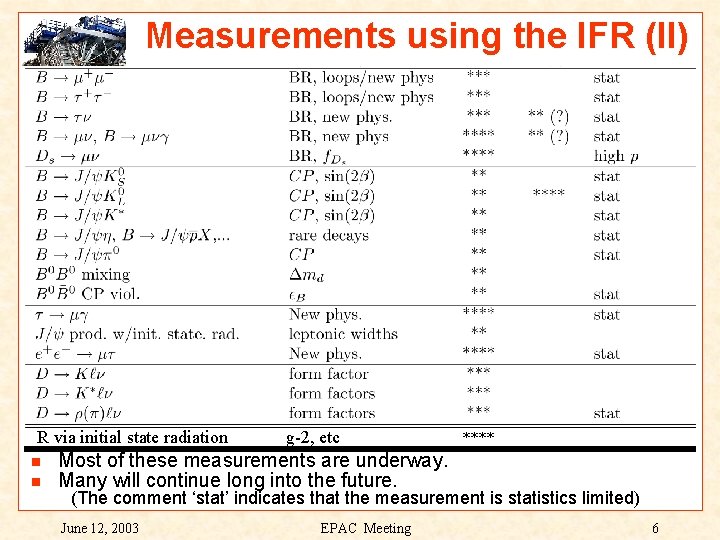
Measurements using the IFR (II) R via initial state radiation g-2, etc **** Most of these measurements are underway. Many will continue long into the future. (The comment ‘stat’ indicates that the measurement is statistics limited) June 12, 2003 EPAC Meeting 6
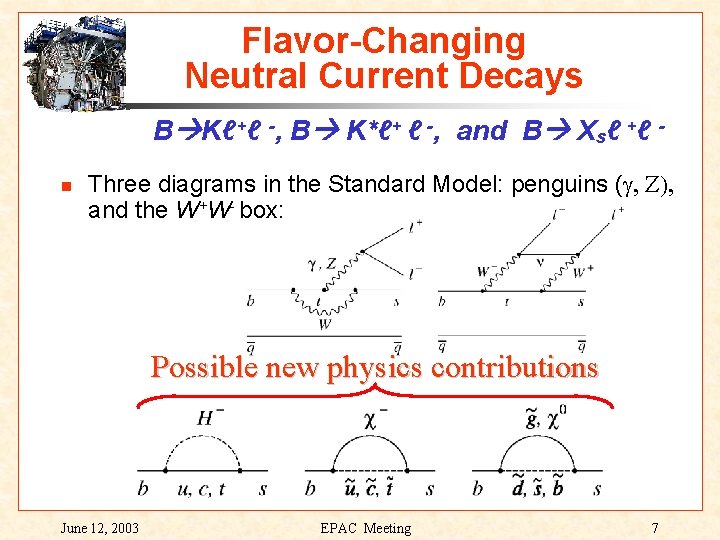
Flavor-Changing Neutral Current Decays B Kℓ+ℓ -, B K*ℓ+ ℓ -, and B Xsℓ +ℓ Three diagrams in the Standard Model: penguins (g, Z), and the W+W- box: Possible new physics contributions June 12, 2003 EPAC Meeting 7
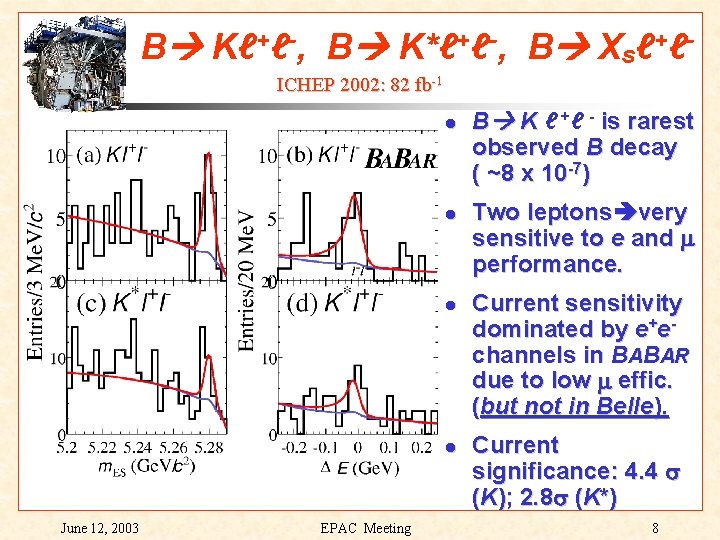
B Kℓ+ℓ-, B K*ℓ+ℓ-, B Xsℓ+ℓICHEP 2002: 82 fb-1 l June 12, 2003 EPAC Meeting B K ℓ +ℓ - is rarest observed B decay ( ~8 x 10 -7) l Two leptons very sensitive to e and m performance. l Current sensitivity dominated by e+echannels in BABAR due to low m effic. (but not in Belle). l Current significance: 4. 4 s (K); 2. 8 s (K*) 8
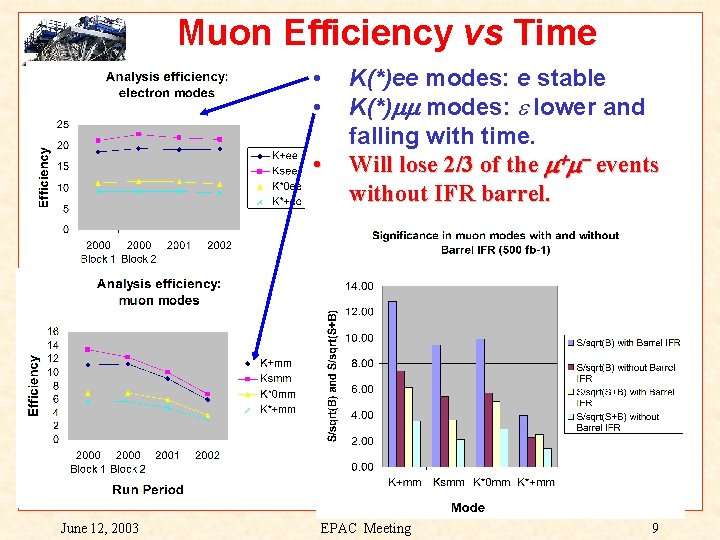
Muon Efficiency vs Time • • • June 12, 2003 K(*)ee modes: e stable K(*)mm modes: e lower and falling with time. Will lose 2/3 of the m+m- events without IFR barrel. EPAC Meeting 9
|Vub| from Rare Semileptonic Decay Challenges: 1. 2. 3. Experimental approaches with high potential to reduce theoretical errors 4 4 Small branching fractions for b uℓn Large b cℓn backgrounds. Theoretical uncertainties from strong interaction effects. Exclusive B p ℓ n at high q 2, using “neutrino reconstruction à la CLEO; ” theory from lattice QCD. Inclusive B Xu ℓ n, using fully reconstructed B sample as tags; theory from heavy quark expansion. Both methods need large event samples. /e comparison important as precision increases. June 12, 2003 EPAC Meeting 10
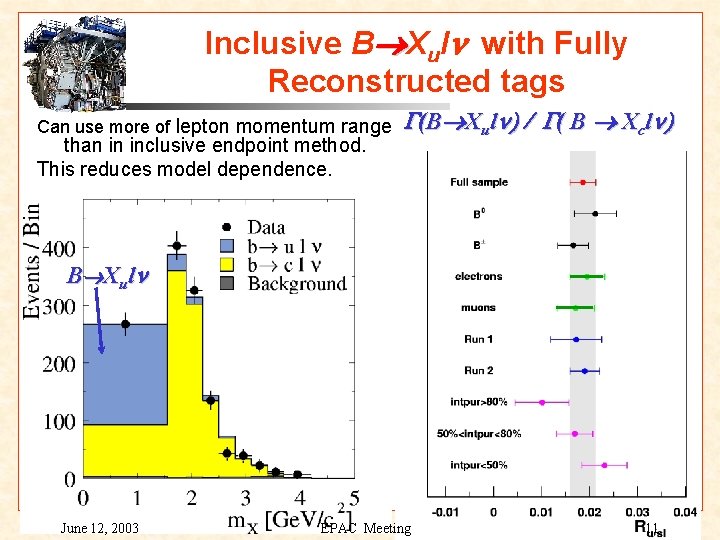
Inclusive B Xuln with Fully Reconstructed tags Can use more of lepton momentum range G(B Xuln) / than in inclusive endpoint method. This reduces model dependence. G ( B X cl n ) B X ul n June 12, 2003 EPAC Meeting 11
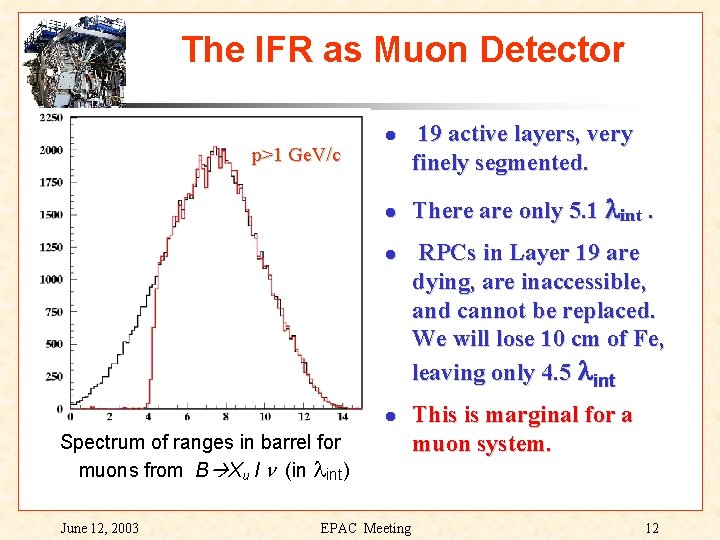
The IFR as Muon Detector p>1 Ge. V/c l l Spectrum of ranges in barrel for muons from B Xu l n (in lint) June 12, 2003 19 active layers, very finely segmented. There are only 5. 1 lint. l RPCs in Layer 19 are dying, are inaccessible, and cannot be replaced. We will lose 10 cm of Fe, leaving only 4. 5 lint l This is marginal for a muon system. EPAC Meeting 12
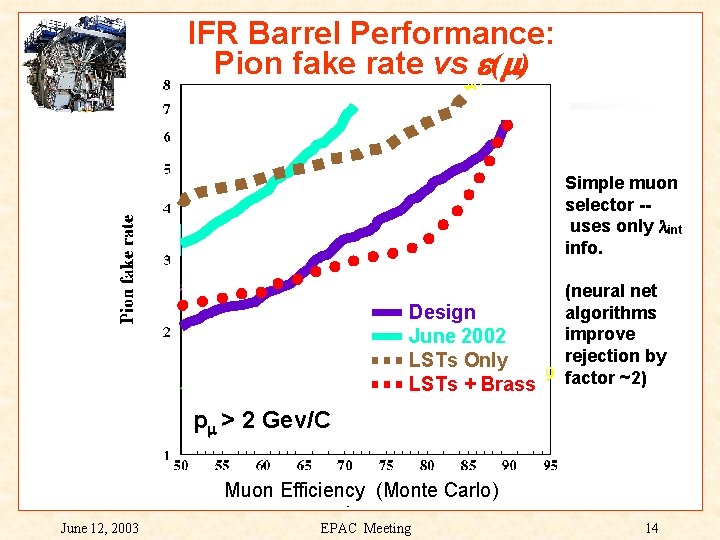
IFR Barrel Performance: Pion fake rate vs e(m) Simple muon selector -uses only lint info. Design June 2002 LSTs Only LSTs + Brass (neural net algorithms improve rejection by factor ~2) pm > 2 Gev/C Muon Efficiency (Monte Carlo) June 12, 2003 EPAC Meeting 14
The LST Team M. Andreotti, D. Bettoni, R. Calabrese†, V. Carassiti, G. Cibinetto, A. Cotta Ramusino, E. Luppi, M. Negrini, L. Piemontese Ferrara University and INFN R. Baldini, A. Calcaterra, U. Denni, P. Patteri, A Zallo Laboratori Nazionali di Frascati dell’INFN R. Capra, M. Lo Vetere, S. Minatoli, S. Passaggio, C. Patrignani, E. Robutti Genova University and INFN T. Allmendinger, K. K. Gan, K. Honscheid, H. Kagan, R. Kass, J. Morris, C. Rush, S. Smith, Q. Wong, M. Zoeller Ohio State University R. Frey, N. Sinev, D. Strom, J. Strube University of Oregon C. Fanin, M. Morandin, M. Posocco, M. Rotondo, R. Stroili, C. Voci Padova University and INFN J. Biesiada, G. Cavoto*, N. Danielson, R. Fernholz, Y. Lau, C. Lu, J. Olsen, W. Sands, A. J. S. Smith† Princeton University S. Morganti , G Piredda, C. Voena Roma “La Sapienza”University and INFN D. B. Mac. Farlane, H. P. Paar University of California at San Diego R. Boyce , P. Kim, J. Krebs , R. Messner, M. Olson , Z. Szalata , T. Webber , W. Wisniewski, C. Young Stanford Linear Accelerator Center Engineers † Contact persons * Also INFN Rome June 12, 2003 EPAC Meeting 15
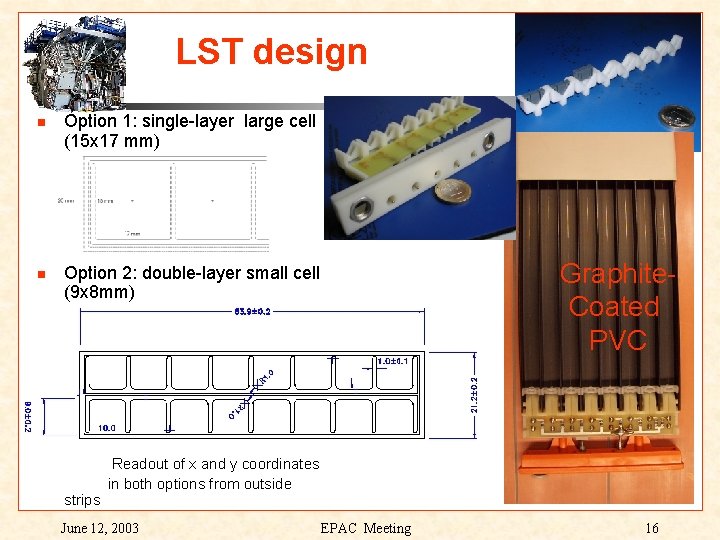
LST design Option 1: single-layer large cell (15 x 17 mm) Option 2: double-layer small cell (9 x 8 mm) Graphite. Coated PVC Readout of x and y coordinates in both options from outside strips June 12, 2003 EPAC Meeting 16
Large cell is the Baseline Mechanically more robust, Looser tolerances Lower failure rate 4 4 ~ 1. 5 mm thinner Only ~1/3 as many cells 4 Required new dies, molds, to make full prototypes. Awaiting confirmation of performance to make final decision 4 4 Simpler HV, Gas systems Significantly cheaper But, R&D slower off the mark than for small cells. 4 ~0. 1%/year failure rate in Macro over more than a decade. Comparable net efficiency loss to that of double/layer ! Simulations, which agree with measurements on 9 x 9’s (E fields, s resolutions, tolerances) are very encouraging. w e Just today, prototypes at Frascati and Pol. Hi. Tech have been put under N g voltage – so far so good, but…. in k a e Br Should know within a week! June 12, 2003 EPAC Meeting 17
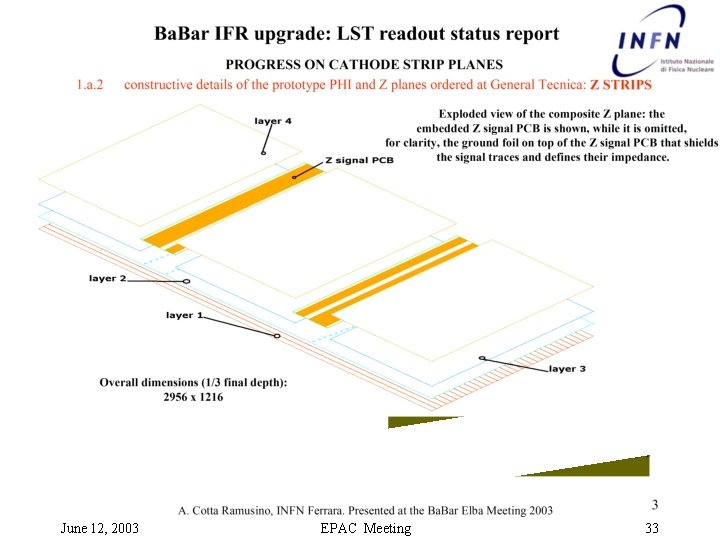
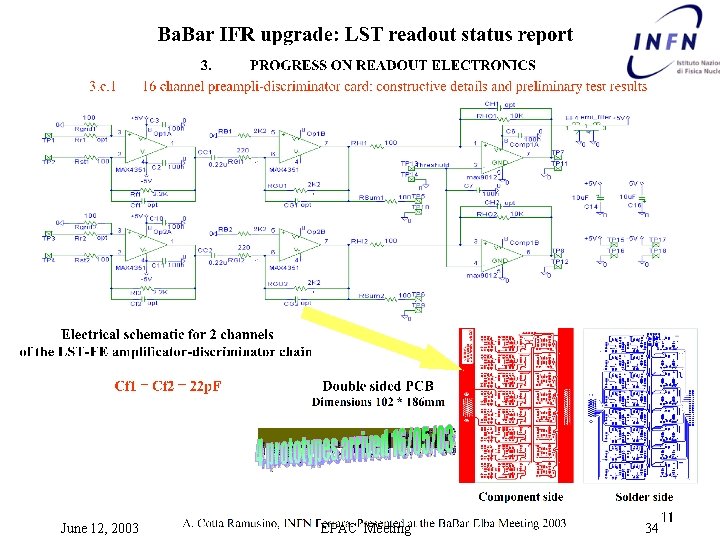
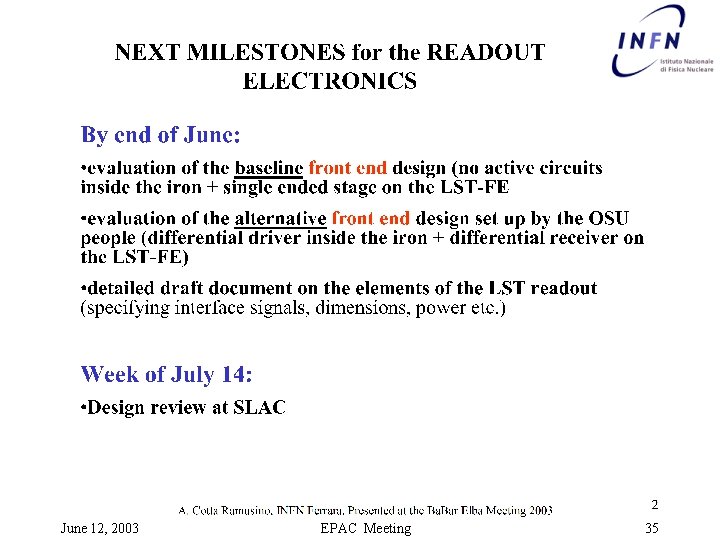
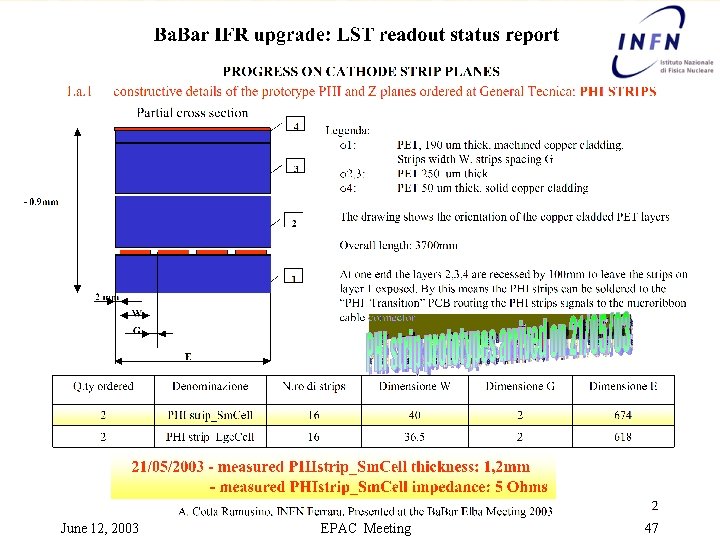
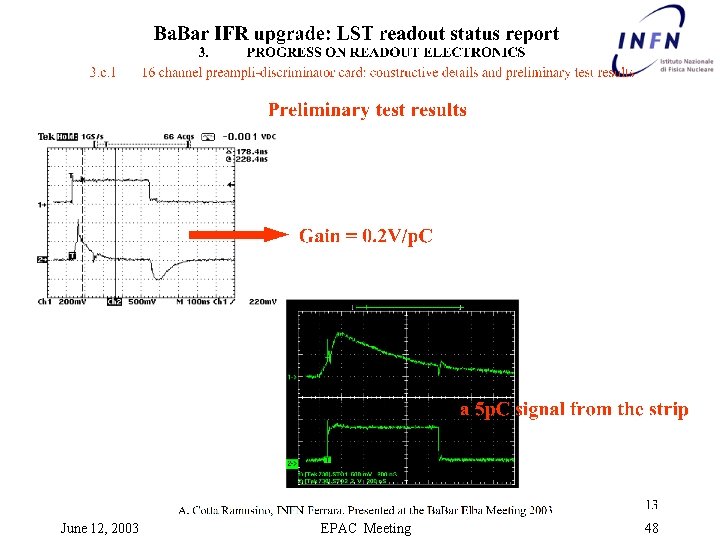
Progress Since Decision 22 standard (9 x 9) tubes produced by vendor (Pol. Hi. Tech): 4 4 4 Preproduction prototypes underway (Ferrara, Frascati, Padova) 4 4 10 single layer (17 x 15) prototypes ordered: first tubes ready by Jun. 5 20 double layer (9 x 8) tubes ordered: first tube ready by Jun. 12 (delay due to dies production) Final strip prototypes: and Z arrived in Ferrara. 4 4 4 Early verification of vendor’s capability. Good plateaux at factory with binary (flammable) gas mixture (larger than 500 V) Shipped to Ferrara, Princeton and Columbus, tests with ternary (safe) gas mixture underway. Test of the readout chain underway (Ferrara) Final strip setup Final preamp-discriminator prototypes of Front End Card ready Electronics (Ferrara, Genova, Ohio State) 4 4 Detailed electrical schematics for Front End Card underway Review at July workshop. June 12, 2003 EPAC Meeting 18
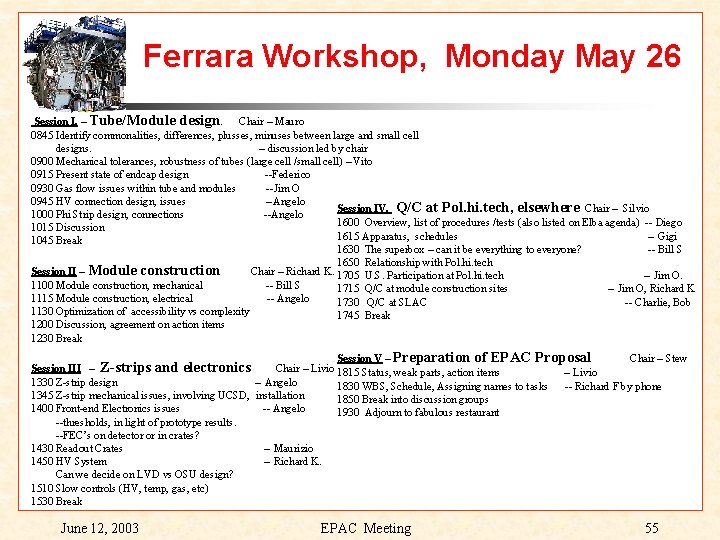
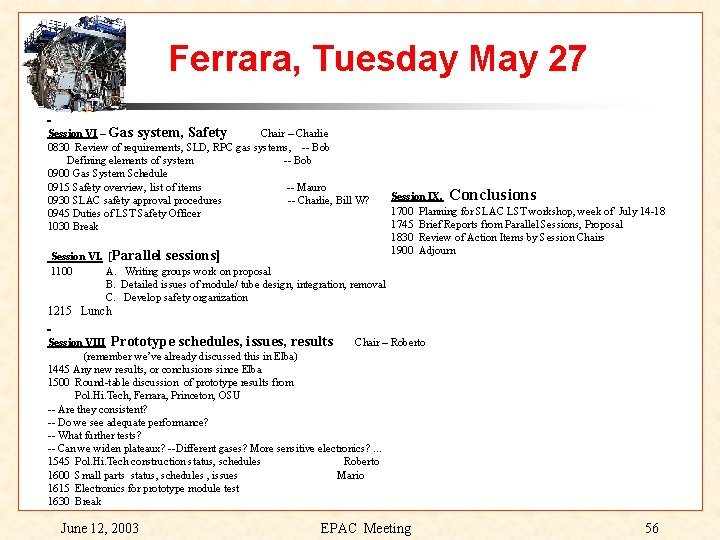
Progress (cont’d) Integration/Installation work underway at SLAC 4 SLAC and Princeton engineers meet weekly. 4 Detailed work for the 2 sextants to be installed in 2004 (1 and 4) Workshops 4 4 Jan 11 -12 in Princeton • Conceptual design, organization, division of responsibilities Mar 17/18 in Rome (and Pol. Hi. Tech). • Mainly QC and final design for prototypes pre-production Apr 24/26 in Columbus (US groups). • Mainly assembly and installation issues May 26/27 in Ferrara. • Mainly QC, production issues, module assembly, preparation of documentation for EPAC Engineering Design Week: Jul. 14 – 18 at SLAC. 4 4 Final design, installation issues, and electronics review Integrate SLAC and Outhouse engineering effort June 12, 2003 EPAC Meeting 19
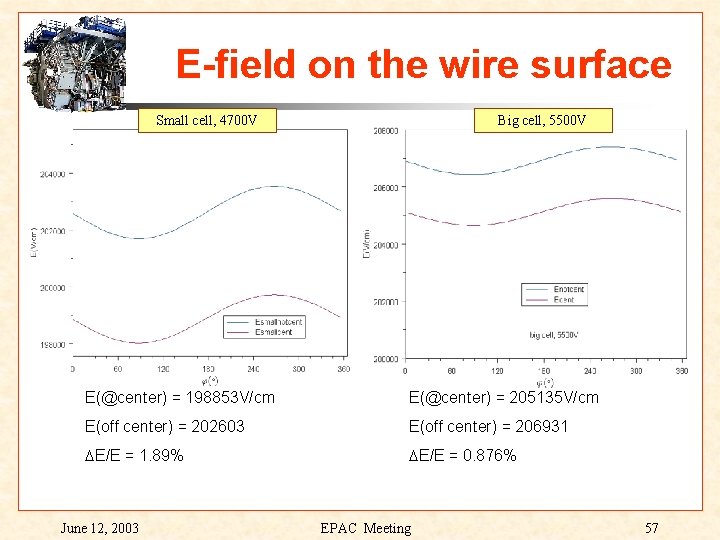
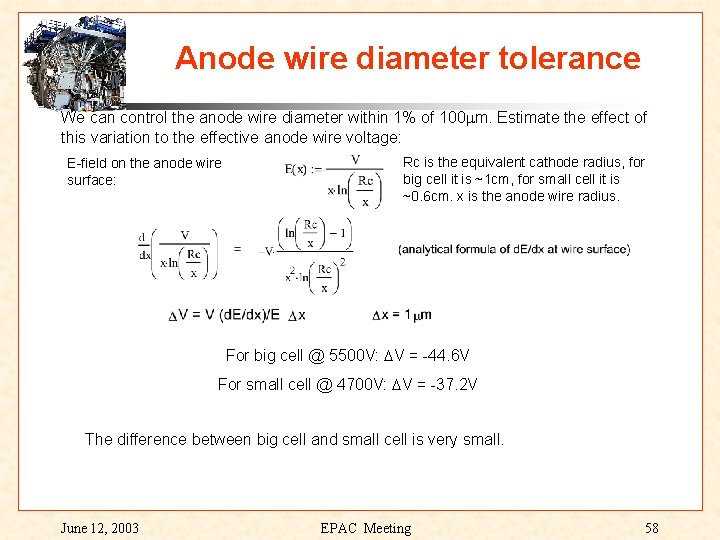
R&D activities • Measurements of plateaux, pulse-heights, etc • Aging tests • Strip signal studies conductive rib effect on the phi strips; Q distribution on z strips Signal propagation, reflections at strip/cable connection • E-field, drift-time characterization of large cell • Gas flow studies: FEA simulation; Full length test results. • Anode wire study: Surface quality; Effect of wire diameter on plateau width. June 12, 2003 EPAC Meeting 20
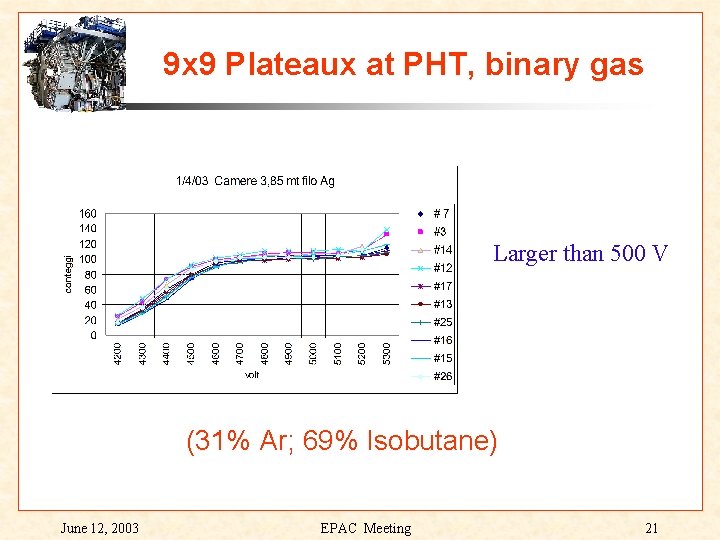
9 x 9 Plateaux at PHT, binary gas Larger than 500 V (31% Ar; 69% Isobutane) June 12, 2003 EPAC Meeting 21
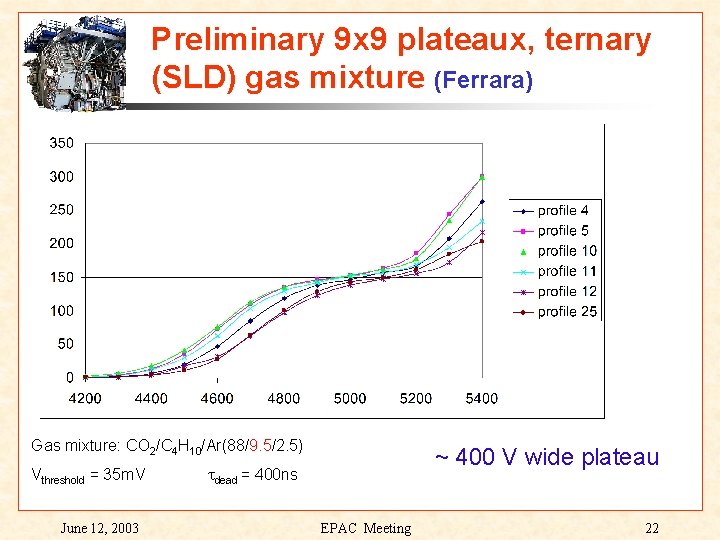
Preliminary 9 x 9 plateaux, ternary (SLD) gas mixture (Ferrara) Gas mixture: CO 2/C 4 H 10/Ar(88/9. 5/2. 5) ~ 400 V wide plateau Vthreshold = 35 m. V dead = 400 ns June 12, 2003 EPAC Meeting 22
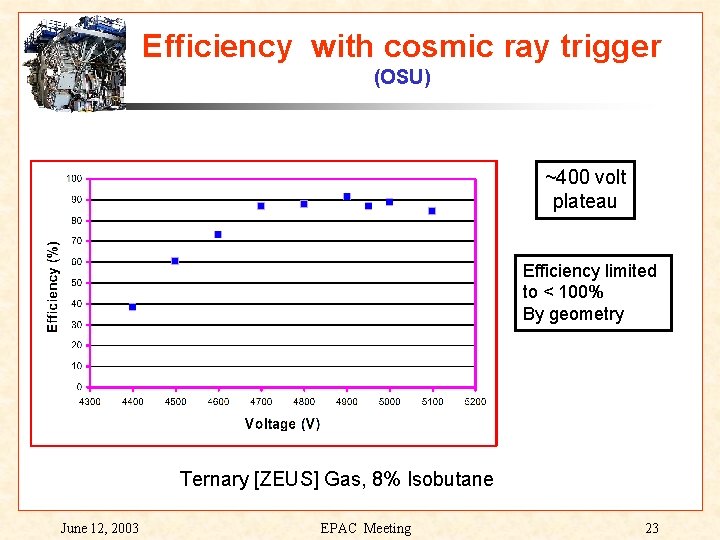
Efficiency with cosmic ray trigger (OSU) ~400 volt plateau Efficiency limited to < 100% By geometry Ternary [ZEUS] Gas, 8% Isobutane June 12, 2003 EPAC Meeting 23
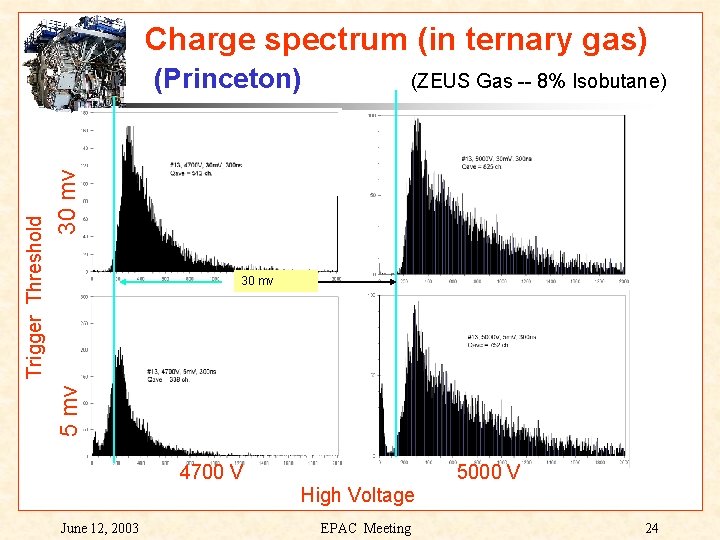
Charge spectrum (in ternary gas) 30 mv (ZEUS Gas -- 8% Isobutane) 30 mv 5 mv Trigger Threshold (Princeton) 4700 V 5000 V High Voltage June 12, 2003 EPAC Meeting 24
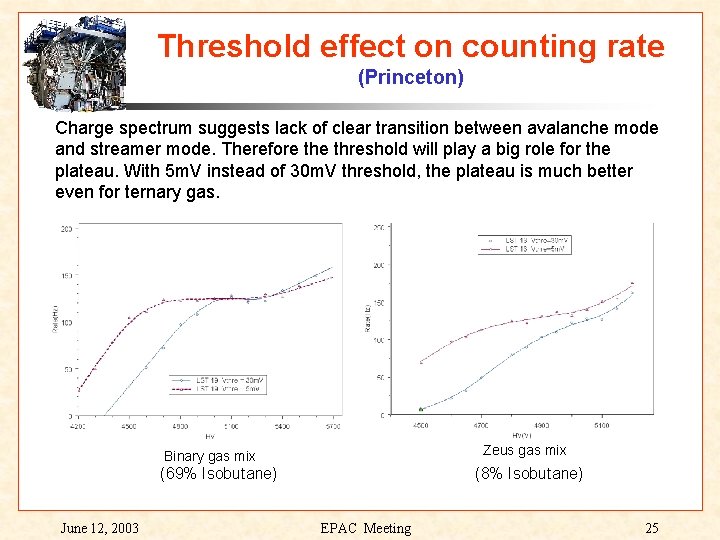
Threshold effect on counting rate (Princeton) Charge spectrum suggests lack of clear transition between avalanche mode and streamer mode. Therefore threshold will play a big role for the plateau. With 5 m. V instead of 30 m. V threshold, the plateau is much better even for ternary gas. Zeus gas mix Binary gas mix (8% Isobutane) (69% Isobutane) June 12, 2003 EPAC Meeting 25
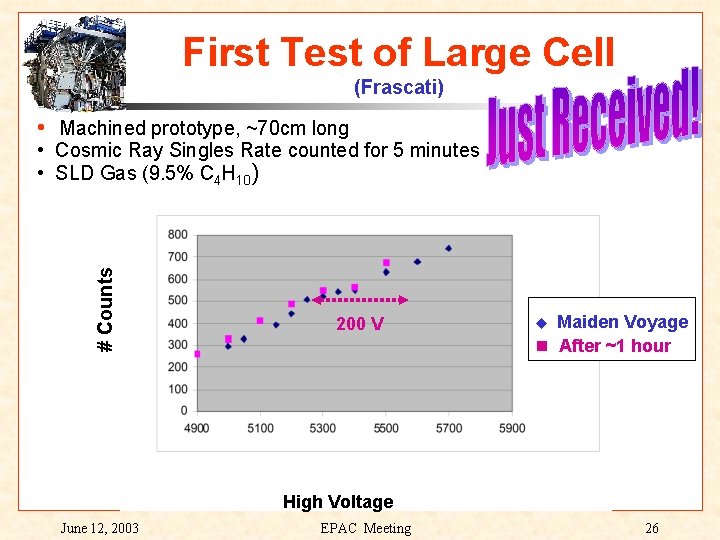
First Test of Large Cell (Frascati) • Machined prototype, ~70 cm long # Counts • Cosmic Ray Singles Rate counted for 5 minutes • SLD Gas (9. 5% C 4 H 10) 200 V u Maiden Voyage After ~1 hour High Voltage June 12, 2003 EPAC Meeting 26
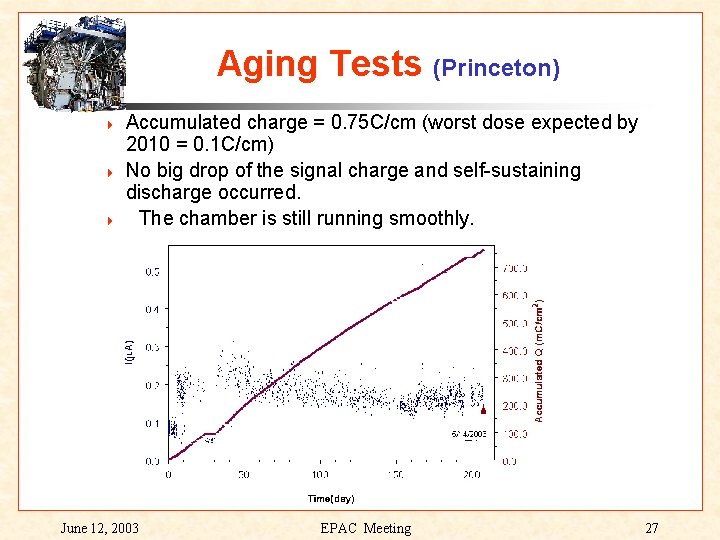
Aging Tests (Princeton) 4 4 4 Accumulated charge = 0. 75 C/cm (worst dose expected by 2010 = 0. 1 C/cm) No big drop of the signal charge and self-sustaining discharge occurred. The chamber is still running smoothly. June 12, 2003 EPAC Meeting 27
Quality Control Absolutely crucial to get this right! Q/C procedures at Pol. Hi. Tech. (PHT) 4 4 Have been discussed, defined in various meetings with the company and have been accepted. Test equipment to be supplied partly by INFN, and accepted by the company. Tube acceptance criteria to be defined together with PHT. Procedures and equipment in place by end of August Q/C and long term test procedures at US sites basically designed. June 12, 2003 EPAC Meeting 28
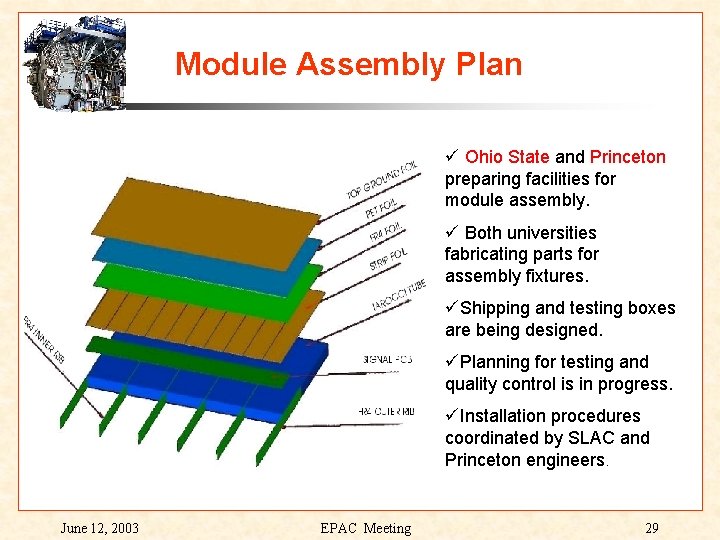
Module Assembly Plan ü Ohio State and Princeton preparing facilities for module assembly. ü Both universities fabricating parts for assembly fixtures. üShipping and testing boxes are being designed. üPlanning for testing and quality control is in progress. üInstallation procedures coordinated by SLAC and Princeton engineers. June 12, 2003 EPAC Meeting 29
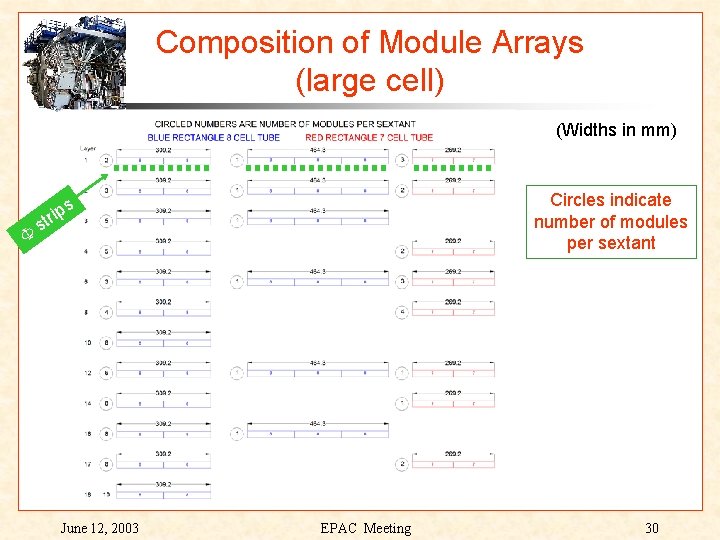
Composition of Module Arrays (large cell) (Widths in mm) F Circles indicate number of modules per sextant s trip s June 12, 2003 EPAC Meeting 30
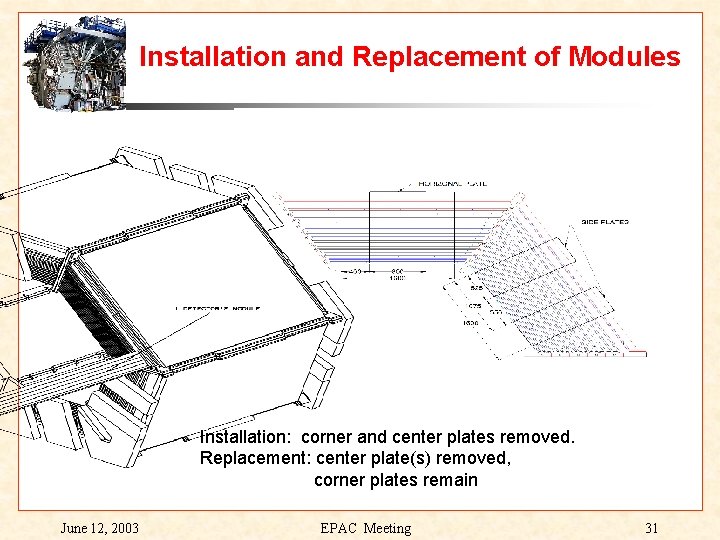
Installation and Replacement of Modules Installation: corner and center plates removed. Replacement: center plate(s) removed, corner plates remain June 12, 2003 EPAC Meeting 31
HV Power Supply (OSU, Padova) OSU HV System design in final phase 4 4 Further refined prototype. Ripple now < 25 m. V, and will be significantly less with tube and HV capacitor connected. (CAEN specs list ripple as < 50 m. V. ) First tests of control logic, current and voltage read-out Full prototype 96 channels, 2 u, 19’’ (twice the CAEN density) • Current monitor for each channel, 48 ch. share common HV setting (12 in CAEN system) • Diode protection circuit integrated. CAEN HV Supplies from LVD experiment may be available 4 4 OSU engineers believe the (ZEUS) diode protection circuit can be fit into the modules. Need to find solution for external HV distribution (SHV? ) Should be able to evaluate suitability and availability soon. June 12, 2003 EPAC Meeting 32
June 12, 2003 EPAC Meeting 33
Ferrara June 12, 2003 EPAC Meeting 34
June 12, 2003 EPAC Meeting 35
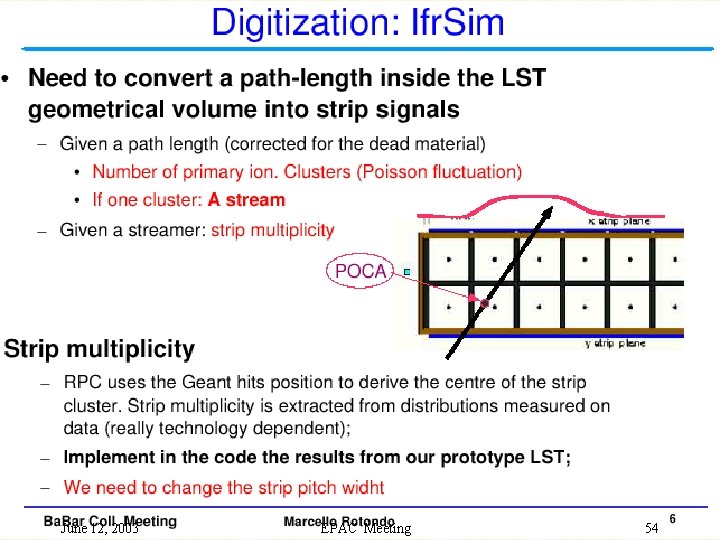
SIMULATION Goals 4 Implement a full GEANT 4 based simulation • No workaround • Just try to understand the whole machinery and adapt to our need Reuse as much code as we can 4 Work in the most recent functional release (12. 5. 2) 4 • Need to learn some new CDB technology 4 Understand the Detector Model • mostly done Status Working LST simulation Ready by the end of June 4 We continue to need help from the IFR experts 4 Already have had a lot of useful interactions. . . 4 June 12, 2003 EPAC Meeting 36
From Prototypes to Project June 12 June 15 June 22 June 27 June 30 Aug 1 Oct 1 Feb 1 ’ 04 May 1 July 2005 June 12, 2003 -- EPAC Review -- Cost/Schedule/WBS prepared -- INFN Gruppo Uno Evaluation -- Ba. Bar IFC Meeting -- Large/Small Cell Decision -- Place Orders for Tubes -- Tube Production begins -- 1/3 tubes shipped to Princeton/OSU -- Modules for 2 sextants to SLAC -- Installation of 2 sextants -- Remaining 4 sextants (ready earlier) EPAC Meeting 37
Summary 1. 2. Physics with m’s is essential to BABAR’s long-term program. Barrel IFR provides about 50% of our muon acceptance. 4 4 3. In addition to the added statistical power, muons are also valuable because they have very different systematics from electrons (Different detectors, much less radiation than from electrons, etc. ) Important modes with 2 leptons, such as B Kll, B K*ll, and B Xsll, would be severely affected without the barrel replacement. Muon ID suffers from inadequate material in current IFR. 4 4 Already marginal, exacerbated by impending demise of layer 19. Muon ID can be significantly improved by replacing some of the active detector layers with brass. 4. LST project is well underway, strong INFN/US team in place. With strong competition from Belle and soon from CDF, IFR barrel replacement. 38 June 12, 2003 BABAR needs the EPAC Meeting
Backup Slides June 12, 2003 EPAC Meeting 39
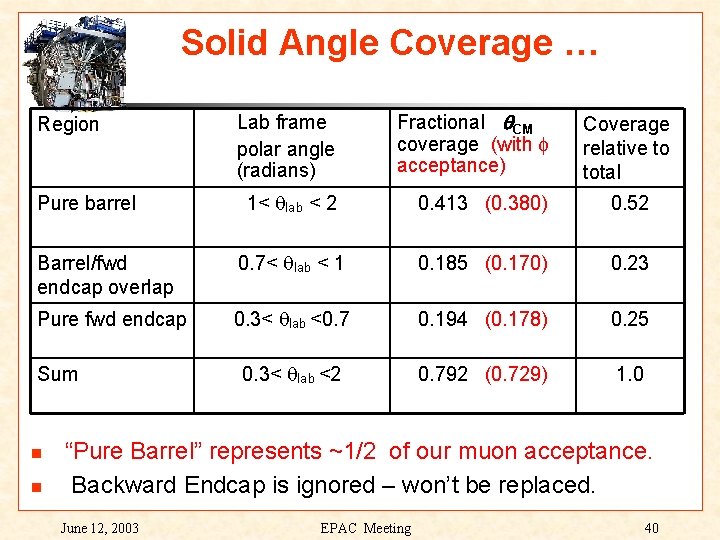
Solid Angle Coverage … Region Pure barrel Lab frame polar angle (radians) Fractional q. CM coverage (with f acceptance) Coverage relative to total 1< qlab < 2 0. 413 (0. 380) 0. 52 Barrel/fwd endcap overlap 0. 7< qlab < 1 0. 185 (0. 170) 0. 23 Pure fwd endcap 0. 3< qlab <0. 7 0. 194 (0. 178) 0. 25 0. 3< qlab <2 0. 792 (0. 729) 1. 0 Sum “Pure Barrel” represents ~1/2 of our muon acceptance. Backward Endcap is ignored – won’t be replaced. June 12, 2003 EPAC Meeting 40
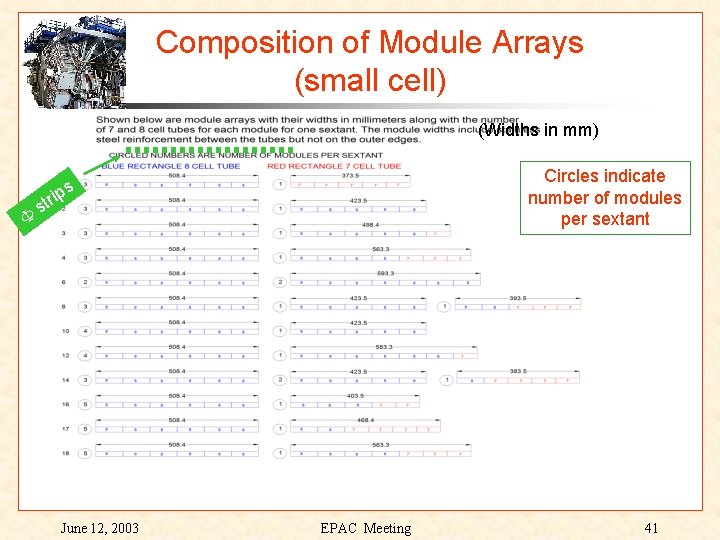
Composition of Module Arrays (small cell) (Widths in mm) Circles indicate number of modules per sextant ips F str June 12, 2003 EPAC Meeting 41
General Infrastructure for Q/C QC data and other relevant information collected by hand or, whenever possible, automatically with several DAQ stations. Common systems at PHT, Princeton, OSU, and SLAC. Labview will be used to write the DAQ software and design the interface. The DAQ stations will be operated by physicists on shift and/or PHT personnel. All DAQ stations will be on a wireless LAN. The DAQ station output will be simple text files. Local production database will be available on site. Data files will be transferred every day to an outside server to be imported in the official offsite LST database. June 12, 2003 EPAC Meeting 42
Scope of Q/C Activities at PHT Barcode labelling Inspection of profiles 4 4 4 June 12, 2003 Mechanical Graphite coating Resistivity Measurement Inspection of jackets, endcaps, circuit cards Gas tightness (leak test) Wire check Wire-cathode distance measurement HV conditioning and plateau measurement Long range tests EPAC Meeting 43
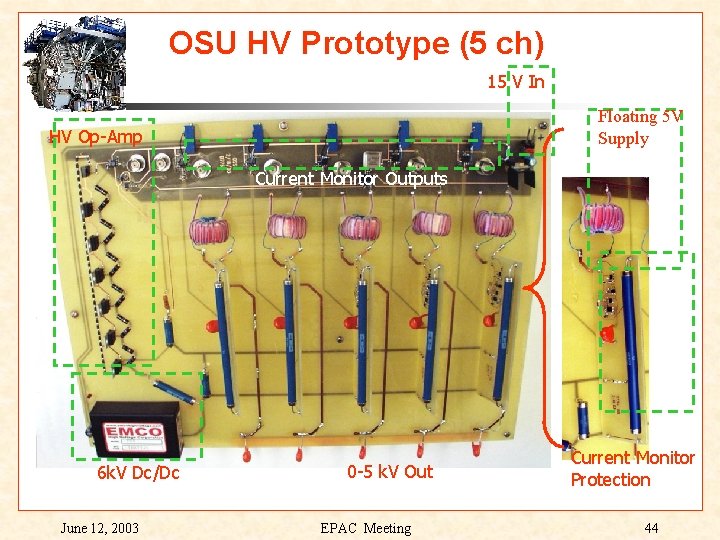
OSU HV Prototype (5 ch) 15 V In Floating 5 V Supply HV Op-Amp Current Monitor Outputs 6 k. V Dc/Dc June 12, 2003 0 -5 k. V Out EPAC Meeting Current Monitor Protection 44
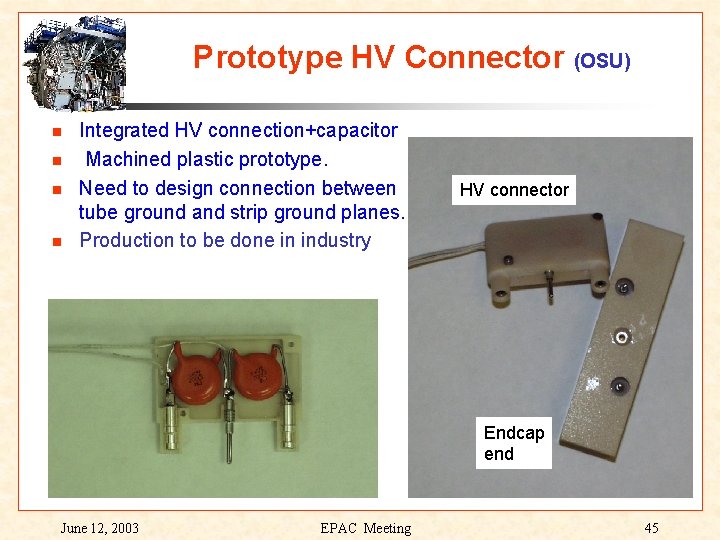
Prototype HV Connector (OSU) Integrated HV connection+capacitor Machined plastic prototype. Need to design connection between tube ground and strip ground planes. Production to be done in industry HV connector Endcap end June 12, 2003 EPAC Meeting 45
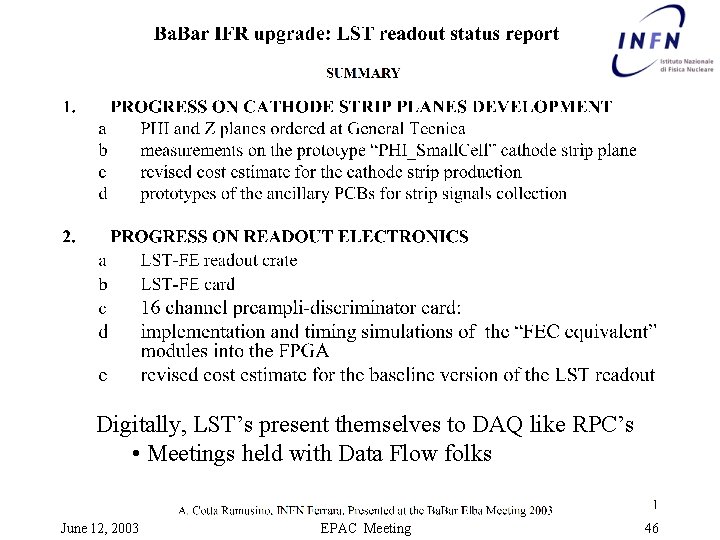
Digitally, LST’s present themselves to DAQ like RPC’s • Meetings held with Data Flow folks June 12, 2003 EPAC Meeting 46
June 12, 2003 EPAC Meeting 47
June 12, 2003 EPAC Meeting 48
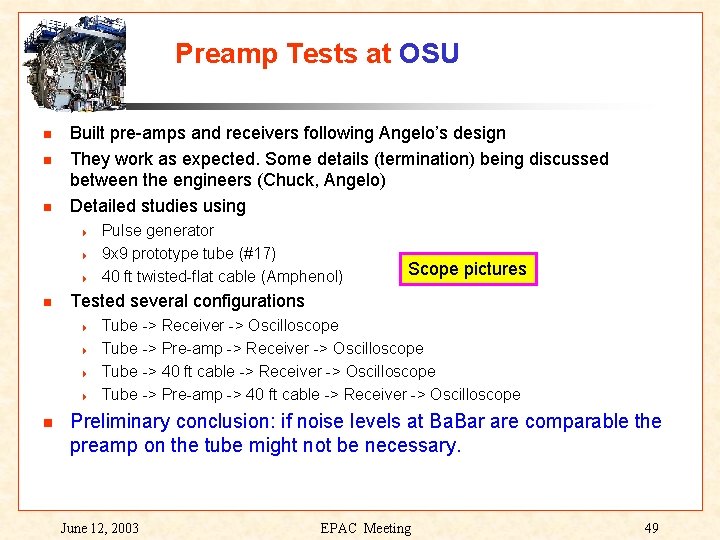
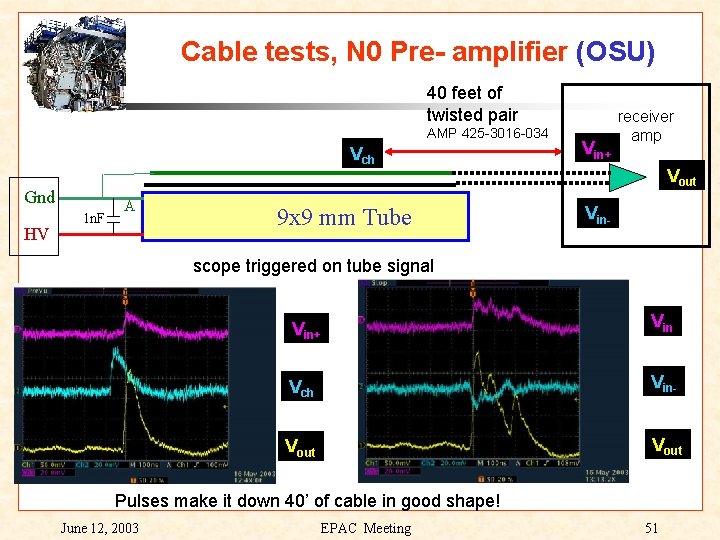
Preamp Tests at OSU Built pre-amps and receivers following Angelo’s design They work as expected. Some details (termination) being discussed between the engineers (Chuck, Angelo) Detailed studies using 4 4 4 Scope pictures Tested several configurations 4 4 Pulse generator 9 x 9 prototype tube (#17) 40 ft twisted-flat cable (Amphenol) Tube -> Receiver -> Oscilloscope Tube -> Pre-amp -> Receiver -> Oscilloscope Tube -> 40 ft cable -> Receiver -> Oscilloscope Tube -> Pre-amp -> 40 ft cable -> Receiver -> Oscilloscope Preliminary conclusion: if noise levels at Ba. Bar are comparable the preamp on the tube might not be necessary. June 12, 2003 EPAC Meeting 49
Cable tests, N 0 Pre- amplifier (OSU) 40 feet of twisted pair AMP 425 -3016 -034 Vch Gnd HV 1 n. F A 9 x 9 mm Tube Vin+ receiver amp Vout Vin- scope triggered on tube signal Vin+ Vin Vch Vin- Vout Pulses make it down 40’ of cable in good shape! June 12, 2003 EPAC Meeting 51
Ferrara June 12, 2003 EPAC Meeting 52
4 x 4 x 4 x flat cable for 16 input June 12, 2003 flat cable for 16 input flat cable for 16 input EPAC Meeting LST-FAST OR for SCALERS LST-FAST OR for TDCs TRIG OUT LST-Crate Service Card LST-FE 16 x TRIG IN flat cable for 16 input LST-FE LST-FE LST-FE LST-FE BACKPLANE flat cable for 16 input flat cable for 16 input 4 x 4 x flat cable for 16 input Ba. Bar IFR upgrade: LST 3. PROGRESS ON READOUT ELECTRONICS readout status report 3. a Recalling the outline of the LST-FE readout crate in the POWER SUPPLY baseline version CRATE FEATURES: VME 6 U mechanical standard +/- 5 V, 350 W power supply University / I. N. Ferrara University / I. N. F. N. Genova 53
June 12, 2003 EPAC Meeting 54
Ferrara Workshop, Monday May 26 Session I. – Tube/Module design. Chair – Mauro 0845 Identify commonalities, differences, plusses, minuses between large and small cell designs. – discussion led by chair 0900 Mechanical tolerances, robustness of tubes (large cell /small cell) --Vito 0915 Present state of endcap design --Federico 0930 Gas flow issues within tube and modules --Jim O 0945 HV connection design, issues --Angelo Session IV. Q/C at Pol. hi. tech, elsewhere Chair – Silvio 1000 Phi Strip design, connections --Angelo 1600 Overview, list of procedures /tests (also listed on Elba agenda) -- Diego 1015 Discussion 1615 Apparatus, schedules -- Gigi 1045 Break 1630 The superbox – can it be everything to everyone? -- Bill S 1650 Relationship with Pol. hi. tech Session II – Module construction Chair – Richard K. 1705 U. S. Participation at Pol. hi. tech -- Jim O. 1100 Module construction, mechanical -- Bill S 1715 Q/C at module construction sites -- Jim O, Richard K 1115 Module construction, electrical -- Angelo 1730 Q/C at SLAC -- Charlie, Bob 1130 Optimization of accessibility vs complexity 1745 Break 1200 Discussion, agreement on action items 1230 Break Session V – Preparation of EPAC Proposal Chair – Stew Session III – Z-strips and electronics Chair – Livio 1815 Status, weak parts, action items -- Livio 1330 Z-strip design -- Angelo 1830 WBS, Schedule, Assigning names to tasks -- Richard F by phone 1345 Z-strip mechanical issues, involving UCSD, installation 1850 Break into discussion groups 1400 Front-end Electronics issues -- Angelo 1930 Adjourn to fabulous restaurant --thresholds, in light of prototype results. --FEC’s on detector or in crates? 1430 Readout Crates -- Maurizio 1450 HV System -- Richard K. Can we decide on LVD vs OSU design? 1510 Slow controls (HV, temp, gas, etc) 1530 Break June 12, 2003 EPAC Meeting 55
Ferrara, Tuesday May 27 Session VI – Gas system, Safety Chair – Charlie 0830 Review of requirements, SLD, RPC gas systems, -- Bob Defining elements of system -- Bob 0900 Gas System Schedule 0915 Safety overview, list of items -- Mauro 0930 SLAC safety approval procedures -- Charlie, Bill W? 0945 Duties of LST Safety Officer 1030 Break Session VI. [Parallel sessions] 1100 A. Writing groups work on proposal B. Detailed issues of module/ tube design, integration, removal C. Develop safety organization Session IX. Conclusions 1700 Planning for SLAC LST workshop, week of July 14 -18 1745 Brief Reports from Parallel Sessions, Proposal 1830 Review of Action Items by Session Chairs 1900 Adjourn 1215 Lunch Session VIII Prototype schedules, issues, results Chair – Roberto (remember we’ve already discussed this in Elba) 1445 Any new results, or conclusions since Elba 1500 Round-table discussion of prototype results from Pol. Hi. Tech, Ferrara, Princeton, OSU -- Are they consistent? -- Do we see adequate performance? -- What further tests? -- Can we widen plateaux? --Different gases? More sensitive electronics? … 1545 Pol. Hi. Tech construction status, schedules Roberto 1600 Small parts status, schedules , issues Mario 1615 Electronics for prototype module test 1630 Break June 12, 2003 EPAC Meeting 56
E-field on the wire surface Small cell, 4700 V Big cell, 5500 V E(@center) = 198853 V/cm E(@center) = 205135 V/cm E(off center) = 202603 E(off center) = 206931 E/E = 1. 89% E/E = 0. 876% June 12, 2003 EPAC Meeting 57
Anode wire diameter tolerance We can control the anode wire diameter within 1% of 100 m. Estimate the effect of this variation to the effective anode wire voltage: E-field on the anode wire surface: Rc is the equivalent cathode radius, for big cell it is ~1 cm, for small cell it is ~0. 6 cm. x is the anode wire radius. For big cell @ 5500 V: V = -44. 6 V For small cell @ 4700 V: V = -37. 2 V The difference between big cell and small cell is very small. June 12, 2003 EPAC Meeting 58
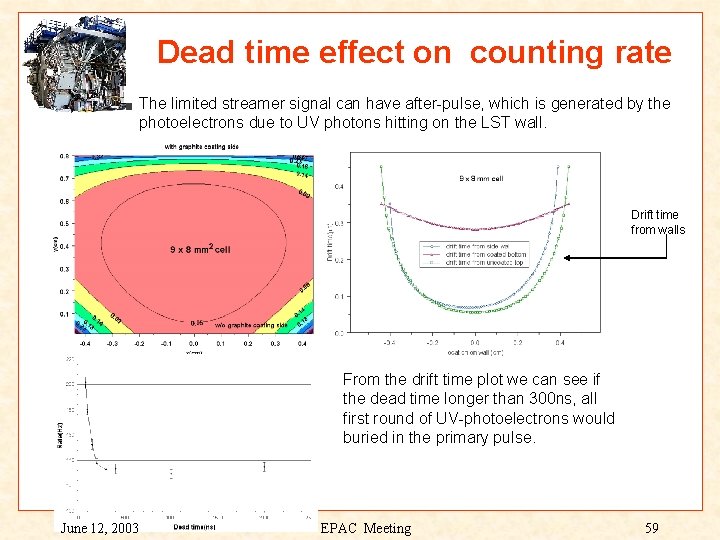
Dead time effect on counting rate The limited streamer signal can have after-pulse, which is generated by the photoelectrons due to UV photons hitting on the LST wall. Drift time from walls From the drift time plot we can see if the dead time longer than 300 ns, all first round of UV-photoelectrons would buried in the primary pulse. June 12, 2003 EPAC Meeting 59
- Slides: 57