
Limitations to FlatField Correction Methods when used with
- Slides: 14
Limitations to Flat-Field Correction Methods when used with an X-ray Spectrum David W. Davidson University of Glasgow Co-Authors: Christer Frojdh, Hans-Erik Nilsson: ITM, Sundsvall Val O’Shea, Mahfuzur Rahman: University of Glasgow 1
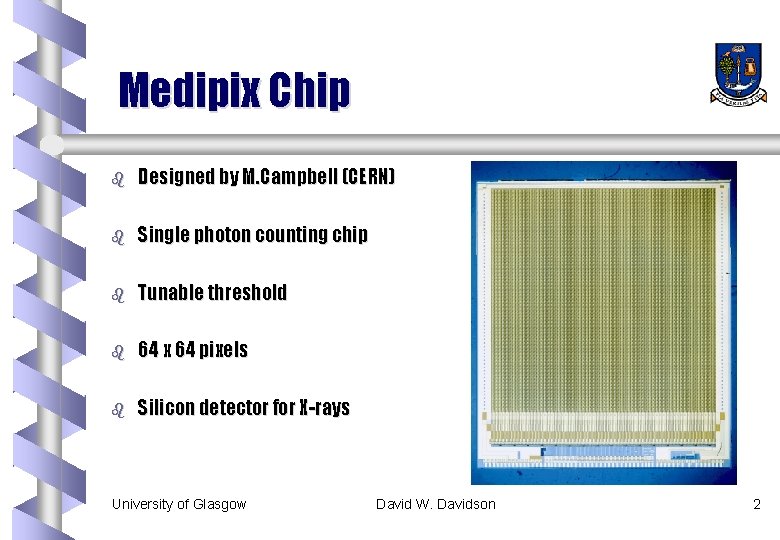
Medipix Chip b Designed by M. Campbell (CERN) b Single photon counting chip b Tunable threshold b 64 x 64 pixels b Silicon detector for X-rays University of Glasgow David W. Davidson 2
Flat-Field Correction b b b Used to correct for inhomogeneity of response in X-ray imaging sensors Numerous images are taken with the sensor exposed to a uniform field The sensitivity of each pixel is determined by the average response and a gain map calculated Further images can be corrected by dividing by this gain map If the gain map is functioning correctly the variations remaining should be due to the statistical variation of the noise University of Glasgow David W. Davidson 3
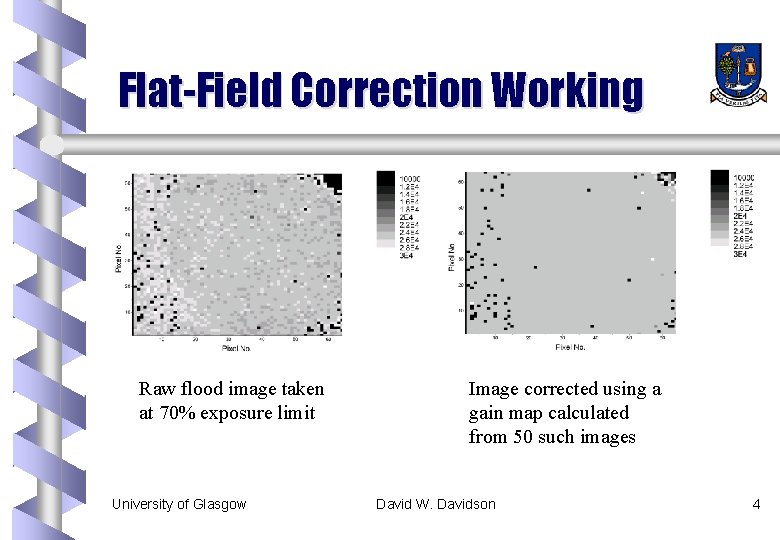
Flat-Field Correction Working Raw flood image taken at 70% exposure limit University of Glasgow Image corrected using a gain map calculated from 50 such images David W. Davidson 4
Gain Map Variations b It has been seen that the gain map, taken for one source, will not correctly adjust for all sources using the same chip b Test effect of map on flood images b Set of flood images with non-monochromatic source to test for consistency b The variation of efficiency map with incident spectra is obtained University of Glasgow David W. Davidson 5
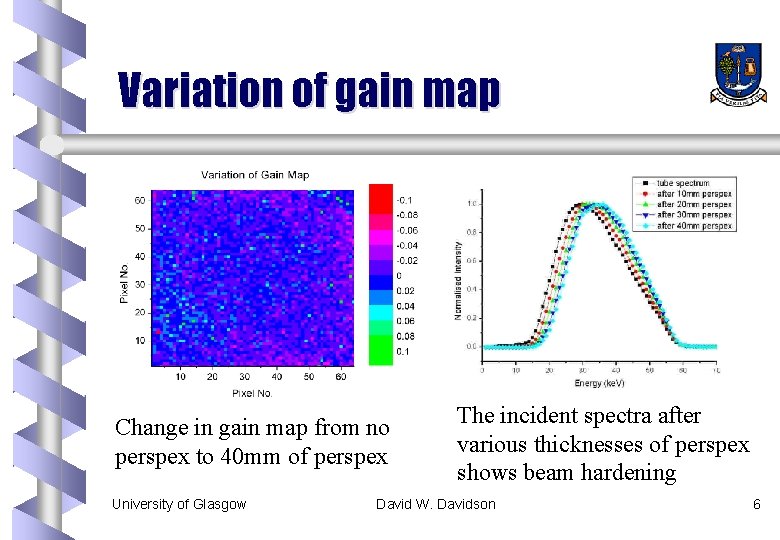
Variation of gain map Change in gain map from no perspex to 40 mm of perspex University of Glasgow The incident spectra after various thicknesses of perspex shows beam hardening David W. Davidson 6
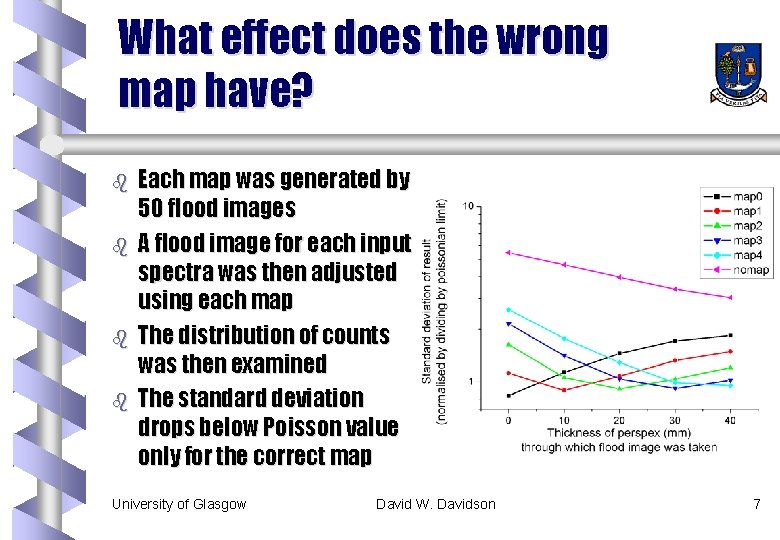
What effect does the wrong map have? b b Each map was generated by 50 flood images A flood image for each input spectra was then adjusted using each map The distribution of counts was then examined The standard deviation drops below Poisson value only for the correct map University of Glasgow David W. Davidson 7
Explanation of gain map variation b b b b Each photon absorbed in detector releases charge This charge depends on photon energy and ionisation energy of detector material Charge is drifted to electrodes Loss in material included in charge collection efficiency (CCE) Lack of uniformity across detector brings in use of gain correction factor per pixel Any variation in effective thickness of detector medium will result in a variation of absorption efficiency dependent on incident energy spectrum This gain correction factor will be dependent on the energy of the photon University of Glasgow David W. Davidson 8
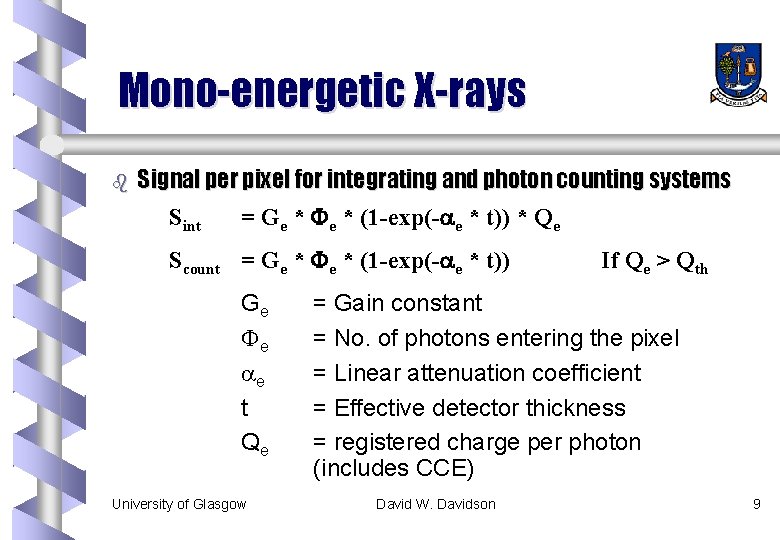
Mono-energetic X-rays b Signal per pixel for integrating and photon counting systems Sint = Ge * Fe * (1 -exp(-ae * t)) * Qe Scount = Ge * Fe * (1 -exp(-ae * t)) Ge Fe ae t Qe University of Glasgow If Qe > Qth = Gain constant = No. of photons entering the pixel = Linear attenuation coefficient = Effective detector thickness = registered charge per photon (includes CCE) David W. Davidson 9
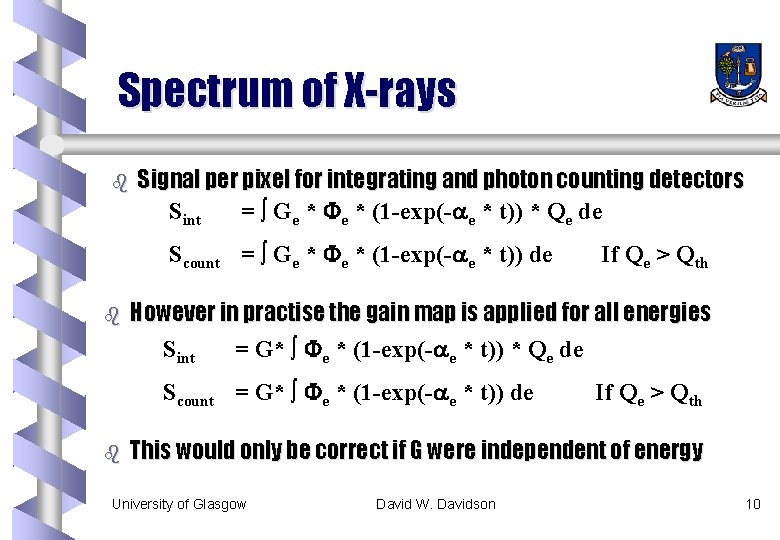
Spectrum of X-rays b Signal per pixel for integrating and photon counting detectors Sint = ∫ Ge * Fe * (1 -exp(-ae * t)) * Qe de Scount = ∫ Ge * Fe * (1 -exp(-ae * t)) de b However in practise the gain map is applied for all energies Sint = G* ∫ Fe * (1 -exp(-ae * t)) * Qe de Scount = G* ∫ Fe * (1 -exp(-ae * t)) de b If Qe > Qth This would only be correct if G were independent of energy University of Glasgow David W. Davidson 10
Potential Solution b Possibility of calculating theoretical gain maps b Forming a database of gain maps b Reducing amounts of preparation work for any set of results b Interpolating between available gain maps University of Glasgow David W. Davidson 11
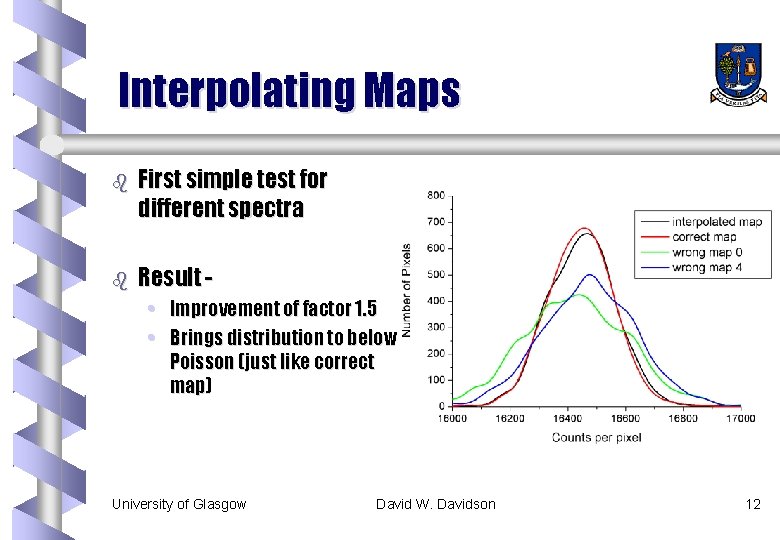
Interpolating Maps b First simple test for different spectra b Result • Improvement of factor 1. 5 • Brings distribution to below Poisson (just like correct map) University of Glasgow David W. Davidson 12
Summary b Correct flat-field adjustment is required so as to avoid phantom images (Artefacts) b Flat-field adjustment requires correct gain map b On each separate pixel the gain adjust is dependent on energy b Some calculation of theoretical gain maps is possible University of Glasgow David W. Davidson 13
Final Solution b The use of monochromatic sources would remove this effect and allow correct adjustment of the image regardless of objects placed in the beam or b The inclusion of an ADC on each pixel would allow the incident spectrum to be found a correction for the relative intensity of each energy present would be possible University of Glasgow David W. Davidson 14