
Limitations of Port Knocking Software Project Presentation Paper

- Slides: 14
Limitations of Port Knocking Software Project Presentation Paper Study – Part III Group Member: Liew Jiun Hau (20086034) Lee Shirly (20095815) Ong Ivy (20095040)
Agenda �Out-of-Order Delivery �Network Address Translation (NAT) �Authentication-Connection Association
Out-of-Order Delivery �Problem ◦ Attackers can perform Do. S on a client: �Send one packet per second to a random port of server �Spoofing the client IP as the source IP ◦ Knock sequence broken authentication fail �Solution ◦ Divide the bits representing port number into data bits and sequence number bits ◦ Server will be able to reorder packets correctly before decoding the knock sequence ◦ Use SPA mechanism – only a single packet
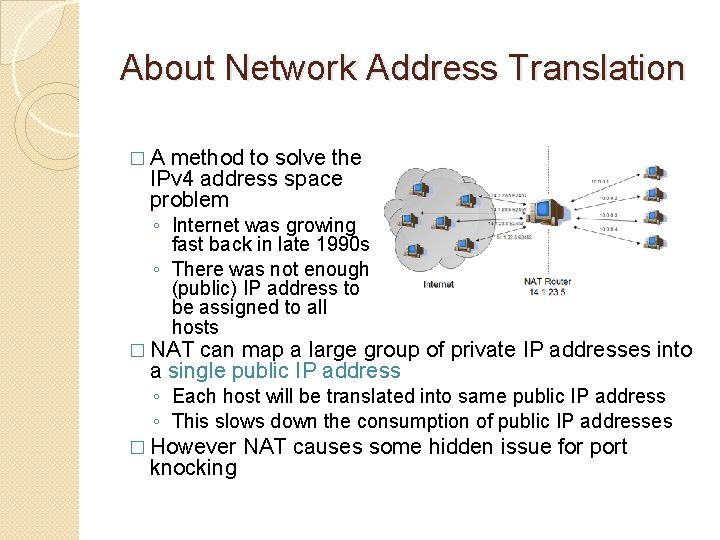
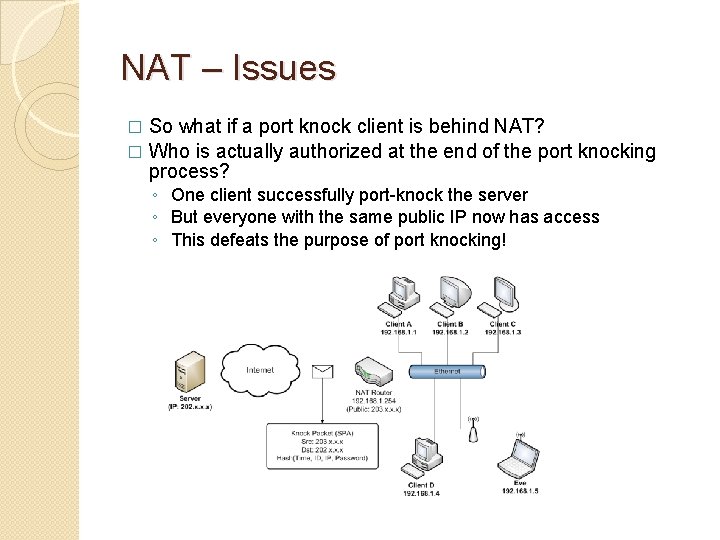
About Network Address Translation � A method to solve the IPv 4 address space problem ◦ Internet was growing fast back in late 1990 s ◦ There was not enough (public) IP address to be assigned to all hosts � NAT can map a large group of private IP addresses into a single public IP address ◦ Each host will be translated into same public IP address ◦ This slows down the consumption of public IP addresses � However NAT causes some hidden issue for port knocking
NAT – Issues So what if a port knock client is behind NAT? � Who is actually authorized at the end of the port knocking process? � ◦ One client successfully port-knock the server ◦ But everyone with the same public IP now has access ◦ This defeats the purpose of port knocking!
NAT – Issues (cont) �In SPA, IP address information is hashed together with Timestamp, ID and Password ◦ How do a client know about its public IP address? ◦ Can it know in a secure way?
NAT – Possible Solutions �Set up a simple server machine at the boundary of the private network ◦ Client can securely discover its public IP address by querying the boundary server machine �Using some external service ◦ www. whatismyip. com ◦ Use by fwknop (one of the SPA implementation)
NAT – Possible Solutions (cont) � The other alternative will be a three-pass mutual authentication ◦ Originally proposed by Rennie de. Graaf, John Aycock and Michael Jacobson Jr � The notations used are as follow ◦ ◦ ◦ � A = Client B = Server NX = Nonce of X PIDX = Public IP of X MAC = Message Authentication Code (e. g. HMAC-SHA-1) K = Pre-shared key between client and server The steps are as follow: ◦ 1: A B ◦ 2: ◦ 3: � req, NA, MACK(req, NA) B A PIDA, NB, MACK(NA, PIDB) A B MACK (NB, PIDA, PIDB) This approach is more secure but make port knocking less “stealthy”
NAT – Possible Solutions � We can also add some configurations to further mitigate risk ◦ Set a short timeout ◦ Close the port after timeout ◦ Close the port immediately after a connection is made � This leave only a small window during which the client can connect � This also avoid a problem where adversaries could eavesdrop ◦ They can wait for the port to be opened and try to make connection after the authentic client did ◦ There might still exist a race condition ◦ Adversaries can send request faster than client � So how can we solve this issue?
Authentication-Connection Association �A successfully opened port can still be hijacked by an attacker ◦ Attacker will be able to impersonating the client ◦ This is the unsolved issue in previous slide �To counter this, we can wrap post- authentication connections within an encrypted session ◦ Use a pre-shared key that only known by the client and server ◦ Attacker has no way of crafting valid packets without the key ◦ Invalid packets will be dropped at server side �This however increase the load on server
Authentication-Connection Association (cont) � The other possible solution would be to generate TCP Sequence Numbers (SN) in a randomized & authentication-dependent manner ◦ Server can verify the TCP sequence number based on previous authentication ◦ But this require client to have heightened privileges to manipulate the TCP / IP packet fields ◦ Powerful adversaries who can perform MITM is not affected
Next Presentation �Continue to study and analyze other known problems and their possible solutions/improvements in details �Present and discuss in next session �Questions?
References Jeanquier S (2006) An Analysis of Port Knocking and Single Packet Authorization. M. Sc. Thesis. Royal Holloway, University of London. Sept 2006. � de. Graaf R, Aycock C, and Jacobson M. ‘Improved Port Knocking with Strong Authentication’. ACSAC 2005, pp. 409418. � Rash M. ‘Single Packet Authorization with Fwknop’. The USENIX Magazine. Feb 2006, Vol. 31, No. 1, pp 63 -69. � William Stallings. Cryptography and Network Security: Principles and Practices (3 rd Edition). Pearson Education. 2003. � James. F. Kurose, Keith W. Ross. Computer Networking: A Top-Down Approach Featuring the Internet (3 rd Edition). Addison Wesley. May 23, 2004. �
Thank you