
Limitations of IPR Incentive Mechanism in Economic Growth

- Slides: 25
知识产权激励机制在经济 增长中的有限性及其克服 Limitations of IPR Incentive Mechanism in Economic Growth and the Response Thereto 宁波大学法学院 蒋万来 Jiang Wanlai, Ningbo University Law School jiangwanlai@nbu. edu. cn 2016. 11. 08 伦敦 8 November 2016 London
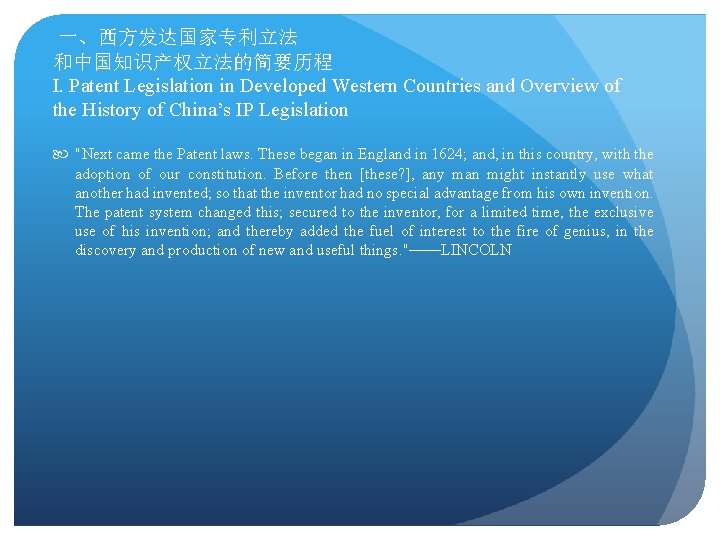
一、西方发达国家专利立法 和中国知识产权立法的简要历程 I. Patent Legislation in Developed Western Countries and Overview of the History of China’s IP Legislation "Next came the Patent laws. These began in England in 1624; and, in this country, with the adoption of our constitution. Before then [these? ], any man might instantly use what another had invented; so that the inventor had no special advantage from his own invention. The patent system changed this; secured to the inventor, for a limited time, the exclusive use of his invention; and thereby added the fuel of interest to the fire of genius, in the discovery and production of new and useful things. "——LINCOLN
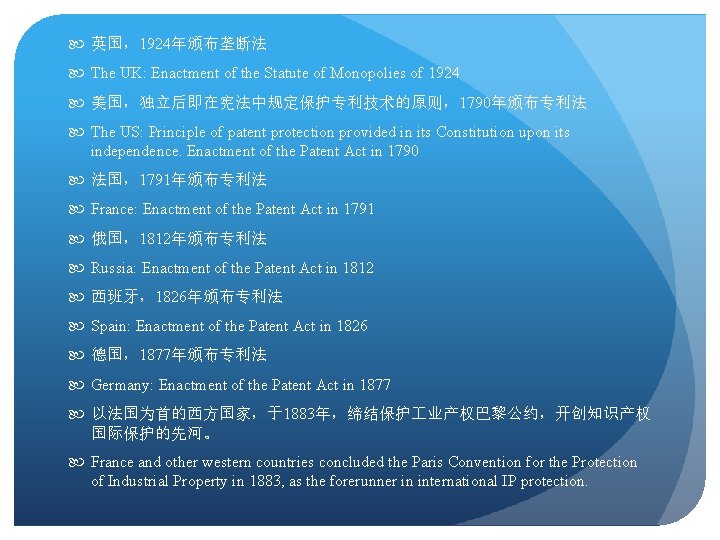
英国,1924年颁布垄断法 The UK: Enactment of the Statute of Monopolies of 1924 美国,独立后即在宪法中规定保护专利技术的原则,1790年颁布专利法 The US: Principle of patent protection provided in its Constitution upon its independence. Enactment of the Patent Act in 1790 法国,1791年颁布专利法 France: Enactment of the Patent Act in 1791 俄国,1812年颁布专利法 Russia: Enactment of the Patent Act in 1812 西班牙,1826年颁布专利法 Spain: Enactment of the Patent Act in 1826 德国,1877年颁布专利法 Germany: Enactment of the Patent Act in 1877 以法国为首的西方国家,于1883年,缔结保护 业产权巴黎公约,开创知识产权 国际保护的先河。 France and other western countries concluded the Paris Convention for the Protection of Industrial Property in 1883, as the forerunner in international IP protection.
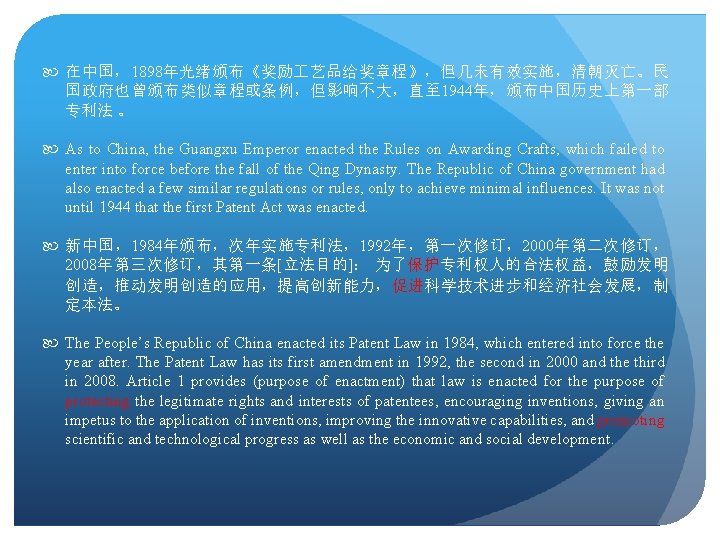
在中国,1898年光绪颁布《奖励 艺品给奖章程》,但几未有效实施,清朝灭亡。民 国政府也曾颁布类似章程或条例,但影响不大,直至 1944年,颁布中国历史上第一部 专利法 。 As to China, the Guangxu Emperor enacted the Rules on Awarding Crafts, which failed to enter into force before the fall of the Qing Dynasty. The Republic of China government had also enacted a few similar regulations or rules, only to achieve minimal influences. It was not until 1944 that the first Patent Act was enacted. 新中国,1984年颁布,次年实施专利法,1992年,第一次修订,2000年第二次修订, 2008年第三次修订,其第一条[立法目的]: 为了保护专利权人的合法权益,鼓励发明 创造,推动发明创造的应用,提高创新能力,促进科学技术进步和经济社会发展,制 定本法。 The People’s Republic of China enacted its Patent Law in 1984, which entered into force the year after. The Patent Law has its first amendment in 1992, the second in 2000 and the third in 2008. Article 1 provides (purpose of enactment) that law is enacted for the purpose of protecting the legitimate rights and interests of patentees, encouraging inventions, giving an impetus to the application of inventions, improving the innovative capabilities, and promoting scientific and technological progress as well as the economic and social development.
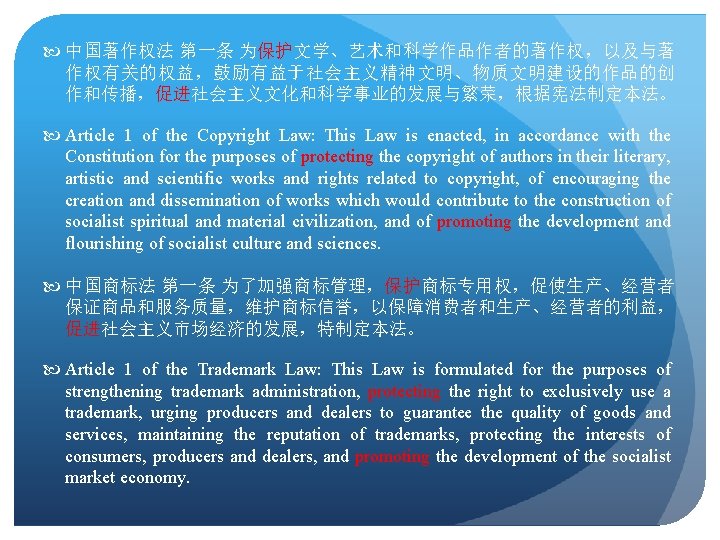
中国著作权法 第一条 为保护文学、艺术和科学作品作者的著作权,以及与著 作权有关的权益,鼓励有益于社会主义精神文明、物质文明建设的作品的创 作和传播,促进社会主义文化和科学事业的发展与繁荣,根据宪法制定本法。 Article 1 of the Copyright Law: This Law is enacted, in accordance with the Constitution for the purposes of protecting the copyright of authors in their literary, artistic and scientific works and rights related to copyright, of encouraging the creation and dissemination of works which would contribute to the construction of socialist spiritual and material civilization, and of promoting the development and flourishing of socialist culture and sciences. 中国商标法 第一条 为了加强商标管理,保护商标专用权,促使生产、经营者 保证商品和服务质量,维护商标信誉,以保障消费者和生产、经营者的利益, 促进社会主义市场经济的发展,特制定本法。 Article 1 of the Trademark Law: This Law is formulated for the purposes of strengthening trademark administration, protecting the right to exclusively use a trademark, urging producers and dealers to guarantee the quality of goods and services, maintaining the reputation of trademarks, protecting the interests of consumers, producers and dealers, and promoting the development of the socialist market economy.
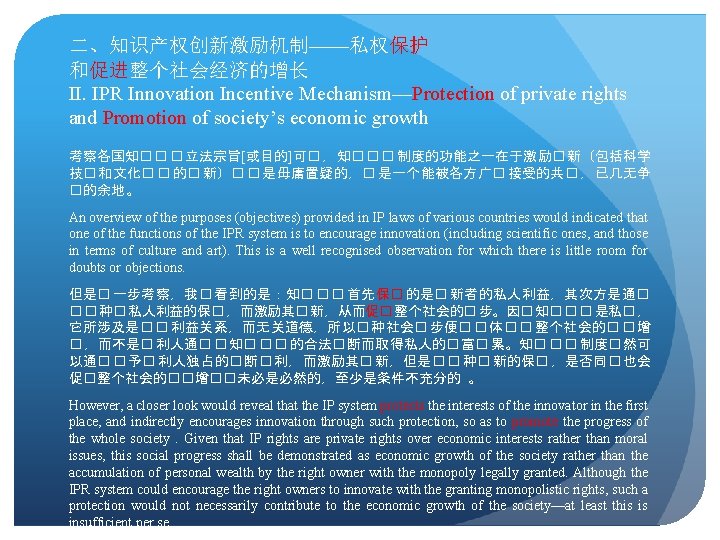
二、知识产权创新激励机制——私权保护 和促进整个社会经济的增长 II. IPR Innovation Incentive Mechanism—Protection of private rights and Promotion of society’s economic growth 考察各国知� � � 立法宗旨[或目的]可� ,知� � � 制度的功能之一在于激励� 新(包括科学 技� 和文化� � 的� 新)� � 是毋庸置疑的,� 是一个能被各方广� 接受的共� ,已几无争 �的余地 。 An overview of the purposes (objectives) provided in IP laws of various countries would indicated that one of the functions of the IPR system is to encourage innovation (including scientific ones, and those in terms of culture and art). This is a well recognised observation for which there is little room for doubts or objections. 但是� 一步考察,我� 看到的是:知� � � 首先保� 的是� 新者的私人利益,其次方是通� ��种�私人利益的保�,而激励其�新,从而促�整个社会的�步。因�知���是私�, 它所涉及是� � 利益关系,而无关道德,所以� 种社会� 步便� � 体� � 整个社会的� � 增 � ,而不是� 利人通� � 知� � � 的合法� 断而取得私人的� 富� 累。知� � � 制度� 然可 以通� � 予� 利人独占的� 断� 利,而激励其� 新,但是� � 种� 新的保� ,是否同� 也会 促�整个社会的��增��未必是必然的,至少是条件不充分的 。 However, a closer look would reveal that the IP system protects the interests of the innovator in the first place, and indirectly encourages innovation through such protection, so as to promote the progress of the whole society. Given that IP rights are private rights over economic interests rather than moral issues, this social progress shall be demonstrated as economic growth of the society rather than the accumulation of personal wealth by the right owner with the monopoly legally granted. Although the IPR system could encourage the right owners to innovate with the granting monopolistic rights, such a protection would not necessarily contribute to the economic growth of the society—at least this is insufficient per se.
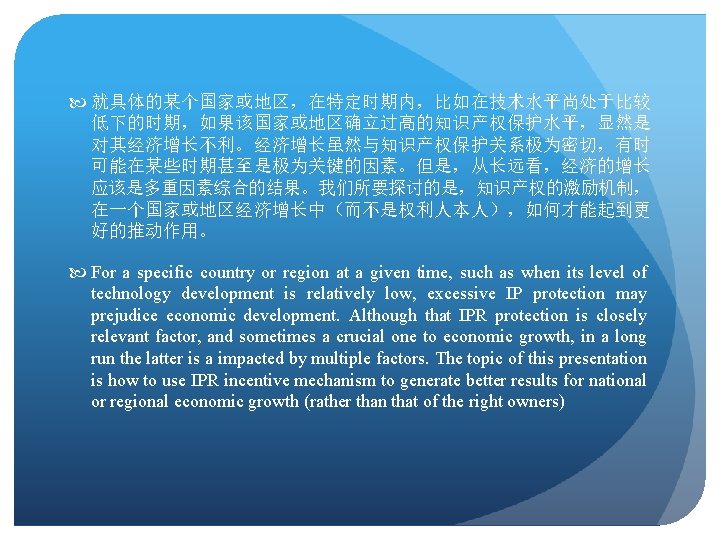
就具体的某个国家或地区,在特定时期内,比如在技术水平尚处于比较 低下的时期,如果该国家或地区确立过高的知识产权保护水平,显然是 对其经济增长不利。经济增长虽然与知识产权保护关系极为密切,有时 可能在某些时期甚至是极为关键的因素。但是,从长远看,经济的增长 应该是多重因素综合的结果。我们所要探讨的是,知识产权的激励机制, 在一个国家或地区经济增长中(而不是权利人本人),如何才能起到更 好的推动作用。 For a specific country or region at a given time, such as when its level of technology development is relatively low, excessive IP protection may prejudice economic development. Although that IPR protection is closely relevant factor, and sometimes a crucial one to economic growth, in a long run the latter is a impacted by multiple factors. The topic of this presentation is how to use IPR incentive mechanism to generate better results for national or regional economic growth (rather than that of the right owners)
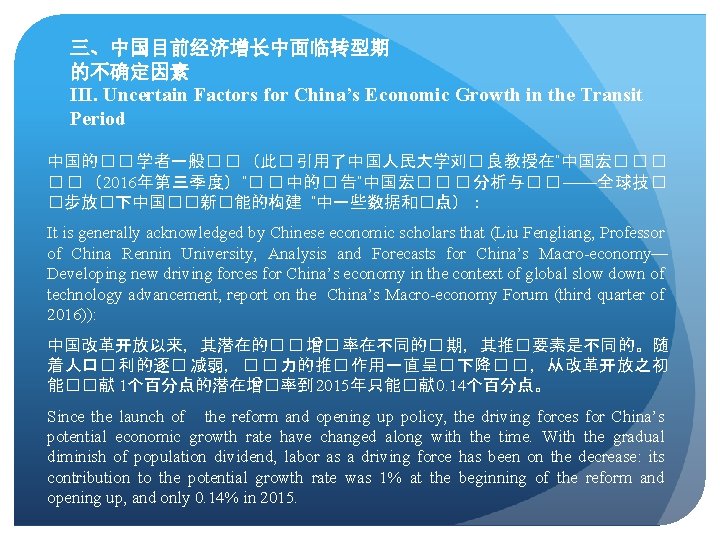
三、中国目前经济增长中面临转型期 的不确定因素 III. Uncertain Factors for China’s Economic Growth in the Transit Period 中国的� � 学者一般� � (此� 引用了中国人民大学刘� 良教授在“中国宏� � � (2016年第三季度)”� � 中的� 告“中国宏� � � 分析与� � ——全球技� �步放�下中国��新�能的构建 ”中一些数据和�点): It is generally acknowledged by Chinese economic scholars that (Liu Fengliang, Professor of China Rennin University, Analysis and Forecasts for China’s Macro-economy— Developing new driving forces for China’s economy in the context of global slow down of technology advancement, report on the China’s Macro-economy Forum (third quarter of 2016)): 中国改革开放以来,其潜在的� � 增� 率在不同的� 期,其推� 要素是不同的。随 着人口� 利的逐� 减弱,� � 力的推� 作用一直呈� 下降� � ,从改革开放之初 能��献 1个百分点的潜在增�率到 2015年只能�献 0. 14个百分点。 Since the launch of the reform and opening up policy, the driving forces for China’s potential economic growth rate have changed along with the time. With the gradual diminish of population dividend, labor as a driving force has been on the decrease: its contribution to the potential growth rate was 1% at the beginning of the reform and opening up, and only 0. 14% in 2015.
� 本的� 献相� � 定,改革开放以来,平均年� 献 3. 7个 百分点的潜在增� 率。不� ,随着� 本� � � 酬逐� 下 降,2011年以来,�本���增�的�献也在逐年下降。 The contribution of capitals is relatively stable, with an annual average of 3. 7% since the reform and opening up. However, along with the decrease in the marginal return of capital, capital’s contribution to economic growth has been declining since 2011. 在 资 本 和 劳 动 投 入 之 外 , 全 要 素 生 产 率 ( Total Factor Productivity)的变动是潜在增长率波动的最主要原因。 In addition to capital and labour, changes in the total factor productivity is the main cause for the fluctuation of the potential growth rate.
� � 模仿性技� � 步、改革� 利、需求� � 所� 生的� 模效� ,都呈 � 弱化� � ,� 致全要素生� 率增� 放� ,加之人口� 利逐� 消失和� 本��效益�减, 增�的���能��消失。 The scale effect caused by technological development traditionally based on imitation, reform dividend and expansion of demands is becoming weaker, which leads to the slow down of total factor productivity. That combined with the diminishing population dividend and the declining marginal benefit of capital, the traditional driving forces are gradually stopping. 中国经济目前面临的问题是,中等收入陷进,这和其他国家的发展经历相 似。但是历史上,只有13个国家面临中等收入时候跳过这个陷进。 As with other countries at the same stage of development, China is currently faced with the middle-income trap. Historical record shows that only 13 has managed to escape the trap.
知识产权制度促进 业化发展, 业化促进经济发展,固然没错,但是到了中等收入阶段, 这种增速似乎失灵。当经济结构服务化以后,任何国家都会出现结构性减速特征,中国到了 2014年服务业开 始超过制造业,2015年服务业已经占了51%, While it is true that the IPR system would promote industrialisation, which would in turn promote economic growth, such a mechanism seems to be losing its touch when a country reaches the middle-income stage. With the servitization of economic structure, countries experience symptoms of structural slow down. For China, the service industry exceeded manufacturing in 2014, and account for 15% in 2015. 中国一些主流经济学家(比如张平)认为:此阶段 经济结构进入了服务化阶段,此阶段 服务业的特征不再存在 业化推动经济发展的一个重要特征,即规模经济递增性。 Mainstream economists in China (such as Zhang Ping) hold that as such, the economic structure enters its servitization stage. At this stage, a major character in the industrialisation-driven development, increase of the economies of scale, ceases to exist in the service industry. 过去通过政府干预堆积资源在 业化部门,导致的规模效益递增,在服务化阶段或者中 等收入阶段变得不确定。 Economies of scale becomes uncertain in the servitization or middle-income stage, as a contrast with its increase in the industrialisation as a result of resources accumulation due to governmental intervention.
这种不确定性,表现为三种形态: The uncertainties could be categorised into the following three: 1、在服务化阶段,技术整体放缓,主要是技术模仿空间变小。在 业化时期,中国最重要 的技术进步主要体现在引进先进设备的过程中,吸收模仿国外的高科技,这对资本深化具有 同步效应。但是到服务化阶段,这种过程能否导致前沿创新,变得不确定,这需要一整套的 市场激励机制同时予以有效的保障。 At the servitization stage, technological development slows down due to the reduced chances of technological imitation. During the industrialisation stage, the China’s most important technological advancement were achieved though consultation and imitation of foreign high technologies, which would synchronize capital deepening. By contrast, the promotion of cutting-edge innovation becomes uncertain when it comes to the servitization stage, which means that a set of market incentive mechanism, as well effective sustainable measures are needed. 法学界的人士,特别是知识产权专家强调知识产权的保护,强调知识产权的激励机制,这固 然完全正确,但是,很多经济学家的视野有所不同,甚至更开阔,他们认为除了知识产权之 外,则更注重这些整套的激励机制的共同作用,比如,资本市场的贴现激励,垄断租金定价。 如果没有这些因素的共同作用,前沿创新和商业前景则是脱节的。 Academics of law, especially IPR experts, tend to emphasis the importance of IPR incentive system, which is certainly correct. By contrast, economists have demonstrated different, or even wider perspectives, in holding that the combination of the set of various incentives, such as discount for the capital market and monopolised rent control are more crucial than the single factor of IP. Without the synergy of these factors, the cutting-edges innovation would be detached from commercial prospects.
2008年金融危机之后,国际上广泛期望出现一次技术革新,从而推动全 球经济复苏与增长。于是, 业 4. 0等想法纷纷兴起,试图从环保、新 能源等领域找到下一次技术革命的发源地。但是,当前创新投入和创新 成果似乎都预示着,新的技术革命还没有孕育成熟,世界经济仍处在信 息革命的深化期。从创新投入角度来看,世界上主要进行研发的公司集 中在计算机和电子设备行业,其他领域还相对较少。 After the 2008 financial crisis, it was hoped by the international community that a new round of technology reform would reinvigorate the global economy and push for new growth. The concept of Industry 4. 0 was therefore put forward in sectors such as environmental protection and new energies as an attempt to achieve the breakthrough for the next technological revolution. However, the inputs for and outputs of innovation seem to indicate that it is premature to expect a new technological revolution while the world economy is still undergoing the deepening stage of the Information Revolution. In terms of inputs for innovation, R&D intensive companies are mostly grouped in the computer and electronics industry, with fewer in other sectors.
据欧盟调查,在企业 2014到 2017年的研发投资预期中,仅有以半导体、3 D打印 等现代信息技术为核心的硬件和设备制造行业相比于以往预期的研发投入有所上 升,而在其他领域,例如制药和生物技术等,企业都预计将减少研发投入。从创 新产出即专利申请情况来看,当前最有前景的技术领域还是主要集中在信息技术。 According to an EU research, of all the enterprise R&D investment expectation in the period of 2014 to 2017, only IT-centered hardware and equipment manufacturing sectors, such as semiconductor and 3 D printing, have seen a rise, while the rest, such as pharmaceuticals and biotechnology, expect a decrease in R&D. Judging from the innovation outcome, i. e. , patent applications, IT is the most promising technical area. 相比于本世纪初,世界主要创新型公司仅在“计算机技术”、“电气机械”、“半导 体”、“数字通信”中的专利活动表现出不同程度的增加,其他技术领域甚至呈现 下降态势。这些继续进行研发高投入和专利增加的技术领域无疑还是上一次信息 革命的深度扩展。 When compared with the beginning of this century, patent activities of major innovative companies of the world have only increased in computer technology, electric apparatus, semiconductor, and digital communication. Other areas only see a decreasing tendency. It is undoubted that such continuance of high R&D investment and patent growth is the in-depth expansion of the last Information Revolution.
第二个不确定性,一般认为服务业极为容易引起 业成本上升,服务业是跟城市化高度相关联的。 As for the second uncertainty, it is well recognised that the service industry, which is closely related to urbanisation, would easily lead to increase in industrial costs. 在中国,城市化成本越来越大,尤其是土地价格、人 资成本和管理成本无不是在飞速上升, 这种城市化病可能会加速制造业的断裂。特别是目前,中国到处在搞所谓互联网+,这表面上似乎 是服务业的创新,但实际上常常忽视了实体经济的基础作用。有人认为这是高服务业的泡沫病, 如果这种病染到了整个城市化的高成本病,必然对制造业的技术演进和产业升级具有断裂性的影 响。所以服务业比重不是越高越好,而是看他的本质是不是人力资本密集和效率能够提升,否则 服务业升级困难,只能停留在低水平的人 劳动力资源的不稳定流动,如果不是一个知识密集型 的服务业的发展,难以导致一个创新过程。中国城市里的民 潮就是一个典型的例子。 In China, urbanisation is facing ever greater costs, especially the rocketing land prices, personnel costs and administration costs. These issues may accelerate the fracture of the manufacture industry. In particular, the Internet Plus initiative is prevalent is China, which despite appearing to be innovations of the service industry, more often than not neglects the foundation of real economy. Such is the bubble of high percentage of service industries, which, if combined with the high costs of urbanisation, would have devastating impacts on technological evolution and industry upgrading. Higher percentage of service industries are not necessarily better. The key is the nature, i. e. , whether it is human capital intensive and efficiency-increasable. If not, high percentage would only hamper service industry upgrading and restrain it to the mere unstable movement of labour resource. Innovation is hardly possible in service industries unless they are knowledge intensive ones. A case in example its the migrant worker boom in Chinese cities.
第三个不确定的因素是广义的消费。在中国经济增长快速的时期,投资、出口和消费是三驾马车。从 业化角度看,消费在中国一般都是表现为物质的生活消费,但是从发达国家情况看,更表现为知识消费 的比重不断提高。经济学家认为,广义人力资本的消费比重在不断提高,使得人的素质不断提高,这才 有了透过消费导致叫做动态技术补偿,即人的素质不断提高以后,我们下一代才会有更大的创新性。 The third uncertainty is consumption in the broad sense. Investment, export and consumption are three driven forces of China’s economy during its rapid growth. From a industrial perspective, consumption in China is usually of materials, which in developed countries, it is more of knowledge. Economists have theory that the increase in consumption ratio of human capital results in continuous improvement of population qualities, which in turn leads to dynamic technical compensation through overconsumption. In other words, greater innovative capacity of the next generation is conditioned on the continuous population quality improvement. 在中国科教文卫体全部是事业单位,但是这些为国民提高知识消费的部门最被管制的部门,是纳入国家 计划而不是按市场供给的部分。这就是说,我们最需要的提升广义人力资本消费的部分是被管制的,动 态补偿在消费方面得不到补偿,技术进步并不能够很好地从以往 业化时期技术模仿转向所谓的自主创 新,产业结构由于城市病可能会导致产业结构的升级断裂。现在中国高层提出了供给侧体制改革,在这 方面是不是也应该有所作为是很值得关注的。 In China, the scientific, teaching, cultural, sanitary and sports departments—those that are key to the increase of knowledge consumption— are all public institutions that are highly regulated by national planning, instead of being supplied the market. In other words, the most needed increase of human capital consumption is subject to strict control, as a result of which consumption fails to offer sufficient dynamic compensation, technical advancement faces great difficulties in transiting from the imitation that characterised the industrialisation stage to indigenous innovation, and the industrial structure may collapse due to the to failure in addressing the issues of urbanisation. In the context of supply side structural reform pursued by the senior governing officials, one may suggest its implementation in this area.
四、经济增长新动能的构建 和知识产权激励的有限性 IV. Development of New Driving Forces of Economic Growth and Limitations of IPR Incentives. 目前中国经济从 业化向服务化的转型时期,面临中等收入陷进,经济学家和政 府决策部门纷纷研究对策。一般地都认为,在世界技术进步放缓的背景下,挖掘 旧动能,构建新动能,将是实现中国长期持续增长的关键。他们的建议是近期应 着力于实现下面几个方面新动能的转换: In the transiting period from industrialisation to servitization, China is facing the middle-income trap, an issue that draws the attention of both economists and decision makers. It is generally acknowledged that in the context of global slow down of technology development, the key for China’s continuous development lies in utilising the old driving forces and exploring new ones. As suggested, the driving force transition may take place in the following ways: (1)以技术前沿创新代替技术模仿: (1) To replace technical imitation with cutting-edge technical innovation; (2)以人口质量红利代替人口数量红利; (2) To replace population quantity dividend with population quality dividend
(3)以技术创新导向的民间资本设备投资取代政府主导的基础设施投资; (3) To replace government-led infrastructure investment with technological innovation oriented civilian investment in equipment (4)以质量提升为导向的农业现代化和深度 业化代替原来数量扩张为导向的农业 产业化和 业化; (4) To replace the quantity-oriented agricultural industrialisation and industrialisation with quality-oriented agricultural modernisation and in-depth industrialisation; (5)以攀升国际价值链的新型开放和提升国内居民消费水平取代外需的数量扩张; (5) To replace the expansion of overseas market demands with new opening up with a higher position in the international value chain and development of domestic consumption level; (6)以城市群一体化为代表的深度城市化代替简单数量增加的城市化; (6) To replace the quantity-oriented urbanisation with in-depth urbanisation represented by urban agglomeration integration (7)以新一轮结构性改革红利提升原有改革红利。 (7) To promote the former reform dividend with that of the new round of structural reform
在经济学家看来,为策应 业化向服务化过程转化中,保持经济稳定的增长,而 不致落入中等收入陷进,以技术前沿创新代替技术模仿,虽然是首要的,但显然 也不是唯一的,如果没有其他措施的配套跟进,它激励机制的有限性则显得十分 突出。可以说,在这里,每一个措施都是木桶上的一块板子。 From an economist’s perspective, during the transiting period from industrialisation to servitization, replacement technical imitation with cutting-edge technical innovation, as an attempt to keep the economic growth steady and avoid the middle-income trap, is not the single solution despite its high importance. Without complementary measures, its effectiveness in innovation encouragement is very much limited. It may be concluded that each and every measure is one piece of the barrel. 更重要的是,对知识产权制度本身而言,虽然有其激励机制方面的功能和重要意 义,但它对技术创新能力的培育和技术创新之后,如何走向市场化,从而带动产 业发展,甚至整个经济增长则显得力不从心。这恐怕要留待其他部门的法律制度 来进行调整。 More importantly, with regard to the IPR system, despite its high importance and effectiveness in innovation encouragement, it shows less power in the cultivation of innovative capacity, as well as the marketisation of innovation results, the industrial development and the overall economic growth. These issues shall be addressed by laws of other areas.
或许,知识产权的激励机制在这方面的有限性,可以用这样的比喻来说明:就好 比银行对客户说,你若把钱存到我这里来,就给你高额的利息,可是首先是客户 如何才能有了这笔钱(本金)是个问题,这不是银行的激励机制可以解决的。又 或比如,运动会的组织者对运动员说,你若跑得快,我给你奖牌,这也是激励, 但是如何真的能跑的快这不是这个激励可以解决的。 The limitations of the IPR incentive mechanism in innovation encouragement may be explained with the following metaphor: while a bank may attract clients with higher interests for their deposits, such a measure could not solve the client’s short of money (the principal). Or, in a different line of speaking, an sports games organiser may encourage the athletes to run fast by awarding medals, but the incentive could not help with the issue of how could the athlete run that fast. 于是如何先让客户有钱,或者先提高运动员的跑步水平才是基础。想对应地,在 促进经济增长方面,其可能着重于解决前置的科研能力培育和孵化等方面的法律, 以及在创新技术的产业化方面的后续法律,而不仅仅是知识产权法律本身。 Therefore, how could the client have the principal, or how could the athlete run fast enough is the foundation. Accordingly, in terms of economic growth, the emphasis should be laid on laws that address premises of R&D capacity and the cultivation thereof, as well as laws on the follow-up: the industrialisation of technologies, rather than the IPR system per se.
五、结论——有限性的克服 V. Conclusion—Response to the Limitations 在此,我们可以看到,中国技术前沿的创新,在经济增长中具有重要意义。强调知识 产权对这种创新的保护,同样也是极为重要,但是从上述的分析来看,必须看到: 如果是仅仅是停留在知识产权层面,则是远远不够的。 It is undoubted that cutting edge technological innovations are vital to economic growth, and that the protection thereof through the IPR system is equally important. But in the meantime, one should acknowledge that: IPR system is far from the final solution. 从某种意义上说,虽然技术创新具有先导性,但对这种创新的保护,则更多的可能是 具有滞后性,并且这种创新能否应用于市场,除了给权利人带来垄断的实际利益之外, 是不是带动整个产业发展,甚至是整个社会的经济增长,则是我们知识产权法学专家 们以往容易忽视的一个问题。 Protection of innovations is, to a certain extent, always lagged behind inspire of the leading nature of technological innovations. In addition, marketisation of such innovations, and if so, its contribution to the development of the industry and the overall economic growth, other than the economic benefits to the right owner as a result of the monopoly, are issues that are more often than not neglected by IPR legal experts.
知识产权对创新的意义,严格来说,可以区分为保护和激励两个方面。 Strictly speaking, the IPR system’s importance to innovation may be categorised into protection and incentive. 在我们看来,从本质上说,作为私权性质的财产权,知识产权对创新的保护,是 主要的,也是滞后的,也就是说,先有创新后有保护。 As a private right— specifically a property right, IPR primarily offers protection that are lags behind the innovation. In other words, innovation comes before protection. 而对激励而言,则是先有激励后有创新,在知识产权制度上,但相对而言,这种 激励能否真正促使技术创新的产生,则是依赖于诸多综合因素的共同作用。 By contrast, incentive comes before innovation; under the IPR system, relatively speaking, whether incentive can really promote the production of technological innovation lies in the functioning of a number of factors.
上述分析中中国目前 业化向服务化转型时期的三大 方面的不确定因素,给我们是否能有效跨越中等收入 陷进,促进整个社会经济增长提出了难题。中国现在 依赖于土地、财政的城市化,依赖于行政等级的城市 化,这种城市化对我们整体的服务业也好,制造业也 好,都是一个非常大的断裂式的影响。 The aforementioned three uncertainties in the transit from industrialisation to servitization pose challenges as to how we could avoid the middle-income trap and achieve overall economic growth. The current urbanisation in China, one that relies heavily on land, finance and administrative ranks may have fracturing influences on the service industries as well the manufacturing industry.
所以激励创新,并使得这种创新能真正产业化,促进社会经济稳定持续的增长, 恐怕远非知识产权制度本身独自可以解决的。需从以下几方面共同着手: As a conclusion, incentive, innovation, and the industrialisation of such innovation for steady economic growth requires not the mere IPR system but a holistic approach consisting of the following: 除了知识产权保护,其他完整的法律制度同样不可或缺,比如体现在法律制度方 面,科技促进法,税法,教育法等。 A set of complete and well-functioning legal systems other than IPR protection. An example of this is, in terms of legislation, technology promotion law, tax law and education law. 一个基于资本市场激励,一个基于允许一定租金定价的市场诱惑的系列制度变革, 都是激励技术创新不可或缺的要素,才能使得人的素质提高,才有可能转型升级 成功,跨越中等收入陷阱。 Institutional reforms based on capital market incentives and market incentives such as rents within a certain scale are all indispensable to encouraging technological innovation. Only with such an approach could we improve population quality, and stand a chance in avoiding the middle-income trap with successful transform and upgrading.
谢谢聆听! Thank You for Your Attention