
Limitations of Handheld XRF Instruments as Quantitative Tools

- Slides: 48
Limitations of Handheld XRF Instruments as Quantitative Tools for Analyzing Heavy Metal Pesticides on Organic Art Objects IARC Symposium “Native Collections and Pesticides: Testing, Analysis and Mediation” Özge Gençay Üstün 28 May 2009
Introduction v Handheld X-Ray Florescence instruments are used to test for heavy metal pesticides in ethnographic objects in museums. These objects are made up of organic materials varying in thickness, density, surface features, and shapes. These variables will affect the readings along with the errors inherent in the handheld analyzers. 1
Summary v v v Brief info and history about pesticides and their detection (slides 3 -11) X-Ray Fluorescence technique XRF instruments Limitations of the XRF instruments experimental demonstrations (slides 22 -41) Documentation done at the Southwest Museum 2
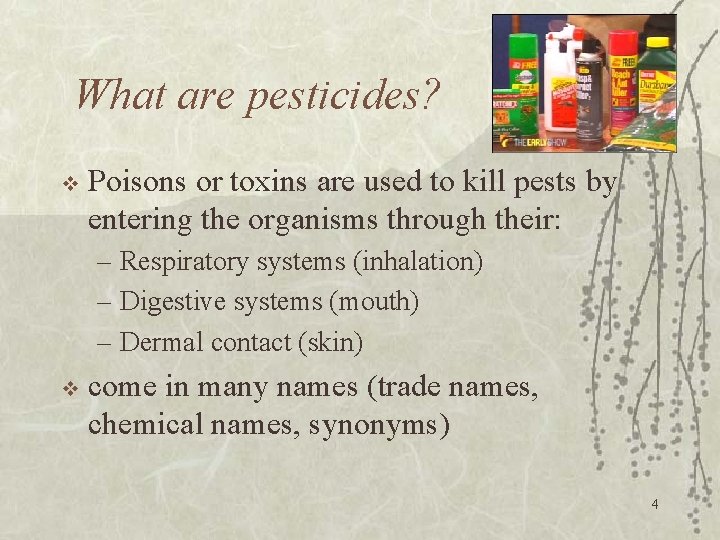
What are pesticides? v v v Museums provide food (organic objects) and a suitable habitat (quite, dark, and comfortable place) for pests. Pesticides, fungicides, herbicides, and other substances are chemicals that have been used to prevent, destroy, or repel pests in order to preserve museum collections Pesticides applied in the past are now known to be toxic to humans 3
What are pesticides? v Poisons or toxins are used to kill pests by entering the organisms through their: – Respiratory systems (inhalation) – Digestive systems (mouth) – Dermal contact (skin) v come in many names (trade names, chemical names, synonyms) 4
What are these toxic pesticides applied in the past? v Types of pesticides used in the museums: – Inorganic pesticides - contain heavy metals that are highly toxic to any living creature. Arsenic, lead, and mercury containing ones are common. Due to their physical and chemical nature they are persistent – Other type of pesticides - are usually volatile organic chemical compositions, yet poisonous by-products may not readily be decomposed – Sometimes the mixture of the two 5
The history of pesticide use v v Pesticides use by field collectors and museum personnel on natural history collections and ethnological artifacts was common from the late 19 th century to the mid-20 th century. Arsenical soaps and mercuric chloride were used in taxidermy collections, which was adapted later to natural history and ethnographic collections 6
The history of pesticide use v v Along with inorganic pesticides some toxic organic pesticides such as dichloro-dihpenyltrichloroethane (DDT), dichlorvos (DDVP), and mothballs (paradichlorobenzene or naphthalene) have been used. Applications involved fumigation, dusting, spraying, and sometimes shoveling chemical concoctions onto artifacts 7
The history of pesticide use v v 1980 arsenic containing pesticides are restricted, but the utilization was ceased in the late 80 s. Mercuric chloride restricted in the 1970 s and ceased in the late 80 s. 8
The pesticide issue v NAGPRA objects – 1995 Hopi “Friends” at Harvard Peabody Museum contaminated with As v v Handling the sacred objects extensively during initial cleaning, repair, and preparation for storage, almost daily during their long-term care Storage places used by most family members – newborns to elders, were underground ceremonial chambers that were overcrowded and had no ventilation along with houses where dry food was kept and daily activities took place. 9
The pesticide issue v v v NAGPRA (January 1996 addition 10. 10(e) t) that gives the museums the responsibility to report on pesticides treatment histories. Seminars It was required that a proper documentation to inform tribes during repatriation process is prepared by the museums because “there was no recognition of the educational needs of tribes who would need to interpret the technical information” (Loma’omvaya). 10
The pesticide issue v It was decided toxicologists and museum health professionals should be involved in to decide the levels of toxic inorganics (Pb, As, and Hg) found in these objects. – Nature of the pesticide – Place of the pesticide within the artifact – Amount of the pesticide in/on the artifact 11
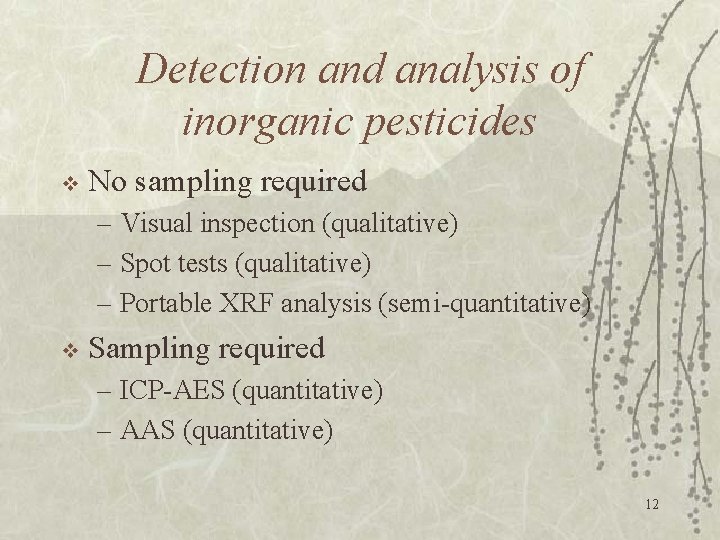
Detection and analysis of inorganic pesticides v No sampling required – Visual inspection (qualitative) – Spot tests (qualitative) – Portable XRF analysis (semi-quantitative) v Sampling required – ICP-AES (quantitative) – AAS (quantitative) 12
X-Ray Florescence Technique –Offers elemental analysis of materials –Elements with an atomic number of 15 (phosphorus) and higher can be identified with air path XRF instruments –For lighter elements a vacuum can be used. 13
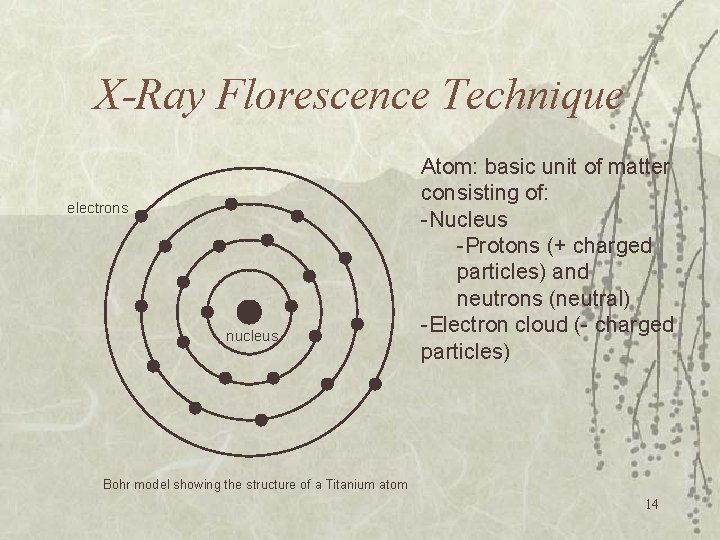
X-Ray Florescence Technique electrons nucleus Atom: basic unit of matter consisting of: -Nucleus -Protons (+ charged particles) and neutrons (neutral) -Electron cloud (- charged particles) Bohr model showing the structure of a Titanium atom 14
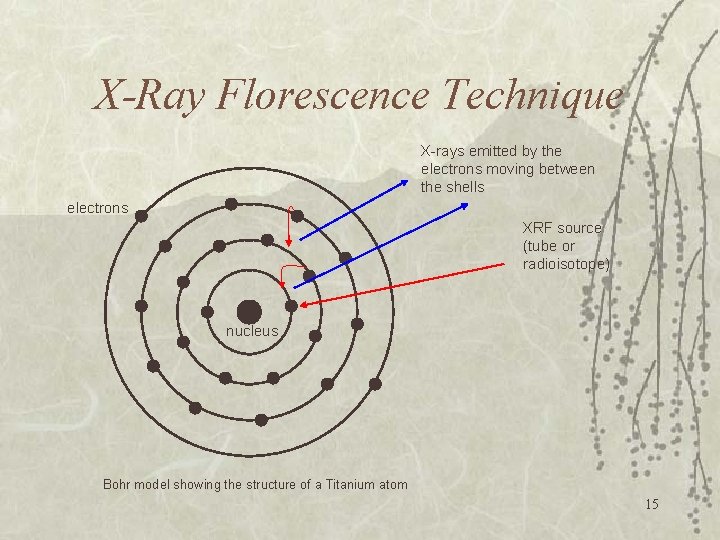
X-Ray Florescence Technique X-rays emitted by the electrons moving between the shells electrons XRF source (tube or radioisotope) nucleus Bohr model showing the structure of a Titanium atom 15
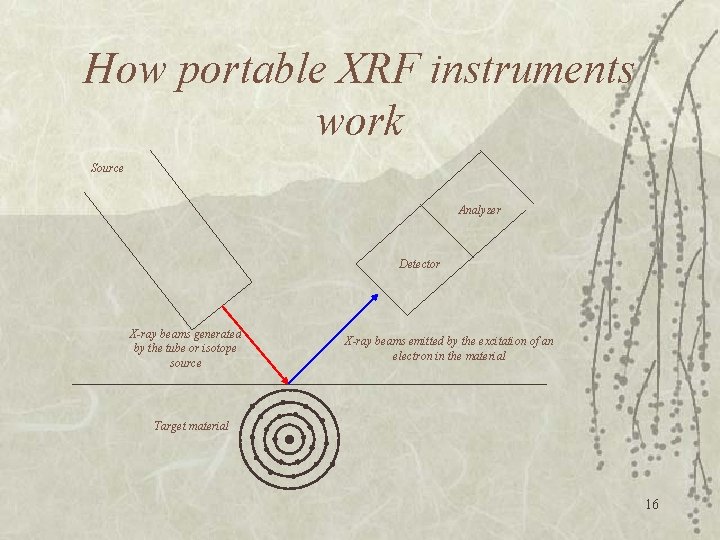
How portable XRF instruments work Source Analyzer Detector X-ray beams generated by the tube or isotope source X-ray beams emitted by the excitation of an electron in the material Target material 16
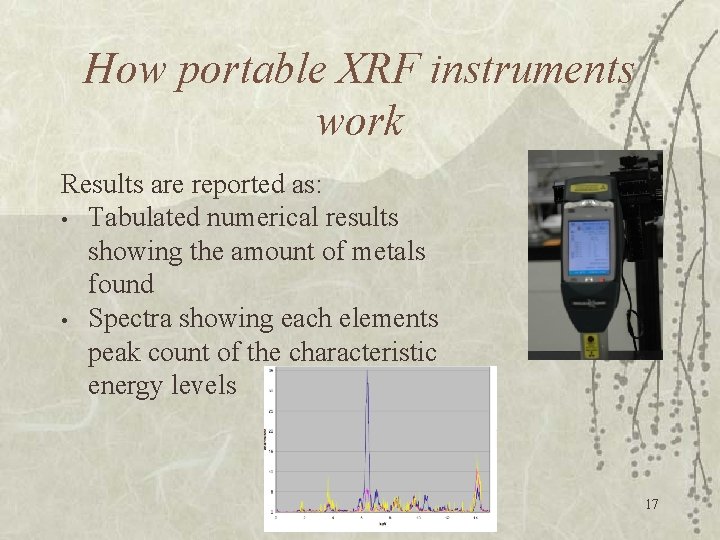
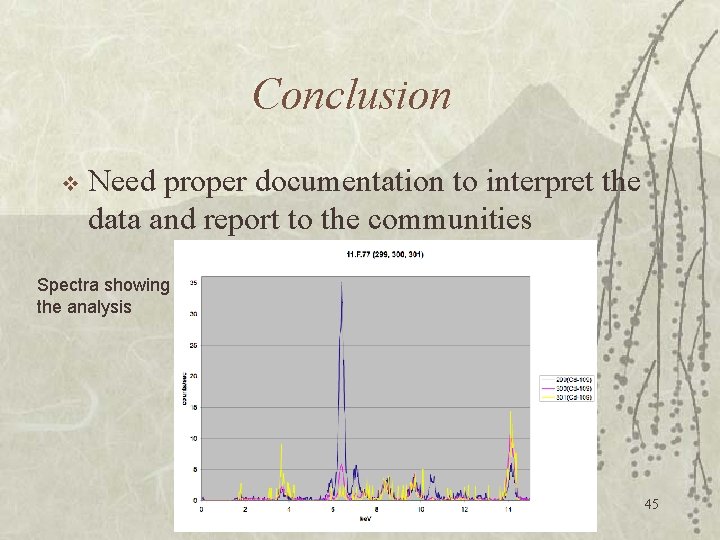
How portable XRF instruments work Results are reported as: • Tabulated numerical results showing the amount of metals found • Spectra showing each elements peak count of the characteristic energy levels 17
Handheld XRF analyzers have advantages and disadvantages Some advantages are…. 18
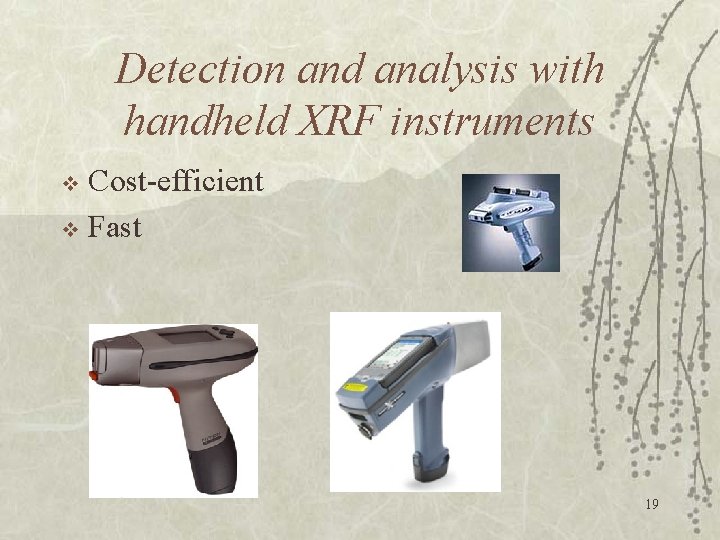
Detection and analysis with handheld XRF instruments Cost-efficient v Fast v 19
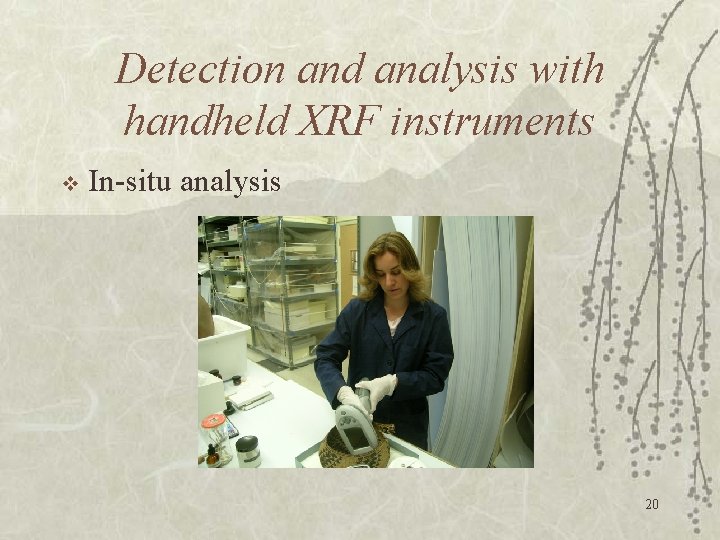
Detection and analysis with handheld XRF instruments v In-situ analysis 20
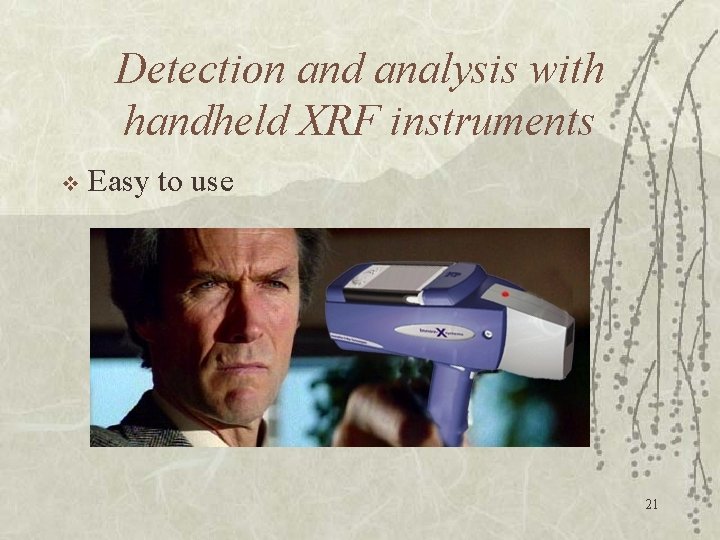
Detection and analysis with handheld XRF instruments v Easy to use 21
Limiting factors in quantitative analysis of organic objects Some disadvantages of the portable XRF instruments are due to: • Object • Instrument • Or both 22
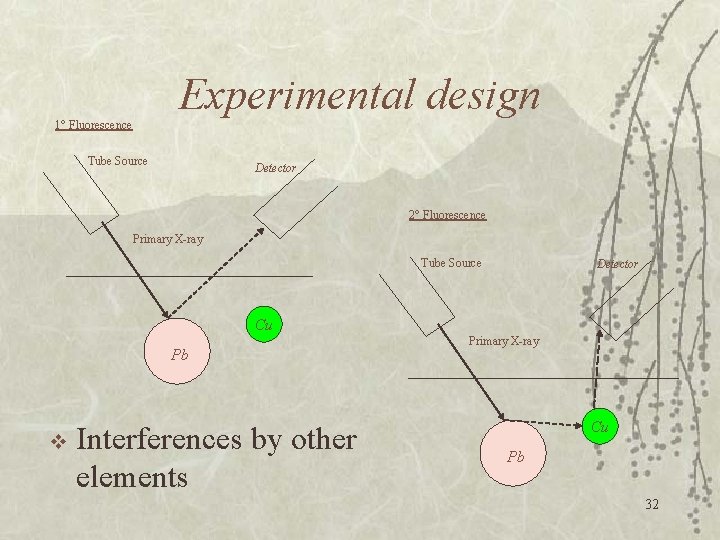
Limiting factors in quantitative analysis of organic objects Some disadvantages are: • Relative humidity and/or temperature affect both the analyzer and the substrate • Density and geometry of the substrate, instruments calibrated for the soil and scrap metal industry. • Interferences caused by elements other than the metal of interest (by absorption, scattering, or enhancing the fluorescence) • Detection limits of the element of interest • Elements in question are not homogenously distributed in or on the artifact 23
Limiting factors in quantitative analysis of organic objects Let’s investigate these limiting factors • Density and geometry (thickness and surface geometry) of the substrate • Interferences caused by elements other than the metal of interest (by absorption, scattering, or enhancing the fluorescence) • Relative humidity and/or temperature 24
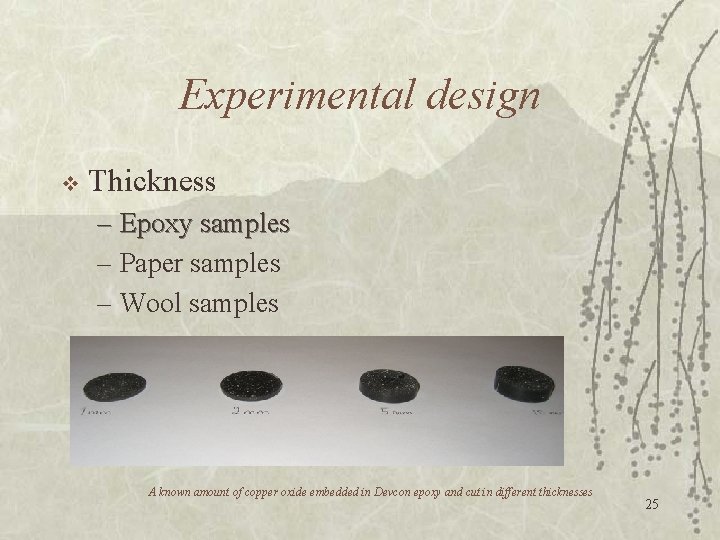
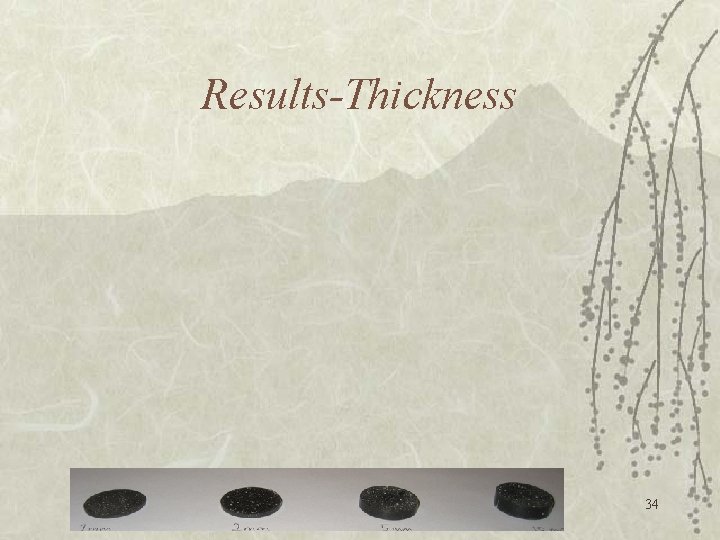
Experimental design v Thickness – Epoxy samples – Paper samples – Wool samples A known amount of copper oxide embedded in Devcon epoxy and cut in different thicknesses 25
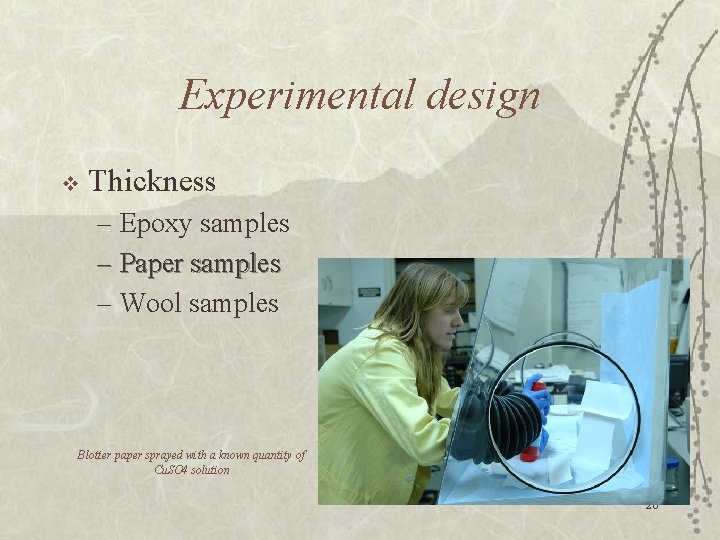
Experimental design v Thickness – Epoxy samples – Paper samples – Wool samples Blotter paper sprayed with a known quantity of Cu. SO 4 solution 26
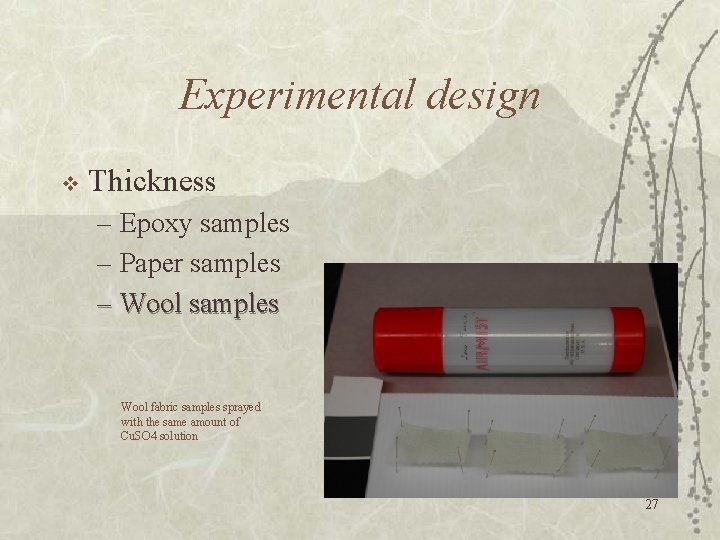
Experimental design v Thickness – Epoxy samples – Paper samples – Wool samples Wool fabric samples sprayed with the same amount of Cu. SO 4 solution 27
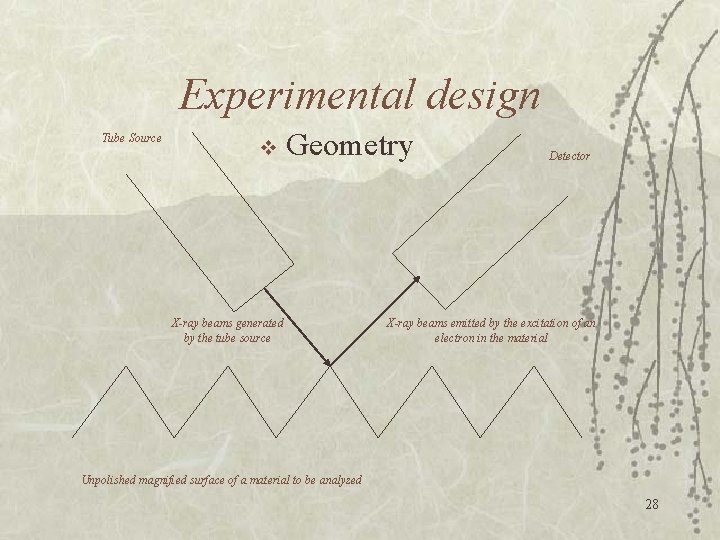
Experimental design Tube Source v Geometry X-ray beams generated by the tube source Detector X-ray beams emitted by the excitation of an electron in the material Unpolished magnified surface of a material to be analyzed 28
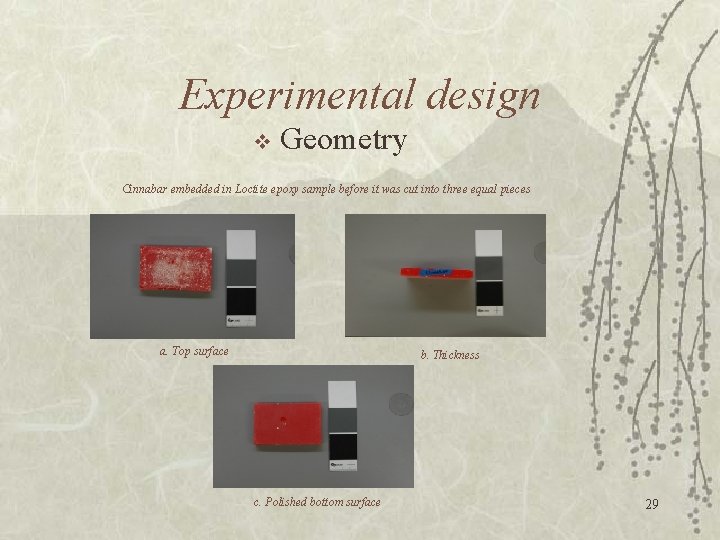
Experimental design v Geometry Cinnabar embedded in Loctite epoxy sample before it was cut into three equal pieces a. Top surface b. Thickness c. Polished bottom surface 29
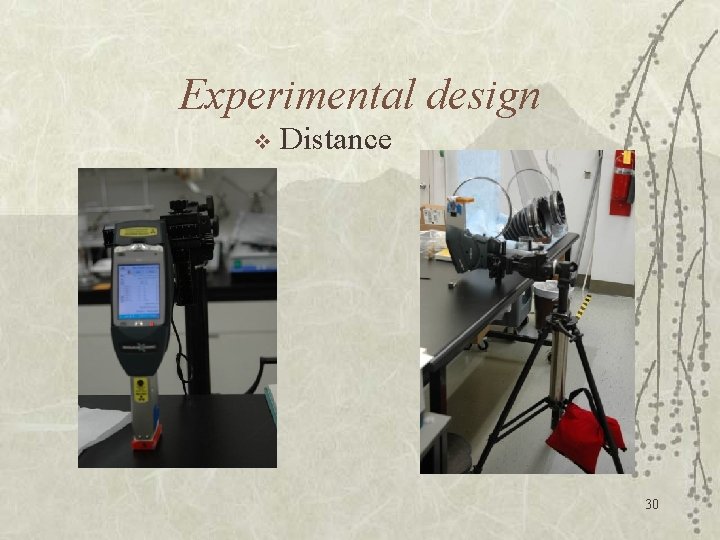
Experimental design v Distance 30
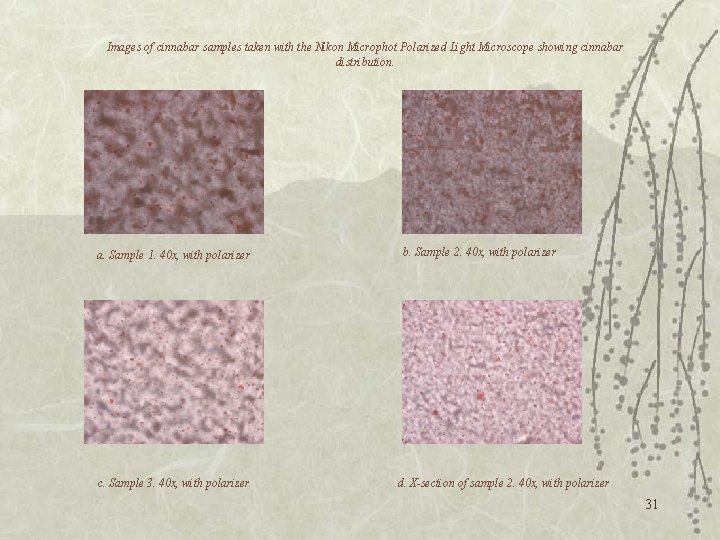
Images of cinnabar samples taken with the Nikon Microphot Polarized Light Microscope showing cinnabar distribution. a. Sample 1. 40 x, with polarizer c. Sample 3. 40 x, with polarizer b. Sample 2. 40 x, with polarizer d. X-section of sample 2. 40 x, with polarizer 31
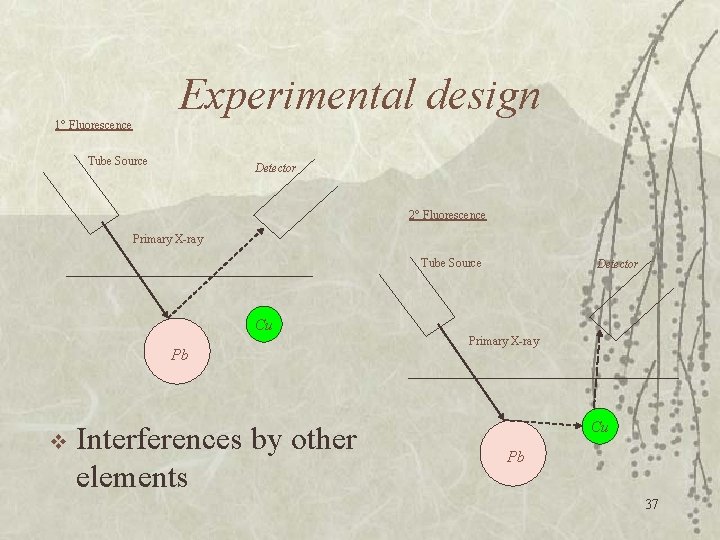
Experimental design 1° Fluorescence Tube Source Detector 2° Fluorescence Primary X-ray Tube Source Detector Cu Pb v Interferences by other elements Primary X-ray Cu Pb 32
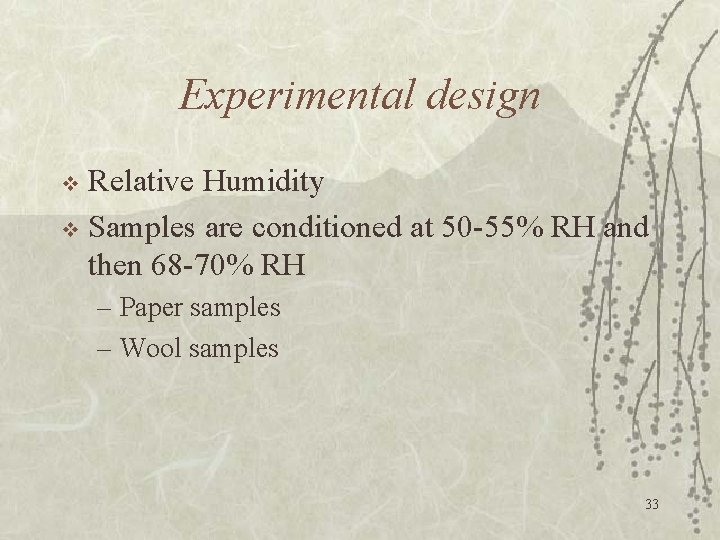
Experimental design Relative Humidity v Samples are conditioned at 50 -55% RH and then 68 -70% RH v – Paper samples – Wool samples 33
Results-Thickness 34
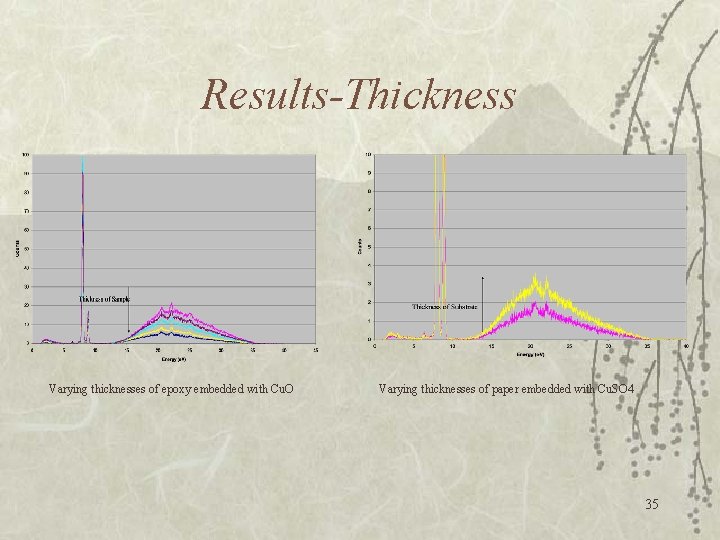
Results-Thickness 4 Varying thicknesses of epoxy embedded with Cu. O Varying thicknesses of paper embedded with Cu. SO 4 35
Results-Metal interference The change in the analyzed Pb/Cu ratio due to metal interferences 36
Experimental design 1° Fluorescence Tube Source Detector 2° Fluorescence Primary X-ray Tube Source Detector Cu Pb v Interferences by other elements Primary X-ray Cu Pb 37
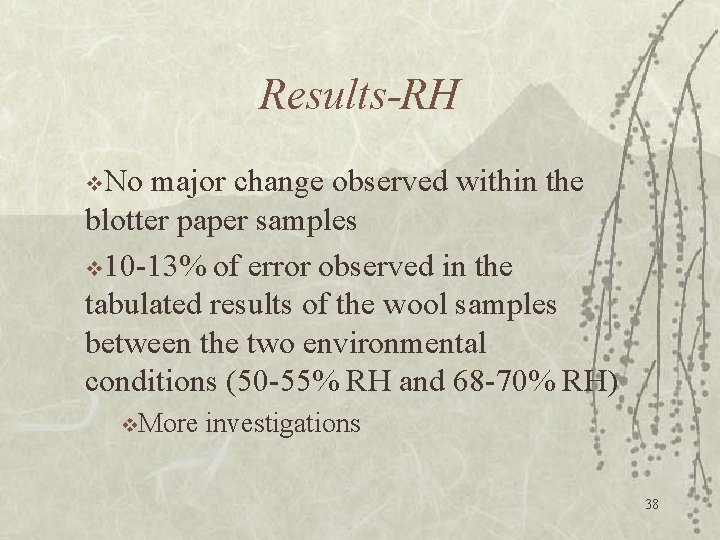
Results-RH v. No major change observed within the blotter paper samples v 10 -13% of error observed in the tabulated results of the wool samples between the two environmental conditions (50 -55% RH and 68 -70% RH) v. More investigations 38
Results-Geometry Two Trials of three cinnabar samples acquired from five spots each sample showing the quantity of Hg vs. polished surface 39
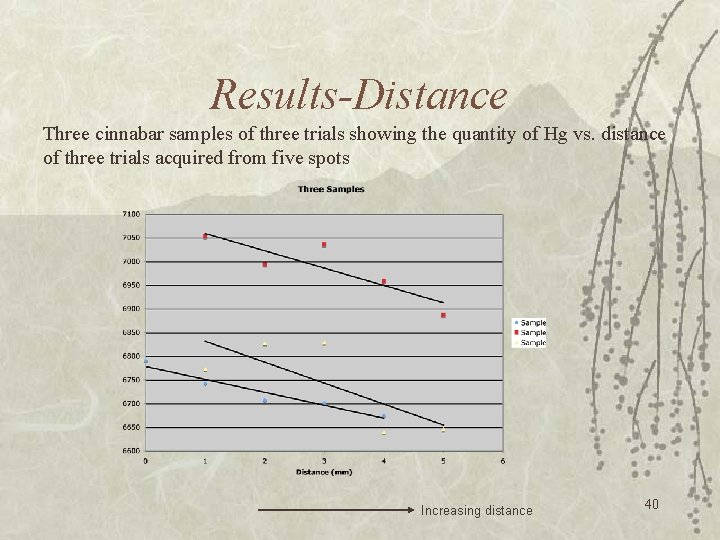
Results-Distance Three cinnabar samples of three trials showing the quantity of Hg vs. distance of three trials acquired from five spots Increasing distance 40
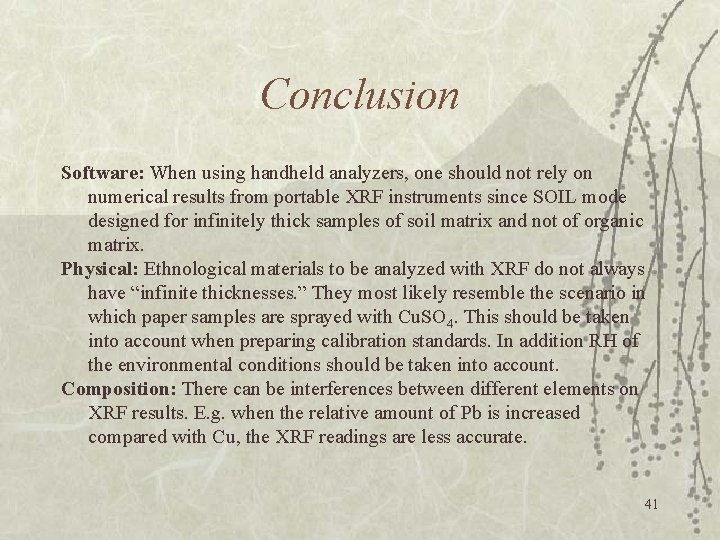
Conclusion Software: When using handheld analyzers, one should not rely on numerical results from portable XRF instruments since SOIL mode designed for infinitely thick samples of soil matrix and not of organic matrix. Physical: Ethnological materials to be analyzed with XRF do not always have “infinite thicknesses. ” They most likely resemble the scenario in which paper samples are sprayed with Cu. SO 4. This should be taken into account when preparing calibration standards. In addition RH of the environmental conditions should be taken into account. Composition: There can be interferences between different elements on XRF results. E. g. when the relative amount of Pb is increased compared with Cu, the XRF readings are less accurate. 41
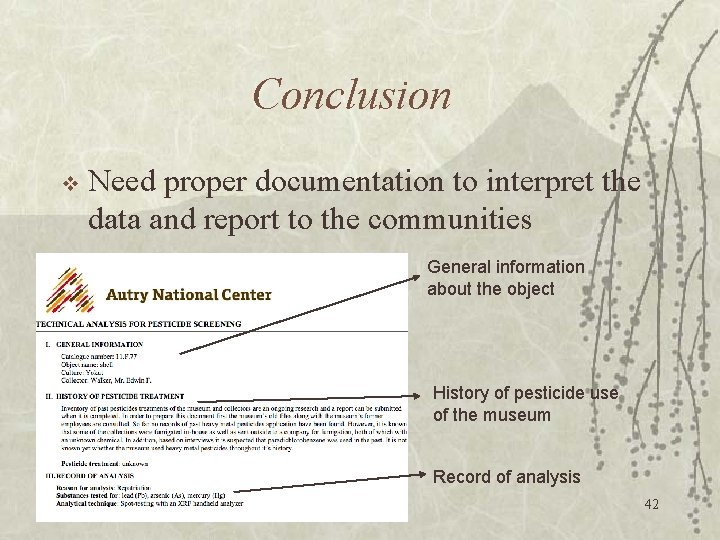
Conclusion v Need proper documentation to interpret the data and report to the communities General information about the object History of pesticide use of the museum Record of analysis 42
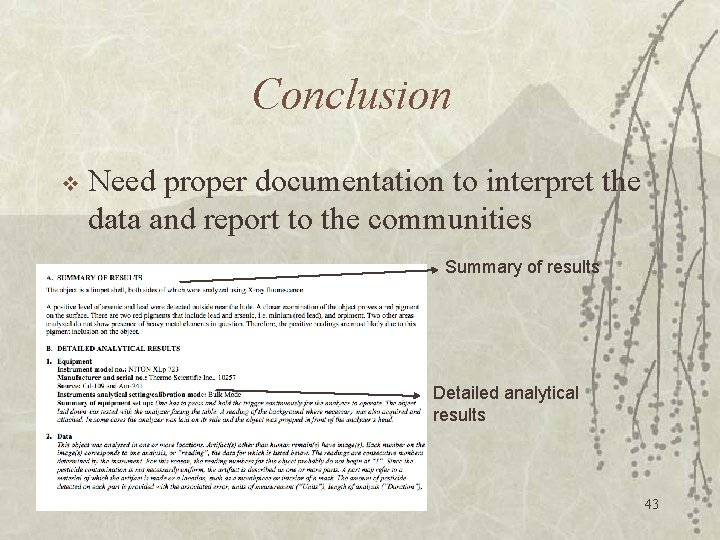
Conclusion v Need proper documentation to interpret the data and report to the communities Summary of results Detailed analytical results 43
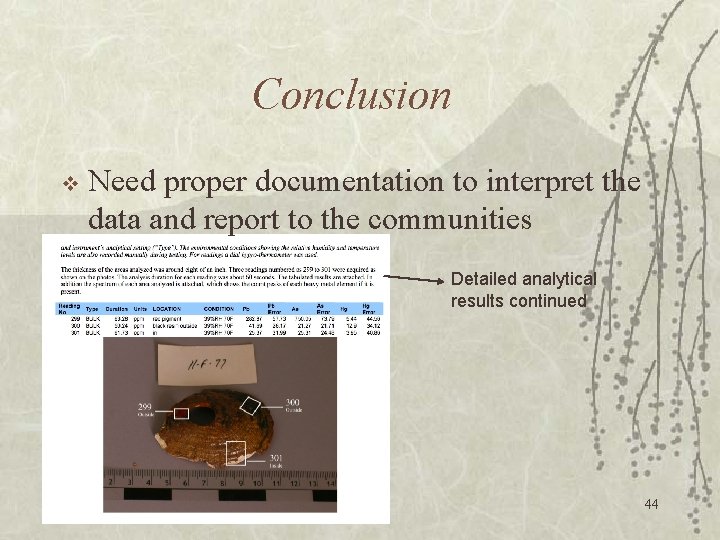
Conclusion v Need proper documentation to interpret the data and report to the communities Detailed analytical results continued 44
Conclusion v Need proper documentation to interpret the data and report to the communities Spectra showing the analysis 45
Acknowledgements v v v v Charlotte Eng and Frank Preusser, LACMA Jessie Johnson, NMAI Odile Madden, MCI Conservation and Collections staff, Southwest Museum Faculty, UCLA/Getty Conservation Program Cevat Üstün, physicist Yokut tribe 46
Thank you 47