
Limit Pricing and Entry Deterrence Chapter 12 Limit
- Slides: 23
Limit Pricing and Entry Deterrence Chapter 12: Limit Pricing and Entry Deterrence 1
Introduction • A firm that can restrict output to raise market price has market power • Microsoft (95% of operating systems) and Campbell’s (70% of tinned soup market) are giants in their industries • Have maintained their dominant position for many years – Why can’t existing rivals compete away the position of such firms? – Why aren’t new rivals lured by the profits? • Answer: firms with monopoly power may – eliminate existing rivals – prevent entry of new firms • These actions are predatory conduct if they are profitable only if rivals, in fact, exit – e. g. , R&D to reduce costs is not predatory Chapter 12: Limit Pricing and Entry Deterrence 2
Evolution of market structure • Evolution of markets depends on many factors – one is relationship between firm size and growth • Gibrat’s Law – – begin with equal sized firms each grows in each period by a rate drawn from a random distribution this distribution has constant mean and variance over time result is that firm size distribution approaches a log-normal distribution • Very mechanistic – no strategy for growth • Including strategic decision making affects distribution but not conclusion that firm sizes are unequal – What about the facts in the market place? Chapter 12: Limit Pricing and Entry Deterrence 3
Monopoly power and market entry • Several stylized facts about entry – entry is common – entry is generally small-scale • so small-scale entry is relatively easy – survival rate is low: >60% exit within 5 years – entry is highly correlated with exit • not consistent with entry being caused by excess profits • “revolving door” • reflects repeated attempts to penetrate markets dominated by large firms • Not always easy to prove that this reflects predatory conduct • But we need to understand predation it if we are to find it Chapter 12: Limit Pricing and Entry Deterrence 4
Predatory conduct and limit pricing • Predatory actions come in two broad forms – Limit pricing: prices so low that entry is deterred – Predatory pricing: prices so low that existing firms are driven out • Outcome of either action is the same—the monopolist retains control of the market • Legal action focuses on predatory pricing because this case has an identifiable victim – a firm that was in the market but that has left • Consider first a model of limit pricing – Stackelberg leader chooses output first – entrant believes that the leader is committed to this output choice – entrant has decreasing costs over some initial level of output Chapter 12: Limit Pricing and Entry Deterrence 5
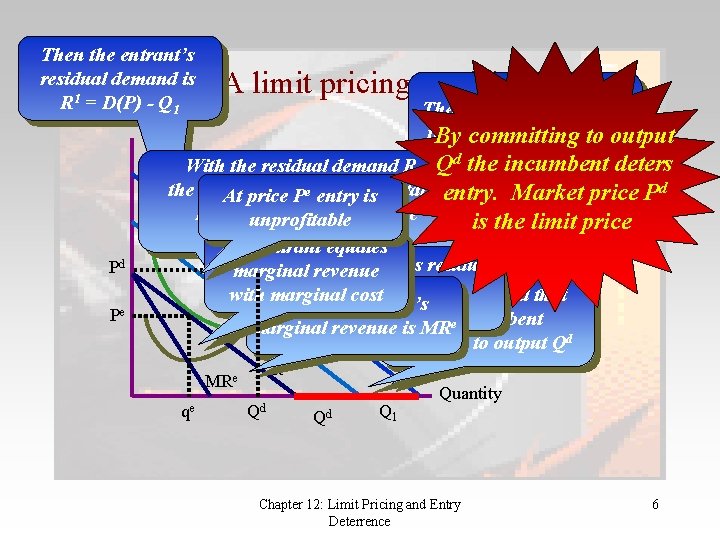
Then the entrant’s residual demand is R 1 = D(P) - Q 1 $/unit Pd Pe A limit pricing model These are the cost curves for potential entrant Bythe committing to output With the residual demand R 1, Qd the incumbent deters the entrant can. Poperate profitably. entry. Market price Pd e entry is At price Entry is not deterred by the unprofitable is the limit price R 1 incumbent choosing The entrant equates. Q 1. MC entrant’s residual marginale. The revenue ACe demand is with marginal Assumeinstead that thethat Then the. Rcost entrant’s e = D(P) - Qd the eincumbent commits marginal revenueincumbent is MR D(P) =to Market commits output to Demand output Q 1 Q d Re MRe qe Qd Qd Q 1 Quantity Chapter 12: Limit Pricing and Entry Deterrence 6
Limit pricing • Committing to output Qd may be aimed either at eliminating an existing rival or driving out a potential entrant. • Either way, several questions arise: – Is limit pricing more profitable than other strategies? – Is the output commitment credible? – If output is costly to adjust then commitment is possible • why should this property hold? – could be claimed to be ad hoc to support theory • even if it holds, is monopoly at output Qd better than Cournot? – may not be if the entrant’s costs are low enough • Credibility may relate output to capacity Chapter 12: Limit Pricing and Entry Deterrence 7
Capacity expansion and entry deterrence • For predation to be successful and rational – the incumbent must convince the entrant that the market after the entrant comes in will not be profitable one • How can the incumbent credibly make this threat? • One possible mechanism – install capacity in advance of production • installed capacity is a commitment to a minimum level of output • the lead firm can manipulate entrants through capacity choice • the lead firm may be able to deter entry through its capacity choice – but is this credible? – capacity must be costly to install and should be irreversible Chapter 12: Limit Pricing and Entry Deterrence 8
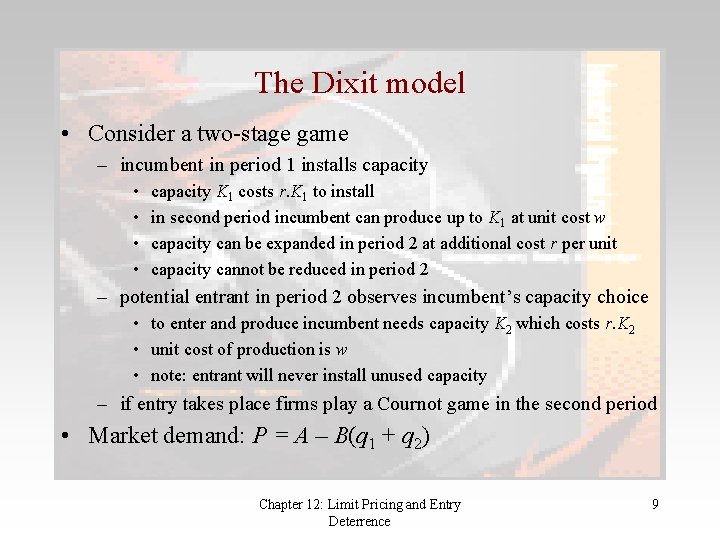
The Dixit model • Consider a two-stage game – incumbent in period 1 installs capacity • • capacity K 1 costs r. K 1 to install in second period incumbent can produce up to K 1 at unit cost w capacity can be expanded in period 2 at additional cost r per unit capacity cannot be reduced in period 2 – potential entrant in period 2 observes incumbent’s capacity choice • to enter and produce incumbent needs capacity K 2 which costs r. K 2 • unit cost of production is w • note: entrant will never install unused capacity – if entry takes place firms play a Cournot game in the second period • Market demand: P = A – B(q 1 + q 2) Chapter 12: Limit Pricing and Entry Deterrence 9
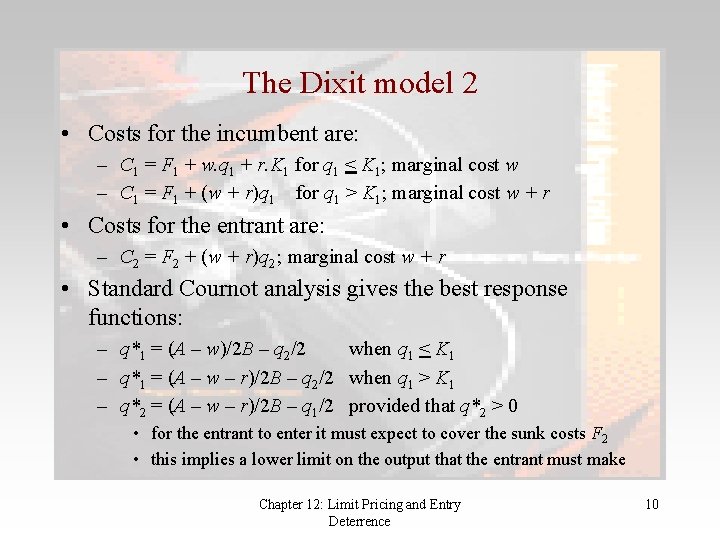
The Dixit model 2 • Costs for the incumbent are: – C 1 = F 1 + w. q 1 + r. K 1 for q 1 < K 1; marginal cost w – C 1 = F 1 + (w + r)q 1 for q 1 > K 1; marginal cost w + r • Costs for the entrant are: – C 2 = F 2 + (w + r)q 2 ; marginal cost w + r • Standard Cournot analysis gives the best response functions: – q*1 = (A – w)/2 B – q 2/2 when q 1 < K 1 – q*1 = (A – w – r)/2 B – q 2/2 when q 1 > K 1 – q*2 = (A – w – r)/2 B – q 1/2 provided that q*2 > 0 • for the entrant to enter it must expect to cover the sunk costs F 2 • this implies a lower limit on the output that the entrant must make Chapter 12: Limit Pricing and Entry Deterrence 10
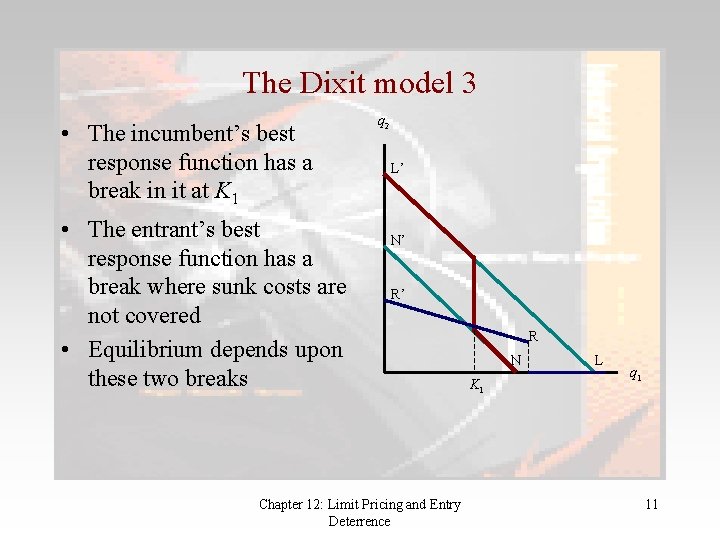
The Dixit model 3 • The incumbent’s best response function has a break in it at K 1 • The entrant’s best response function has a break where sunk costs are not covered • Equilibrium depends upon these two breaks q 2 L’ N’ R’ Chapter 12: Limit Pricing and Entry Deterrence R N K 1 L q 1 11
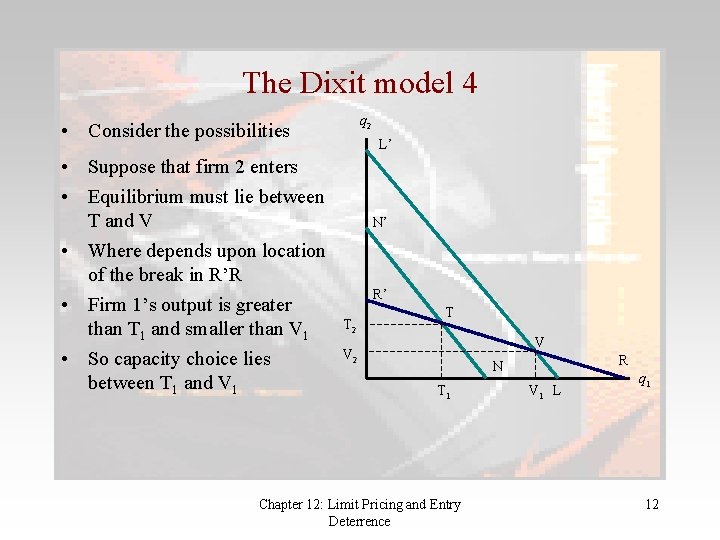
The Dixit model 4 q 2 • Consider the possibilities • Suppose that firm 2 enters • Equilibrium must lie between T and V • Where depends upon location of the break in R’R • Firm 1’s output is greater than T 1 and smaller than V 1 • So capacity choice lies between T 1 and V 1 L’ N’ R’ T 2 T V V 2 R N T 1 Chapter 12: Limit Pricing and Entry Deterrence V 1 L q 1 12
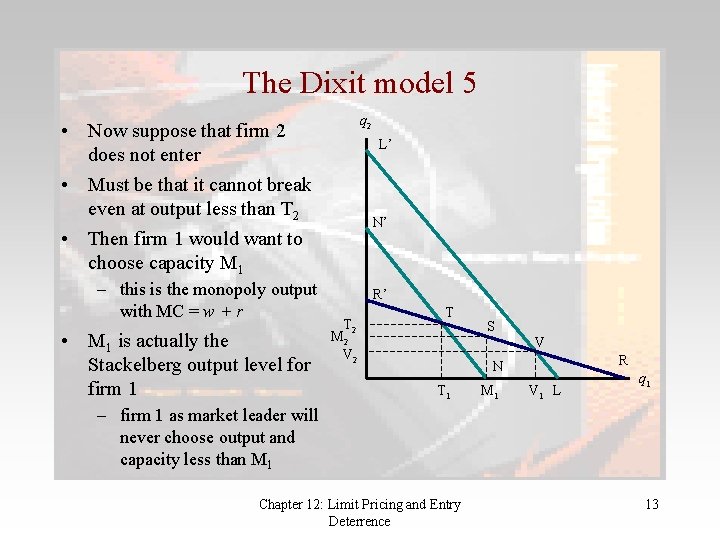
The Dixit model 5 q 2 • Now suppose that firm 2 does not enter • Must be that it cannot break even at output less than T 2 • Then firm 1 would want to choose capacity M 1 – this is the monopoly output with MC = w + r • M 1 is actually the Stackelberg output level for firm 1 L’ N’ R’ T 2 M 2 V 2 T S V R N T 1 M 1 V 1 L q 1 – firm 1 as market leader will never choose output and capacity less than M 1 Chapter 12: Limit Pricing and Entry Deterrence 13
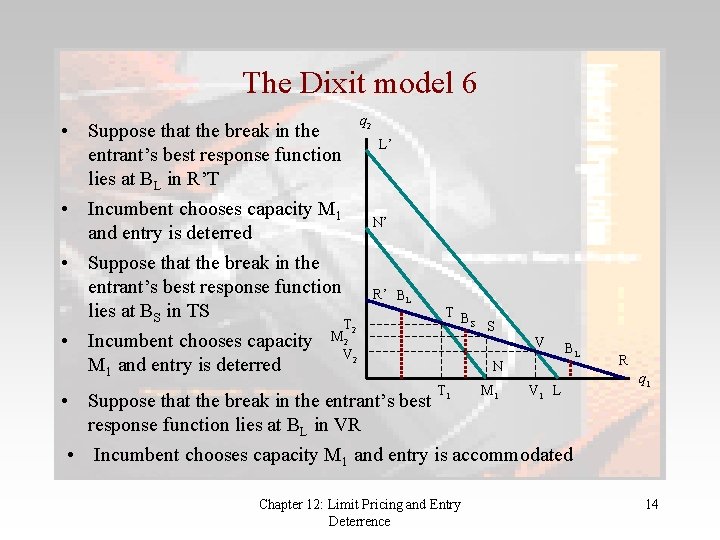
The Dixit model 6 • Suppose that the break in the entrant’s best response function lies at BL in R’T • Incumbent chooses capacity M 1 and entry is deterred • Suppose that the break in the entrant’s best response function lies at BS in TS T 2 M • Incumbent chooses capacity 2 V 2 M 1 and entry is deterred q 2 L’ N’ R’ BL T B S S V BL N T 1 M 1 V 1 L R q 1 • Suppose that the break in the entrant’s best response function lies at BL in VR • Incumbent chooses capacity M 1 and entry is accommodated Chapter 12: Limit Pricing and Entry Deterrence 14
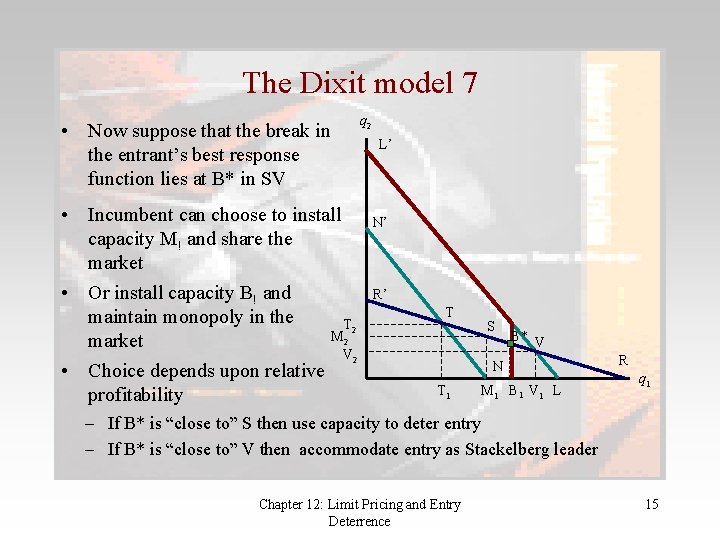
The Dixit model 7 • Now suppose that the break in the entrant’s best response function lies at B* in SV • Incumbent can choose to install capacity M! and share the market • Or install capacity B! and maintain monopoly in the T 2 M 2 market V 2 • Choice depends upon relative profitability q 2 L’ N’ R’ T S B* V N T 1 M 1 B 1 V 1 L R q 1 – If B* is “close to” S then use capacity to deter entry – If B* is “close to” V then accommodate entry as Stackelberg leader Chapter 12: Limit Pricing and Entry Deterrence 15
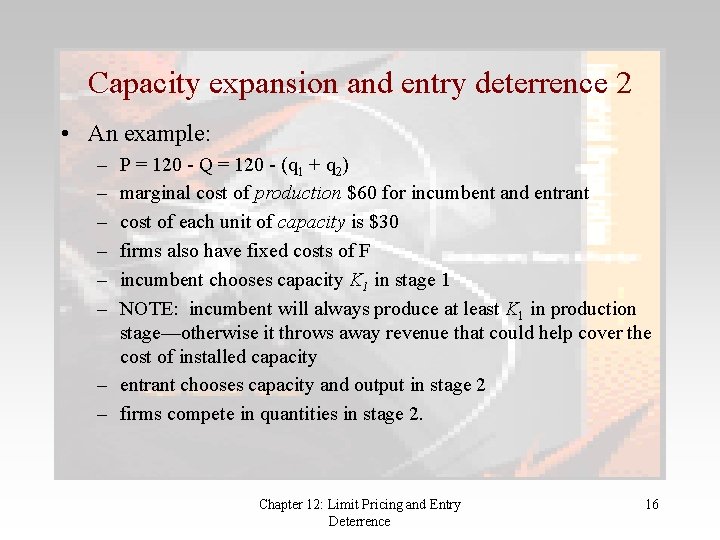
Capacity expansion and entry deterrence 2 • An example: – – – P = 120 - Q = 120 - (q 1 + q 2) marginal cost of production $60 for incumbent and entrant cost of each unit of capacity is $30 firms also have fixed costs of F incumbent chooses capacity K 1 in stage 1 NOTE: incumbent will always produce at least K 1 in production stage—otherwise it throws away revenue that could help cover the cost of installed capacity – entrant chooses capacity and output in stage 2 – firms compete in quantities in stage 2. Chapter 12: Limit Pricing and Entry Deterrence 16
Entry deterrence • Entry may not occur – entrant’s costs are too high • blockaded entry • not predatory • Entry may be accommodated – entrant’s costs are low • incumbent takes advantage of its being first in the market • but does not deter • Entry may be strategically deterred – strategic deterrence profitable for the incumbent – installs excess capacity as an entry-deterring strategy – uses a credible commitment Chapter 12: Limit Pricing and Entry Deterrence 17
Preemption and the persistence of monopoly • A distinct but related issue is an incumbent investing early to prevent new entry – market may be a natural monopoly at current size – but expected to grow and attract entry • Now we have an issue of timing • It may be in the interests of an incumbent to preempt by – building new plants prior to a rival’s entry – adding new products prior to a rival’s entry • Related to another issue – entrant may race to innovate to preempt entry • A simple model: Chapter 12: Limit Pricing and Entry Deterrence 18
Preemption and the persistence of monopoly 2 • A simple market with an incumbent – current profit M – market is expected to double in the next period and stay at the new size in perpetuity – to meet the new demand requires additional capacity at cost of F – the new capacity can be added: • In first period or in second period • By incumbent or by new entrant • With no threat of entry – incumbent installs new capacity at beginning of second period – profit is 2 M minus cost of capacity • With threat of entry may need to install capacity early Chapter 12: Limit Pricing and Entry Deterrence 19
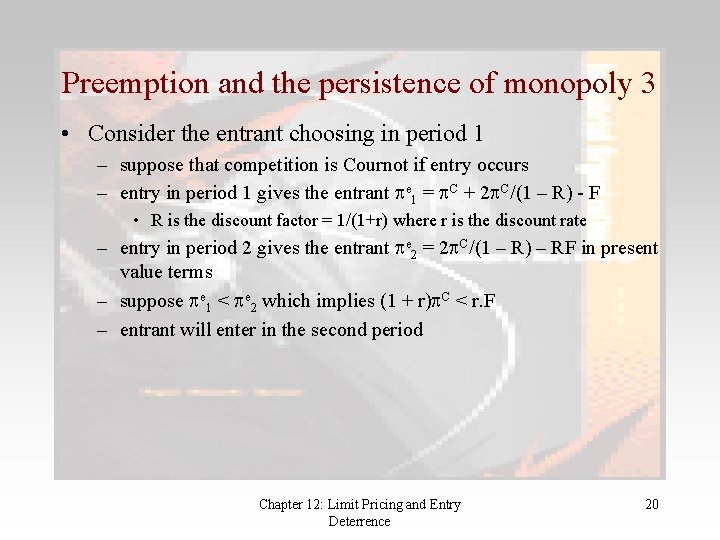
Preemption and the persistence of monopoly 3 • Consider the entrant choosing in period 1 – suppose that competition is Cournot if entry occurs – entry in period 1 gives the entrant e 1 = C + 2 C/(1 – R) - F • R is the discount factor = 1/(1+r) where r is the discount rate – entry in period 2 gives the entrant e 2 = 2 C/(1 – R) – RF in present value terms – suppose e 1 < e 2 which implies (1 + r) C < r. F – entrant will enter in the second period Chapter 12: Limit Pricing and Entry Deterrence 20
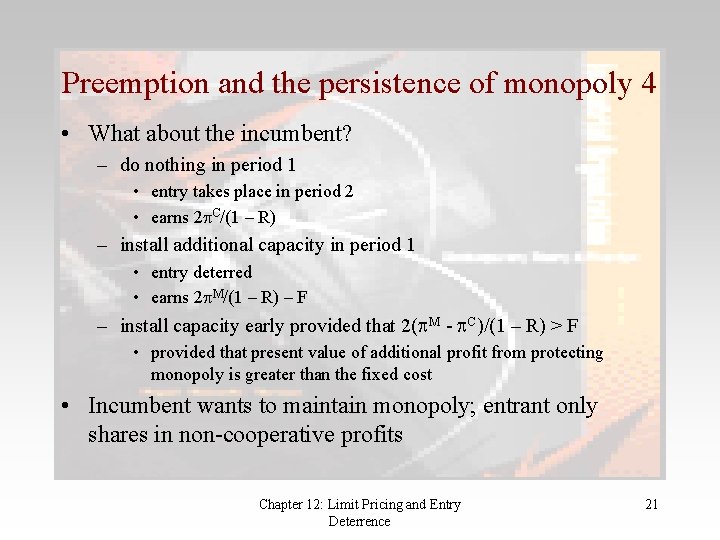
Preemption and the persistence of monopoly 4 • What about the incumbent? – do nothing in period 1 • entry takes place in period 2 • earns 2 C/(1 – R) – install additional capacity in period 1 • entry deterred • earns 2 M/(1 – R) – F – install capacity early provided that 2( M - C)/(1 – R) > F • provided that present value of additional profit from protecting monopoly is greater than the fixed cost • Incumbent wants to maintain monopoly; entrant only shares in non-cooperative profits Chapter 12: Limit Pricing and Entry Deterrence 21
Market preemption • Why does the incumbent have a stronger incentive to invest “early”? – – the incumbent is protecting a valuable monopoly the entrant is seeking a share of the market so the incumbent’s incentive is stronger willing to incur initial losses to maintain market control Chapter 12: Limit Pricing and Entry Deterrence 22
Evidence on predatory expansion • Some anecdotal evidence • Alcoa – evidence that consistently expanded capacity in advance of demand • Safeway in Edmonton – evidence that it aggressively expanded store locations in response to potential entry • Du. Pont in titanium oxide – rapidly expanded capacity in response to to changes in rivals’ costs – market share grew from 34% to 46% Chapter 12: Limit Pricing and Entry Deterrence 23