
Limbs Tutor Information PULSE Preparation for Finals Tutor
Limbs: Tutor Information PULSE: Preparation for Finals Tutor name
Resource summary • Common viva questions/topics • Case-based additional information (Cases 1 – 9)
Common questions • Things you might pick up and questions you will get asked…
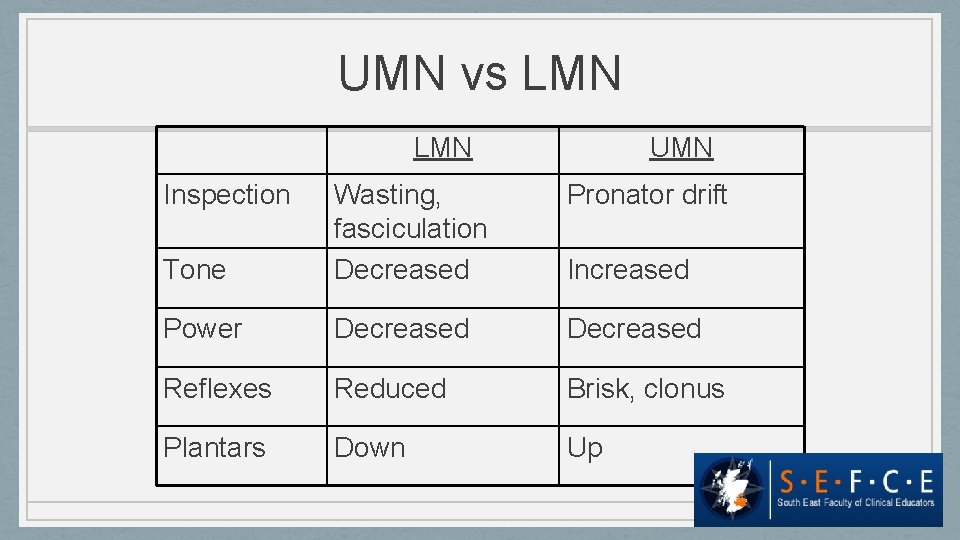
UMN vs LMN Inspection UMN Pronator drift Tone Wasting, fasciculation Decreased Power Decreased Reflexes Reduced Brisk, clonus Plantars Down Up Increased
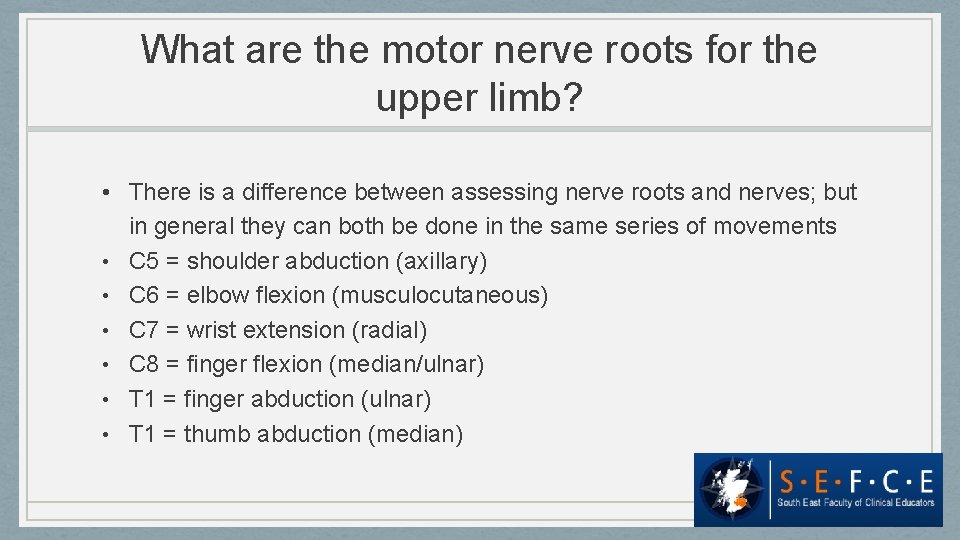
What are the motor nerve roots for the upper limb? • There is a difference between assessing nerve roots and nerves; but in general they can both be done in the same series of movements • C 5 = shoulder abduction (axillary) • C 6 = elbow flexion (musculocutaneous) • C 7 = wrist extension (radial) • C 8 = finger flexion (median/ulnar) • T 1 = finger abduction (ulnar) • T 1 = thumb abduction (median)
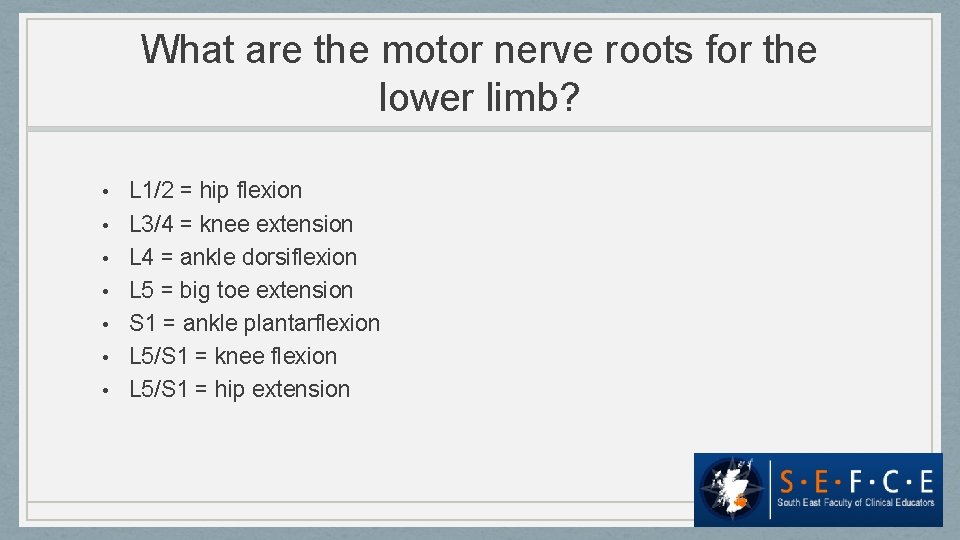
What are the motor nerve roots for the lower limb? • • L 1/2 = hip flexion L 3/4 = knee extension L 4 = ankle dorsiflexion L 5 = big toe extension S 1 = ankle plantarflexion L 5/S 1 = knee flexion L 5/S 1 = hip extension
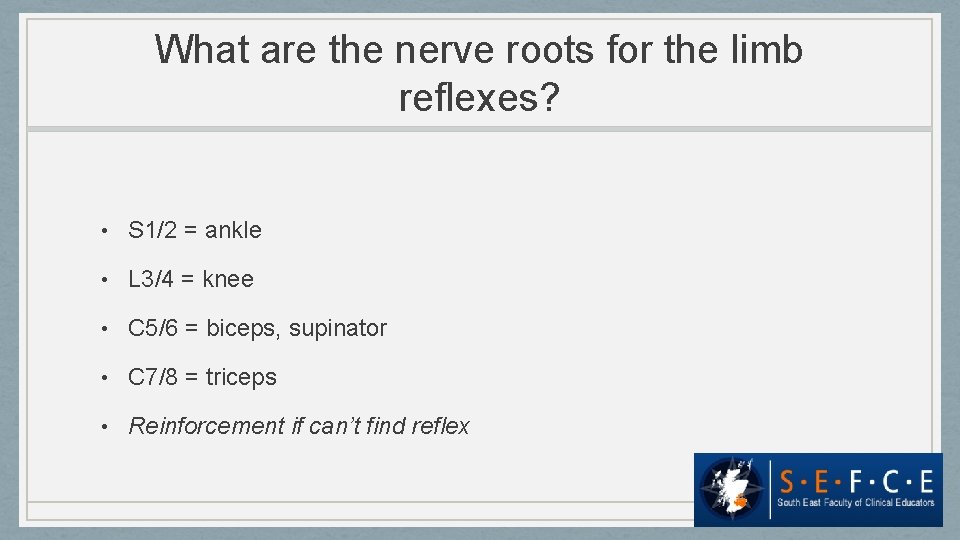
What are the nerve roots for the limb reflexes? • S 1/2 = ankle • L 3/4 = knee • C 5/6 = biceps, supinator • C 7/8 = triceps • Reinforcement if can’t find reflex
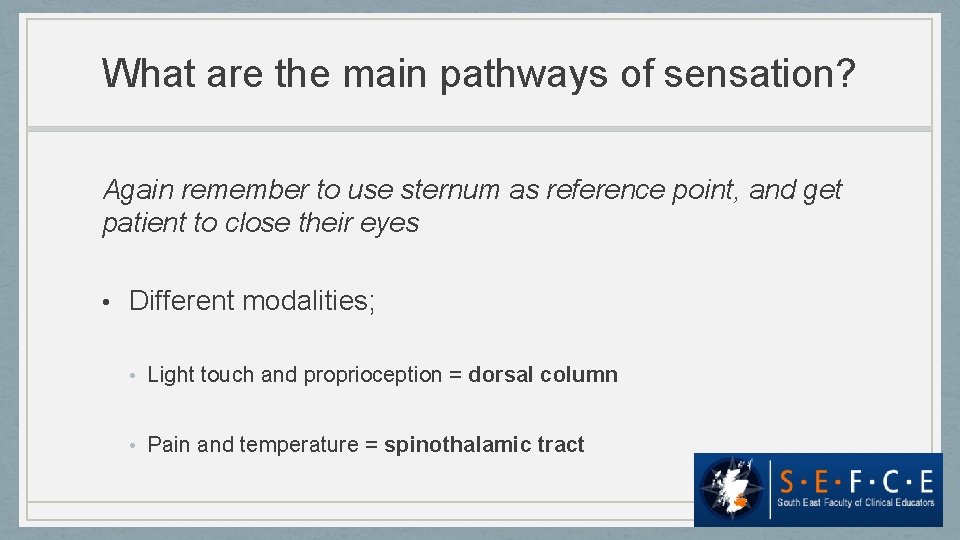
What are the main pathways of sensation? Again remember to use sternum as reference point, and get patient to close their eyes • Different modalities; • Light touch and proprioception = dorsal column • Pain and temperature = spinothalamic tract
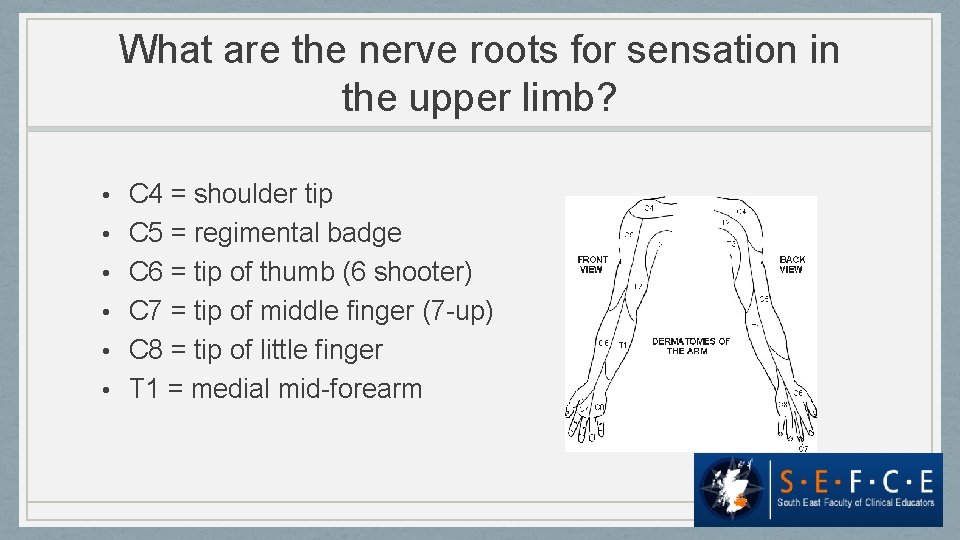
What are the nerve roots for sensation in the upper limb? • C 4 = shoulder tip • C 5 = regimental badge • C 6 = tip of thumb (6 shooter) • C 7 = tip of middle finger (7 -up) • C 8 = tip of little finger • T 1 = medial mid-forearm
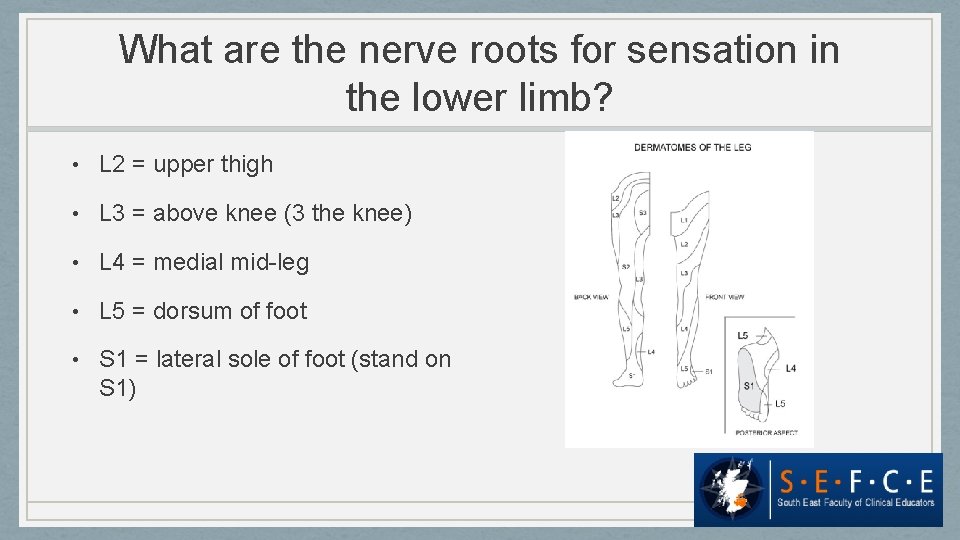
What are the nerve roots for sensation in the lower limb? • L 2 = upper thigh • L 3 = above knee (3 the knee) • L 4 = medial mid-leg • L 5 = dorsum of foot • S 1 = lateral sole of foot (stand on S 1)
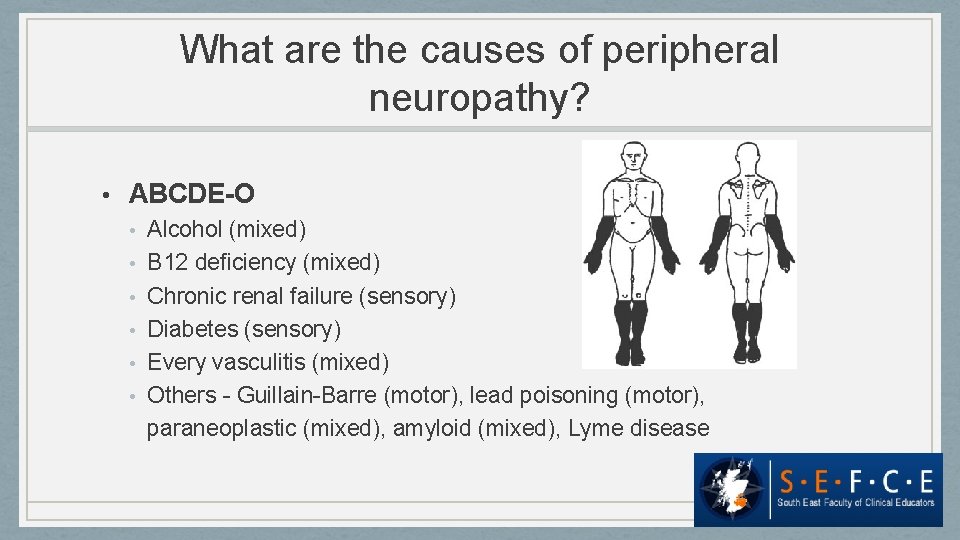
What are the causes of peripheral neuropathy? • ABCDE-O • Alcohol (mixed) • B 12 deficiency (mixed) • Chronic renal failure (sensory) • Diabetes (sensory) • Every vasculitis (mixed) • Others - Guillain-Barre (motor), lead poisoning (motor), paraneoplastic (mixed), amyloid (mixed), Lyme disease
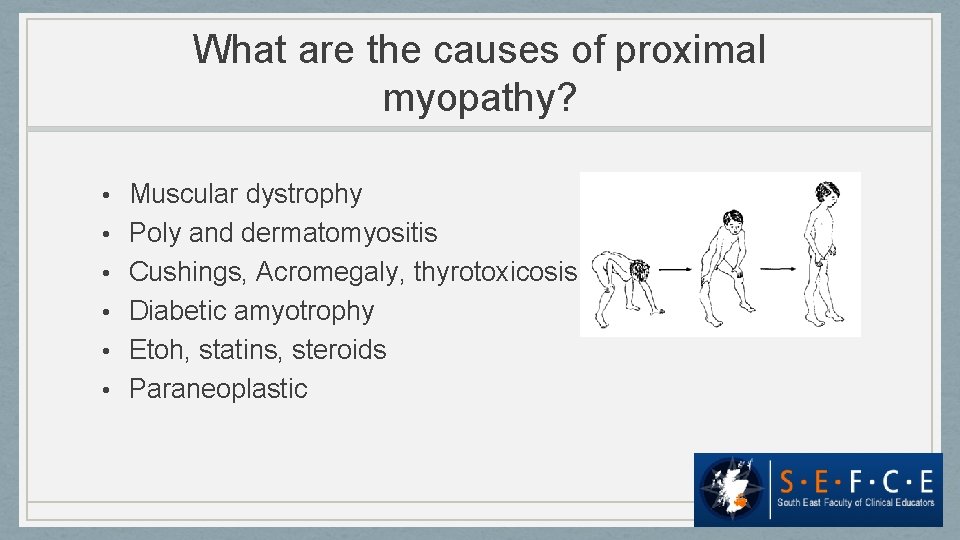
What are the causes of proximal myopathy? • Muscular dystrophy • Poly and dermatomyositis • Cushings, Acromegaly, thyrotoxicosis • Diabetic amyotrophy • Etoh, statins, steroids • Paraneoplastic
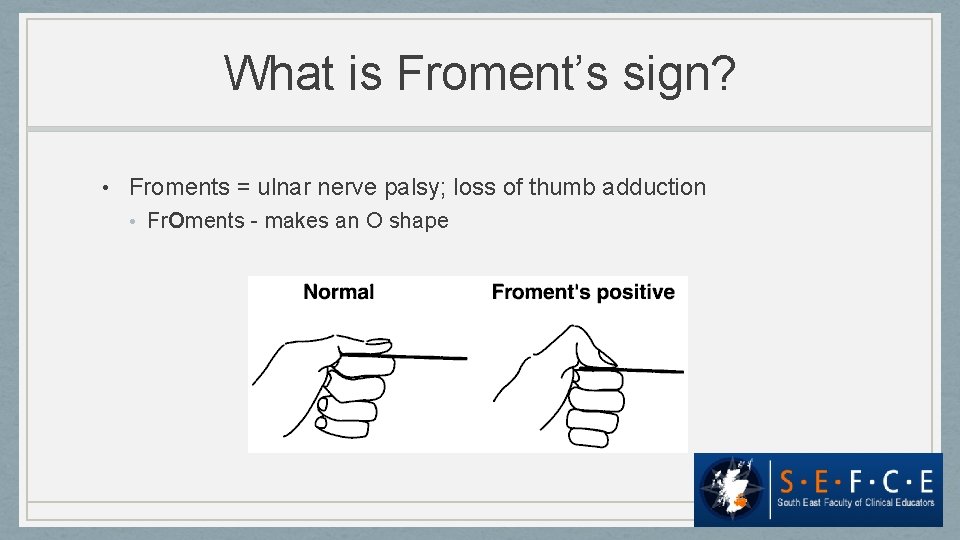
What is Froment’s sign? • Froments = ulnar nerve palsy; loss of thumb adduction • Fr. Oments - makes an O shape
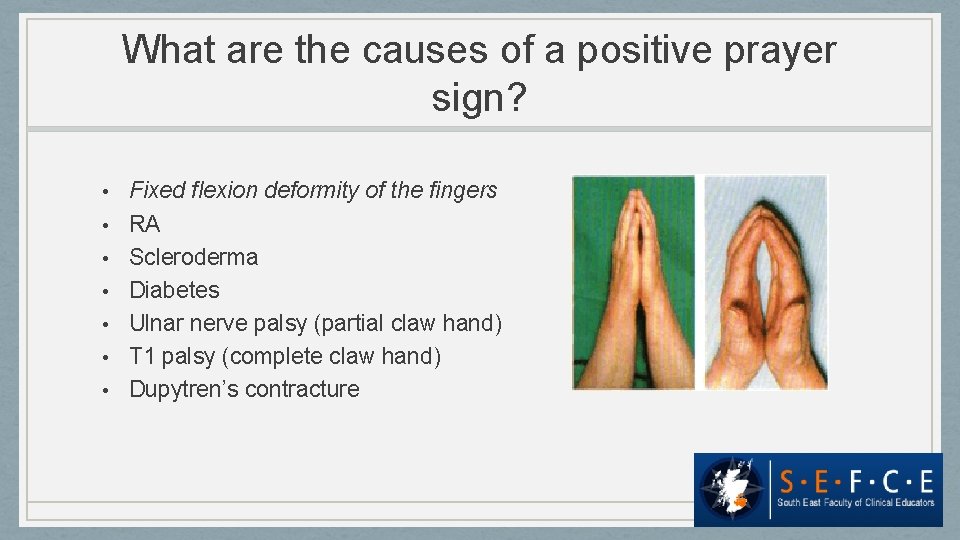
What are the causes of a positive prayer sign? • • Fixed flexion deformity of the fingers RA Scleroderma Diabetes Ulnar nerve palsy (partial claw hand) T 1 palsy (complete claw hand) Dupytren’s contracture
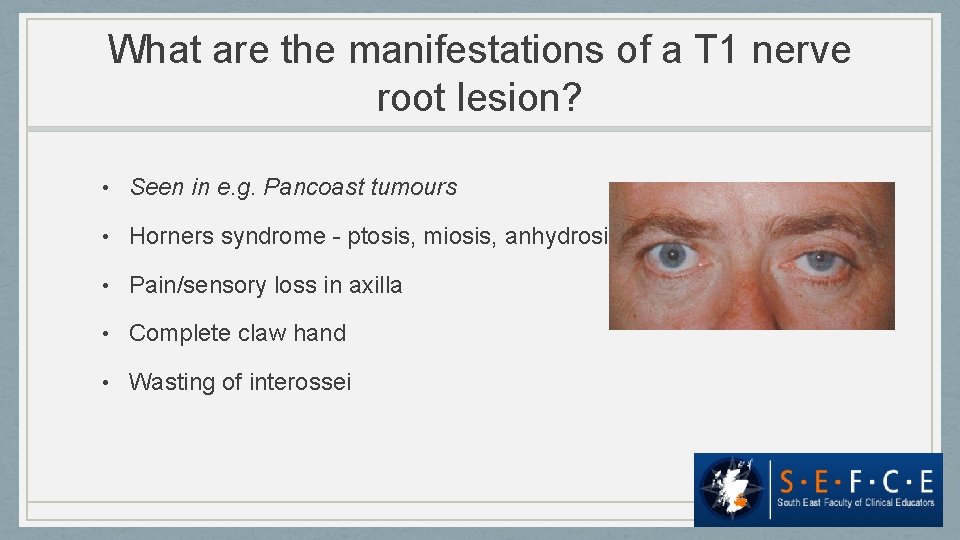
What are the manifestations of a T 1 nerve root lesion? • Seen in e. g. Pancoast tumours • Horners syndrome - ptosis, miosis, anhydrosis • Pain/sensory loss in axilla • Complete claw hand • Wasting of interossei
Case 1
To complete my examination… • Full cranial nerve examination (homonymous hemianopia, visual defects) • Assessment of higher cognitive function – speech (dominant hemisphere) and sensory inattention (non-dominant hemisphere) • Cardiovascular examination – including BP, Carotid bruits and murmurs, AF, • Cardiovascular history - modifiable risk factors
Differential Diagnoses • Vascular – ischaemia, infarction, embolism, heamorrhage • SOL – malignancy, abcess, hydrocephalus • Inflammatory – MS, Consider the age of the patient when ranking these.
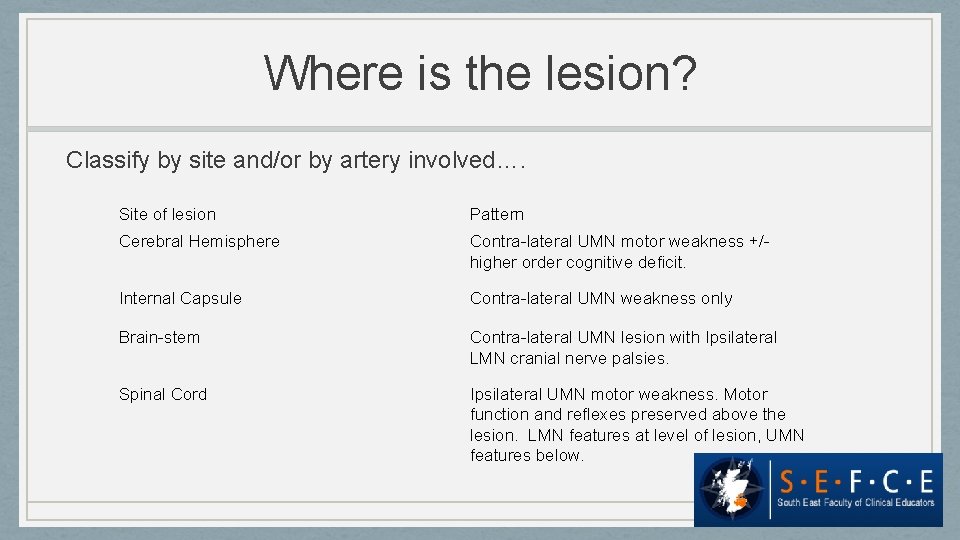
Where is the lesion? Classify by site and/or by artery involved…. Site of lesion Pattern Cerebral Hemisphere Contra-lateral UMN motor weakness +/higher order cognitive deficit. Internal Capsule Contra-lateral UMN weakness only Brain-stem Contra-lateral UMN lesion with Ipsilateral LMN cranial nerve palsies. Spinal Cord Ipsilateral UMN motor weakness. Motor function and reflexes preserved above the lesion. LMN features at level of lesion, UMN features below.
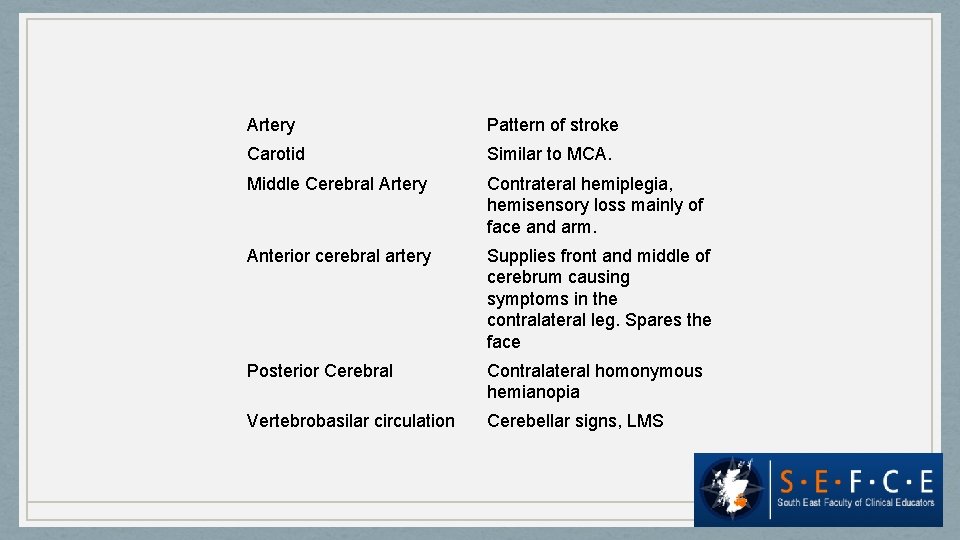
Artery Pattern of stroke Carotid Similar to MCA. Middle Cerebral Artery Contrateral hemiplegia, hemisensory loss mainly of face and arm. Anterior cerebral artery Supplies front and middle of cerebrum causing symptoms in the contralateral leg. Spares the face Posterior Cerebral Contralateral homonymous hemianopia Vertebrobasilar circulation Cerebellar signs, LMS
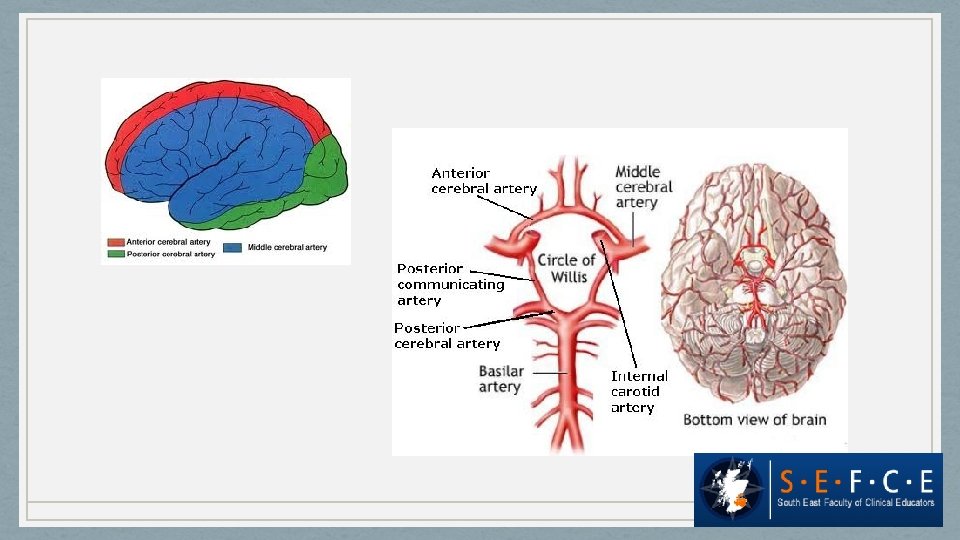
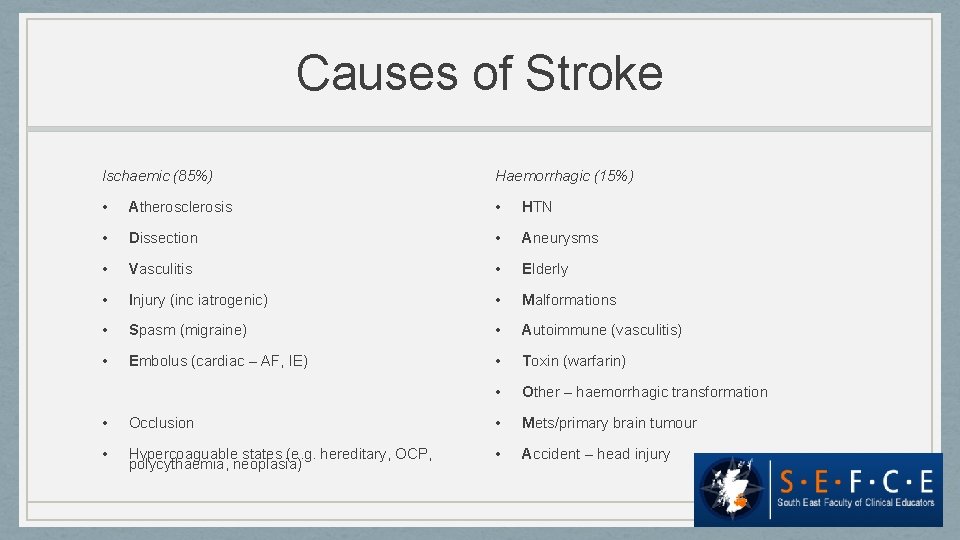
Causes of Stroke Ischaemic (85%) Haemorrhagic (15%) • Atherosclerosis • HTN • Dissection • Aneurysms • Vasculitis • Elderly • Injury (inc iatrogenic) • Malformations • Spasm (migraine) • Autoimmune (vasculitis) • Embolus (cardiac – AF, IE) • Toxin (warfarin) • Other – haemorrhagic transformation • Occlusion • Mets/primary brain tumour • Hypercoaguable states (e. g. hereditary, OCP, polycythaemia, neoplasia) • Accident – head injury
Case 2
What are the causes of a peripheral neuropathy? Genetic • Charcot-Marie-Tooth syndrome • Friedrich’s ataxia Metabolic/endocrine • DM • Chronic renal failure • Porphyria • Amyloidosis • Liver failure • Hypothyroidism Inflammatory disease • Guillain-Barré syndrome • SLE • Leprosy • Sjogren’s Physical trauma Toxic • Compression Alcohol • Pinching Drugs • Cutting - Fluoroquinolones • Projectile injuries - Vincristin • Strokes including prolonged - Phenytoin occlusion of blood flow - Nitrofurantoin Others - Isoniazid • Shingles Organic metals • Malignant disease Heavy metals • HIV Excess Vit B 6 (pyridoxine) • Radiation Vit deficiency Most common causes: • Chemotherapy • B 12 1. DM • A 2. Alcohol • E 3. Vitamin deficiency • B 1
Case 3
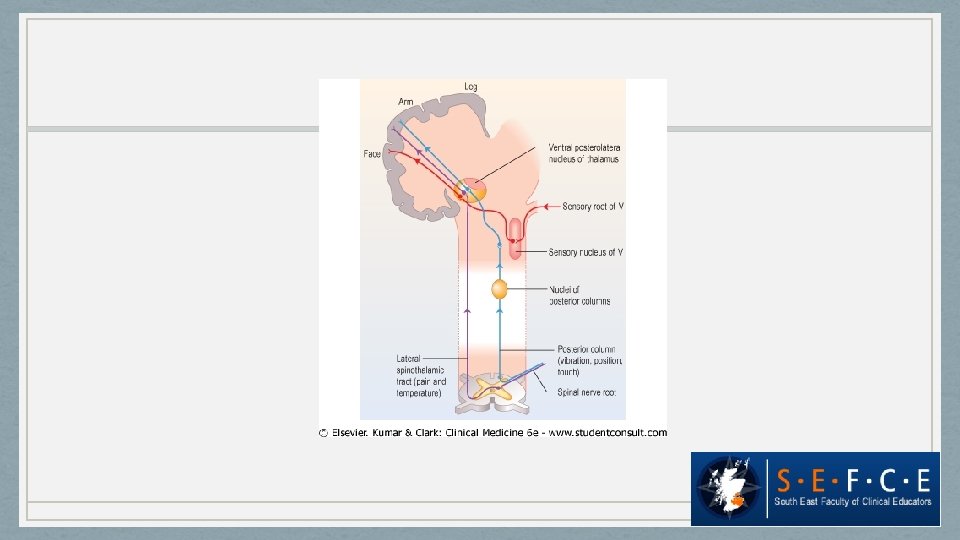
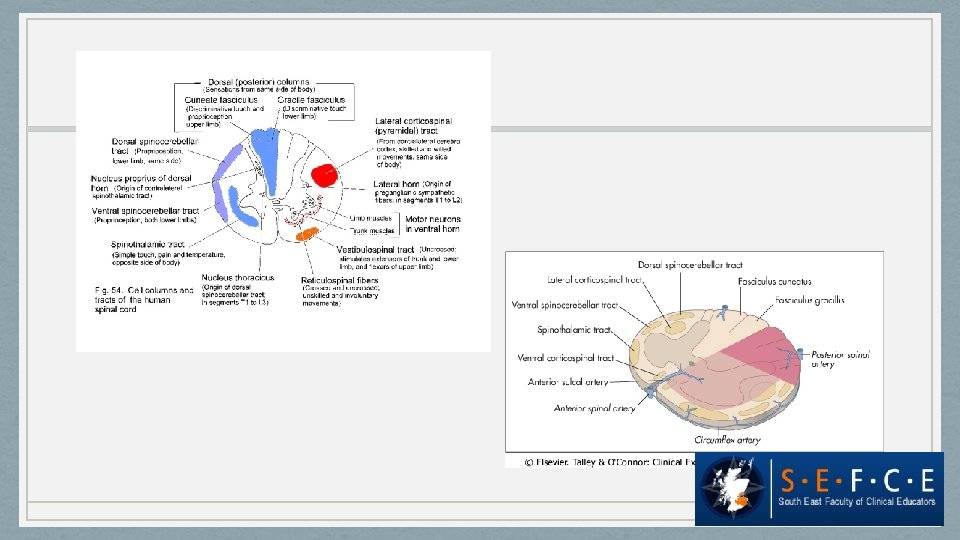
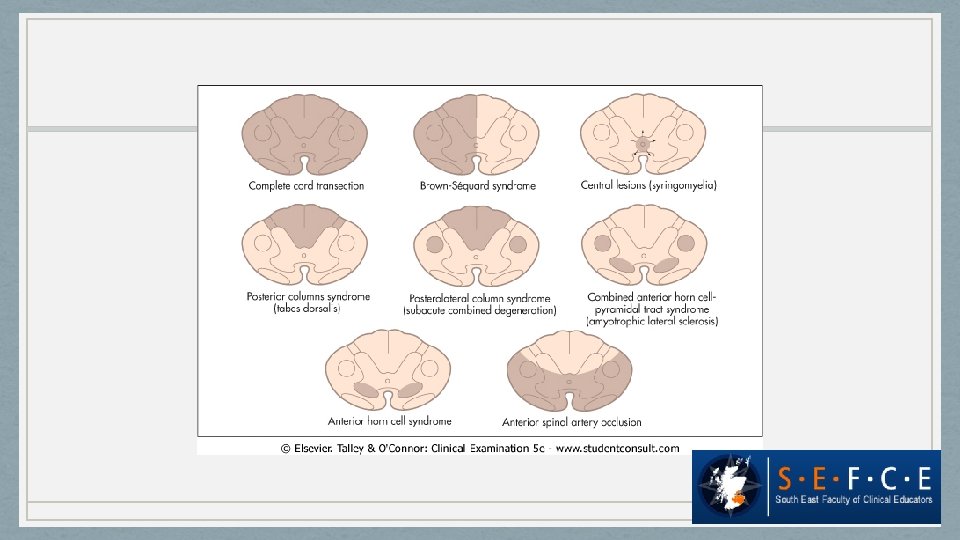
Causes Brown-Sequard Syndrome • Degenerative disease of the spine • Syringomyelia • Motor changes • Ipsilateral UMN signs below the hemisection (corticospinal tract) • LMN signs at the level of hemisection on the same side • Sensory changes • Contralateral pain and temperature loss (upper level of sensory loss usually a few segments below the level of the lesion) spinothalamic tract • Ipsilateral vibration and proprioception loss (dorsal column) • In segment of lesion – ipsilateral anaesthesia and zone of hyperaesthesia • Cord tumour • Haematomyelia • MS • Angioma • Trauma, e. g. bullet or stab wounds • Myelitis • Post-radiation myelopathy
Case 4
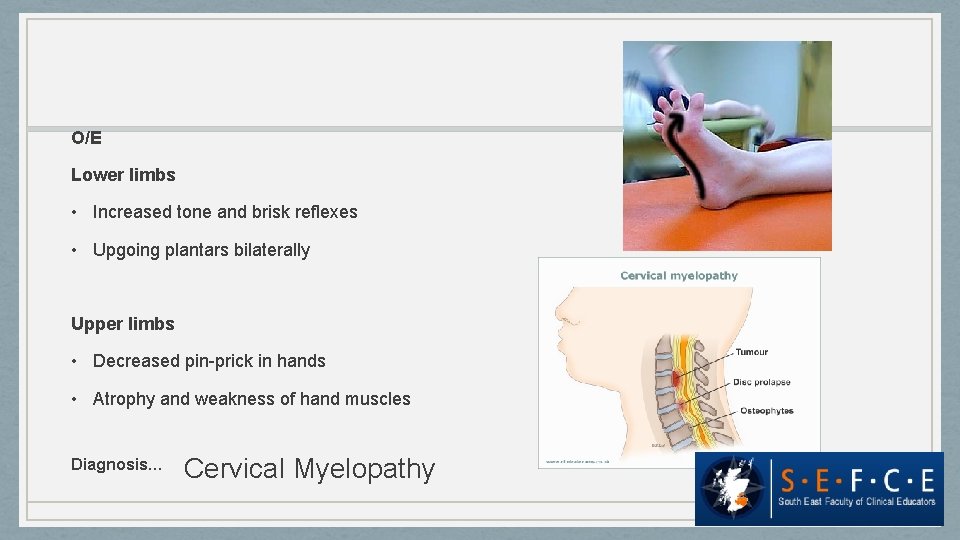
O/E Lower limbs • Increased tone and brisk reflexes • Upgoing plantars bilaterally Upper limbs • Decreased pin-prick in hands • Atrophy and weakness of hand muscles Diagnosis… Cervical Myelopathy
Case 5
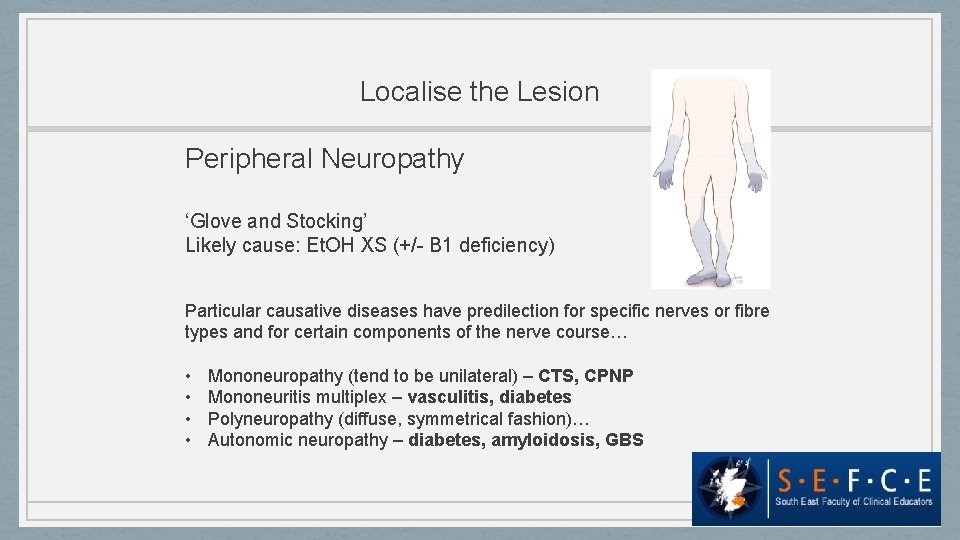
Localise the Lesion Peripheral Neuropathy ‘Glove and Stocking’ Likely cause: Et. OH XS (+/- B 1 deficiency) Particular causative diseases have predilection for specific nerves or fibre types and for certain components of the nerve course… • • Mononeuropathy (tend to be unilateral) – CTS, CPNP Mononeuritis multiplex – vasculitis, diabetes Polyneuropathy (diffuse, symmetrical fashion)… Autonomic neuropathy – diabetes, amyloidosis, GBS
Peripheral Neuropathy Aetiology • Inflammatory – Guillain Barré Syndrome, CIDP, RA, SLE, vasculitis • Infective - Leprosy Tests Bloods to Ix cause ? Lumbar puncture (GBS/CIDP) Nerve conduction studies • Toxic – Et. OH (+ thiamine deficiency), Drugs (chemo) • Metabolic – Diabetes, Hypothyroid, CKD • Idiopathic (one third of cases cause unknown) • Neoplastic – paraneoplastic, MGUS, myeloma • Deficiency – vitamins B 12, B 1, B 6 • Genetic – HSMN (Charcot-Marie Tooth), Friedrich’s Ataxia Treatment Neuropathic analgesia, Mx underlying cause
Case 6
O/E • Large sore tongue Lower limbs • Spastic paresis • Romberg positive, wide based gait • Bilateral Babinski sign • Loss of sensation in a stocking distribution • Absent ankle reflexes Diagnosis… Subacute Combined Degeneration of Spinal Cord
Case 7
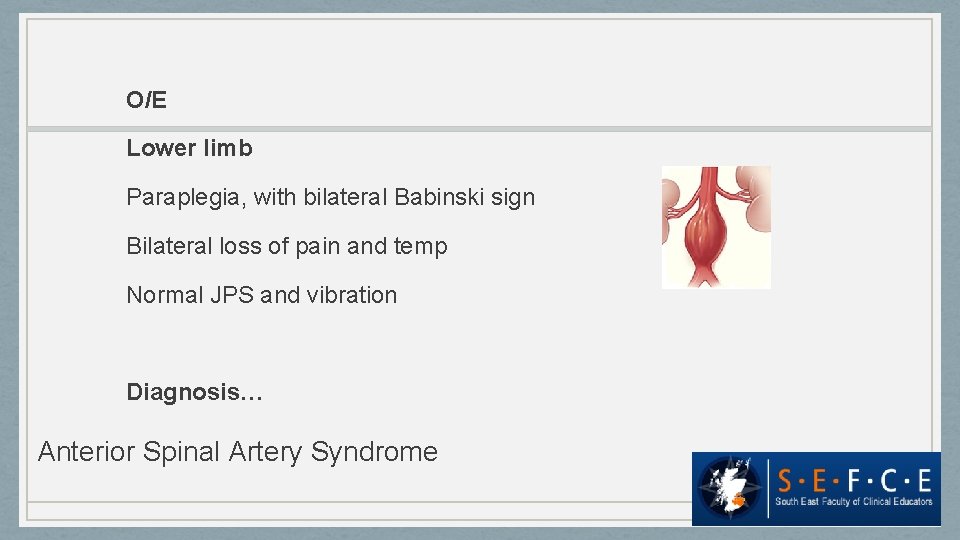
O/E Lower limb Paraplegia, with bilateral Babinski sign Bilateral loss of pain and temp Normal JPS and vibration Diagnosis… Anterior Spinal Artery Syndrome
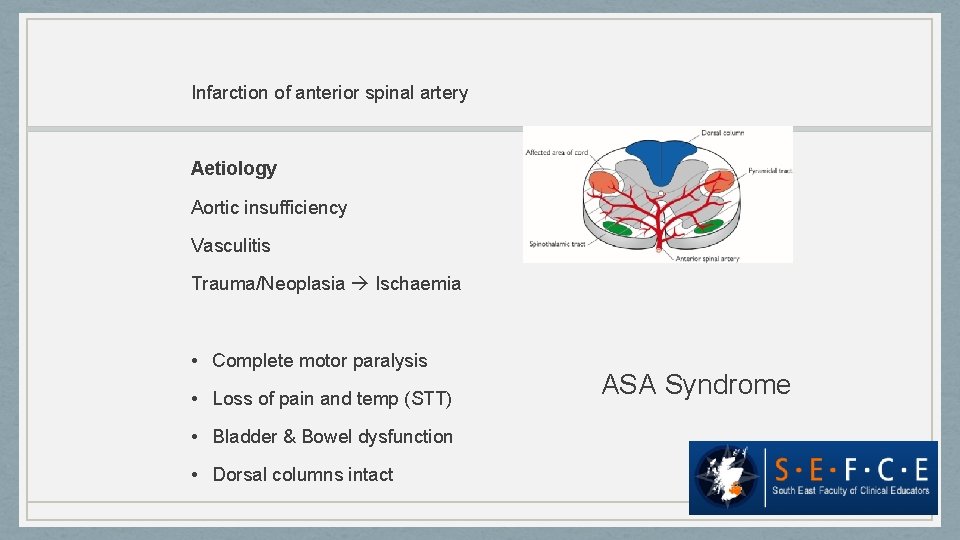
Infarction of anterior spinal artery Aetiology Aortic insufficiency Vasculitis Trauma/Neoplasia Ischaemia • Complete motor paralysis • Loss of pain and temp (STT) • Bladder & Bowel dysfunction • Dorsal columns intact ASA Syndrome
Case 8
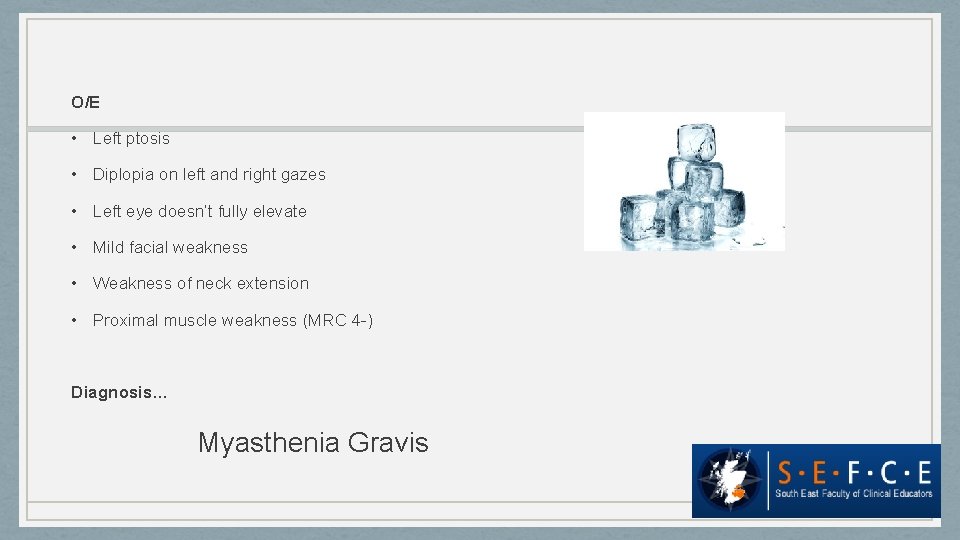
O/E • Left ptosis • Diplopia on left and right gazes • Left eye doesn’t fully elevate • Mild facial weakness • Weakness of neck extension • Proximal muscle weakness (MRC 4 -) Diagnosis… Myasthenia Gravis
Case 9
O/E • Flaccid paralysis in arms and legs • Widespread areflexia • Absent sensation in arms and legs • Evidence of sacral sparing – voluntary anal sphincter contraction • Hypotension Diagnosis… Spinal Shock
- Slides: 43