
Limb vs Torso Electrode Placement on Electrocardiogram Interpretation
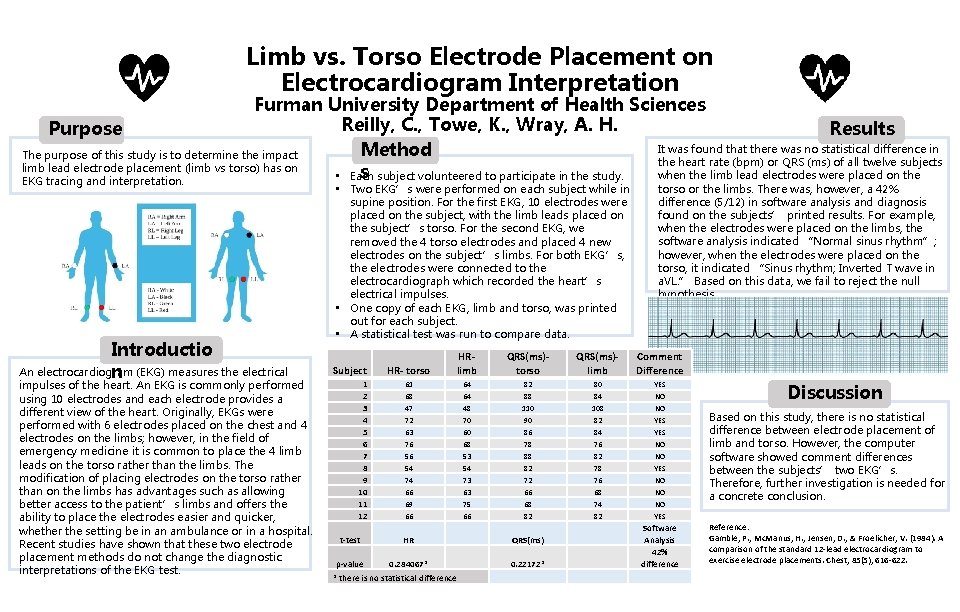
Limb vs. Torso Electrode Placement on Electrocardiogram Interpretation Furman University Department of Health Sciences Reilly, C. , Towe, K. , Wray, A. H. Purpose Results It was found that there was no statistical difference in Method The purpose of this study is to determine the impact the heart rate (bpm) or QRS (ms) of all twelve subjects limb lead electrode placement (limb vs torso) has on s when the limb lead electrodes were placed on the • Each subject volunteered to participate in the study. EKG tracing and interpretation. Introductio An electrocardiogram (EKG) measures the electrical n impulses of the heart. An EKG is commonly performed using 10 electrodes and each electrode provides a different view of the heart. Originally, EKGs were performed with 6 electrodes placed on the chest and 4 electrodes on the limbs; however, in the field of emergency medicine it is common to place the 4 limb leads on the torso rather than the limbs. The modification of placing electrodes on the torso rather than on the limbs has advantages such as allowing better access to the patient’s limbs and offers the ability to place the electrodes easier and quicker, whether the setting be in an ambulance or in a hospital. Recent studies have shown that these two electrode placement methods do not change the diagnostic interpretations of the EKG test. • Two EKG’s were performed on each subject while in supine position. For the first EKG, 10 electrodes were placed on the subject, with the limb leads placed on the subject’s torso. For the second EKG, we removed the 4 torso electrodes and placed 4 new electrodes on the subject’s limbs. For both EKG’s, the electrodes were connected to the electrocardiograph which recorded the heart’s electrical impulses. • One copy of each EKG, limb and torso, was printed out for each subject. • A statistical test was run to compare data. torso or the limbs. There was, however, a 42% difference (5/12) in software analysis and diagnosis found on the subjects’ printed results. For example, when the electrodes were placed on the limbs, the software analysis indicated “Normal sinus rhythm”; however, when the electrodes were placed on the torso, it indicated “Sinus rhythm; Inverted T wave in a. VL. ” Based on this data, we fail to reject the null hypothesis. HR- torso HRlimb QRS(ms)torso QRS(ms)limb Comment Difference 61 68 47 72 63 76 56 54 74 66 69 66 64 64 48 70 60 68 53 54 73 63 75 66 82 88 110 90 86 78 88 82 72 66 68 82 80 84 108 82 84 76 82 78 76 68 74 82 YES NO NO NO YES t-test HR QRS(ms) p-value 0. 284067* 0. 22172* Software Analysis 42% difference Subject 1 2 3 4 5 6 7 8 9 10 11 12 * there is no statistical difference Discussion Based on this study, there is no statistical difference between electrode placement of limb and torso. However, the computer software showed comment differences between the subjects’ two EKG’s. Therefore, further investigation is needed for a concrete conclusion. Reference: Gamble, P. , Mc. Manus, H. , Jensen, D. , & Froelicher, V. (1984). A comparison of the standard 12 -lead electrocardiogram to exercise electrode placements. Chest, 85(5), 616 -622.
- Slides: 1