
Lilli Nielsen Jan van Dijk and Jean Ayres




- Slides: 39
Lilli Nielsen, Jan van Dijk, and Jean Ayres - 3 Great Gurus and What I Have Learned From Them David Brown Educational Specialist California Deaf-Blind Services San Francisco State University The contents of this Power. Point presentation were developed under a grant from the US Department of Education, #H 326 C 080009. However, those contents do not necessarily represent the policy of the US Department of Education, and you should not assume endorsement by the Federal Government. Project Officer, Jo Ann Mc. Cann.
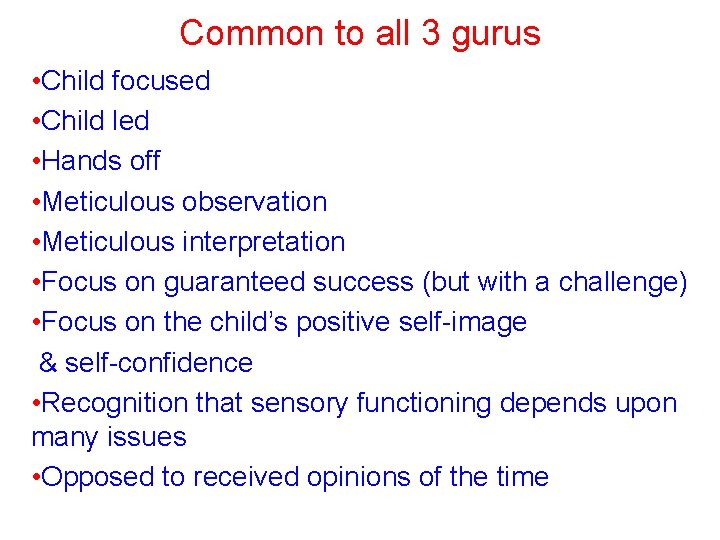
Common to all 3 gurus • Child focused • Child led • Hands off • Meticulous observation • Meticulous interpretation • Focus on guaranteed success (but with a challenge) • Focus on the child’s positive self-image & self-confidence • Recognition that sensory functioning depends upon many issues • Opposed to received opinions of the time
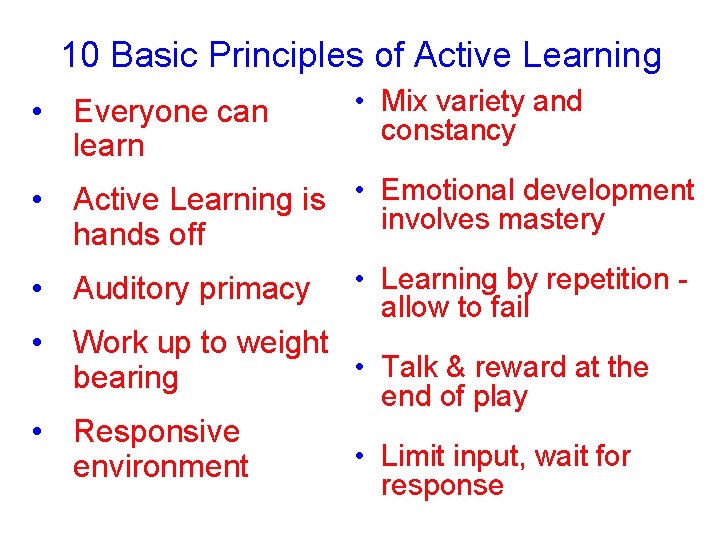
10 Basic Principles of Active Learning • Everyone can learn • Mix variety and constancy • Active Learning is • Emotional development involves mastery hands off • Auditory primacy • Learning by repetition allow to fail • Work up to weight • Talk & reward at the bearing end of play • Responsive environment • Limit input, wait for response
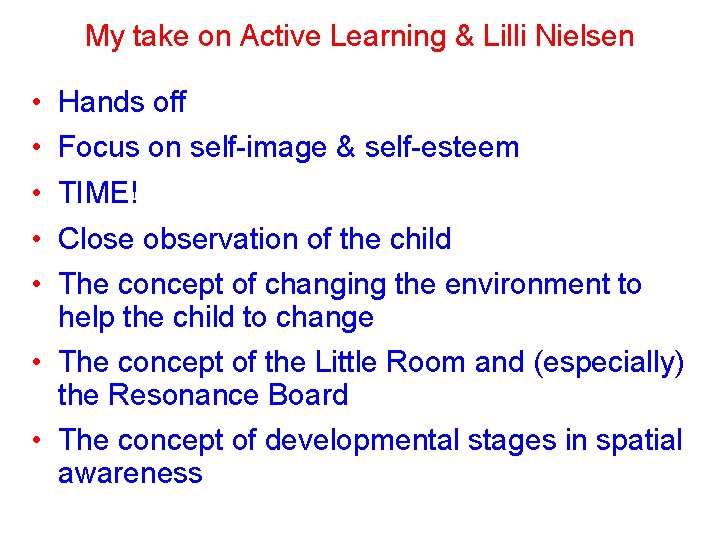
My take on Active Learning & Lilli Nielsen • • • Hands off Focus on self-image & self-esteem TIME! Close observation of the child The concept of changing the environment to help the child to change • The concept of the Little Room and (especially) the Resonance Board • The concept of developmental stages in spatial awareness
Useful Websites • www. lilliworks. com • http: //nationaldb. org/dbp • http: //www. tsbvi. edu/outreach • www. visionkits. com
“Sensory Integration” means… 1. A neurological process 2. A theory developed by Jean Ayres 3. A treatment approach developed from Ayres’ theory
Jean Ayres defines Sensory Integration (1989) “. . the neurological process that organizes sensation from one’s own body and from the environment and makes it possible to use the body effectively within the environment. The spatial and temporal aspects of inputs from different sensory modalities are interpreted, associated, and unified. Sensory integration is information processing…The brain must select, enhance, inhibit, compare, and associate the sensory information in a flexible, constantly changing pattern; in other words, the brain must integrate it. ”
Ayres’ theory That the environment has a crucial impact on brain development, that the brain changes in response to external stimuli, and that experiences resulting from sensory inputs and the child’s responses to them affects brain development.
‘A sensory integrative approach to treating learning disorders differs from many other approaches in that it does not teach specific skills… Rather, the objective is to enhance the brain’s… capacity to perceive, remember, and motor plan… Therapy is considered a supplement, not a substitute to formal classroom instruction… ‘ Jean Ayres, 1972
Examples of behaviors indicating possible sensory integration dysfunction in children with deafblindness (1) • repeatedly seeking strong stimulation through particular sensory channels. • sensory defensiveness. • abnormally low or high pain thresholds. • apparent variability or inconsistency in sensory perception abilities. • unusual postures. • distractibility.
Examples of behaviors indicating possible sensory integration dysfunction in children with deafblindness (2) • disturbed sleep patterns. • problems with regulating arousal levels. • postural & gravitational insecurity if moved by others, but pleasure in rhythmic movement. • inconsistent or inappropriate use of pressure when grasping, tapping, kicking etc.
The specific objectives of sensory integration therapy are: (Karen Nagel) • To achieve an alert, calm state. • To promote the organization of the Central Nervous System. • To enhance the child’s ability to regulate and adjust the sensations from their environment. • To increase conceptual development.
Key principles of Sensory Integration Therapy • The Just Right Challenge • The Adaptive Response • Active Engagement • Child Directed
Possible suggestions may include… • Brushing • Rhythmic joint compression • Deep tissue massage • Vibro-tactile input • Objects to chew • Sucking and/or blowing activities • Textured bed sheets and/or heavy bed covers • Lycra clothing or sleeve • Swinging (forward & back or side to side) • Rocking (forward & back or side to side) • Weighted clothing
Sensory Issues o Information may be missing, partial, distorted, or fragmented o Over-sensitivity &/or under-sensitivity o Processing time may be very extended o Confusion & the need for consistency & predictability o But…. . think about consistency versus variety o Fatigue o Communication issues (receptive & expressive) o Movement & postural differences o Idiosyncratic behaviors & misinterpretation o Developmental delay
The Senses and Deaf-blindness When there are multiple sensory impairments, it is important to consider the impact on the child’s: – Self-awareness – Body-awareness – Voluntary movement abilities – Health (especially pain and discomfort) – Attention – Memory, Prior Knowledge – Intentions, Tasks, Goals – Motivators – Emotion and Behaviour 16
“After air to breathe, postural security is our next most urgent priority. ” Jean Ayres 17
Three important concepts • Sensory modulation, enhancing, inhibiting • Sensory diet • Level of arousal
The 9 levels of arousal (Carolina Record of Individual Behavior) • • • Uncontrollable agitation Mild agitation Fussy awake Active awake Quiet awake Drowsy Active sleep Quiet sleep Deep sleep
[Self-regulation]… “is defined as the capacity to manage one’s thoughts, feelings and actions in adaptive and flexible ways across a range of contexts” Jude Nicholas, CHARGE Accounts, Summer 2007 20
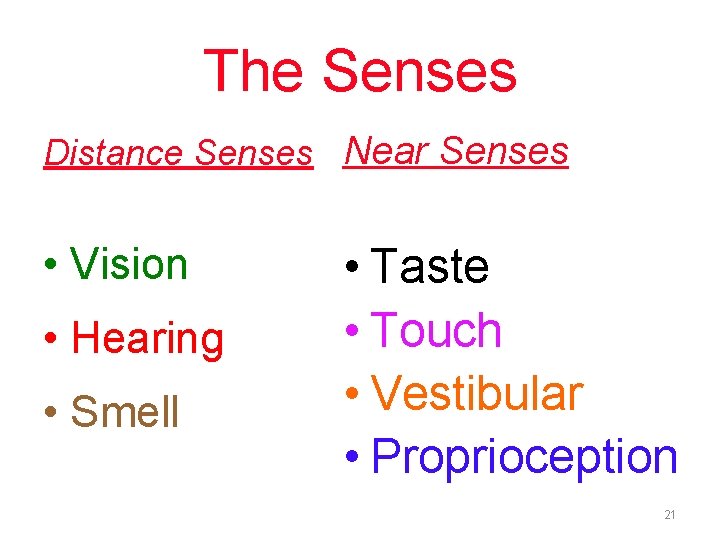
The Senses Distance Senses Near Senses • Vision • Hearing • Smell • Taste • Touch • Vestibular • Proprioception 21
My take on Jean Ayres & Sensory Integration theory & Therapy (1) §The constancy & inter-relatedness of sensory inputs §The senses connect the brain to the body §Sensory inputs have a significant & direct impact on arousal levels §Some senses may be more important than others §Most children with deaf-blindness are not in touch with/do not feel their bodies very well
My take on Jean Ayres & Sensory Integration theory & Therapy (2) §We all self-stimulate (all the time? ) to maintain alertness, to wake up, to calm down, to maintain postural control, to keep/get comfortable, to occupy our minds, to self-regulate, to fight boredom, to maintain attention, to keep sane, and generally to improve our functioning to achieve our goals §Sensory deficits and poor sensory perception make children with deaf-blindness self-stimulate in mostly normal ways – but often with more intensity, more persistence, and for a longer period of their lives than “normal”
My take on Jean Ayres & Sensory Integration theory & Therapy (3) §For various reasons children with deafblindness may have poor social awareness, so self-stimulation behaviors may be more obvious §Attempts to stifle and stop self-stimulation behaviors may result in worse self-regulation and generally less good functioning §Observing how and when a child selfstimulates will offer invaluable insights into who they are and how they work, for assessment, teaching, behavior management, and relationship building
“Communication, communication”
Mc. Innes & Treffry Deafblind Infants & Children 1982 Communication can be summed up as our attempts to obtain information from and impose order upon the world around us
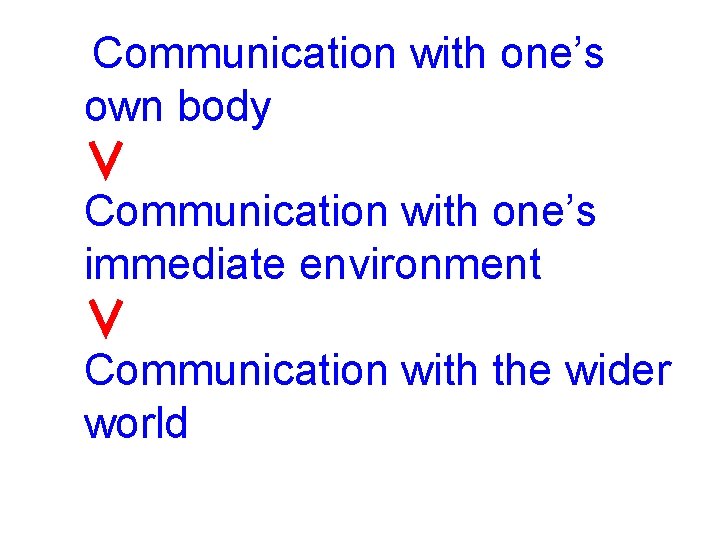
Communication with one’s own body ∨ Communication with one’s immediate environment ∨ Communication with the wider world
Jan van Dijk (1966) “In the educational atmosphere I describe, the child holds the central position, the teacher ‘follows’ the child and, when the child responds, the teacher is present to answer the child’s request”
Van Dijk & Nelson “Principles of Assessment” (2001) • Make the child at ease • Determine the child’s biobehavioral state • Determine the child’s interest • Follow the child’s interest
Van Dijk Approach to Assessment • Child-guided • Fluid • Looks at the processes children with multiple disabilities including sensory impairments use to learn & develop • Assessment is summarized in terms of strengths and next steps for intervention
Areas of the Van Dijk Framework • Ability to maintain & modulate state • Preferred learning channels • Ability to learn, remember & anticipate routines • Accommodation of new experiences with existing schemes • Problem solving approaches • Ability to form social attachments and interact • Communication modes
Assessment Questions D Brown “Follow the Child” (1997/2001) • • How do you feel? What do you like? What do you want? What do you do?
Van Dijk & Nelson “Principles of Assessment” (2001) • Make the child at ease • Determine the child’s biobehavioral state • Determine the child’s interest • Follow the child’s interest
Van Dijk Approach - Evaluation challenges • No prescribed protocol • No specific implementation order • No set of testing materials • Each assessment is unique • No set interpretation scale
Van Dijk Approach - Quality indicators • Respecting the caregiver • Respecting the child • Following the child’s lead • Communicating with the child • Utilizing turn-taking routines • Creating of enjoyable routines
• • • Van Dijk Approach - Fidelity Utilization of stop-start within routines Adding a mismatch with expectations Returning to established routines in order to examine memory Creating situations that allow for problem-solving Utilizing varying sensory channels
My take on Jan van Dijk • Follow the child • Observe • Identify & use motivators • Time & pacing • Credit behaviors with meaning • Respect and seek the opinions of others • The conversational approach • The child’s preferred modes of communication • BUILD relationships
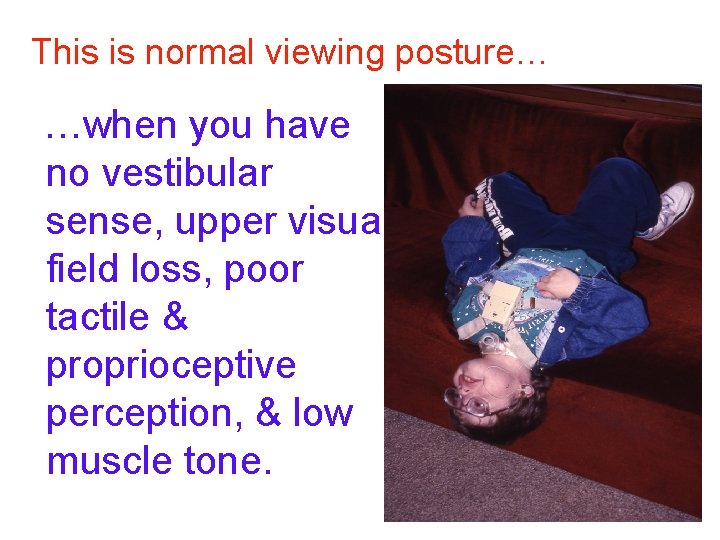
This is normal viewing posture… …when you have no vestibular sense, upper visual field loss, poor tactile & proprioceptive perception, & low muscle tone.
davidb@sfsu. edu