
Likelihood Ratio as Weight of Forensic Evidence A
- Slides: 23
Likelihood Ratio as Weight of Forensic Evidence: A Closer Look Steve Lund and Hari Iyer November 8, 2018
Disclaimer • Viewpoints expressed are our own and are not intended to reflect the viewpoints of anyone else at NIST • We are only discussing what makes sense to us and are not trying to claim that these are new perspectives
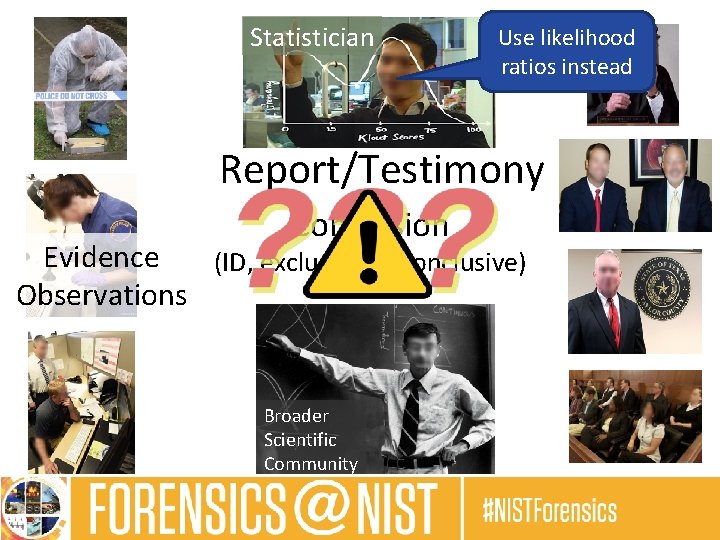
Statistician Use likelihood ratios instead Report/Testimony Conclusion Evidence (ID, exclusion, inconclusive) Observations Broader Scientific Community
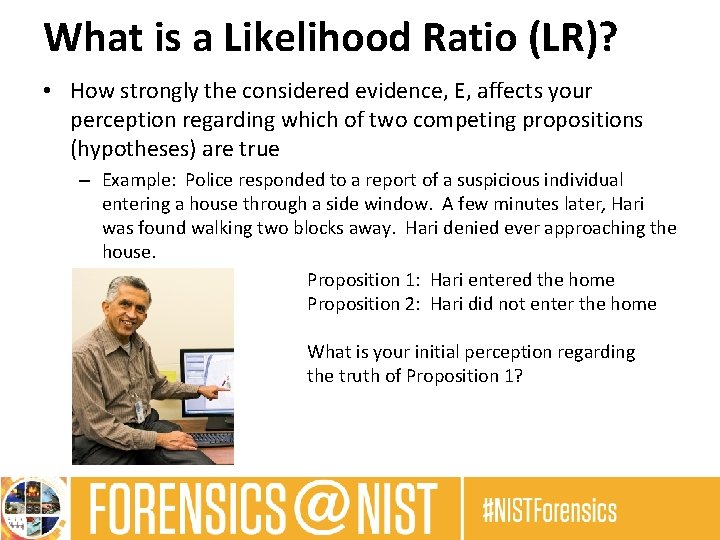
What is a Likelihood Ratio (LR)? • How strongly the considered evidence, E, affects your perception regarding which of two competing propositions (hypotheses) are true – Example: Police responded to a report of a suspicious individual entering a house through a side window. A few minutes later, Hari was found walking two blocks away. Hari denied ever approaching the house. Proposition 1: Hari entered the home Proposition 2: Hari did not enter the home What is your initial perception regarding the truth of Proposition 1?
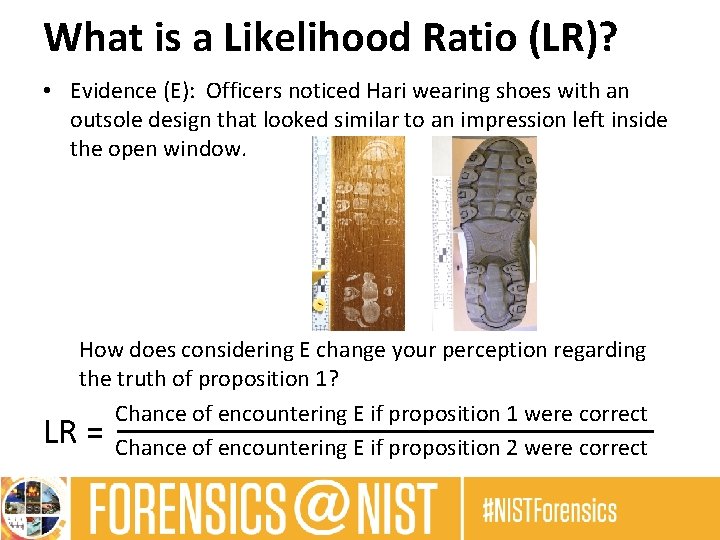
What is a Likelihood Ratio (LR)? • Evidence (E): Officers noticed Hari wearing shoes with an outsole design that looked similar to an impression left inside the open window. How does considering E change your perception regarding the truth of proposition 1? Chance of encountering E if proposition 1 were correct LR = Chance of encountering E if proposition 2 were correct
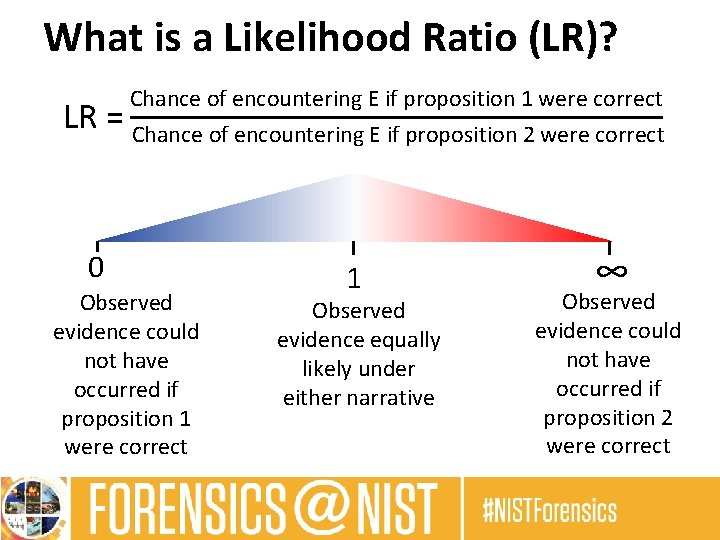
What is a Likelihood Ratio (LR)? Chance of encountering E if proposition 1 were correct LR = Chance of encountering E if proposition 2 were correct 0 Observed evidence could not have occurred if proposition 1 were correct 1 Observed evidence equally likely under either narrative ∞ Observed evidence could not have occurred if proposition 2 were correct
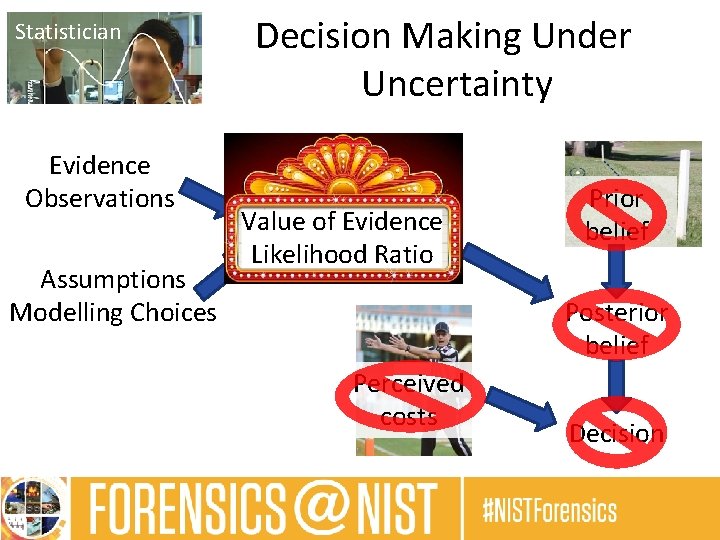
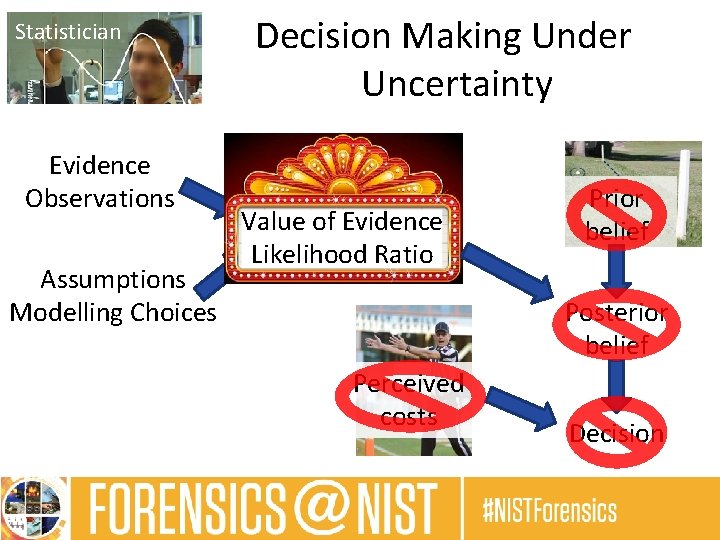
Statistician Evidence Observations Assumptions Modelling Choices Decision Making Under Uncertainty Value of Evidence Likelihood Ratio Prior belief Posterior belief Perceived costs Decision
Statistician Evidence Observations Assumptions Modelling Choices Decision Making Under Uncertainty Value of Evidence Likelihood Ratio Prior belief Posterior belief Perceived costs Decision
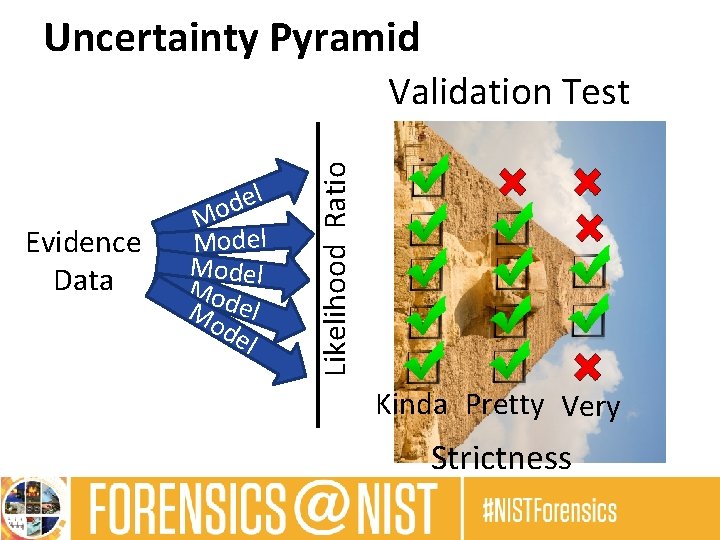
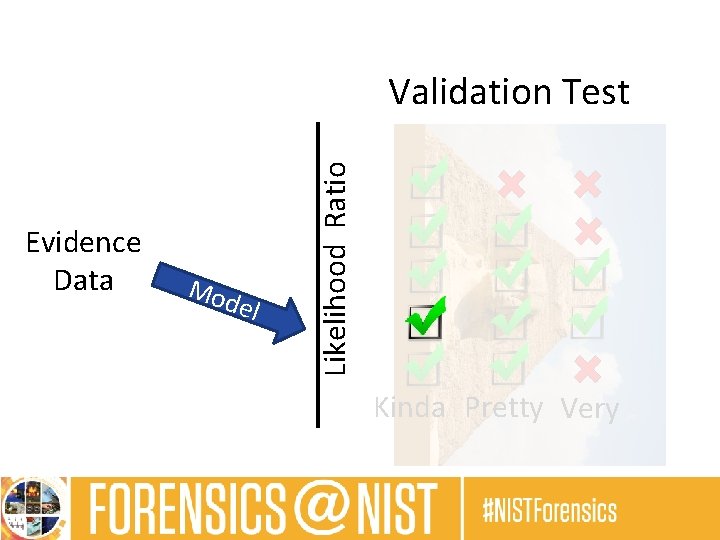
Uncertainty Pyramid Evidence Data l e d Mo Model Mod Mo el de l Likelihood Ratio Validation Test Kinda Pretty Very Strictness
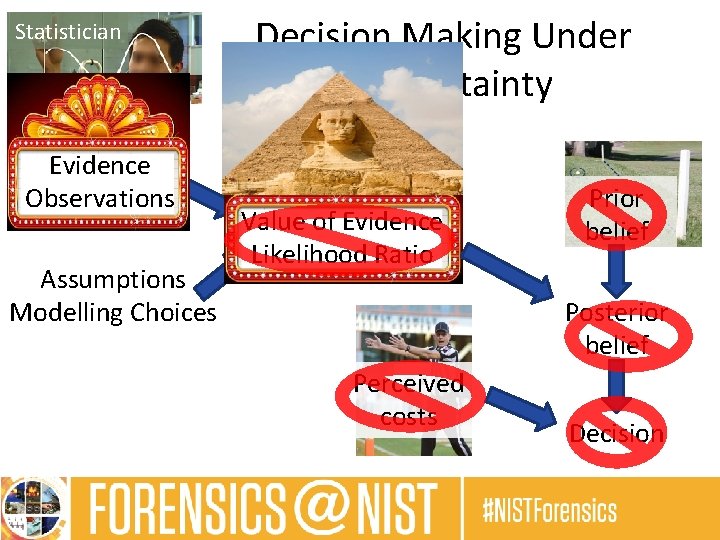
Statistician Evidence Observations Assumptions Modelling Choices Decision Making Under Uncertainty Value of Evidence Likelihood Ratio Prior belief Posterior belief Perceived costs Decision
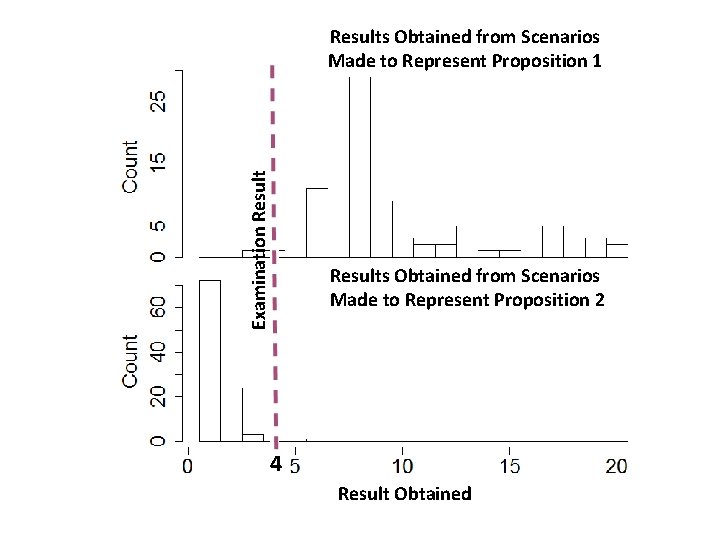
Examination Results Obtained from Scenarios Made to Represent Proposition 1 Results Obtained from Scenarios Made to Represent Proposition 2 4 Result Obtained
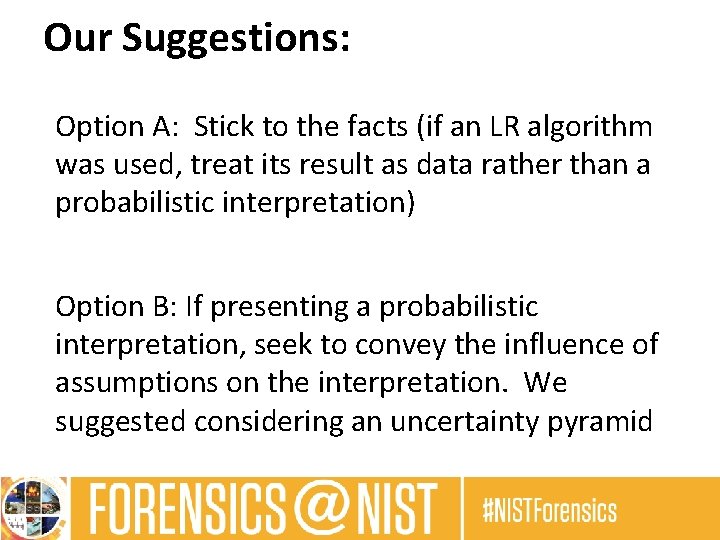
Our Suggestions: Option A: Stick to the facts (if an LR algorithm was used, treat its result as data rather than a probabilistic interpretation) Option B: If presenting a probabilistic interpretation, seek to convey the influence of assumptions on the interpretation. We suggested considering an uncertainty pyramid
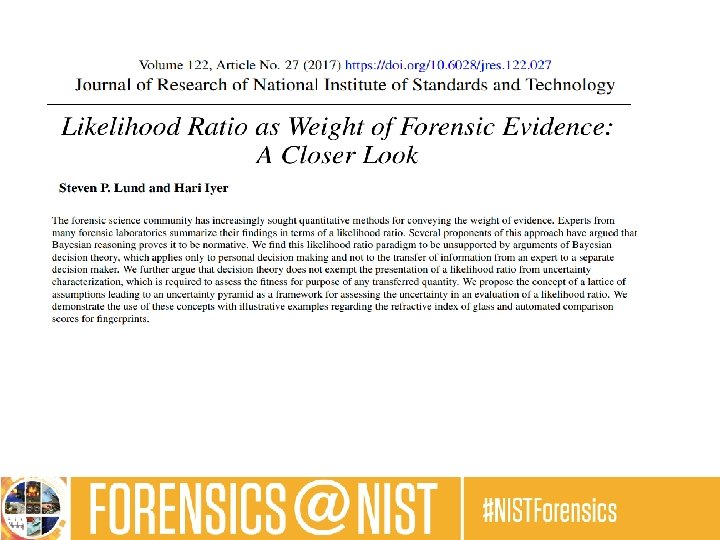
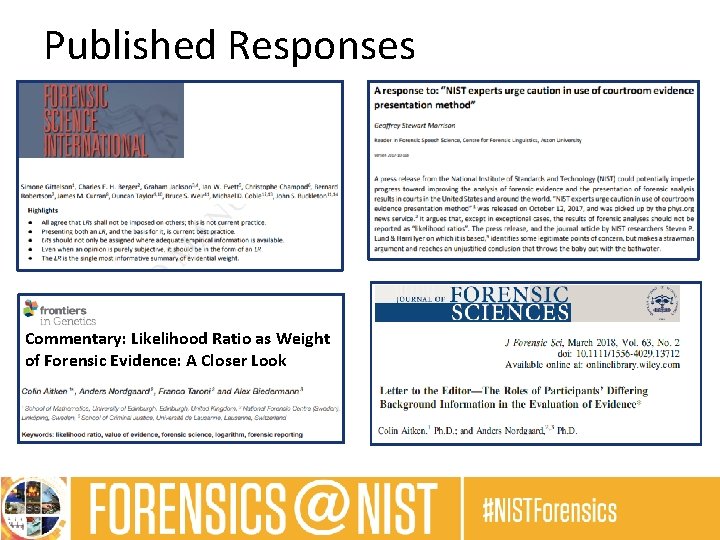
Published Responses Commentary: Likelihood Ratio as Weight of Forensic Evidence: A Closer Look
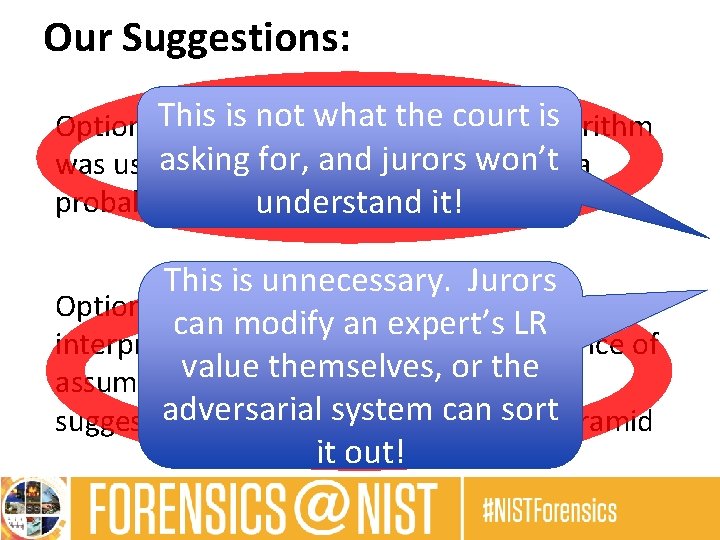
Our Suggestions: This is not what court is Option A: Stick to the factsthe (if an LR algorithm asking jurors won’t was used, treat for, it as and a score rather than a probabilistic interpretation) understand it! This is unnecessary. Jurors Option B: If translating data to probabilistic can modify an expert’s LR interpretation, seek to convey the influence of value themselves, or the assumptions on the interpretation. We adversarial can sortpyramid suggested consideringsystem an uncertainty it out!
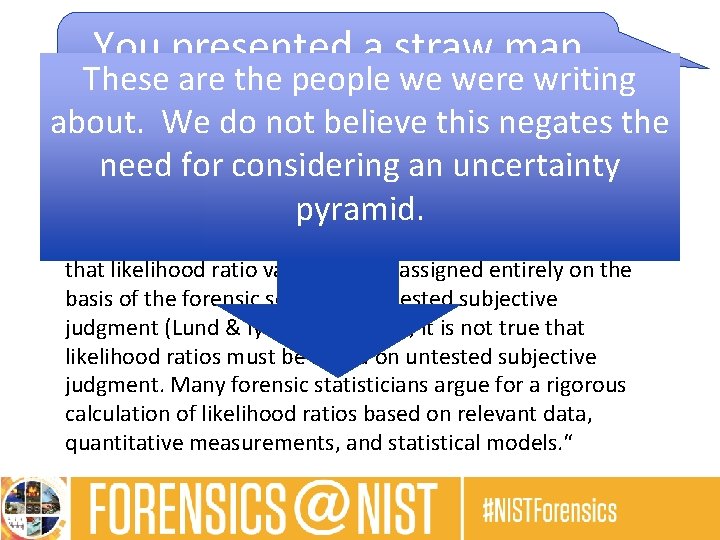
You presented a straw man These are the people we were writing argument! about. We do not believe this negates the Morrison (page 4 -5): need for considering an uncertainty “Although therepyramid. are some advocates of the use of the likelihood ratio framework who also take the view that likelihood ratio values can be assigned entirely on the basis of the forensic scientist’s untested subjective judgment (Lund & Iyer’s strawman), it is not true that likelihood ratios must be based on untested subjective judgment. Many forensic statisticians argue for a rigorous calculation of likelihood ratios based on relevant data, quantitative measurements, and statistical models. “
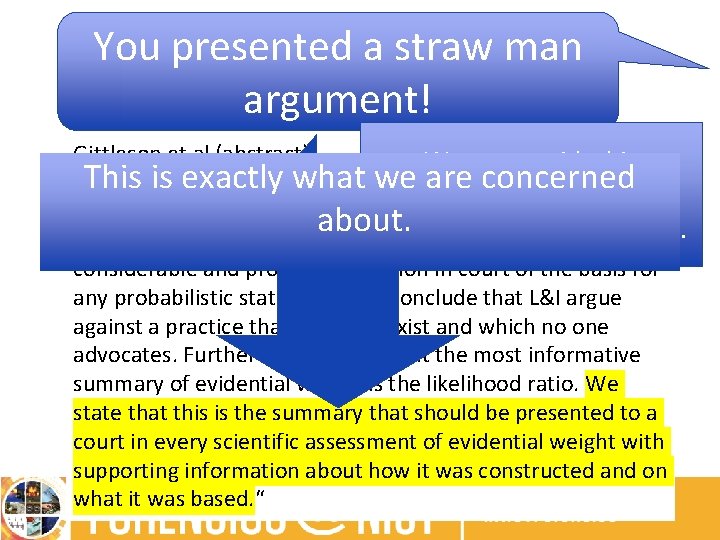
You presented a straw man argument! Gittleson et al (abstract): We agree with this This “L&I is exactly we are concerned argue thatwhat the decision maker should not accept “argument, ” but did not the expert’s likelihood ratio without further consideration. about. attempt to make this point. This is agreed by all parties. In normal practice, there is often considerable and proper exploration in court of the basis for any probabilistic statement. We conclude that L&I argue against a practice that does not exist and which no one advocates. Further we conclude that the most informative summary of evidential weight is the likelihood ratio. We state that this is the summary that should be presented to a court in every scientific assessment of evidential weight with supporting information about how it was constructed and on what it was based. “
Evidence Data Mod el Likelihood Ratio Validation Test Kinda Pretty Very
LR framework is logically what’s required • Agree, broadly – Likelihood of evidence should be assessed under each of an exhaustive set of plausible explanations • Points of potential disagreement: – Framework does not imply an expert should provide opinion in the form of a numerical LR – “CASE framework” (Consider All Sensible Explanations) – Some situations not conducive to a pair of propositions
You say a model has to be theoretical best before being used. The theoretical best is not even relevant to the court • We did not suggest this, and agree it’s not relevant because it’s unattainable.
You say a model has to be theoretical best before being used. The theoretical best is not even relevant to the court • We said an offered model can only be shown to be reasonable, not uniquely best, and argue it’s essential to discuss what results are produced by other reasonable models
Your concerns apply to any probabilistic assessment or interpretation (including categorical conclusions), not just likelihood ratios. • We agree! Any uncertainty that affects LRs is a part of the uncertainty that would need to be considered for posteriors or categorical conclusions
Your suggestions are already the status quo! • That has not been our perception based on conversations, presentations, and readings We’re not the ones experiencing we’ve encountered, including the responses so based on • Ifday-to-day true, we wouldusage, have expected the rebuttal toyour simplyown point practices, to ample reports and for judge transcripts across many disciplines that stick yourself! to the facts or illustrate uncertainty pyramid