
Like Kind Exchanges Peter Baumgarten Ciro Immordino Belan
Like Kind Exchanges Peter Baumgarten Ciro Immordino Belan Wagner * Views are of the speakers and should not be considered the views of the Internal Revenue Service or Franchise Tax Board. 1
Drop and Swap 2

Drop and Swap LLC contracts to sell property LLC distributes property to members LLC Members sell or exchange property 3
Drop and Swap Issues • Holding period • The entity, not the owners, is treated as the seller 4
Drop and Swap • Commissioner v. Court Holding Co. (1945) 324 U. S. 331 • Bolker v. Commissioner (1983) 81 T. C. 782 affd. (9 th Cir. 1985) 760 F. 2 d 1039 5
Swap and Drop 6
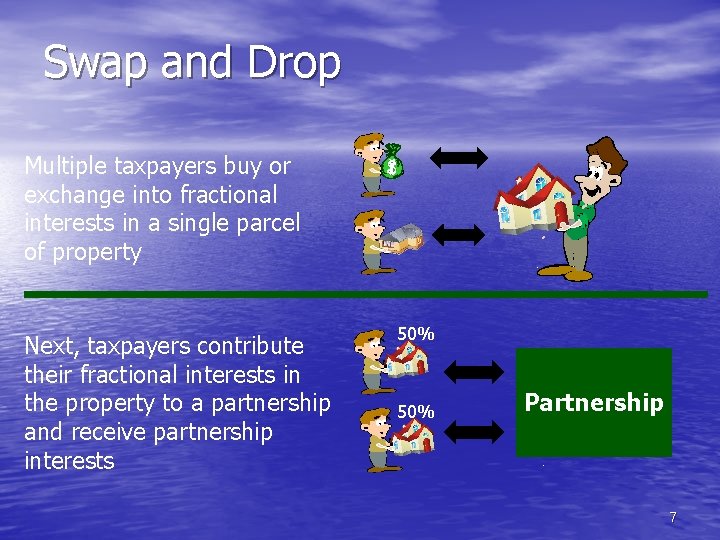
Swap and Drop Multiple taxpayers buy or exchange into fractional interests in a single parcel of property Next, taxpayers contribute their fractional interests in the property to a partnership and receive partnership interests 50% Partnership 7
Swap and Drop Issues • Holding period • The taxpayer is treated as receiving a partnership interest 8
Swap and Drop • Section 1031(a)(2)(D) – Partnership interests are excluded from 1031 exchange treatment. 9
PIN Transactions 10
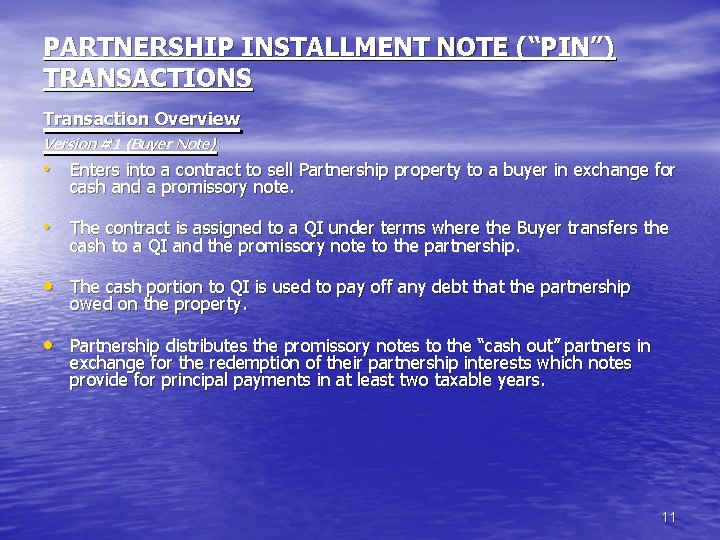
PARTNERSHIP INSTALLMENT NOTE (“PIN”) TRANSACTIONS Transaction Overview Version #1 (Buyer Note): • Enters into a contract to sell Partnership property to a buyer in exchange for cash and a promissory note. • The contract is assigned to a QI under terms where the Buyer transfers the cash to a QI and the promissory note to the partnership. • The cash portion to QI is used to pay off any debt that the partnership owed on the property. • Partnership distributes the promissory notes to the “cash out” partners in exchange for the redemption of their partnership interests which notes provide for principal payments in at least two taxable years. 11
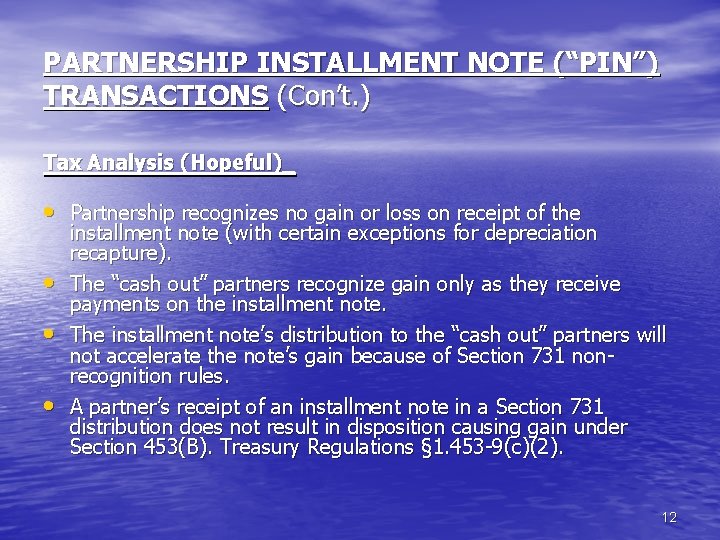
PARTNERSHIP INSTALLMENT NOTE (“PIN”) TRANSACTIONS (Con’t. ) Tax Analysis (Hopeful)_ • Partnership recognizes no gain or loss on receipt of the • • • installment note (with certain exceptions for depreciation recapture). The “cash out” partners recognize gain only as they receive payments on the installment note. The installment note’s distribution to the “cash out” partners will not accelerate the note’s gain because of Section 731 nonrecognition rules. A partner’s receipt of an installment note in a Section 731 distribution does not result in disposition causing gain under Section 453(B). Treasury Regulations § 1. 453 -9(c)(2). 12
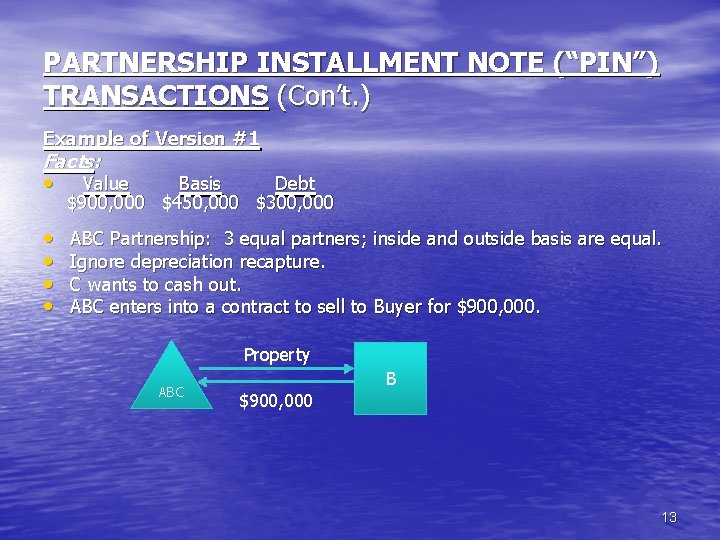
PARTNERSHIP INSTALLMENT NOTE (“PIN”) TRANSACTIONS (Con’t. ) Example of Version #1 Facts: · Value Basis Debt $900, 000 $450, 000 $300, 000 · · ABC Partnership: 3 equal partners; inside and outside basis are equal. Ignore depreciation recapture. C wants to cash out. ABC enters into a contract to sell to Buyer for $900, 000. Property ABC $900, 000 B 13
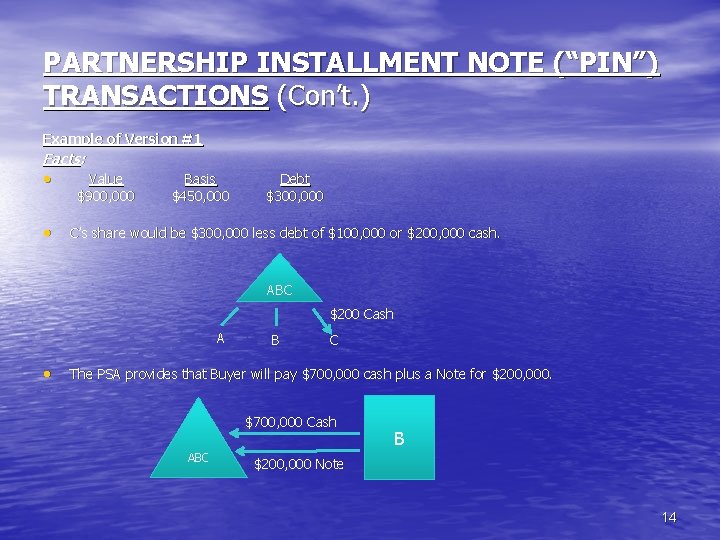
PARTNERSHIP INSTALLMENT NOTE (“PIN”) TRANSACTIONS (Con’t. ) Example of Version #1 Facts: · · Value $900, 000 Basis $450, 000 Debt $300, 000 C’s share would be $300, 000 less debt of $100, 000 or $200, 000 cash. ABC $200 Cash A · B C The PSA provides that Buyer will pay $700, 000 cash plus a Note for $200, 000. $700, 000 Cash ABC B $200, 000 Note 14
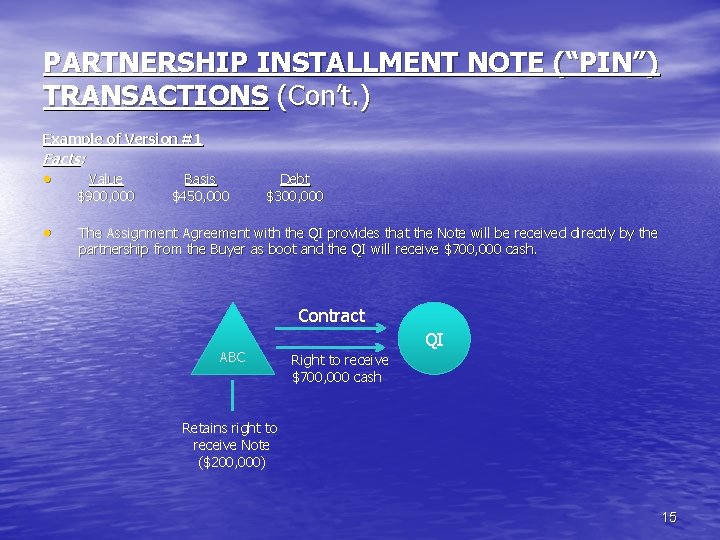
PARTNERSHIP INSTALLMENT NOTE (“PIN”) TRANSACTIONS (Con’t. ) Example of Version #1 Facts: · Value $900, 000 · The Assignment Agreement with the QI provides that the Note will be received directly by the partnership from the Buyer as boot and the QI will receive $700, 000 cash. Basis $450, 000 Debt $300, 000 Contract ABC QI Right to receive $700, 000 cash Retains right to receive Note ($200, 000) 15
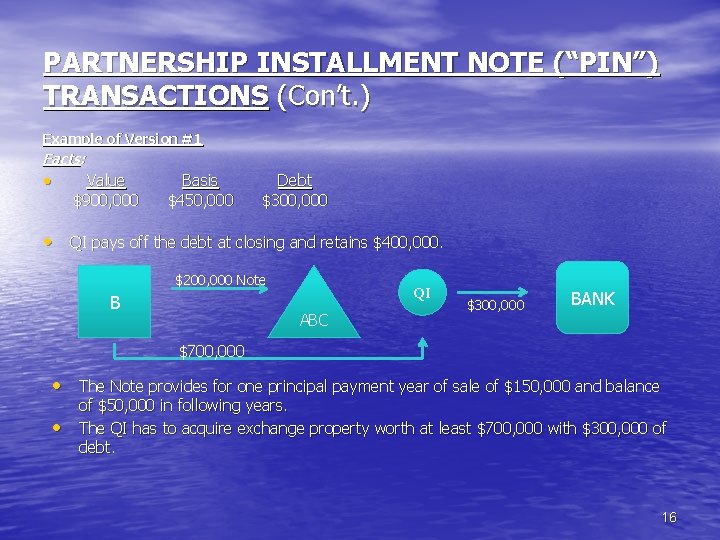
PARTNERSHIP INSTALLMENT NOTE (“PIN”) TRANSACTIONS (Con’t. ) Example of Version #1 Facts: · Value $900, 000 Basis $450, 000 Debt $300, 000 · QI pays off the debt at closing and retains $400, 000. $200, 000 Note B QI ABC $300, 000 BANK $700, 000 · The Note provides for one principal payment year of sale of $150, 000 and balance · of $50, 000 in following years. The QI has to acquire exchange property worth at least $700, 000 with $300, 000 of debt. 16
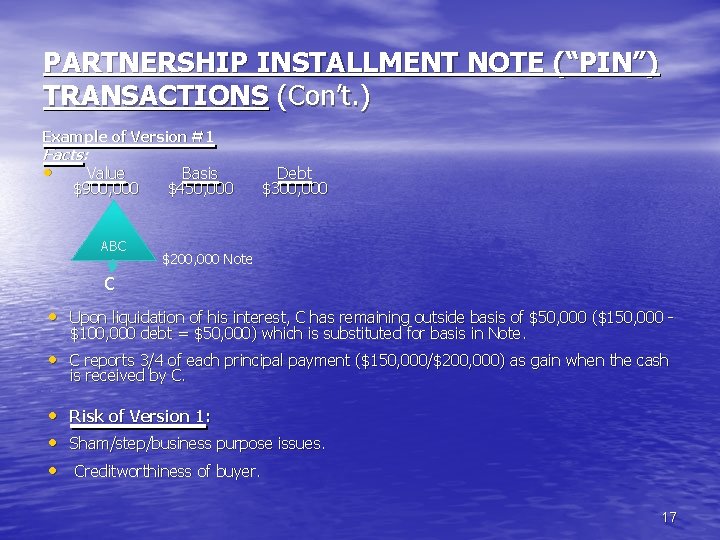
PARTNERSHIP INSTALLMENT NOTE (“PIN”) TRANSACTIONS (Con’t. ) Example of Version #1 Facts: · Value $900, 000 ABC Basis $450, 000 Debt $300, 000 $200, 000 Note C · Upon liquidation of his interest, C has remaining outside basis of $50, 000 ($150, 000 $100, 000 debt = $50, 000) which is substituted for basis in Note. · C reports 3/4 of each principal payment ($150, 000/$200, 000) as gain when the cash is received by C. · Risk of Version 1: · Sham/step/business purpose issues. · Creditworthiness of buyer. 17
PARTNERSHIP INSTALLMENT NOTE (“PIN”) TRANSACTIONS Transaction Overview Version #2 (Note Issued by QI): • Partnership sells real property to a buyer for cash. • • • Buyer transfers cash to QI. QI pays off any debt the Partnership owed on property. QI issues promissory note to Partnership in the amount of the interest of the “cash out” partner. Partnership distributes the promissory notes to the “cash out” partner in retirement of the “cash out” partner. 18
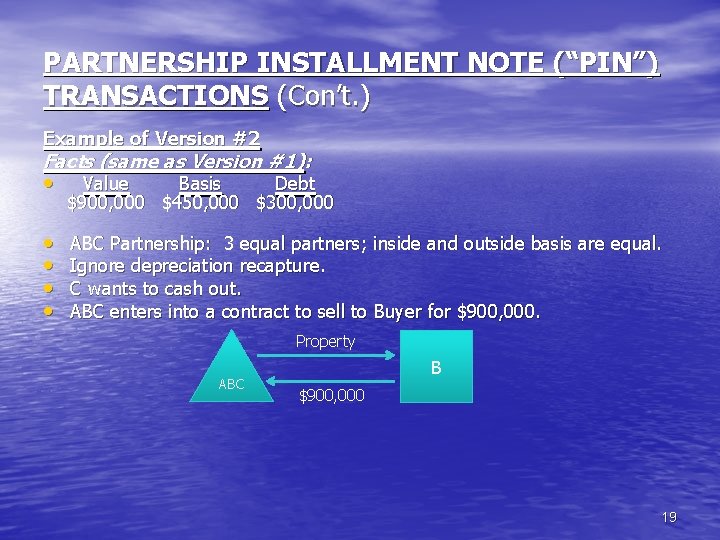
PARTNERSHIP INSTALLMENT NOTE (“PIN”) TRANSACTIONS (Con’t. ) Example of Version #2 Facts (same as Version #1): · Value Basis Debt $900, 000 $450, 000 $300, 000 · · ABC Partnership: 3 equal partners; inside and outside basis are equal. Ignore depreciation recapture. C wants to cash out. ABC enters into a contract to sell to Buyer for $900, 000. Property ABC B $900, 000 19
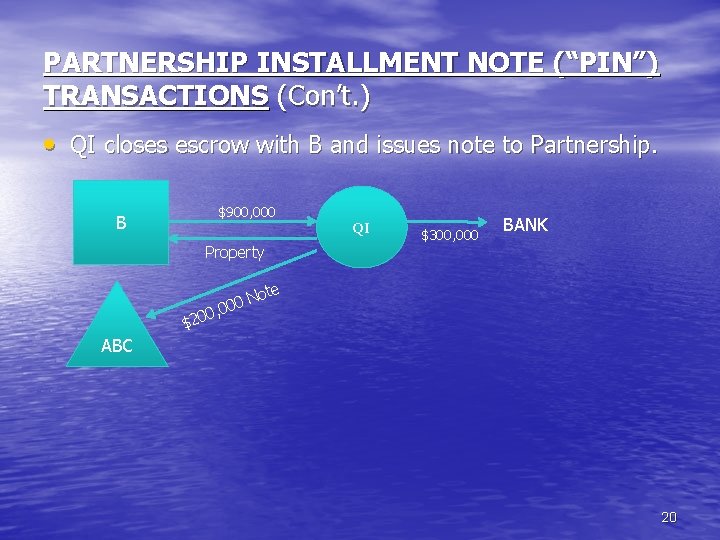
PARTNERSHIP INSTALLMENT NOTE (“PIN”) TRANSACTIONS (Con’t. ) · QI closes escrow with B and issues note to Partnership. $900, 000 B Property QI $300, 000 BANK e 0 $20 ot N 0 0 , 0 ABC 20
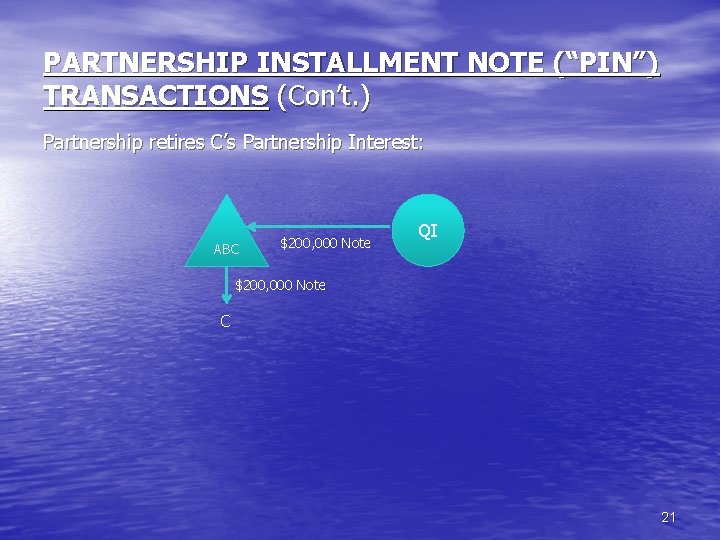
PARTNERSHIP INSTALLMENT NOTE (“PIN”) TRANSACTIONS (Con’t. ) Partnership retires C’s Partnership Interest: ABC $200, 000 Note QI $200, 000 Note C 21
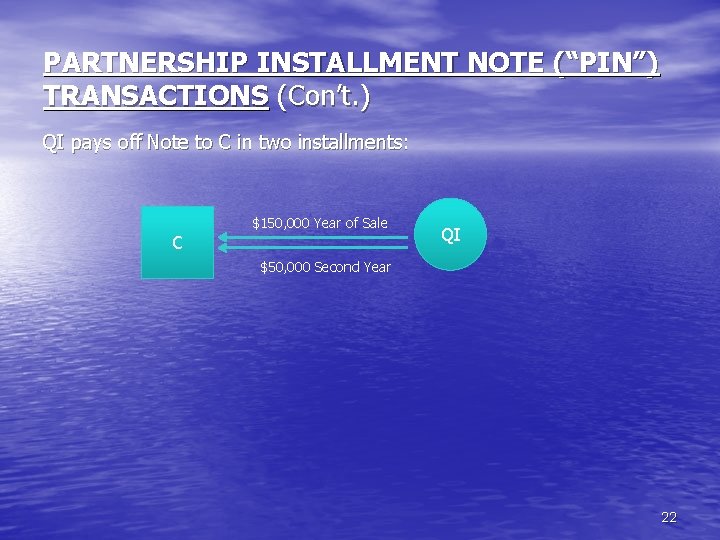
PARTNERSHIP INSTALLMENT NOTE (“PIN”) TRANSACTIONS (Con’t. ) QI pays off Note to C in two installments: $150, 000 Year of Sale C QI $50, 000 Second Year 22
PARTNERSHIP INSTALLMENT NOTE (“PIN”) TRANSACTIONS (Con’t. ) QI retains $400, 000 cash and exchange must be completed with $400, 000 cash and $300, 000 debt. 23
PARTNERSHIP INSTALLMENT NOTE (“PIN”) TRANSACTIONS (Con’t. ) Risks of Version 2: • Is the QI still within the “safe harbor” of being a non-agent? • Will the installment note be considered as a third -party note ineligible for installment reporting? • • • Sham/step/business purpose issues. Creditworthiness of QI. Basis allocation to exchange property. 24
Debt Incurred or Shifted Near in Time to an Exchange 25
Debt Incurred / Shifted Near in Time to an Exchange • Receiving money as part of an exchange requires tax recognition – IRC section 1031(b) • Issue: What is the impact of debt created/ shifted as part of an exchange 26
Debt Incurred / Shifted Near in Time to an Exchange • New debt or shifting of debts not allowed without independent economic substance: – In anticipation of sale of relinquished property – During an exchange • What about a refinance set up during an exchange, but disbursement occurs after the exchange? 27
Debt Incurred / Shifted Near in Time to an Exchange • Long v. Comm’r (1981) 77 TC 1045 • Garcia v. Comm’r (1983) 80 T. C. 491 • Fredericks v. Comm’r (1994) T. C. Memo. 1994 -27 • Behrens v. Comm’r (1985) T. C. Memo. 1985 -195 28
Recent Related Party Exchange Litigation 29
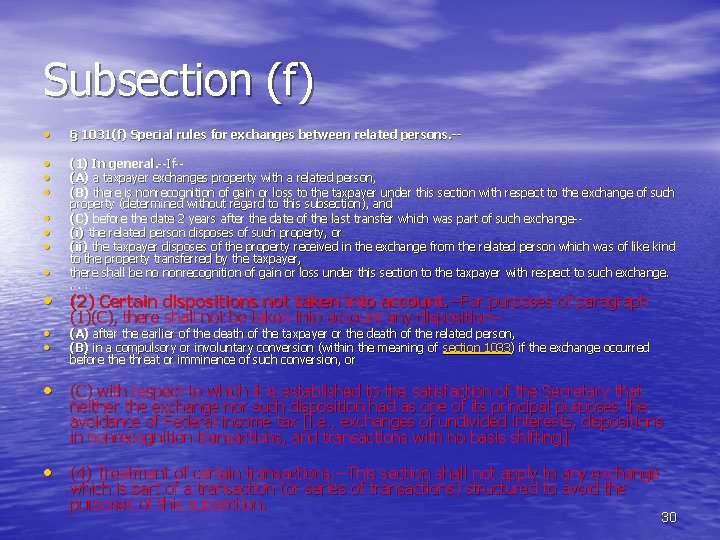
Subsection (f) • § 1031(f) Special rules for exchanges between related persons. -- • • • (1) In general. --If-(A) a taxpayer exchanges property with a related person, (B) there is nonrecognition of gain or loss to the taxpayer under this section with respect to the exchange of such property (determined without regard to this subsection), and (C) before the date 2 years after the date of the last transfer which was part of such exchange-(i) the related person disposes of such property, or (ii) the taxpayer disposes of the property received in the exchange from the related person which was of like kind to the property transferred by the taxpayer, there shall be no nonrecognition of gain or loss under this section to the taxpayer with respect to such exchange. . • • • (2) Certain dispositions not taken into account. --For purposes of paragraph • • (1)(C), there shall not be taken into account any disposition-- (A) after the earlier of the death of the taxpayer or the death of the related person, (B) in a compulsory or involuntary conversion (within the meaning of section 1033) if the exchange occurred before threat or imminence of such conversion, or • (C) with respect to which it is established to the satisfaction of the Secretary that neither the exchange nor such disposition had as one of its principal purposes the avoidance of Federal income tax [i. e. , exchanges of undivided interests, dispositions in nonrecognition transactions, and transactions with no basis shifting]. • (4) Treatment of certain transactions. --This section shall not apply to any exchange which is part of a transaction (or series of transactions) structured to avoid the purposes of this subsection. 30
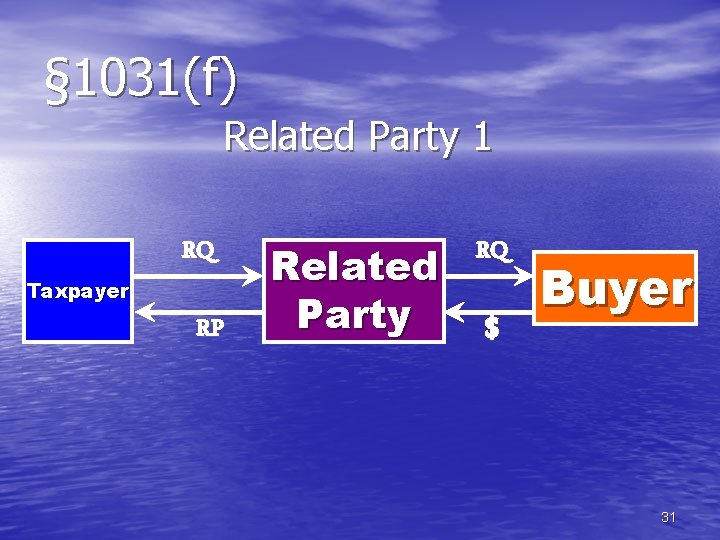
§ 1031(f) Related Party 1 Taxpayer RQ RP Related Party RQ $ Buyer 31
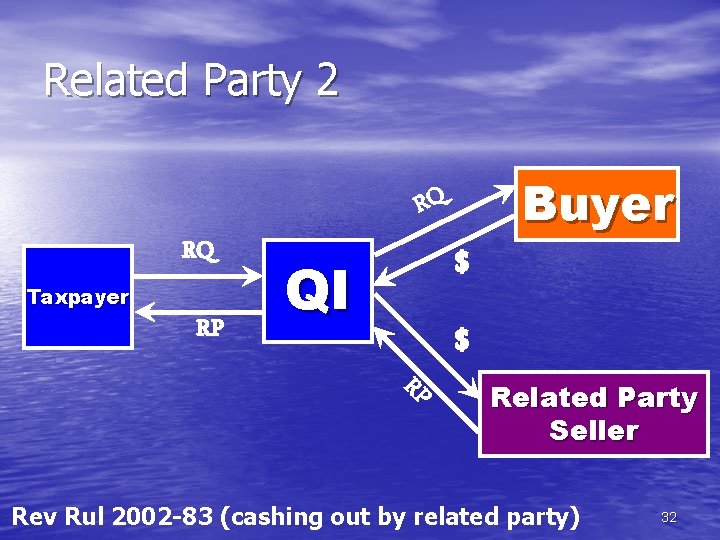
Related Party 2 Buyer RQ RQ Taxpayer RP $ QI $ RP Related Party Seller Rev Rul 2002 -83 (cashing out by related party) 32
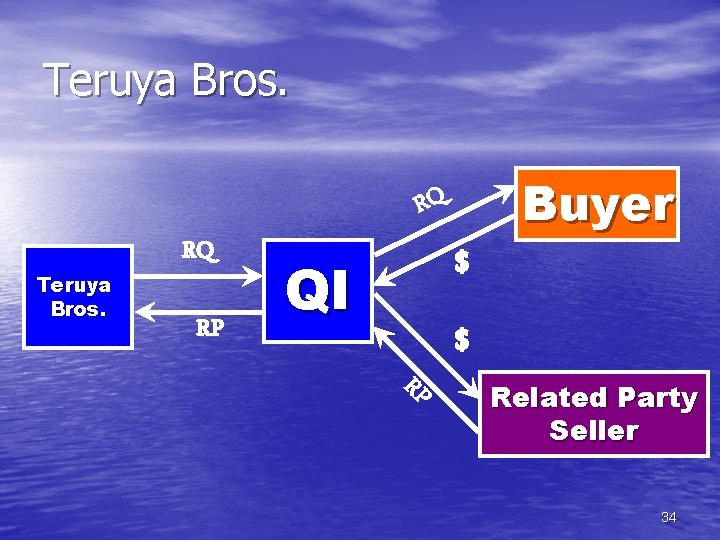
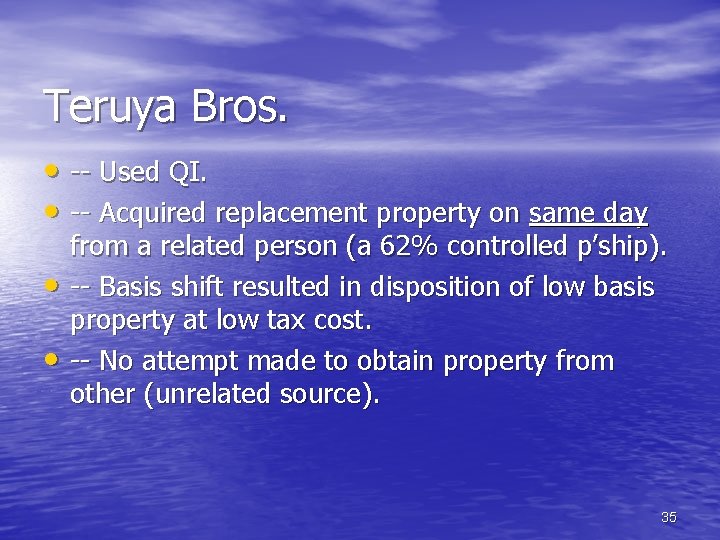
Teruya Bros. , Ltd v. Commissioner, 124 T. C. 45 (2005), aff’d, 580 F. 3 d 1038 (9 th Cir. 2009), cert denied, 130 S. Ct. 1526 (Feb. 22, 2010). Rejected Mechanical Application of Rev. Rul. But… 33
Teruya Bros. Buyer RQ Teruya Bros. RQ RP $ QI $ RP Related Party Seller 34
Teruya Bros. • -- Used QI. • -- Acquired replacement property on same day • • from a related person (a 62% controlled p’ship). -- Basis shift resulted in disposition of low basis property at low tax cost. -- No attempt made to obtain property from other (unrelated source). 35
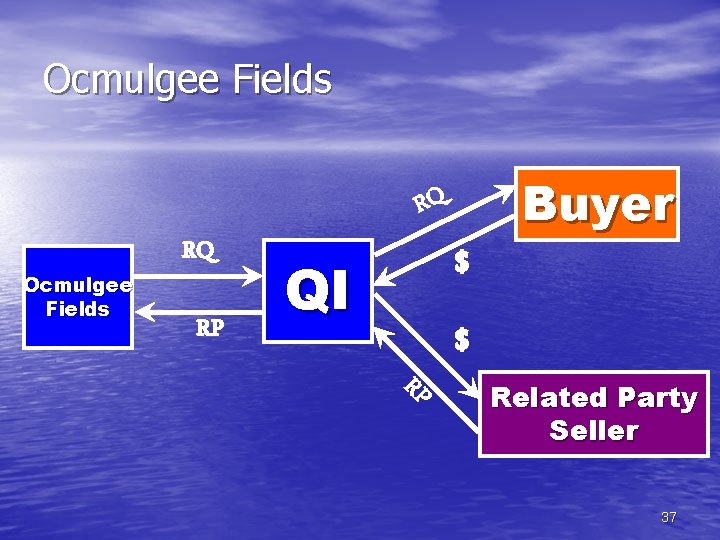
Ocmulgee Fields, Inc. v. Commissioner, 132 T. C. 105 (2009), aff’d. 613 F. 3 d 1360 (11 th Cir. 2010). 36
Ocmulgee Fields Buyer RQ Ocmulgee Fields RQ RP $ QI $ RP Related Party Seller 37
Claim: That No Other Replacement Property Was Available 38

North Central Rental & Leasing LLC v. United States, 779 F. 3 d 738 (8 th Cir. 2015). 39
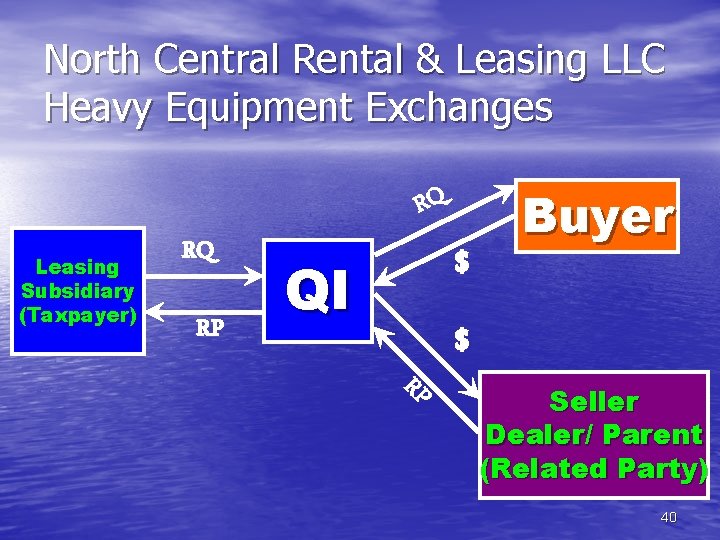
North Central Rental & Leasing LLC Heavy Equipment Exchanges RQ Leasing Subsidiary (Taxpayer) RQ RP $ QI Buyer $ RP Seller Dealer/ Parent (Related Party) 40
Is there a Business Purpose Exception ? 41
Bifurcation of Properties 42
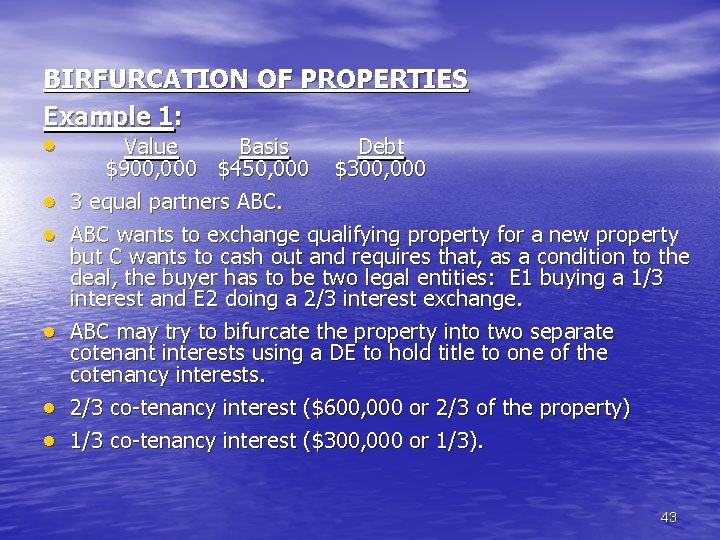
BIRFURCATION OF PROPERTIES Example 1: · Value Basis $900, 000 $450, 000 3 equal partners ABC. Debt $300, 000 · · ABC wants to exchange qualifying property for a new property · but C wants to cash out and requires that, as a condition to the deal, the buyer has to be two legal entities: E 1 buying a 1/3 interest and E 2 doing a 2/3 interest exchange. ABC may try to bifurcate the property into two separate cotenant interests using a DE to hold title to one of the cotenancy interests. 2/3 co-tenancy interest ($600, 000 or 2/3 of the property) · · 1/3 co-tenancy interest ($300, 000 or 1/3). 43
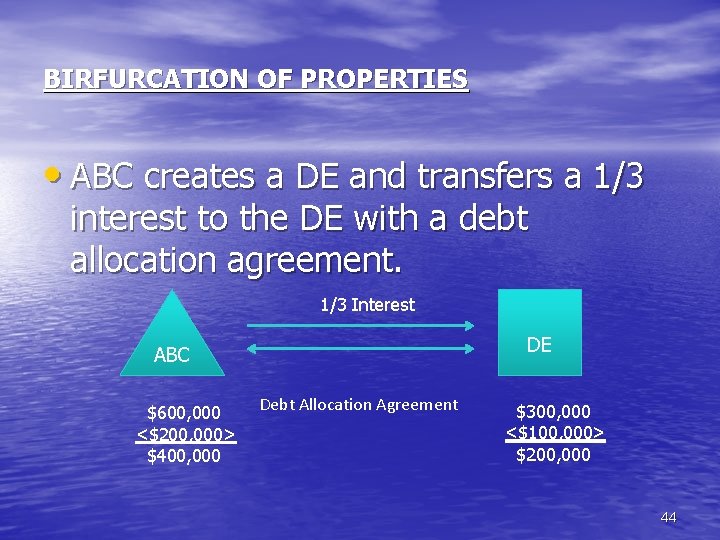
BIRFURCATION OF PROPERTIES • ABC creates a DE and transfers a 1/3 interest to the DE with a debt allocation agreement. 1/3 Interest DE ABC $600, 000 <$200, 000> $400, 000 Debt Allocation Agreement $300, 000 <$100, 000> $200, 000 44
BIRFURCATION OF PROPERTIES • ABC Partnership Agreement is amended to allocate all of the gain ($300, 000 $150, 000) to C. 45
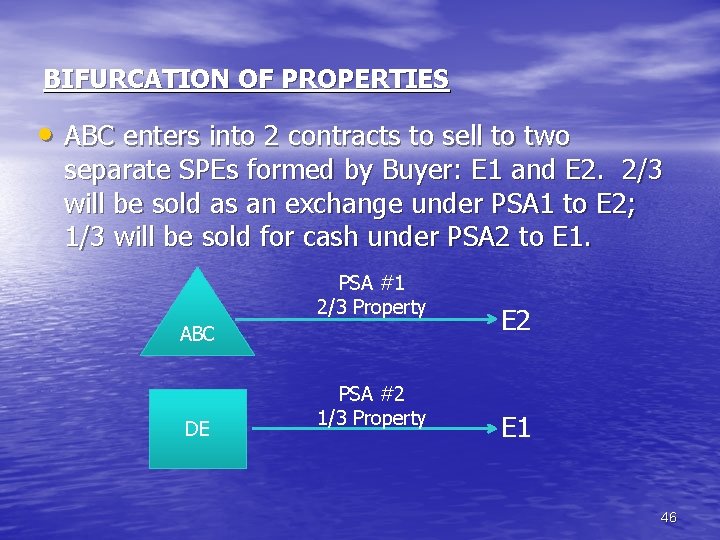
BIFURCATION OF PROPERTIES • ABC enters into 2 contracts to sell to two separate SPEs formed by Buyer: E 1 and E 2. 2/3 will be sold as an exchange under PSA 1 to E 2; 1/3 will be sold for cash under PSA 2 to E 1. PSA #1 2/3 Property ABC DE PSA #2 1/3 Property E 2 E 1 46
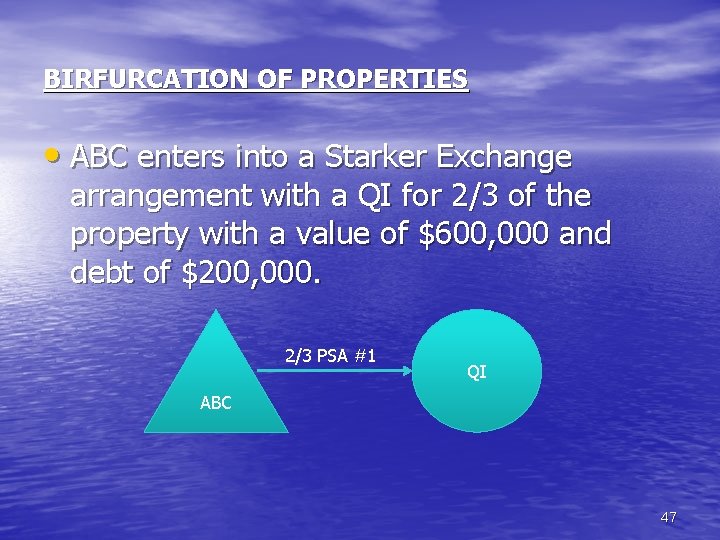
BIRFURCATION OF PROPERTIES • ABC enters into a Starker Exchange arrangement with a QI for 2/3 of the property with a value of $600, 000 and debt of $200, 000. 2/3 PSA #1 QI ABC 47
BIRFURCATION OF PROPERTIES • DE sells 1/3 of the property to E 1 for cash and ABC then distributes the DE to C in retirement of C’s interest. 48
BIRFURCATION OF PROPERTIES • C’s basis is increased to $200, 000 as follows: – $150, 000 (outside basis) - $100, 000 (debt relief) + $150, 000 of gain = $200, 000. – C receives the DE with $200, 000 in cash as its liquidating distribution without gain. 49
BIFURCATION OF PROPERTIES Benefits and Risks Benefits: • TP’s gain from the sale of the second part is $150, 000 rather than the $200, 000 which would have to have been recognized if treated as boot. • Gain is allocated to C who is in effect selling out. Risks: • If the Buyer entities are DEs, this would create more risk. • Sham/step/business purpose. • 704(b) allocation not recognized and may not be able to make numbers work exactly right. Alternatives: • If the property consists of multiple parcels, might have a better chance of working if there is an exchange of some parcels and sale of other parcels. • Perhaps use a sale for part of property and a lease option for 50 balance.
Exchanges of Property Underlying an Option 51
Options • Scenario – Taxpayer holds an option to buy Greenacre – Taxpayer receives an offer to sell Greenacre – Taxpayer exercises option and attempts to exchange Greenacre for Blackacre 52
Options • IRC section 1031(a) requires an exchange of “like kind” property • Issues: – Recasting the transaction as an exchange of an option for Blackacre – Holding period 53
Defeasance Transactions 54
DEFEASANCE TRANSACTIONS • “CONDUIT LOANS” are commercial mortgage-back securities pooled together in real estate mortgage investment conduits. 55
DEFEASANCE TRANSACTIONS • CONDUIT LOANS must be principally secured by an interest in real property to be considered a qualified mortgage. A mortgage ceases to be considered a qualified mortgage if a REMIC releases its lien on real property unless the borrower pledges substitute collateral that consists solely of government securities. 56
DEFEASANCE TRANSACTIONS • CONDUIT LOANS generally prohibit the borrower from prepaying the CONDUIT LOAN because a prepayment on any of the underlying loans in the REMIC pool would affect the yield on the bonds issued by the REMIC and frustrate the bond investors’ expectations. 57
DEFEASANCE TRANSACTIONS • “Defeasance” generally means that the original real estate securing the CONDUIT LOAN is released as collateral and new collateral is substituted that will generate cash flow that closely matches the timing and amount of payments due under the CONDUIT LOAN. 58
DEFEASANCE TRANSACTIONS Legal Defeasance: • The borrower uses a single purpose entity (SPE) and funds it with U. S. securities and provides the lender with a Pledge Agreement on the securities. • The borrower transfers the SPE to a trustee or custodian. • The borrower is legally released from any continuing liability on the debt; excess funds generated by the defeasance collateral revert to the trustee or custodian rather than the borrower. 59
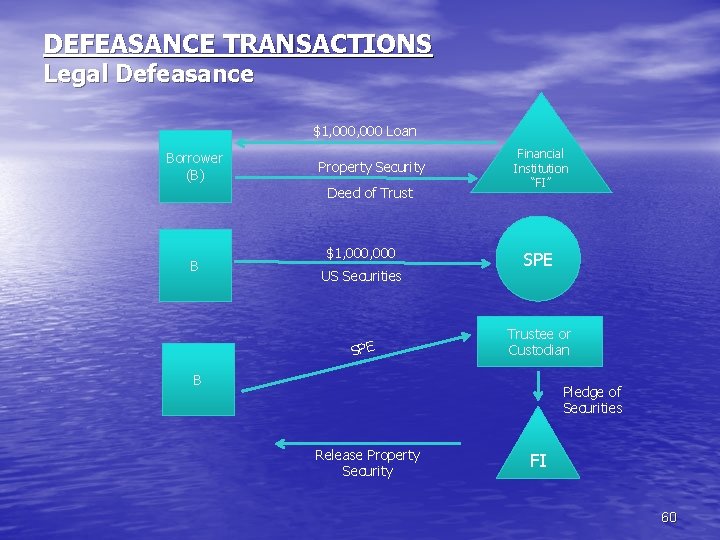
DEFEASANCE TRANSACTIONS Legal Defeasance $1, 000 Loan Borrower (B) Property Security Deed of Trust B $1, 000 US Securities SPE Financial Institution “FI” SPE Trustee or Custodian B Pledge of Securities Release Property Security FI 60
DEFEASANCE TRANSACTIONS In-Substance Defeasance: • Same structure as above except the borrower retains ownership of the SPE and the borrower remains legally liable to the lender to make required payments under the loan in the event there is a shortfall in cash flow generated by the substitute collateral. • Any excess cash flow from the substitute collateral generally reverts to the borrower. 61
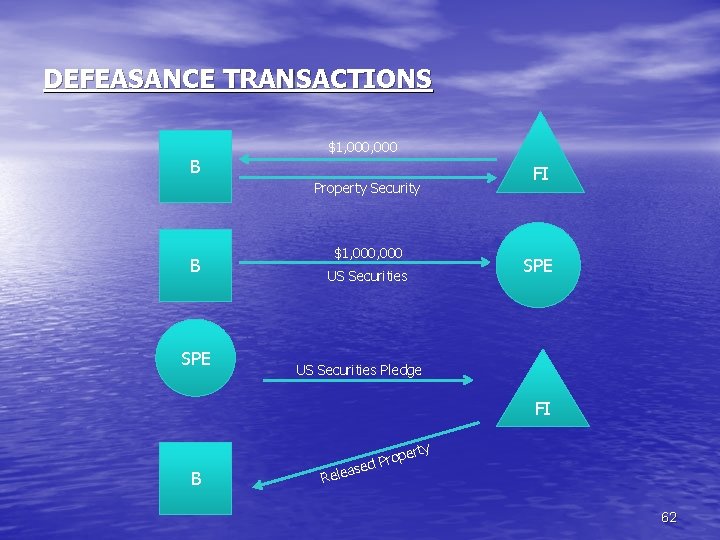
DEFEASANCE TRANSACTIONS $1, 000 B Property Security B SPE $1, 000 US Securities FI SPE US Securities Pledge FI B Rele erty as rop ed P 62
DEFEASANCE TRANSACTIONS Tax Issues • Issue: If the seller/borrower intends to engage in a like-kind exchange of the property pursuant to Code Sec. 1031, the issue is whether the defeasance of the CONDUIT LOAN will result in taxable boot to the seller/borrower. • Netting of Loans: Reg Sec. 1. 1031(b)-1(c) provides that, consideration by the seller given in the form of an assumption of liabilities (or a receipt of property subject to a liability) shall be offset against consideration received in the form of an assumption of liabilities by the buyer. • No Netting of Debt Against Cash or Property: However, Reg. Sec. 1. 1031(d)-2 provides that consideration received in the form of cash or other property is not offset by consideration given in the form of an assumption of a liability or receipt of property subject to a liability. 63
DEFEASANCE TRANSACTIONS Example 1 – Legal Defeasance: • X owns Property A with a fair market value of $100, a tax basis of $50, subject to a CONDUIT LOAN of $85. • X intends to sell the property to Y for $100 in connection with a like-kind exchange under Code Section 1031. • Y does not want to assume the debt. • Based on the prevailing interest rates, in order for X to defease the CONDUIT LOAN, X must purchase $90 worth of U. S. Government securities, which includes a $5 defeasance premium. 64
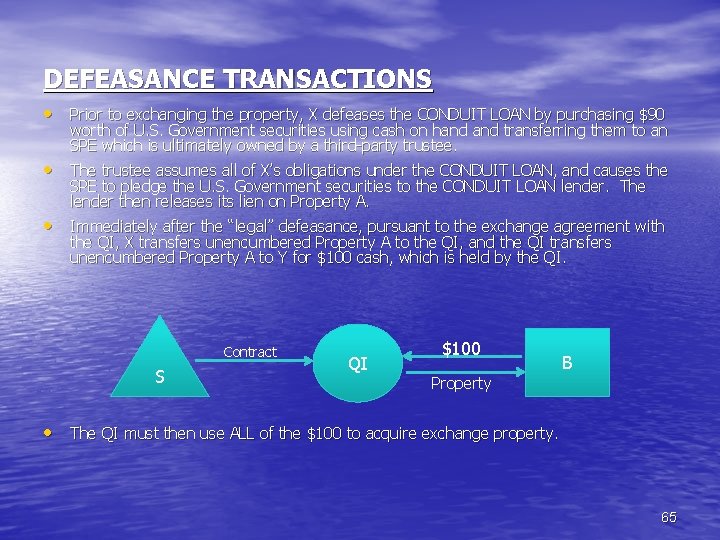
DEFEASANCE TRANSACTIONS • Prior to exchanging the property, X defeases the CONDUIT LOAN by purchasing $90 worth of U. S. Government securities using cash on hand transferring them to an SPE which is ultimately owned by a third-party trustee. • The trustee assumes all of X’s obligations under the CONDUIT LOAN, and causes the SPE to pledge the U. S. Government securities to the CONDUIT LOAN lender. The lender then releases its lien on Property A. • Immediately after the “legal” defeasance, pursuant to the exchange agreement with the QI, X transfers unencumbered Property A to the QI, and the QI transfers unencumbered Property A to Y for $100 cash, which is held by the QI. Contract S QI $100 B Property • The QI must then use ALL of the $100 to acquire exchange property. 65
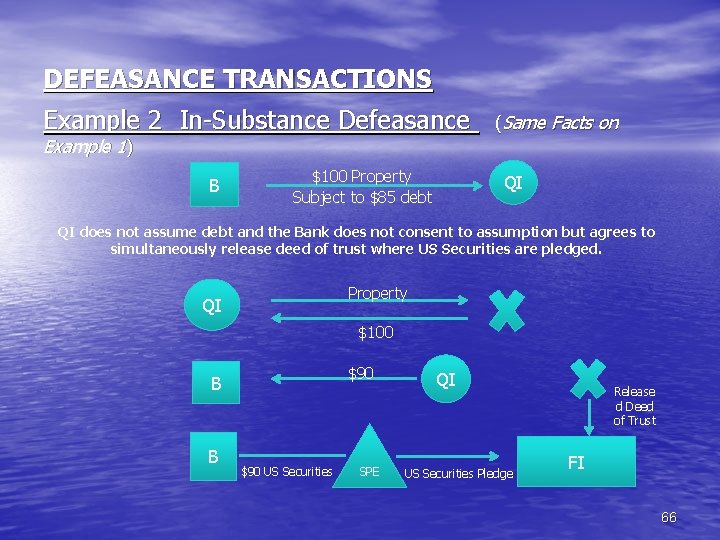
DEFEASANCE TRANSACTIONS Example 2 In-Substance Defeasance Example 1) B $100 Property Subject to $85 debt (Same Facts on QI QI does not assume debt and the Bank does not consent to assumption but agrees to simultaneously release deed of trust where US Securities are pledged. Property QI $100 $90 B B $90 US Securities SPE QI US Securities Pledge Release d Deed of Trust FI 66
DEFEASANCE TRANSACTIONS Risks • In a “in-substance” defeasance, if the QI acquires property with • • a value of $100 subject to $90 of debt and then reimburses for the $90 spent on defeasance, X may not be able to net the $90 of cash boot received with the $90 of liability boot paid, and X may have to recognize $50 of gain as a result of the exchange because the Regulations provide that cash received cannot be netted against the assumption of debt. So a significant disadvantage of this transaction is that it may not be viewed as a single transaction allowing netting of the loans. As we will discuss later, it may be possible for the seller to use pocket money to buy the U. S. securities, not withdraw money from the exchange and refinance the property AFTER the exchange and reimburse himself for all of part of the $90 paid to defease the loan. 67

Any Questions? 68
- Slides: 68