
Lijphart v Horowitz Consociationalism Alternative Vote 1 People
- Slides: 2
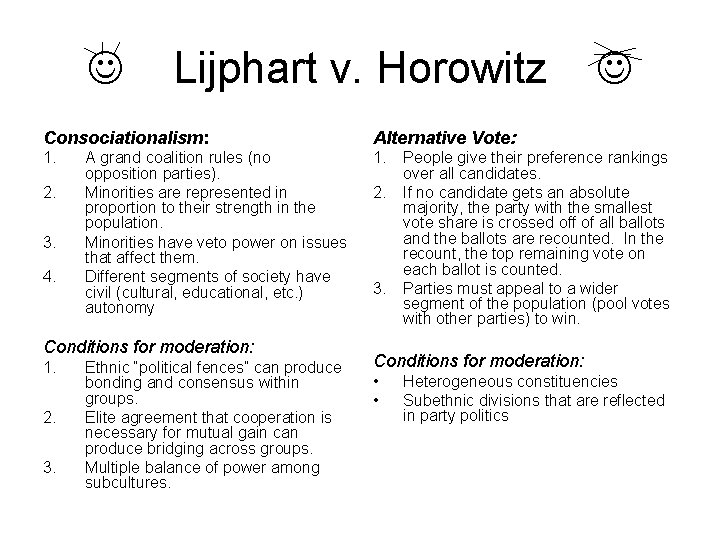
Lijphart v. Horowitz Consociationalism: Alternative Vote: 1. People give their preference rankings over all candidates. 2. If no candidate gets an absolute majority, the party with the smallest vote share is crossed off of all ballots and the ballots are recounted. In the recount, the top remaining vote on each ballot is counted. 3. Parties must appeal to a wider segment of the population (pool votes with other parties) to win. 2. 3. 4. A grand coalition rules (no opposition parties). Minorities are represented in proportion to their strength in the population. Minorities have veto power on issues that affect them. Different segments of society have civil (cultural, educational, etc. ) autonomy Conditions for moderation: 1. 2. 3. Ethnic “political fences” can produce bonding and consensus within groups. Elite agreement that cooperation is necessary for mutual gain can produce bridging across groups. Multiple balance of power among subcultures. Conditions for moderation: • • Heterogeneous constituencies Subethnic divisions that are reflected in party politics
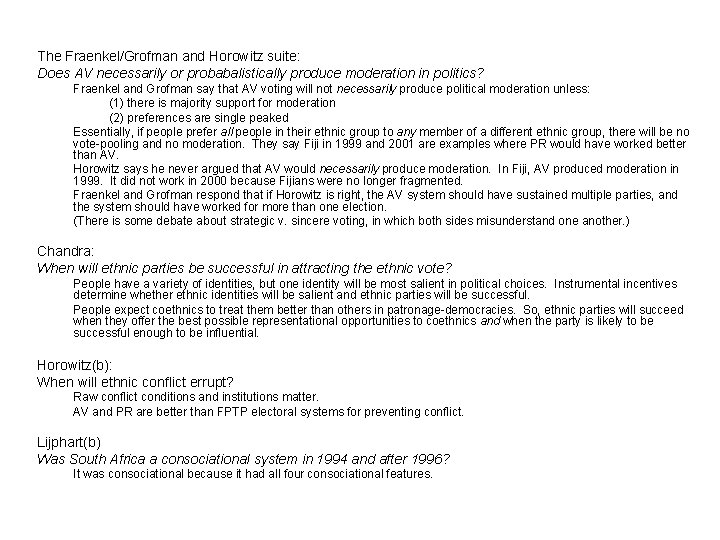
The Fraenkel/Grofman and Horowitz suite: Does AV necessarily or probabalistically produce moderation in politics? Fraenkel and Grofman say that AV voting will not necessarily produce political moderation unless: (1) there is majority support for moderation (2) preferences are single peaked Essentially, if people prefer all people in their ethnic group to any member of a different ethnic group, there will be no vote-pooling and no moderation. They say Fiji in 1999 and 2001 are examples where PR would have worked better than AV. Horowitz says he never argued that AV would necessarily produce moderation. In Fiji, AV produced moderation in 1999. It did not work in 2000 because Fijians were no longer fragmented. Fraenkel and Grofman respond that if Horowitz is right, the AV system should have sustained multiple parties, and the system should have worked for more than one election. (There is some debate about strategic v. sincere voting, in which both sides misunderstand one another. ) Chandra: When will ethnic parties be successful in attracting the ethnic vote? People have a variety of identities, but one identity will be most salient in political choices. Instrumental incentives determine whether ethnic identities will be salient and ethnic parties will be successful. People expect coethnics to treat them better than others in patronage-democracies. So, ethnic parties will succeed when they offer the best possible representational opportunities to coethnics and when the party is likely to be successful enough to be influential. Horowitz(b): When will ethnic conflict errupt? Raw conflict conditions and institutions matter. AV and PR are better than FPTP electoral systems for preventing conflict. Lijphart(b) Was South Africa a consociational system in 1994 and after 1996? It was consociational because it had all four consociational features.