
LIGOG 060012 00 R Detection of Gravitational Waves
- Slides: 46
LIGO-G 060012 -00 -R Detection of Gravitational Waves with Interferometers Giant detectors Precision measurement The search for the elusive waves Nergis Mavalvala (on behalf of the LIGO Scientific Collaboration) AAS Meeting, Washington D. C. January 2006
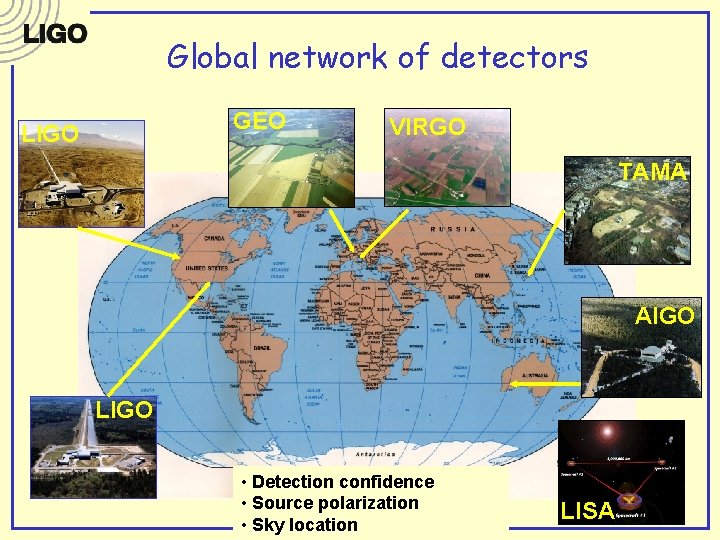
Global network of detectors GEO LIGO VIRGO TAMA AIGO LIGO • Detection confidence • Source polarization • Sky location LISA
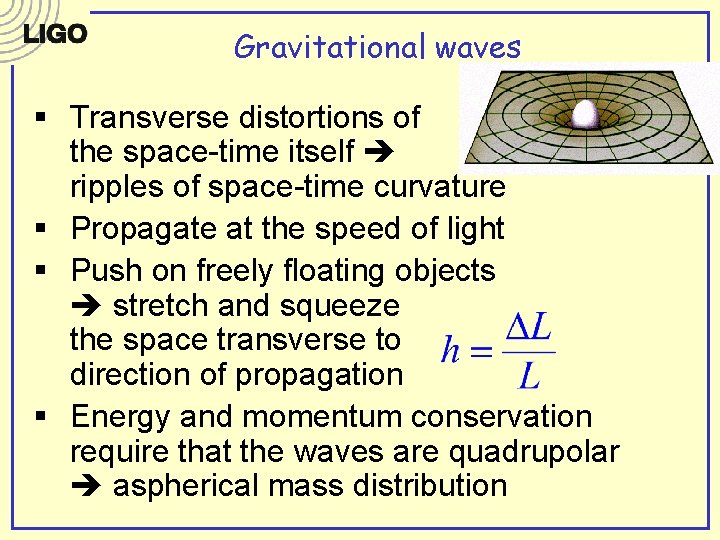
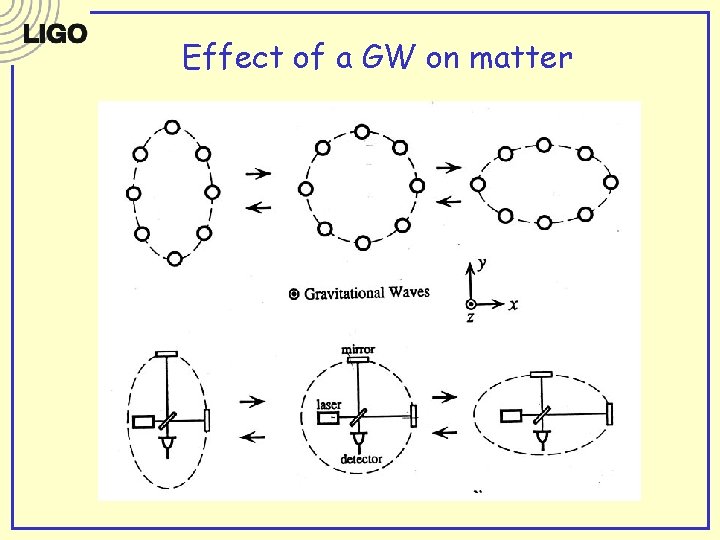
Gravitational waves § Transverse distortions of the space-time itself ripples of space-time curvature § Propagate at the speed of light § Push on freely floating objects stretch and squeeze the space transverse to direction of propagation § Energy and momentum conservation require that the waves are quadrupolar aspherical mass distribution
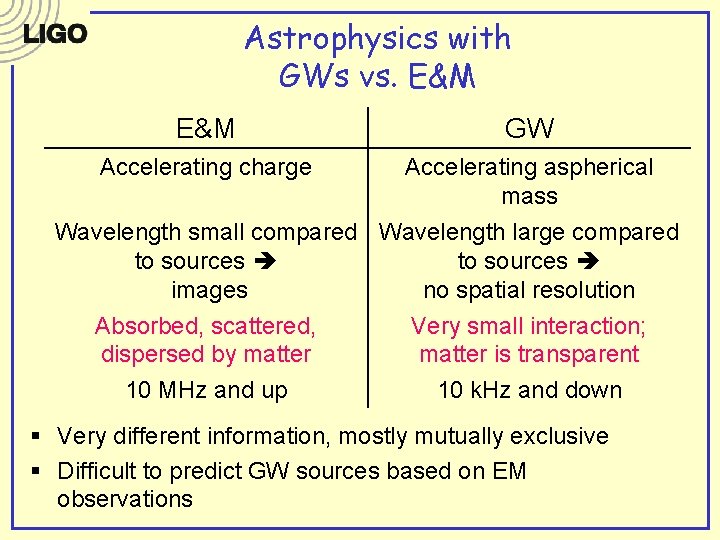
Astrophysics with GWs vs. E&M GW Accelerating charge Accelerating aspherical mass Wavelength small compared Wavelength large compared to sources images no spatial resolution Absorbed, scattered, Very small interaction; dispersed by matter is transparent 10 MHz and up 10 k. Hz and down § Very different information, mostly mutually exclusive § Difficult to predict GW sources based on EM observations
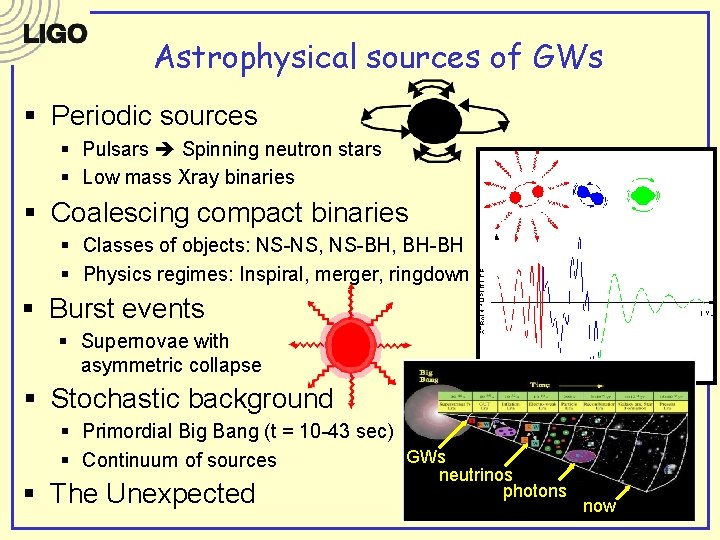
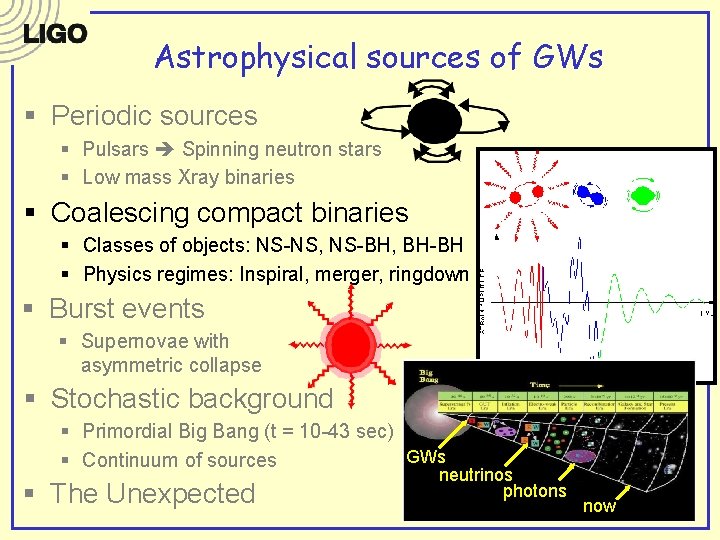
Astrophysical sources of GWs § Periodic sources § Pulsars Spinning neutron stars § Low mass Xray binaries § Coalescing compact binaries § Classes of objects: NS-NS, NS-BH, BH-BH § Physics regimes: Inspiral, merger, ringdown § Burst events § Supernovae with asymmetric collapse § Stochastic background § Primordial Big Bang (t = 10 -43 sec) GWs § Continuum of sources § The Unexpected neutrinos photons now
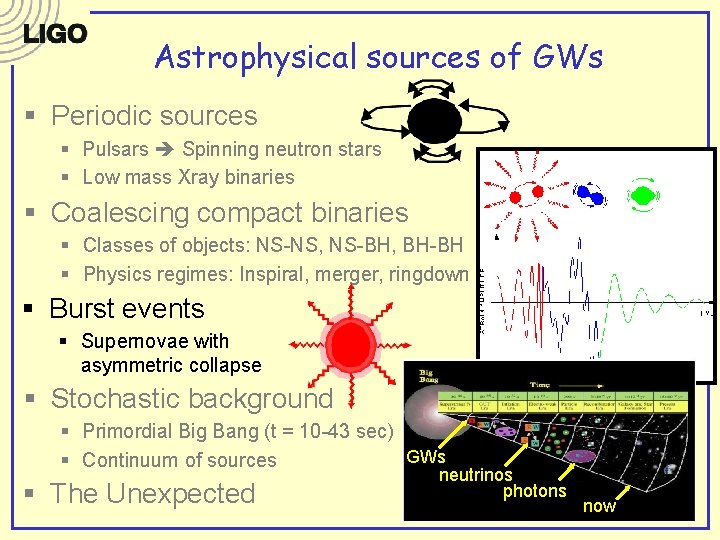
Astrophysical sources of GWs § Periodic sources § Pulsars Spinning neutron stars § Low mass Xray binaries § Coalescing compact binaries § Classes of objects: NS-NS, NS-BH, BH-BH § Physics regimes: Inspiral, merger, ringdown § Burst events § Supernovae with asymmetric collapse § Stochastic background § Primordial Big Bang (t = 10 -43 sec) GWs § Continuum of sources § The Unexpected neutrinos photons now
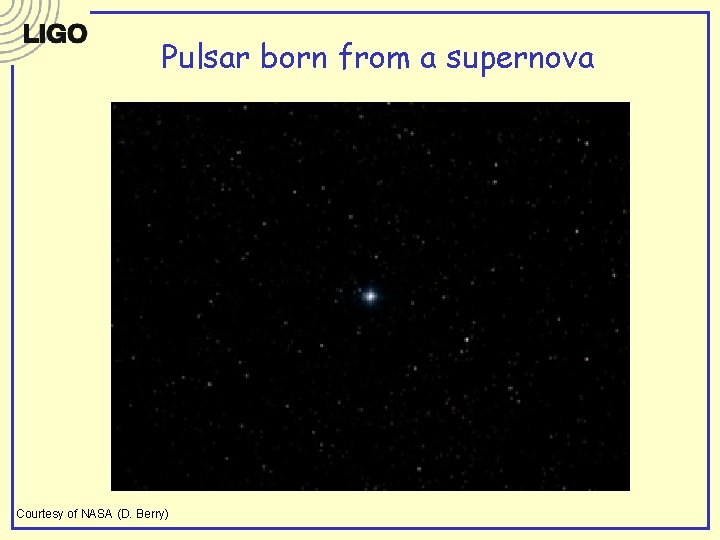
Pulsar born from a supernova Courtesy of NASA (D. Berry)
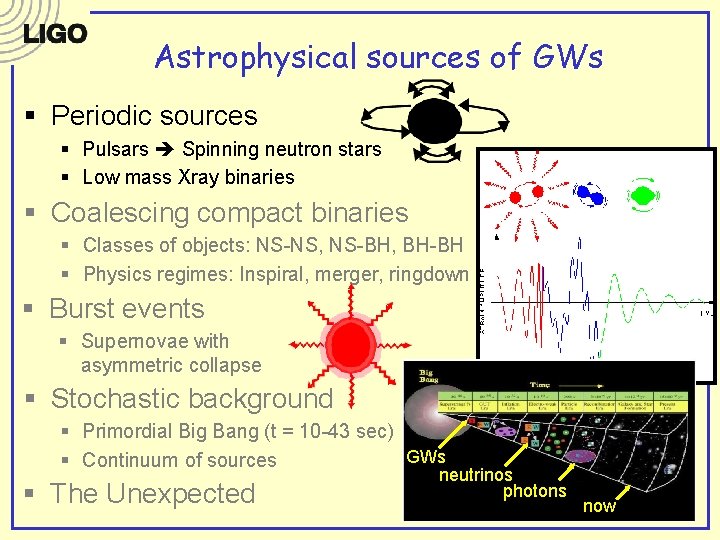
Astrophysical sources of GWs § Periodic sources § Pulsars Spinning neutron stars § Low mass Xray binaries § Coalescing compact binaries § Classes of objects: NS-NS, NS-BH, BH-BH § Physics regimes: Inspiral, merger, ringdown § Burst events § Supernovae with asymmetric collapse § Stochastic background § Primordial Big Bang (t = 10 -43 sec) GWs § Continuum of sources § The Unexpected neutrinos photons now
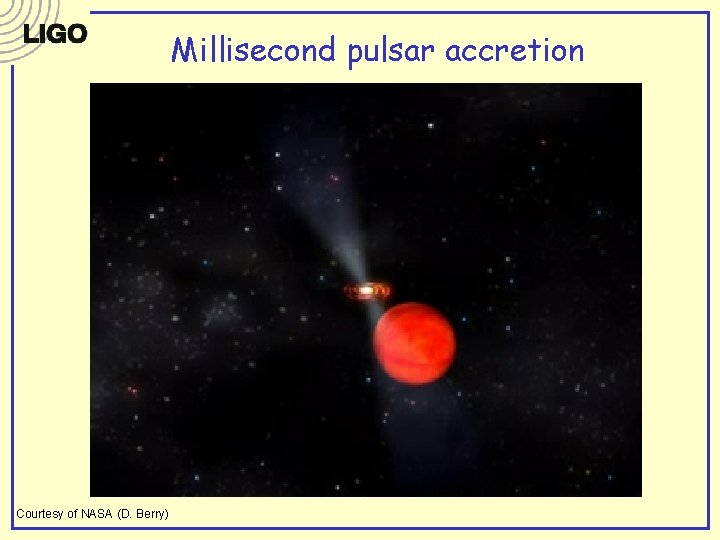
Millisecond pulsar accretion Courtesy of NASA (D. Berry)
Astrophysical sources of GWs § Periodic sources § Pulsars Spinning neutron stars § Low mass Xray binaries § Coalescing compact binaries § Classes of objects: NS-NS, NS-BH, BH-BH § Physics regimes: Inspiral, merger, ringdown § Burst events § Supernovae with asymmetric collapse § Stochastic background § Primordial Big Bang (t = 10 -43 sec) GWs § Continuum of sources § The Unexpected neutrinos photons now
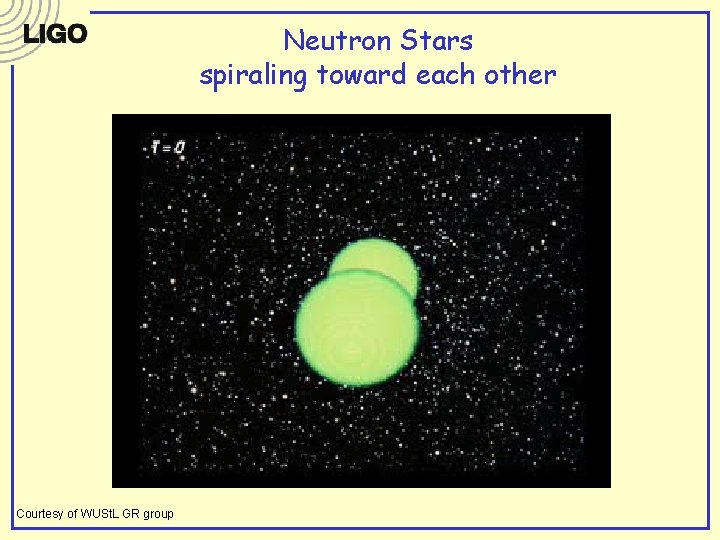
Neutron Stars spiraling toward each other Courtesy of WUSt. L GR group
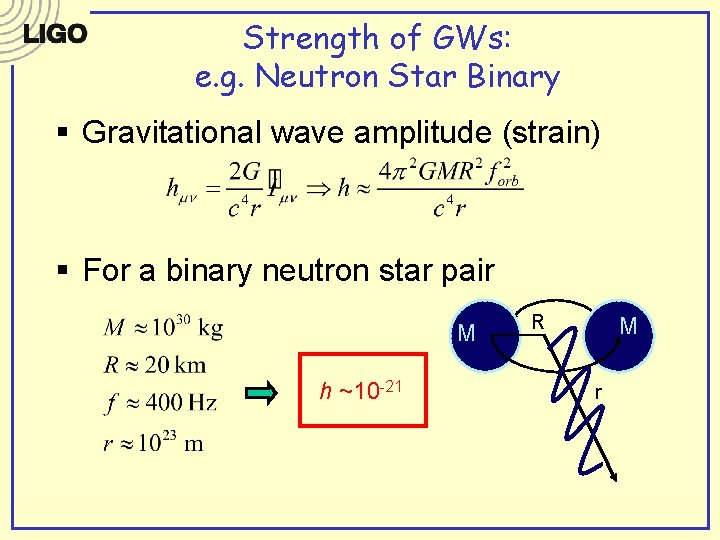
Strength of GWs: e. g. Neutron Star Binary § Gravitational wave amplitude (strain) § For a binary neutron star pair M h ~10 -21 R M r
Effect of a GW on matter
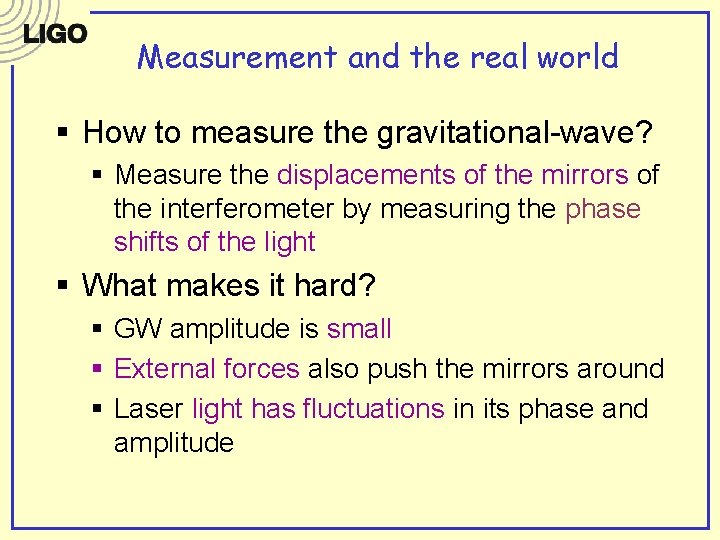
Measurement and the real world § How to measure the gravitational-wave? § Measure the displacements of the mirrors of the interferometer by measuring the phase shifts of the light § What makes it hard? § GW amplitude is small § External forces also push the mirrors around § Laser light has fluctuations in its phase and amplitude
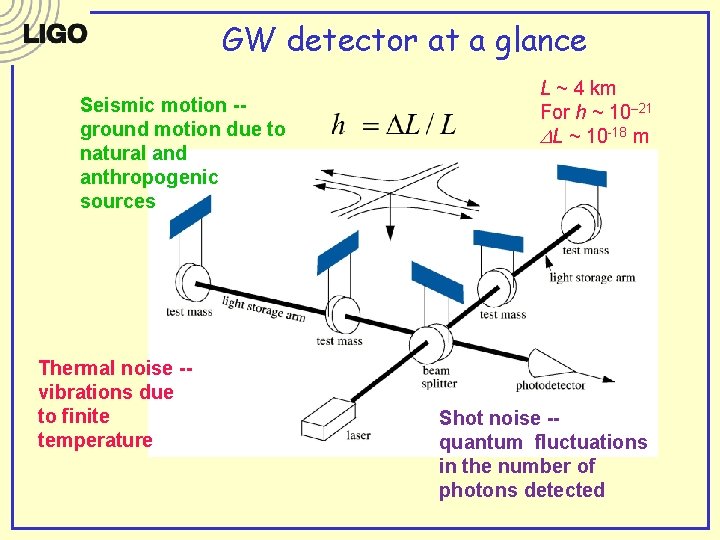
GW detector at a glance Seismic motion -ground motion due to natural and anthropogenic sources Thermal noise -vibrations due to finite temperature L ~ 4 km For h ~ 10– 21 DL ~ 10 -18 m Shot noise -quantum fluctuations in the number of photons detected
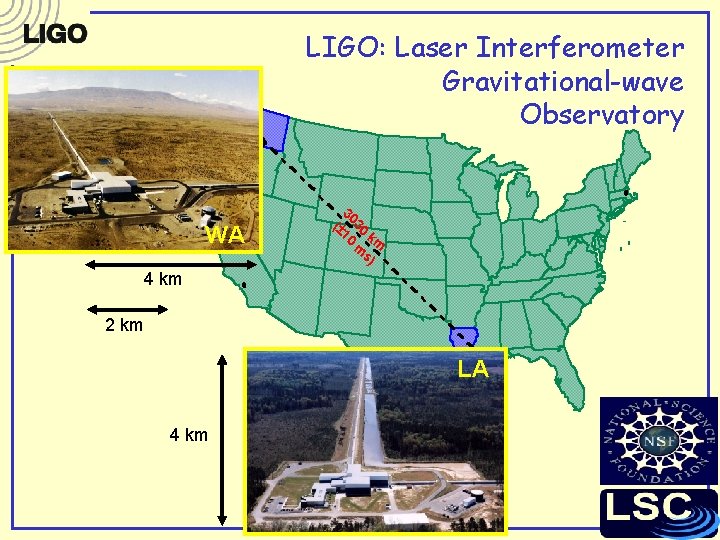
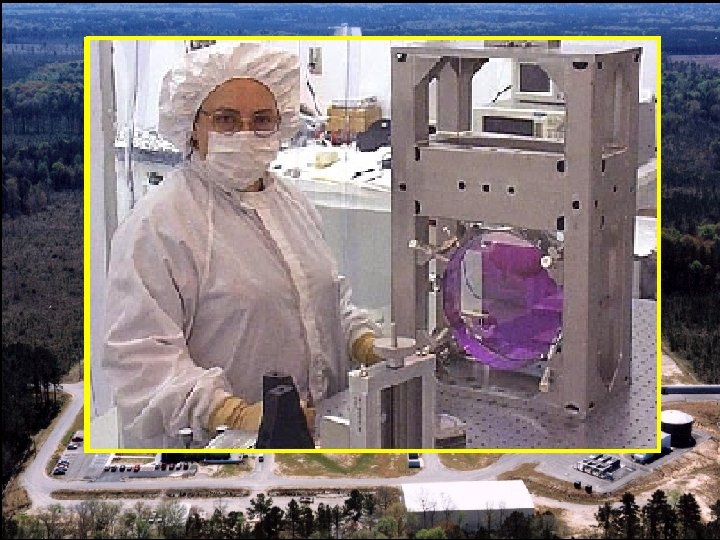
LIGO: Laser Interferometer Gravitational-wave Observatory WA 30 (± 30 10 k m m s) 4 km 2 km LA 4 km
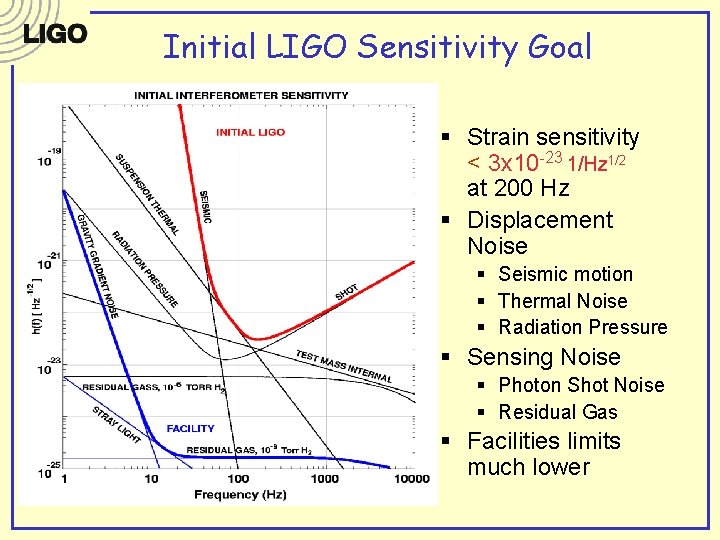
Initial LIGO Sensitivity Goal § Strain sensitivity < 3 x 10 -23 1/Hz 1/2 at 200 Hz § Displacement Noise § Seismic motion § Thermal Noise § Radiation Pressure § Sensing Noise § Photon Shot Noise § Residual Gas § Facilities limits much lower
Gravitational-wave searches
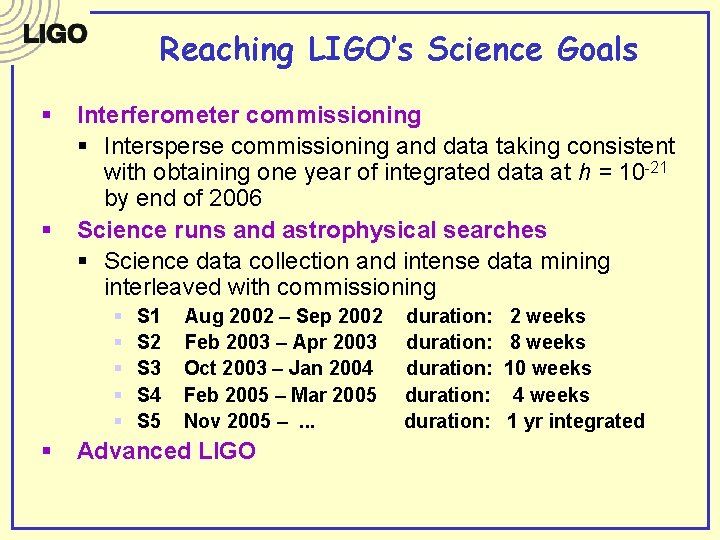
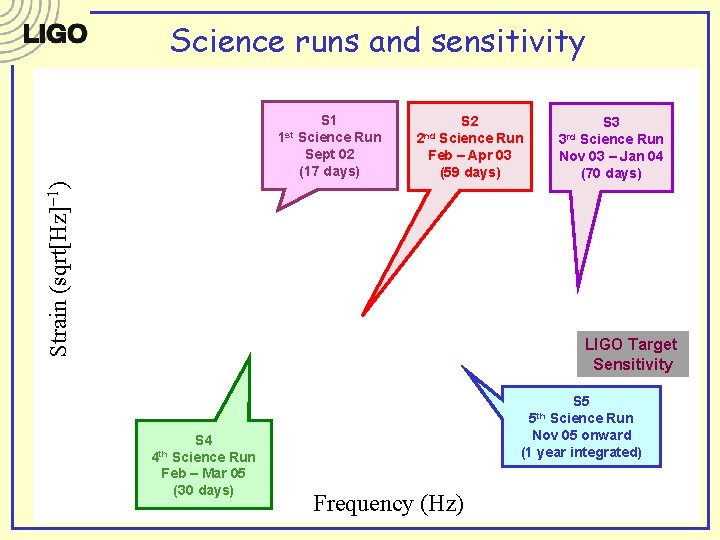
Reaching LIGO’s Science Goals § § Interferometer commissioning § Intersperse commissioning and data taking consistent with obtaining one year of integrated data at h = 10 -21 by end of 2006 Science runs and astrophysical searches § Science data collection and intense data mining interleaved with commissioning § § § S 1 S 2 S 3 S 4 S 5 Aug 2002 – Sep 2002 Feb 2003 – Apr 2003 Oct 2003 – Jan 2004 Feb 2005 – Mar 2005 Nov 2005 –. . . Advanced LIGO duration: duration: 2 weeks 8 weeks 10 weeks 4 weeks 1 yr integrated
Science runs and sensitivity S 1 Science Run Sept 02 (17 days) S 2 Science Run Feb – Apr 03 (59 days) S 3 3 rd Science Run Nov 03 – Jan 04 (70 days) 2 nd Strain (sqrt[Hz]-1) 1 st LIGO Target Sensitivity S 5 Science Run Nov 05 onward (1 year integrated) 5 th S 4 Science Run Feb – Mar 05 (30 days) 4 th Frequency (Hz)
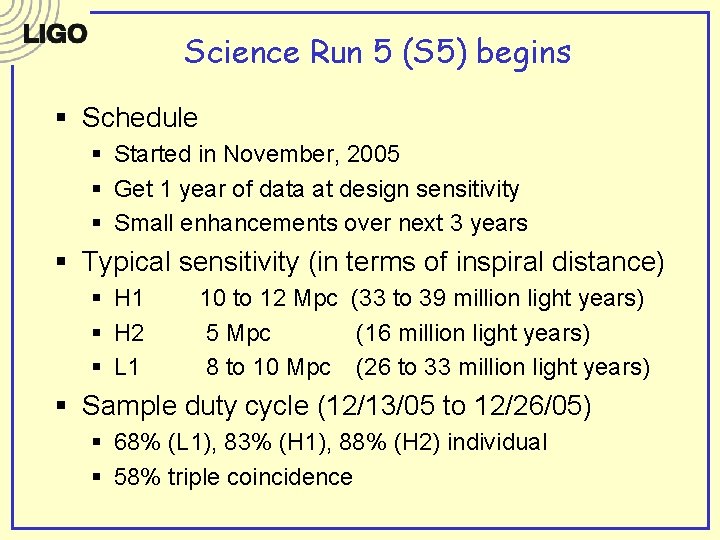
Science Run 5 (S 5) begins § Schedule § Started in November, 2005 § Get 1 year of data at design sensitivity § Small enhancements over next 3 years § Typical sensitivity (in terms of inspiral distance) § H 1 § H 2 § L 1 10 to 12 Mpc (33 to 39 million light years) 5 Mpc (16 million light years) 8 to 10 Mpc (26 to 33 million light years) § Sample duty cycle (12/13/05 to 12/26/05) § 68% (L 1), 83% (H 1), 88% (H 2) individual § 58% triple coincidence
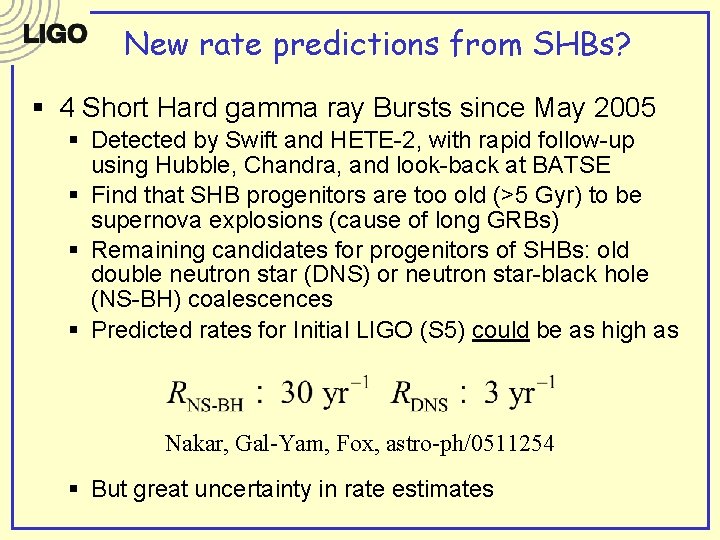
New rate predictions from SHBs? § 4 Short Hard gamma ray Bursts since May 2005 § Detected by Swift and HETE-2, with rapid follow-up using Hubble, Chandra, and look-back at BATSE § Find that SHB progenitors are too old (>5 Gyr) to be supernova explosions (cause of long GRBs) § Remaining candidates for progenitors of SHBs: old double neutron star (DNS) or neutron star-black hole (NS-BH) coalescences § Predicted rates for Initial LIGO (S 5) could be as high as Nakar, Gal-Yam, Fox, astro-ph/0511254 § But great uncertainty in rate estimates
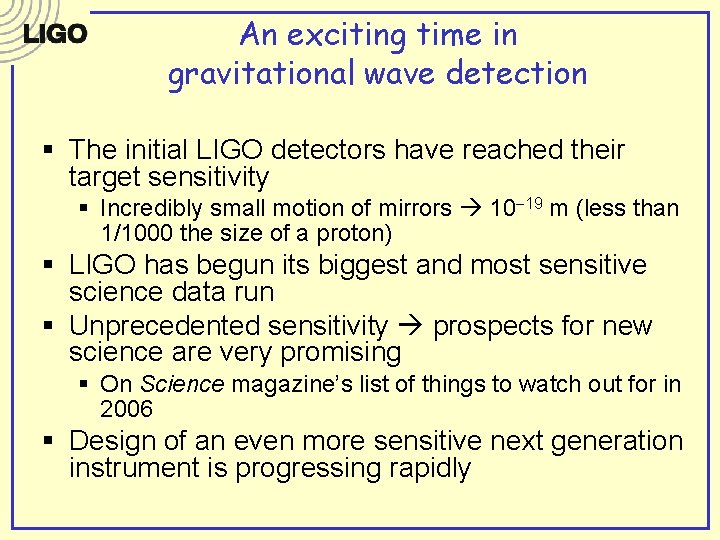
An exciting time in gravitational wave detection § The initial LIGO detectors have reached their target sensitivity § Incredibly small motion of mirrors 10 -19 m (less than 1/1000 the size of a proton) § LIGO has begun its biggest and most sensitive science data run § Unprecedented sensitivity prospects for new science are very promising § On Science magazine’s list of things to watch out for in 2006 § Design of an even more sensitive next generation instrument is progressing rapidly
Gravitational-wave searches Pulsars
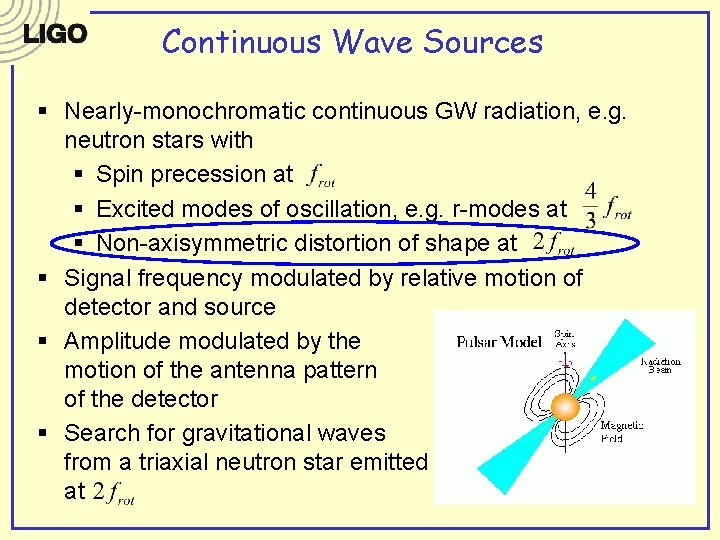
Continuous Wave Sources § Nearly-monochromatic continuous GW radiation, e. g. neutron stars with § Spin precession at § Excited modes of oscillation, e. g. r-modes at § Non-axisymmetric distortion of shape at § Signal frequency modulated by relative motion of detector and source § Amplitude modulated by the motion of the antenna pattern of the detector § Search for gravitational waves from a triaxial neutron star emitted at
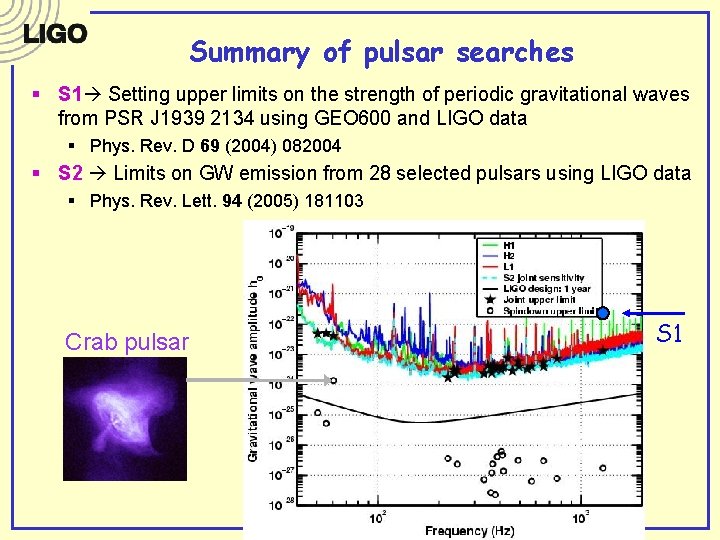
Summary of pulsar searches § S 1 Setting upper limits on the strength of periodic gravitational waves from PSR J 1939 2134 using GEO 600 and LIGO data § Phys. Rev. D 69 (2004) 082004 § S 2 Limits on GW emission from 28 selected pulsars using LIGO data § Phys. Rev. Lett. 94 (2005) 181103 Crab pulsar S 1
Gravitational-wave Searches Binary Inspirals
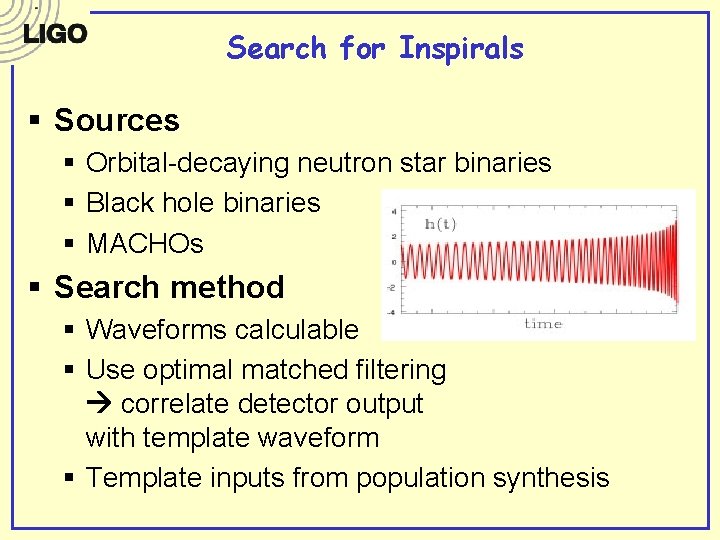
Search for Inspirals § Sources § Orbital-decaying neutron star binaries § Black hole binaries § MACHOs § Search method § Waveforms calculable § Use optimal matched filtering correlate detector output with template waveform § Template inputs from population synthesis
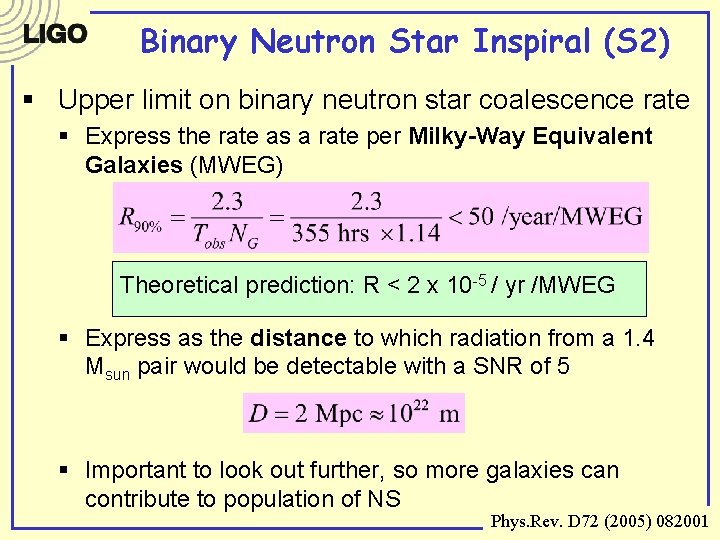
Binary Neutron Star Inspiral (S 2) § Upper limit on binary neutron star coalescence rate § Express the rate as a rate per Milky-Way Equivalent Galaxies (MWEG) Theoretical prediction: R < 2 x 10 -5 / yr /MWEG § Express as the distance to which radiation from a 1. 4 Msun pair would be detectable with a SNR of 5 § Important to look out further, so more galaxies can contribute to population of NS Phys. Rev. D 72 (2005) 082001
Gravitational-wave searches Stochastic Background
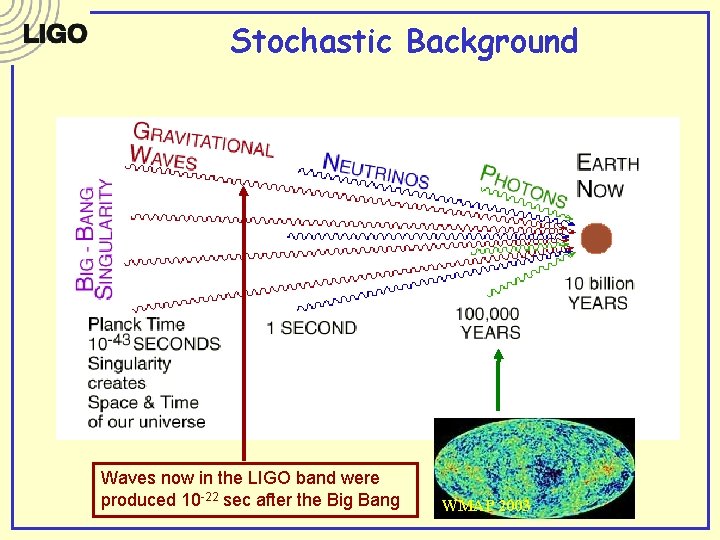
Stochastic Background Waves now in the LIGO band were produced 10 -22 sec after the Big Bang WMAP 2003
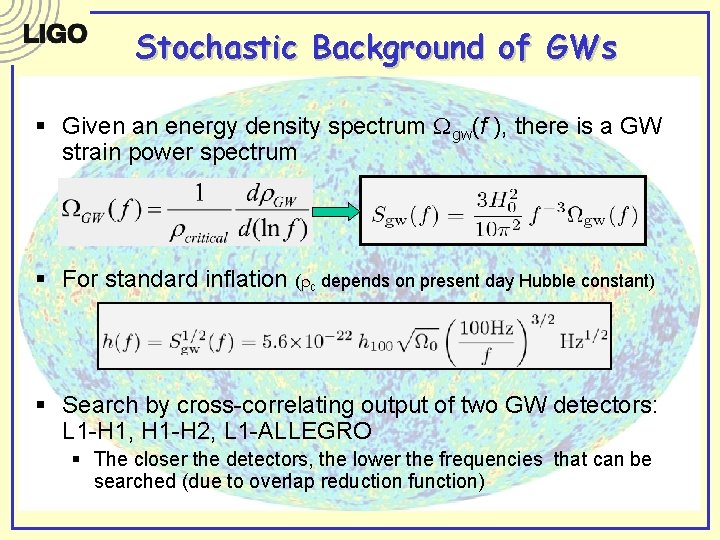
Stochastic Background of GWs § Given an energy density spectrum gw(f ), there is a GW strain power spectrum § For standard inflation (rc depends on present day Hubble constant) § Search by cross-correlating output of two GW detectors: L 1 -H 1, H 1 -H 2, L 1 -ALLEGRO § The closer the detectors, the lower the frequencies that can be searched (due to overlap reduction function)
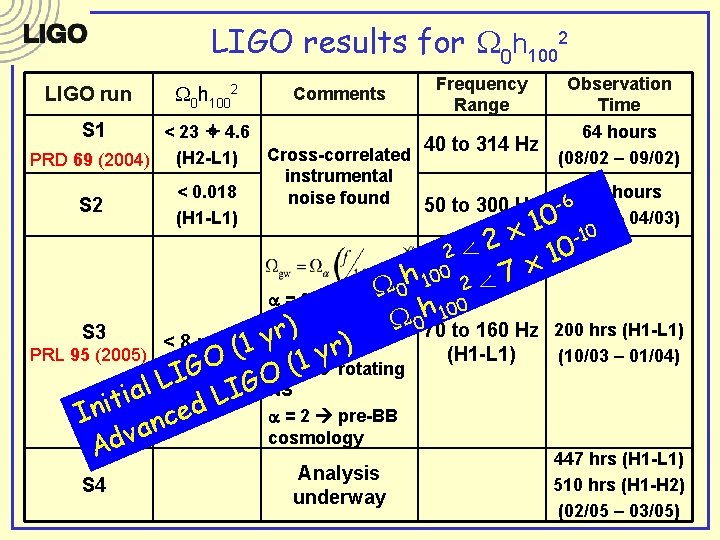
LIGO results for 0 h 1002 LIGO run S 1 0 h 1002 Comments Frequency Range Observation Time 64 hours (08/02 – 09/02) < 23 4. 6 40 to 314 Hz Cross-correlated (H 2 -L 1) PRD 69 (2004) instrumental < 0. 018 387 hours noise found S 2 50 to 300 Hz -6 (H 1 -L 1) – 04/03) 0(02/03 1 0 x -1 2 2 < 0 1 x h 100 2 < 7 0 a=0 h 100 inflationary or 070 to 160 Hz 200 hrs (H 1 -L 1) ) S 3 r -4 < 8 x 10(1 y. CS models ) r PRL 95 (2005) (H 1 -L 1) (10/03 – 01/04) y O 1 ( a = 1 rotating G I O L G l NS I a i L t a = 2 pre-BB Ini nced cosmology va d A 447 hrs (H 1 -L 1) Analysis 510 hrs (H 1 -H 2) S 4 underway (02/05 – 03/05)
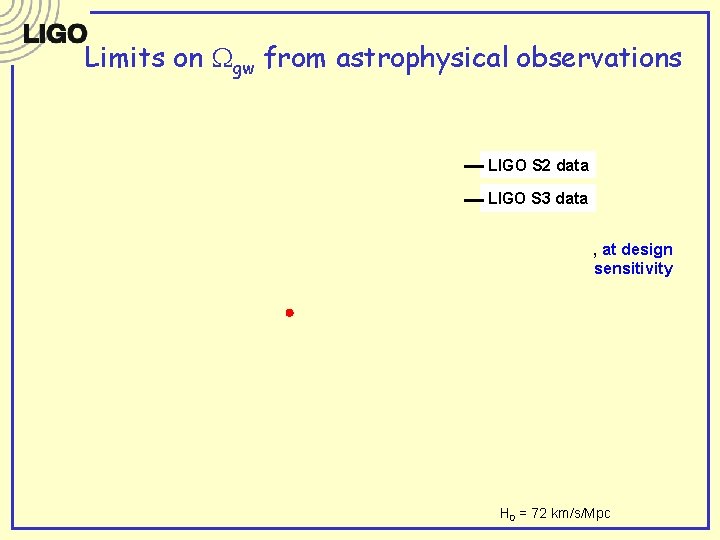
Limits on gw from astrophysical observations LIGO S 2 data LIGO S 3 data , at design sensitivity H 0 = 72 km/s/Mpc
Gravitational-wave Searches Transient or “burst’ events
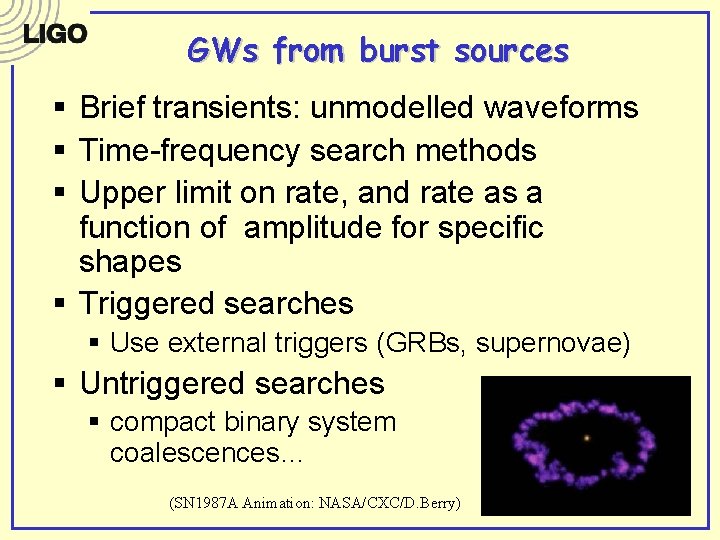
GWs from burst sources § Brief transients: unmodelled waveforms § Time-frequency search methods § Upper limit on rate, and rate as a function of amplitude for specific shapes § Triggered searches § Use external triggers (GRBs, supernovae) § Untriggered searches § compact binary system coalescences… (SN 1987 A Animation: NASA/CXC/D. Berry)
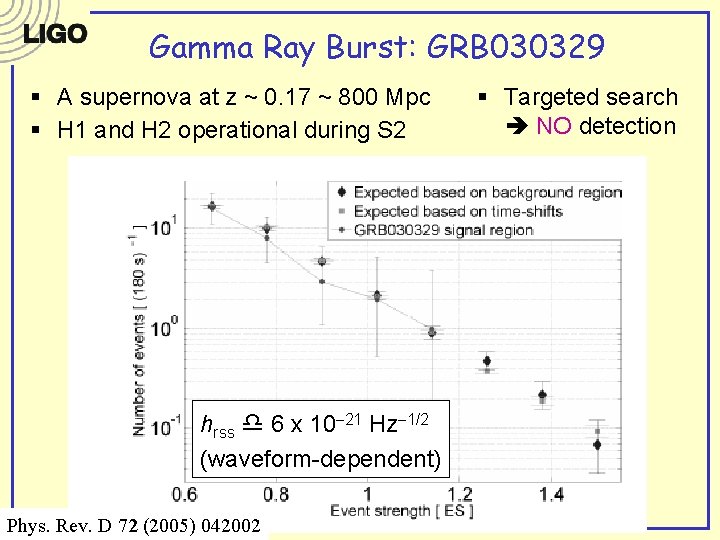
Gamma Ray Burst: GRB 030329 Integration time (logarithmic steps) § A supernova at z ~ 0. 17 ~ 800 Mpc § H 1 and H 2 operational during S 2 (from HETE) hrss 6 x 10 -21 Hz-1/2 (waveform-dependent) Phys. Rev. D 72 (2005) 042002 Segment time § Targeted search NO detection
Advanced LIGO
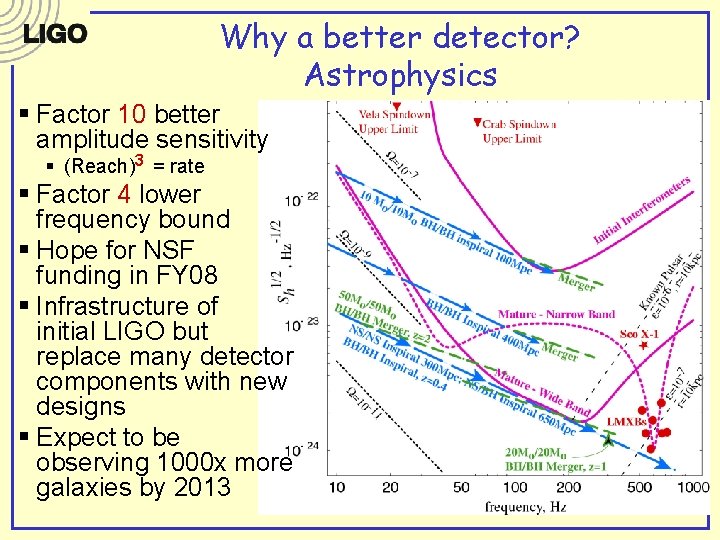
Why a better detector? Astrophysics § Factor 10 better amplitude sensitivity § (Reach)3 = rate § Factor 4 lower frequency bound § Hope for NSF funding in FY 08 § Infrastructure of initial LIGO but replace many detector components with new designs § Expect to be observing 1000 x more galaxies by 2013
LISA Laser Interferometer Space Antenna
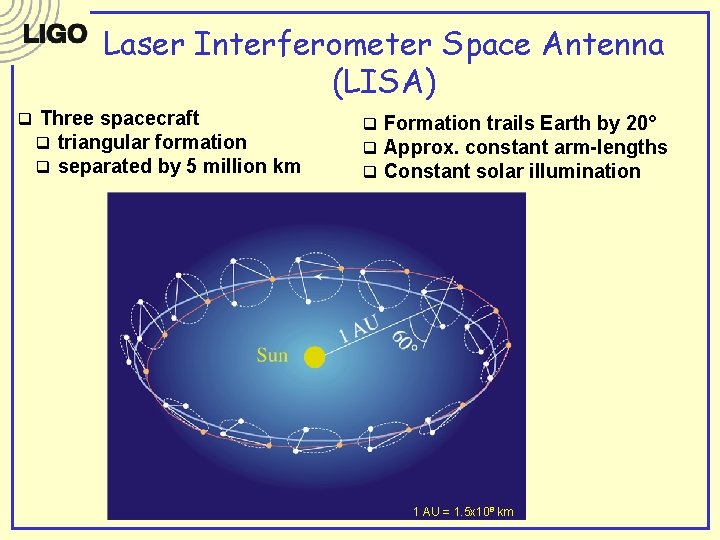
Laser Interferometer Space Antenna (LISA) q Three spacecraft q triangular formation q separated by 5 million km q Formation trails Earth by 20° q Approx. constant arm-lengths q Constant solar illumination 1 AU = 1. 5 x 10⁸ km
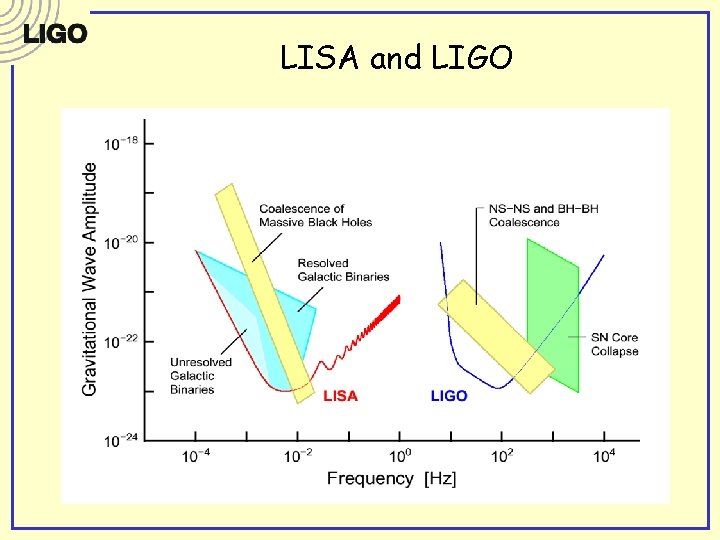
LISA and LIGO
In closing. . . § Astrophysical searches from early science data runs completed § The most sensitive search yet (S 5) begun with plan to get 1 year of data at initial LIGO sensitivity § Advanced LIGO approved by the NSB § Construction funding expected (hoped? ) to begin in FY 2008 § Joint searches with partner observatories in Europe and Japan
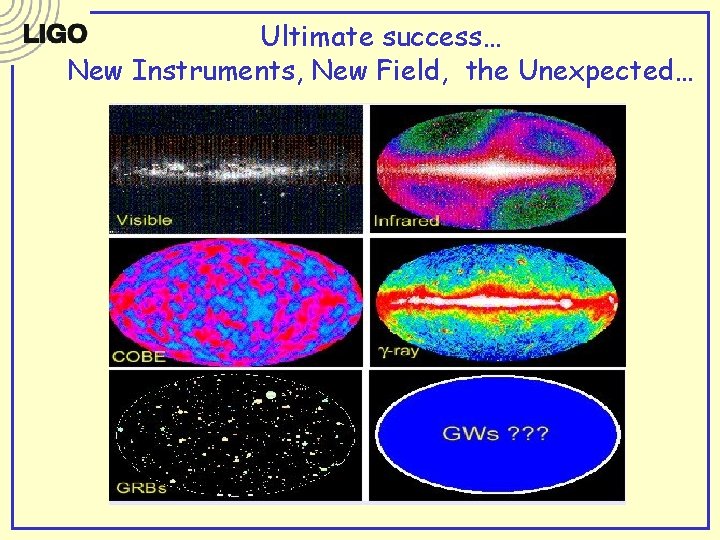
Ultimate success… New Instruments, New Field, the Unexpected…
The End