
LIGO The Search for Gravitational Waves Gregory M
- Slides: 35
LIGO: The Search for Gravitational Waves Gregory M. Harry LIGO Laboratory/Massachusetts Institute of Technology - On behalf of the LIGO Science Collaboration January 21, 2002 Worcester Polytechnic Institute Department of Physics Colloquium LIGO-G 020005 -00 -0 1
Overview • General relativity and gravitational waves • Sources of gravitational radiation • Interferometers and LIGO • Noise and technology • Next steps • Current status LIGO-G 020005 -00 -0 2
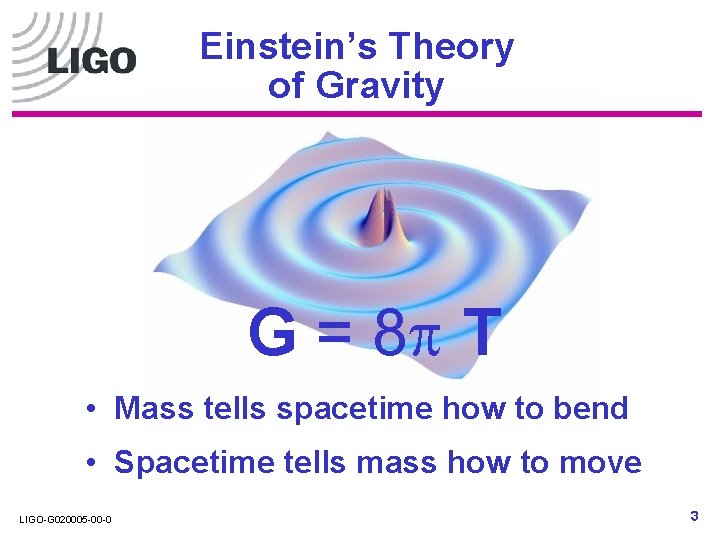
Einstein’s Theory of Gravity G = 8 T • Mass tells spacetime how to bend • Spacetime tells mass how to move LIGO-G 020005 -00 -0 3
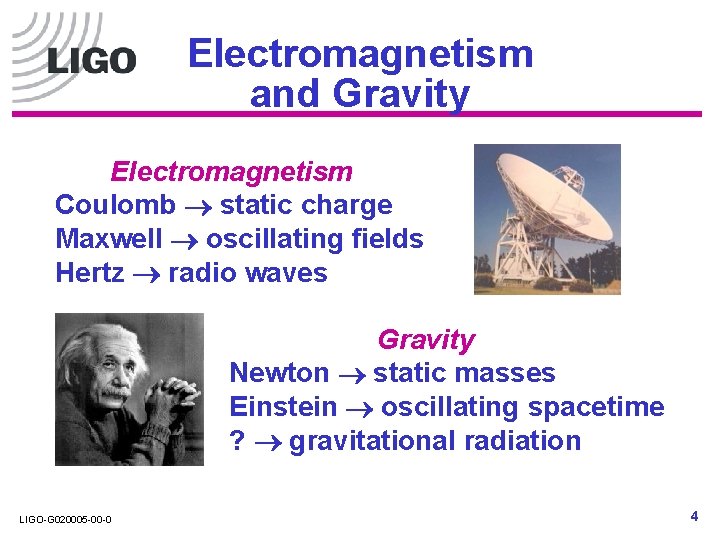
Electromagnetism and Gravity Electromagnetism Coulomb static charge Maxwell oscillating fields Hertz radio waves Gravity Newton static masses Einstein oscillating spacetime ? gravitational radiation LIGO-G 020005 -00 -0 4
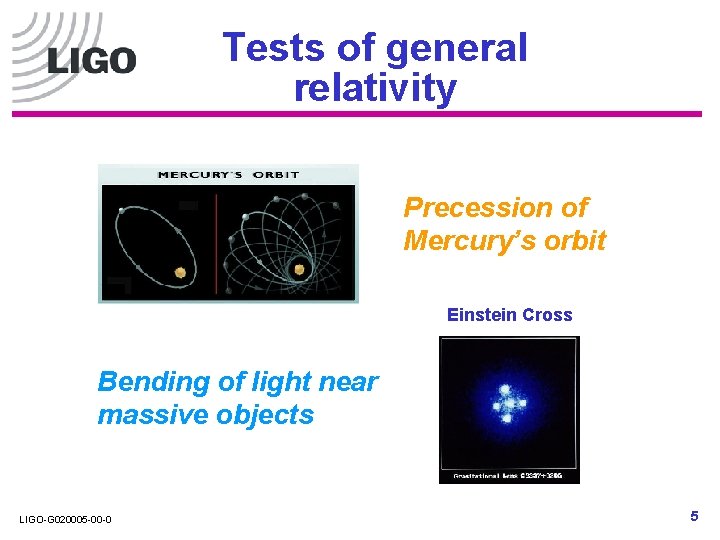
Tests of general relativity Precession of Mercury’s orbit Einstein Cross Bending of light near massive objects LIGO-G 020005 -00 -0 5
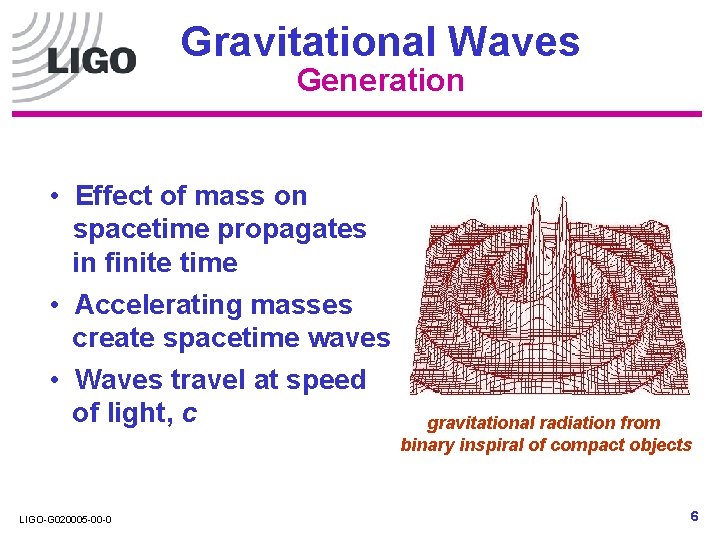
Gravitational Waves Generation • Effect of mass on spacetime propagates in finite time • Accelerating masses create spacetime waves • Waves travel at speed of light, c LIGO-G 020005 -00 -0 gravitational radiation from binary inspiral of compact objects 6
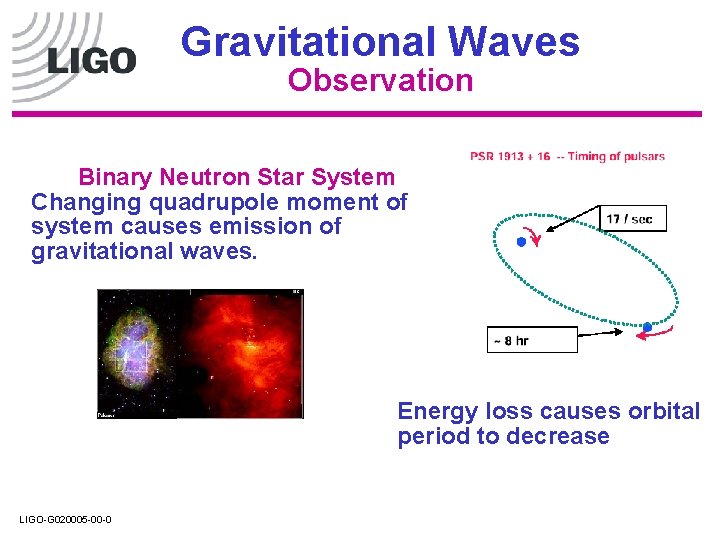
Gravitational Waves Observation Binary Neutron Star System Changing quadrupole moment of system causes emission of gravitational waves. Energy loss causes orbital period to decrease LIGO-G 020005 -00 -0
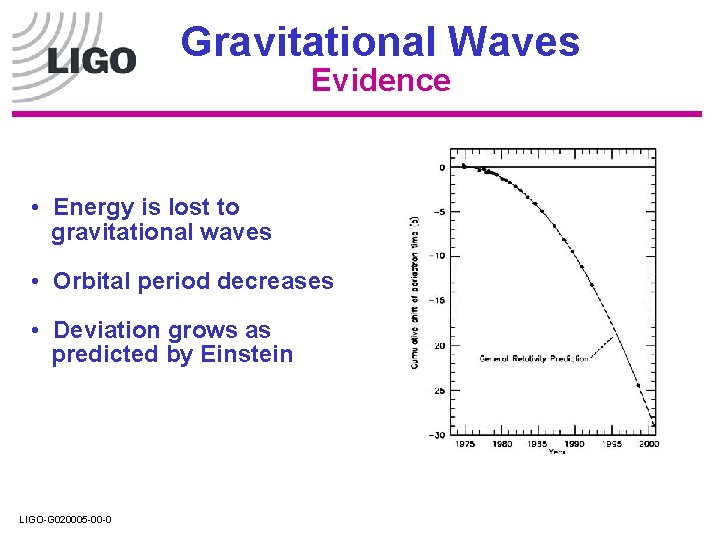
Gravitational Waves Evidence • Energy is lost to gravitational waves • Orbital period decreases • Deviation grows as predicted by Einstein LIGO-G 020005 -00 -0
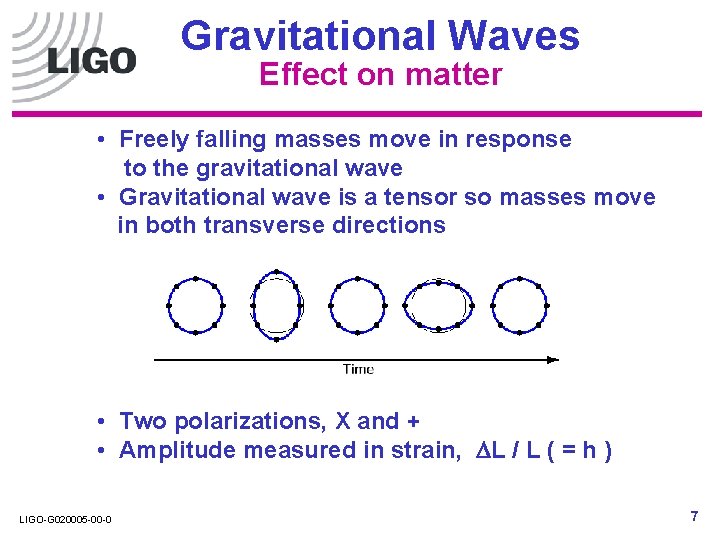
Gravitational Waves Effect on matter • Freely falling masses move in response to the gravitational wave • Gravitational wave is a tensor so masses move in both transverse directions • Two polarizations, X and + • Amplitude measured in strain, DL / L ( = h ) LIGO-G 020005 -00 -0 7
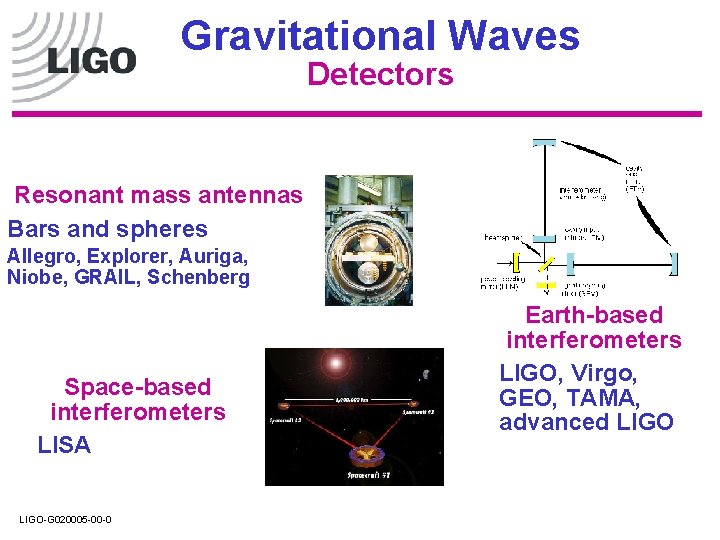
Gravitational Waves Detectors Resonant mass antennas Bars and spheres Allegro, Explorer, Auriga, Niobe, GRAIL, Schenberg Space-based interferometers LISA LIGO-G 020005 -00 -0 Earth-based interferometers LIGO, Virgo, GEO, TAMA, advanced LIGO
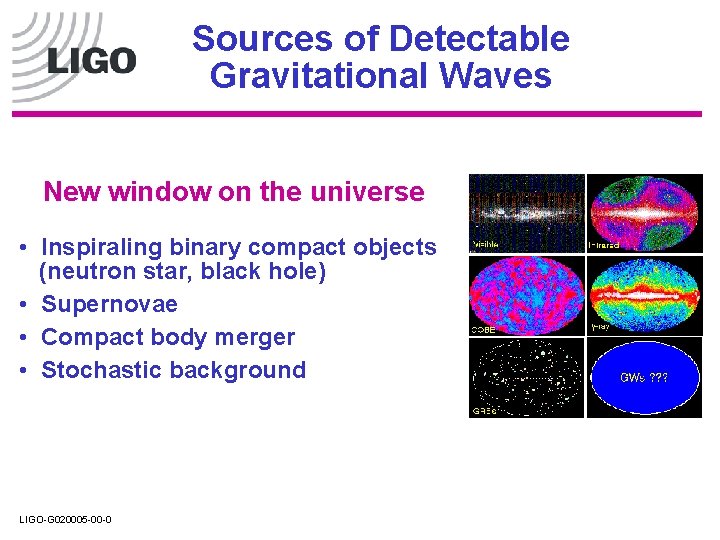
Sources of Detectable Gravitational Waves New window on the universe • Inspiraling binary compact objects (neutron star, black hole) • Supernovae • Compact body merger • Stochastic background LIGO-G 020005 -00 -0
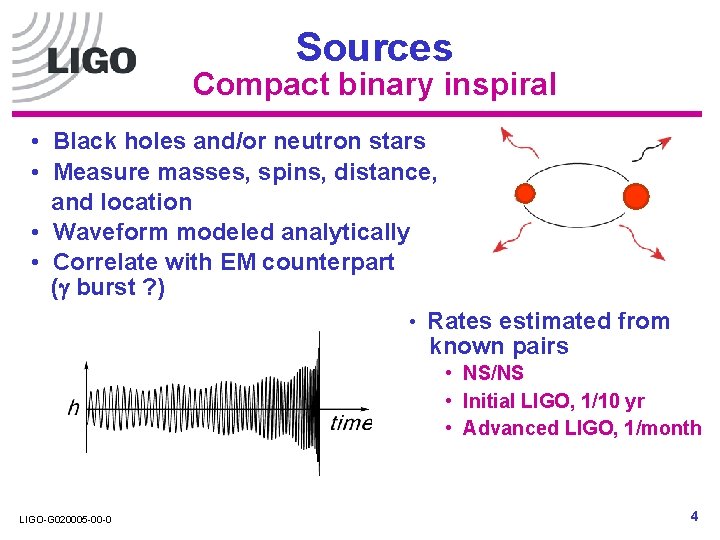
Sources Compact binary inspiral • Black holes and/or neutron stars • Measure masses, spins, distance, and location • Waveform modeled analytically • Correlate with EM counterpart (g burst ? ) • Rates estimated from known pairs • NS/NS • Initial LIGO, 1/10 yr • Advanced LIGO, 1/month LIGO-G 020005 -00 -0 4
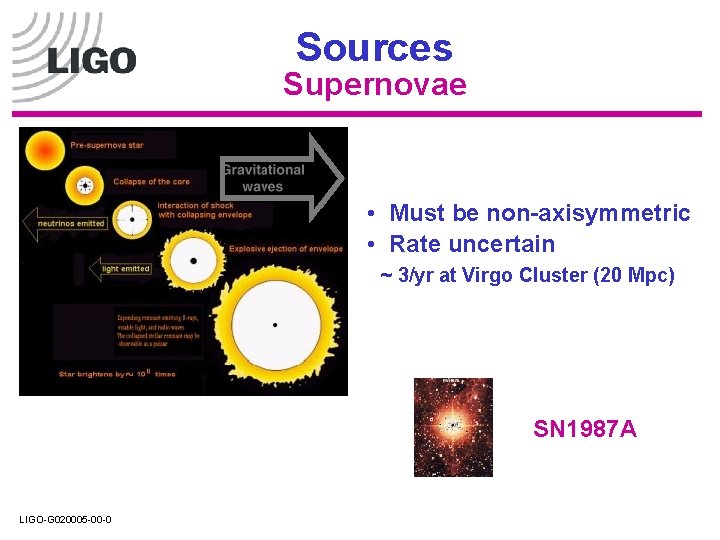
Sources Supernovae • Must be non-axisymmetric • Rate uncertain ~ 3/yr at Virgo Cluster (20 Mpc) SN 1987 A LIGO-G 020005 -00 -0
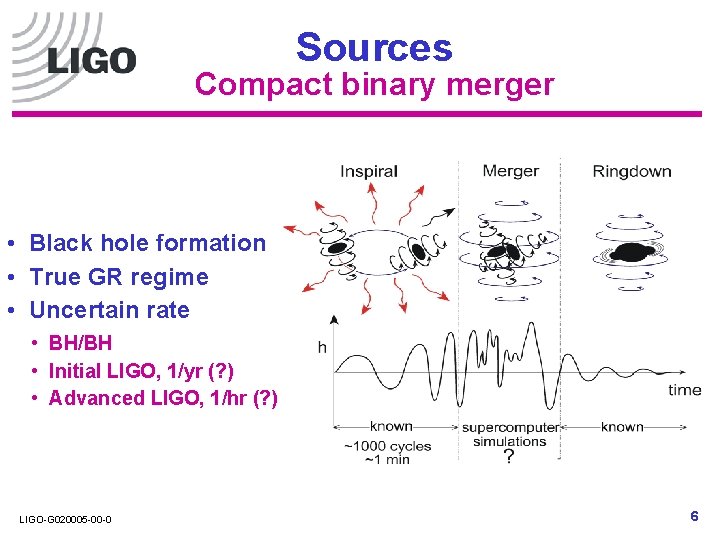
Sources Compact binary merger • Black hole formation • True GR regime • Uncertain rate • BH/BH • Initial LIGO, 1/yr (? ) • Advanced LIGO, 1/hr (? ) LIGO-G 020005 -00 -0 6
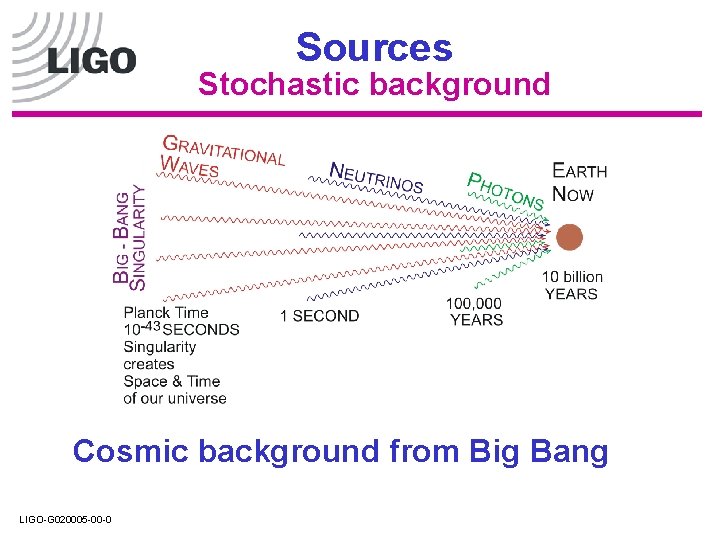
Sources Stochastic background Cosmic background from Big Bang LIGO-G 020005 -00 -0
Sources Unpredicted phenomenon • Big surprises likely ? LIGO-G 020005 -00 -0
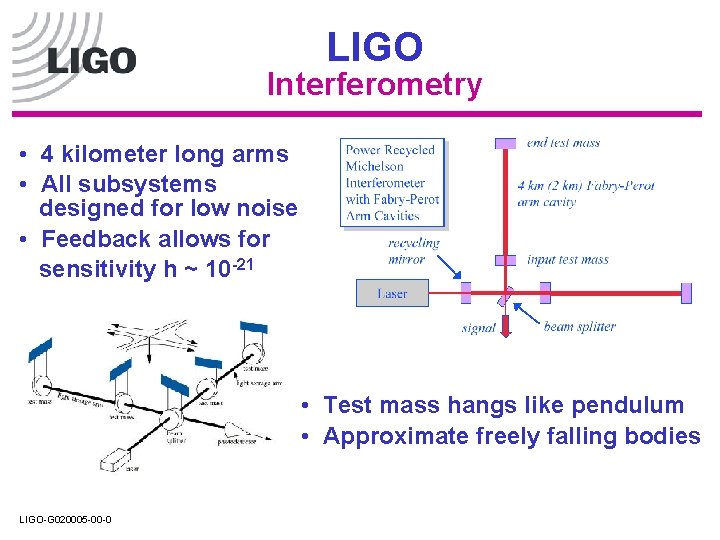
LIGO Interferometry • 4 kilometer long arms • All subsystems designed for low noise • Feedback allows for sensitivity h ~ 10 -21 • Test mass hangs like pendulum • Approximate freely falling bodies LIGO-G 020005 -00 -0
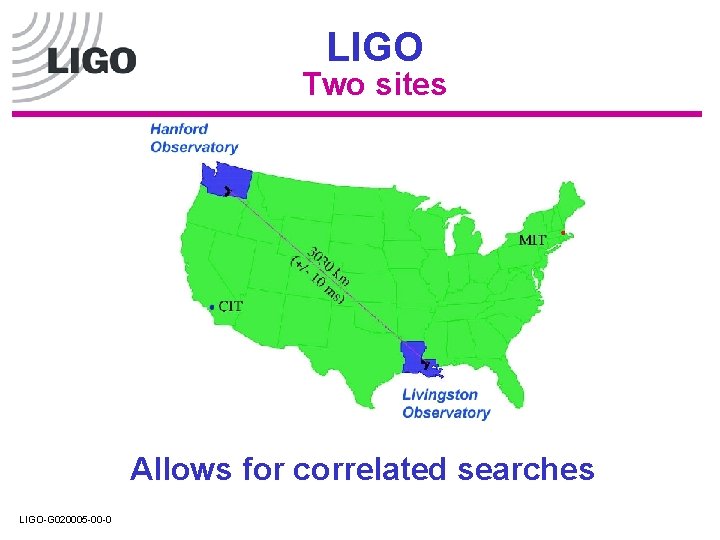
LIGO Two sites Allows for correlated searches LIGO-G 020005 -00 -0
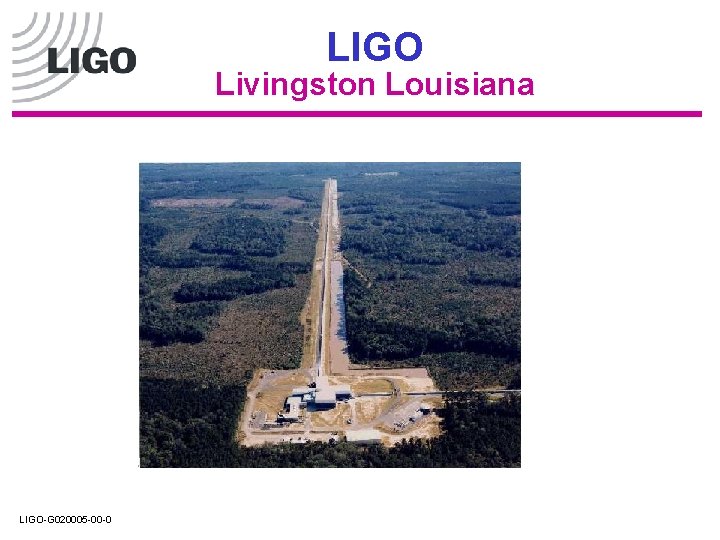
LIGO Livingston Louisiana LIGO-G 020005 -00 -0
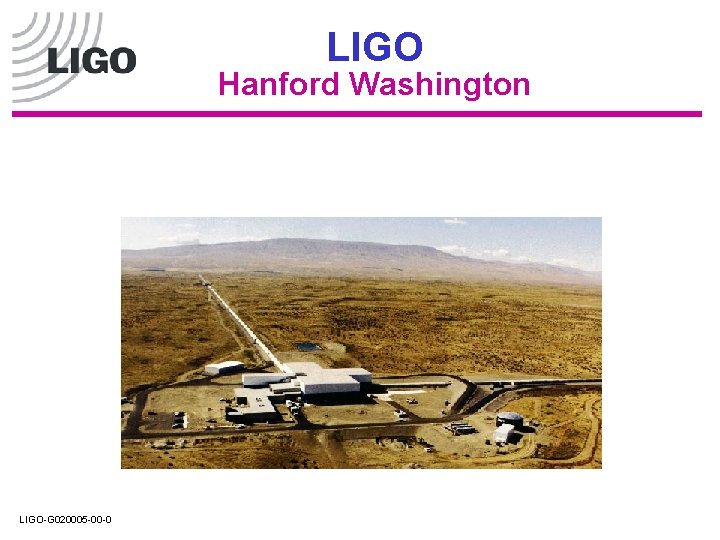
LIGO Hanford Washington LIGO-G 020005 -00 -0
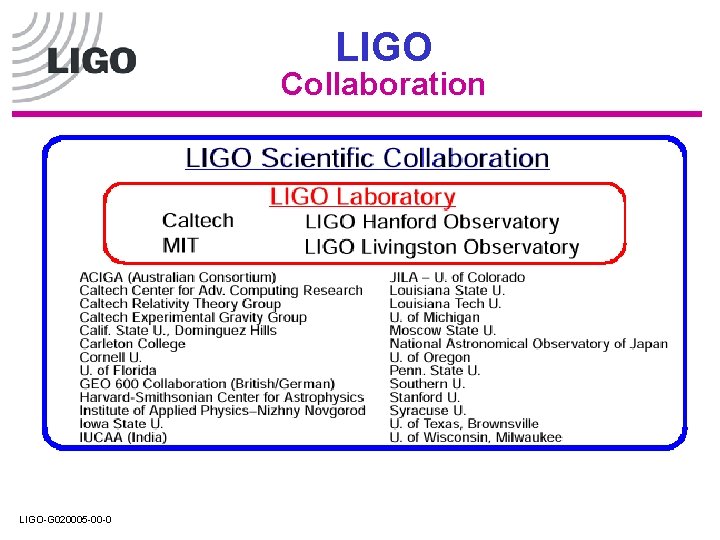
LIGO Collaboration LIGO-G 020005 -00 -0
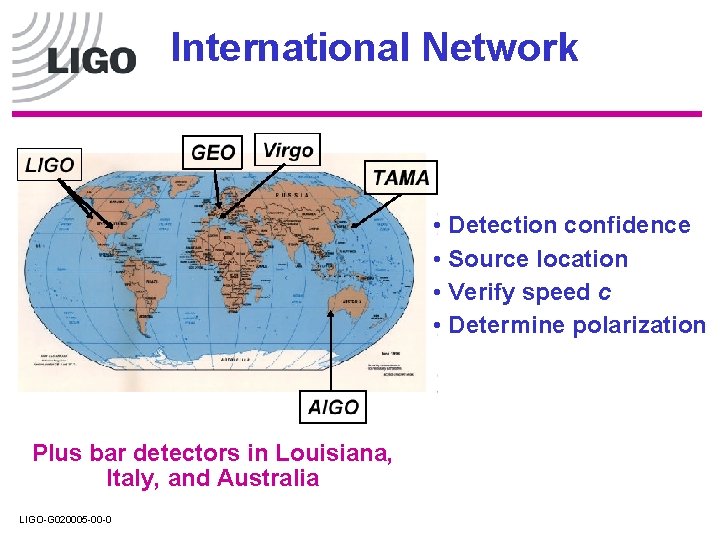
International Network • Detection confidence • Source location • Verify speed c • Determine polarization Plus bar detectors in Louisiana, Italy, and Australia LIGO-G 020005 -00 -0
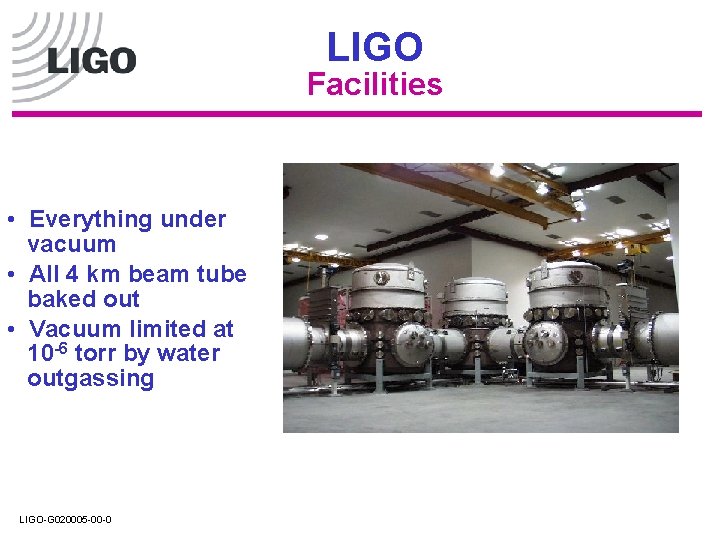
LIGO Facilities • Everything under vacuum • All 4 km beam tube baked out • Vacuum limited at 10 -6 torr by water outgassing LIGO-G 020005 -00 -0
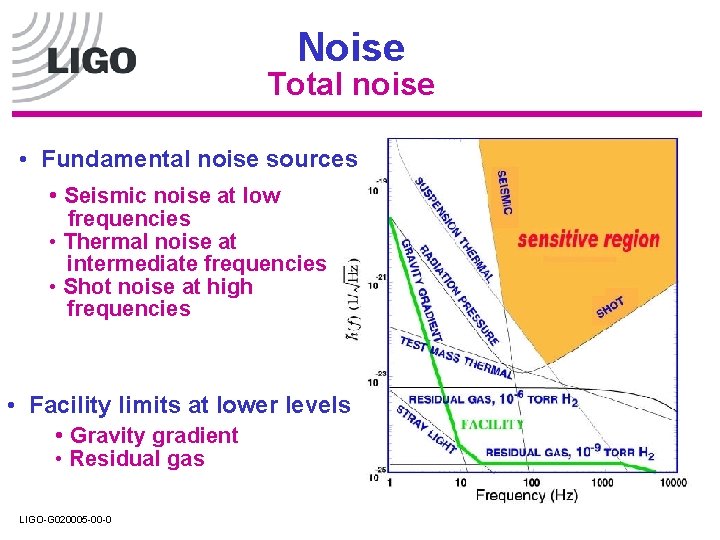
Noise Total noise • Fundamental noise sources • Seismic noise at low frequencies • Thermal noise at intermediate frequencies • Shot noise at high frequencies • Facility limits at lower levels • Gravity gradient • Residual gas LIGO-G 020005 -00 -0
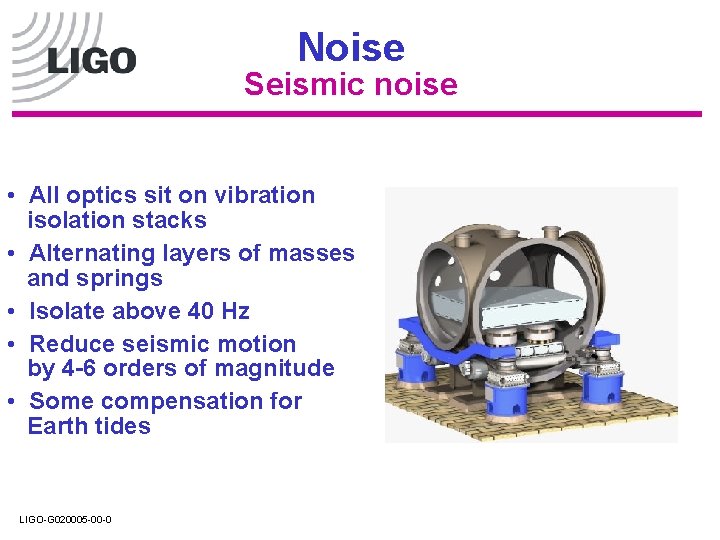
Noise Seismic noise • All optics sit on vibration isolation stacks • Alternating layers of masses and springs • Isolate above 40 Hz • Reduce seismic motion by 4 -6 orders of magnitude • Some compensation for Earth tides LIGO-G 020005 -00 -0
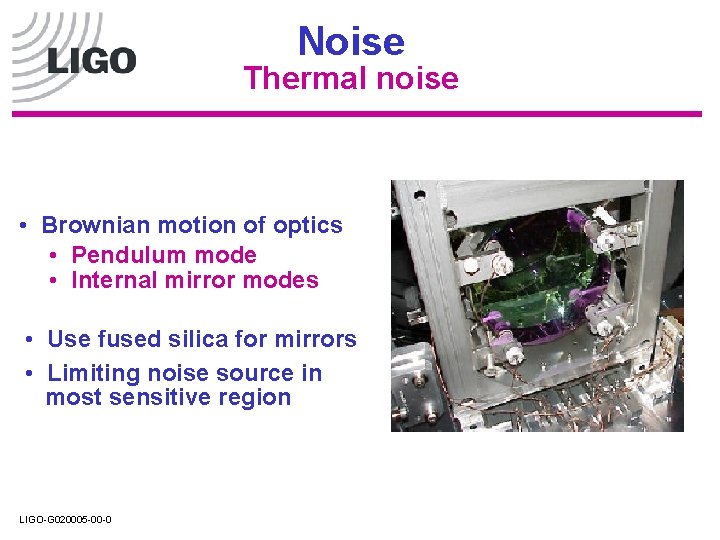
Noise Thermal noise • Brownian motion of optics • Pendulum mode • Internal mirror modes • Use fused silica for mirrors • Limiting noise source in most sensitive region LIGO-G 020005 -00 -0
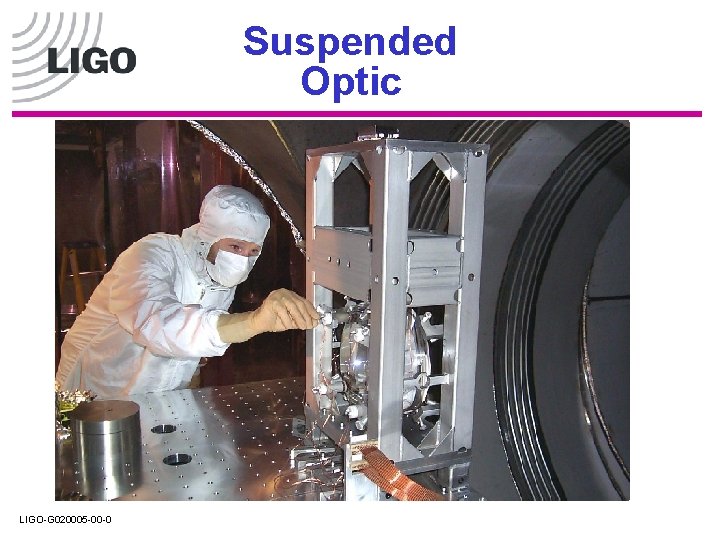
Suspended Optic LIGO-G 020005 -00 -0
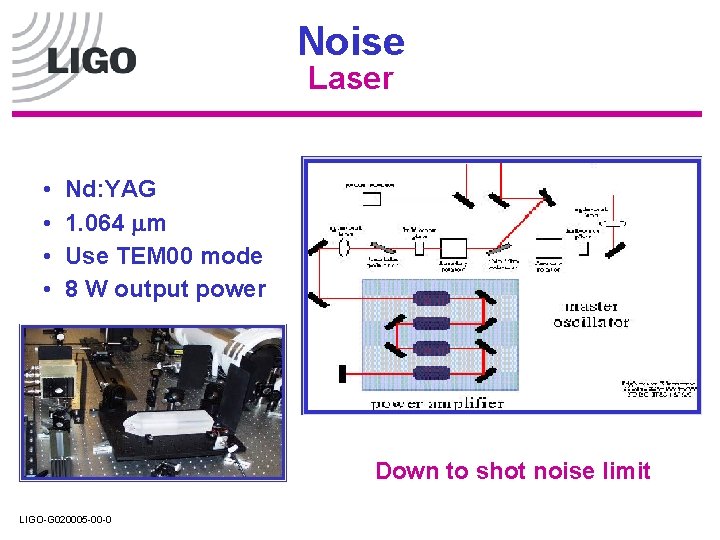
Noise Laser • • Nd: YAG 1. 064 mm Use TEM 00 mode 8 W output power Down to shot noise limit LIGO-G 020005 -00 -0
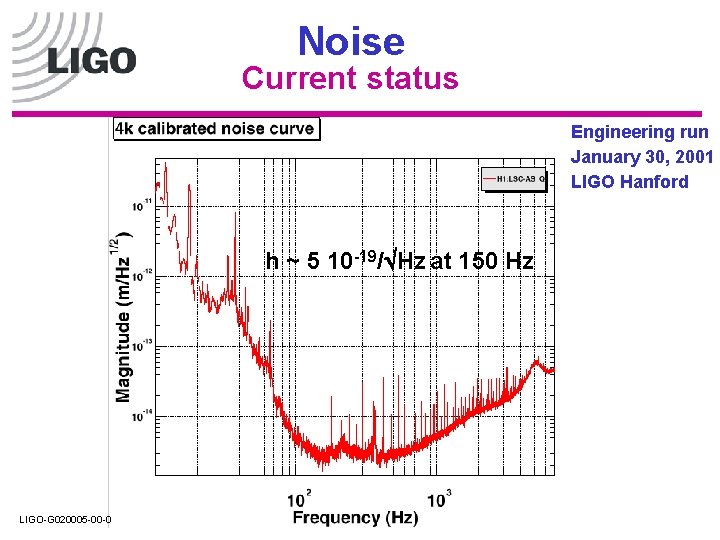
Noise Current status Engineering run January 30, 2001 LIGO Hanford h ~ 5 10 -19/ Hz at 150 Hz LIGO-G 020005 -00 -0
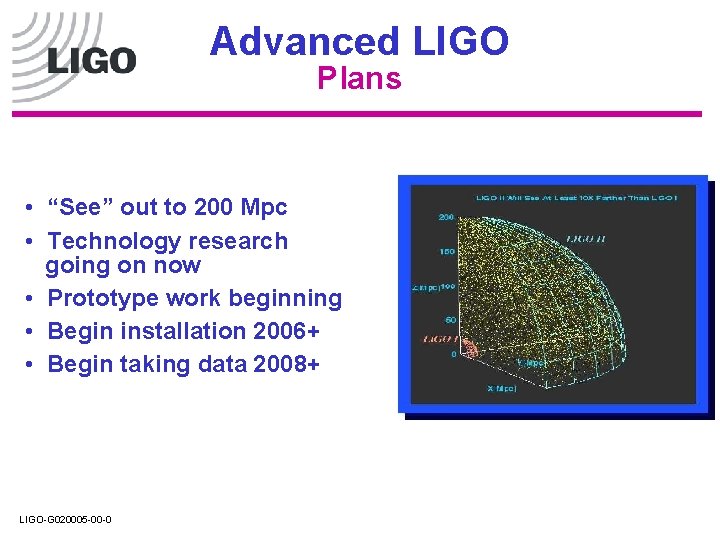
Advanced LIGO Plans • “See” out to 200 Mpc • Technology research going on now • Prototype work beginning • Begin installation 2006+ • Begin taking data 2008+ LIGO-G 020005 -00 -0
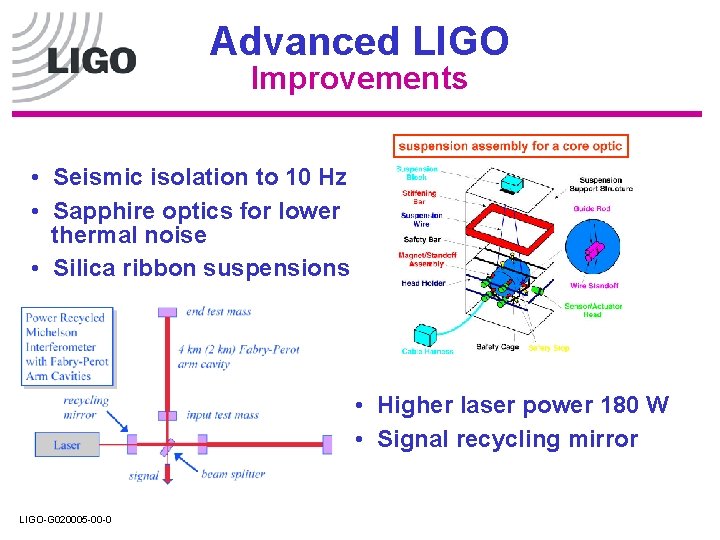
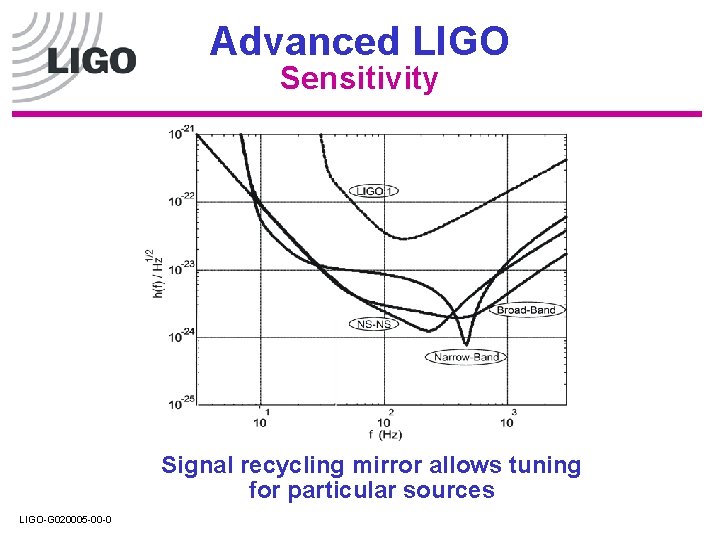
Advanced LIGO Improvements • Seismic isolation to 10 Hz • Sapphire optics for lower thermal noise • Silica ribbon suspensions • Higher laser power 180 W • Signal recycling mirror LIGO-G 020005 -00 -0
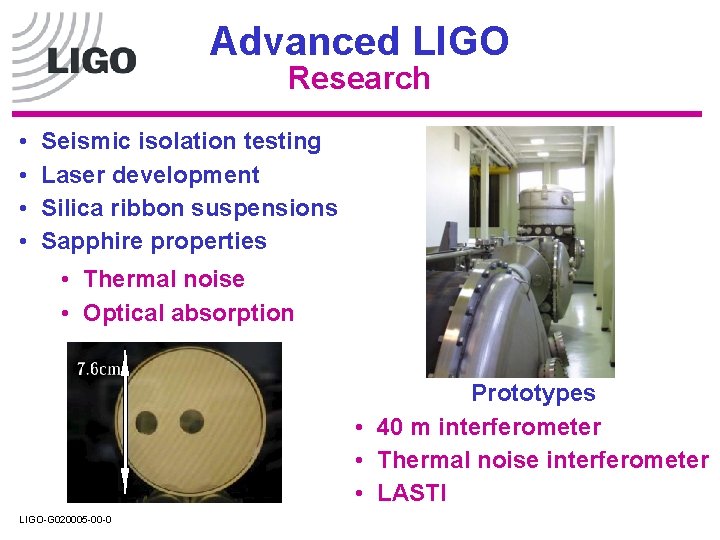
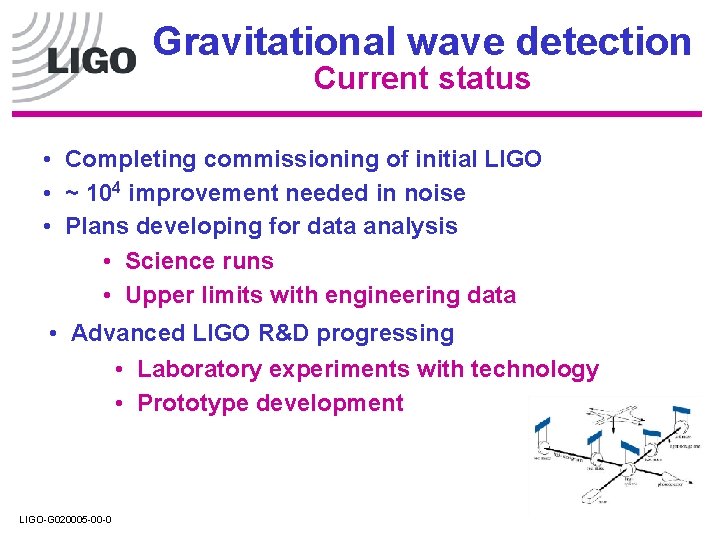
Advanced LIGO Research • • Seismic isolation testing Laser development Silica ribbon suspensions Sapphire properties • Thermal noise • Optical absorption Prototypes • 40 m interferometer • Thermal noise interferometer • LASTI LIGO-G 020005 -00 -0
Advanced LIGO Sensitivity Signal recycling mirror allows tuning for particular sources LIGO-G 020005 -00 -0
Gravitational wave detection Current status • Completing commissioning of initial LIGO • ~ 104 improvement needed in noise • Plans developing for data analysis • Science runs • Upper limits with engineering data • Advanced LIGO R&D progressing • Laboratory experiments with technology • Prototype development LIGO-G 020005 -00 -0
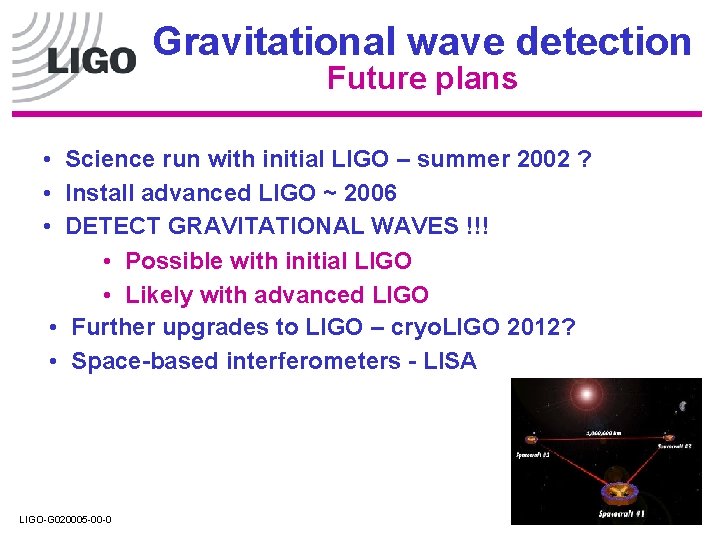
Gravitational wave detection Future plans • Science run with initial LIGO – summer 2002 ? • Install advanced LIGO ~ 2006 • DETECT GRAVITATIONAL WAVES !!! • Possible with initial LIGO • Likely with advanced LIGO • Further upgrades to LIGO – cryo. LIGO 2012? • Space-based interferometers - LISA LIGO-G 020005 -00 -0