
LIGO and the Search for Gravitational Waves Barry
LIGO and the Search for Gravitational Waves Barry Barish Stanford Colloquium 15 -Jan-01 15 -Jan-02 Stanford Colloquium
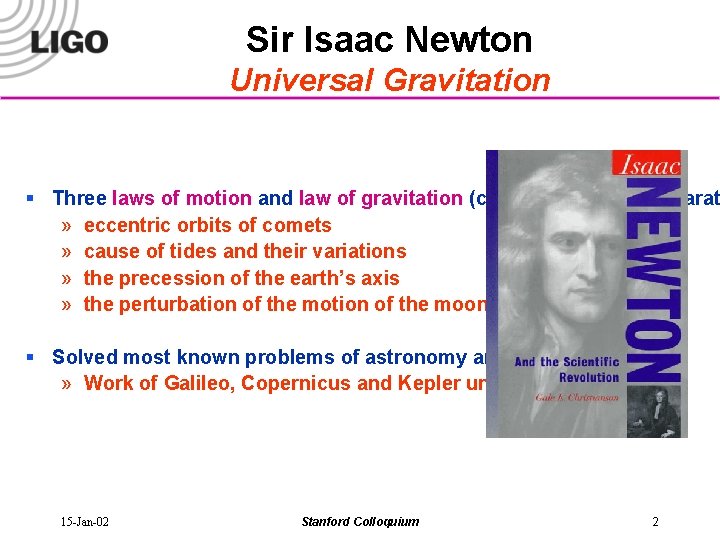
Sir Isaac Newton Universal Gravitation § Three laws of motion and law of gravitation (centripetal force) disparat » eccentric orbits of comets » cause of tides and their variations » the precession of the earth’s axis » the perturbation of the moon by gravity of the sun § Solved most known problems of astronomy and terrestrial physics » Work of Galileo, Copernicus and Kepler unified. 15 -Jan-02 Stanford Colloquium 2
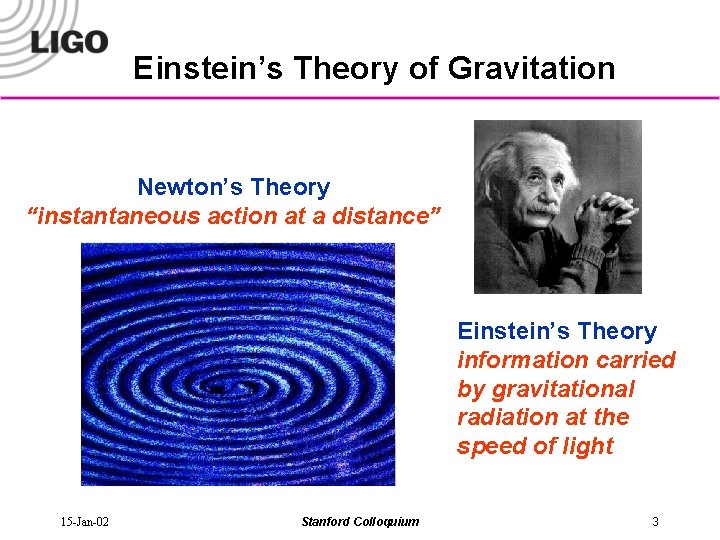
Einstein’s Theory of Gravitation Newton’s Theory “instantaneous action at a distance” Einstein’s Theory information carried by gravitational radiation at the speed of light 15 -Jan-02 Stanford Colloquium 3
General Relativity the essential idea § Overthrew the 19 th-century concepts of absolute space and time § Einstein: gravity is not a force, but a property of space & time » Spacetime = 3 spatial dimensions + time » Perception of space or time is relative § Concentrations of mass or energy distort (warp) spacetime § Objects follow the shortest path through this warped spacetime; path is the same for all objects 15 -Jan-02 Stanford Colloquium 4
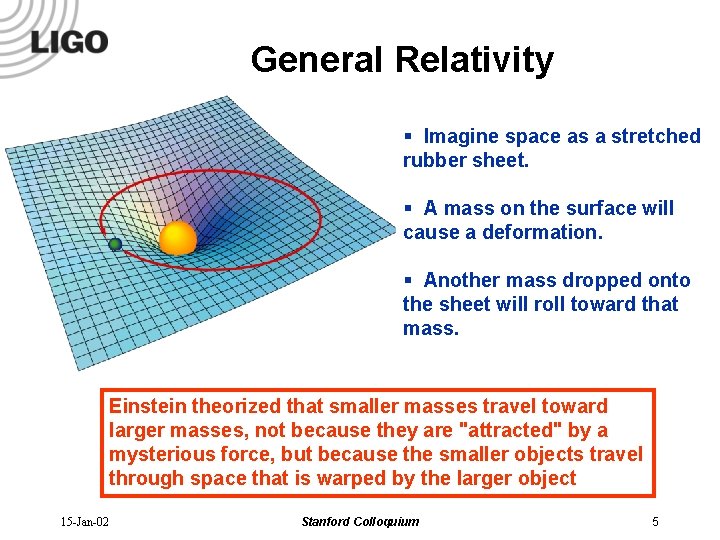
General Relativity § Imagine space as a stretched rubber sheet. § A mass on the surface will cause a deformation. § Another mass dropped onto the sheet will roll toward that mass. Einstein theorized that smaller masses travel toward larger masses, not because they are "attracted" by a mysterious force, but because the smaller objects travel through space that is warped by the larger object 15 -Jan-02 Stanford Colloquium 5
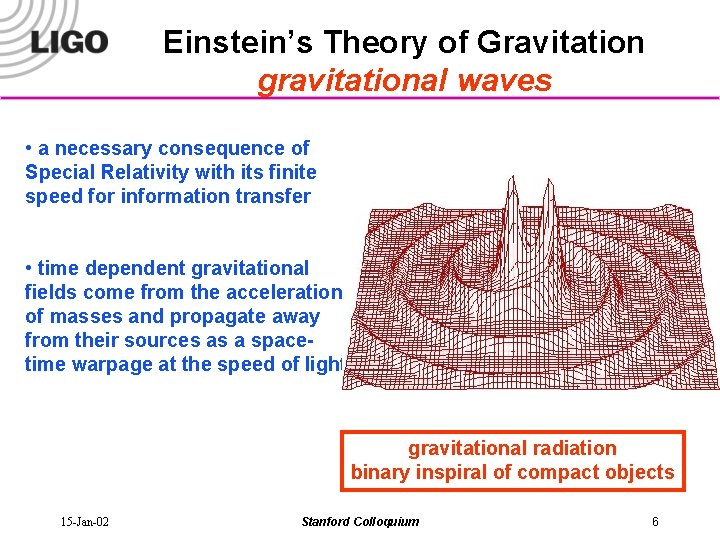
Einstein’s Theory of Gravitation gravitational waves • a necessary consequence of Special Relativity with its finite speed for information transfer • time dependent gravitational fields come from the acceleration of masses and propagate away from their sources as a spacetime warpage at the speed of light gravitational radiation binary inspiral of compact objects 15 -Jan-02 Stanford Colloquium 6
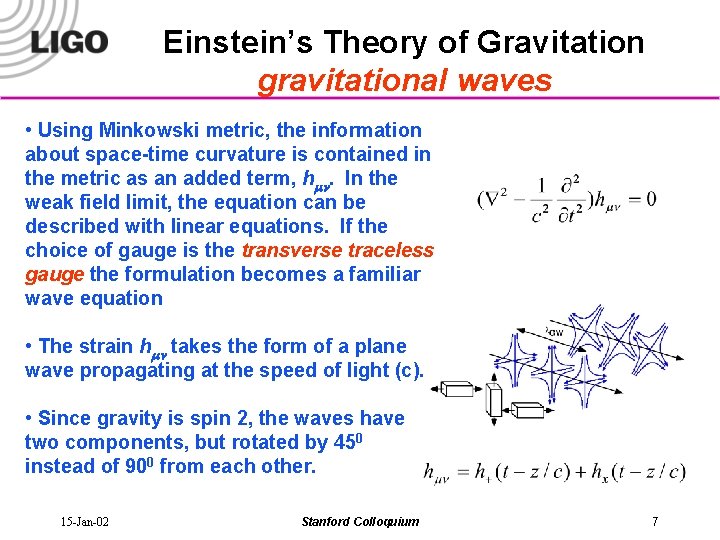
Einstein’s Theory of Gravitation gravitational waves • Using Minkowski metric, the information about space-time curvature is contained in the metric as an added term, hmn. In the weak field limit, the equation can be described with linear equations. If the choice of gauge is the transverse traceless gauge the formulation becomes a familiar wave equation • The strain hmn takes the form of a plane wave propagating at the speed of light (c). • Since gravity is spin 2, the waves have two components, but rotated by 450 instead of 900 from each other. 15 -Jan-02 Stanford Colloquium 7
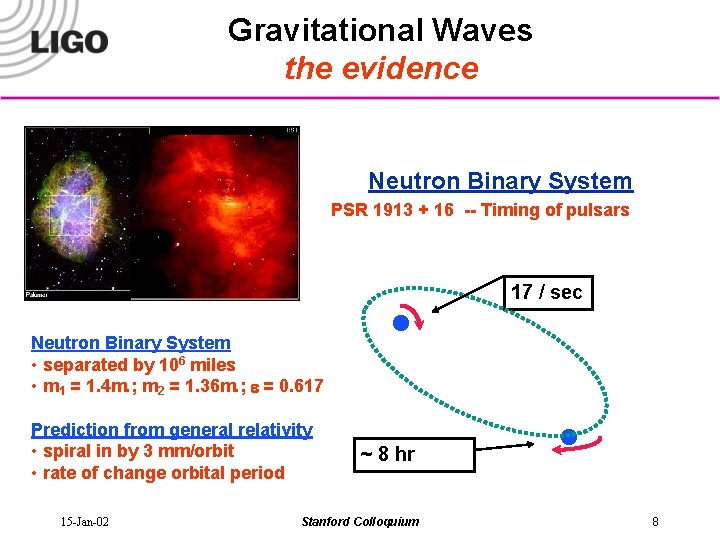
Gravitational Waves the evidence Neutron Binary System PSR 1913 + 16 -- Timing of pulsars Neutron Binary System • separated by 106 miles • m 1 = 1. 4 m ; m 2 = 1. 36 m ; e = 0. 617 Prediction from general relativity • spiral in by 3 mm/orbit • rate of change orbital period 15 -Jan-02 · ~ 8 hr Stanford Colloquium 17 / sec · 8
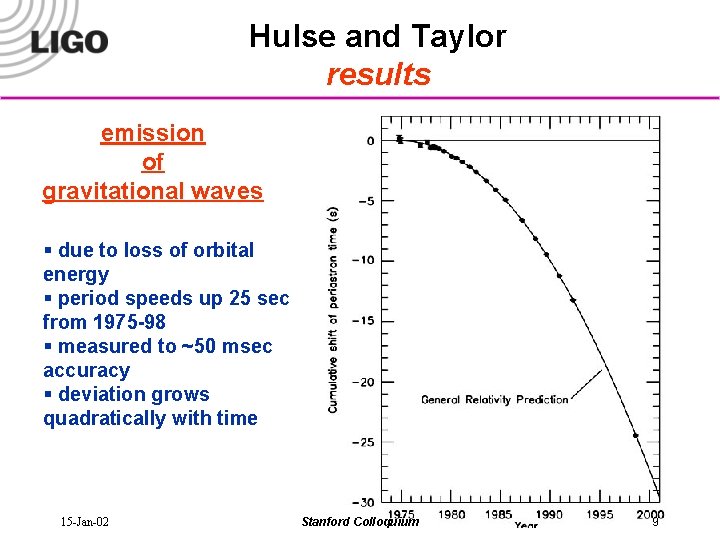
Hulse and Taylor results emission of gravitational waves § due to loss of orbital energy § period speeds up 25 sec from 1975 -98 § measured to ~50 msec accuracy § deviation grows quadratically with time 15 -Jan-02 Stanford Colloquium 9
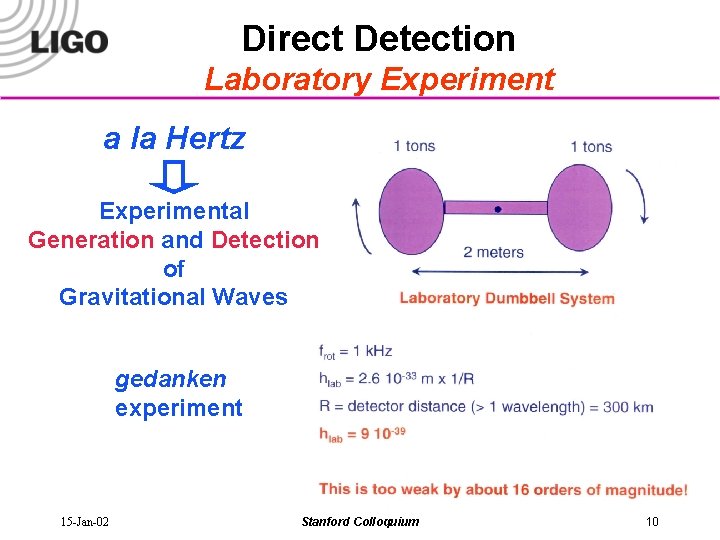
Direct Detection Laboratory Experiment a la Hertz Experimental Generation and Detection of Gravitational Waves gedanken experiment 15 -Jan-02 Stanford Colloquium 10
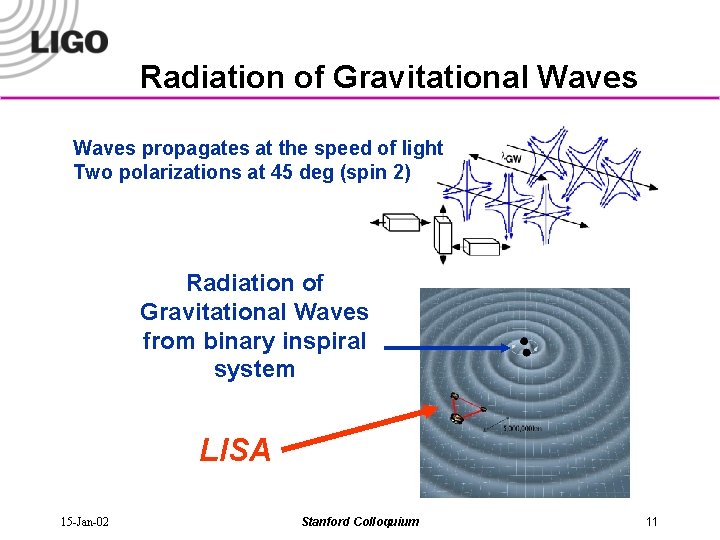
Radiation of Gravitational Waves propagates at the speed of light Two polarizations at 45 deg (spin 2) Radiation of Gravitational Waves from binary inspiral system LISA 15 -Jan-02 Stanford Colloquium 11
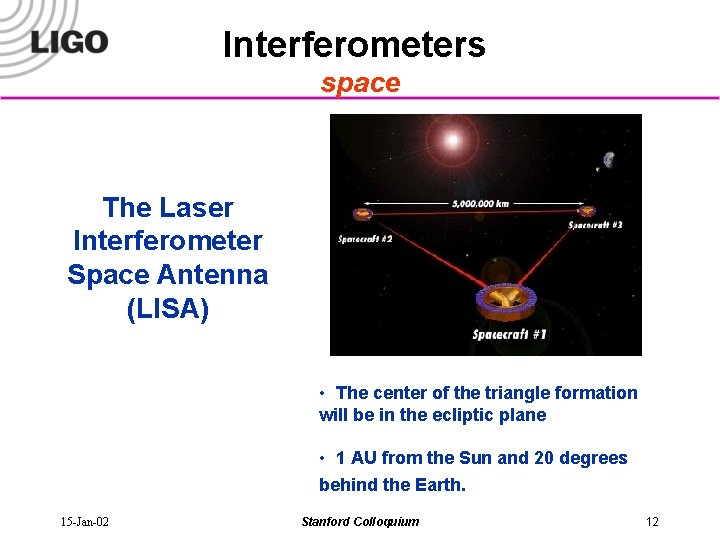
Interferometers space The Laser Interferometer Space Antenna (LISA) • The center of the triangle formation will be in the ecliptic plane • 1 AU from the Sun and 20 degrees behind the Earth. 15 -Jan-02 Stanford Colloquium 12
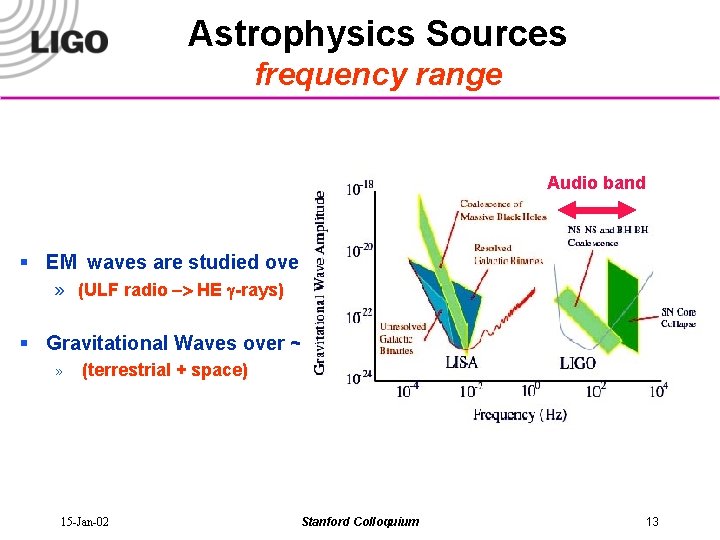
Astrophysics Sources frequency range Audio band § EM waves are studied over ~20 orders of magnitude » (ULF radio -> HE -rays) § Gravitational Waves over ~10 orders of magnitude » (terrestrial + space) 15 -Jan-02 Stanford Colloquium 13
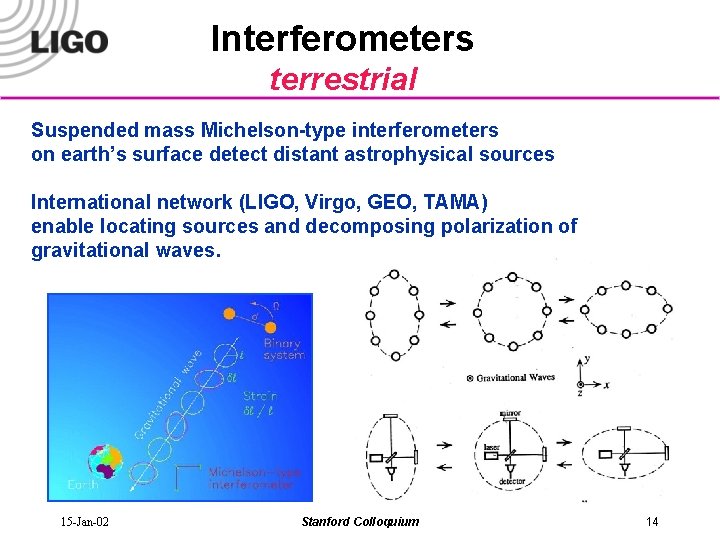
Interferometers terrestrial Suspended mass Michelson-type interferometers on earth’s surface detect distant astrophysical sources International network (LIGO, Virgo, GEO, TAMA) enable locating sources and decomposing polarization of gravitational waves. 15 -Jan-02 Stanford Colloquium 14
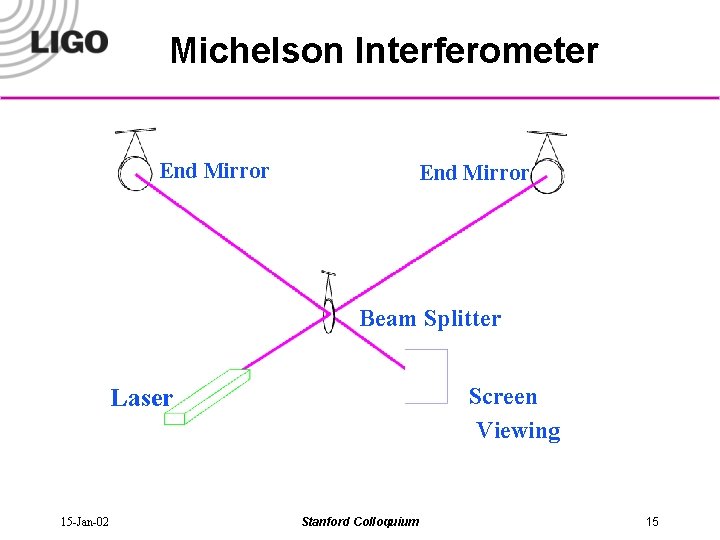
Michelson Interferometer End Mirror Beam Splitter Screen Viewing Laser 15 -Jan-02 Stanford Colloquium 15
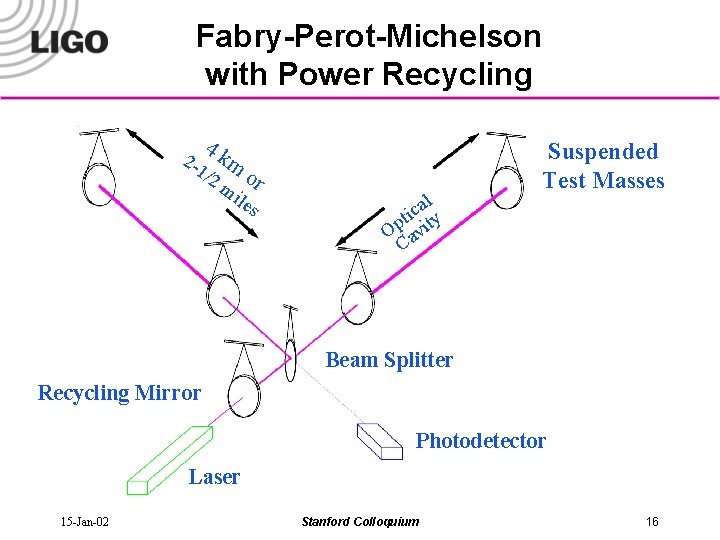
Fabry-Perot-Michelson with Power Recycling 2 - 4 k 1/2 m o mi r les l a c ti ity p O av C Suspended Test Masses Beam Splitter Recycling Mirror Photodetector Laser 15 -Jan-02 Stanford Colloquium 16
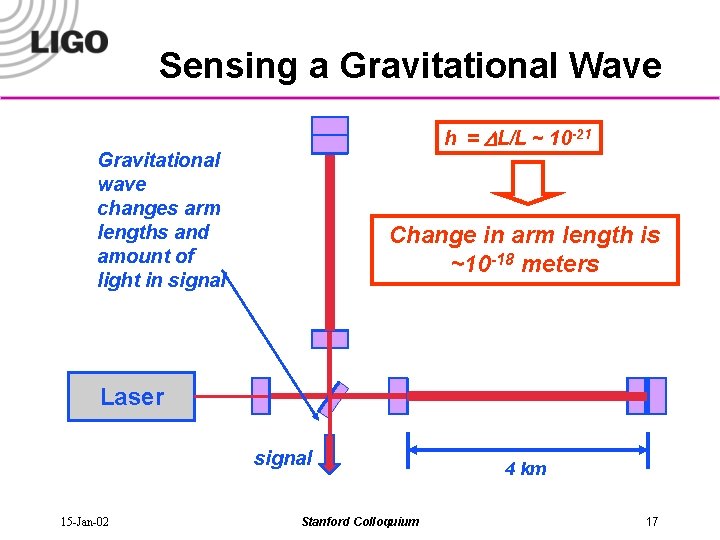
Sensing a Gravitational Wave h = DL/L ~ 10 -21 Gravitational wave changes arm lengths and amount of light in signal Change in arm length is ~10 -18 meters Laser signal 15 -Jan-02 Stanford Colloquium 4 km 17
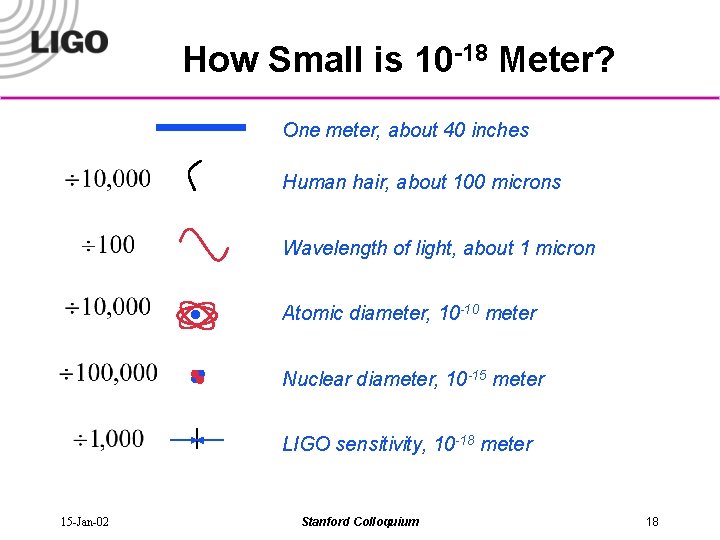
How Small is 10 -18 Meter? One meter, about 40 inches Human hair, about 100 microns Wavelength of light, about 1 micron Atomic diameter, 10 -10 meter Nuclear diameter, 10 -15 meter LIGO sensitivity, 10 -18 meter 15 -Jan-02 Stanford Colloquium 18
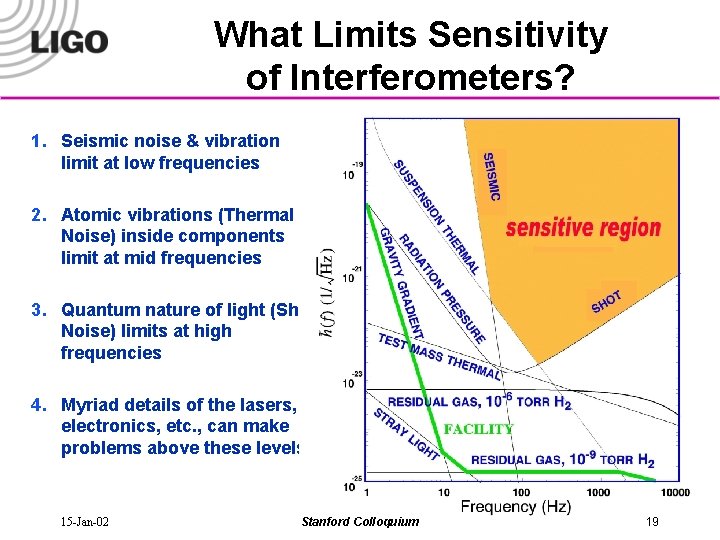
What Limits Sensitivity of Interferometers? 1. Seismic noise & vibration limit at low frequencies 2. Atomic vibrations (Thermal Noise) inside components limit at mid frequencies 3. Quantum nature of light (Shot Noise) limits at high frequencies 4. Myriad details of the lasers, electronics, etc. , can make problems above these levels 15 -Jan-02 Stanford Colloquium 19
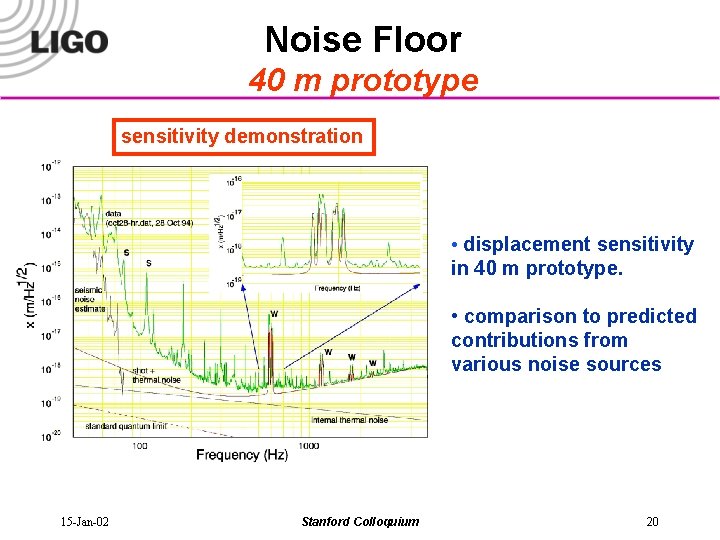
Noise Floor 40 m prototype sensitivity demonstration • displacement sensitivity in 40 m prototype. • comparison to predicted contributions from various noise sources 15 -Jan-02 Stanford Colloquium 20
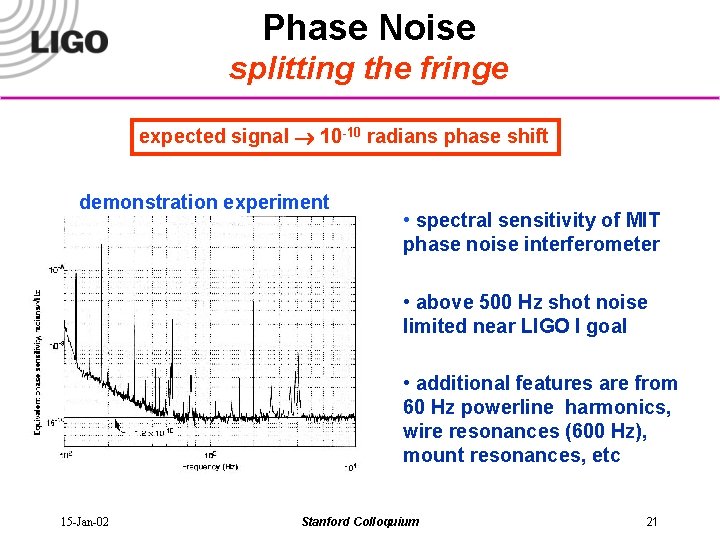
Phase Noise splitting the fringe expected signal 10 -10 radians phase shift demonstration experiment • spectral sensitivity of MIT phase noise interferometer • above 500 Hz shot noise limited near LIGO I goal • additional features are from 60 Hz powerline harmonics, wire resonances (600 Hz), mount resonances, etc 15 -Jan-02 Stanford Colloquium 21
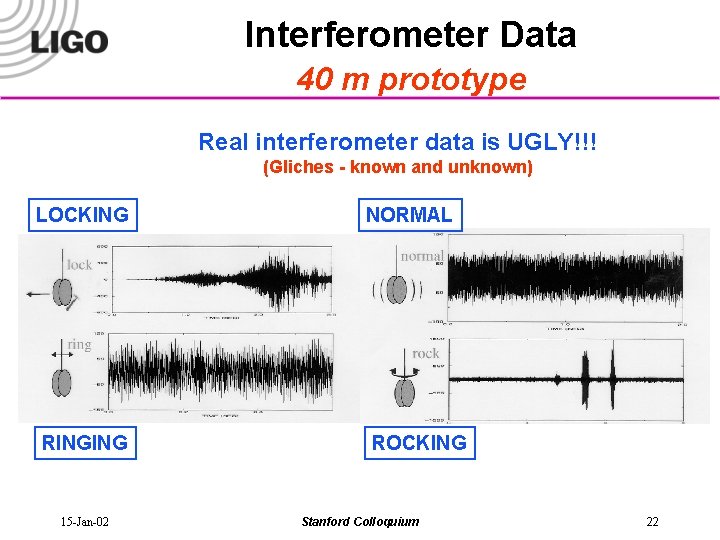
Interferometer Data 40 m prototype Real interferometer data is UGLY!!! (Gliches - known and unknown) LOCKING NORMAL RINGING ROCKING 15 -Jan-02 Stanford Colloquium 22
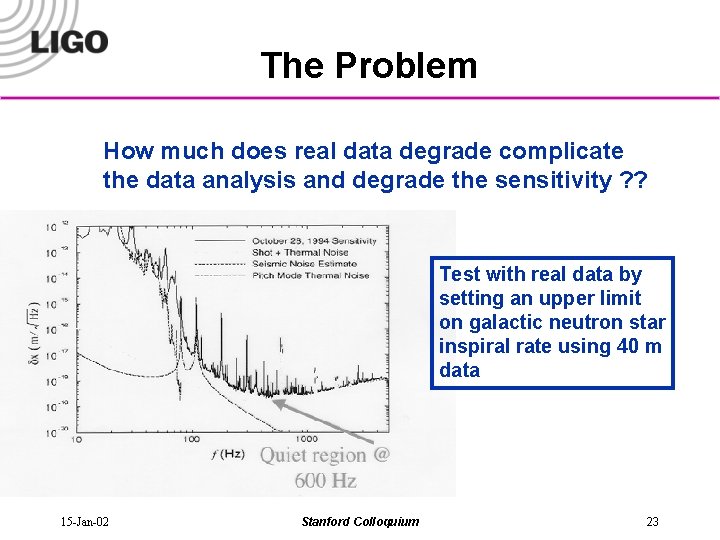
The Problem How much does real data degrade complicate the data analysis and degrade the sensitivity ? ? Test with real data by setting an upper limit on galactic neutron star inspiral rate using 40 m data 15 -Jan-02 Stanford Colloquium 23
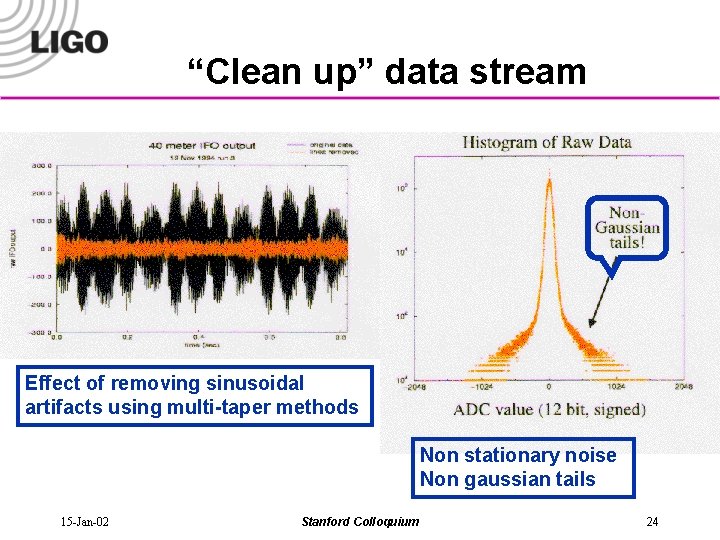
“Clean up” data stream Effect of removing sinusoidal artifacts using multi-taper methods Non stationary noise Non gaussian tails 15 -Jan-02 Stanford Colloquium 24
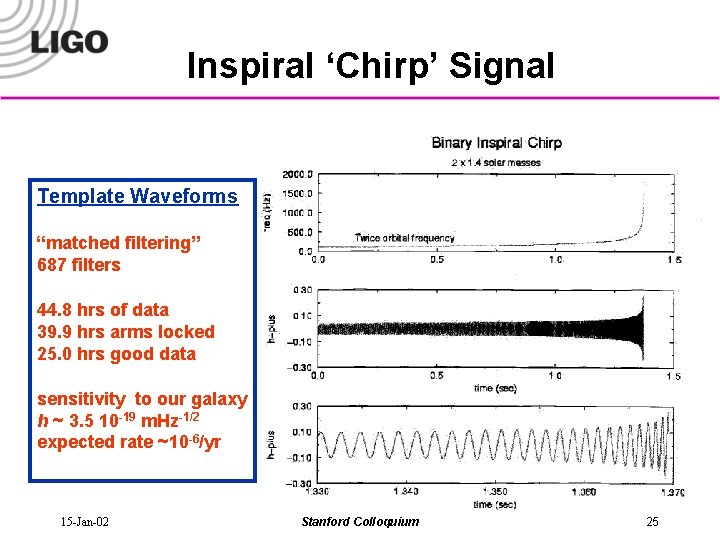
Inspiral ‘Chirp’ Signal Template Waveforms “matched filtering” 687 filters 44. 8 hrs of data 39. 9 hrs arms locked 25. 0 hrs good data sensitivity to our galaxy h ~ 3. 5 10 -19 m. Hz-1/2 expected rate ~10 -6/yr 15 -Jan-02 Stanford Colloquium 25
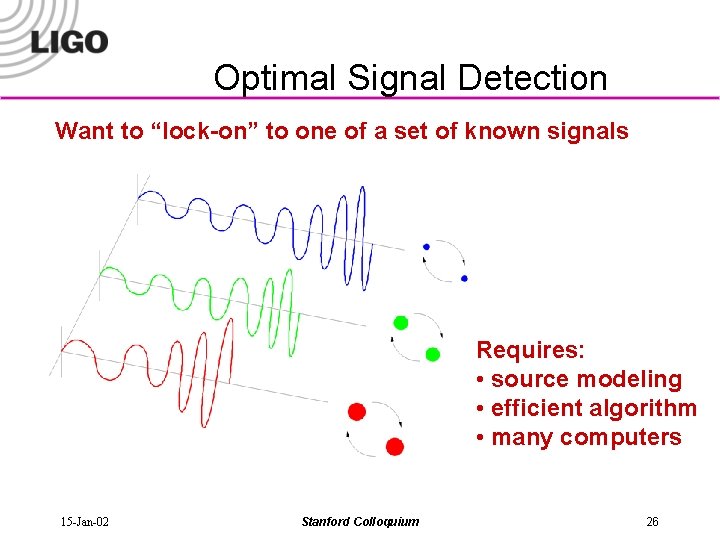
Optimal Signal Detection Want to “lock-on” to one of a set of known signals Requires: • source modeling • efficient algorithm • many computers 15 -Jan-02 Stanford Colloquium 26
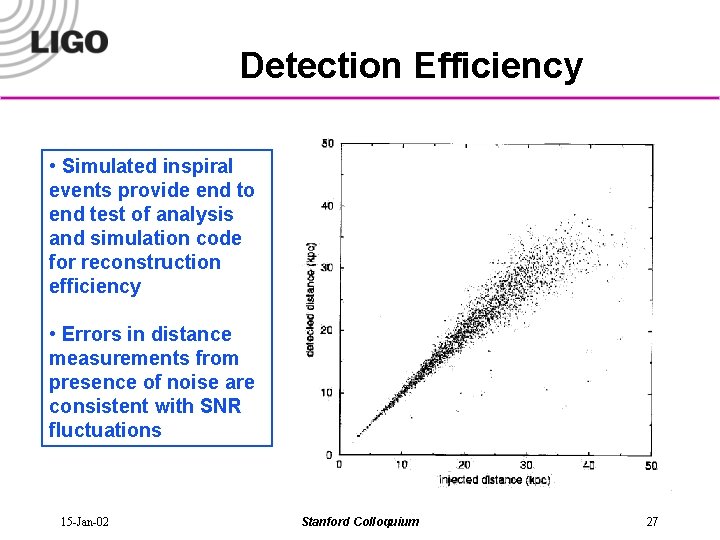
Detection Efficiency • Simulated inspiral events provide end to end test of analysis and simulation code for reconstruction efficiency • Errors in distance measurements from presence of noise are consistent with SNR fluctuations 15 -Jan-02 Stanford Colloquium 27
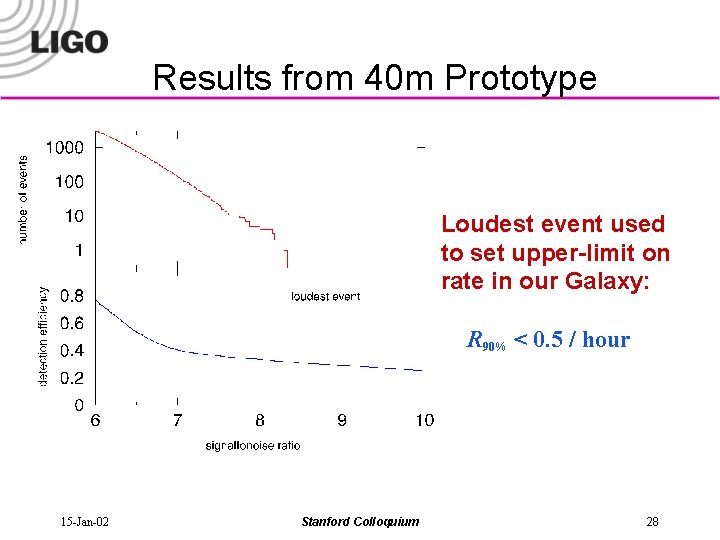
Results from 40 m Prototype Loudest event used to set upper-limit on rate in our Galaxy: R 90% < 0. 5 / hour 15 -Jan-02 Stanford Colloquium 28
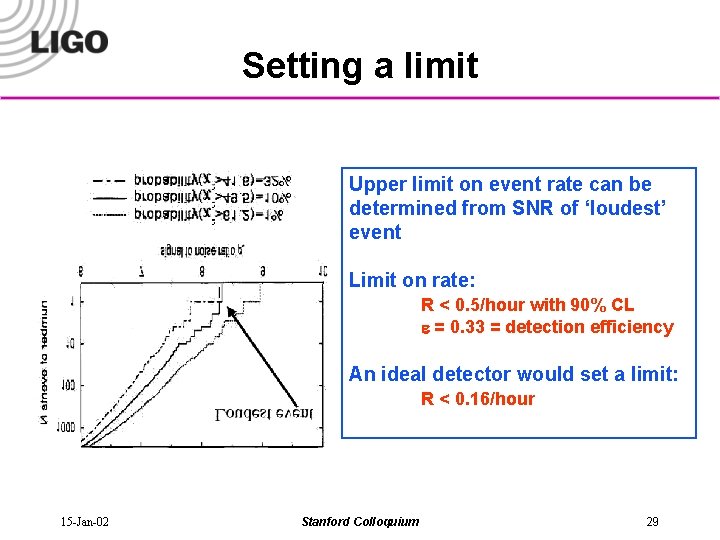
Setting a limit Upper limit on event rate can be determined from SNR of ‘loudest’ event Limit on rate: R < 0. 5/hour with 90% CL e = 0. 33 = detection efficiency An ideal detector would set a limit: R < 0. 16/hour 15 -Jan-02 Stanford Colloquium 29
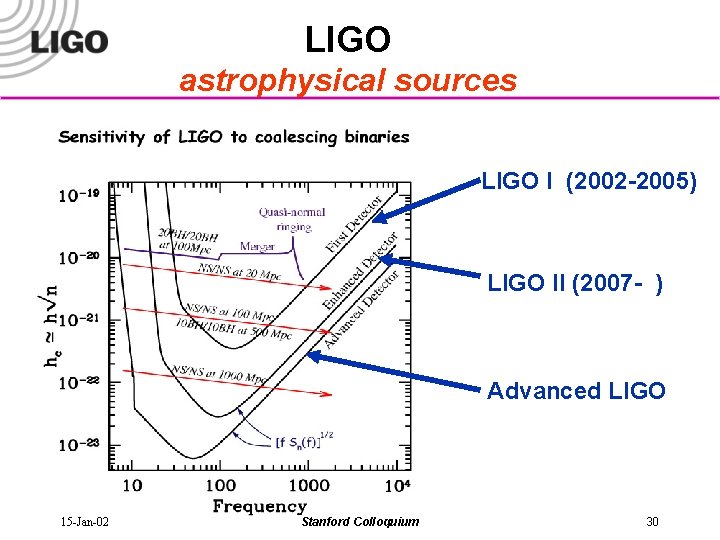
LIGO astrophysical sources LIGO I (2002 -2005) LIGO II (2007 - ) Advanced LIGO 15 -Jan-02 Stanford Colloquium 30
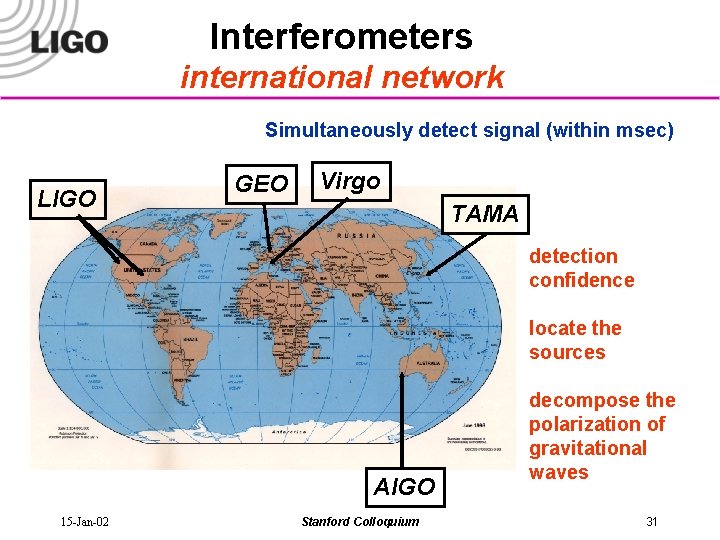
Interferometers international network Simultaneously detect signal (within msec) LIGO GEO Virgo TAMA detection confidence locate the sources AIGO 15 -Jan-02 Stanford Colloquium decompose the polarization of gravitational waves 31
Astrophysical Signatures data analysis § Compact binary inspiral: “chirps” » NS-NS waveforms are well described » BH-BH need better waveforms » search technique: matched templates § Supernovae / GRBs: “bursts” » burst signals in coincidence with signals in electromagnetic radiation » prompt alarm (~ one hour) with neutrino detectors § Pulsars in our galaxy: “periodic” » search for observed neutron stars (frequency, doppler shift) » all sky search (computing challenge) » r-modes § Cosmological Signals 15 -Jan-02 “stochastic background” Stanford Colloquium 32
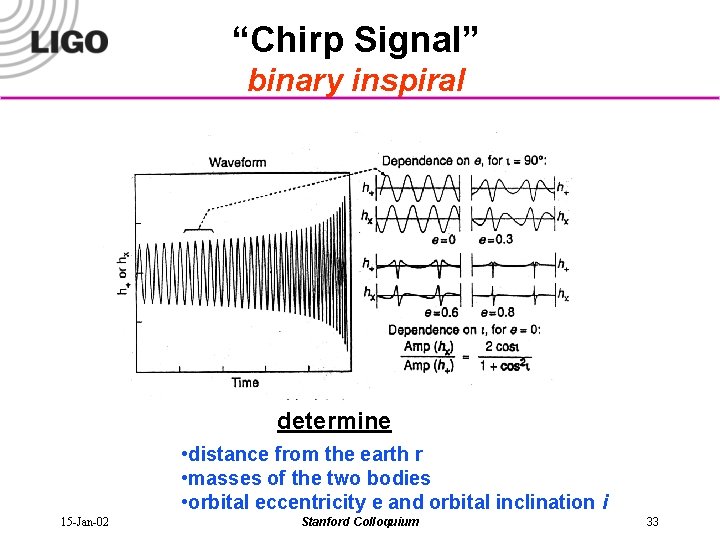
“Chirp Signal” binary inspiral determine • distance from the earth r • masses of the two bodies • orbital eccentricity e and orbital inclination i 15 -Jan-02 Stanford Colloquium 33
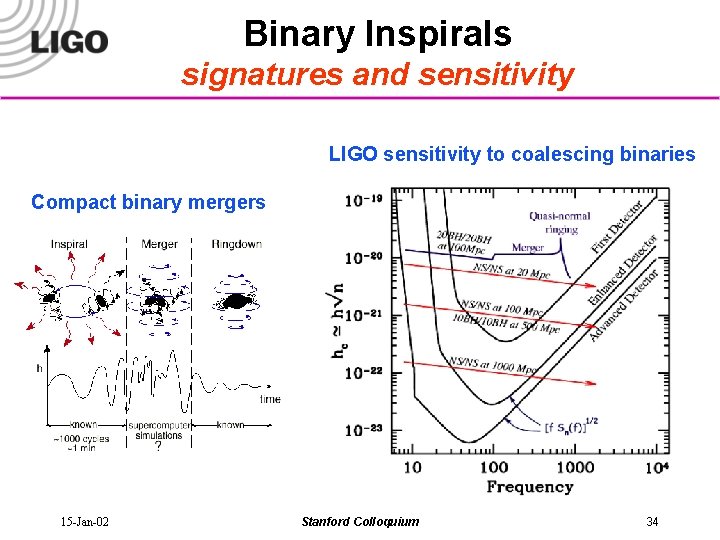
Binary Inspirals signatures and sensitivity LIGO sensitivity to coalescing binaries Compact binary mergers 15 -Jan-02 Stanford Colloquium 34
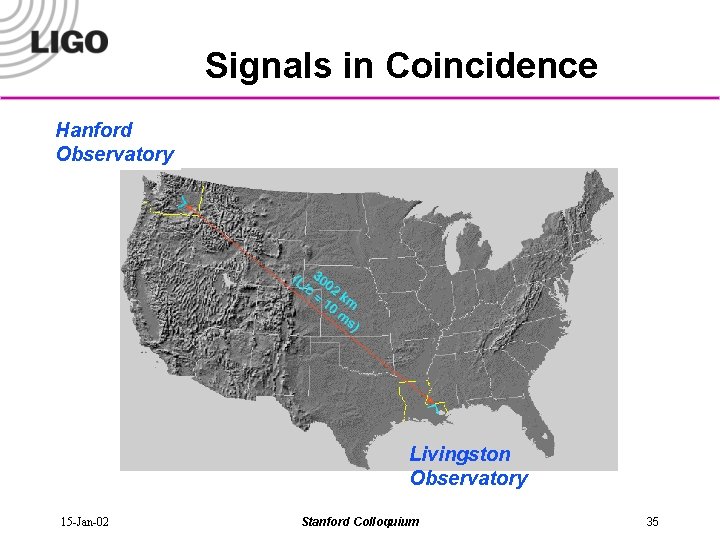
Signals in Coincidence Hanford Observatory Livingston Observatory 15 -Jan-02 Stanford Colloquium 35
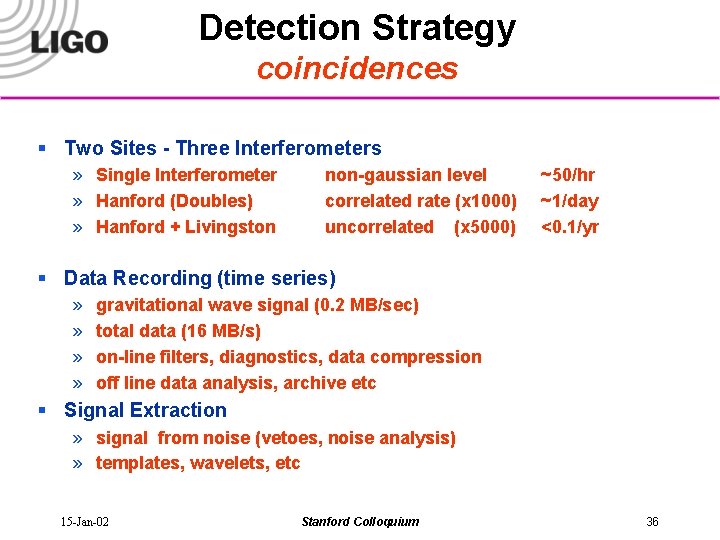
Detection Strategy coincidences § Two Sites - Three Interferometers » Single Interferometer » Hanford (Doubles) » Hanford + Livingston non-gaussian level correlated rate (x 1000) uncorrelated (x 5000) ~50/hr ~1/day <0. 1/yr § Data Recording (time series) » » gravitational wave signal (0. 2 MB/sec) total data (16 MB/s) on-line filters, diagnostics, data compression off line data analysis, archive etc § Signal Extraction » signal from noise (vetoes, noise analysis) » templates, wavelets, etc 15 -Jan-02 Stanford Colloquium 36

“Burst Signal” supernova gravitational waves n’s light 15 -Jan-02 Stanford Colloquium 37
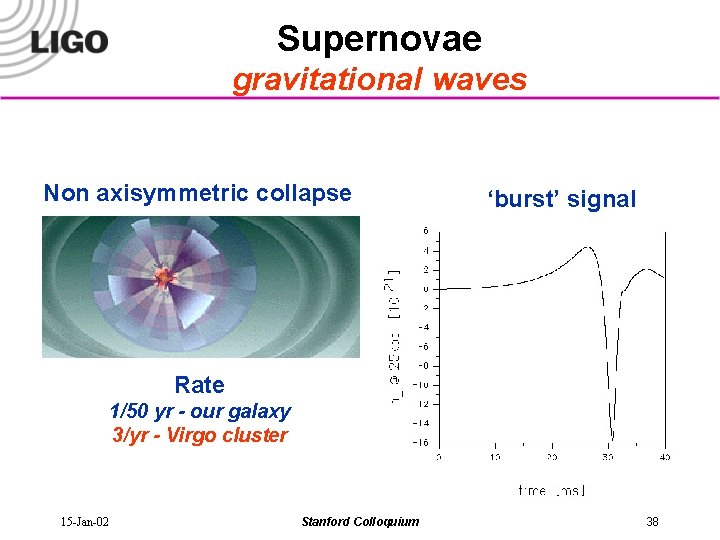
Supernovae gravitational waves Non axisymmetric collapse ‘burst’ signal Rate 1/50 yr - our galaxy 3/yr - Virgo cluster 15 -Jan-02 Stanford Colloquium 38
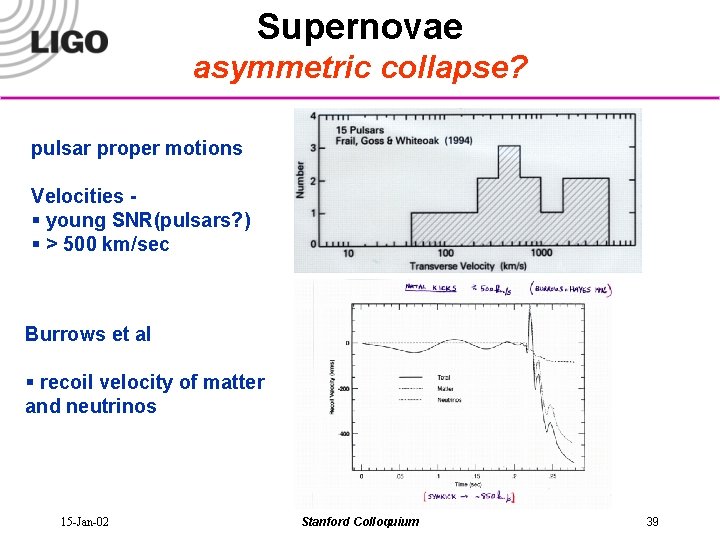
Supernovae asymmetric collapse? pulsar proper motions Velocities § young SNR(pulsars? ) § > 500 km/sec Burrows et al § recoil velocity of matter and neutrinos 15 -Jan-02 Stanford Colloquium 39
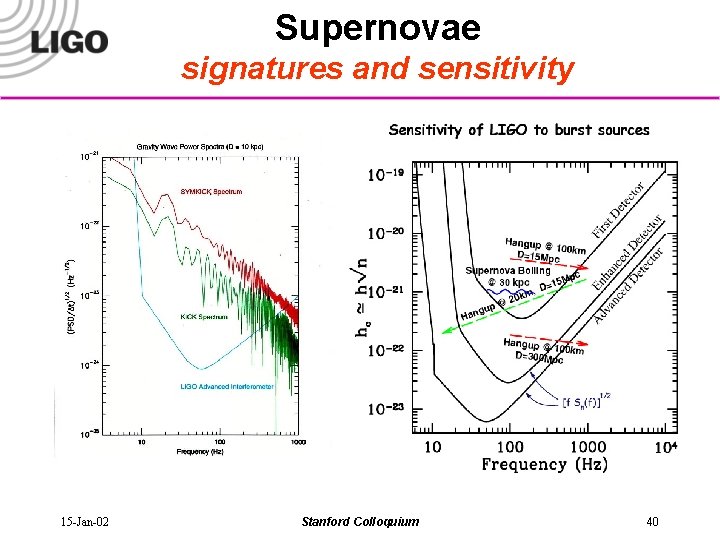
Supernovae signatures and sensitivity 15 -Jan-02 Stanford Colloquium 40
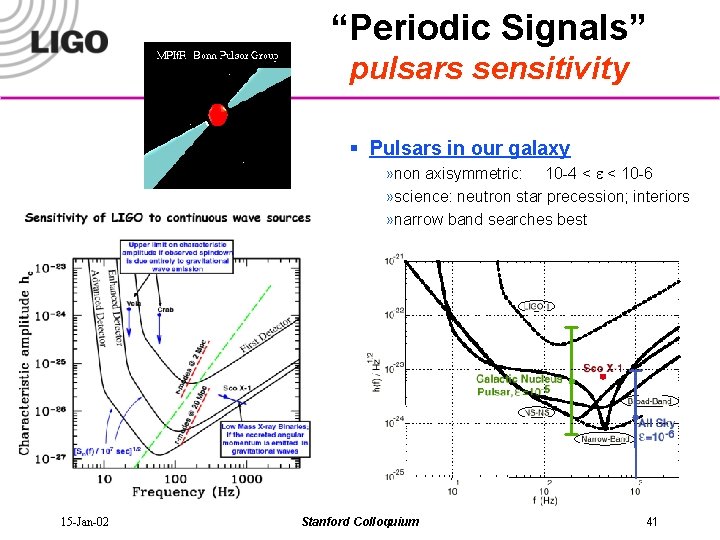
“Periodic Signals” pulsars sensitivity § Pulsars in our galaxy » non axisymmetric: 10 -4 < e < 10 -6 » science: neutron star precession; interiors » narrow band searches best 15 -Jan-02 Stanford Colloquium 41
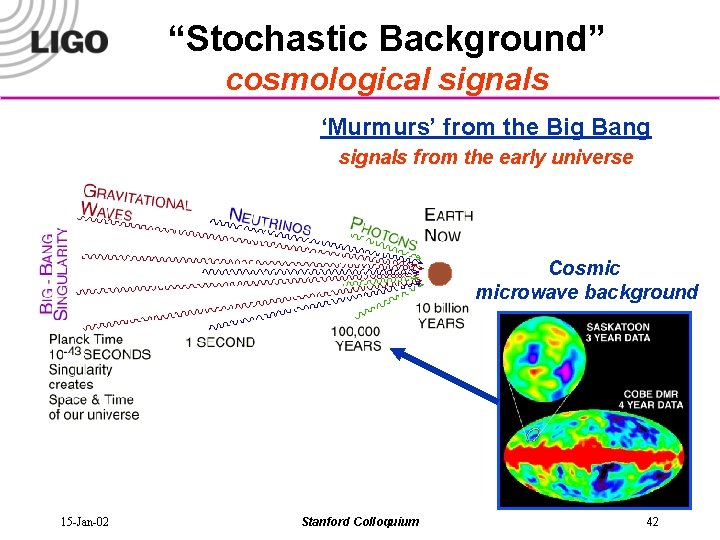
“Stochastic Background” cosmological signals ‘Murmurs’ from the Big Bang signals from the early universe Cosmic microwave background 15 -Jan-02 Stanford Colloquium 42
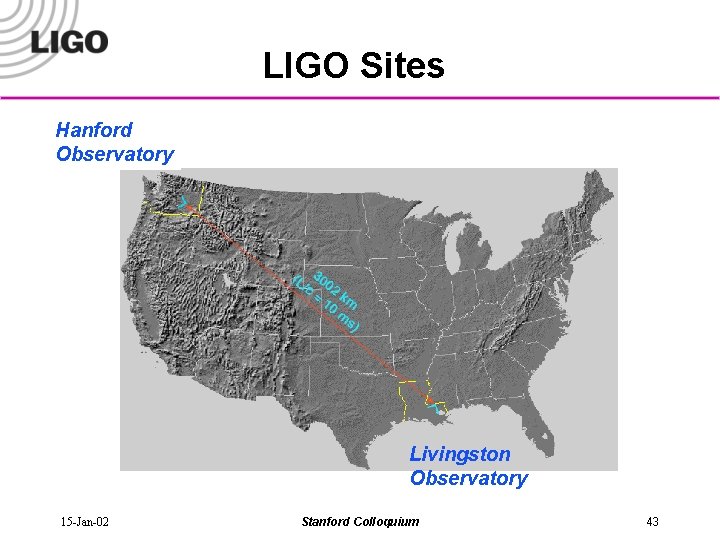
LIGO Sites Hanford Observatory Livingston Observatory 15 -Jan-02 Stanford Colloquium 43
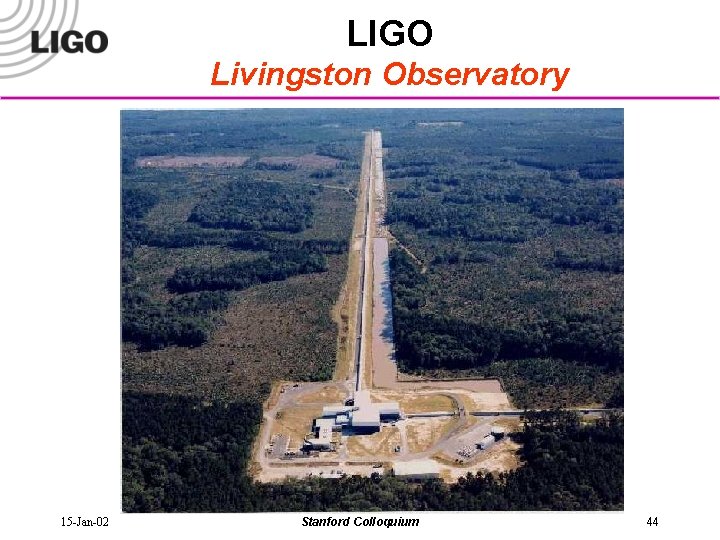
LIGO Livingston Observatory 15 -Jan-02 Stanford Colloquium 44
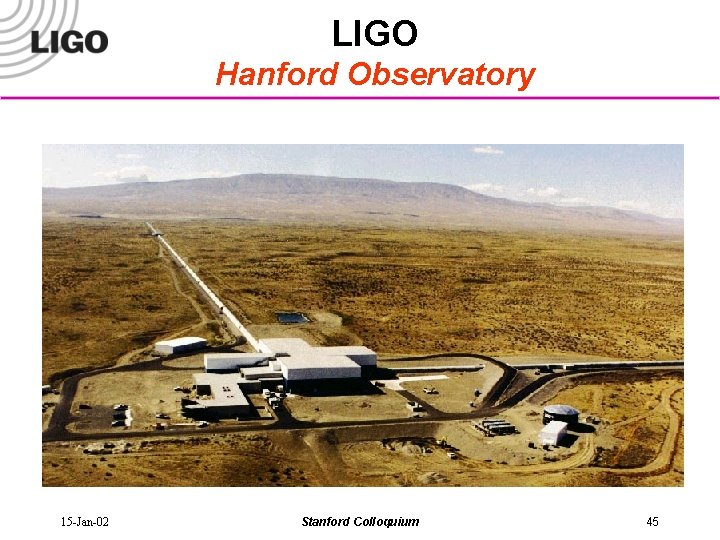
LIGO Hanford Observatory 15 -Jan-02 Stanford Colloquium 45
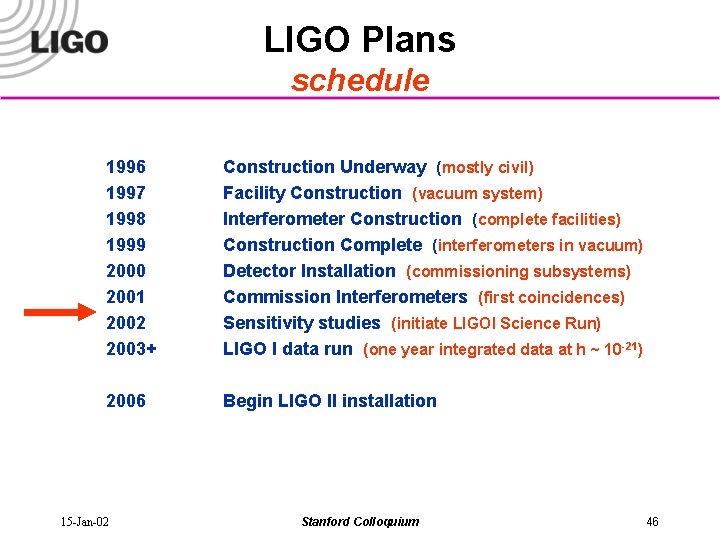
LIGO Plans schedule 1996 1997 1998 1999 2000 2001 2002 2003+ Construction Underway (mostly civil) Facility Construction (vacuum system) Interferometer Construction (complete facilities) Construction Complete (interferometers in vacuum) Detector Installation (commissioning subsystems) Commission Interferometers (first coincidences) Sensitivity studies (initiate LIGOI Science Run) LIGO I data run (one year integrated data at h ~ 10 -21) 2006 Begin LIGO II installation 15 -Jan-02 Stanford Colloquium 46
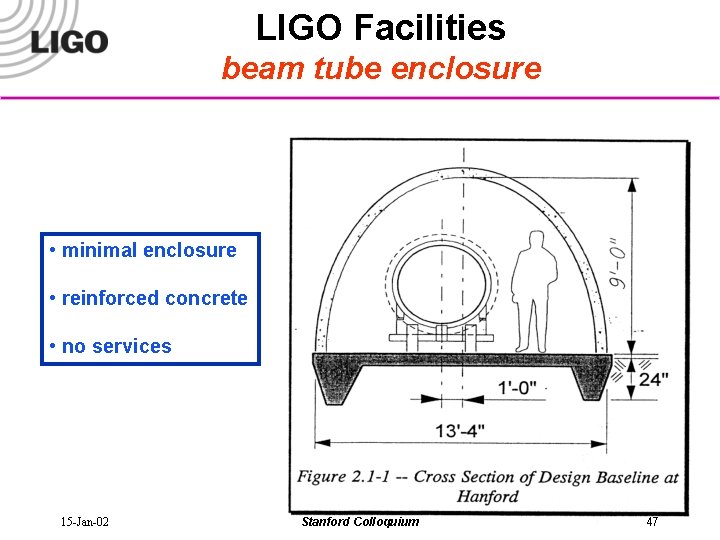
LIGO Facilities beam tube enclosure • minimal enclosure • reinforced concrete • no services 15 -Jan-02 Stanford Colloquium 47
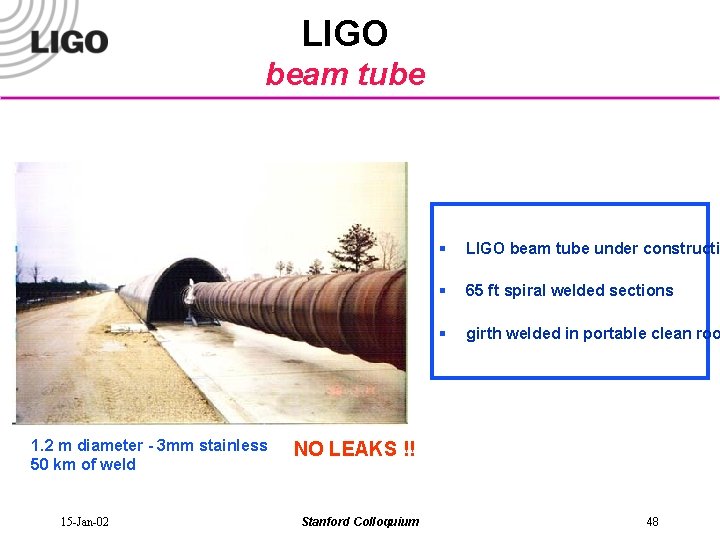
LIGO beam tube 1. 2 m diameter - 3 mm stainless 50 km of weld 15 -Jan-02 § LIGO beam tube under constructi § 65 ft spiral welded sections § girth welded in portable clean roo NO LEAKS !! Stanford Colloquium 48
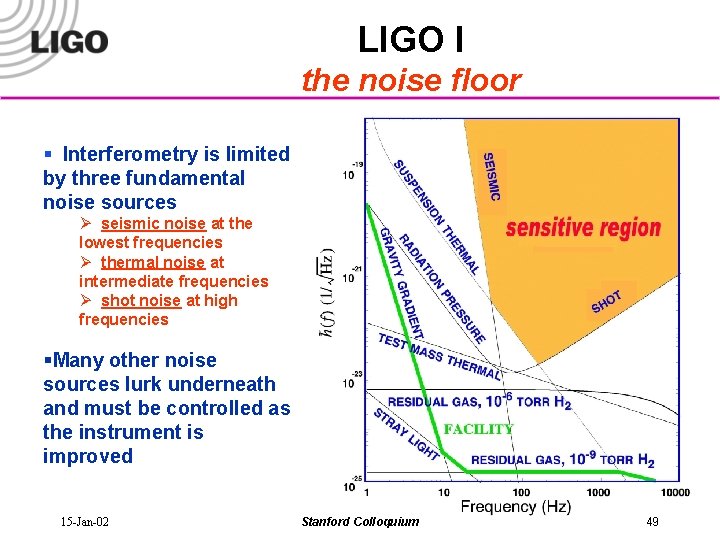
LIGO I the noise floor § Interferometry is limited by three fundamental noise sources Ø seismic noise at the lowest frequencies Ø thermal noise at intermediate frequencies Ø shot noise at high frequencies §Many other noise sources lurk underneath and must be controlled as the instrument is improved 15 -Jan-02 Stanford Colloquium 49
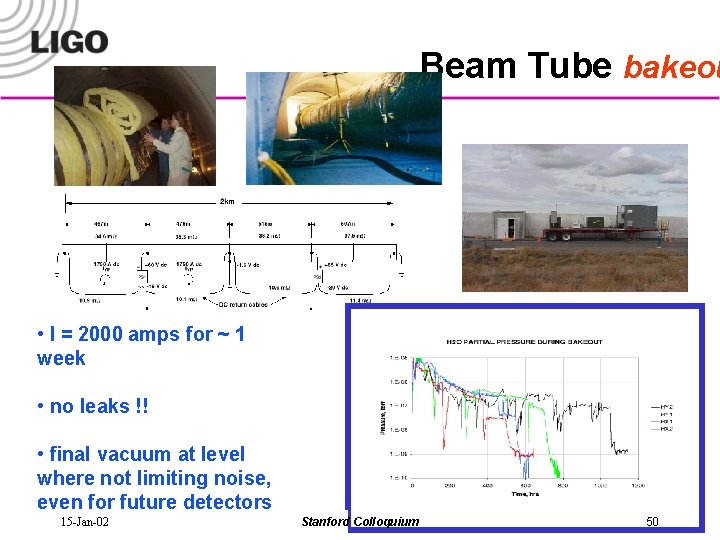
Beam Tube bakeou • I = 2000 amps for ~ 1 week • no leaks !! • final vacuum at level where not limiting noise, even for future detectors 15 -Jan-02 Stanford Colloquium 50
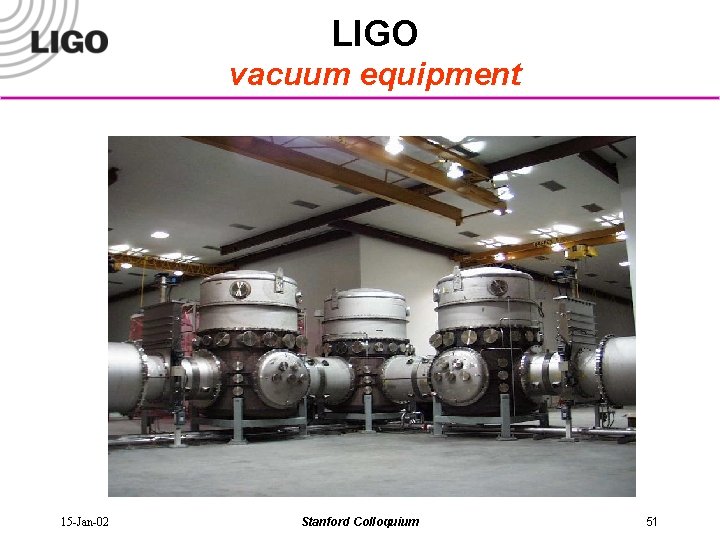
LIGO vacuum equipment 15 -Jan-02 Stanford Colloquium 51
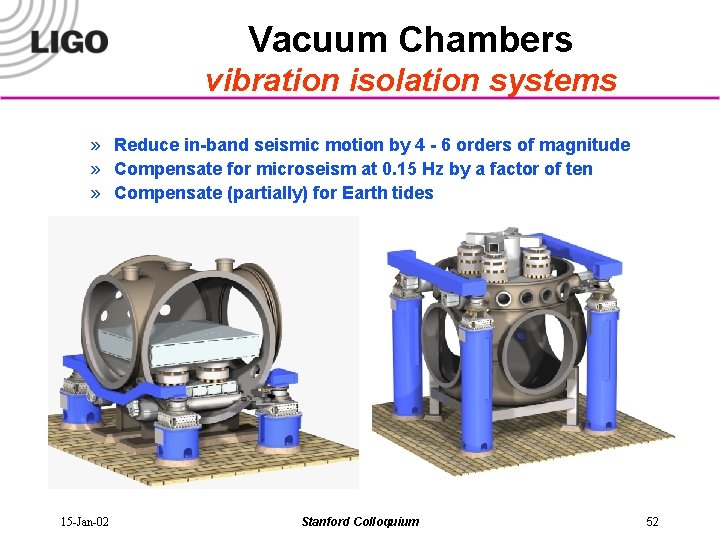
Vacuum Chambers vibration isolation systems » Reduce in-band seismic motion by 4 - 6 orders of magnitude » Compensate for microseism at 0. 15 Hz by a factor of ten » Compensate (partially) for Earth tides 15 -Jan-02 Stanford Colloquium 52
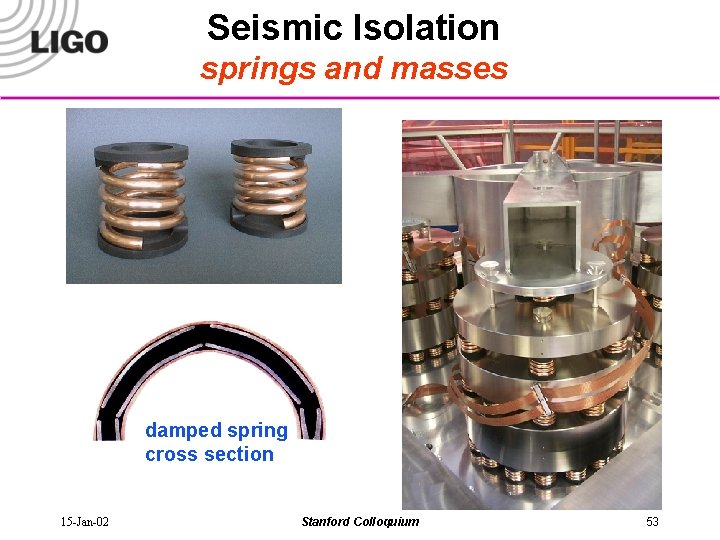
Seismic Isolation springs and masses damped spring cross section 15 -Jan-02 Stanford Colloquium 53
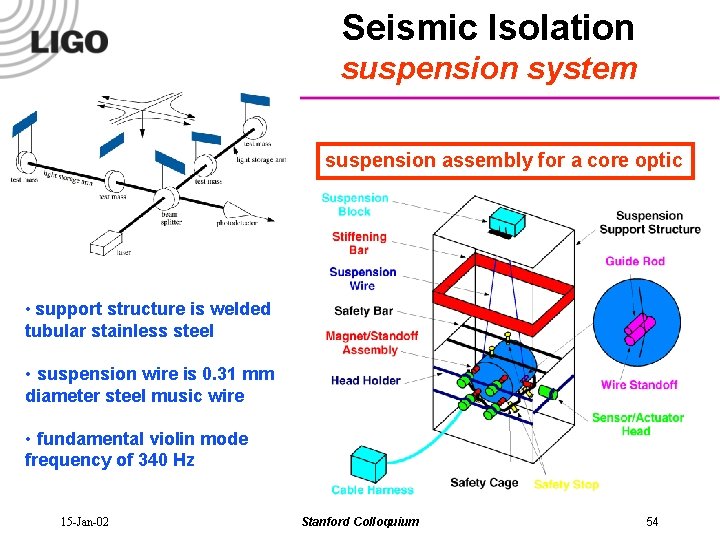
Seismic Isolation suspension system suspension assembly for a core optic • support structure is welded tubular stainless steel • suspension wire is 0. 31 mm diameter steel music wire • fundamental violin mode frequency of 340 Hz 15 -Jan-02 Stanford Colloquium 54
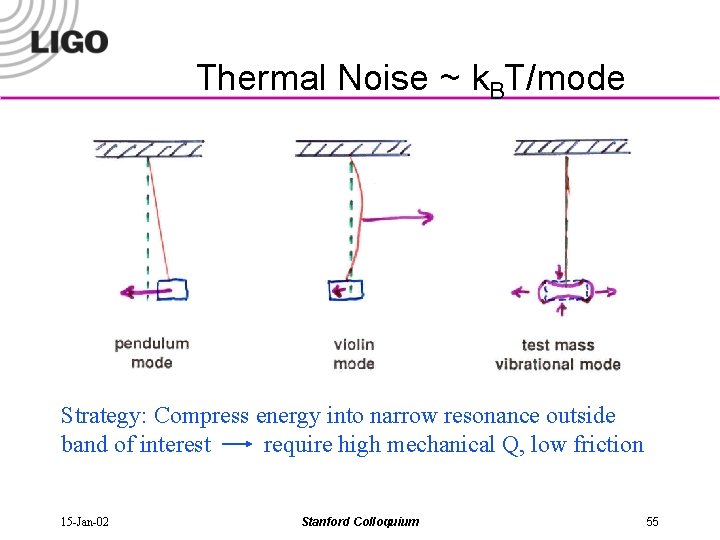
Thermal Noise ~ k. BT/mode Strategy: Compress energy into narrow resonance outside band of interest require high mechanical Q, low friction 15 -Jan-02 Stanford Colloquium 55
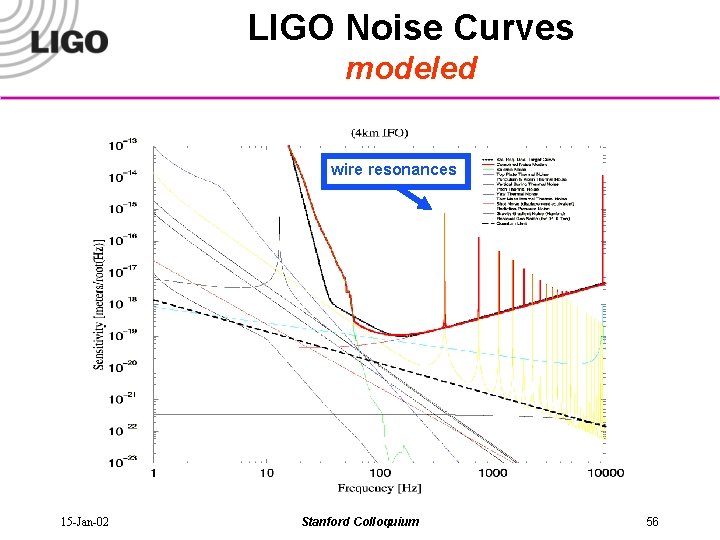
LIGO Noise Curves modeled wire resonances 15 -Jan-02 Stanford Colloquium 56
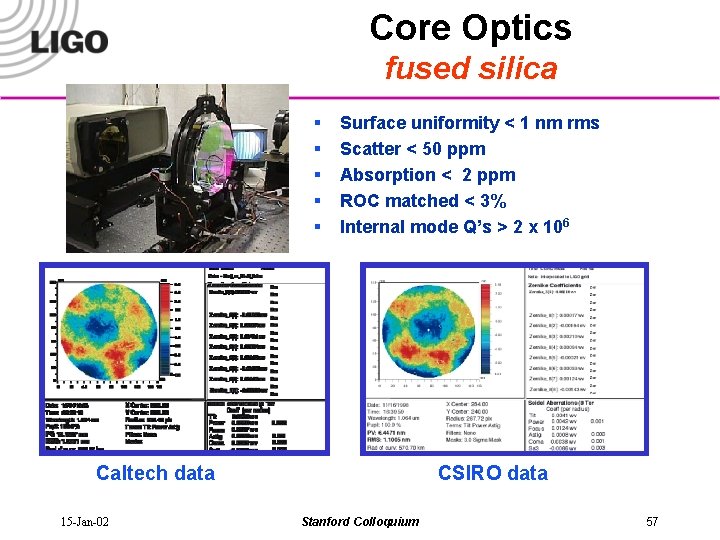
Core Optics fused silica § § § Surface uniformity < 1 nm rms Scatter < 50 ppm Absorption < 2 ppm ROC matched < 3% Internal mode Q’s > 2 x 10⁶ Caltech data 15 -Jan-02 CSIRO data Stanford Colloquium 57
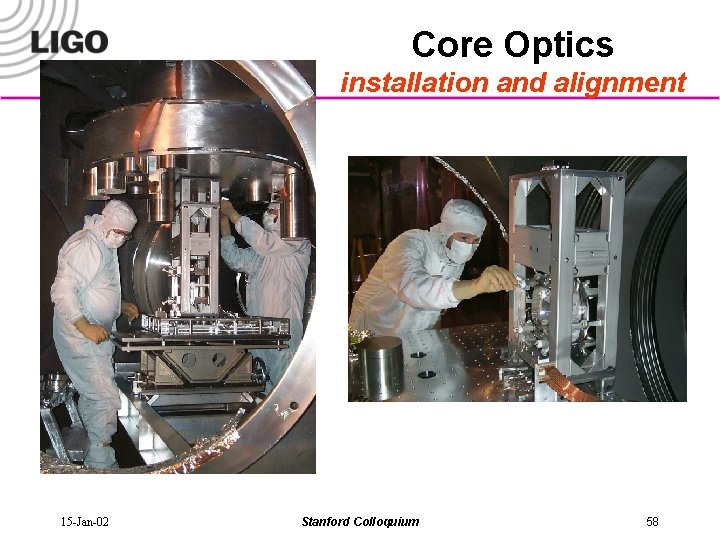
Core Optics installation and alignment 15 -Jan-02 Stanford Colloquium 58
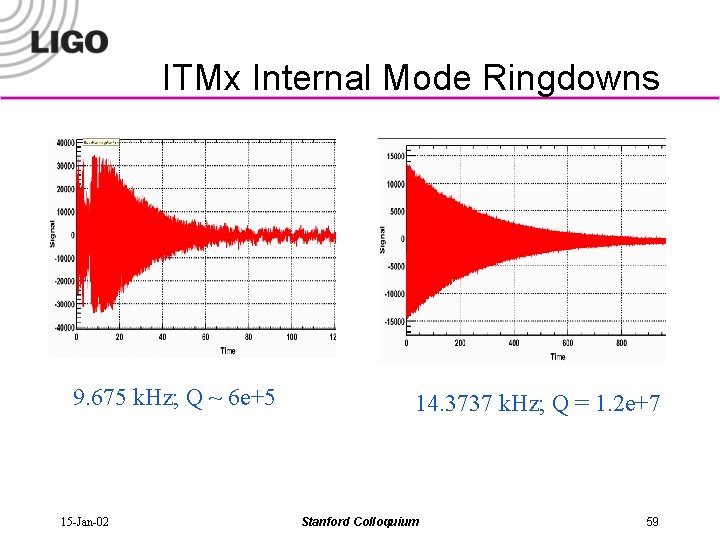
ITMx Internal Mode Ringdowns 9. 675 k. Hz; Q ~ 6 e+5 15 -Jan-02 14. 3737 k. Hz; Q = 1. 2 e+7 Stanford Colloquium 59
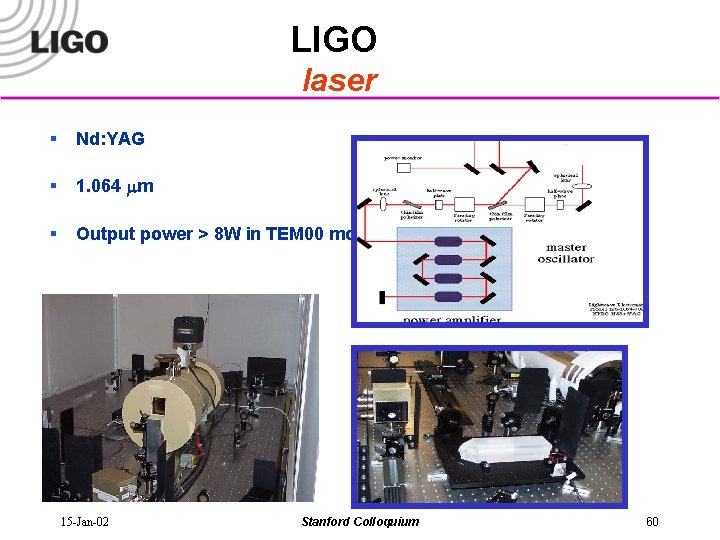
LIGO laser § Nd: YAG § 1. 064 mm § Output power > 8 W in TEM 00 mode 15 -Jan-02 Stanford Colloquium 60
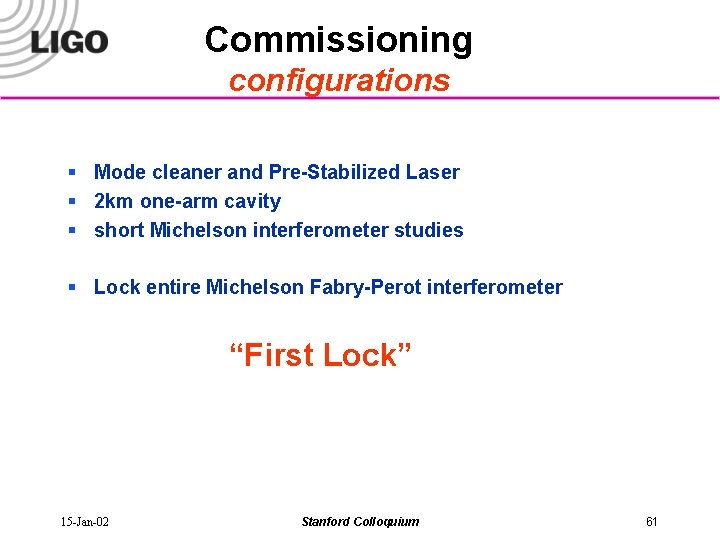
Commissioning configurations § Mode cleaner and Pre-Stabilized Laser § 2 km one-arm cavity § short Michelson interferometer studies § Lock entire Michelson Fabry-Perot interferometer “First Lock” 15 -Jan-02 Stanford Colloquium 61
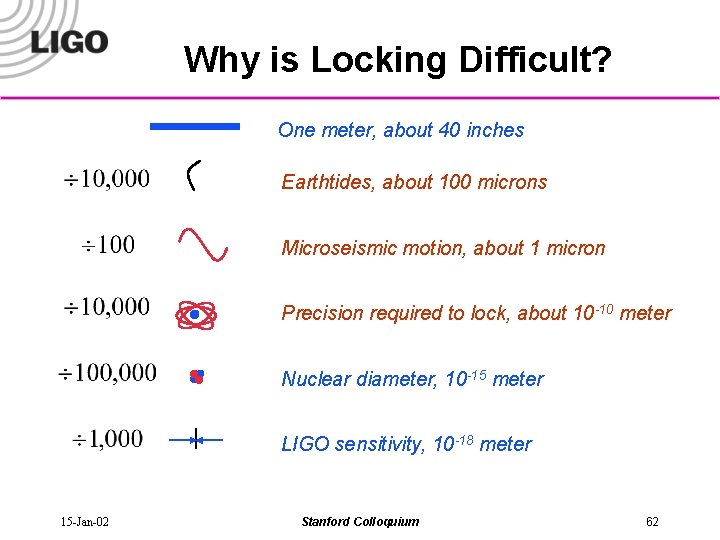
Why is Locking Difficult? One meter, about 40 inches Human hair, about Earthtides, about 100 microns Wavelength ofmotion, Microseismic light, about 11 micron Atomic diameter, Precision required 10 to-10 lock, meter about 10 -10 meter Nuclear diameter, 10 -15 meter LIGO sensitivity, 10 -18 meter 15 -Jan-02 Stanford Colloquium 62
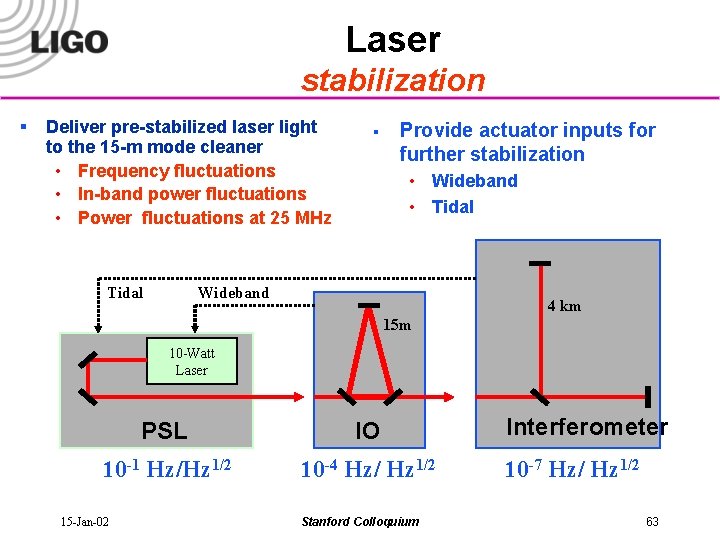
Laser stabilization § Deliver pre-stabilized laser light to the 15 -m mode cleaner • Frequency fluctuations • In-band power fluctuations • Power fluctuations at 25 MHz Tidal § Provide actuator inputs for further stabilization • Wideband • Tidal Wideband 4 km 15 m 10 -Watt Laser PSL IO 10 -1 Hz/Hz 1/2 10 -4 Hz/ Hz 1/2 15 -Jan-02 Stanford Colloquium Interferometer 10 -7 Hz/ Hz 1/2 63

Prestabalized Laser performance 15 -Jan-02 Stanford Colloquium § > 18, 000 hours continuous operation § Frequency and lock very robust § TEM 00 power > 8 watts § Non-TEM 00 power < 10% 64
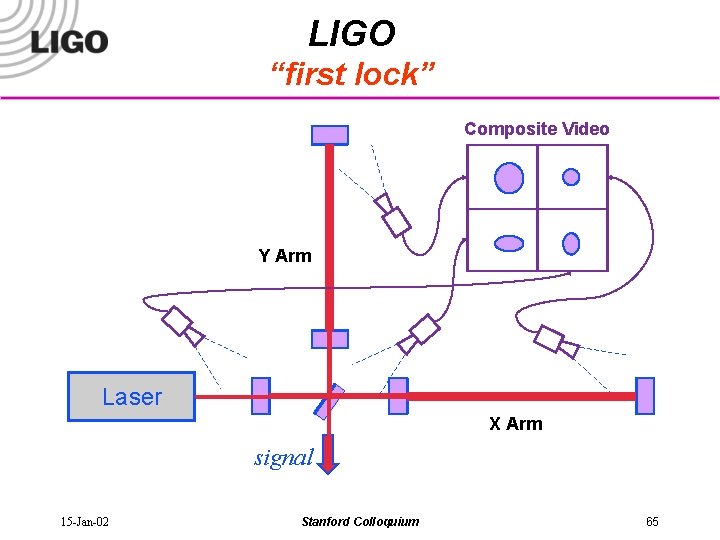
LIGO “first lock” Composite Video Y Arm Laser X Arm signal 15 -Jan-02 Stanford Colloquium 65
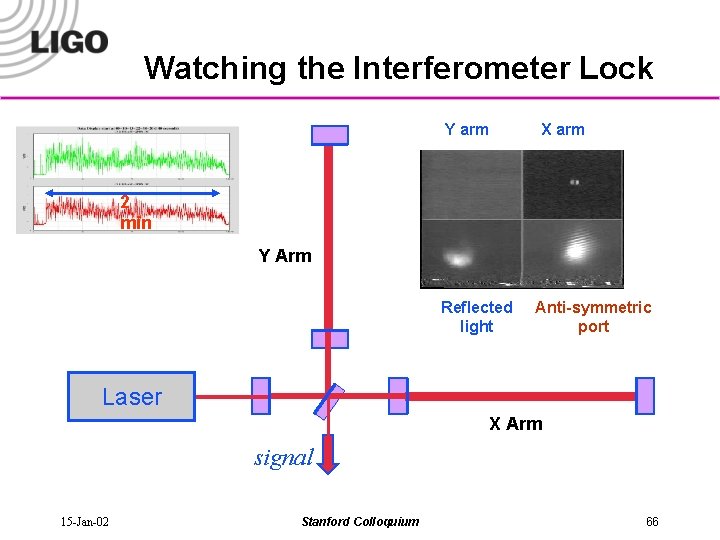
Watching the Interferometer Lock Y arm X arm 2 min Y Arm Reflected light Anti-symmetric port Laser X Arm signal 15 -Jan-02 Stanford Colloquium 66
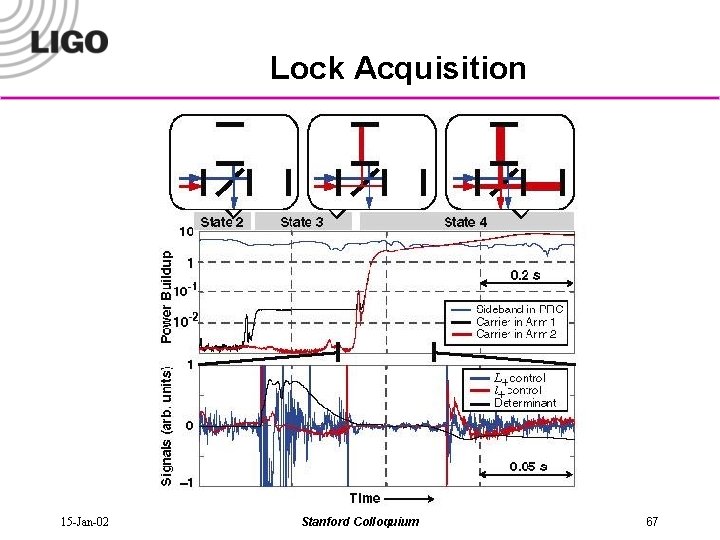
Lock Acquisition 15 -Jan-02 Stanford Colloquium 67
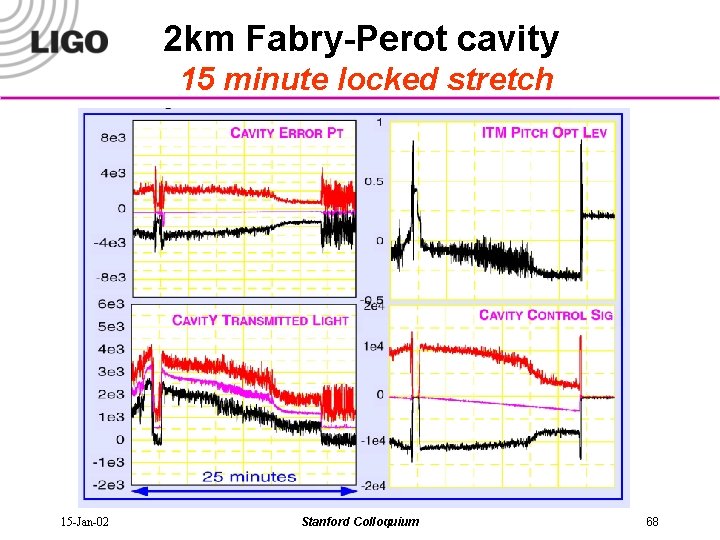
2 km Fabry-Perot cavity 15 minute locked stretch 15 -Jan-02 Stanford Colloquium 68

Engineering Run detecting earthquakes From electronic logbook 2 -Jan-02 An earthquake occurred, starting at UTC 17: 38. The plot shows the band limited rms output in counts over the 0. 1 - 0. 3 Hz band for four seismometer channels. We turned off lock acquisition and are waiting for the ground motion to calm down. 15 -Jan-02 Stanford Colloquium 69
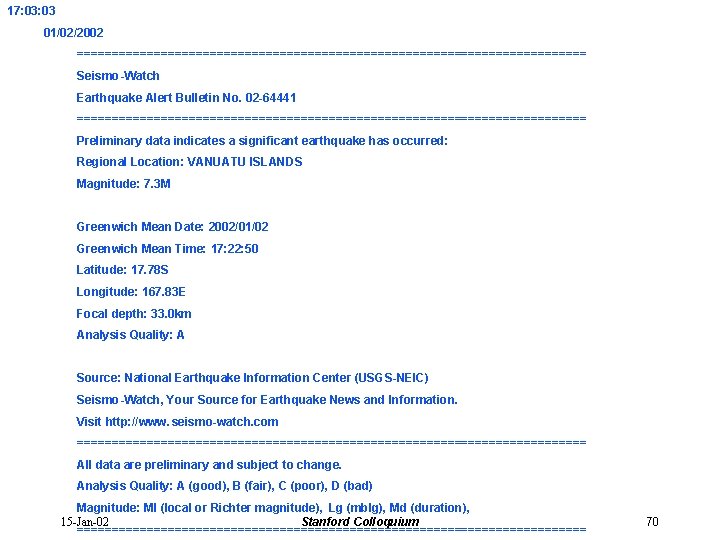
17: 03 01/02/2002 ===================================== Seismo-Watch Earthquake Alert Bulletin No. 02 -64441 ===================================== Preliminary data indicates a significant earthquake has occurred: Regional Location: VANUATU ISLANDS Magnitude: 7. 3 M Greenwich Mean Date: 2002/01/02 Greenwich Mean Time: 17: 22: 50 Latitude: 17. 78 S Longitude: 167. 83 E Focal depth: 33. 0 km Analysis Quality: A Source: National Earthquake Information Center (USGS-NEIC) Seismo-Watch, Your Source for Earthquake News and Information. Visit http: //www. seismo-watch. com ===================================== All data are preliminary and subject to change. Analysis Quality: A (good), B (fair), C (poor), D (bad) Magnitude: Ml (local or Richter magnitude), Lg (mblg), Md (duration), 15 -Jan-02 Stanford Colloquium ===================================== 70
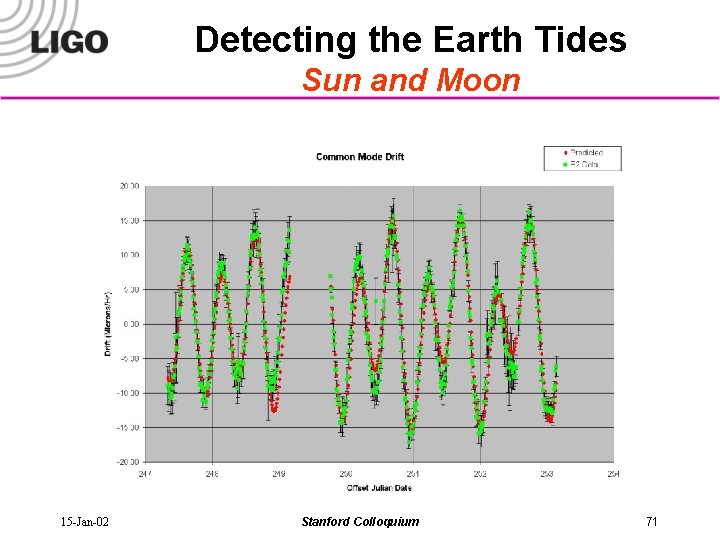
Detecting the Earth Tides Sun and Moon 15 -Jan-02 Stanford Colloquium 71
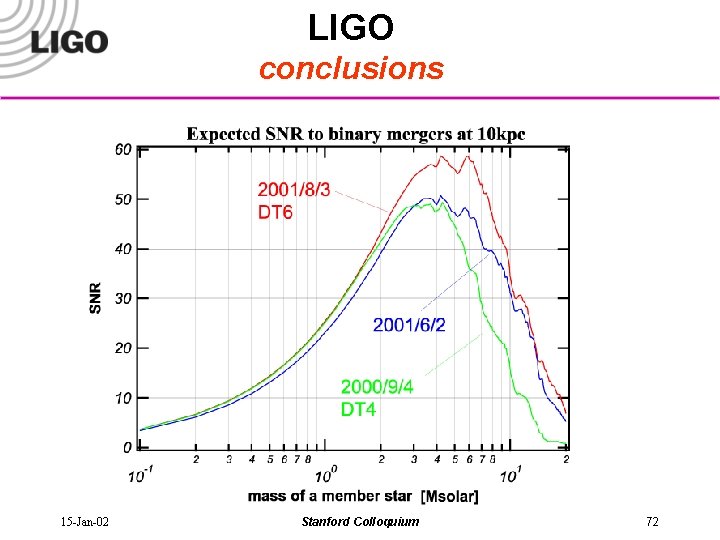
LIGO conclusions 15 -Jan-02 Stanford Colloquium 72
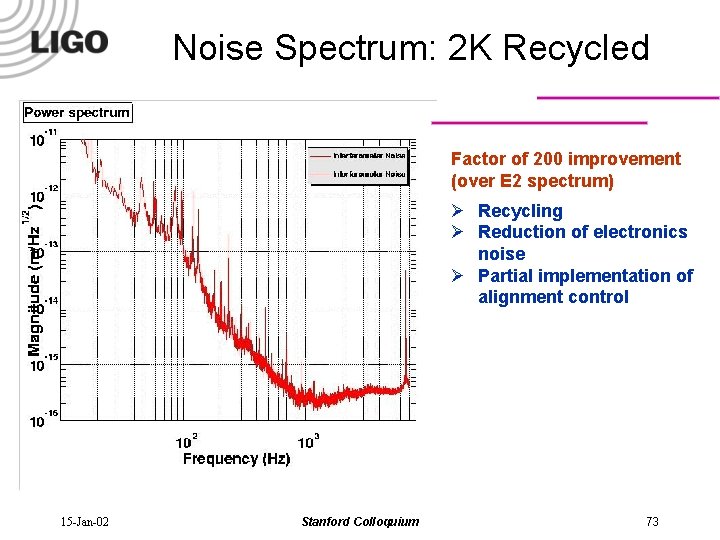
Noise Spectrum: 2 K Recycled Factor of 200 improvement (over E 2 spectrum) Ø Recycling Ø Reduction of electronics noise Ø Partial implementation of alignment control 15 -Jan-02 Stanford Colloquium 73
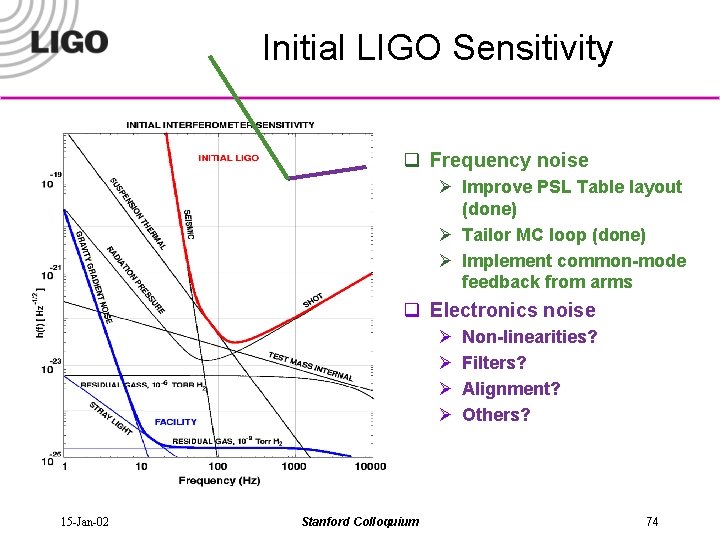
Initial LIGO Sensitivity q Frequency noise Ø Improve PSL Table layout (done) Ø Tailor MC loop (done) Ø Implement common-mode feedback from arms q Electronics noise Ø Ø 15 -Jan-02 Stanford Colloquium Non-linearities? Filters? Alignment? Others? 74
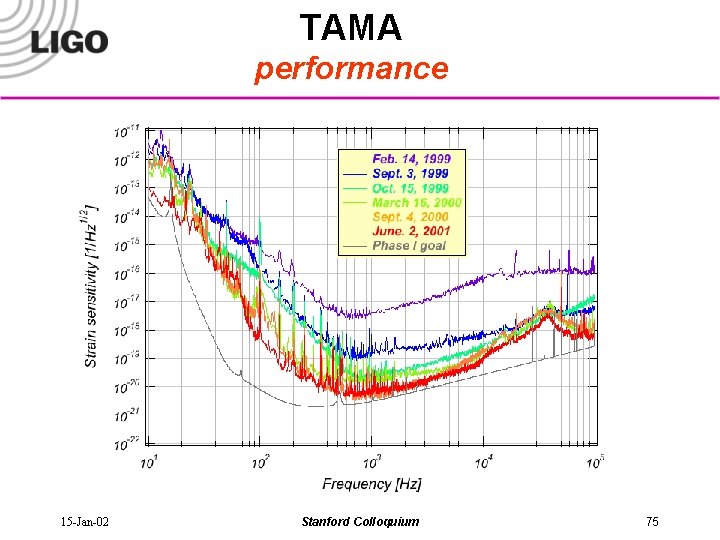
TAMA performance 15 -Jan-02 Stanford Colloquium 75

LIGO conclusions § LIGO construction complete § LIGO commissioning and testing ‘on track’ § “First Lock” officially established 20 Oct 00 § Engineering test runs begin now, during period when emphasis is on commissioning, detector sensitivity and reliability § First Science Run will begin during 2003 § Significant improvements in sensitivity anticipated to begin about 2006 15 -Jan-02 Stanford Colloquium 76
15 -Jan-02 Stanford Colloquium 77
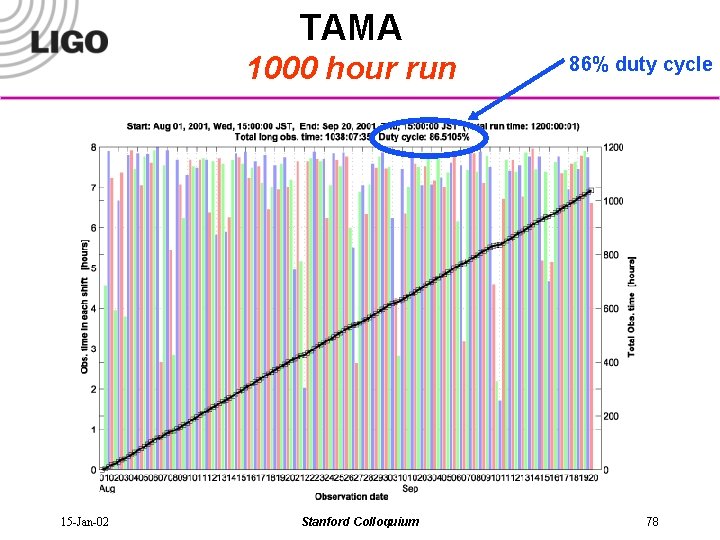
TAMA 1000 hour run 15 -Jan-02 Stanford Colloquium 86% duty cycle 78
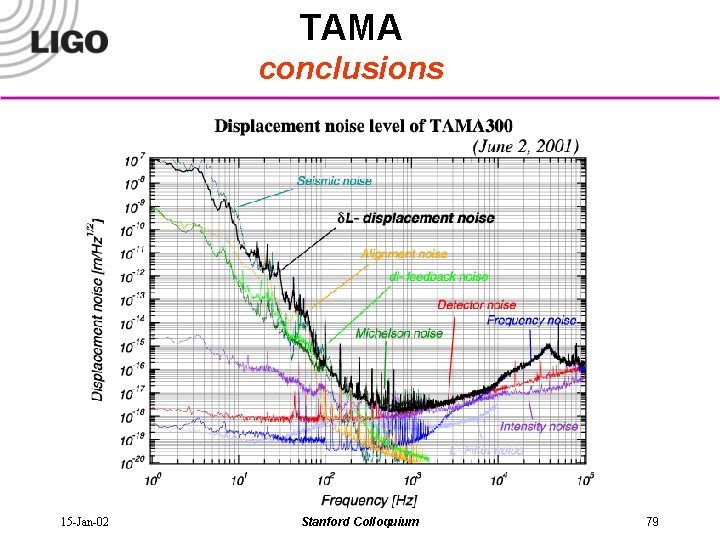
TAMA conclusions 15 -Jan-02 Stanford Colloquium 79
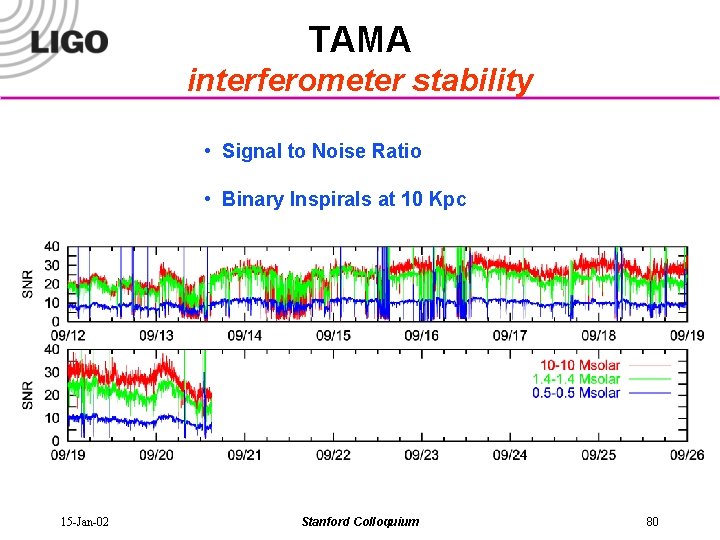
TAMA interferometer stability • Signal to Noise Ratio • Binary Inspirals at 10 Kpc 15 -Jan-02 Stanford Colloquium 80
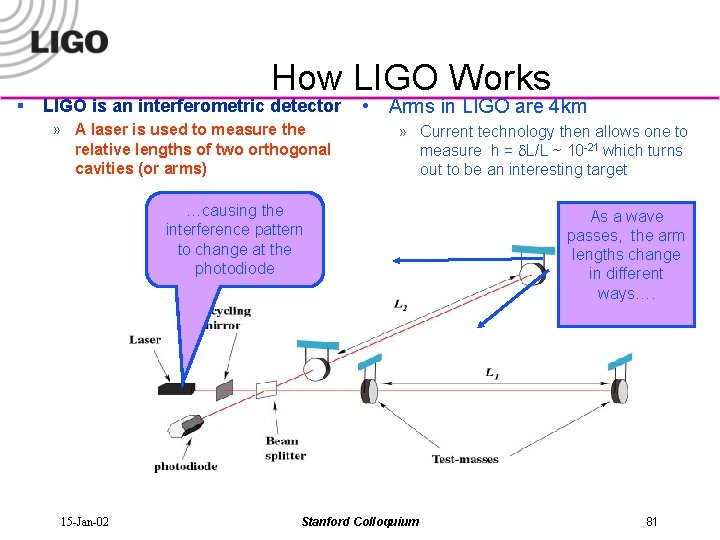
§ How LIGO Works LIGO is an interferometric detector » A laser is used to measure the relative lengths of two orthogonal cavities (or arms) • Arms in LIGO are 4 km » Current technology then allows one to measure h = d. L/L ~ 10 -21 which turns out to be an interesting target …causing the interference pattern to change at the photodiode 15 -Jan-02 Stanford Colloquium As a wave passes, the arm lengths change in different ways…. 81
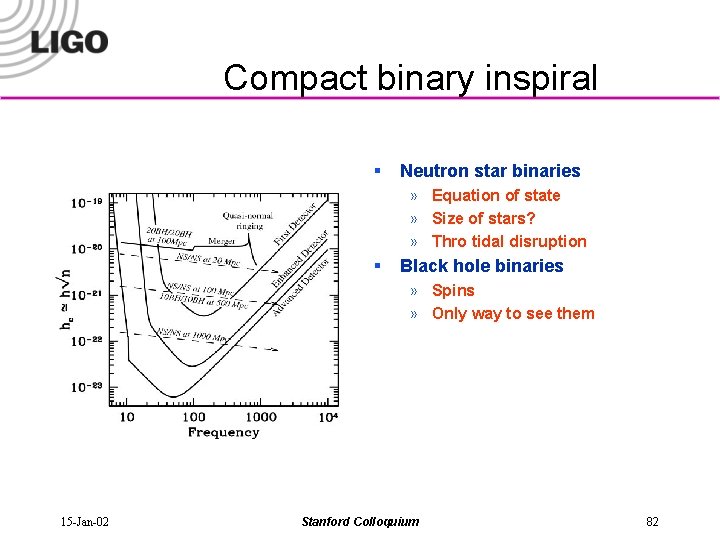
Compact binary inspiral § Neutron star binaries » Equation of state » Size of stars? » Thro tidal disruption § Black hole binaries » Spins » Only way to see them 15 -Jan-02 Stanford Colloquium 82
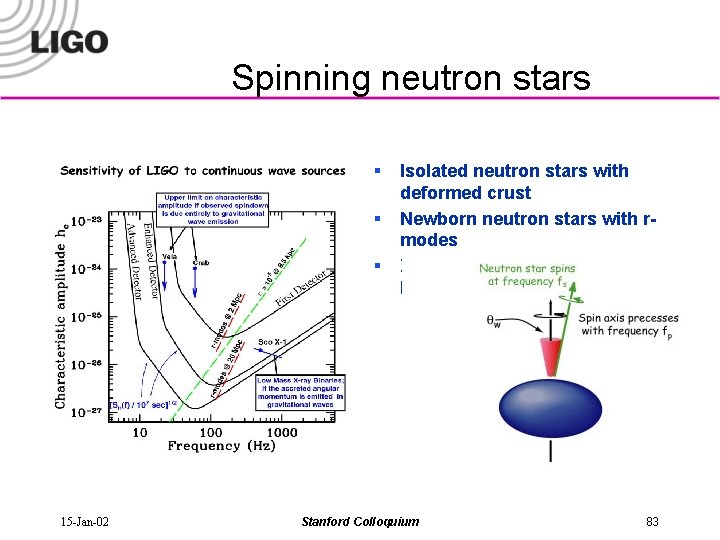
Spinning neutron stars § § § 15 -Jan-02 Isolated neutron stars with deformed crust Newborn neutron stars with rmodes X-ray binaries may be limited by gravitational waves Stanford Colloquium 83
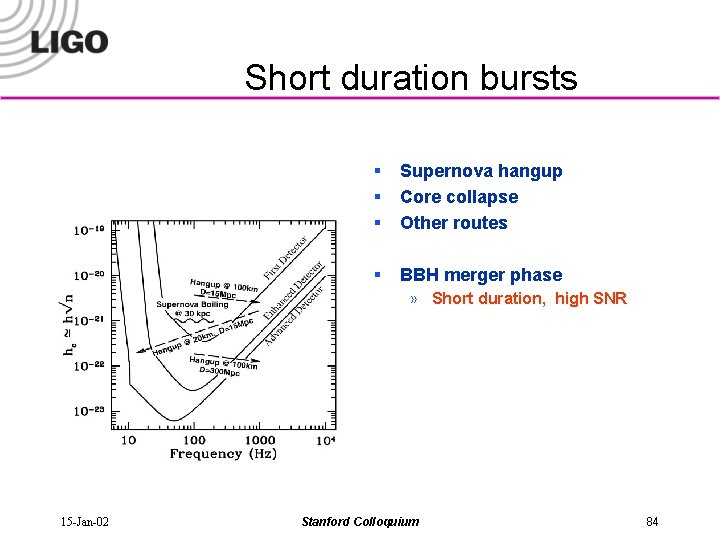
Short duration bursts § § § Supernova hangup Core collapse Other routes § BBH merger phase » Short duration, high SNR 15 -Jan-02 Stanford Colloquium 84
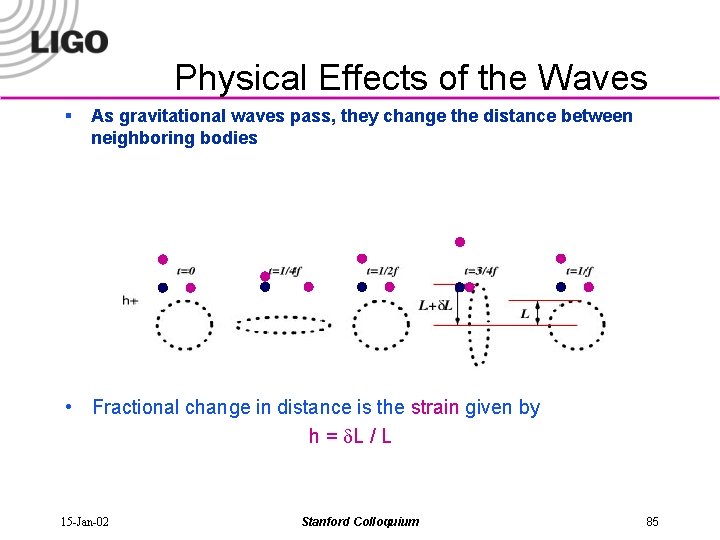
Physical Effects of the Waves § As gravitational waves pass, they change the distance between neighboring bodies • Fractional change in distance is the strain given by h = d. L / L 15 -Jan-02 Stanford Colloquium 85
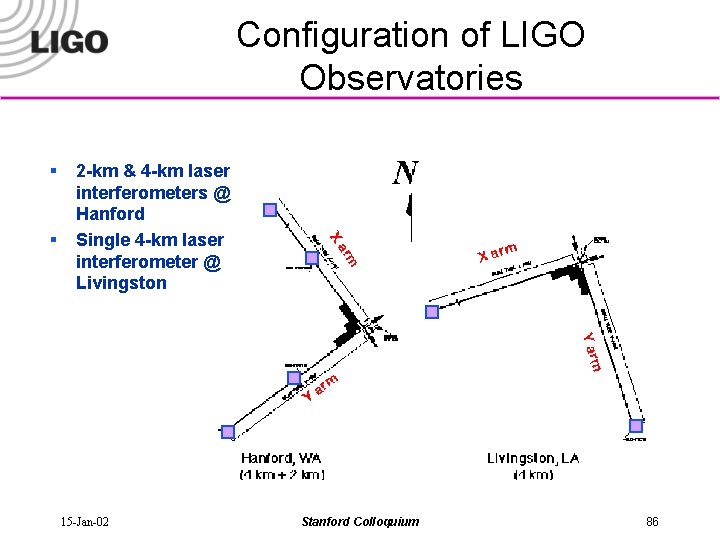
Configuration of LIGO Observatories § § 2 -km & 4 -km laser interferometers @ Hanford Single 4 -km laser interferometer @ Livingston 15 -Jan-02 Stanford Colloquium 86
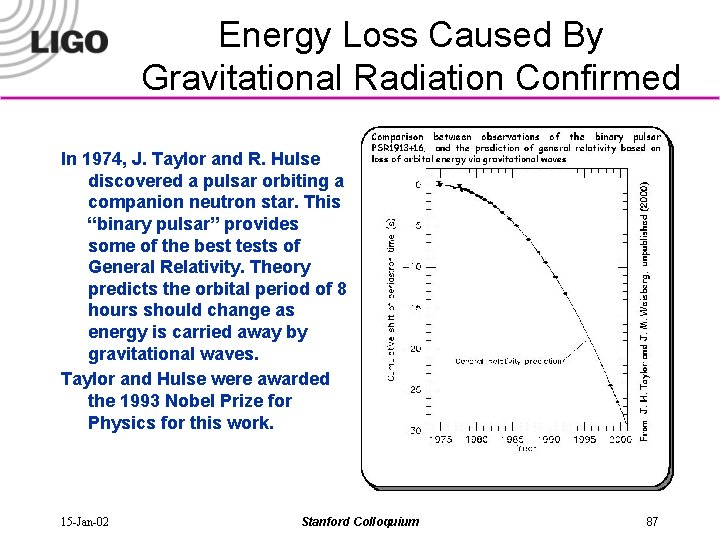
Energy Loss Caused By Gravitational Radiation Confirmed In 1974, J. Taylor and R. Hulse discovered a pulsar orbiting a companion neutron star. This “binary pulsar” provides some of the best tests of General Relativity. Theory predicts the orbital period of 8 hours should change as energy is carried away by gravitational waves. Taylor and Hulse were awarded the 1993 Nobel Prize for Physics for this work. 15 -Jan-02 Stanford Colloquium 87
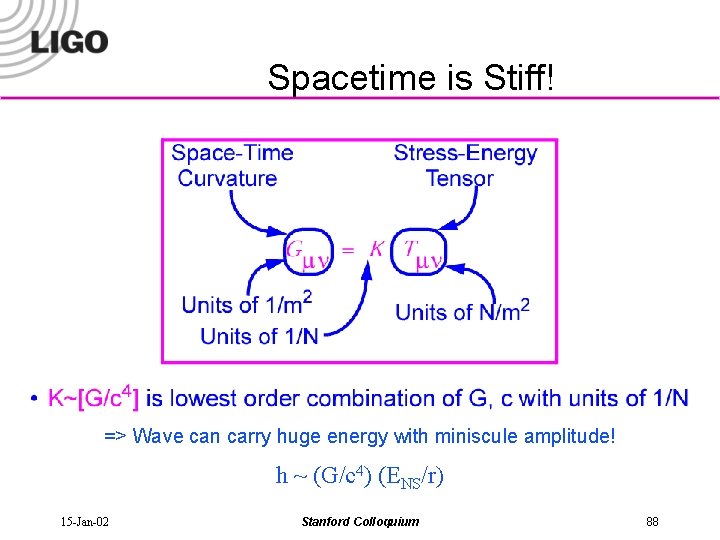
Spacetime is Stiff! => Wave can carry huge energy with miniscule amplitude! h ~ (G/c 4) (ENS/r) 15 -Jan-02 Stanford Colloquium 88
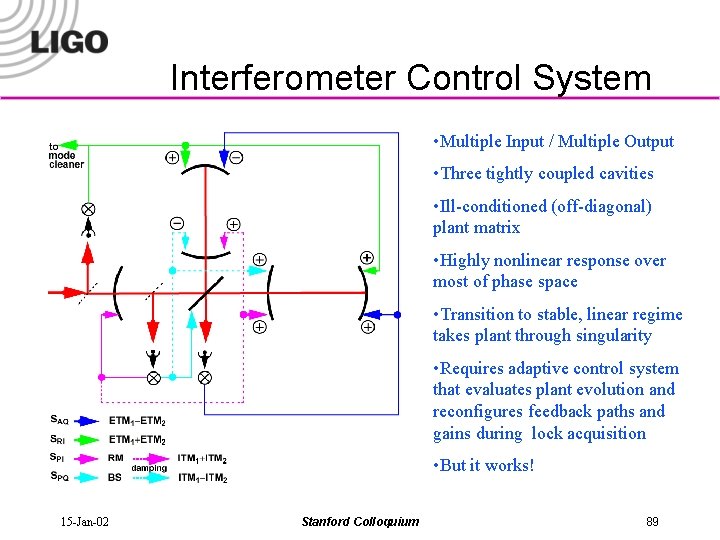
Interferometer Control System • Multiple Input / Multiple Output • Three tightly coupled cavities • Ill-conditioned (off-diagonal) plant matrix • Highly nonlinear response over most of phase space • Transition to stable, linear regime takes plant through singularity • Requires adaptive control system that evaluates plant evolution and reconfigures feedback paths and gains during lock acquisition • But it works! 15 -Jan-02 Stanford Colloquium 89

Digital Interferometer Sensing & Control System 15 -Jan-02 Stanford Colloquium 90
When Will It Work? Status of LIGO in Spring 2001 § Initial detectors are being commissioned, with first Science Runs commencing in 2002. § Advanced detector R&D underway, planning for upgrade near end of 2006 » » Active seismic isolation systems Single-crystal sapphire mirrors 1 megawatt of laser power circulating in arms Tunable frequency response at the quantum limit § Quantum Non Demolition / Cryogenic detectors in future? § Laser Interferometer Space Antenna (LISA) in planning and design stage (2015 launch? ) 15 -Jan-02 Stanford Colloquium 91
- Slides: 91