
Lightweight Active RouterQueue Management for Multimedia Networking M
- Slides: 35
Lightweight Active Router-Queue Management for Multimedia Networking M. Parris, K. Jeffay, and F. D. Smith Department of Computer Science University of North Carolina Multimedia Computing and Networking (MMCN) January 1999
Outline • Problem – Supporting multimedia on the Internet • Context – Drop Tail – RED – FRED • Approach – CBT • Evaluation • Conclusion
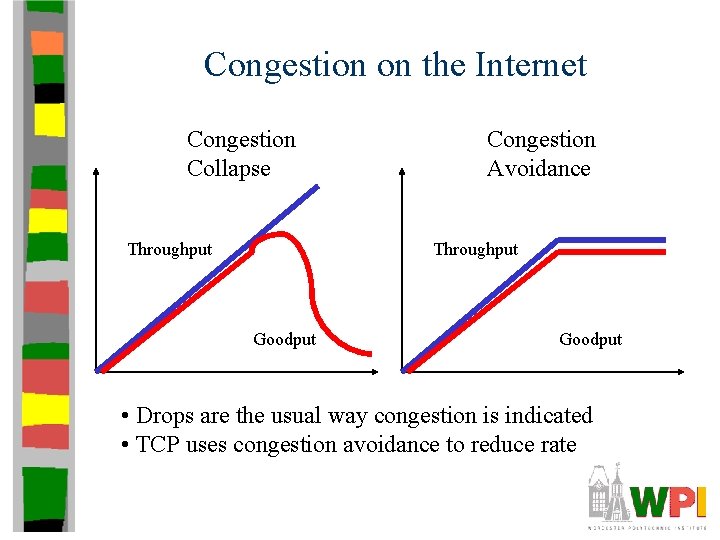
Congestion on the Internet Congestion Collapse Throughput Congestion Avoidance Throughput Goodput • Drops are the usual way congestion is indicated • TCP uses congestion avoidance to reduce rate
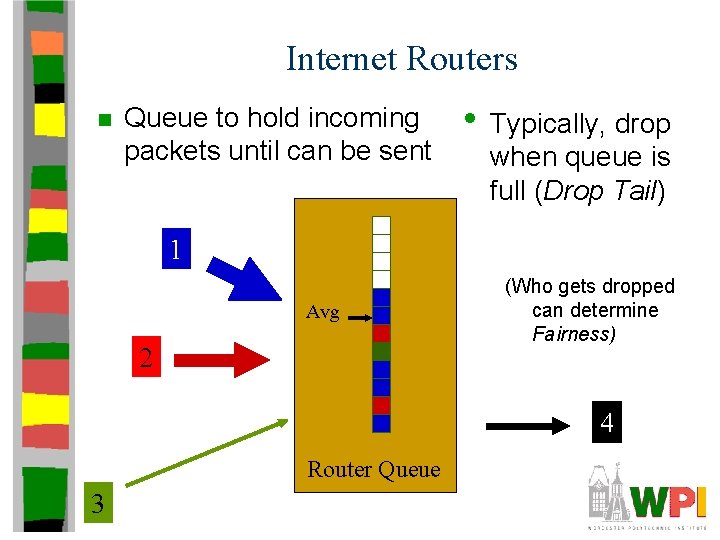
Internet Routers n Queue to hold incoming packets until can be sent • Typically, drop when queue is full (Drop Tail) 1 Avg 2 (Who gets dropped can determine Fairness) 4 Router Queue 3
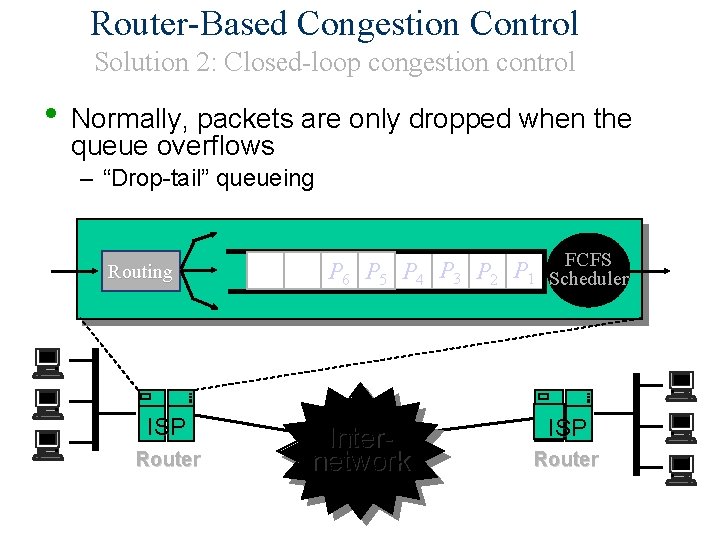
Router-Based Congestion Control Solution 2: Closed-loop congestion control • Normally, packets are only dropped when the queue overflows – “Drop-tail” queueing Routing ISP Router FCFS P 6 P 5 P 4 P 3 P 2 P 1 Scheduler Internetwork ISP Router
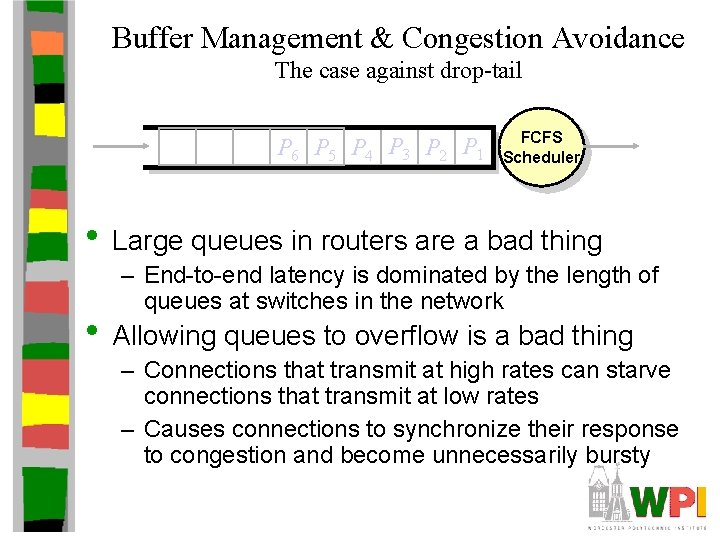
Buffer Management & Congestion Avoidance The case against drop-tail P 6 P 5 P 4 P 3 P 2 P 1 FCFS Scheduler • Large queues in routers are a bad thing – End-to-end latency is dominated by the length of queues at switches in the network • Allowing queues to overflow is a bad thing – Connections that transmit at high rates can starve connections that transmit at low rates – Causes connections to synchronize their response to congestion and become unnecessarily bursty
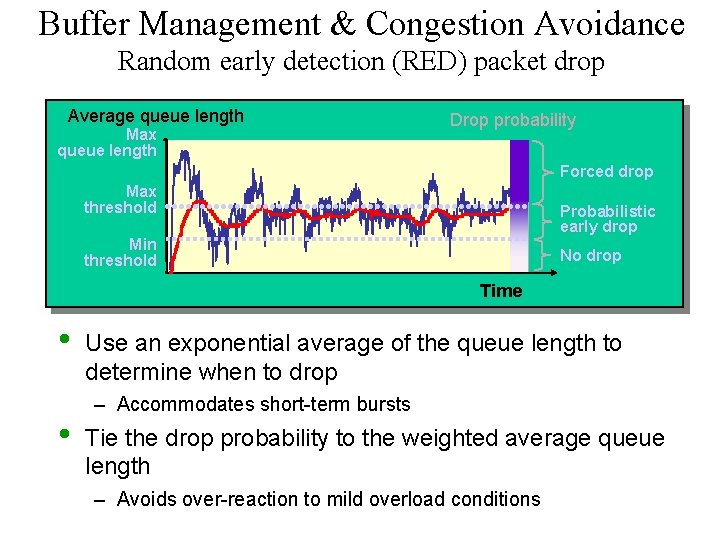
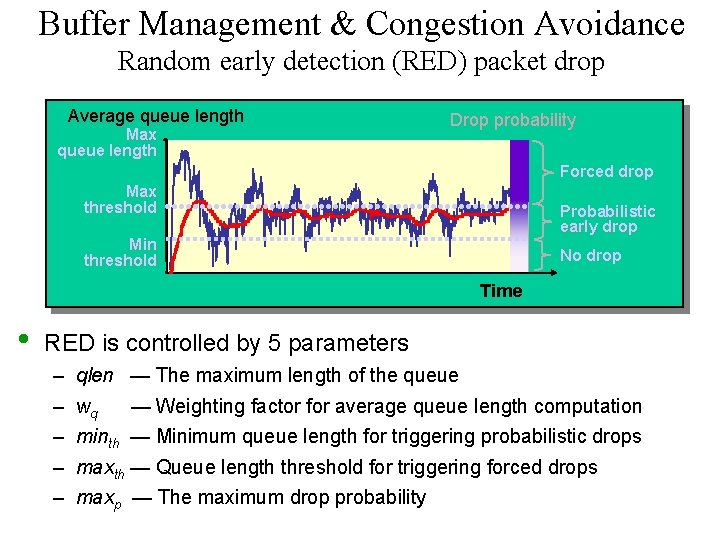
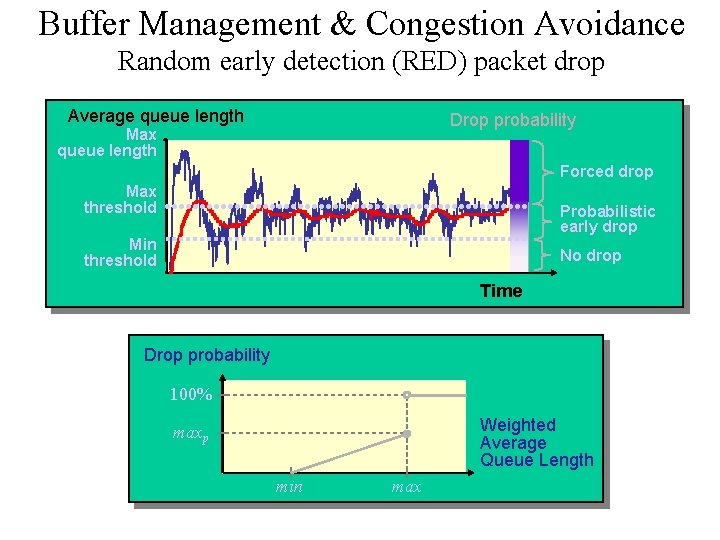
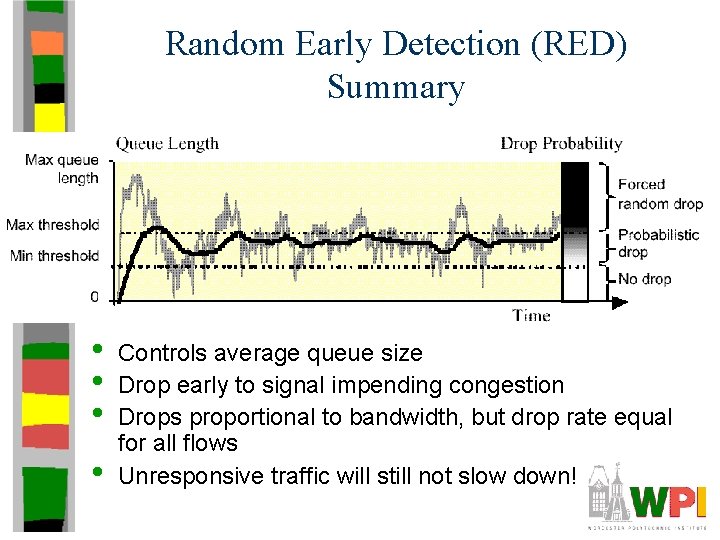
Buffer Management & Congestion Avoidance Random early detection (RED) packet drop Average queue length Max queue length Drop probability Forced drop Max threshold Probabilistic early drop Min threshold No drop Time • • Use an exponential average of the queue length to determine when to drop – Accommodates short-term bursts Tie the drop probability to the weighted average queue length – Avoids over-reaction to mild overload conditions
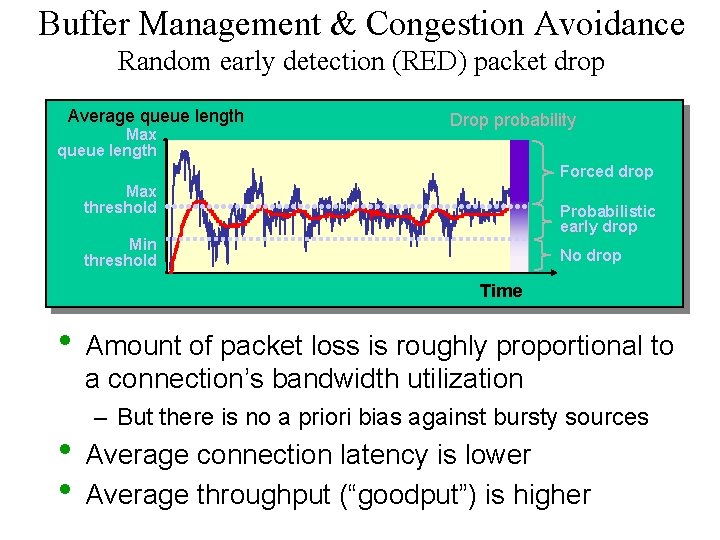
Buffer Management & Congestion Avoidance Random early detection (RED) packet drop Average queue length Max queue length Drop probability Forced drop Max threshold Probabilistic early drop Min threshold No drop Time • Amount of packet loss is roughly proportional to a connection’s bandwidth utilization – But there is no a priori bias against bursty sources • Average connection latency is lower • Average throughput (“goodput”) is higher
Buffer Management & Congestion Avoidance Random early detection (RED) packet drop Average queue length Max queue length Drop probability Forced drop Max threshold Probabilistic early drop Min threshold No drop Time • RED is controlled by 5 parameters – – – qlen — The maximum length of the queue wq — Weighting factor for average queue length computation minth — Minimum queue length for triggering probabilistic drops maxth — Queue length threshold for triggering forced drops maxp — The maximum drop probability
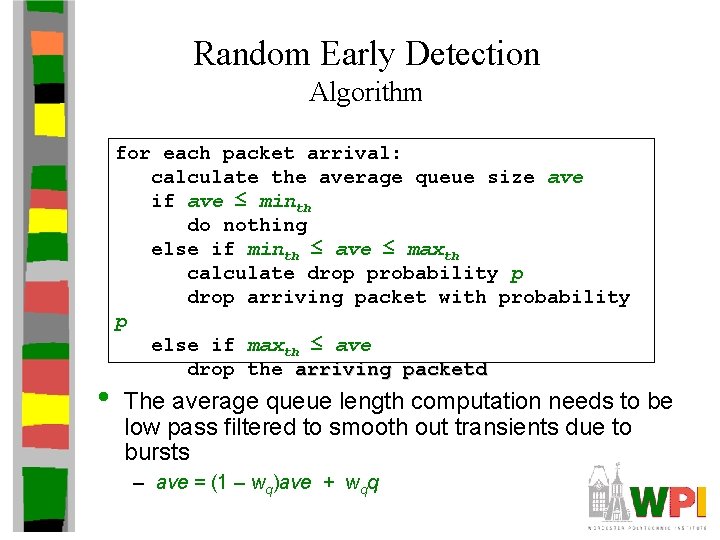
Random Early Detection Algorithm • for each packet arrival: calculate the average queue size ave if ave ≤ minth do nothing else if minth ≤ ave ≤ maxth calculate drop probability p drop arriving packet with probability p else if maxth ≤ ave drop the arriving packetd The average queue length computation needs to be low pass filtered to smooth out transients due to bursts – ave = (1 – wq)ave + wqq
Buffer Management & Congestion Avoidance Random early detection (RED) packet drop Average queue length Drop probability Max queue length Forced drop Max threshold Probabilistic early drop Min threshold No drop Time Drop probability 100% Weighted Average Queue Length maxp min max
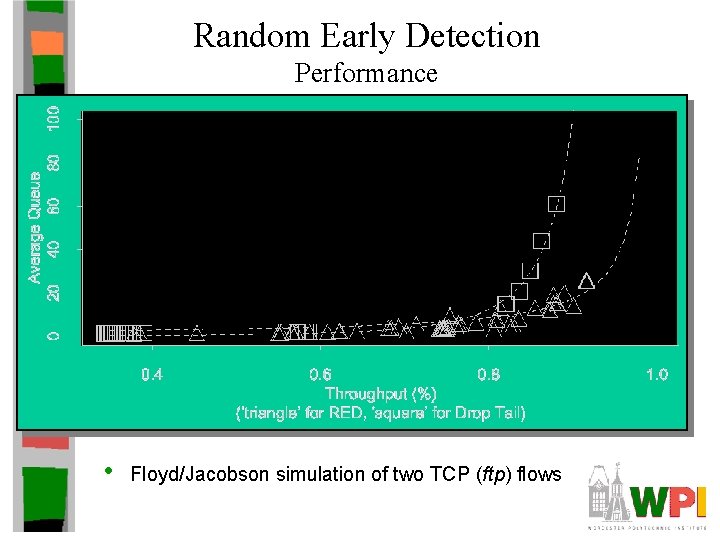
Random Early Detection Performance • Floyd/Jacobson simulation of two TCP (ftp) flows
Random Early Detection (RED) Summary • • Controls average queue size Drop early to signal impending congestion Drops proportional to bandwidth, but drop rate equal for all flows Unresponsive traffic will still not slow down!
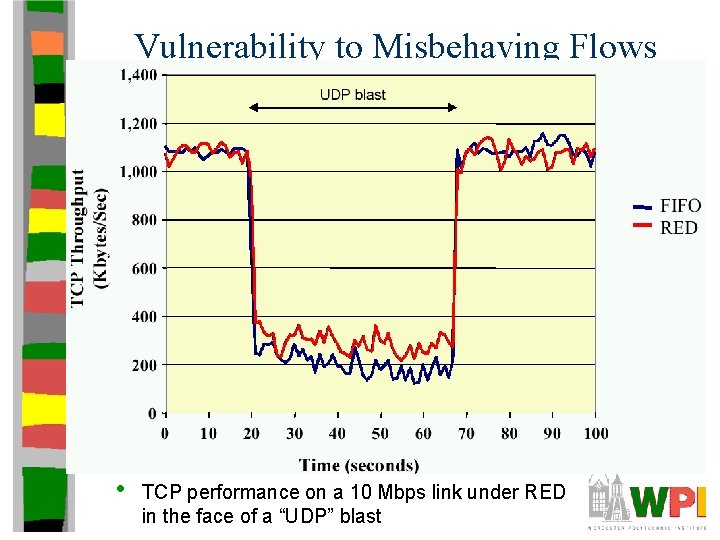
Vulnerability to Misbehaving Flows • TCP performance on a 10 Mbps link under RED in the face of a “UDP” blast
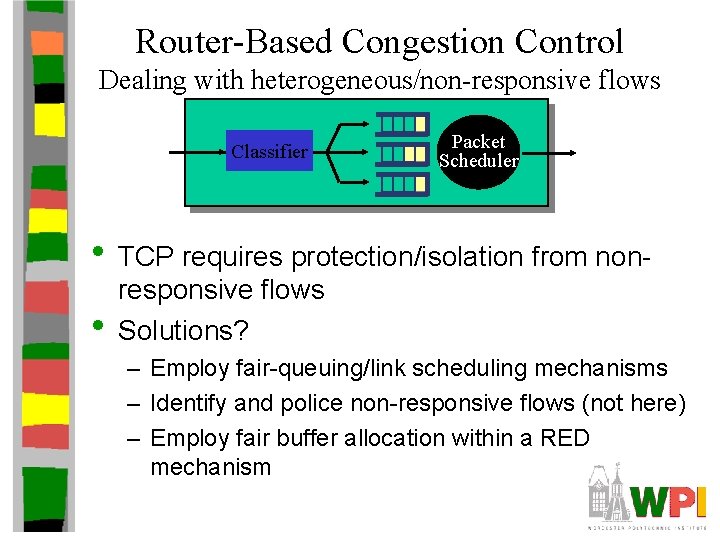
Router-Based Congestion Control Dealing with heterogeneous/non-responsive flows Classifier Packet Scheduler • TCP requires protection/isolation from non • responsive flows Solutions? – Employ fair-queuing/link scheduling mechanisms – Identify and police non-responsive flows (not here) – Employ fair buffer allocation within a RED mechanism
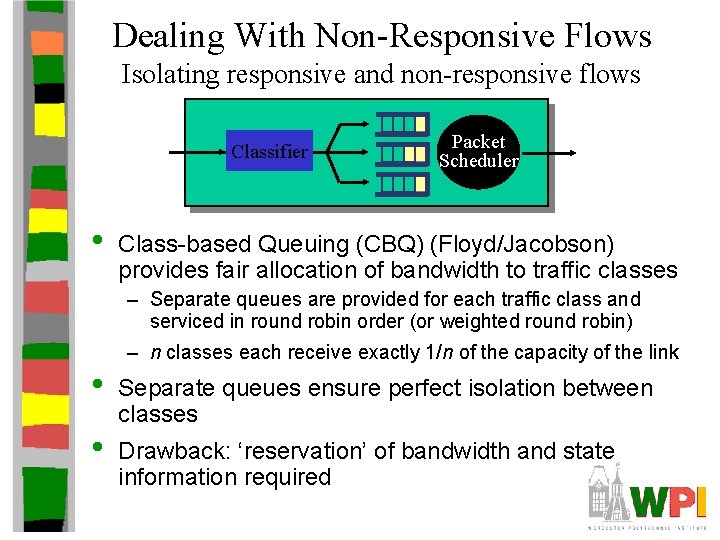
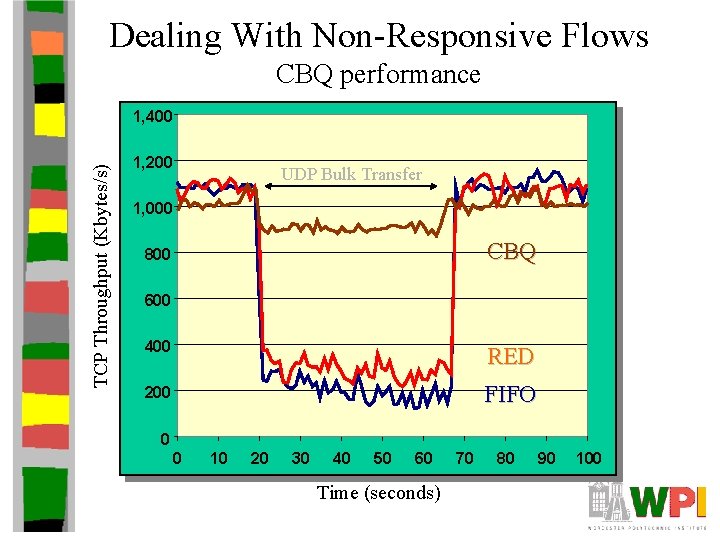
Dealing With Non-Responsive Flows Isolating responsive and non-responsive flows Classifier • Packet Scheduler Class-based Queuing (CBQ) (Floyd/Jacobson) provides fair allocation of bandwidth to traffic classes – Separate queues are provided for each traffic class and serviced in round robin order (or weighted round robin) • • – n classes each receive exactly 1/n of the capacity of the link Separate queues ensure perfect isolation between classes Drawback: ‘reservation’ of bandwidth and state information required
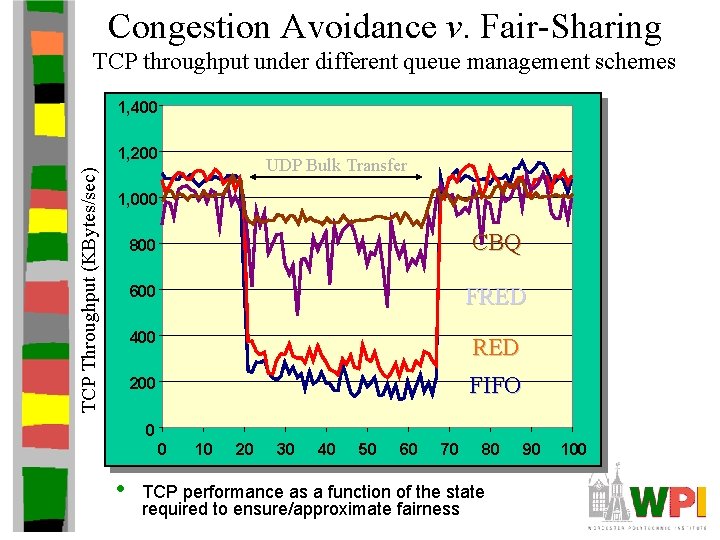
Dealing With Non-Responsive Flows CBQ performance TCP Throughput (Kbytes/s) 1, 400 1, 200 UDP Bulk Transfer 1, 000 CBQ 800 600 400 RED 200 FIFO 0 0 10 20 30 40 50 60 Time (seconds) 70 80 90 100
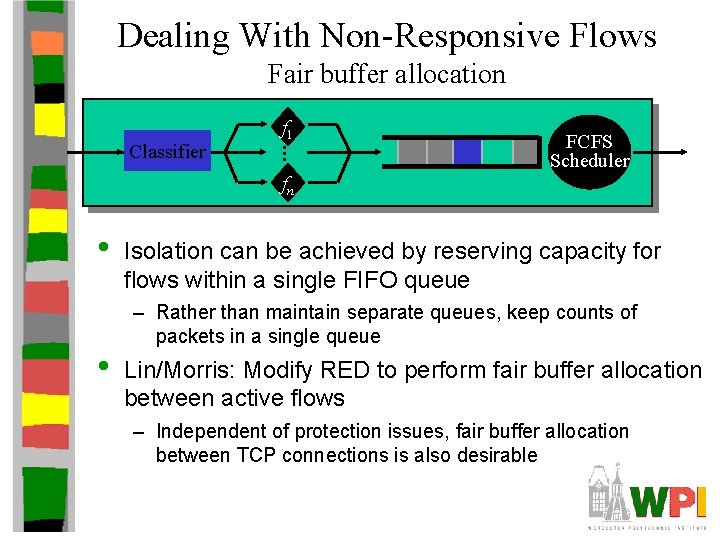
Dealing With Non-Responsive Flows Fair buffer allocation. . . Classifier f 1 FCFS Scheduler fn • • Isolation can be achieved by reserving capacity for flows within a single FIFO queue – Rather than maintain separate queues, keep counts of packets in a single queue Lin/Morris: Modify RED to perform fair buffer allocation between active flows – Independent of protection issues, fair buffer allocation between TCP connections is also desirable
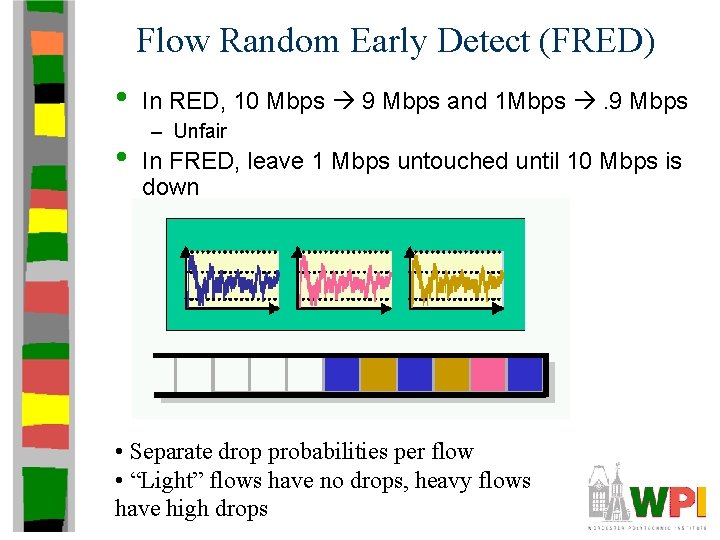
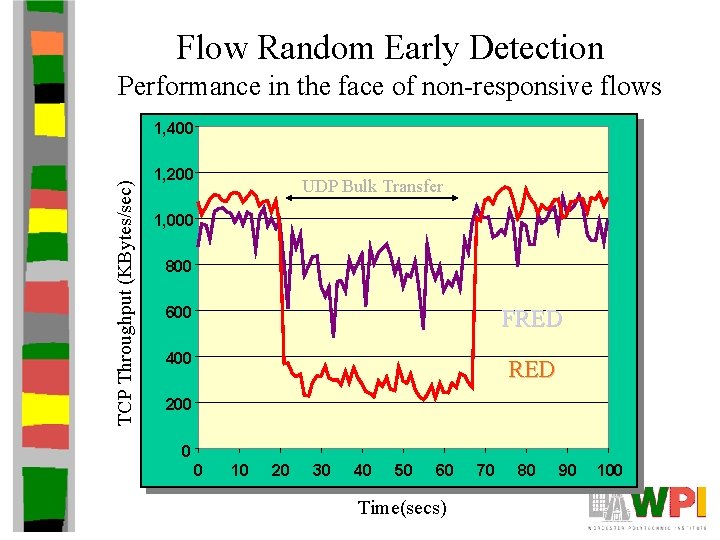
Flow Random Early Detect (FRED) • • In RED, 10 Mbps 9 Mbps and 1 Mbps . 9 Mbps – Unfair In FRED, leave 1 Mbps untouched until 10 Mbps is down • Separate drop probabilities per flow • “Light” flows have no drops, heavy flows have high drops
Flow Random Early Detection Performance in the face of non-responsive flows TCP Throughput (KBytes/sec) 1, 400 1, 200 UDP Bulk Transfer 1, 000 800 600 FRED 400 RED 200 0 0 10 20 30 40 50 60 Time(secs) 70 80 90 100
Congestion Avoidance v. Fair-Sharing TCP throughput under different queue management schemes 1, 400 TCP Throughput (KBytes/sec) 1, 200 UDP Bulk Transfer 1, 000 800 CBQ 600 FRED 400 RED 200 FIFO 0 0 • 10 20 30 40 50 60 70 80 TCP performance as a function of the state required to ensure/approximate fairness 90 100
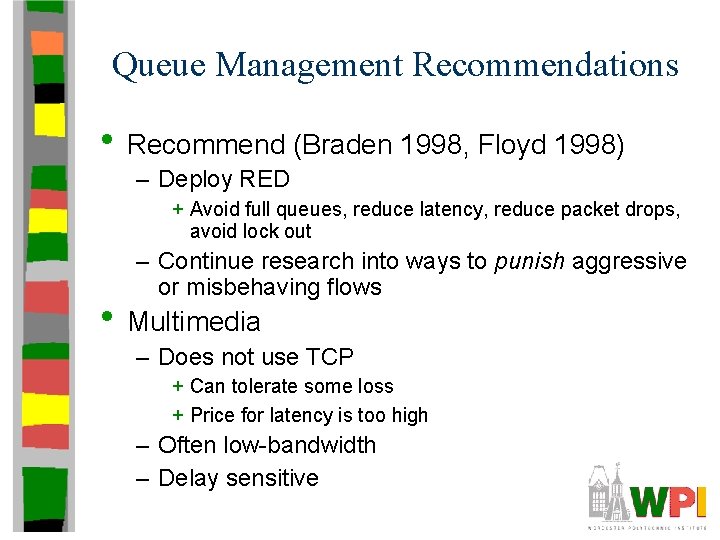
Queue Management Recommendations • Recommend (Braden 1998, Floyd 1998) – Deploy RED + Avoid full queues, reduce latency, reduce packet drops, avoid lock out – Continue research into ways to punish aggressive or misbehaving flows • Multimedia – Does not use TCP + Can tolerate some loss + Price for latency is too high – Often low-bandwidth – Delay sensitive
Outline • Problem – Supporting multimedia on the Internet • Context – Drop Tail – RED – FRED • Approach – CBT • Evaluation • Conclusion
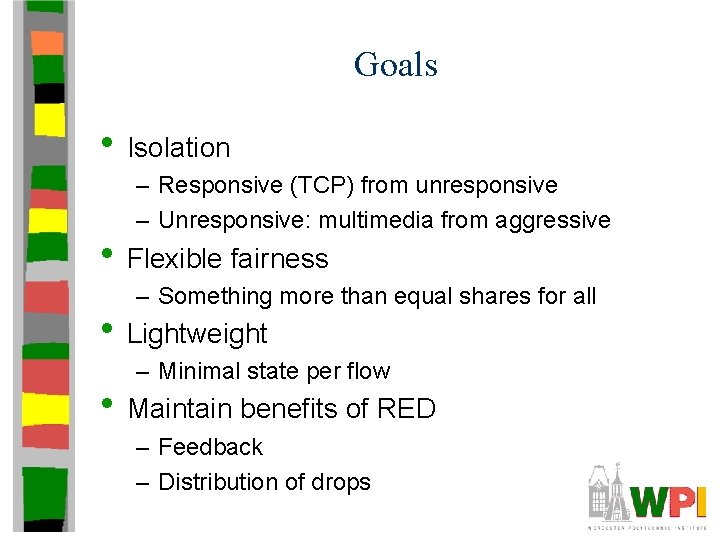
Goals • Isolation – Responsive (TCP) from unresponsive – Unresponsive: multimedia from aggressive • Flexible fairness – Something more than equal shares for all • Lightweight – Minimal state per flow • Maintain benefits of RED – Feedback – Distribution of drops
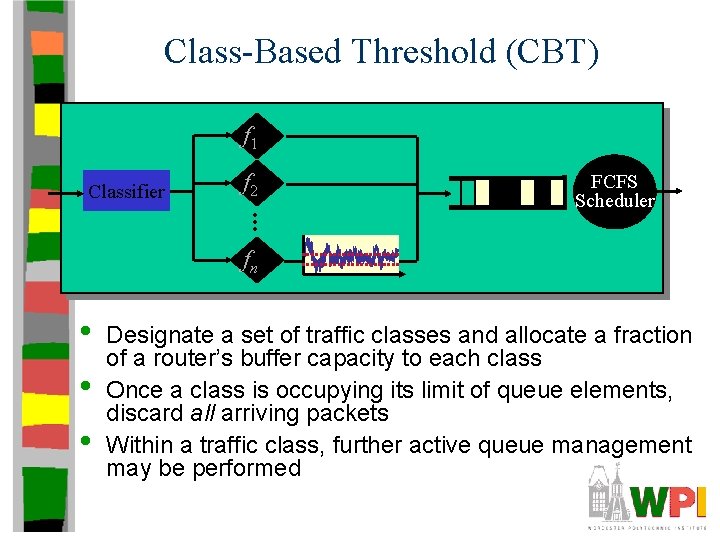
Class-Based Threshold (CBT) f 1 ≤ Classifier f 2 ≤ FCFS Scheduler . . . fn ≤ • • • Designate a set of traffic classes and allocate a fraction of a router’s buffer capacity to each class Once a class is occupying its limit of queue elements, discard all arriving packets Within a traffic class, further active queue management may be performed
Class-Based Threshold (CBT) • Isolation – Packets are classified into 1 of 3 classes – Statistics are kept for each class • Flexible fairness – Configurable thresholds determine the ratios between classes during periods of congestion • Lightweight – State per class and not per flow – Still one outbound queue • Maintain benefits of RED – Continue with RED policies for TCP
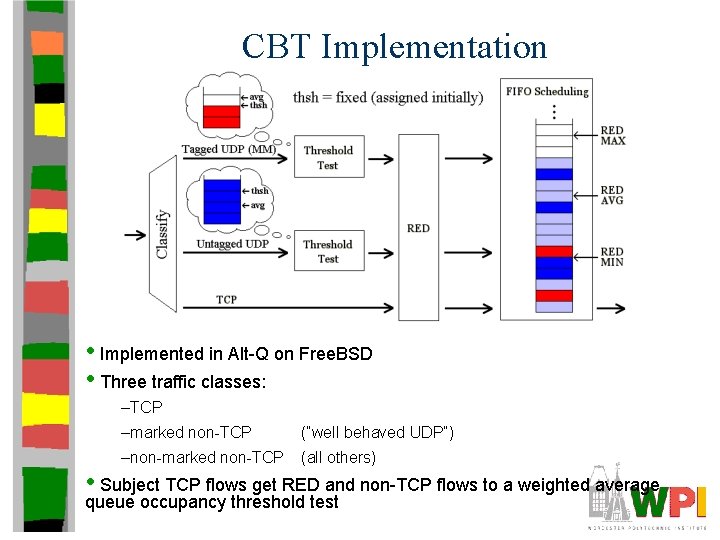
CBT Implementation • Implemented in Alt-Q on Free. BSD • Three traffic classes: –TCP –marked non-TCP (“well behaved UDP”) –non-marked non-TCP (all others) • Subject TCP flows get RED and non-TCP flows to a weighted average queue occupancy threshold test
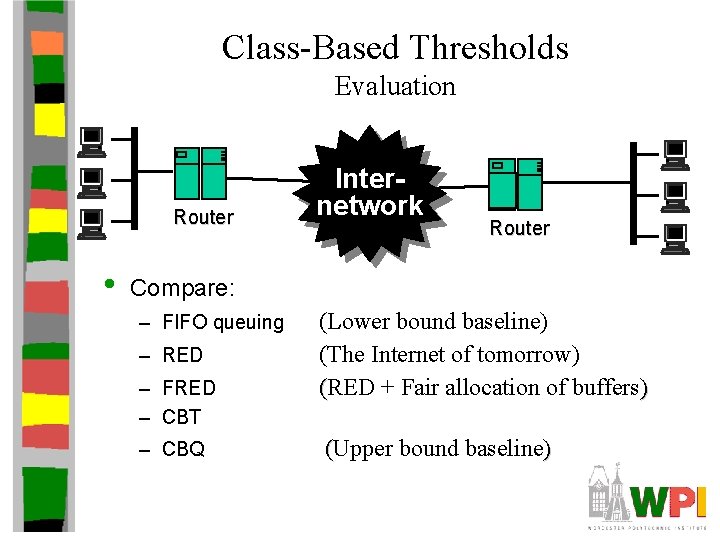
Class-Based Thresholds Evaluation Router • Internetwork Router Compare: – FIFO queuing – RED – FRED – CBT – CBQ (Lower bound baseline) (The Internet of tomorrow) (RED + Fair allocation of buffers) (Upper bound baseline)
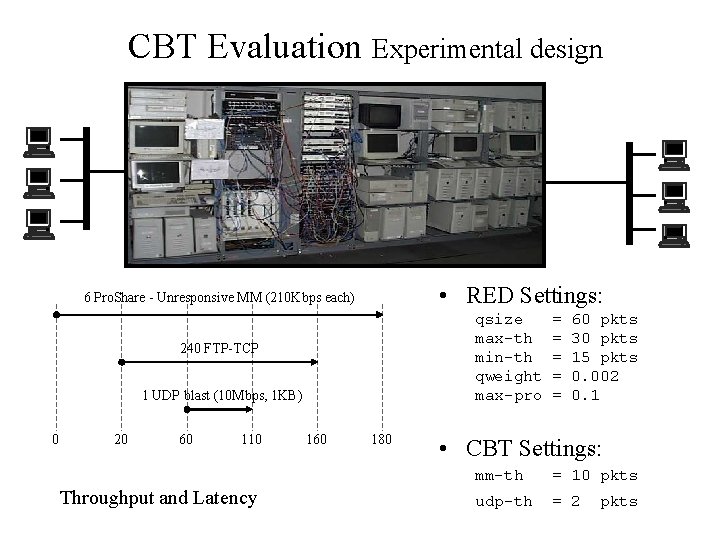
CBT Evaluation Experimental design Internetwork Router • RED Settings: 6 Pro. Share - Unresponsive MM (210 Kbps each) qsize max-th min-th qweight max-pro 240 FTP-TCP 1 UDP blast (10 Mbps, 1 KB) 0 20 60 110 Throughput and Latency Router 160 180 = = = 60 pkts 30 pkts 15 pkts 0. 002 0. 1 • CBT Settings: mm-th = 10 pkts udp-th = 2 pkts
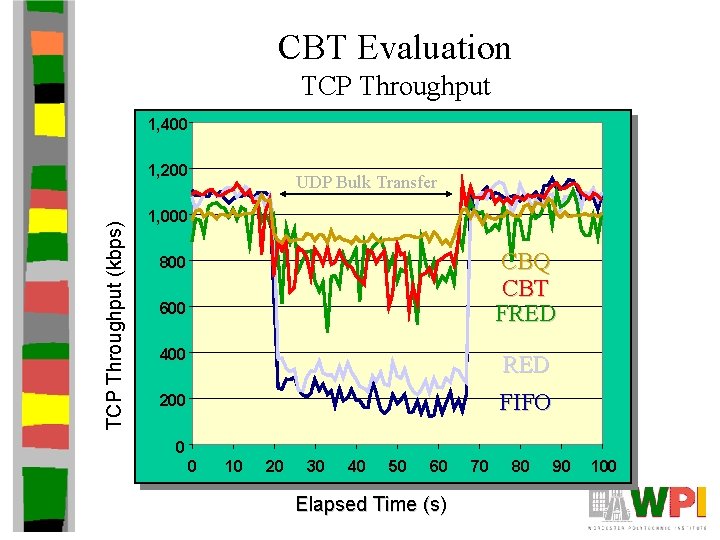
CBT Evaluation TCP Throughput 1, 400 TCP Throughput (kbps) 1, 200 UDP Bulk Transfer 1, 000 CBQ CBT FRED 800 600 400 RED 200 FIFO 0 0 10 20 30 40 50 60 Elapsed Time (s) 70 80 90 100
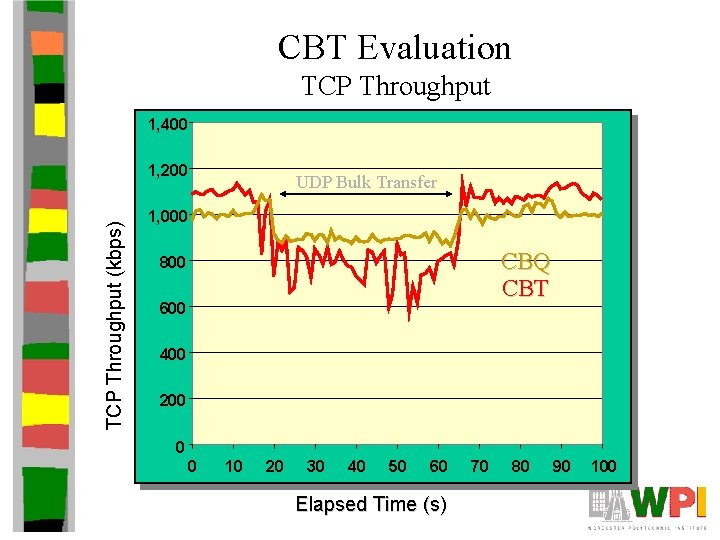
CBT Evaluation TCP Throughput 1, 400 TCP Throughput (kbps) 1, 200 UDP Bulk Transfer 1, 000 CBQ CBT 800 600 400 200 0 0 10 20 30 40 50 60 Elapsed Time (s) 70 80 90 100
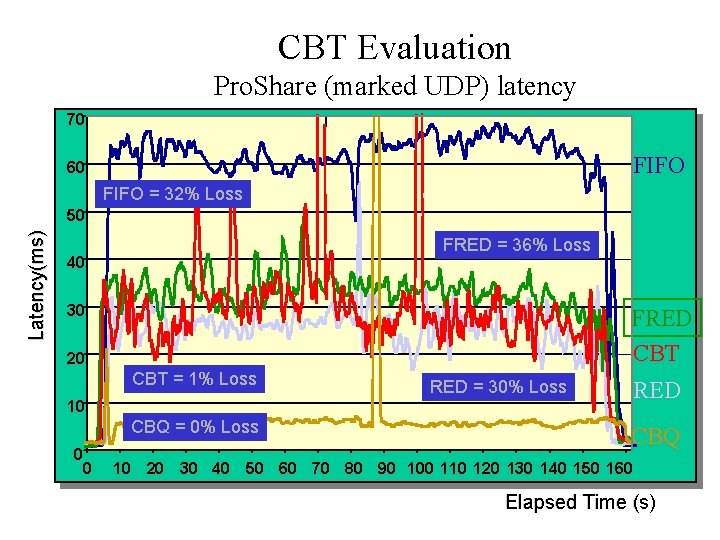
CBT Evaluation Pro. Share (marked UDP) latency 70 FIFO 60 FIFO = 32% Loss Latency(ms) 50 FRED = 36% Loss 40 30 FRED CBT 20 CBT = 1% Loss 10 CBQ = 0% Loss 0 0 RED = 30% Loss RED CBQ 10 20 30 40 50 60 70 80 90 100 110 120 130 140 150 160 Elapsed Time (s)
Conclusion • RED/FIFO scheduling not sufficient – Aggressive unresponsive flows cause trouble – Low bandwidth unresponsive (Vo. IP) punished • CBT provides – – Benefits of RED for TCP only traffic Isolation of TCP vs. Unresponsive Isolation of Aggressive vs. Low Bandwidth Lightweight overhead
Future Work • How to pick thresholds? – Implies reservation – Dynamic adjustments of thresholds (D-CBT) • Additional queue management for classes – Classes use “Drop Tail” now • Extension to other classes – Voice – Video
Evaluation of Science? • Category of Paper • Science Evaluation (1 -10)? • Space devoted to Experiments?