
Lightwave System Modeling at the Lightwave Communication Systems



- Slides: 18
Lightwave System Modeling at the Lightwave Communication Systems Laboratory Information and Telecommunications Technology Center University of Kansas
Why Numerical Simulation l Dispersion and fiber nonlinearities make analytical approaches nearly impossible l Most effects can be included l More cost-effective than experiments l They are very useful tools for system design
Simulations Capabilities l Dispersion and nonlinear effects in optical fiber links l l Evaluate the performance of TDM/WDM systems Compare different kinds of fibers l Simulate different waveform transmissions l Explore new system configurations
What effects are Included in Our Simulations ? l l Fiber loss and dispersion Fiber nonlinear effects: Self-phase modulation (SPM) Cross-phase modulation (XPM) Stimulated Raman Scattering (SRS) Four-wave mixing (FWM) • Polarization mode dispersion (PMD) • Spontaneous amplified emission (ASE)
Modeling Optical Fiber Links l Modeling Two Parts: Numerical methods and component models Two Dimensions: TDM and WDM Two Models: Linear model and nonlinear model l Model architecture Links (Point to Point) Fibers (SMF, DSF, DCF, etc. ) Spans (EDFA Span)
Simulation Results l TDM system with two fiber types: SMF & DCF l FWM effects in a two-channel WDM system l Interaction between solitons and NRZ signals in WDM systems
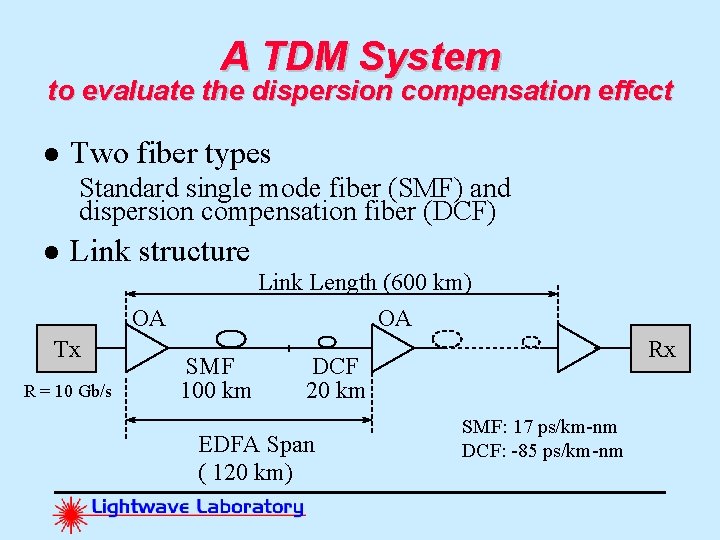
A TDM System to evaluate the dispersion compensation effect l Two fiber types Standard single mode fiber (SMF) and dispersion compensation fiber (DCF) l Link structure Link Length (600 km) OA OA Tx R = 10 Gb/s SMF 100 km Rx DCF 20 km EDFA Span ( 120 km) SMF: 17 ps/km-nm DCF: -85 ps/km-nm
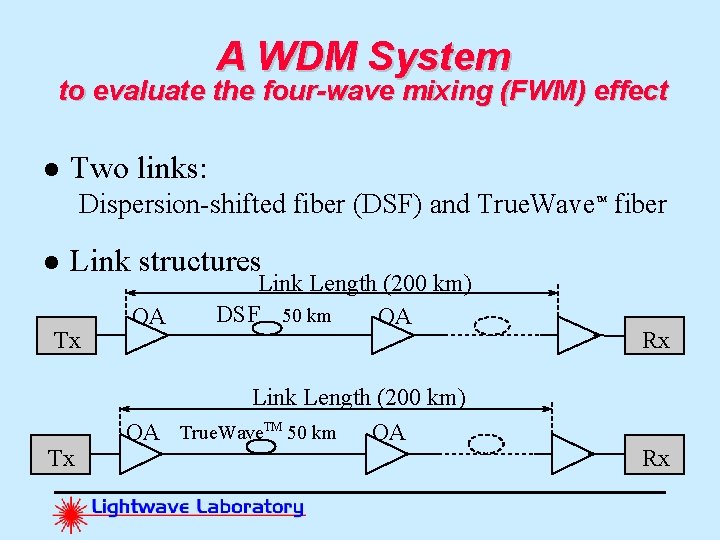
A WDM System to evaluate the four-wave mixing (FWM) effect l Two links: Dispersion-shifted fiber (DSF) and True. Wave fiber TM l Link structures Tx Tx OA Link Length (200 km) DSF 50 km OA Link Length (200 km) OA True. Wave. TM 50 km OA Rx Rx
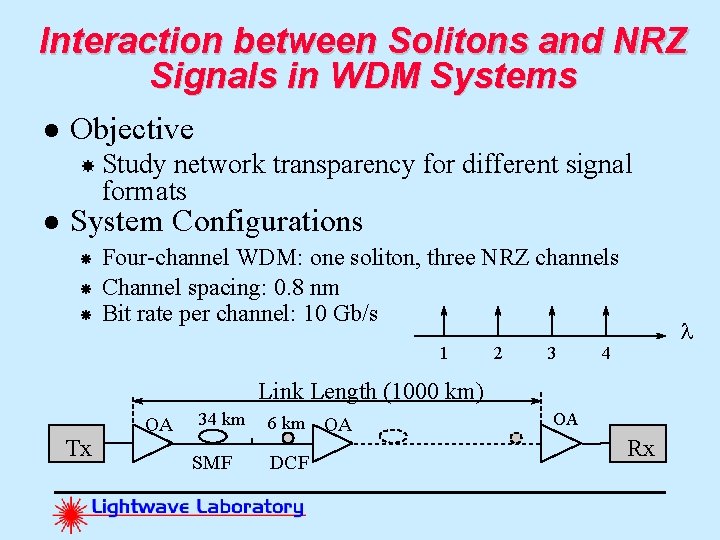
Interaction between Solitons and NRZ Signals in WDM Systems l Objective l Study network transparency for different signal formats System Configurations Four-channel WDM: one soliton, three NRZ channels Channel spacing: 0. 8 nm Bit rate per channel: 10 Gb/s 1 2 3 l 4 Link Length (1000 km) Tx OA 34 km SMF 6 km DCF OA OA Rx
Conclusions • We have developed a powerful, comprehensive modeling tool for lightwave communication systems. • This tool has proven valuable for diagnosing poor performance in systems under development. • We intend to apply this modeling capability to address questions concerning networking evolution issues.