
LightMatter Interaction in Cosmic Dust Thomas Prevenslik QED
- Slides: 16
Light-Matter Interaction in Cosmic Dust Thomas Prevenslik QED Radiations Hong Kong and Berlin 1 Physics of light-matter interaction in Nanostructures (PLMCN 19) – Chengdu, China May 15 -19, 2018
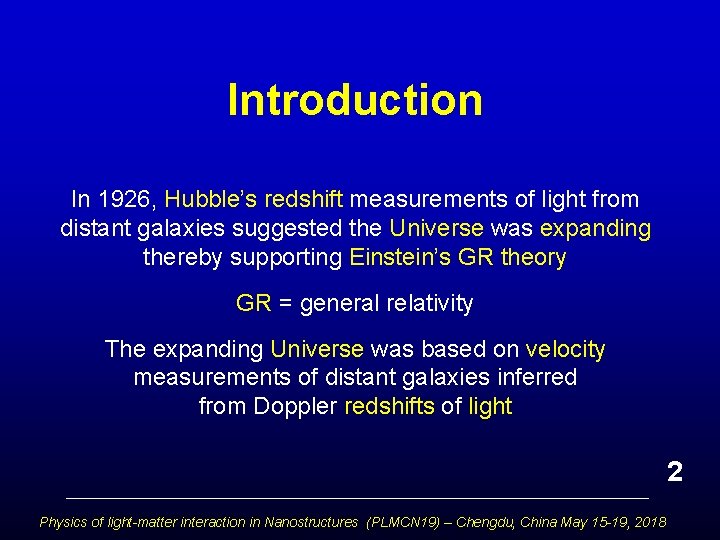
Introduction In 1926, Hubble’s redshift measurements of light from distant galaxies suggested the Universe was expanding thereby supporting Einstein’s GR theory GR = general relativity The expanding Universe was based on velocity measurements of distant galaxies inferred from Doppler redshifts of light 2 Physics of light-matter interaction in Nanostructures (PLMCN 19) – Chengdu, China May 15 -19, 2018
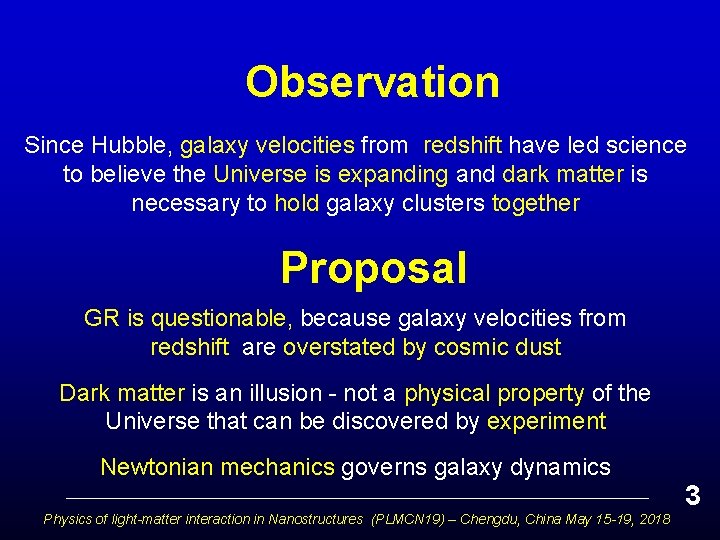
Observation Since Hubble, galaxy velocities from redshift have led science to believe the Universe is expanding and dark matter is necessary to hold galaxy clusters together Proposal GR is questionable, because galaxy velocities from redshift are overstated by cosmic dust Dark matter is an illusion - not a physical property of the Universe that can be discovered by experiment Newtonian mechanics governs galaxy dynamics Physics of light-matter interaction in Nanostructures (PLMCN 19) – Chengdu, China May 15 -19, 2018 3
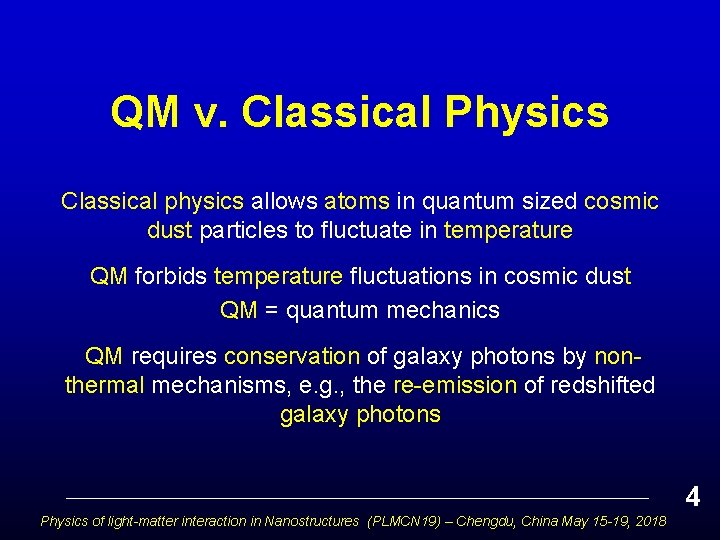
QM v. Classical Physics Classical physics allows atoms in quantum sized cosmic dust particles to fluctuate in temperature QM forbids temperature fluctuations in cosmic dust QM = quantum mechanics QM requires conservation of galaxy photons by nonthermal mechanisms, e. g. , the re-emission of redshifted galaxy photons 4 Physics of light-matter interaction in Nanostructures (PLMCN 19) – Chengdu, China May 15 -19, 2018
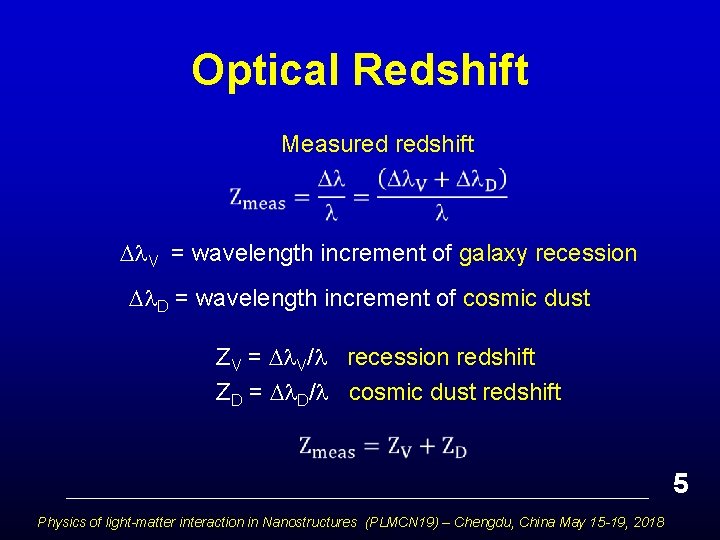
Optical Redshift Measured redshift • V = wavelength increment of galaxy recession D = wavelength increment of cosmic dust ZV = V/ recession redshift ZD = D/ cosmic dust redshift • 5 Physics of light-matter interaction in Nanostructures (PLMCN 19) – Chengdu, China May 15 -19, 2018
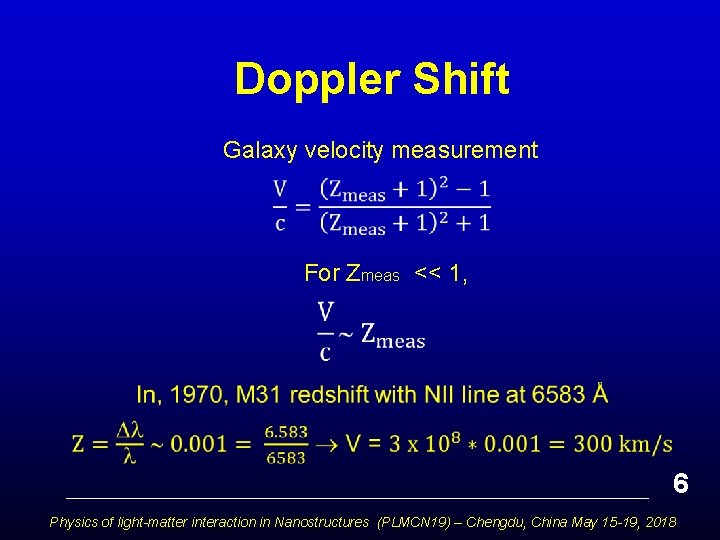
Doppler Shift Galaxy velocity measurement • For Zmeas << 1, • • 6 Physics of light-matter interaction in Nanostructures (PLMCN 19) – Chengdu, China May 15 -19, 2018
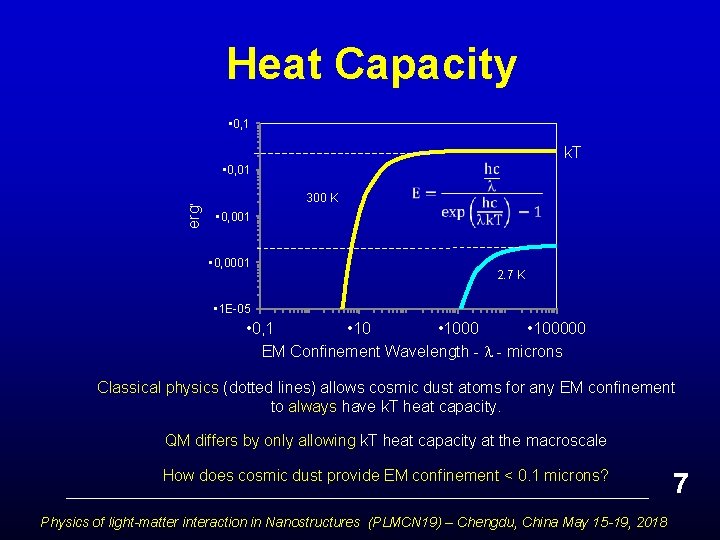
Heat Capacity Planck energy - E - e. V • 0, 1 • 0, 01 300 K k. T • • 0, 001 • 0, 0001 2. 7 K • 1 E-05 • 0, 1 • 100000 EM Confinement Wavelength - - microns Classical physics (dotted lines) allows cosmic dust atoms for any EM confinement to always have k. T heat capacity. QM differs by only allowing k. T heat capacity at the macroscale How does cosmic dust provide EM confinement < 0. 1 microns? Physics of light-matter interaction in Nanostructures (PLMCN 19) – Chengdu, China May 15 -19, 2018 7
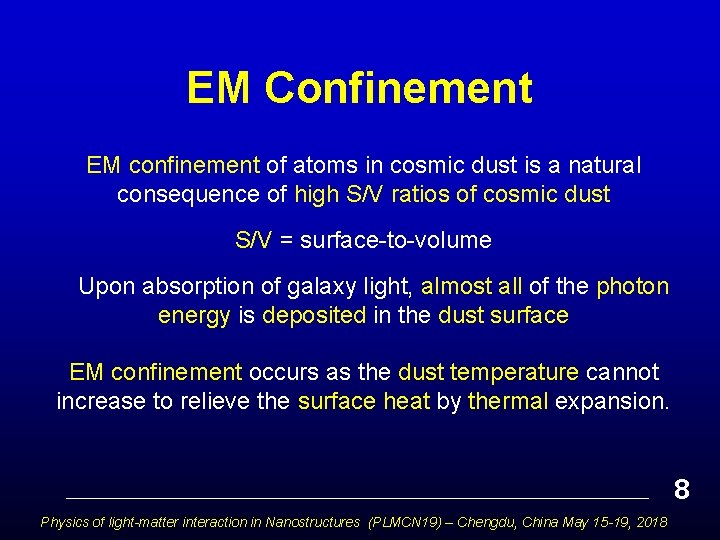
EM Confinement EM confinement of atoms in cosmic dust is a natural consequence of high S/V ratios of cosmic dust S/V = surface-to-volume Upon absorption of galaxy light, almost all of the photon energy is deposited in the dust surface EM confinement occurs as the dust temperature cannot increase to relieve the surface heat by thermal expansion. 8 Physics of light-matter interaction in Nanostructures (PLMCN 19) – Chengdu, China May 15 -19, 2018
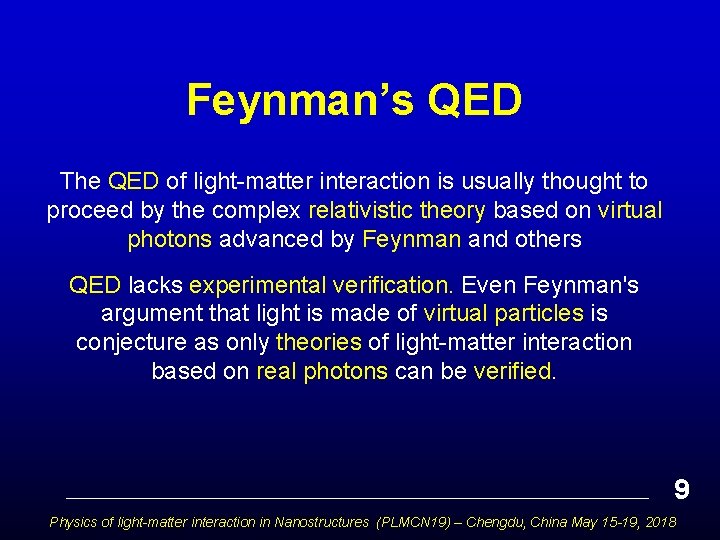
Feynman’s QED The QED of light-matter interaction is usually thought to proceed by the complex relativistic theory based on virtual photons advanced by Feynman and others QED lacks experimental verification. Even Feynman's argument that light is made of virtual particles is conjecture as only theories of light-matter interaction based on real photons can be verified. 9 Physics of light-matter interaction in Nanostructures (PLMCN 19) – Chengdu, China May 15 -19, 2018
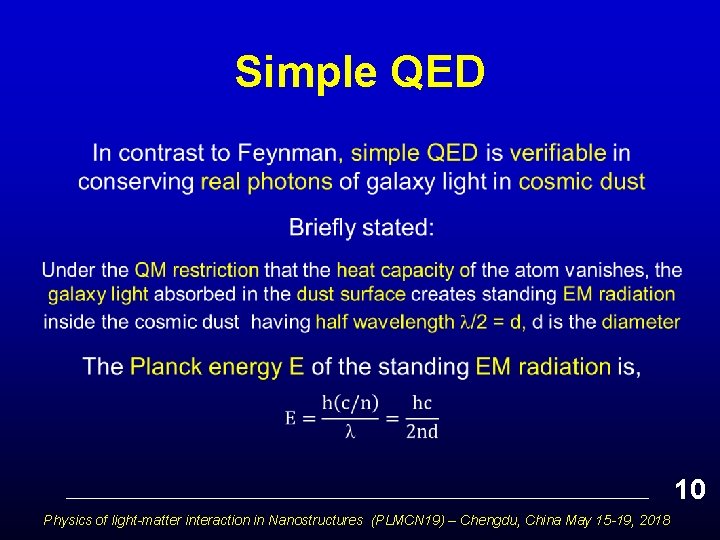
Simple QED • 10 Physics of light-matter interaction in Nanostructures (PLMCN 19) – Chengdu, China May 15 -19, 2018
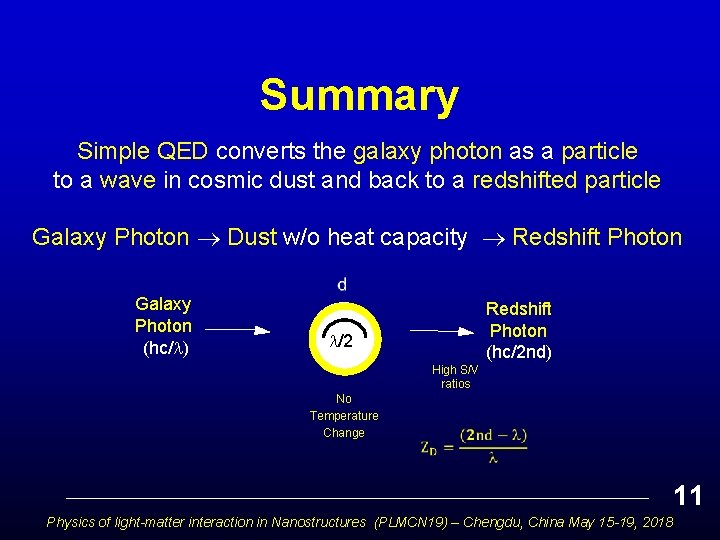
Summary Simple QED converts the galaxy photon as a particle to a wave in cosmic dust and back to a redshifted particle Galaxy Photon Dust w/o heat capacity Redshift Photon Galaxy Photon (hc/ ) Redshift Photon (hc/2 nd) /2 High S/V ratios No Temperature Change • 11 Physics of light-matter interaction in Nanostructures (PLMCN 19) – Chengdu, China May 15 -19, 2018
Discussions Accelerating Universe Expansion Dark Matter 12 Physics of light-matter interaction in Nanostructures (PLMCN 19) – Chengdu, China May 15 -19, 2018
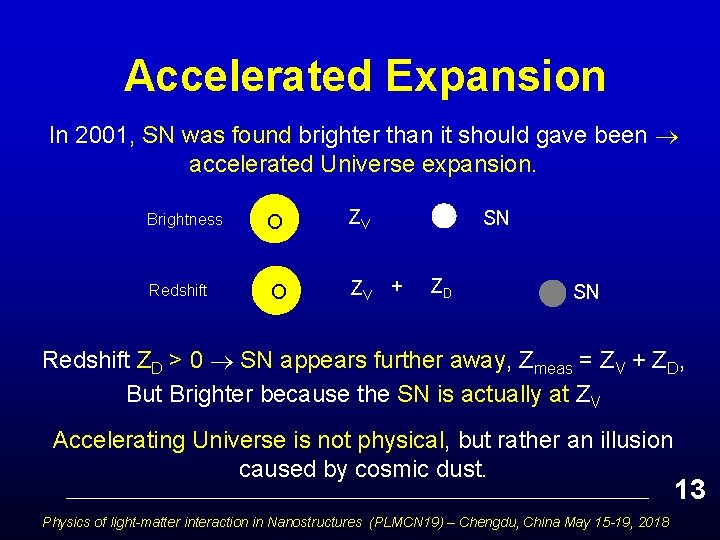
Accelerated Expansion In 2001, SN was found brighter than it should gave been accelerated Universe expansion. Brightness O ZV Redshift O ZV + SN ZD SN Redshift ZD > 0 SN appears further away, Zmeas = ZV + ZD, But Brighter because the SN is actually at ZV Accelerating Universe is not physical, but rather an illusion caused by cosmic dust. Physics of light-matter interaction in Nanostructures (PLMCN 19) – Chengdu, China May 15 -19, 2018 13
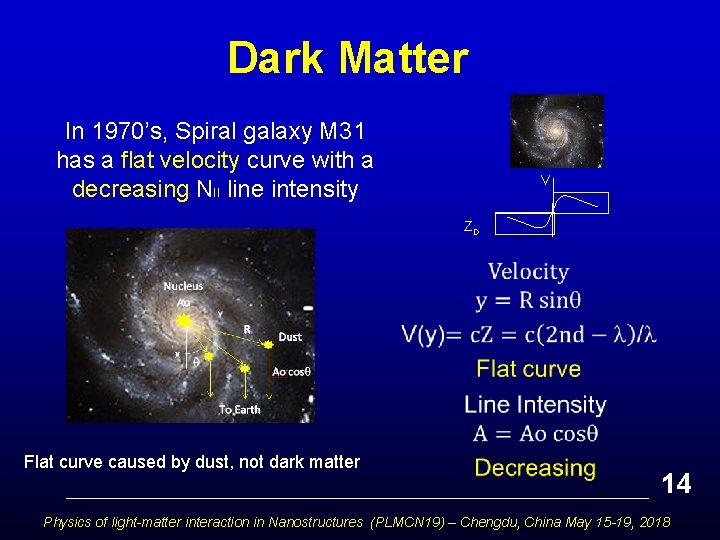
Dark Matter In 1970’s, Spiral galaxy M 31 has a flat velocity curve with a decreasing NII line intensity V ZD • • Flat curve caused by dust, not dark matter 14 Physics of light-matter interaction in Nanostructures (PLMCN 19) – Chengdu, China May 15 -19, 2018
Conclusion By credibly refuting current cosmology for dark matter and Universe expansion, perhaps cosmology may return to Einstein’s once upon a time static and dynamic Universe. 15 Physics of light-matter interaction in Nanostructures (PLMCN 19) – Chengdu, China May 15 -19, 2018
Questions & Papers Email: nanoqed@gmail. com http: //www. nanoqed. org 16 Physics of light-matter interaction in Nanostructures (PLMCN 19) – Chengdu, China May 15 -19, 2018