
Lighting Designing with Daylight q Primarily a study
- Slides: 8
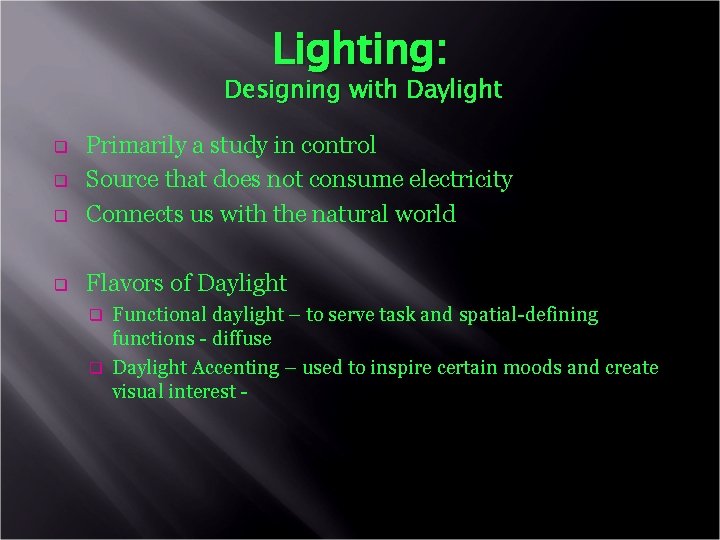
Lighting: Designing with Daylight q Primarily a study in control Source that does not consume electricity Connects us with the natural world q Flavors of Daylight q q Functional daylight – to serve task and spatial-defining functions - diffuse q Daylight Accenting – used to inspire certain moods and create visual interest q
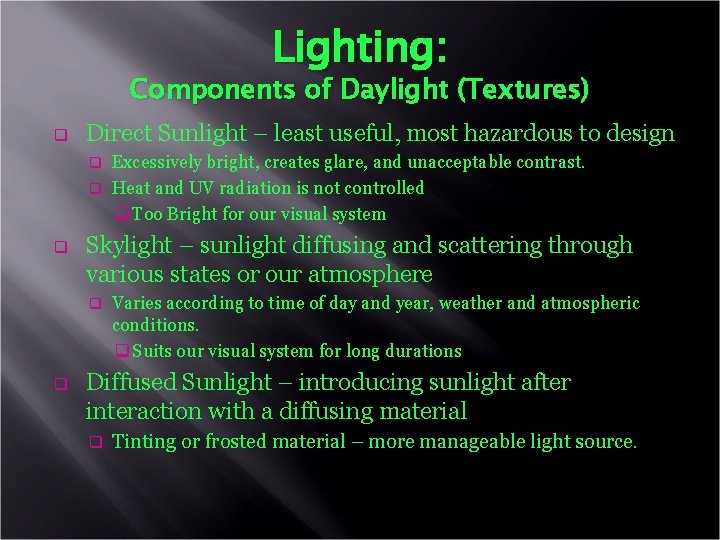
Lighting: Components of Daylight (Textures) q Direct Sunlight – least useful, most hazardous to design Excessively bright, creates glare, and unacceptable contrast. q Heat and UV radiation is not controlled q Too Bright for our visual system q q Skylight – sunlight diffusing and scattering through various states or our atmosphere q q Varies according to time of day and year, weather and atmospheric conditions. q Suits our visual system for long durations Diffused Sunlight – introducing sunlight after interaction with a diffusing material q Tinting or frosted material – more manageable light source.
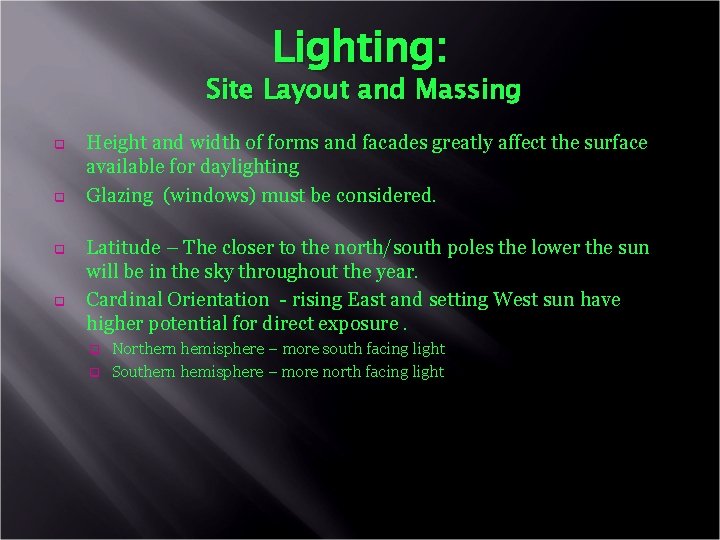
Lighting: Site Layout and Massing q q Height and width of forms and facades greatly affect the surface available for daylighting Glazing (windows) must be considered. Latitude – The closer to the north/south poles the lower the sun will be in the sky throughout the year. Cardinal Orientation - rising East and setting West sun have higher potential for direct exposure. Northern hemisphere – more south facing light q Southern hemisphere – more north facing light q
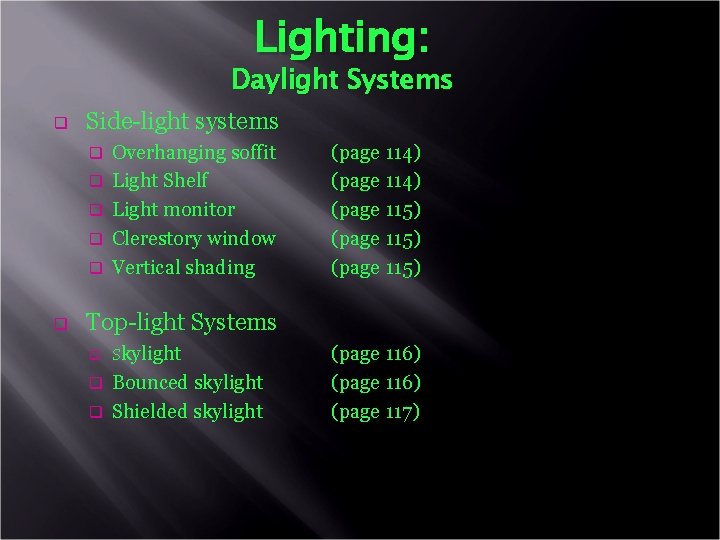
Lighting: Daylight Systems q Side-light systems q q q Overhanging soffit Light Shelf Light monitor Clerestory window Vertical shading (page 114) (page 115) Top-light Systems q Skylight Bounced skylight q Shielded skylight q (page 116) (page 117)
Lighting: Light Control Techniques Diffusing – translucent acrylic, frosted class q q Tinting – reducing transmittance of a transparent substrate q q Mixed reviews, gloomy or dark perception to the outside Fritting – transparent materials with lines etched or embedded in them. q q q Creates a soft even texture like on a cloudy day. Act like miniature louvers to reflect light at various angles Daylight at work – accent feature
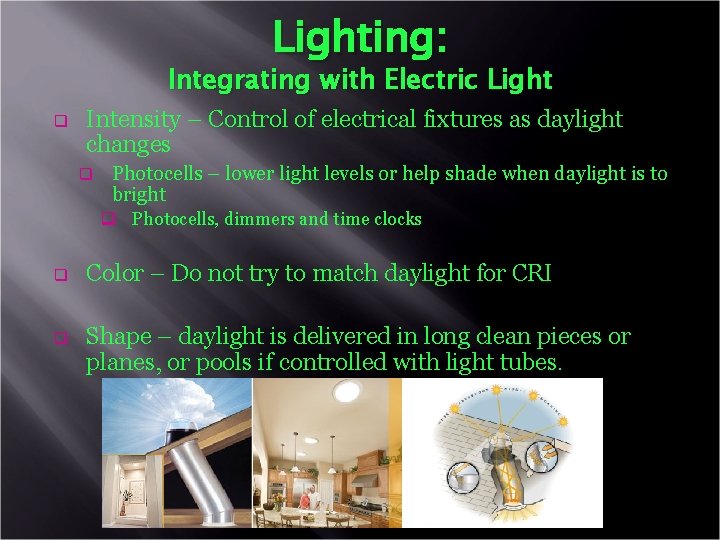
Lighting: Integrating with Electric Light q Intensity – Control of electrical fixtures as daylight changes q Photocells – lower light levels or help shade when daylight is to bright q Photocells, dimmers and time clocks q Color – Do not try to match daylight for CRI q Shape – daylight is delivered in long clean pieces or planes, or pools if controlled with light tubes.
Lighting: Hazards of Daylight q Heat Gains - direct daylight gives heat build up – tinting or expensive glazing techniques can be used. q Glare and Contrast – Uncontrolled sunlight causes glare and intense contrast q Damage to Art, Fabric, and Other Materials – UV radiation and heat will damage dyes, inks, pigments, organic materials. q Excessive Window Light – understand the daylight received from picture windows.
Lighting: Daylight as a Controllable Element Daylight is controllable and predictable. q q q Natural element to be used when used with proper controlling techniques such as draperies, curtains, blinds, etc. Experiment with daylight design Use Sunlight and electrical lighting together for a better design.