
Light Waves Physics 1 L Created by Stephanie
Light Waves Physics 1 L Created by Stephanie Ingle Tweaked by Rex Wolf
Light • Light is a transverse wave. • Light waves are electromagnetic waves --which means that they do NOT need a medium to travel. • Light waves behave like other waves and have the same characteristics such as amplitude, frequency, and wavelength.

Characteristics of Light • Intensity (brightness) -- represented by amplitude • Color -- determined by frequency • Wave speed - depends on the medium • Light waves as well as ALL Electromagnetic waves travel with a speed of 3. 0 x 108 m/s in a vacuum. • Recall: v = f l
Luminous vs Illuminated Luminous – a body that emits light – a body that reflects light – does not emit light of its own Types of Reflection • Regular Reflection – When parallel rays of light fall on a smooth surface they are reflected parallel from the surface. • Diffuse Reflection – When parallel rays of light fall on a textured surface they are reflected in many different directions. They are diffused.
Reflection & Mirrors
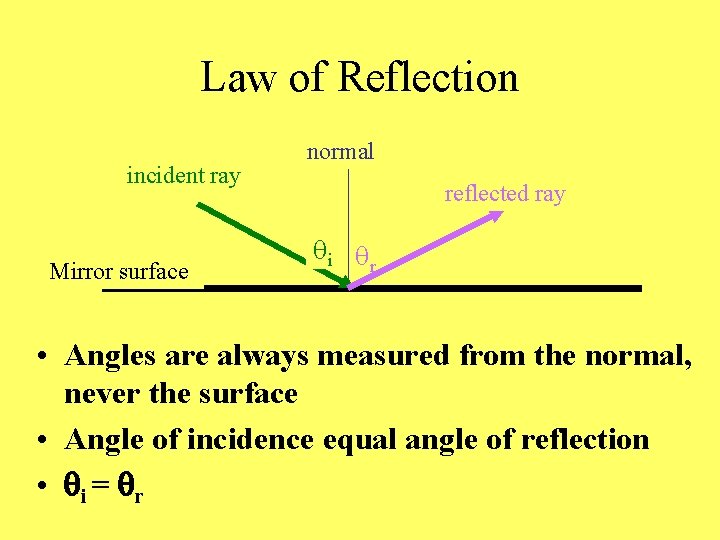
Law of Reflection incident ray Mirror surface normal reflected ray i r • Angles are always measured from the normal, never the surface • Angle of incidence equal angle of reflection • i = r
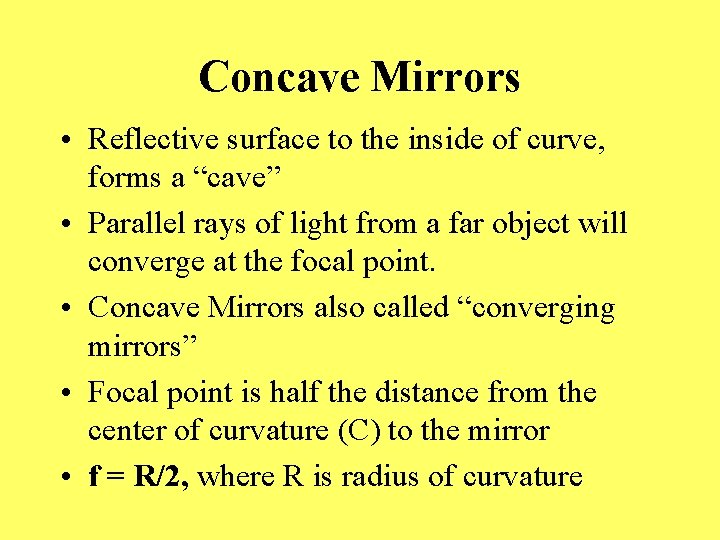
Concave Mirrors • Reflective surface to the inside of curve, forms a “cave” • Parallel rays of light from a far object will converge at the focal point. • Concave Mirrors also called “converging mirrors” • Focal point is half the distance from the center of curvature (C) to the mirror • f = R/2, where R is radius of curvature
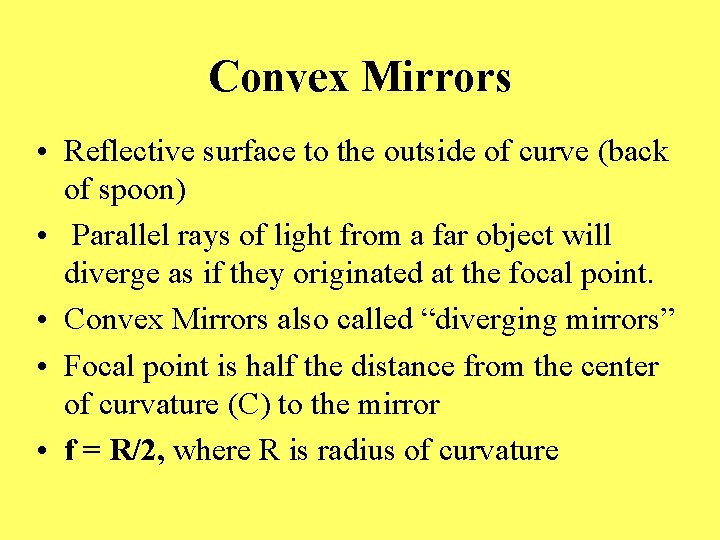
Convex Mirrors • Reflective surface to the outside of curve (back of spoon) • Parallel rays of light from a far object will diverge as if they originated at the focal point. • Convex Mirrors also called “diverging mirrors” • Focal point is half the distance from the center of curvature (C) to the mirror • f = R/2, where R is radius of curvature
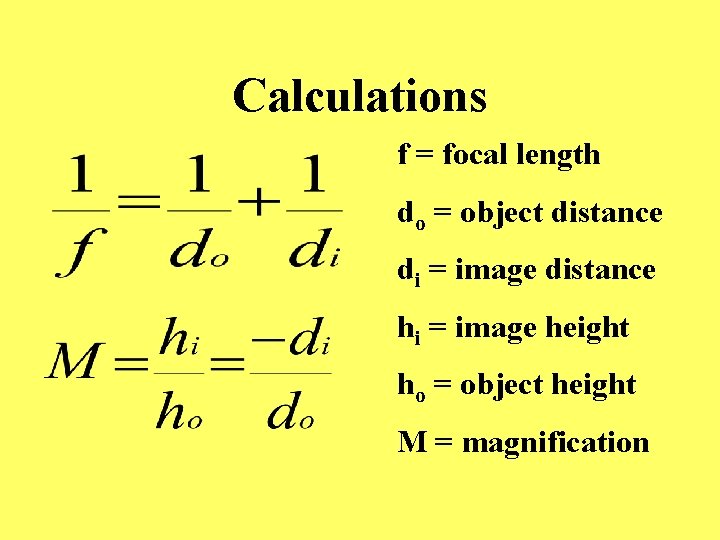
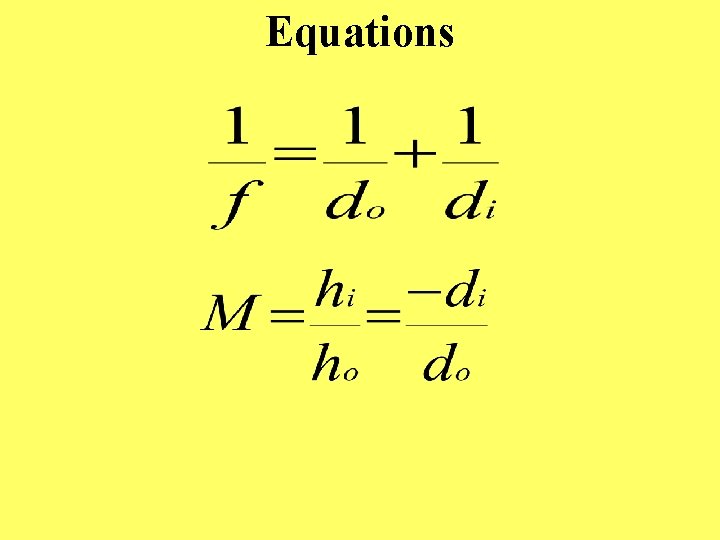
Calculations f = focal length do = object distance di = image distance hi = image height ho = object height M = magnification
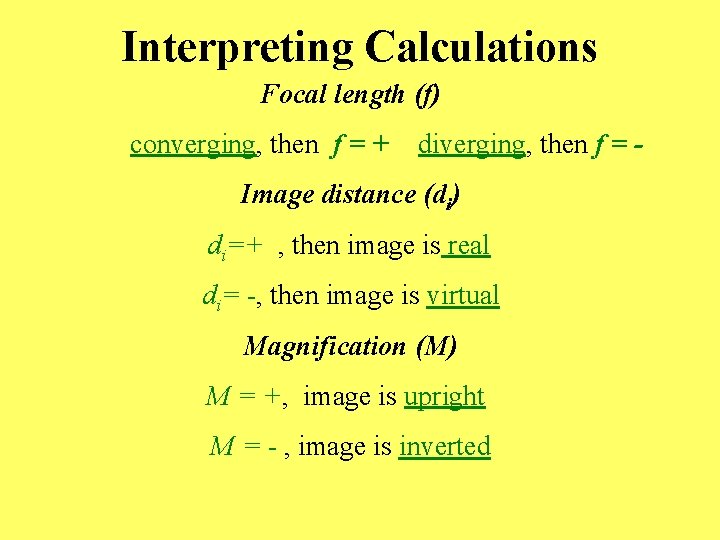
Interpreting Calculations Focal length (f) converging, then f = + diverging, then f = - Image distance (di) di=+ , then image is real di= -, then image is virtual Magnification (M) M = +, image is upright M = - , image is inverted
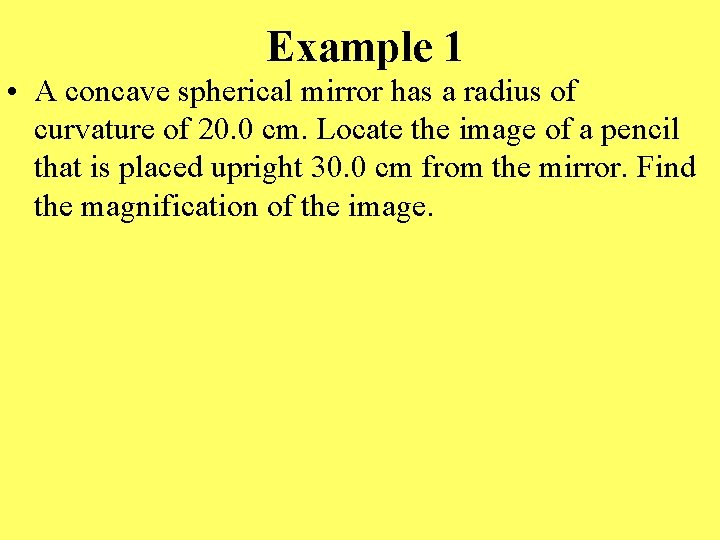
Example 1 • A concave spherical mirror has a radius of curvature of 20. 0 cm. Locate the image of a pencil that is placed upright 30. 0 cm from the mirror. Find the magnification of the image.
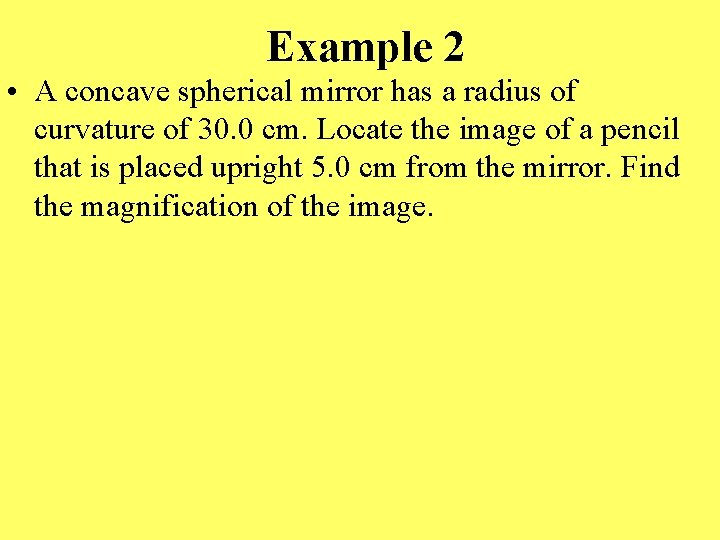
Example 2 • A concave spherical mirror has a radius of curvature of 30. 0 cm. Locate the image of a pencil that is placed upright 5. 0 cm from the mirror. Find the magnification of the image.
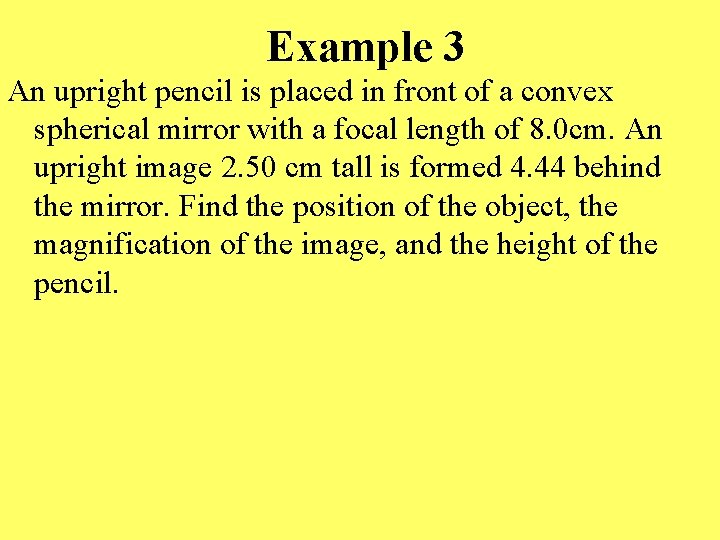
Example 3 An upright pencil is placed in front of a convex spherical mirror with a focal length of 8. 0 cm. An upright image 2. 50 cm tall is formed 4. 44 behind the mirror. Find the position of the object, the magnification of the image, and the height of the pencil.
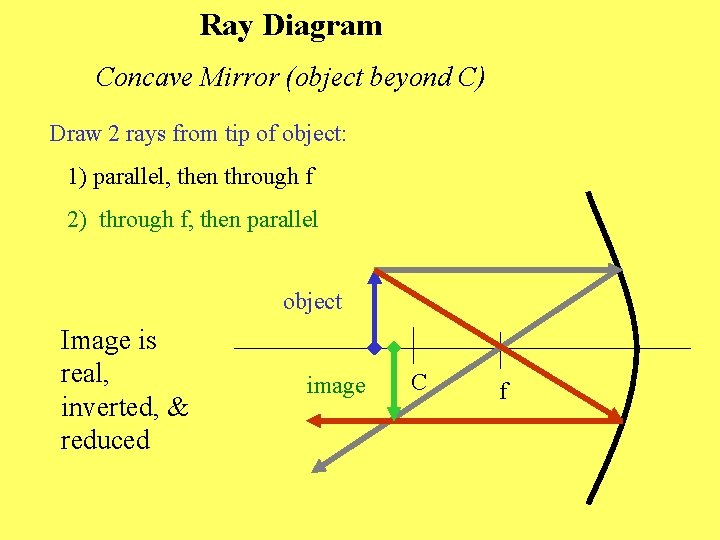
Ray Diagram Concave Mirror (object beyond C) Draw 2 rays from tip of object: 1) parallel, then through f 2) through f, then parallel object Image is real, inverted, & reduced image C f
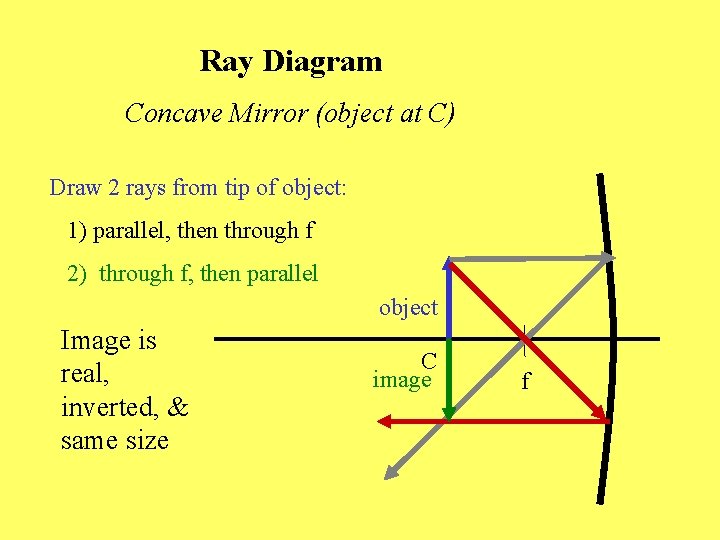
Ray Diagram Concave Mirror (object at C) Draw 2 rays from tip of object: 1) parallel, then through f 2) through f, then parallel object Image is real, inverted, & same size C image f
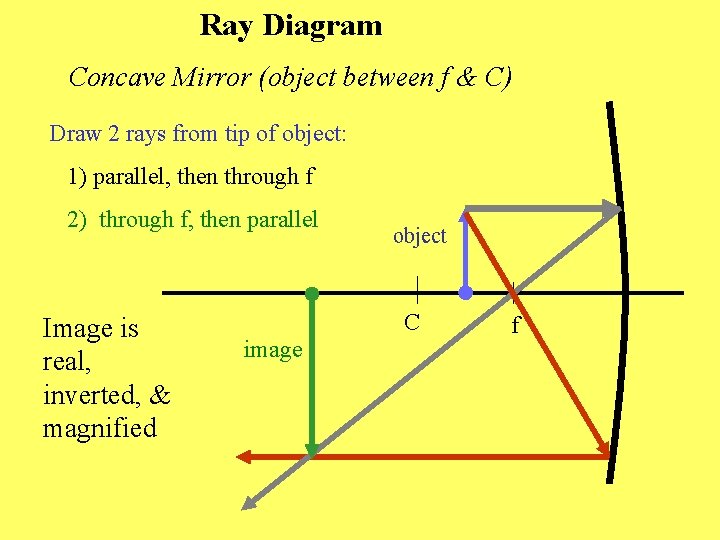
Ray Diagram Concave Mirror (object between f & C) Draw 2 rays from tip of object: 1) parallel, then through f 2) through f, then parallel Image is real, inverted, & magnified image object C f
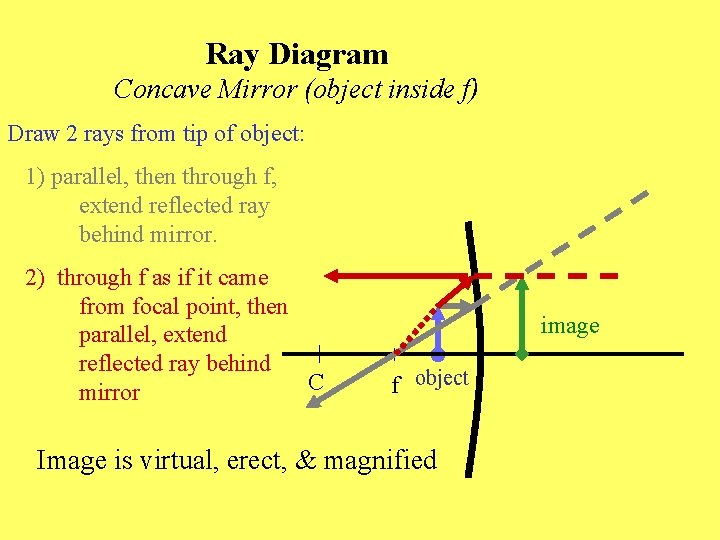
Ray Diagram Concave Mirror (object inside f) Draw 2 rays from tip of object: 1) parallel, then through f, extend reflected ray behind mirror. 2) through f as if it came from focal point, then parallel, extend reflected ray behind C mirror image f object Image is virtual, erect, & magnified
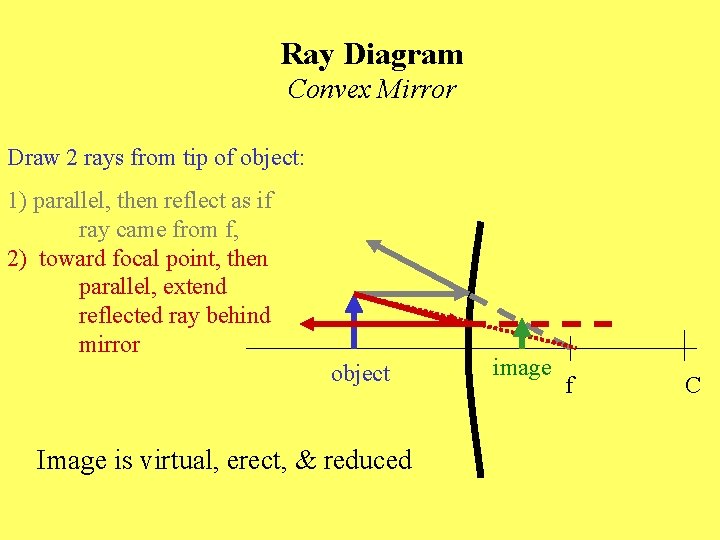
Ray Diagram Convex Mirror Draw 2 rays from tip of object: 1) parallel, then reflect as if ray came from f, 2) toward focal point, then parallel, extend reflected ray behind mirror object Image is virtual, erect, & reduced image f C
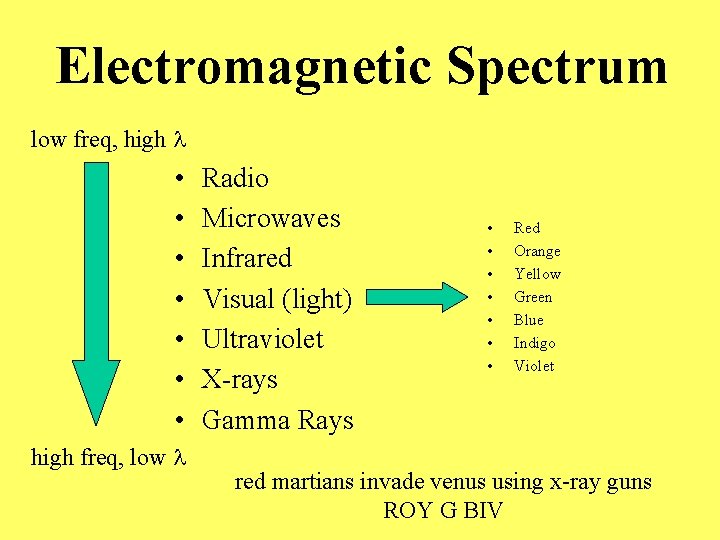
Electromagnetic Spectrum low freq, high l • • high freq, low l Radio Microwaves Infrared Visual (light) Ultraviolet X-rays Gamma Rays • • Red Orange Yellow Green Blue Indigo Violet red martians invade venus using x-ray guns ROY G BIV
Examples • Which has a higher frequency, green light or red light? • Which has a higher wavelength, orange light or microwaves? • Which has a lower frequency, gamma rays or infrared? • Which has a lower wavelength, radio waves or ultraviolet waves? • Which travels faster, yellow light or x-rays?
Pre. Quiz Example Bob the bulldog is 50 cm tall. His virtual image is 100 cm tall, upright, and 30 cm from the mirror. a. Find magnification b. Where is Bob? c. Find focal length. d. Is the mirror concave or convex?
Glass sphere? Lawn sphere?
Equations
- Slides: 23