
Light waves Can light bounce Yes We call
Light waves
Can light bounce? �Yes! We call this a reflection. �Humans have been looking at reflections for thousands of years, however they’re not always clear.
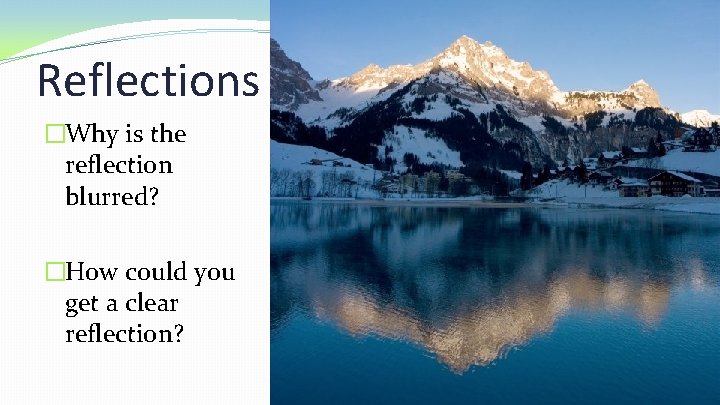
Reflections �Why is the reflection blurred? �How could you get a clear reflection?
The Egyptians �Almost 4, 000 years ago the Egyptians realized that only smooth ponds produce clear reflections. �However it wasn’t until 1835 when Justus von Liebig, a German scientist, developed a method of coating glass with silver to produce a sharp, well-defined, reflected image.
The Law of Reflection �Consider what happens when I bounce pass a basketball. �How can I change the angle of the bounce pass?
The Law of Reflection �Light reflects the same way the basketball does. �Laser Demo �The Law of Reflection: The angle that a reflected ray makes as measured from the normal to a reflective surface equals the angle that the incident ray makes as measured from the same normal.
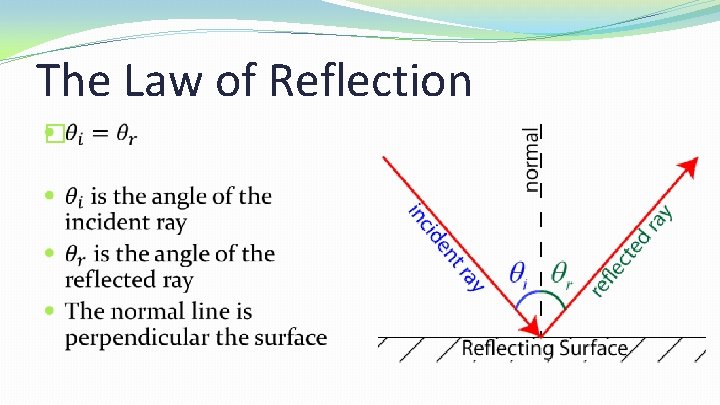
The Law of Reflection �
Bellringer
Updates �Sound Quiz �SLC today �First Regents Review HW due tomorrow � 1 -50 MC

Objectives
The Law of Reflection �Smooth vs rough surfaces �Which will be a better reflector? �Laser demo
The Law of Reflection �Specular Reflection is when parallel light rays are reflected in parallel �Diffuse Reflection is when parallel light rays are not reflected in parallel but instead they are scattered. �This is what allows us to read text or see images from various angles.

Specular Reflection
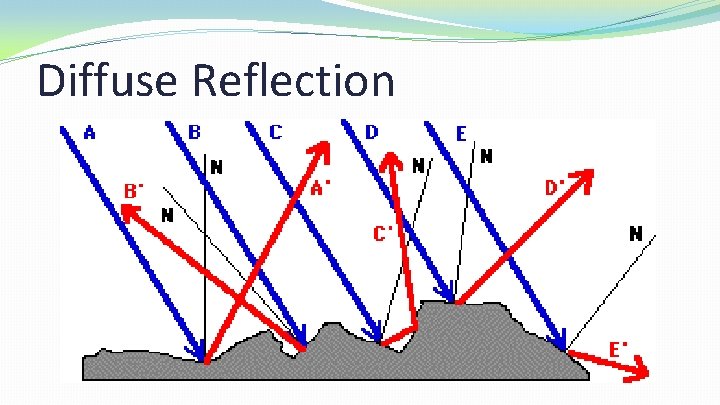
Diffuse Reflection
Checkpoint 1. What is the law of reflection? 2. What is the difference between specular and diffuse reflection? 1. Which one is used by mirrors?
The Law of Reflection �The law of reflection still applies to both types of reflection. �No matter how much light reflects off a wall or a sheet of paper, you will never be able to use them as mirrors. �The light that reflects off the wall or paper is how we see the wall or paper.
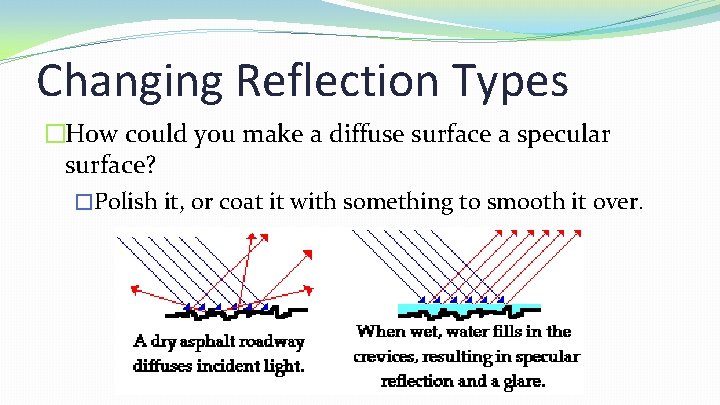
Changing Reflection Types �How could you make a diffuse surface a specular surface? �Polish it, or coat it with something to smooth it over.
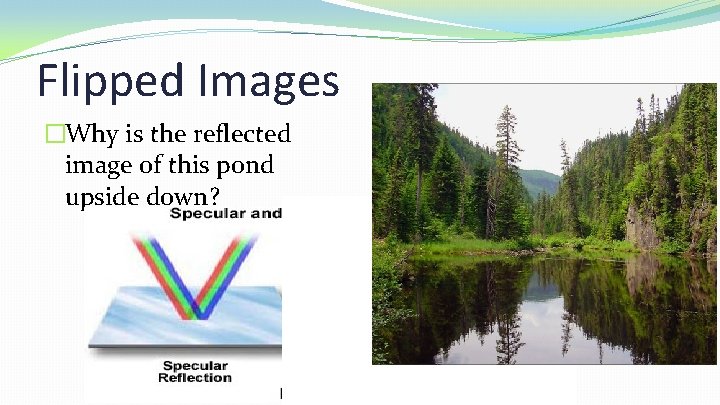
Flipped Images �Why is the reflected image of this pond upside down?
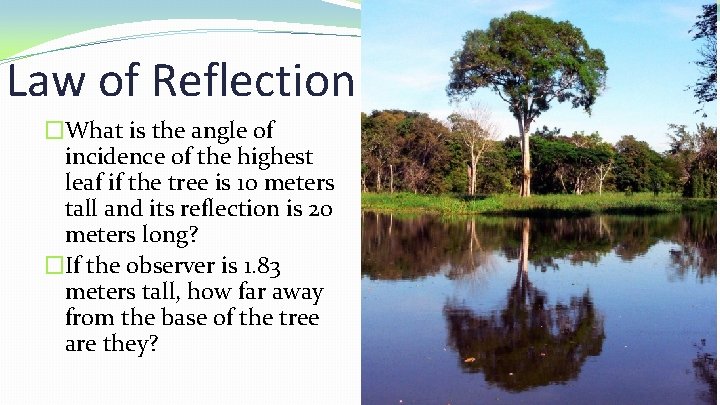
Law of Reflection �What is the angle of incidence of the highest leaf if the tree is 10 meters tall and its reflection is 20 meters long? �If the observer is 1. 83 meters tall, how far away from the base of the tree are they?
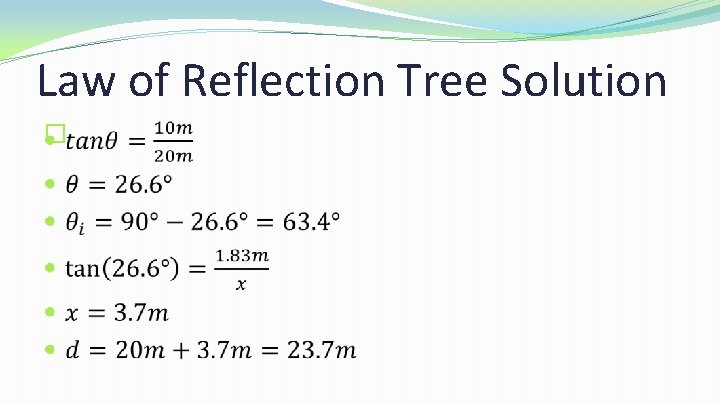
Law of Reflection Tree Solution �
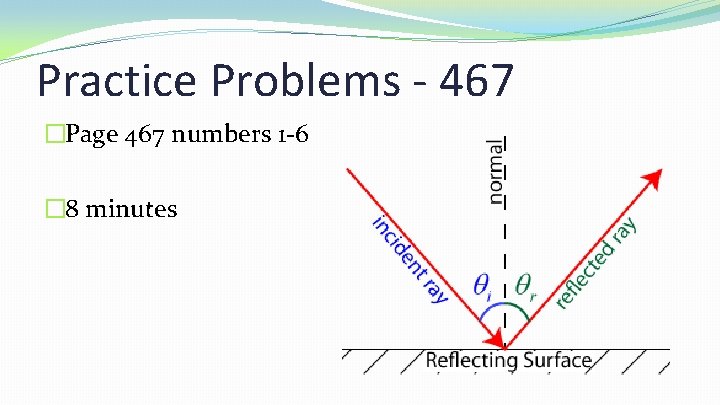
Practice Problems - 467 �Page 467 numbers 1 -6 � 8 minutes
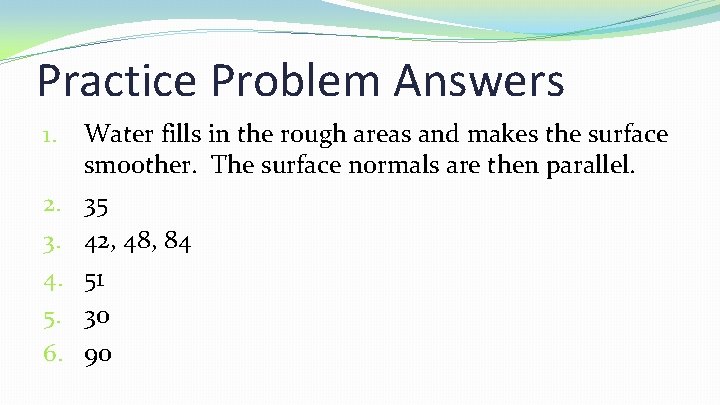
Practice Problem Answers 1. 2. 3. 4. 5. 6. Water fills in the rough areas and makes the surface smoother. The surface normals are then parallel. 35 42, 48, 84 51 30 90
Bellringer
Updates �Sound Quiz �SLC today �First Regents Review HW due tomorrow � 1 -50 MC
Light and Boundaries �What happens when light encounters a boundary like a window? �Some light is transmitted through the window and some light is reflected back. �Laser out the window demo �Is this a property of a wave or a particle?
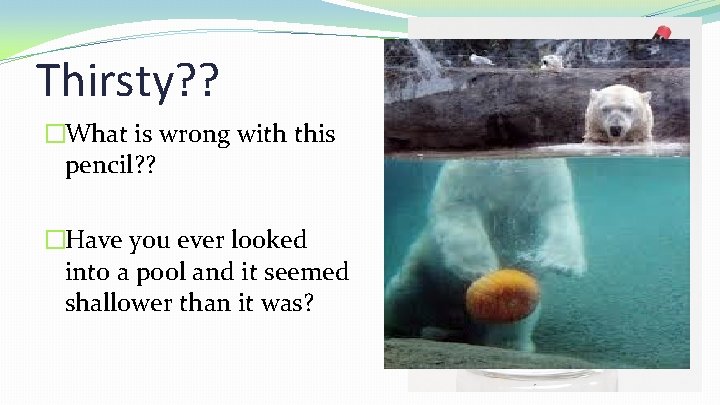
Thirsty? ? �What is wrong with this pencil? ? �Have you ever looked into a pool and it seemed shallower than it was?
Refraction �These phenomena happen because the light rays bend as they enter a new medium. �Refraction: The change in direction of waves at the boundary between two different mediums.
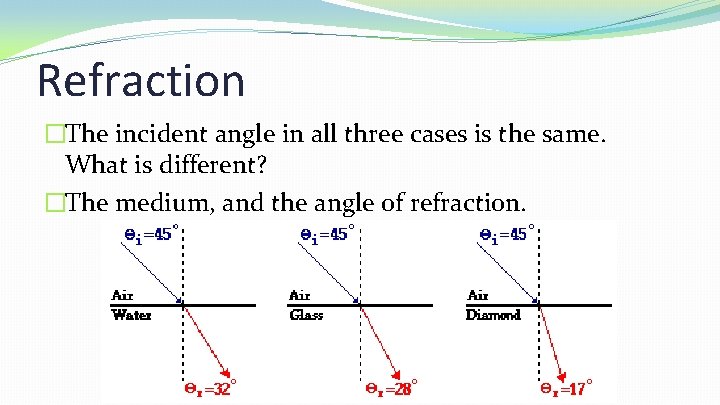
Refraction �The incident angle in all three cases is the same. What is different? �The medium, and the angle of refraction.
Refraction �
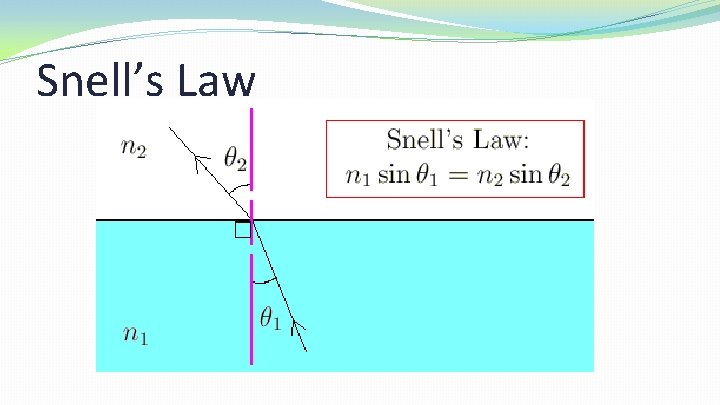
Willebrord Snell �Snell came up with a mathematical law to relate the angle of incidence with the angle of refraction. �He did this using a light source and a piece of glass. �He shot the light at various angles and measured the results. �Then he plotted his data and found a mathematical relationship that fit and could correctly predict the outcome. �Let’s try it! �Watch your eyes…laser beam
Snell’s Findings �He found that the sines of the angles were related! �Woo trig! �He also found that each material had its own “index of refraction” (n) which determines the angle of refraction of light as it crosses the boundary between two mediums.
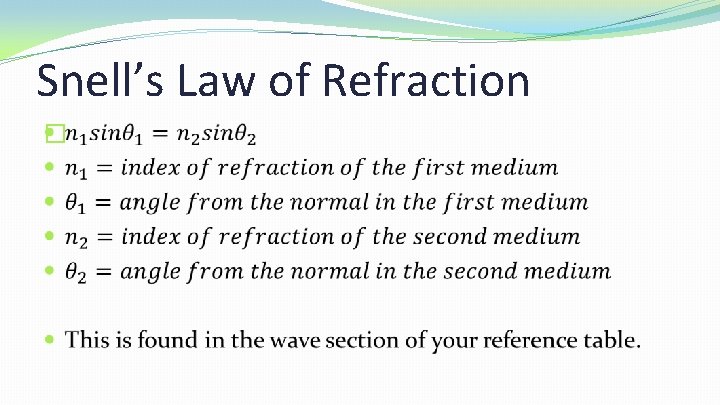
Snell’s Law of Refraction �
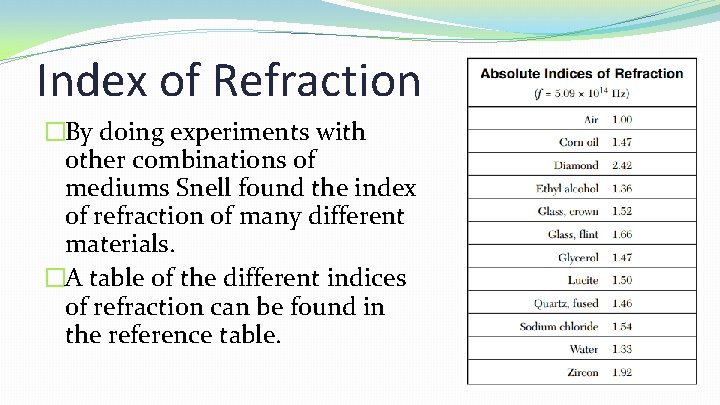
Index of Refraction �By doing experiments with other combinations of mediums Snell found the index of refraction of many different materials. �A table of the different indices of refraction can be found in the reference table.
Beaker Demo �Will light bend as it goes from air to corn oil? �Why? �Will light bend as it goes from corn oil to another medium that has the same n as corn oil? �Why? �Can we make something invisible?
Bellringer
Updates �Missing sound quiz �Physics club on Tuesday �New SLC roster �Review HW due Friday
Snell’s Law
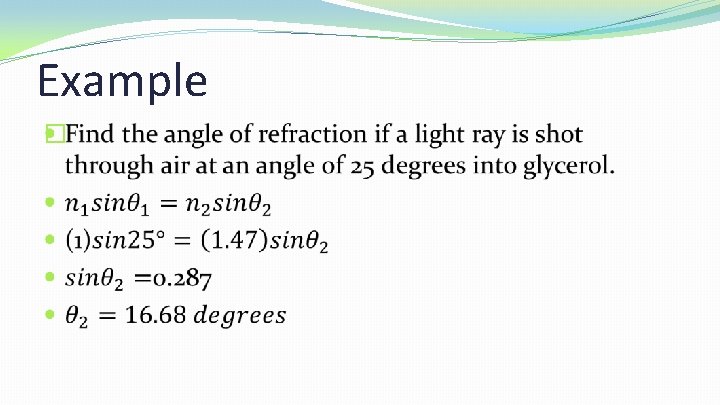
Example �
Practice �Complete practice problems 1 -5 on page 494 of the textbook. �Answers 1. 26. 3 degrees 2. 34. 2 degrees 3. 17. 0 degrees 4. 1. 5 5. The medium is float glass
Where does “n” come from? �The index of refraction (n) describes how much light bends as it enters a medium, but why does it bend? �The light bends because it is changing its speed!
The speed of light �The speed of light can never be faster than when it is traveling through a vacuum, but it can be slower when traveling through a different medium. �The index of refraction is the ratio of the speed of light in a vacuum to the speed of light in the medium.
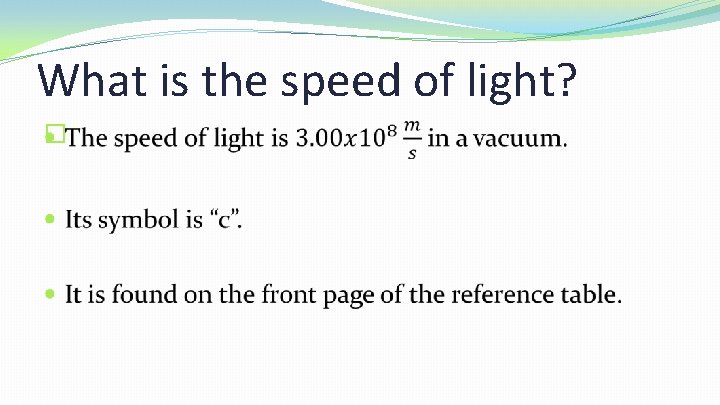
What is the speed of light? �
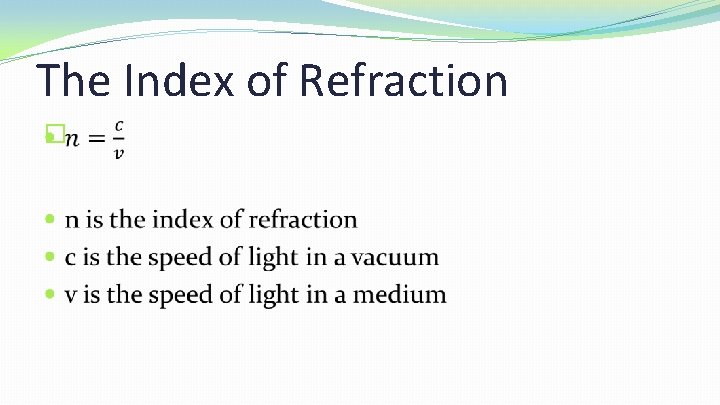
The Index of Refraction �
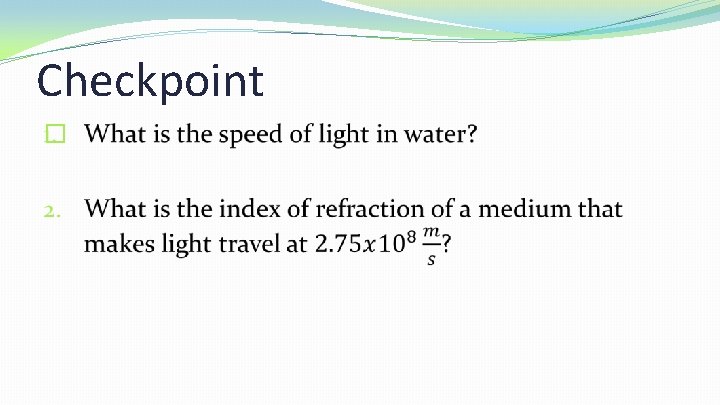
Checkpoint �
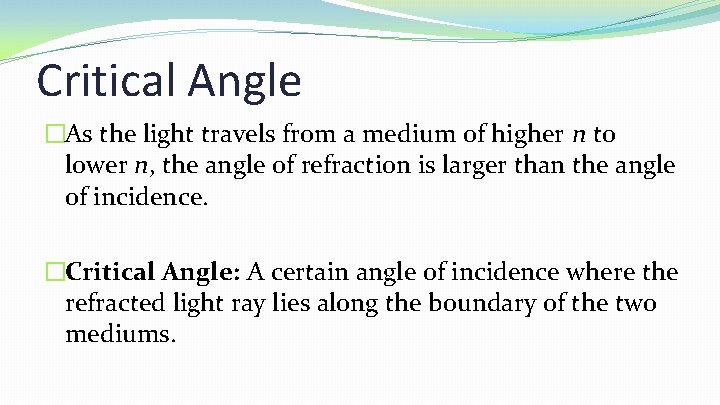
Critical Angle �As the light travels from a medium of higher n to lower n, the angle of refraction is larger than the angle of incidence. �Critical Angle: A certain angle of incidence where the refracted light ray lies along the boundary of the two mediums.
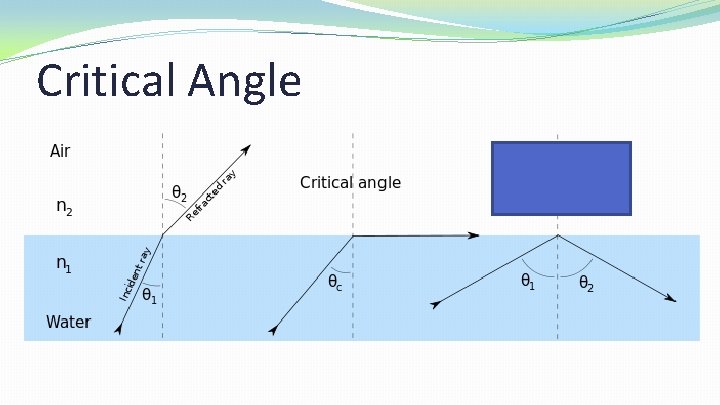
Critical Angle
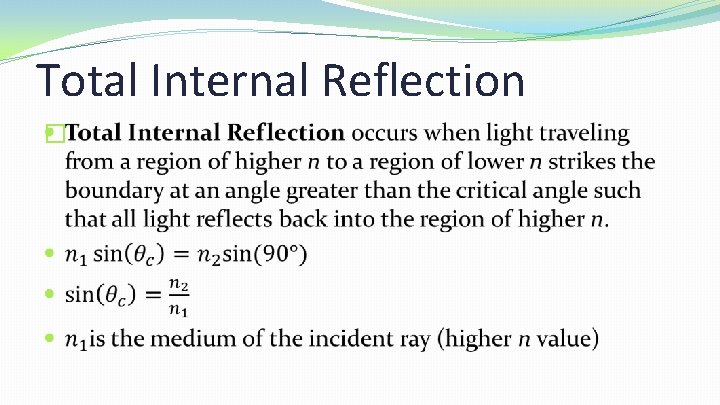
Total Internal Reflection �
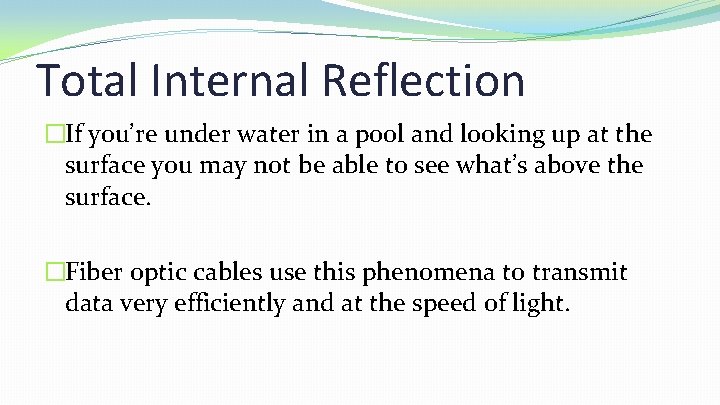
Total Internal Reflection �If you’re under water in a pool and looking up at the surface you may not be able to see what’s above the surface. �Fiber optic cables use this phenomena to transmit data very efficiently and at the speed of light.
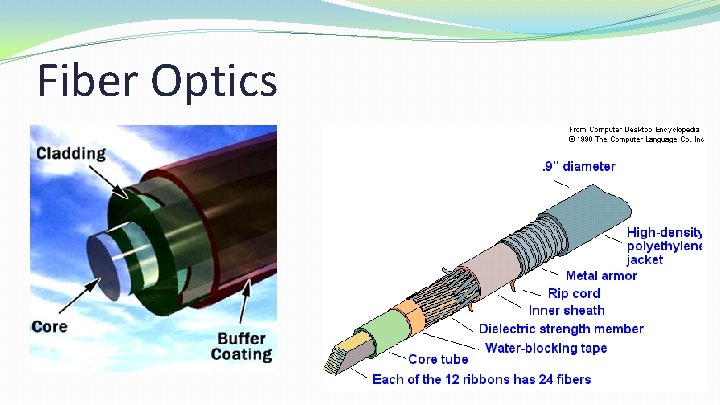
Fiber Optics
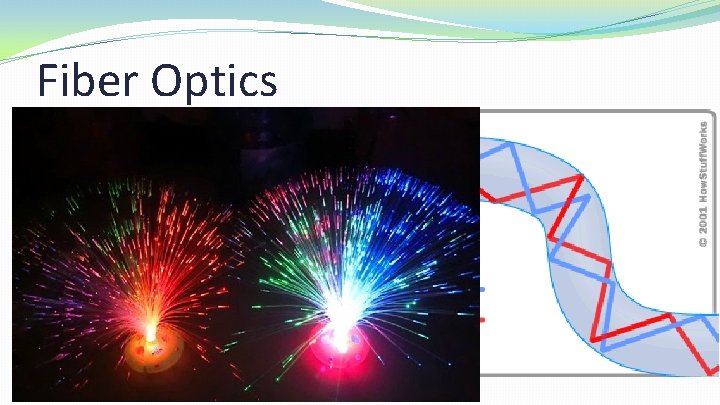
Fiber Optics
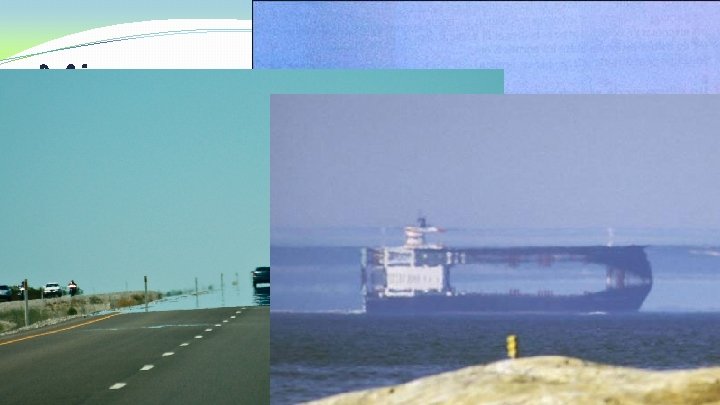
Mirages �As the ground heats up from the sun it creates a thin layer of much warmer air near the ground. �This layer of hot air has a smaller n value than the air at eye level. �This difference in n makes the light rays of the sky and usually an object reflect of the cool and hot air boundary.
Mirages
Checkpoint 1. What conditions are necessary for total internal reflection to occur? 2. What are two examples of total internal reflection in real life? 3. What causes mirages?
Index of Refraction Lab �Take a moment to read the procedure.
Bellringer

Updates �Physics Club today �New SLC Roster �HW due Friday �Next Quiz?
Sound Quiz �Mod 2: 83 �Mod 8: 81
Index of Refraction Lab �How many calculations must you show? �Once you’ve calculated your three different average experimental n values come ask me for theoretical n values.
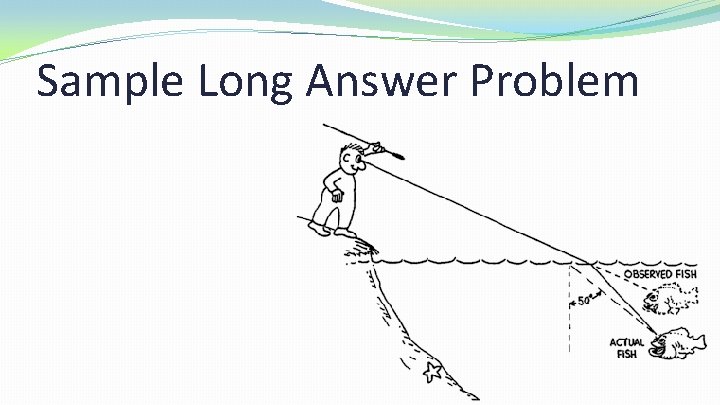
Sample Long Answer Problem
Index of Refraction Lab �How many calculations must you show? �Once you’ve calculated your three different average experimental n values come ask me for theoretical n values.
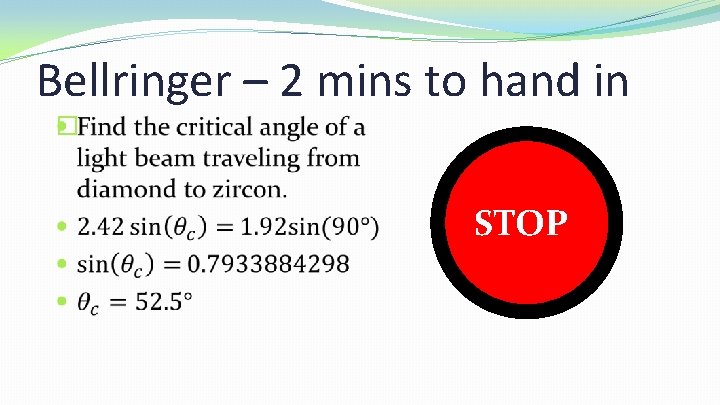
Bellringer – 2 mins to hand in � DO STOP WORK
Bellringer – 2 mins to hand in �What is the difference between a reflected wave and a refracted wave? DO STOP WORK
Objectives �Be able to answer all questions about reflection and refraction of light �Begin your journey through space and astronomy.
Lyrid Meteor Shower �Tonight is the peak of the shower. �Look northeast?
Index of Refraction Labs �Please hand in your completed index of refraction labs.
Lab Checklist - Missing �All labs (except “Series-Parallel Circuits”) are out of 50 points. �You need a grade of 33 or higher for the lab to count towards your lab minutes. �Check off the labs you have in your folder and calculate your total number of lab minutes. �If you have someone’s lab give it to them or me. �When you’re done bring me you lab folder and checklist.
Homework �Complete all the multiple choice questions. �We will spend one mod on Friday reviewing it. �I’d rather you not do it at all than cheat. �The Regents exam is less than two months away. �If anyone fails I will delete you from my memory. �If you do really well you may be sent to the Physics Hall of Fame.
Bellringer
Updates �New SLC Roster �HW due Friday �Next Quiz?
Index of Refraction Lab �Calculations and Conclusion Questions
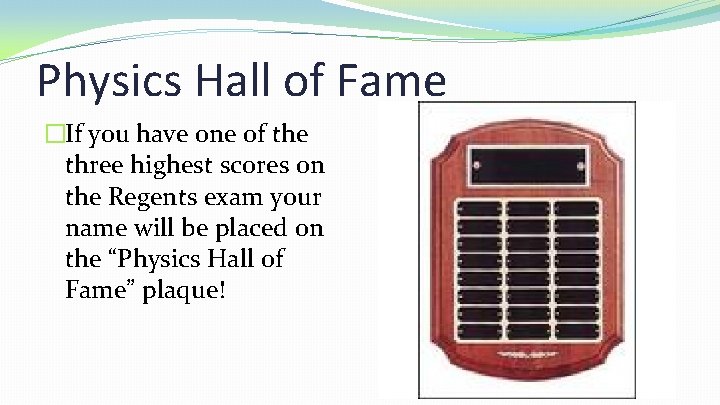
Physics Hall of Fame �If you have one of the three highest scores on the Regents exam your name will be placed on the “Physics Hall of Fame” plaque!
Refraction Bend �If light goes from a lower n to a higher n (slows down) it will bend towards the normal line. �If light goes from a higher n to a lower n (speeds up) it will bend away from the normal line.
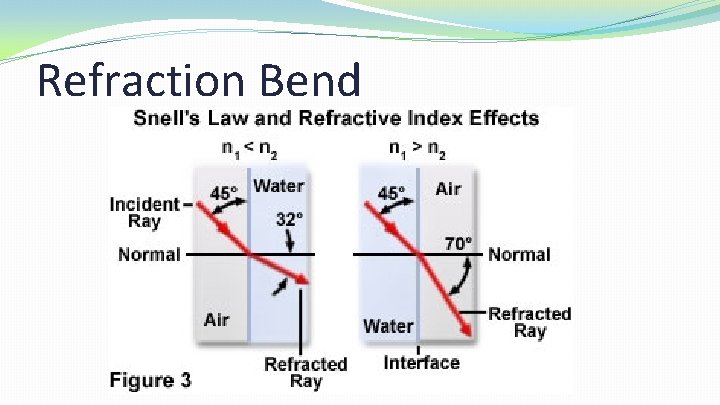
Refraction Bend
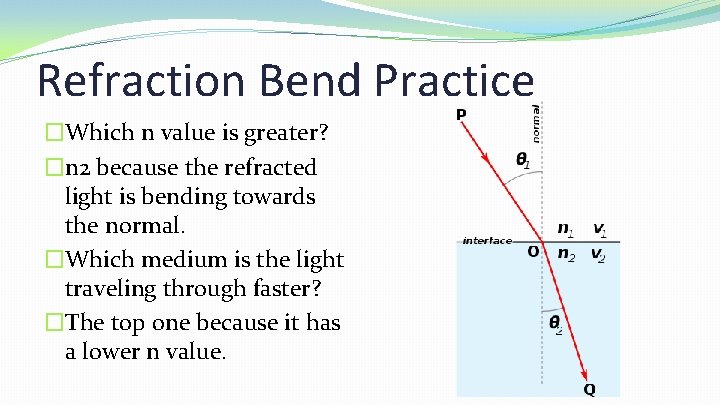
Refraction Bend Practice �Which n value is greater? �n 2 because the refracted light is bending towards the normal. �Which medium is the light traveling through faster? �The top one because it has a lower n value.
Refraction Practice �Complete questions 37 to 40 on page 514 in the next 8 minutes! 37. The angle of incidence is larger than the angle of refraction b/c air has a smaller index of refraction 38. The angle of incidence is smaller than the angle of refraction b/c glass has a larger index of refraction
Refraction Practice 39. The term critical angle refers to the incident angle that causes the refracted ray to lie right along the boundary of the substance when a ray is passing from a region of higher index of refraction to a region of lower index of refraction. If the incident angle exceeds the critical angle, total internal reflection will occur. 40. C>D>B>A
Pyro Board �Oh what you can make once you know physics! �https: //www. youtube. com/watch? v=2 awb. KQ 2 DLRE �What is a standing wave? �What is an antinode? �What determines what frequencies will stand in a pipe?
RR Test – MC Review �Law of Reflection �Two types of reflective surfaces �Snell’s Law �Calculate n values using velocity and c �Ratios of index of refraction, velocity, and wavelength of light at boundaries.
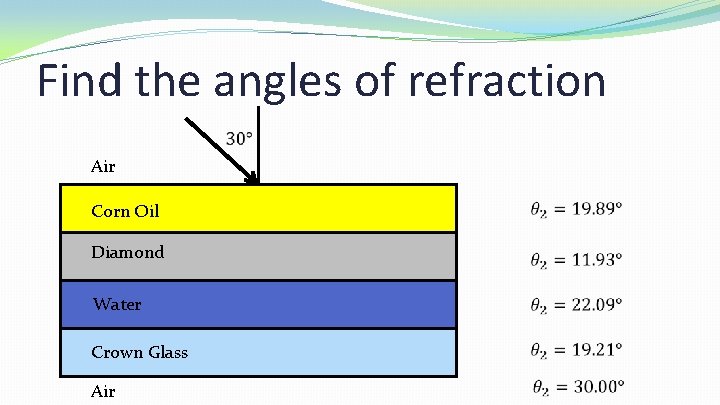
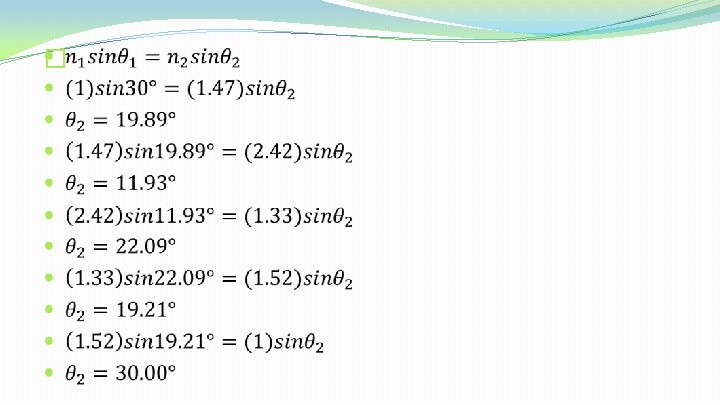
Find the angles of refraction Air Corn Oil Diamond Water Crown Glass Air
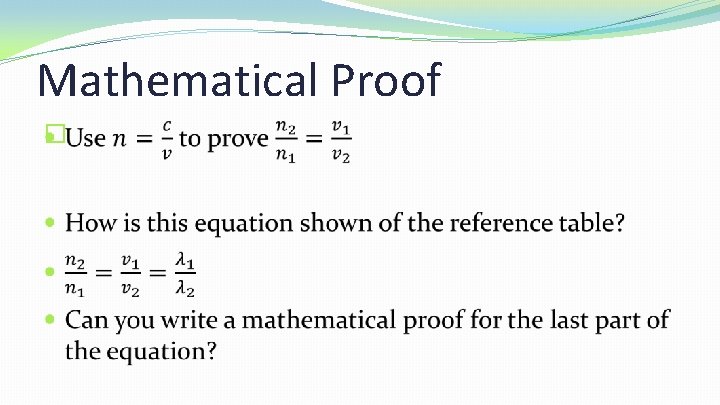
Mathematical Proof �
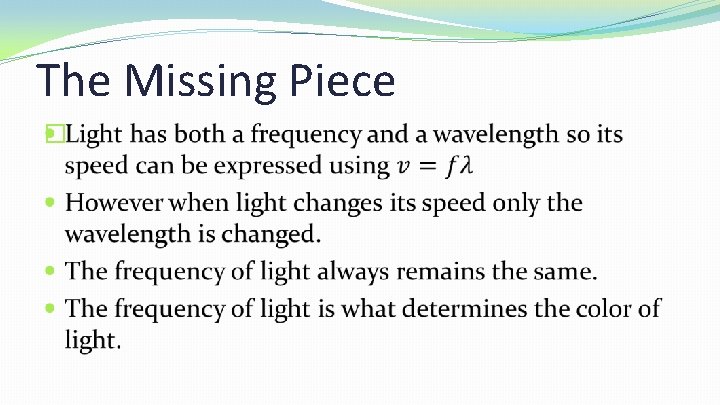
The Missing Piece �
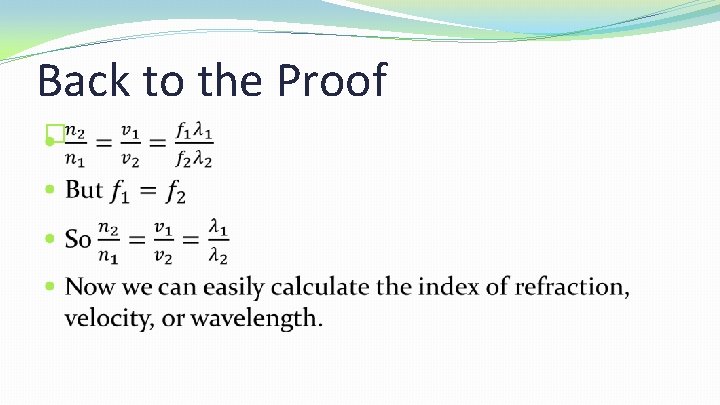
Back to the Proof �
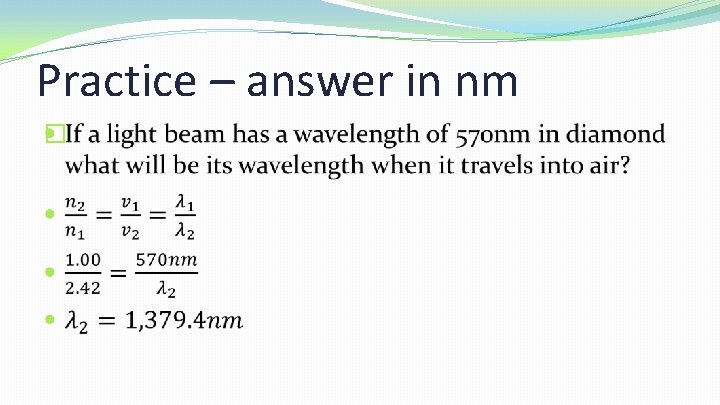
Practice – answer in nm �
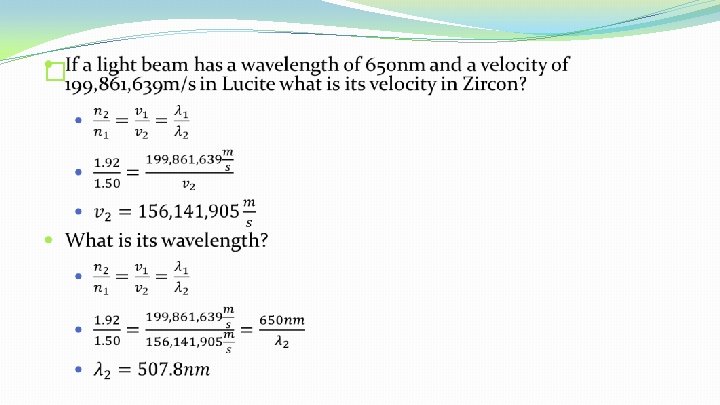
Refraction MC
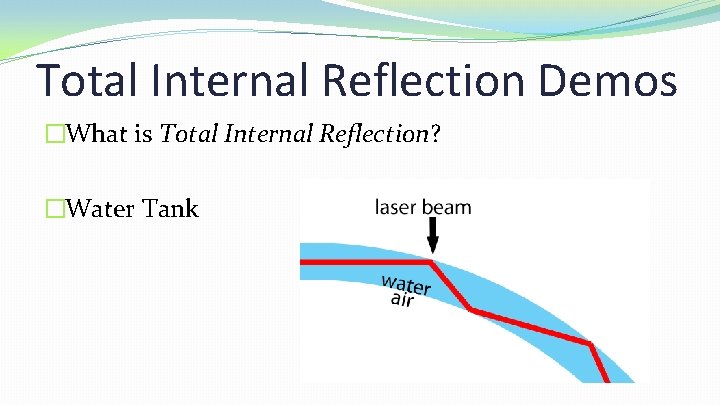
Total Internal Reflection Demos �What is Total Internal Reflection? �Water Tank
Bellringer �What is the difference between a reflected wave and a refracted wave? DO STOP WORK
Objectives �Be able to answer all questions about reflection and refraction of light �Begin your journey through space and astronomy.
Lenses �Two types of lenses Convex – A lens that is thicker at the center than at the edges. 2. Concave – A lens that is thinner at the center than at the edges. 1.
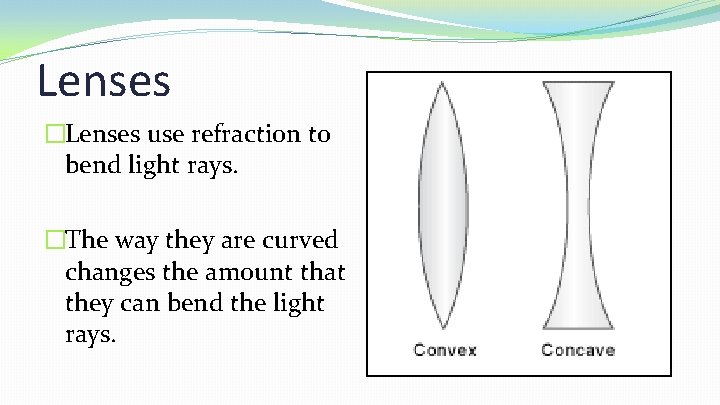
Lenses �Lenses use refraction to bend light rays. �The way they are curved changes the amount that they can bend the light rays.
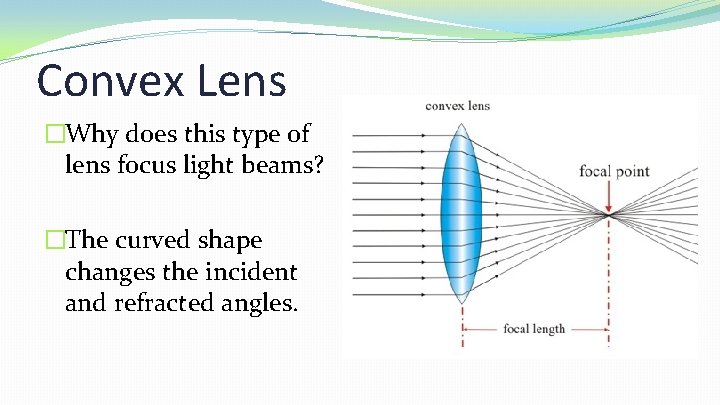
Convex Lens �Why does this type of lens focus light beams? �The curved shape changes the incident and refracted angles.
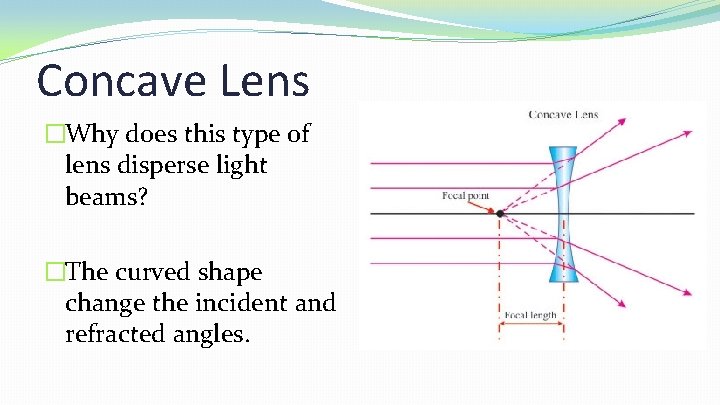
Concave Lens �Why does this type of lens disperse light beams? �The curved shape change the incident and refracted angles.
Computer Demo �https: //phet. colorado. edu/en/simulation/bendinglight
RR Test �Law of Reflection �Two types of reflective surfaces �Snell’s Law �Calculate n values using velocity and c �Ratios of index of refraction, velocity, and wavelength of light at boundaries.
- Slides: 95