
LIGHT Unit 3 Module 2 HOW LIGHT TRAVELS
- Slides: 25
LIGHT Unit 3 Module 2
HOW LIGHT TRAVELS • MS-PS 4 -2. Develop and use a model to describe that waves are reflected, absorbed, or transmitted through various materials. • WALT: • I can develop and use models to describe light’s path as straight line and to describe how objects function to interact with light waves through reflection, absorption and transmission. • • • WILF: I will be able to categorize the characteristics of different types of electromagnetic waves. I will be able to identify the uses of electromagnetic waves. I will be able to model the path light travels. I will be able to collect evidence that light can be reflected, absorbed, or transmitted when it shines on an object.
WHAT IS LIGHT? • Suppose you are touring an underground cave and the lights go out. Would you be able to see anything? • No! There would be no light for your eyes to sense. • Light is electromagnetic radiation that you can see. • Electromagnetic radiation is a type of wave created by vibrating particles.
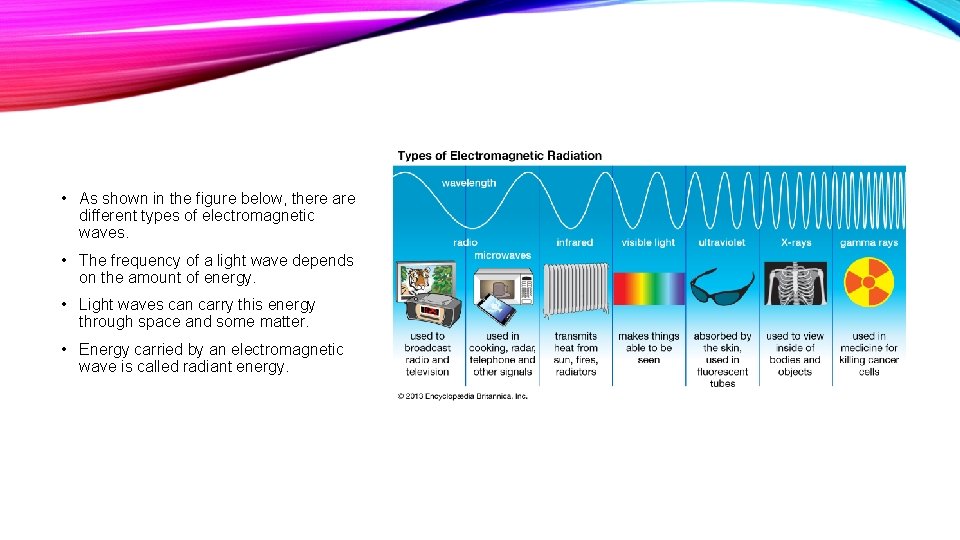
• As shown in the figure below, there are different types of electromagnetic waves. • The frequency of a light wave depends on the amount of energy. • Light waves can carry this energy through space and some matter. • Energy carried by an electromagnetic wave is called radiant energy.
PROPERTIES OF LIGHT • The wavelengths of light waves are very short. • Because they are so short, they are usually measured in nanometers (nm). • One nanometer equals one-billionth of a meter. • The wavelengths of light waves range from about 700 nm to about 400 nm. • This is about one-hundredth the width of a human hair. • When different wavelengths of light waves enter your eyes, you see them as different colors.
ENERGY • As the frequency of an electromagnetic wave increases, the energy of the wave also increases.
BRIGHTNESS • The brightness of a light is a person’s perception of intensity. • Your eyes might be more sensitive to light than your friend’s eyes. • The intensity of light is the amount of energy that passes through a square meter of space in one second. • It depends on the amount of energy emitted by the source. • Light from a flashlight has a much lower intensity than light from the Sun. • Intensity also depends on the light’s distance from the source. • The environment also can affect brightness
HOW DOES LIGHT REACH EARTH? • The Sun emits energy by giving off electromagnetic waves. Only a tiny amount of these waves reach Earth.
SPEED OF LIGHT • Electromagnetic waves can travel through a vacuum where no matter is present. • For example, light can travel through the space between Earth and the Sun. • Light waves travel fastest through a vacuum. The speed of light waves in a vacuum is about 300, 000 km/s. • Light waves travel about 900, 000 times faster than sound waves. • When light enters matter, it slows. • This is because of interactions between the waves and the particles that make up matter. • Light waves travel at different speeds in different materials.
HOW DOES LIGHT MOVE FROM A SOURCE TO YOUR EYE? • Light travels as waves moving away from a source. • Light makes it possible for you to see objects. • It can travel directly from a source. It can also be seen reflecting off some objects. • Light waves can be described as countless rays spreading out in all directions from a source. • Shadows form when an object blocks the path of these rays. • Shadows show that light normally travels in a straight line. • Light can spread out slightly as it moves through a small opening.
HOW DOES LIGHT INTERACT WITH MATTER? • Matter can transmit, absorb, or reflect waves. • How do these interactions affect light that travels from a source to your eyes?
TRANSMISSION, SCATTERING AND ABSORPTION • Air and clear glass transmit light with little or no distortion. • A material that allows almost all of the light striking it to pass through, and through which objects can be seen clearly is transparent. • Materials such as waxed paper or frosted glass also transmit light, but you cannot see objects through the materials clearly. • Light that moves through the material is scattered. • A material that allows most of the light that strikes it to pass through, but through which objects appear blurry is translucent. • Some materials absorb most of the light that strikes them. These materials transmit no light. • Therefore, you cannot see objects through them. • A material through which light does not pass is opaque.
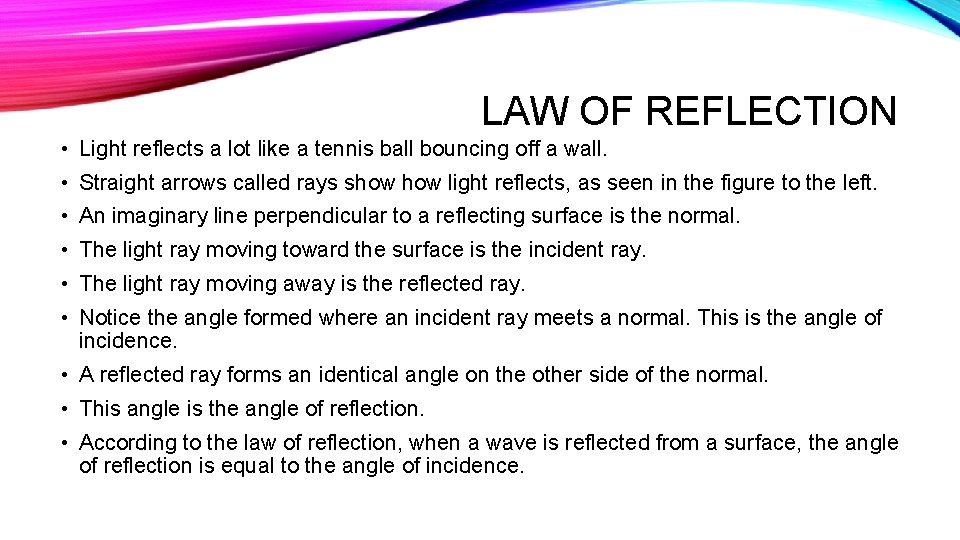
REFLECTION • • Why can you see your reflection clearly in a mirror but not in the wall of your room? Waves reflect off surfaces according to the law of reflection. Light rays that reflects from a smooth surface form a clear image. Rays that reflects from a bumpy surface scatter in many directions. A wall seems smooth, but up close it is too bumpy to form a clear image. Different types of matter interact with light in different ways. For example, a window transmits and reflects light. Although you can see through a transparent window, you also can see your reflection. • Some of the light that strikes an opaque object, such as a book, is absorbed and reflected at the same time.
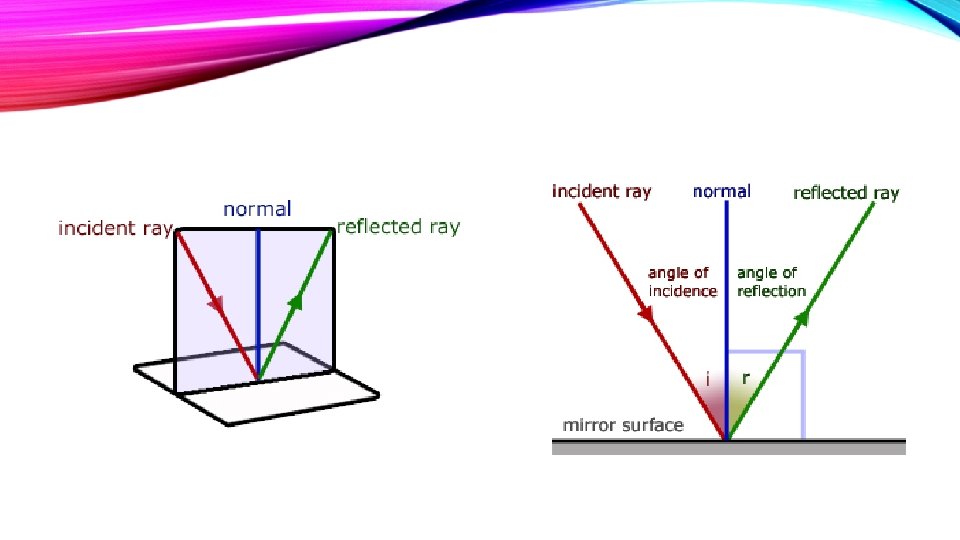
LAW OF REFLECTION • Light reflects a lot like a tennis ball bouncing off a wall. • Straight arrows called rays show light reflects, as seen in the figure to the left. • An imaginary line perpendicular to a reflecting surface is the normal. • The light ray moving toward the surface is the incident ray. • The light ray moving away is the reflected ray. • Notice the angle formed where an incident ray meets a normal. This is the angle of incidence. • A reflected ray forms an identical angle on the other side of the normal. • This angle is the angle of reflection. • According to the law of reflection, when a wave is reflected from a surface, the angle of reflection is equal to the angle of incidence.
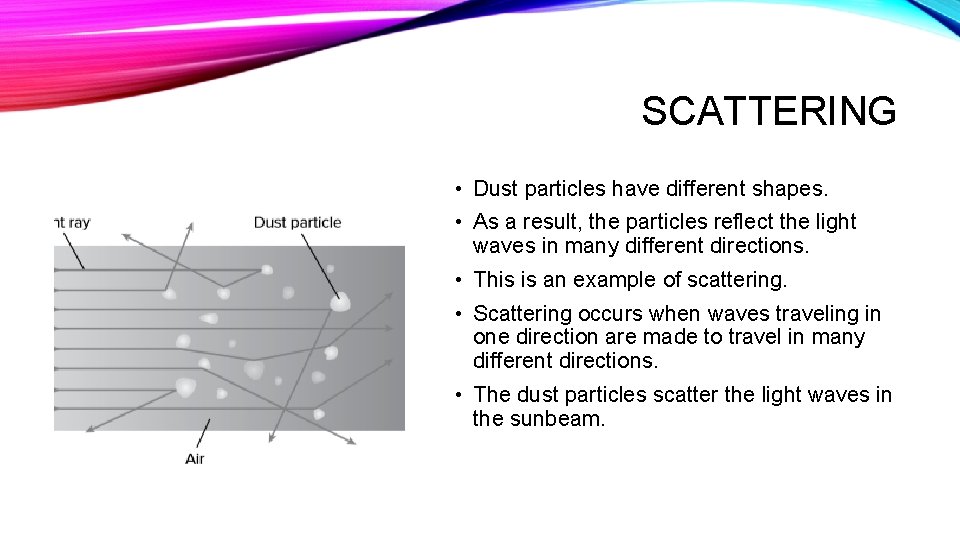
SCATTERING • Dust particles have different shapes. • As a result, the particles reflect the light waves in many different directions. • This is an example of scattering. • Scattering occurs when waves traveling in one direction are made to travel in many different directions. • The dust particles scatter the light waves in the sunbeam.
REFRACTION AND LENSES • Light always travels through empty space at the same speed— about 300, 000 km/s. • Medium Interactions • Light travels more slowly when it moves through a medium such as air, glass, or water. • This is because the atoms of the material interact with the light waves and slow them down. • Refraction of Light • As a light wave moves from one medium into another, its speed changes. • If the wave enters the new medium at an angle, the wave will change direction. • The change in direction of a wave as it changes speed while moving from one medium to another is called refraction
LENSES • A lens is a transparent object with at least one curved side that causes light to change direction. • Most of the light that strikes a transparent material passes through it. Light refracts as it passes through a lens. • The greater the curve of the lens, the more the light refracts. • The direction of refraction depends on whether the lens is curved outward or inward. • A lens that is thicker in the middle than at the edges is a convex lens. • A lens that is thicker at the edges than in the middle is a concave lens.
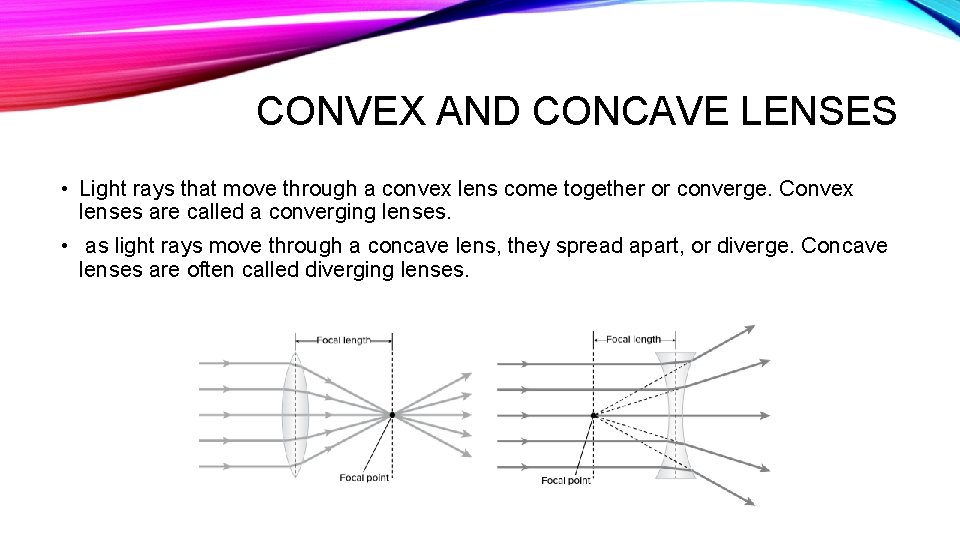
CONVEX AND CONCAVE LENSES • Light rays that move through a convex lens come together or converge. Convex lenses are called a converging lenses. • as light rays move through a concave lens, they spread apart, or diverge. Concave lenses are often called diverging lenses.
LIGHT AND COLOR • When light waves of different wavelengths strike an object, the object absorbs some light waves and reflects others. • The materials that make up the object determine the wavelengths of light that the object absorbs or reflects. • A red rose reflects light waves with certain wavelengths and absorbs all other wavelengths of light. • When the reflected light waves enter your eye, they cause cone cells in your retina to send certain nerve signals to your brain. • These signals cause you to see the rose as red. • A banana absorbs and reflects different wavelengths of light than a red rose does. • The reflected wavelengths cause cone cells to send different signals to your brain. • These signals cause you to see the banana as yellow. Light waves have no color.
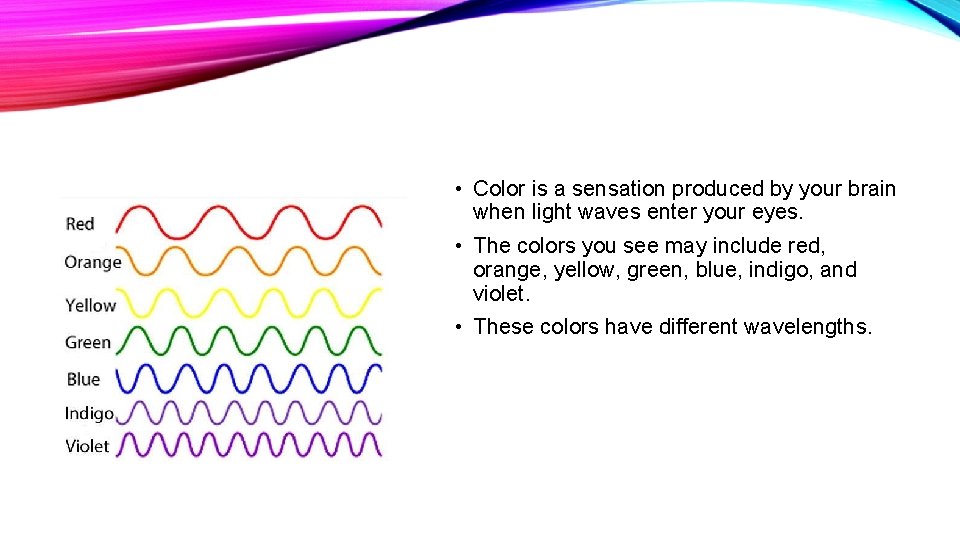
• Color is a sensation produced by your brain when light waves enter your eyes. • The colors you see may include red, orange, yellow, green, blue, indigo, and violet. • These colors have different wavelengths.
HOW DO DIFFERENT COLORS OF LIGHT AFFECT WHAT WE SEE? • Waves with longer wavelengths travel at greater speeds in a material than waves with shorter wavelengths. • Therefore, when entering a material, light with longer wavelengths travels faster and refracts less than light with shorter wavelengths. • As a result, violet refracts the most because its wavelength is the smallest. Red has the longest wavelength and refracts the least.
COLOR OF OBJECTS • Some objects, such as the Sun, lightbulbs, and neon lights, emit light. • The color of an object that emits light depends on the wavelengths of the light waves it emits. • For example, a red neon light emits light waves with wavelengths that you see as red.
COLORS OF LIGHT • Suppose white light shines through blue glass. • The glass absorbs all wavelengths of light except blue. • The blue wavelengths pass through the glass to your eyes. • If the blue glass is translucent, it transmits blue light, but the image is blurry. • Transparent or translucent objects are the colors they transmit.
COLORS FILTERS • Suppose you are wearing a shirt and you are in white light. • The shirt appears blue under the white light. • The only wavelengths that you see are blue. • If a color filter is applied to the light and only blue light is shown on the shirt, the blue light is reflected. • The shirt still appears to be blue. • If another color filter is used, such as red, the red light is absorbed and no light is reflected. • The shirt appears black under the red light. • The color you see always depends on the color of light the object reflects.