
Light Spanners for Snowflake Metrics LeeAd Gottlieb Shay
Light Spanners for Snowflake Metrics Lee-Ad Gottlieb Shay Solomon Ariel University Weizmann Institute So. CG 2014
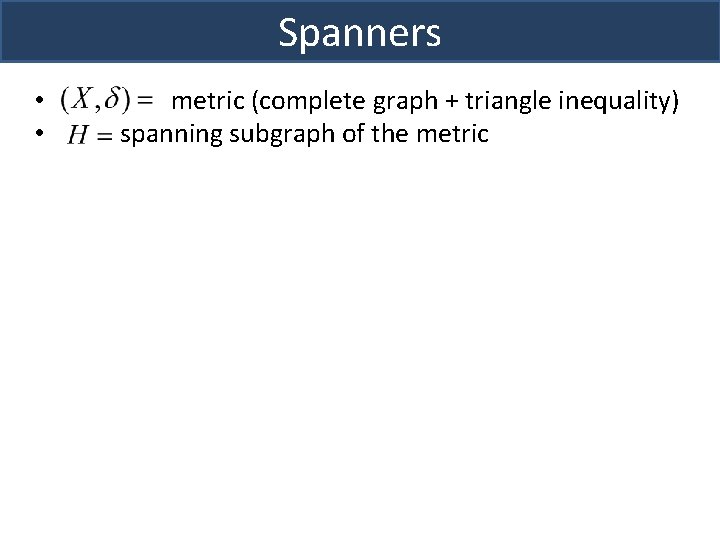
Spanners • • metric (complete graph + triangle inequality) spanning subgraph of the metric
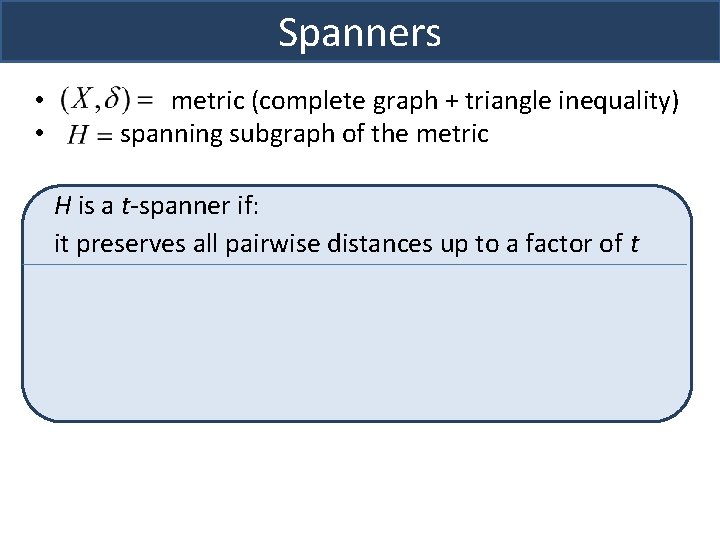
Spanners • • metric (complete graph + triangle inequality) spanning subgraph of the metric H is a t-spanner if: it preserves all pairwise distances up to a factor of t
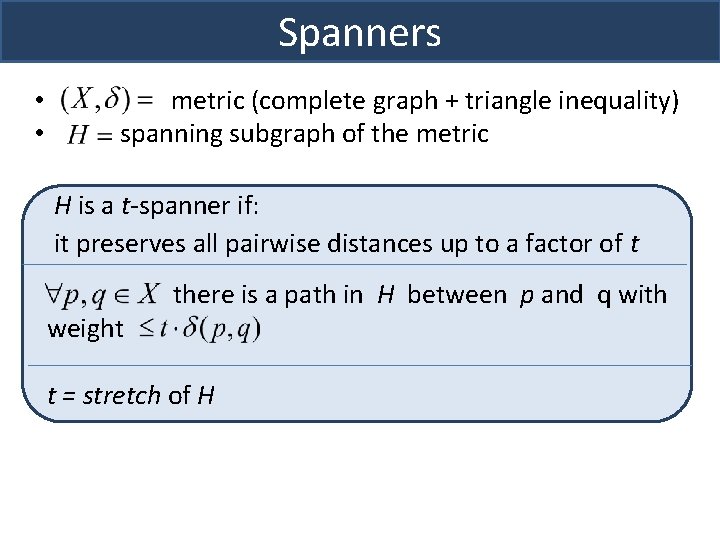
Spanners • • metric (complete graph + triangle inequality) spanning subgraph of the metric H is a t-spanner if: it preserves all pairwise distances up to a factor of t weight there is a path in H between p and q with t = stretch of H
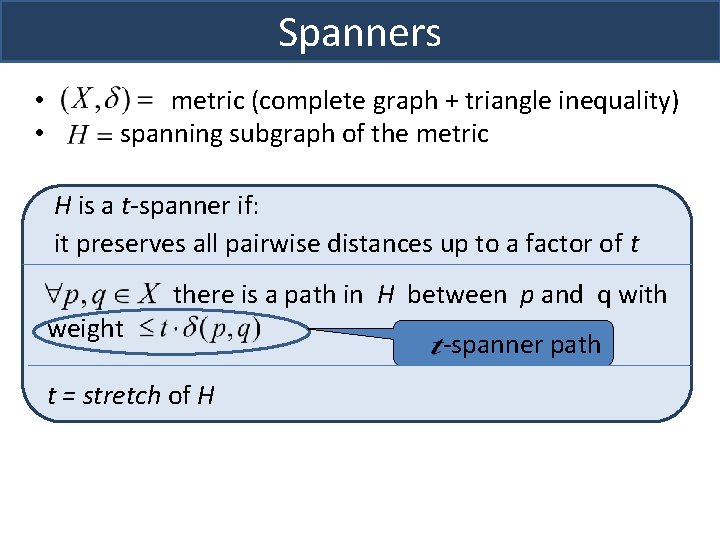
Spanners • • metric (complete graph + triangle inequality) spanning subgraph of the metric H is a t-spanner if: it preserves all pairwise distances up to a factor of t weight there is a path in H between p and q with t = stretch of H -spanner path
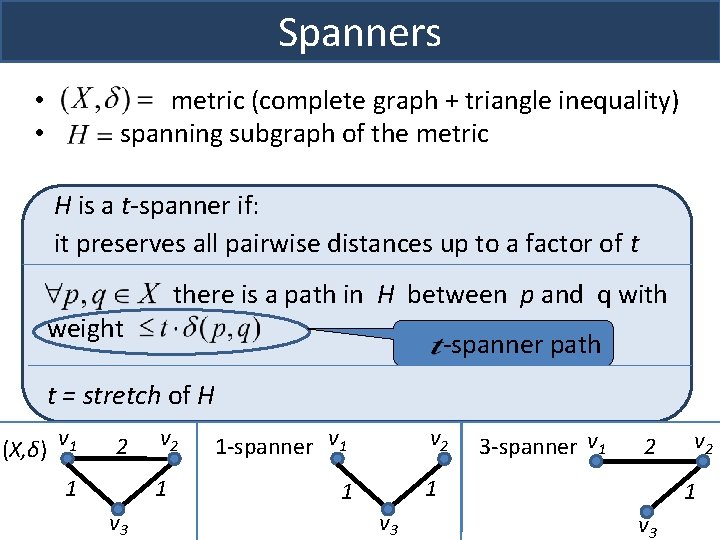
Spanners metric (complete graph + triangle inequality) spanning subgraph of the metric • • H is a t-spanner if: it preserves all pairwise distances up to a factor of t there is a path in H between p and q with weight -spanner path t = stretch of H (X, δ) v 1 2 1 v 3 1 -spanner v 1 v 2 3 -spanner v 1 2 1 1 v 3 v 2 1 v 3
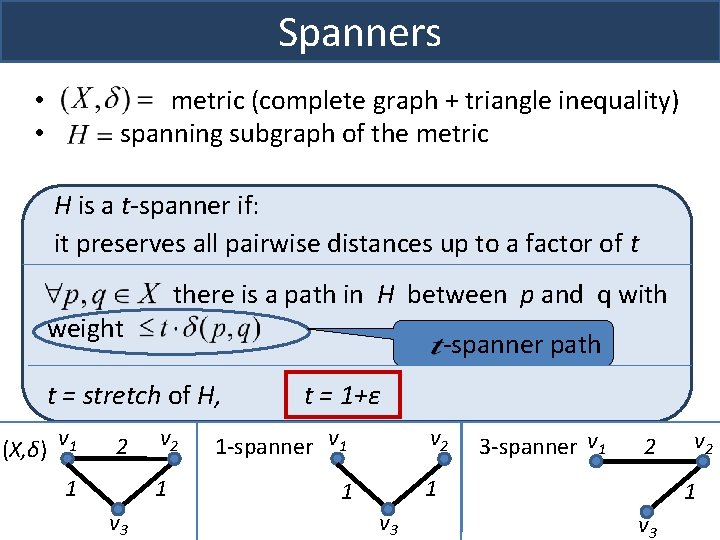
Spanners metric (complete graph + triangle inequality) spanning subgraph of the metric • • H is a t-spanner if: it preserves all pairwise distances up to a factor of t there is a path in H between p and q with weight -spanner path t = stretch of H, (X, δ) v 1 2 1 v 3 t = 1+ε 1 -spanner v 1 v 2 3 -spanner v 1 2 1 1 v 3 v 2 1 v 3
“Good” Spanners stretch 1+ε • Small number of edges, ideally O(n) Applications: distributed computing, TSP, …
“Good” Spanners stretch 1+ε • Small number of edges, ideally O(n) • small weight, ideally O(w(MST)) Applications: distributed computing, TSP, …
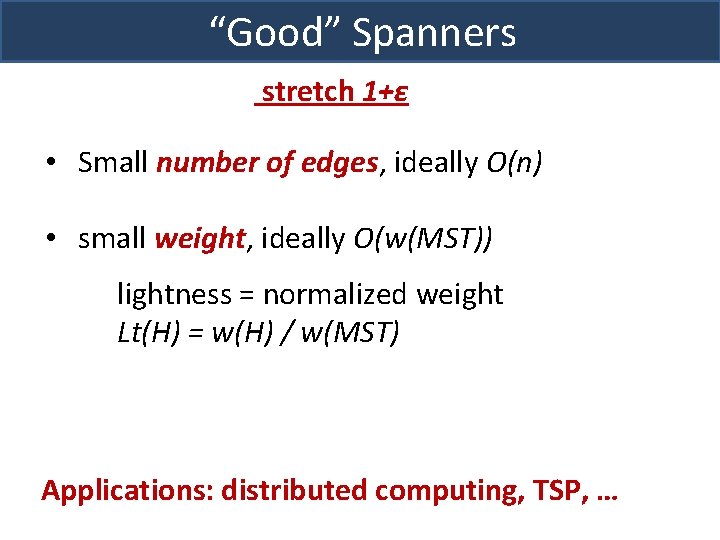
“Good” Spanners stretch 1+ε • Small number of edges, ideally O(n) • small weight, ideally O(w(MST)) lightness = normalized weight Lt(H) = w(H) / w(MST) Applications: distributed computing, TSP, …
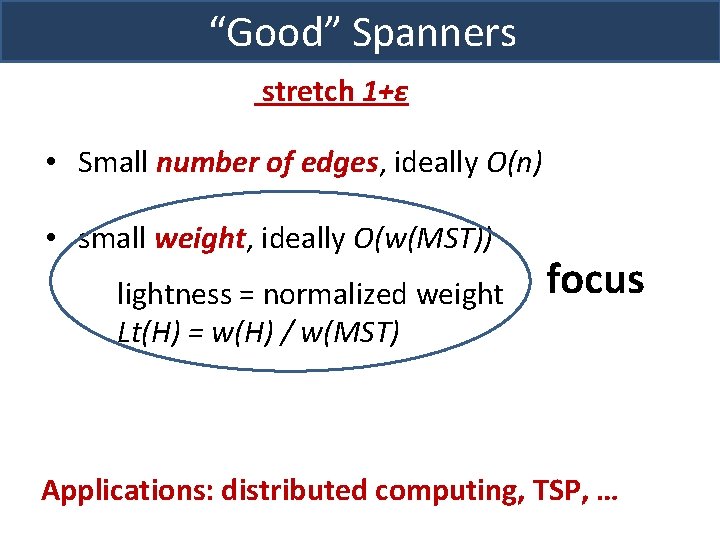
“Good” Spanners stretch 1+ε • Small number of edges, ideally O(n) • small weight, ideally O(w(MST)) lightness = normalized weight Lt(H) = w(H) / w(MST) focus Applications: distributed computing, TSP, …
Doubling Metrics “Good” spanners for arbitrary metrics?
Doubling Metrics “Good” spanners for arbitrary metrics? NO!
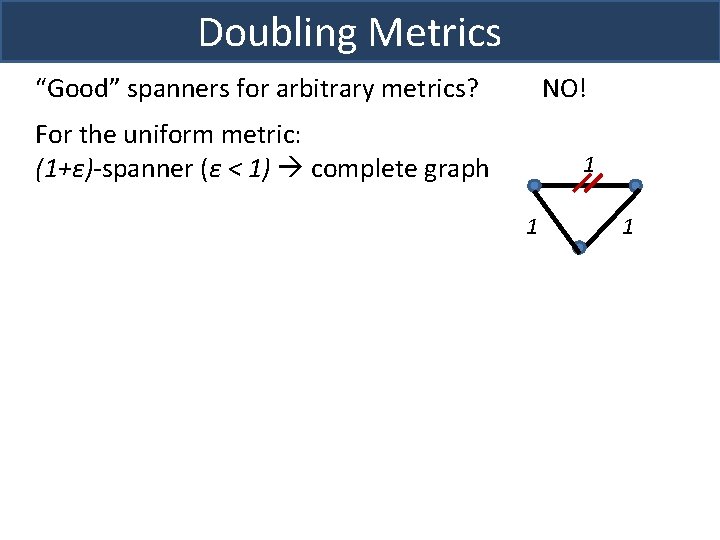
Doubling Metrics “Good” spanners for arbitrary metrics? NO! For the uniform metric: (1+ε)-spanner (ε < 1) complete graph 1 1 1
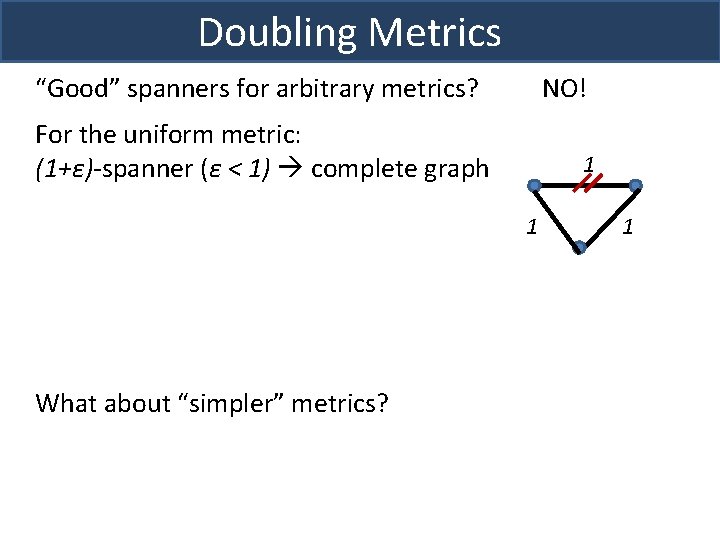
Doubling Metrics “Good” spanners for arbitrary metrics? NO! For the uniform metric: (1+ε)-spanner (ε < 1) complete graph 1 1 What about “simpler” metrics? 1
Doubling Metrics Definition (doubling dimension) Metric (X, δ) has doubling dimension d if every ball can be covered by 2 d balls of half the radius. A metric is doubling if its doubling dimension is constant
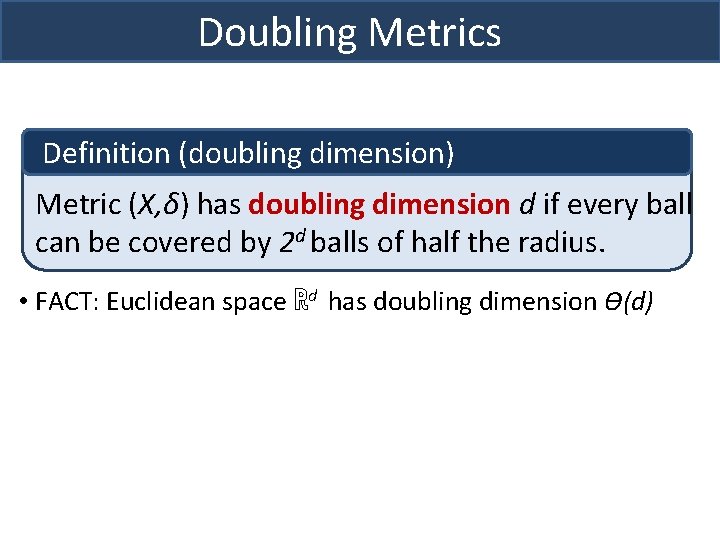
Doubling Metrics Definition (doubling dimension) Metric (X, δ) has doubling dimension d if every ball can be covered by 2 d balls of half the radius. • FACT: Euclidean space ℝd has doubling dimension Ѳ(d)
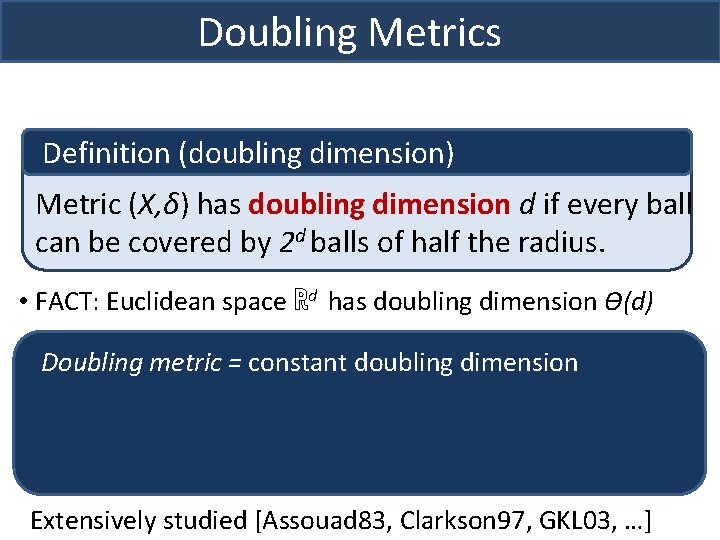
Doubling Metrics Definition (doubling dimension) Metric (X, δ) has doubling dimension d if every ball can be covered by 2 d balls of half the radius. • FACT: Euclidean space ℝd has doubling dimension Ѳ(d) Doubling metric = constant doubling dimension Extensively studied [Assouad 83, Clarkson 97, GKL 03, …]
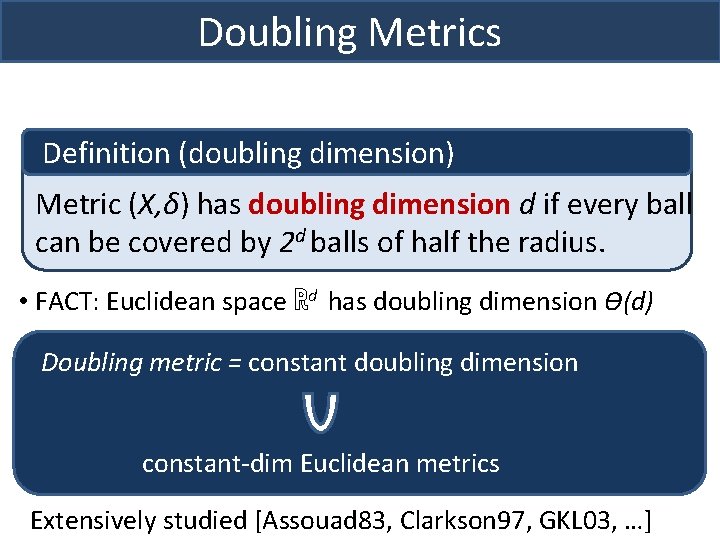
Doubling Metrics Definition (doubling dimension) Metric (X, δ) has doubling dimension d if every ball can be covered by 2 d balls of half the radius. • FACT: Euclidean space ℝd has doubling dimension Ѳ(d) Doubling metric = constant doubling dimension constant-dim Euclidean metrics Extensively studied [Assouad 83, Clarkson 97, GKL 03, …]
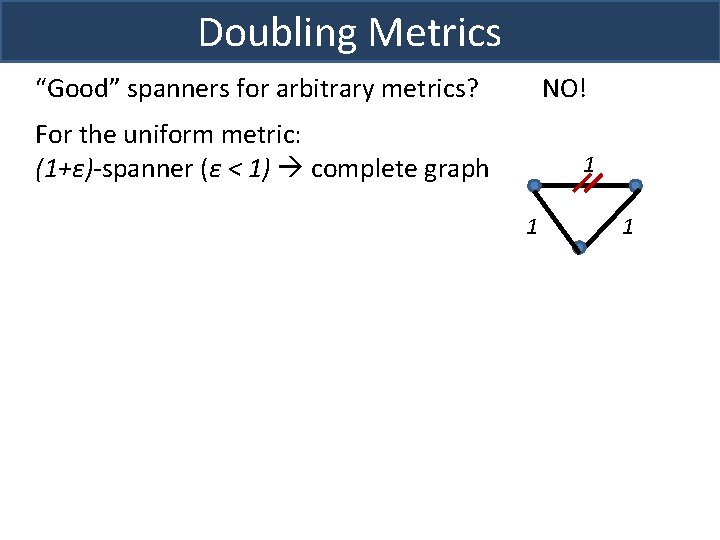
Doubling Metrics “Good” spanners for arbitrary metrics? NO! For the uniform metric: (1+ε)-spanner (ε < 1) complete graph 1 1 1
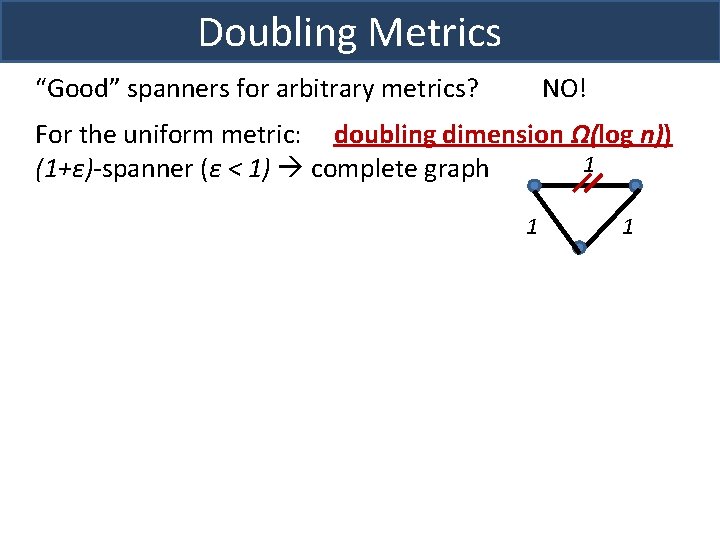
Doubling Metrics “Good” spanners for arbitrary metrics? NO! For the uniform metric: doubling dimension Ω(log n)) 1 (1+ε)-spanner (ε < 1) complete graph 1 1
Light Spanners “Good” spanners for arbitrary metrics? NO! For the uniform metric: doubling dimension Ω(log n)) (1+ε)-spanner (ε < 1) complete graph 1 “light spanner” THEOREM (Euclidean metrics) 1 • Any low-dim Euclidean metric admits (1+ε)-spanners with lightness [Das et al. , So. CG’ 93] A metric is doubling if its doubling dimension is constant
Light Spanners “Good” spanners for arbitrary metrics? NO! For the uniform metric: doubling dimension Ω(log n)) (1+ε)-spanner (ε < 1) complete graph 1 “light spanner” THEOREM (Euclidean metrics) 1 • Any low-dim Euclidean metric admits (1+ε)-spanners with lightness [Das et al. , So. CG’ 93] A metric is doubling if its doubling dimension is constant “light spanner” CONJECTURE (doubling metrics) • Doubling metrics admit (1+ε)-spanners with lightness • naïve bound = lightness
Light Spanners APPLICATION: Euclidean traveling salesman problem (TSP) • PTAS, (1+ε)-approx tour, runtime [Arora JACM’ 98, Mitchell SICOMP’ 99] • Using light spanners, runtime [Rao-Smith, STOC’ 98]
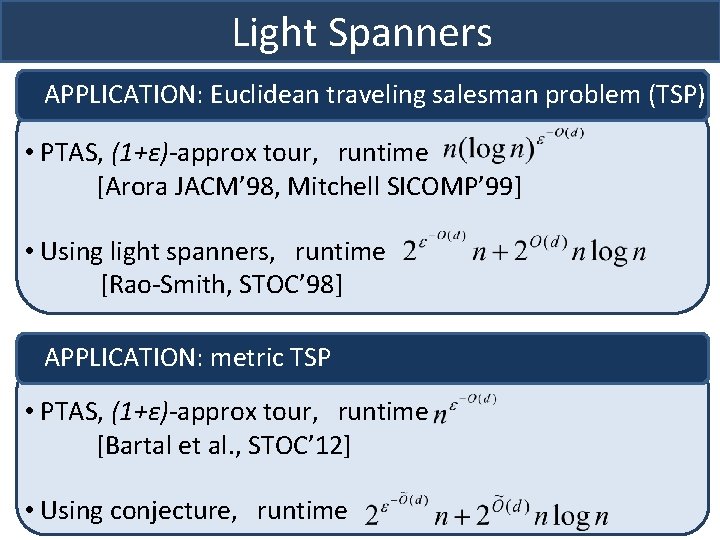
Light Spanners APPLICATION: Euclidean traveling salesman problem (TSP) • PTAS, (1+ε)-approx tour, runtime [Arora JACM’ 98, Mitchell SICOMP’ 99] • Using light spanners, runtime [Rao-Smith, STOC’ 98] APPLICATION: metric TSP • PTAS, (1+ε)-approx tour, runtime [Bartal et al. , STOC’ 12] • Using conjecture, runtime
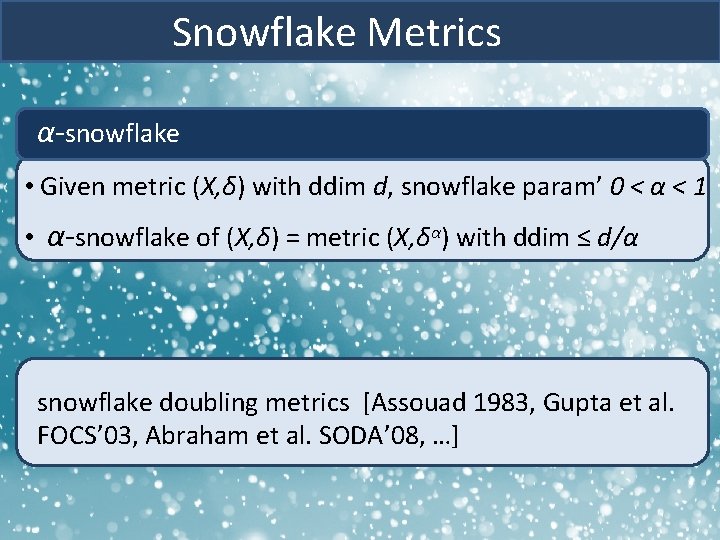
Snowflake Metrics α-snowflake • Given metric (X, δ) with ddim d, snowflake param’ 0 < α < 1 • α-snowflake of (X, δ) = metric (X, δα) with ddim ≤ d/α snowflake doubling metrics [Assouad 1983, Gupta et al. FOCS’ 03, Abraham et al. SODA’ 08, …]
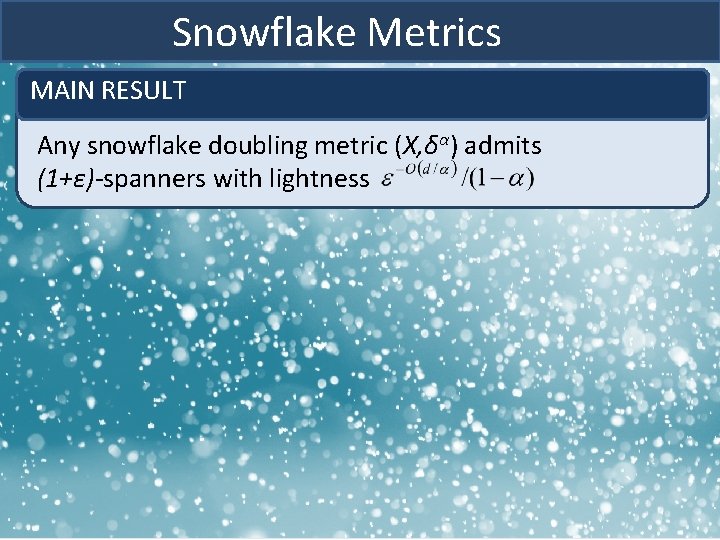
Snowflake Metrics MAIN RESULT Any snowflake doubling metric (X, δα) admits (1+ε)-spanners with lightness
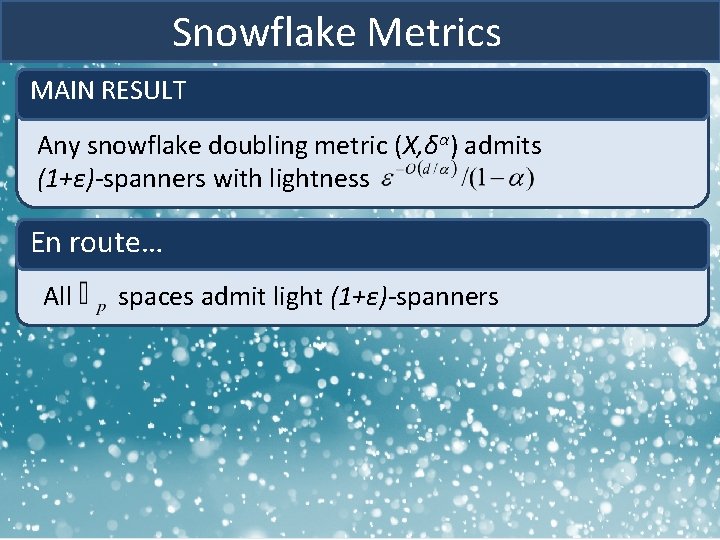
Snowflake Metrics MAIN RESULT Any snowflake doubling metric (X, δα) admits (1+ε)-spanners with lightness En route… All spaces admit light (1+ε)-spanners
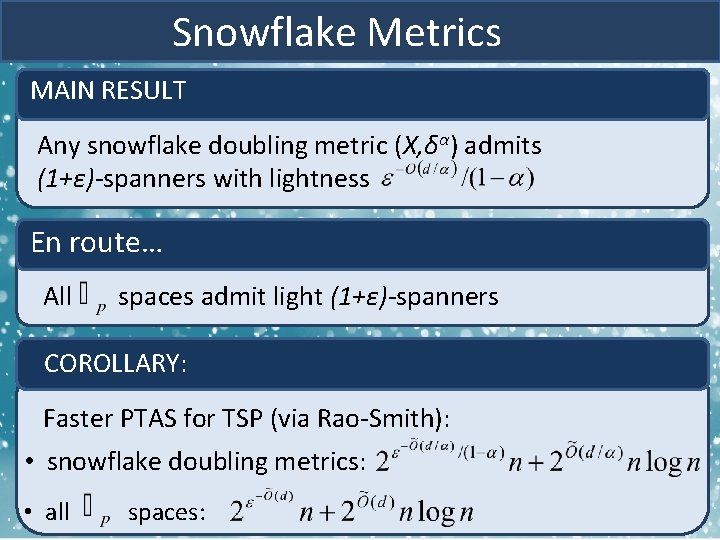
Snowflake Metrics MAIN RESULT Any snowflake doubling metric (X, δα) admits (1+ε)-spanners with lightness En route… All spaces admit light (1+ε)-spanners COROLLARY: Faster PTAS for TSP (via Rao-Smith): • snowflake doubling metrics: • all spaces:

PROOFS
Snowflake Metrics MAIN RESULT • Any snowflake doubling metric (X, δα) admits (1+ε)-spanners with constant lightness PROOF I – combine known results with new lemma •
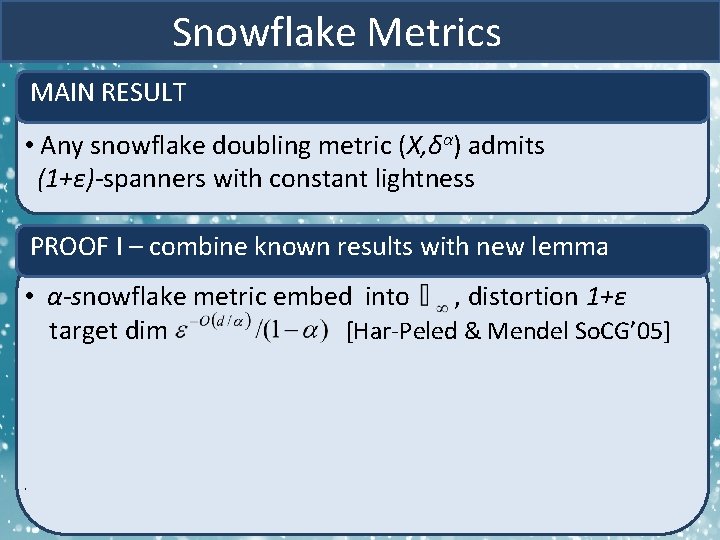
Snowflake Metrics MAIN RESULT • Any snowflake doubling metric (X, δα) admits (1+ε)-spanners with constant lightness PROOF I – combine known results with new lemma • α-snowflake metric embed into , distortion 1+ε target dim [Har-Peled & Mendel So. CG’ 05] •
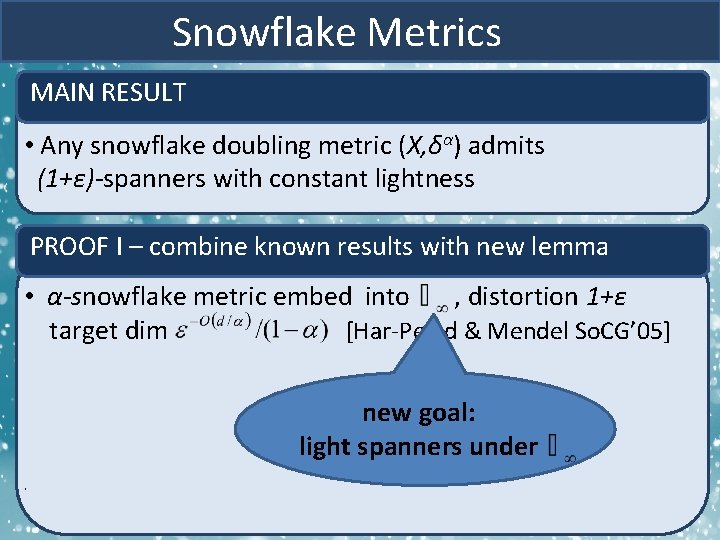
Snowflake Metrics MAIN RESULT • Any snowflake doubling metric (X, δα) admits (1+ε)-spanners with constant lightness PROOF I – combine known results with new lemma • α-snowflake metric embed into , distortion 1+ε target dim [Har-Peled & Mendel So. CG’ 05] new goal: light spanners under •
Snowflake Metrics MAIN RESULT • Any snowflake doubling metric (X, δα) admits (1+ε)-spanners with constant lightness PROOF I – combine known results with new lemma • α-snowflake metric embed into , distortion 1+ε target dim [Har-Peled & Mendel So. CG’ 05] •
Snowflake Metrics MAIN RESULT • Any snowflake doubling metric (X, δα) admits (1+ε)-spanners with constant lightness PROOF I – combine known results with new lemma • α-snowflake metric embed into , distortion 1+ε target dim [Har-Peled & Mendel So. CG’ 05] • WE SAW: light spanners in low-dim Euclidean metrics (under ) [Das et al. , So. CG’ 93]
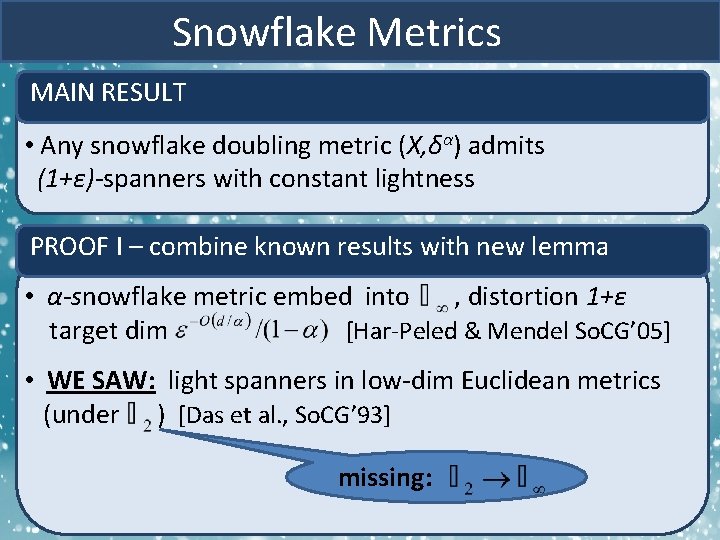
Snowflake Metrics MAIN RESULT • Any snowflake doubling metric (X, δα) admits (1+ε)-spanners with constant lightness PROOF I – combine known results with new lemma • α-snowflake metric embed into , distortion 1+ε target dim [Har-Peled & Mendel So. CG’ 05] • WE SAW: light spanners in low-dim Euclidean metrics (under ) [Das et al. , So. CG’ 93] missing:
Snowflake Metrics MAIN RESULT • Any snowflake doubling metric (X, δα) admits (1+ε)-spanners with constant lightness PROOF I – combine known results with new lemma • α-snowflake metric embed into , distortion 1+ε target dim [Har-Peled & Mendel So. CG’ 05] • WE SAW: light spanners in low-dim Euclidean metrics (under ) [Das et al. , So. CG’ 93]
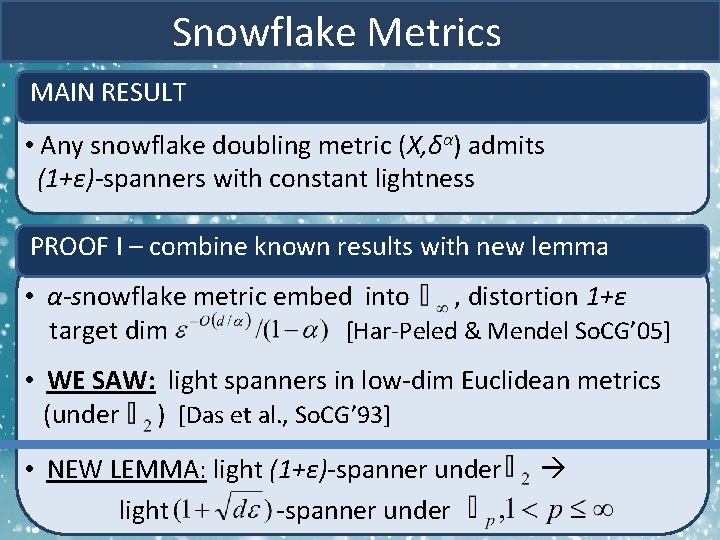
Snowflake Metrics MAIN RESULT • Any snowflake doubling metric (X, δα) admits (1+ε)-spanners with constant lightness PROOF I – combine known results with new lemma • α-snowflake metric embed into , distortion 1+ε target dim [Har-Peled & Mendel So. CG’ 05] • WE SAW: light spanners in low-dim Euclidean metrics (under ) [Das et al. , So. CG’ 93] • NEW LEMMA: light (1+ε)-spanner under light -spanner under
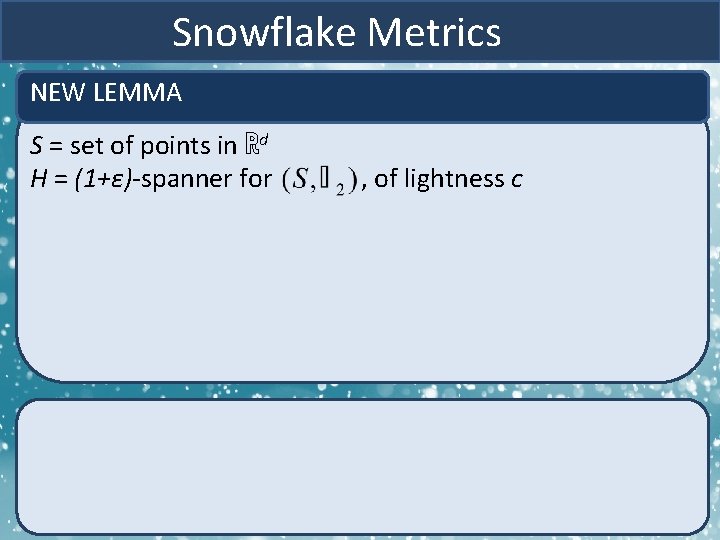
Snowflake Metrics NEW LEMMA S = set of points in ℝd H = (1+ε)-spanner for , of lightness c
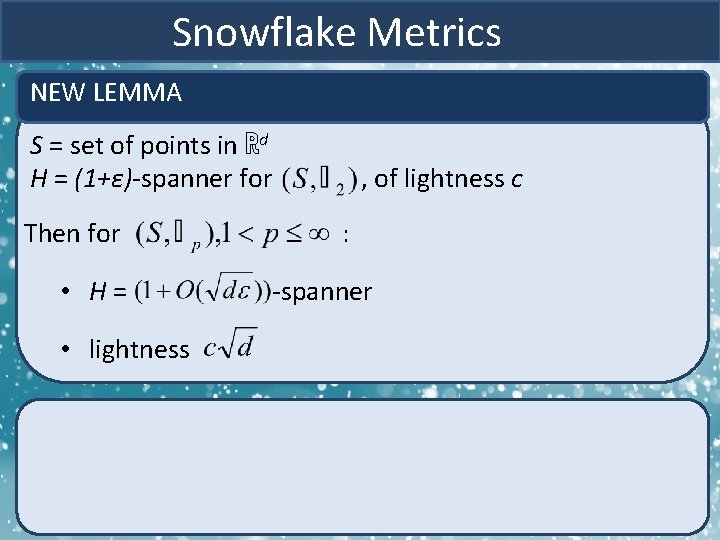
Snowflake Metrics NEW LEMMA S = set of points in ℝd H = (1+ε)-spanner for Then for • H= • lightness , of lightness c : -spanner
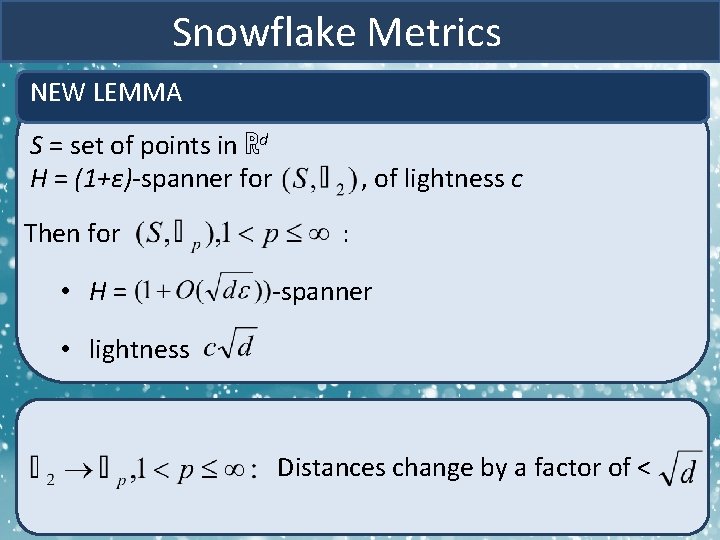
Snowflake Metrics NEW LEMMA S = set of points in ℝd H = (1+ε)-spanner for Then for • H= , of lightness c : -spanner • lightness Distances change by a factor of <
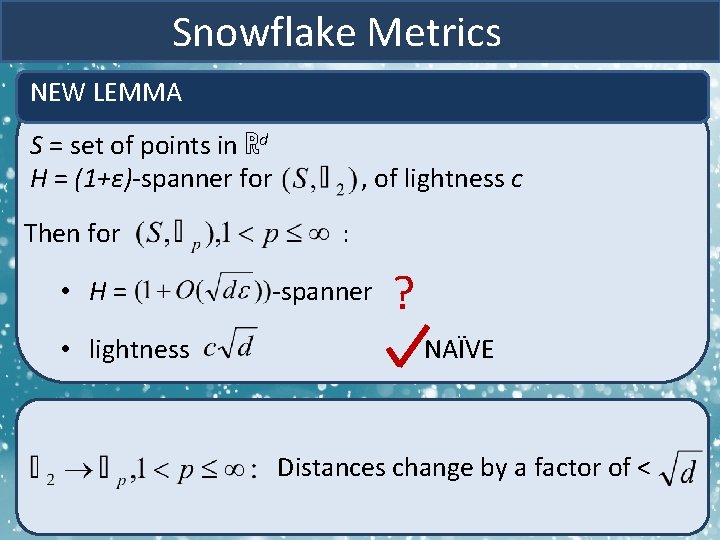
Snowflake Metrics NEW LEMMA S = set of points in ℝd H = (1+ε)-spanner for Then for • H= • lightness , of lightness c : -spanner ? NAÏVE Distances change by a factor of <
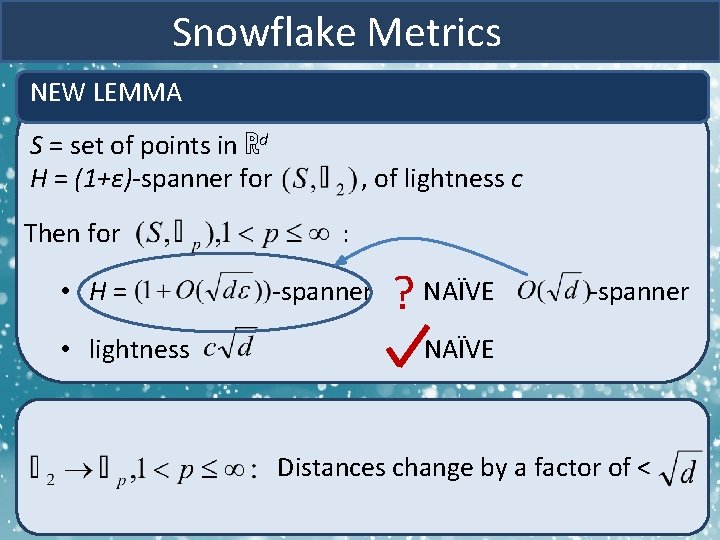
Snowflake Metrics NEW LEMMA S = set of points in ℝd H = (1+ε)-spanner for Then for • H= • lightness , of lightness c : -spanner ? NAÏVE -spanner NAÏVE Distances change by a factor of <
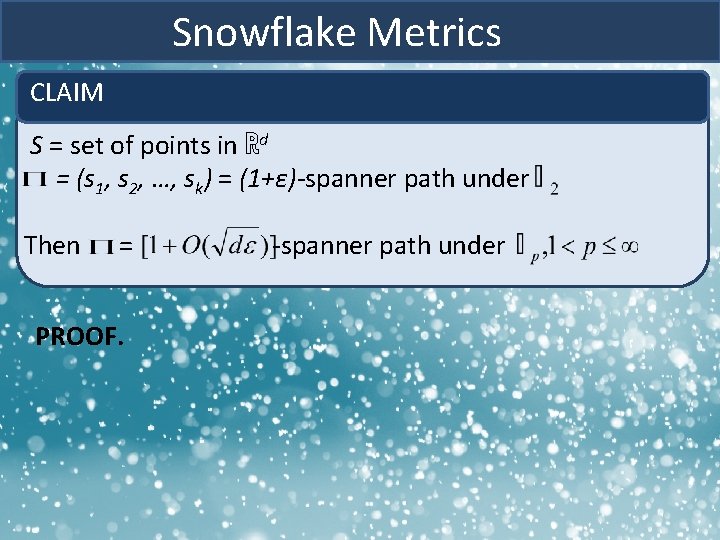
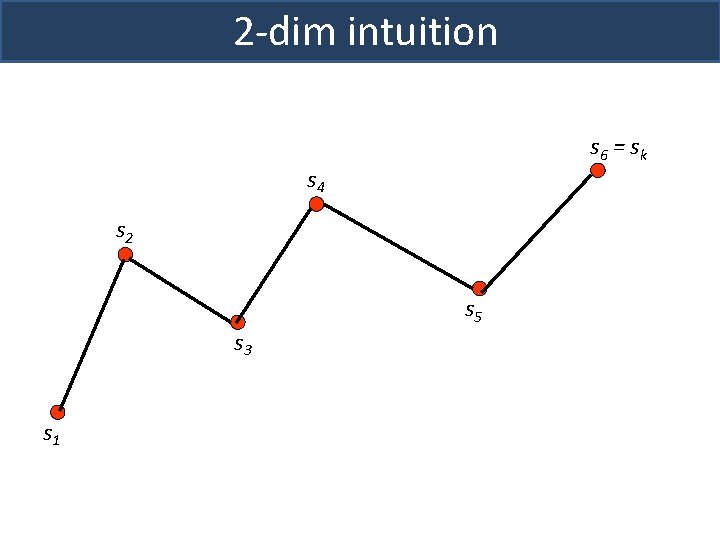
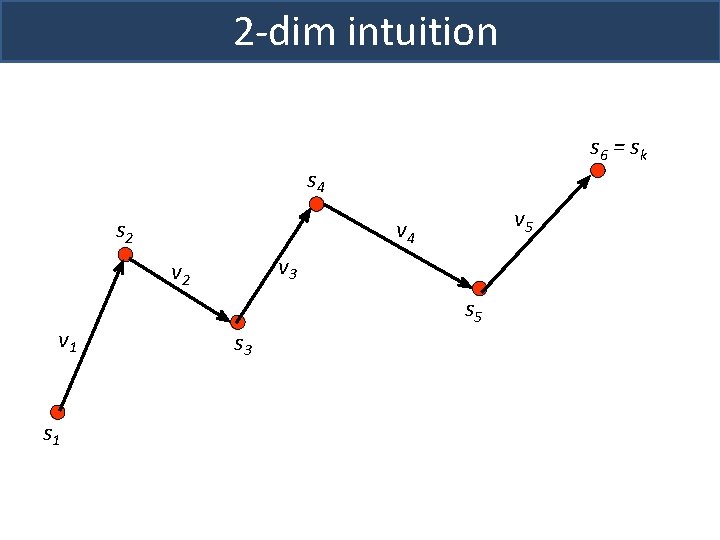
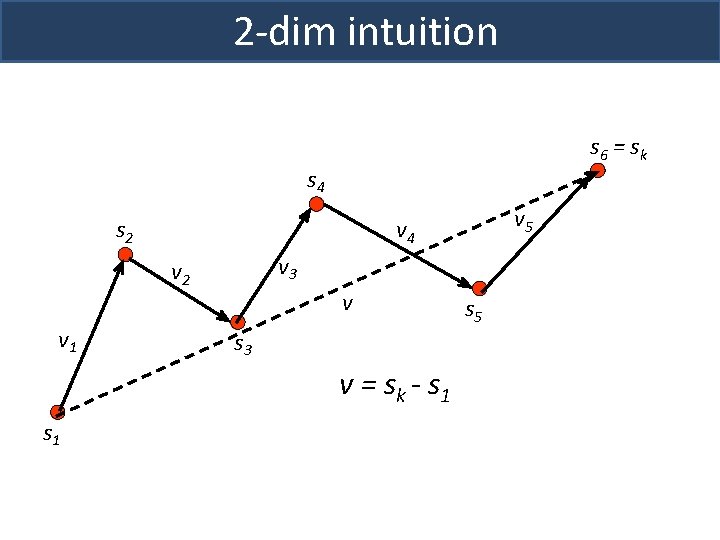
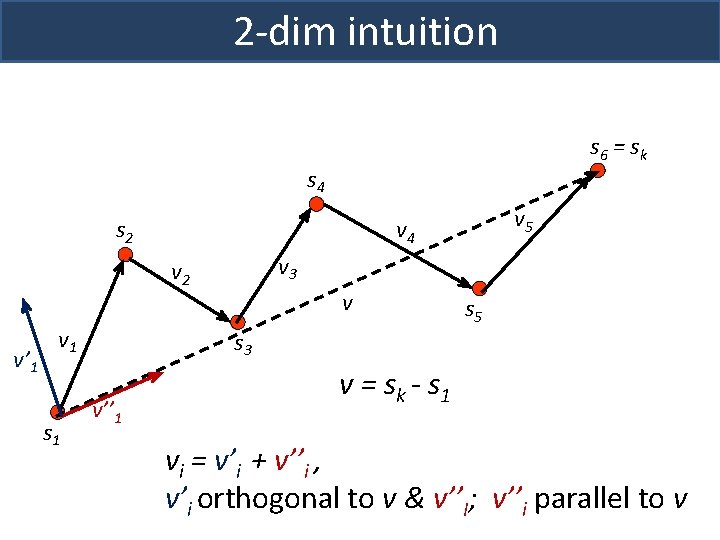
Snowflake Metrics CLAIM S = set of points in ℝd = (s 1, s 2, …, sk) = (1+ε)-spanner path under Then = PROOF. -spanner path under
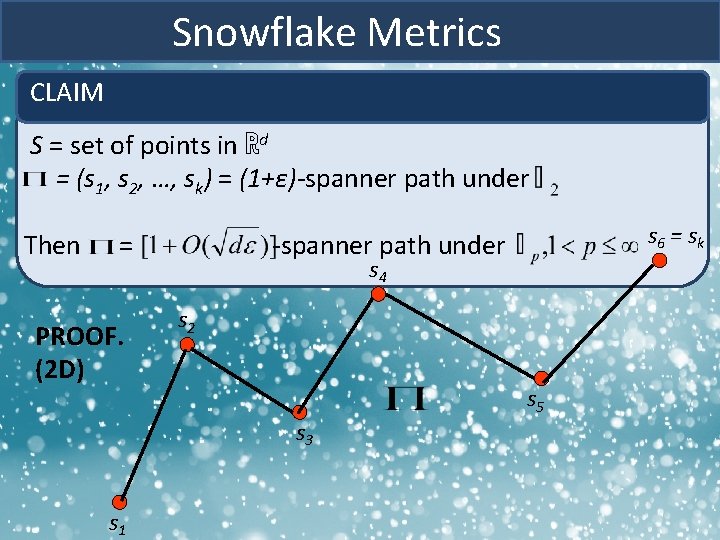
Snowflake Metrics CLAIM S = set of points in ℝd = (s 1, s 2, …, sk) = (1+ε)-spanner path under Then = PROOF. (2 D) s 4 s 2 s 5 s 3 s 1 s 6 = s k -spanner path under
2 -dim intuition s 6 = s k s 4 s 2 s 5 s 3 s 1
2 -dim intuition s 6 = s k s 4 s 2 v 3 v 2 v 1 s 1 v 5 v 4 s 5 s 3
2 -dim intuition s 6 = s k s 4 s 2 v 3 v 2 v 1 v s 3 v = s k - s 1 v 5 v 4 s 5
2 -dim intuition s 6 = s k s 4 s 2 v 3 v 2 v’ 1 v 1 s 1 v 5 v 4 v s 5 s 3 v’’ 1 v = s k - s 1 vi = v’i + v’’i , v’i orthogonal to v & v’’I; v’’i parallel to v
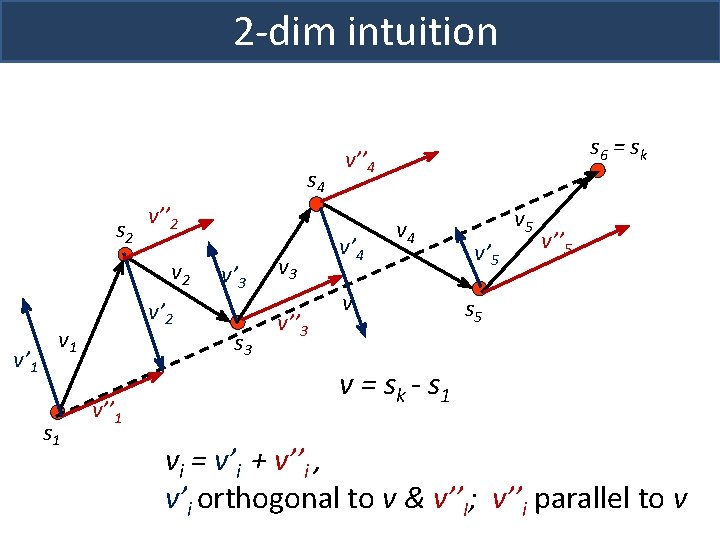
2 -dim intuition s 4 s 2 v’’ 2 v’ 1 v’ 2 v 1 s 1 v’’ 1 v’ 3 s 3 v’’ 3 s 6 = s k v’’ 4 v 4 v v 5 v’’ 5 s 5 v = s k - s 1 vi = v’i + v’’i , v’i orthogonal to v & v’’I; v’’i parallel to v
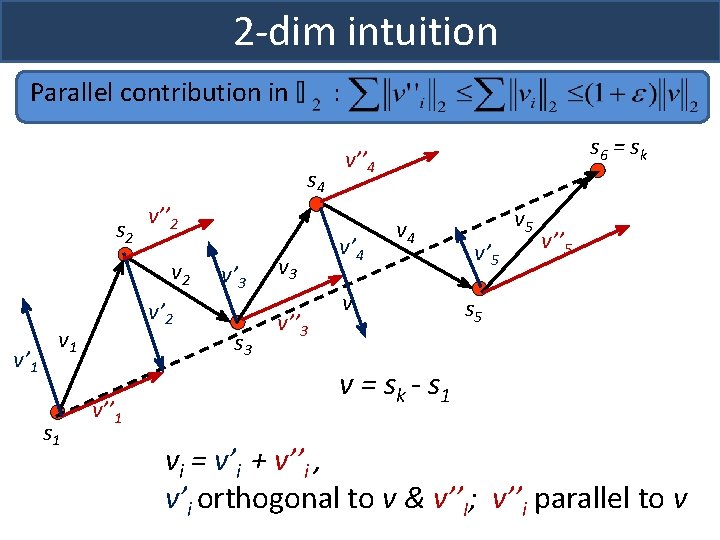
2 -dim intuition Parallel contribution in : s 4 s 2 v’’ 2 v’ 1 v’ 2 v 1 s 1 v’’ 1 v’ 3 s 3 v’’ 3 s 6 = s k v’’ 4 v 4 v v 5 v’’ 5 s 5 v = s k - s 1 vi = v’i + v’’i , v’i orthogonal to v & v’’I; v’’i parallel to v
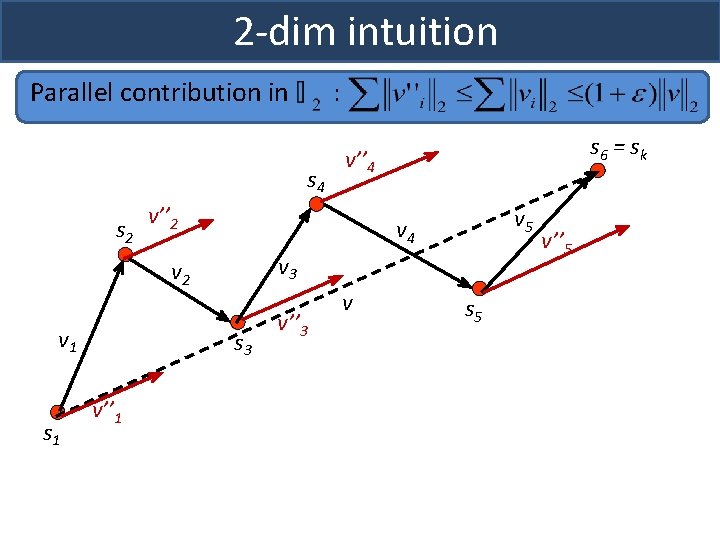
2 -dim intuition Parallel contribution in : s 4 s 2 v’’ 2 v 3 s 1 s 3 v’’ 1 v 5 v 4 v 2 v 1 s 6 = s k v’’ 4 v’’ 3 v s 5 v’’ 5
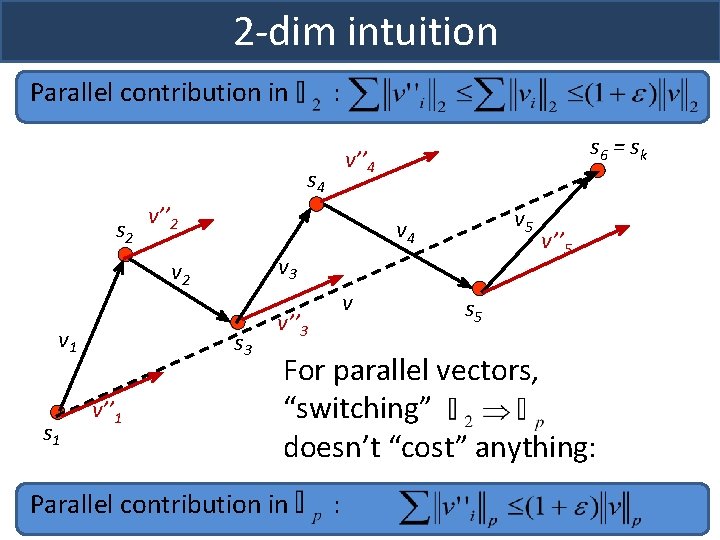
2 -dim intuition Parallel contribution in : s 4 s 2 v’’ 2 v 3 s 1 s 3 v’’ 1 v 5 v 4 v 2 v 1 s 6 = s k v’’ 4 v v’’ 3 v’’ 5 s 5 For parallel vectors, “switching” doesn’t “cost” anything: Parallel contribution in :
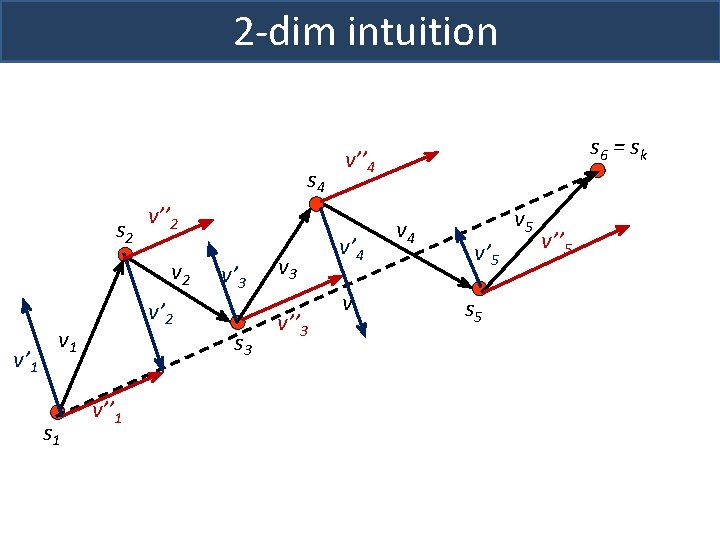
2 -dim intuition s 4 s 2 v’’ 2 v’ 1 v’ 2 v 1 s 1 v’’ 1 v’ 3 s 3 v’’ 3 s 6 = s k v’’ 4 v v 4 v 5 v’ 5 s 5 v’’ 5
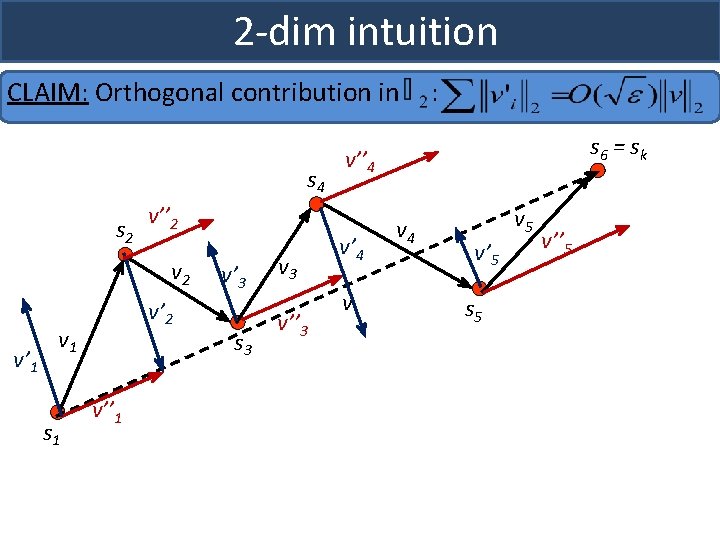
2 -dim intuition CLAIM: Orthogonal contribution in s 4 s 2 v’’ 2 v’ 1 v’ 2 v 1 s 1 v’’ 1 v’ 3 s 3 v’’ 3 : s 6 = s k v’’ 4 v v 4 v 5 v’ 5 s 5 v’’ 5
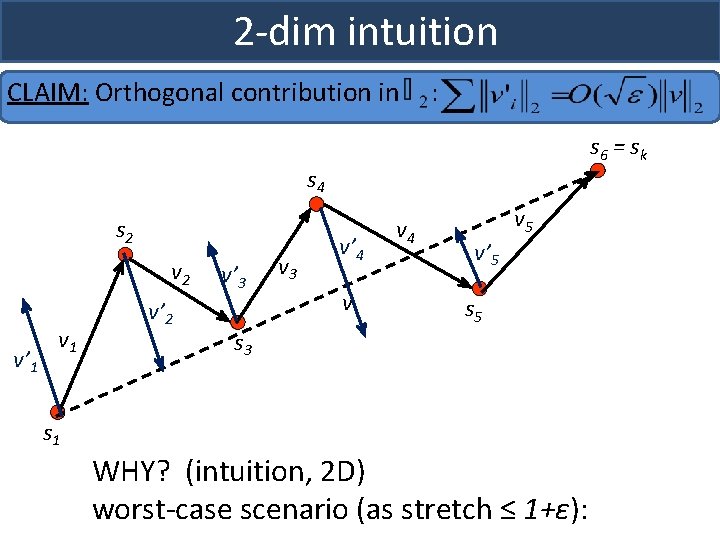
2 -dim intuition CLAIM: Orthogonal contribution in : s 6 = s k s 4 s 2 v’ 1 v’ 2 v’ 3 v’ 4 v v 4 v 5 v’ 5 s 3 s 1 WHY? (intuition, 2 D) worst-case scenario (as stretch ≤ 1+ε):
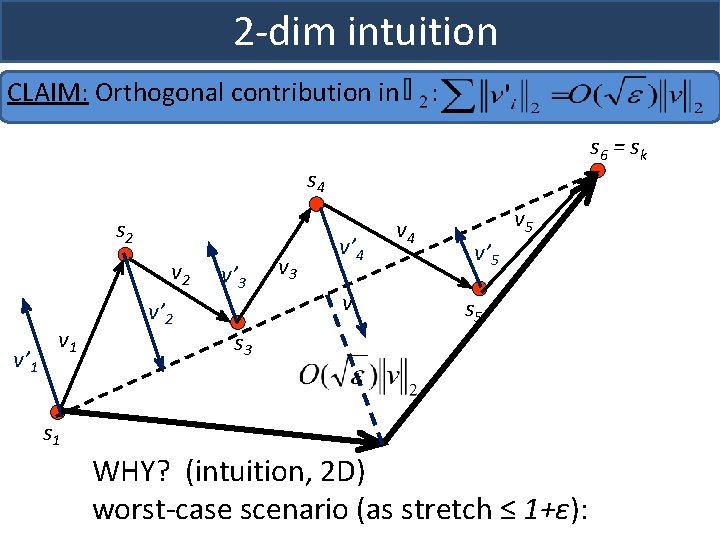
2 -dim intuition CLAIM: Orthogonal contribution in : s 6 = s k s 4 s 2 v’ 1 v’ 2 v’ 3 v’ 4 v v 4 v 5 v’ 5 s 3 s 1 WHY? (intuition, 2 D) worst-case scenario (as stretch ≤ 1+ε):
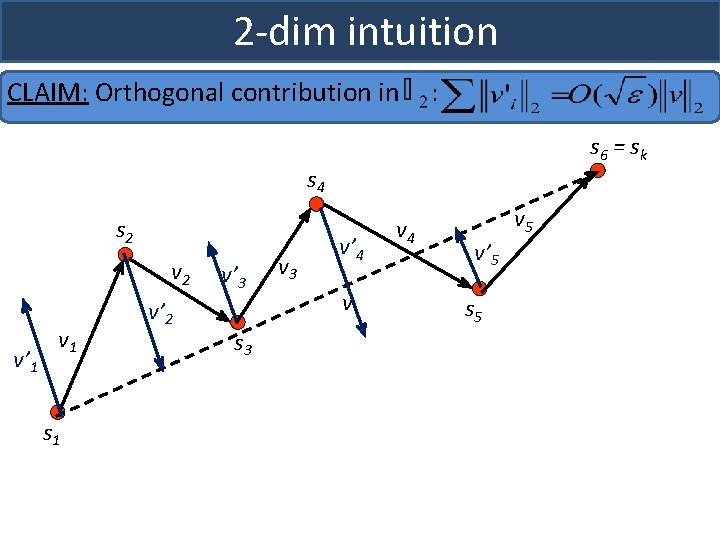
2 -dim intuition CLAIM: Orthogonal contribution in : s 6 = s k s 4 s 2 v’ 1 v 1 s 1 v’ 2 v’ 3 s 3 v’ 4 v v 4 v 5 v’ 5 s 5
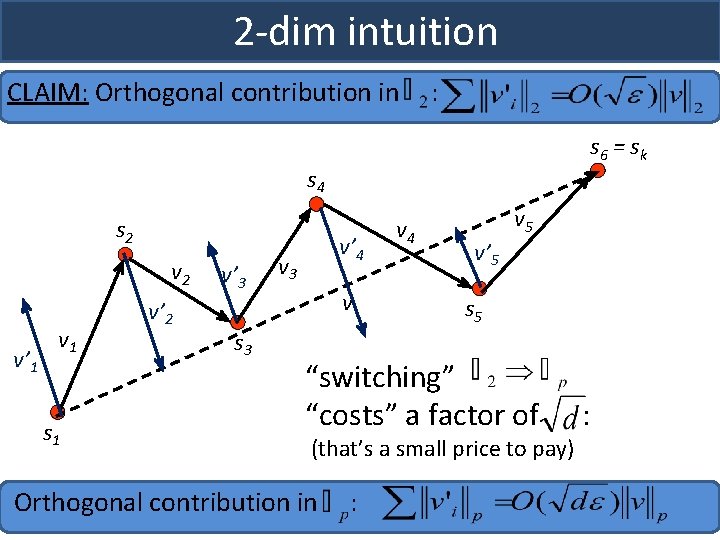
2 -dim intuition CLAIM: Orthogonal contribution in : s 6 = s k s 4 s 2 v’ 1 v 1 s 1 v’ 2 v’ 3 s 3 v’ 4 v 3 v v 4 v 5 v’ 5 s 5 “switching” “costs” a factor of (that’s a small price to pay) Orthogonal contribution in : :
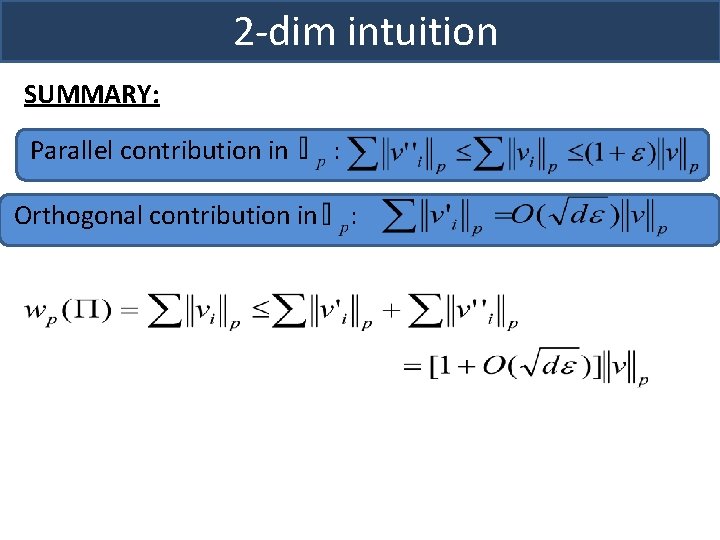
2 -dim intuition SUMMARY: Parallel contribution in Orthogonal contribution in : :
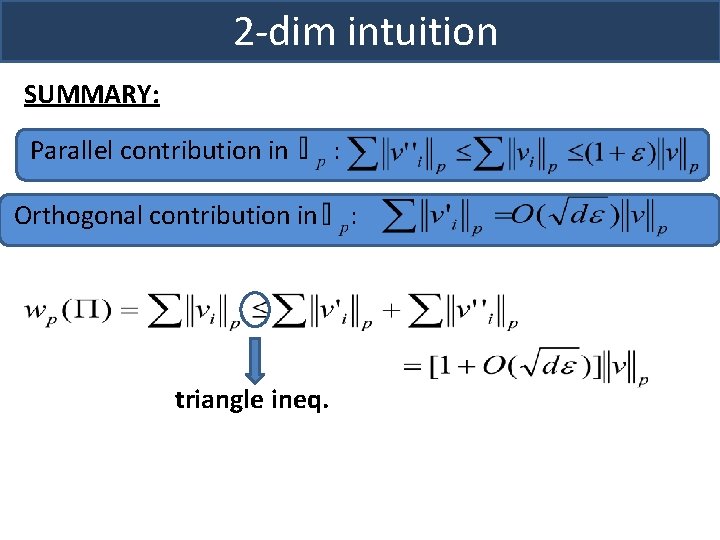
2 -dim intuition SUMMARY: Parallel contribution in Orthogonal contribution in triangle ineq. : :
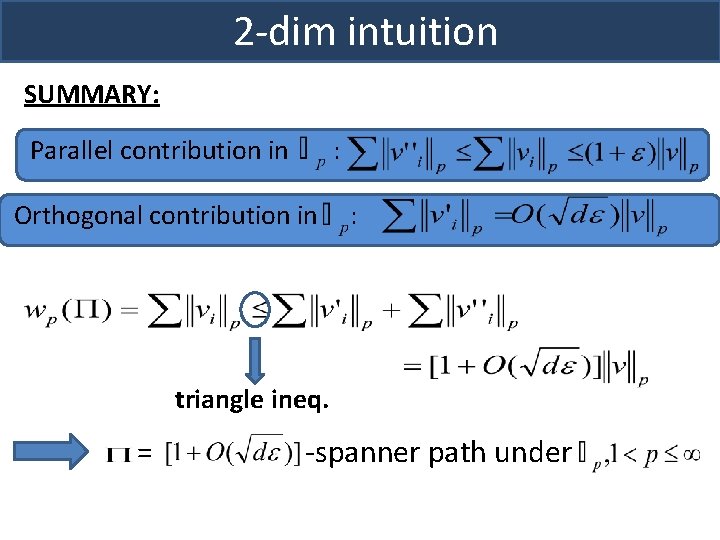
2 -dim intuition SUMMARY: Parallel contribution in : Orthogonal contribution in : triangle ineq. = -spanner path under
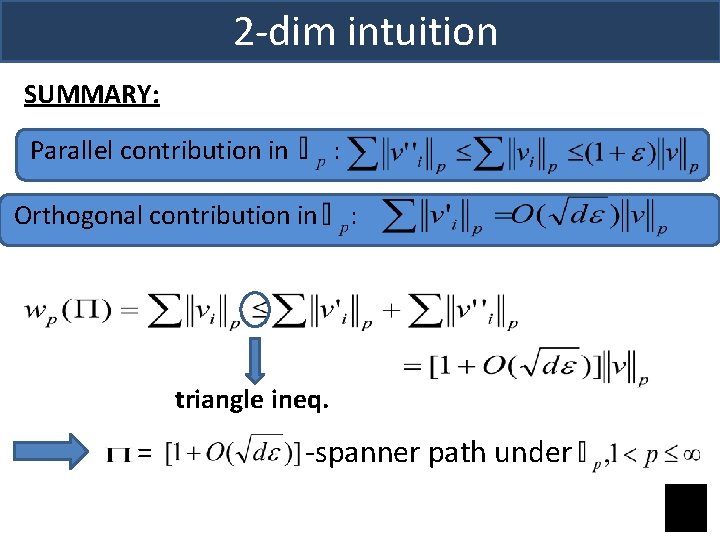
2 -dim intuition SUMMARY: Parallel contribution in : Orthogonal contribution in : triangle ineq. = -spanner path under
Snowflake Metrics PROOF II – direct argument • The standard “net-tree spanner” [Gao et al. So. CG’ 04, Chan et al. SODA’ 05] is light!
Snowflake Metrics PROOF II – direct argument • The standard “net-tree spanner” [Gao et al. So. CG’ 04, Chan et al. SODA’ 05] is light! • More complicated, but bypasses heavy machinery
Snowflake Metrics PROOF II – direct argument • The standard “net-tree spanner” [Gao et al. So. CG’ 04, Chan et al. SODA’ 05] is light! • More complicated, but bypasses heavy machinery • Yields smaller lightness (singly vs. doubly exponential) Important for metric TSP
Snowflake Metrics PROOF II – direct argument • The standard “net-tree spanner” [Gao et al. So. CG’ 04, Chan et al. SODA’ 05] is light! • More complicated, but bypasses heavy machinery • Yields smaller lightness (singly vs. doubly exponential) Important for metric TSP • more advantages (runtime, …)
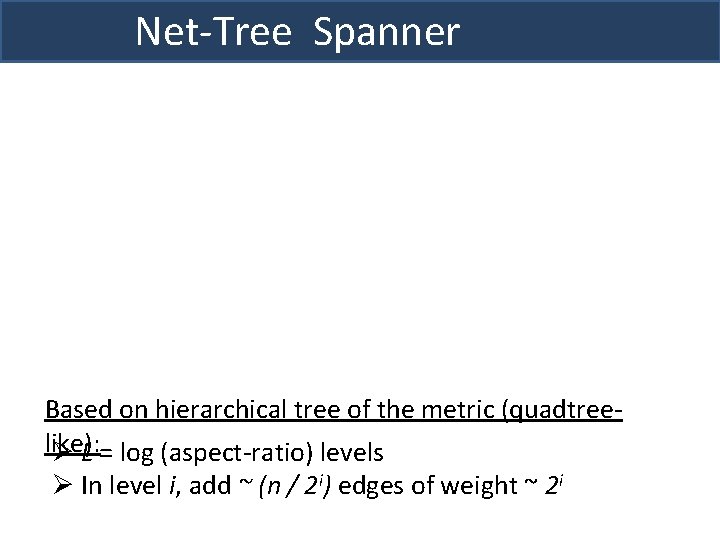
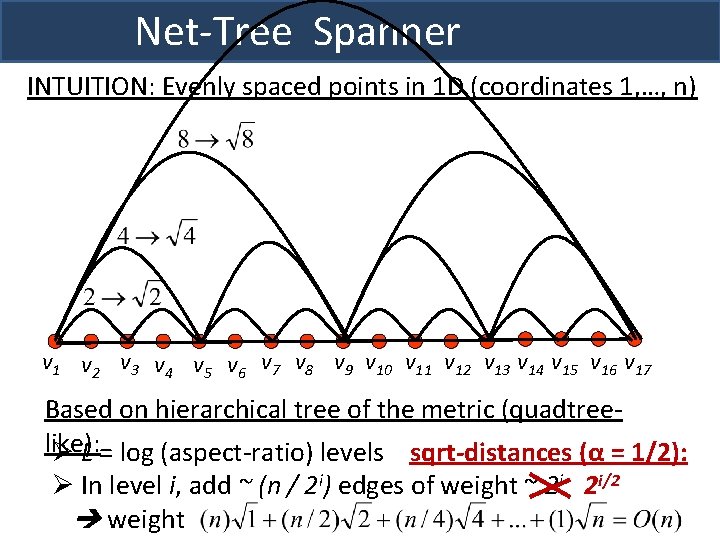
Net-Tree Spanner Based on hierarchical tree of the metric (quadtreelike): Ø L = log (aspect-ratio) levels Ø In level i, add ~ (n / 2 i) edges of weight ~ 2 i
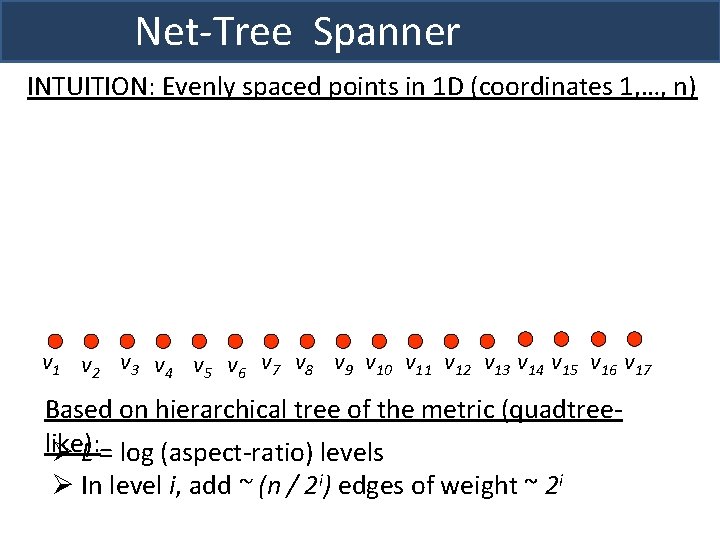
Net-Tree Spanner INTUITION: Evenly spaced points in 1 D (coordinates 1, …, n) v 1 v 2 v 3 v 4 v 5 v 6 v 7 v 8 v 9 v 10 v 11 v 12 v 13 v 14 v 15 v 16 v 17 Based on hierarchical tree of the metric (quadtreelike): Ø L = log (aspect-ratio) levels Ø In level i, add ~ (n / 2 i) edges of weight ~ 2 i
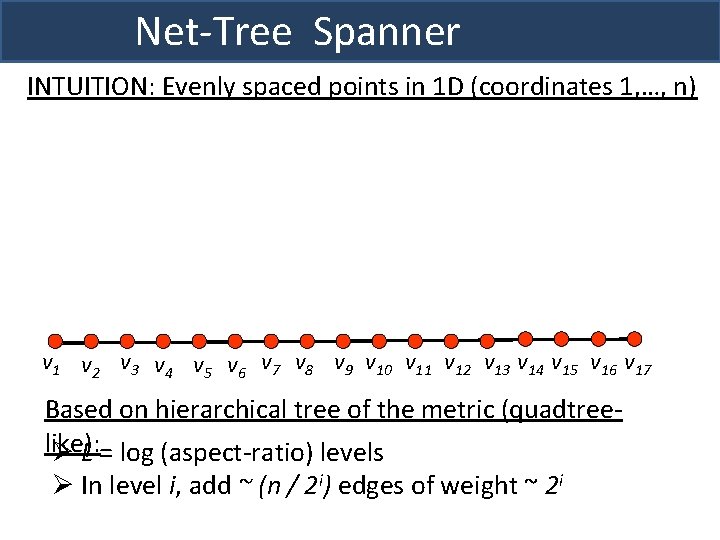
Net-Tree Spanner INTUITION: Evenly spaced points in 1 D (coordinates 1, …, n) v 1 v 2 v 3 v 4 v 5 v 6 v 7 v 8 v 9 v 10 v 11 v 12 v 13 v 14 v 15 v 16 v 17 Based on hierarchical tree of the metric (quadtreelike): Ø L = log (aspect-ratio) levels Ø In level i, add ~ (n / 2 i) edges of weight ~ 2 i
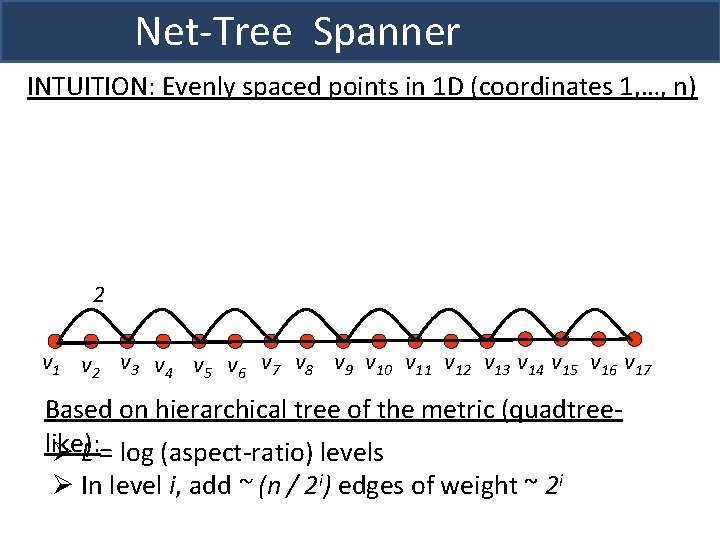
Net-Tree Spanner INTUITION: Evenly spaced points in 1 D (coordinates 1, …, n) 2 v 1 v 2 v 3 v 4 v 5 v 6 v 7 v 8 v 9 v 10 v 11 v 12 v 13 v 14 v 15 v 16 v 17 Based on hierarchical tree of the metric (quadtreelike): Ø L = log (aspect-ratio) levels Ø In level i, add ~ (n / 2 i) edges of weight ~ 2 i
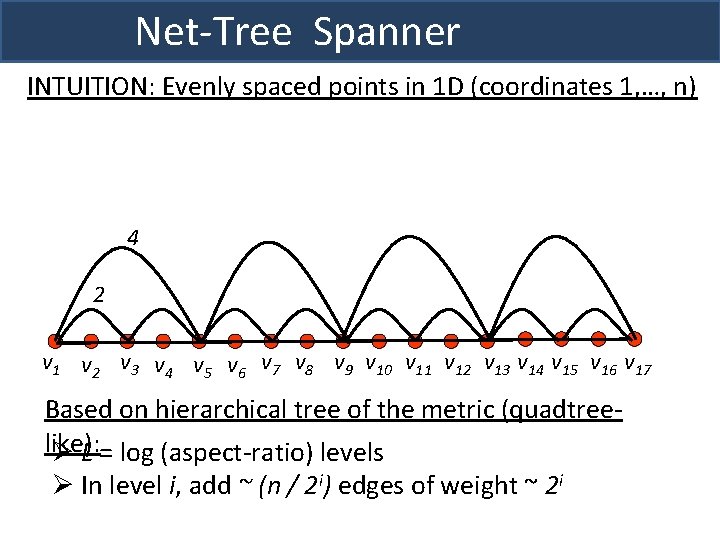
Net-Tree Spanner INTUITION: Evenly spaced points in 1 D (coordinates 1, …, n) 4 2 v 1 v 2 v 3 v 4 v 5 v 6 v 7 v 8 v 9 v 10 v 11 v 12 v 13 v 14 v 15 v 16 v 17 Based on hierarchical tree of the metric (quadtreelike): Ø L = log (aspect-ratio) levels Ø In level i, add ~ (n / 2 i) edges of weight ~ 2 i
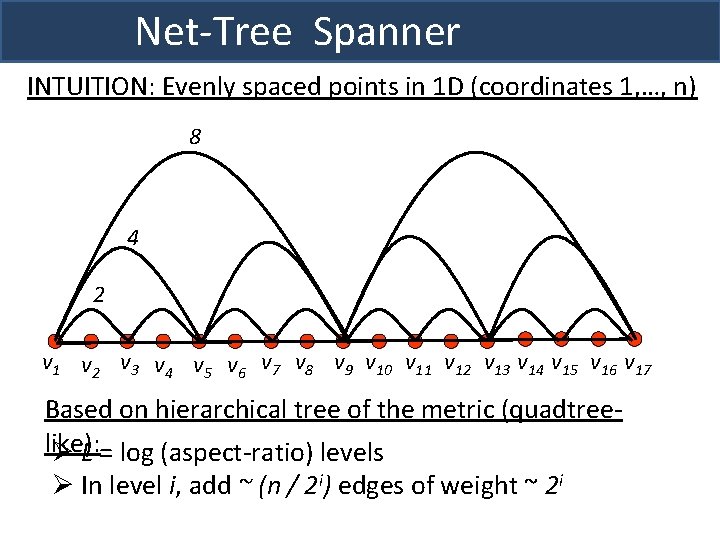
Net-Tree Spanner INTUITION: Evenly spaced points in 1 D (coordinates 1, …, n) 8 4 2 v 1 v 2 v 3 v 4 v 5 v 6 v 7 v 8 v 9 v 10 v 11 v 12 v 13 v 14 v 15 v 16 v 17 Based on hierarchical tree of the metric (quadtreelike): Ø L = log (aspect-ratio) levels Ø In level i, add ~ (n / 2 i) edges of weight ~ 2 i
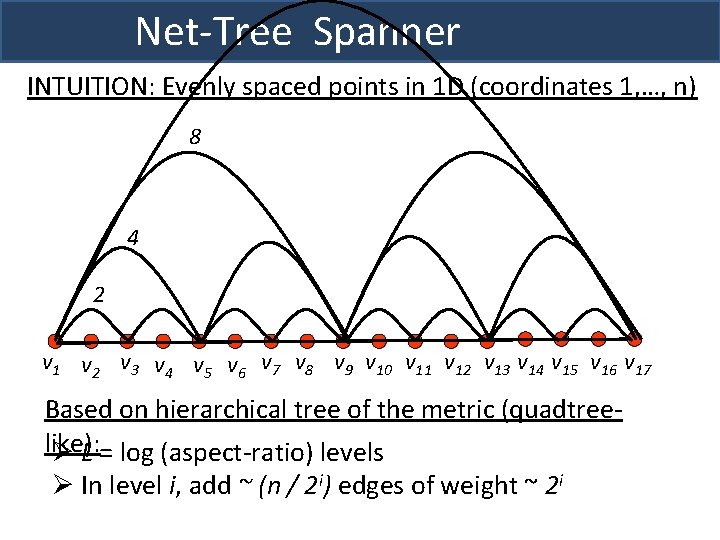
Net-Tree Spanner INTUITION: Evenly spaced points in 1 D (coordinates 1, …, n) 8 4 2 v 1 v 2 v 3 v 4 v 5 v 6 v 7 v 8 v 9 v 10 v 11 v 12 v 13 v 14 v 15 v 16 v 17 Based on hierarchical tree of the metric (quadtreelike): Ø L = log (aspect-ratio) levels Ø In level i, add ~ (n / 2 i) edges of weight ~ 2 i
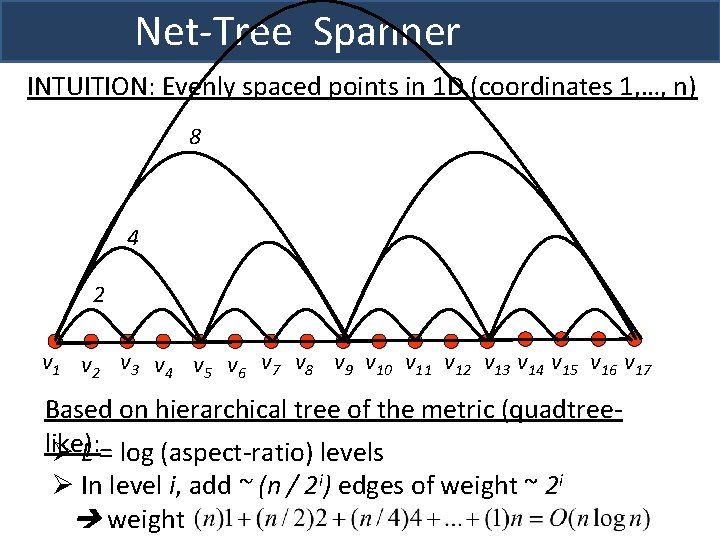
Net-Tree Spanner INTUITION: Evenly spaced points in 1 D (coordinates 1, …, n) 8 4 2 v 1 v 2 v 3 v 4 v 5 v 6 v 7 v 8 v 9 v 10 v 11 v 12 v 13 v 14 v 15 v 16 v 17 Based on hierarchical tree of the metric (quadtreelike): Ø L = log (aspect-ratio) levels Ø In level i, add ~ (n / 2 i) edges of weight ~ 2 i weight
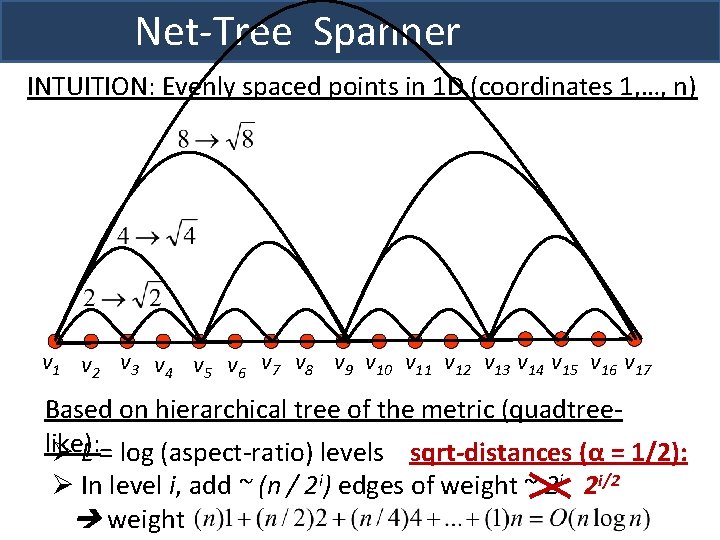
Net-Tree Spanner INTUITION: Evenly spaced points in 1 D (coordinates 1, …, n) v 1 v 2 v 3 v 4 v 5 v 6 v 7 v 8 v 9 v 10 v 11 v 12 v 13 v 14 v 15 v 16 v 17 Based on hierarchical tree of the metric (quadtreelike): Ø L = log (aspect-ratio) levels sqrt-distances (α = 1/2): Ø In level i, add ~ (n / 2 i) edges of weight ~ 2 i 2 i/2 weight
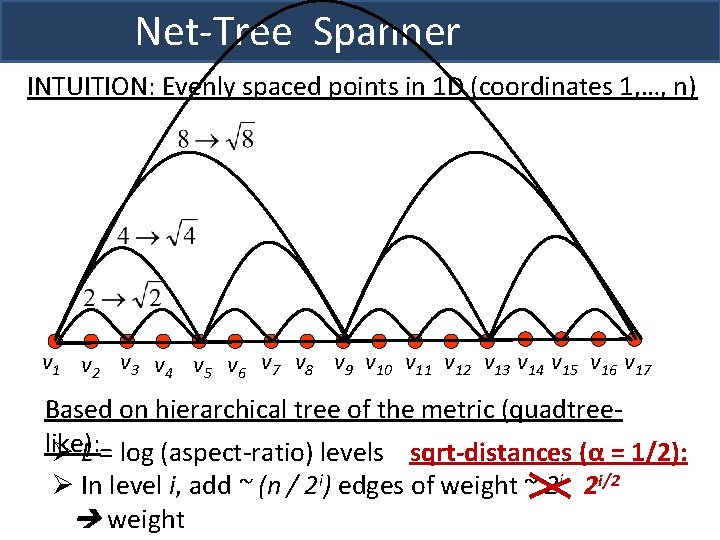
Net-Tree Spanner INTUITION: Evenly spaced points in 1 D (coordinates 1, …, n) v 1 v 2 v 3 v 4 v 5 v 6 v 7 v 8 v 9 v 10 v 11 v 12 v 13 v 14 v 15 v 16 v 17 Based on hierarchical tree of the metric (quadtreelike): Ø L = log (aspect-ratio) levels sqrt-distances (α = 1/2): Ø In level i, add ~ (n / 2 i) edges of weight ~ 2 i 2 i/2 weight
Net-Tree Spanner INTUITION: Evenly spaced points in 1 D (coordinates 1, …, n) v 1 v 2 v 3 v 4 v 5 v 6 v 7 v 8 v 9 v 10 v 11 v 12 v 13 v 14 v 15 v 16 v 17 Based on hierarchical tree of the metric (quadtreelike): Ø L = log (aspect-ratio) levels sqrt-distances (α = 1/2): Ø In level i, add ~ (n / 2 i) edges of weight ~ 2 i 2 i/2 weight
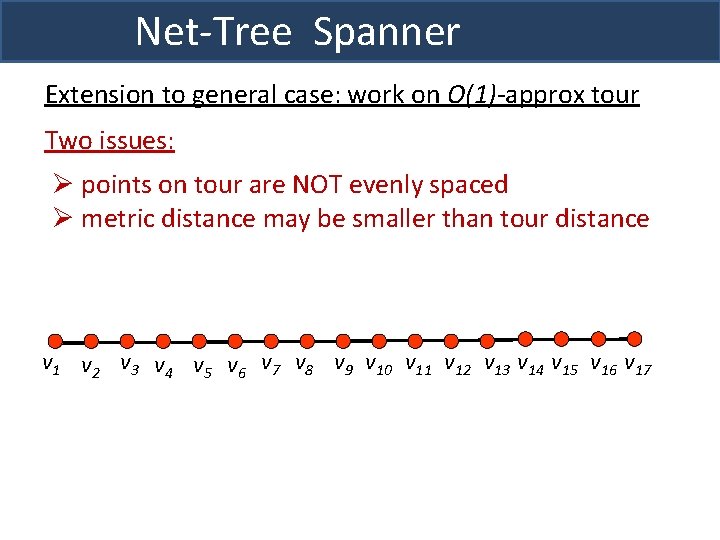
Net-Tree Spanner Extension to general case: work on O(1)-approx tour Two issues: Ø points on tour are NOT evenly spaced Ø metric distance may be smaller than tour distance v 1 v 2 v 3 v 4 v 5 v 6 v 7 v 8 v 9 v 10 v 11 v 12 v 13 v 14 v 15 v 16 v 17
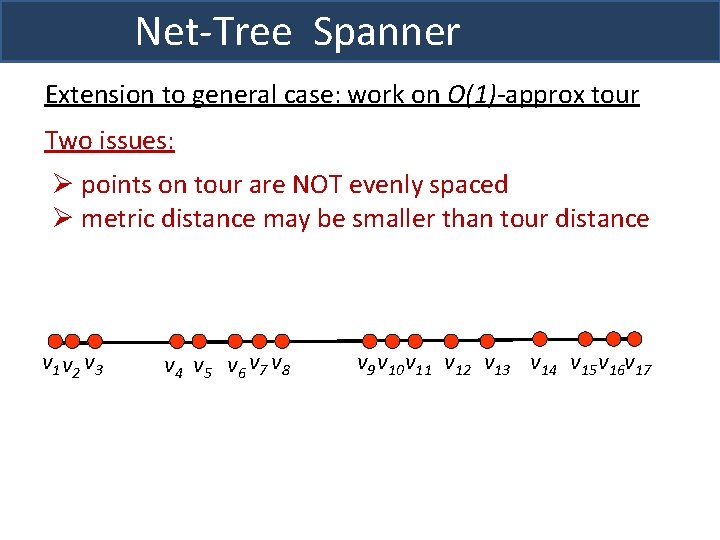
Net-Tree Spanner Extension to general case: work on O(1)-approx tour Two issues: Ø points on tour are NOT evenly spaced Ø metric distance may be smaller than tour distance v 1 v 2 v 3 v 4 v 5 v 6 v 7 v 8 v 9 v 10 v 11 v 12 v 13 v 14 v 15 v 16 v 17
Net-Tree Spanner Extension to general case: work on O(1)-approx tour Two issues: Ø points on tour are NOT evenly spaced Ø metric distance may be smaller than tour distance
Net-Tree Spanner Extension to general case: work on O(1)-approx tour Two issues: Ø points on tour are NOT evenly spaced Ø metric distance may be smaller than tour distance STRATEGY: from global weight to local “covering” Spanner edge (vi, vj) covers j-i tour edges (vi, vi+1), …, (vj-1, vj)
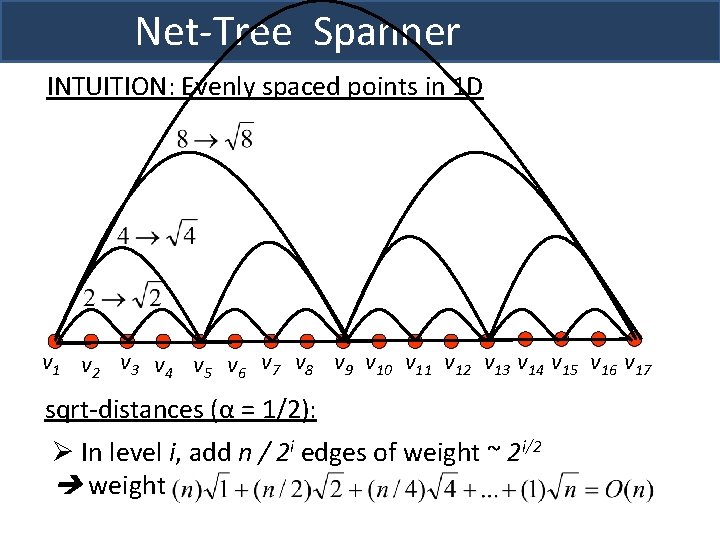
Net-Tree Spanner INTUITION: Evenly spaced points in 1 D v 1 v 2 v 3 v 4 v 5 v 6 v 7 v 8 v 9 v 10 v 11 v 12 v 13 v 14 v 15 v 16 v 17 sqrt-distances (α = 1/2): Ø In level i, add n / 2 i edges of weight ~ 2 i/2 weight
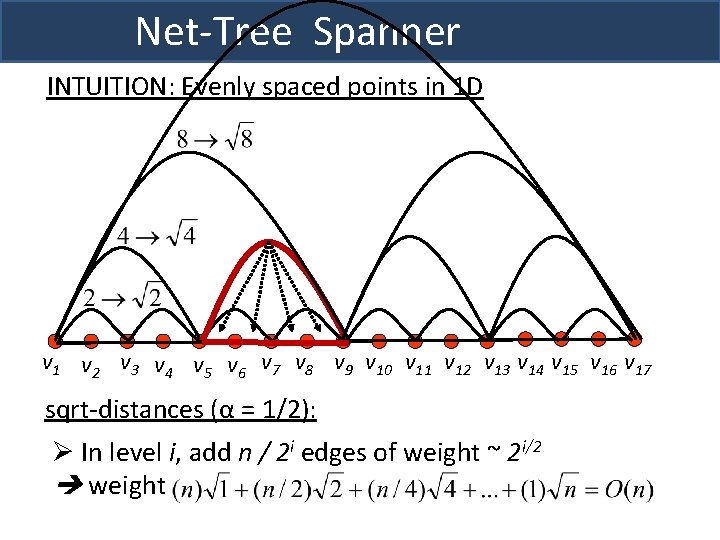
Net-Tree Spanner INTUITION: Evenly spaced points in 1 D v 1 v 2 v 3 v 4 v 5 v 6 v 7 v 8 v 9 v 10 v 11 v 12 v 13 v 14 v 15 v 16 v 17 sqrt-distances (α = 1/2): Ø In level i, add n / 2 i edges of weight ~ 2 i/2 weight
Net-Tree Spanner Extension to general case: work on O(1)-approx tour Two issues: Ø points on tour are NOT evenly spaced Ø metric distance may be smaller than tour distance STRATEGY: from global weight to local “covering” Spanner edge (vi, vj) covers j-i tour edges (vi, vi+1), …, (vj-1, vj)
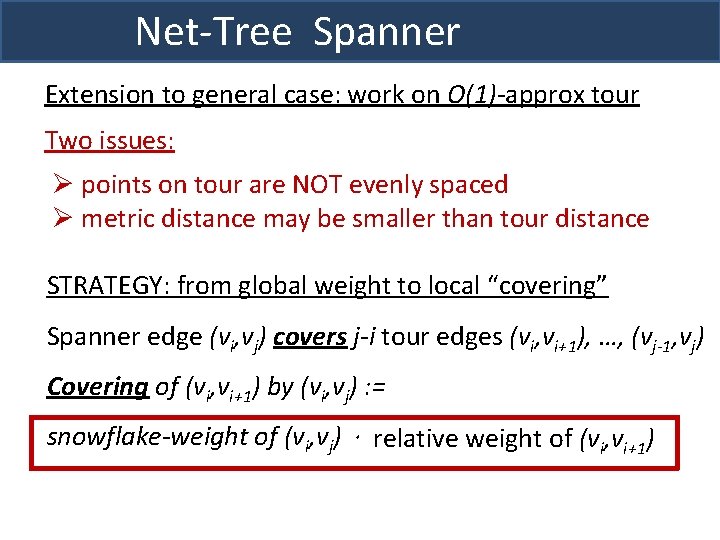
Net-Tree Spanner Extension to general case: work on O(1)-approx tour Two issues: Ø points on tour are NOT evenly spaced Ø metric distance may be smaller than tour distance STRATEGY: from global weight to local “covering” Spanner edge (vi, vj) covers j-i tour edges (vi, vi+1), …, (vj-1, vj) Covering of (vi, vi+1) by (vi, vj) : = snowflake-weight of (vi, vj) ∙ relative weight of (vi, vi+1)
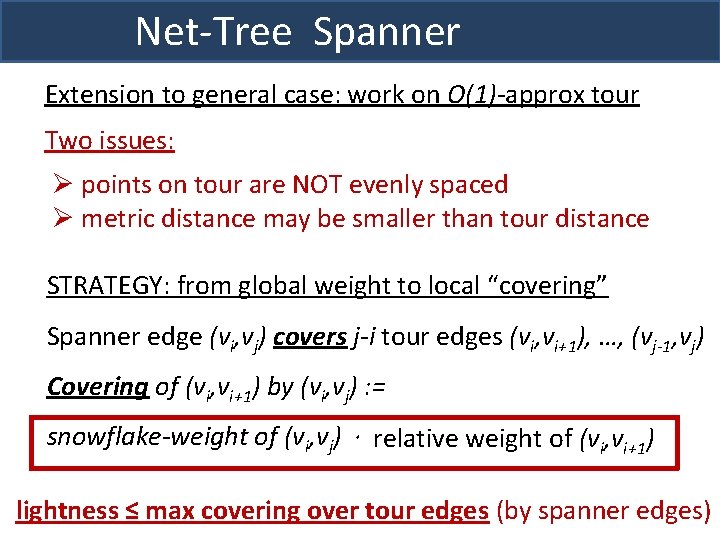
Net-Tree Spanner Extension to general case: work on O(1)-approx tour Two issues: Ø points on tour are NOT evenly spaced Ø metric distance may be smaller than tour distance STRATEGY: from global weight to local “covering” Spanner edge (vi, vj) covers j-i tour edges (vi, vi+1), …, (vj-1, vj) Covering of (vi, vi+1) by (vi, vj) : = snowflake-weight of (vi, vj) ∙ relative weight of (vi, vi+1) lightness ≤ max covering over tour edges (by spanner edges)
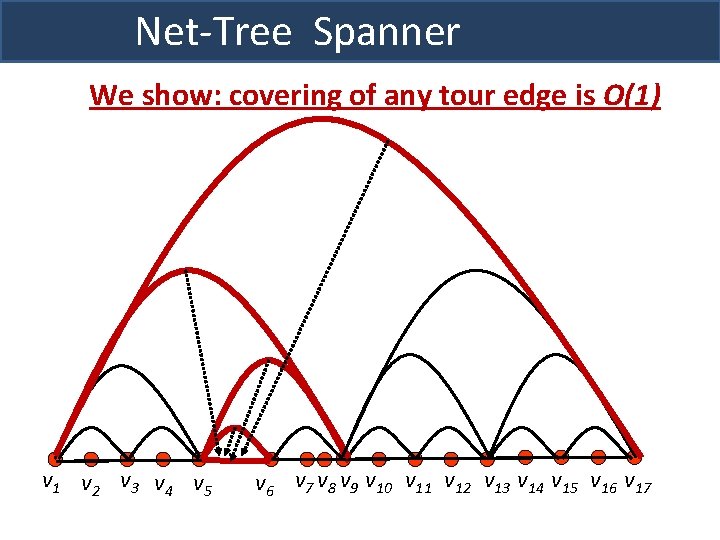
Net-Tree Spanner We show: covering of any tour edge is O(1) v 1 v 2 v 3 v 4 v 5 v 6 v 7 v 8 v 9 v 10 v 11 v 12 v 13 v 14 v 15 v 16 v 17
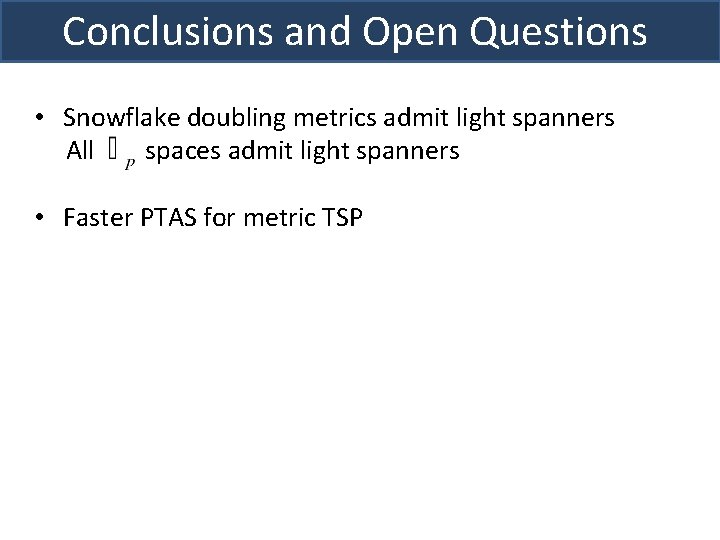
Conclusions and Open Questions • Snowflake doubling metrics admit light spanners All spaces admit light spanners • Faster PTAS for metric TSP
Conclusions and Open Questions • Snowflake doubling metrics admit light spanners All spaces admit light spanners • Faster PTAS for metric TSP • First step towards general conjecture?

THANK YOU!
- Slides: 91