
Light prototype support as high efficiency cooling system


- Slides: 34
Light prototype support as high efficiency cooling system for Layer 0 of the Super-B Silicon Vertex Tracker F. Bosi - M. Massa INFN-Pisa on behalf of the Super-B SVT Group WIT 2010 – LBLN, Berkeley February 3 -5, 2010 F. Bosi, M. Massa, WIT 2010, LBLN – Berkeley, February 3 -5, 2010 1
Outline - General mechanical requirements for the Super-B Layer 0. - Miniaturization, cooling and Microchannel technology. Microchannel module design and prototype production. Experimental results of the Microchannel Module test. Microchannel Net Module. Further developments to reduce X 0 and improve thermal efficiency. Conclusions F. Bosi, M. Massa, WIT 2010, LBLN – Berkeley, February 3 -5, 2010 2
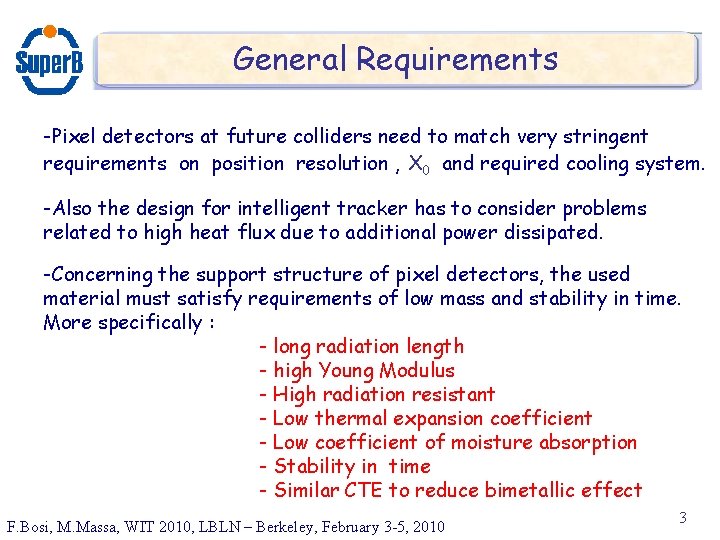
General Requirements -Pixel detectors at future colliders need to match very stringent requirements on position resolution , X 0 and required cooling system. -Also the design for intelligent tracker has to consider problems related to high heat flux due to additional power dissipated. -Concerning the support structure of pixel detectors, the used material must satisfy requirements of low mass and stability in time. More specifically : - long radiation length - high Young Modulus - High radiation resistant - Low thermal expansion coefficient - Low coefficient of moisture absorption - Stability in time - Similar CTE to reduce bimetallic effect F. Bosi, M. Massa, WIT 2010, LBLN – Berkeley, February 3 -5, 2010 3
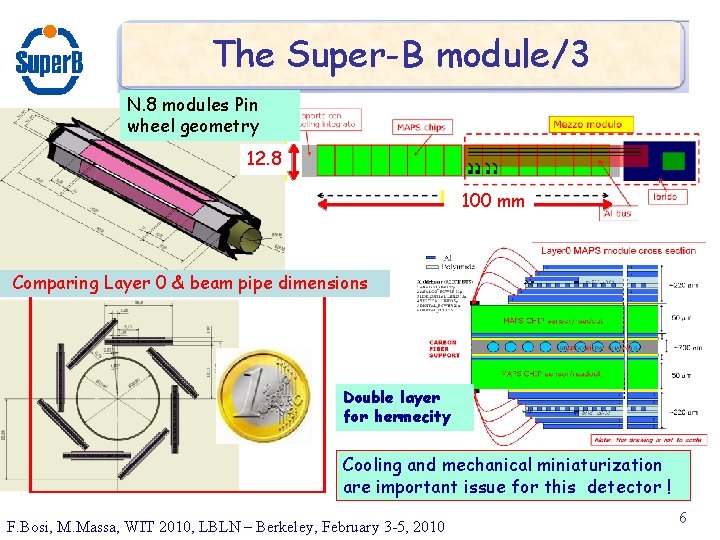
The Super-B Maps sensor/1 For the Super-B L 0 detector, there are other requirements that have an impact on the design : -Geometrical Acceptance: Q: sensitive region > 300 mrad r-f : small radius (as close as possible to the beam-pipe R~12 mm ) - Detector hit resolution ~ 10 mm modules very stiff with small and “stable” (in time) sagitta -The redundancy on the 1 st measured point. -Minimize Multiple scattering for low-Pt tracking minimize the material thickness computed in radiation length X 0 (support + sensors) and uniform distribution of the mass support -The radiation length for the mechanical support, excluding cable and sensor materials, has to be as low as possible and remain in any case below 0. 3 % X 0 F. Bosi, M. Massa, WIT 2010, LBLN – Berkeley, February 3 -5, 2010 4
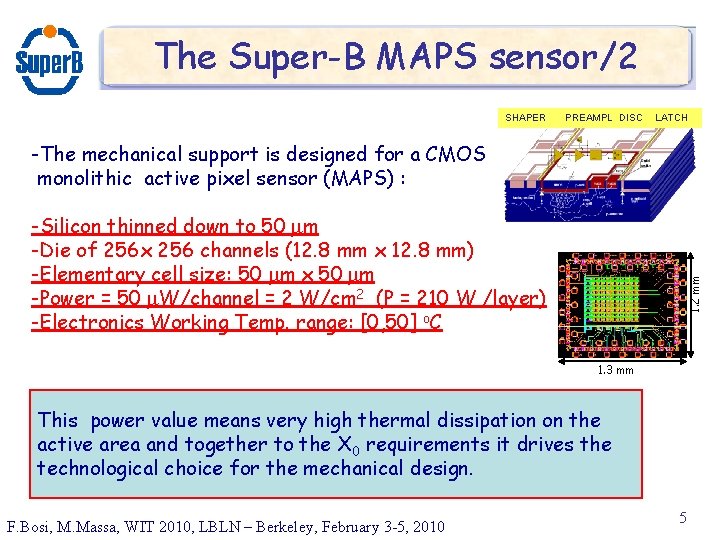
The Super-B MAPS sensor/2 SHAPER PREAMPL DISC LATCH -The mechanical support is designed for a CMOS monolithic active pixel sensor (MAPS) : 1. 2 mm -Silicon thinned down to 50 mm -Die of 256 x 256 channels (12. 8 mm x 12. 8 mm) -Elementary cell size: 50 mm x 50 mm -Power = 50 m. W/channel = 2 W/cm 2 (P = 210 W /layer) -Electronics Working Temp. range: [0, 50] o. C 1. 3 mm This power value means very high thermal dissipation on the active area and together to the X 0 requirements it drives the technological choice for the mechanical design. F. Bosi, M. Massa, WIT 2010, LBLN – Berkeley, February 3 -5, 2010 5
The Super-B module/3 N. 8 modules Pin wheel geometry 12. 8 100 mm Comparing Layer 0 & beam pipe dimensions Double layer for hermecity Cooling and mechanical miniaturization are important issue for this detector ! F. Bosi, M. Massa, WIT 2010, LBLN – Berkeley, February 3 -5, 2010 6
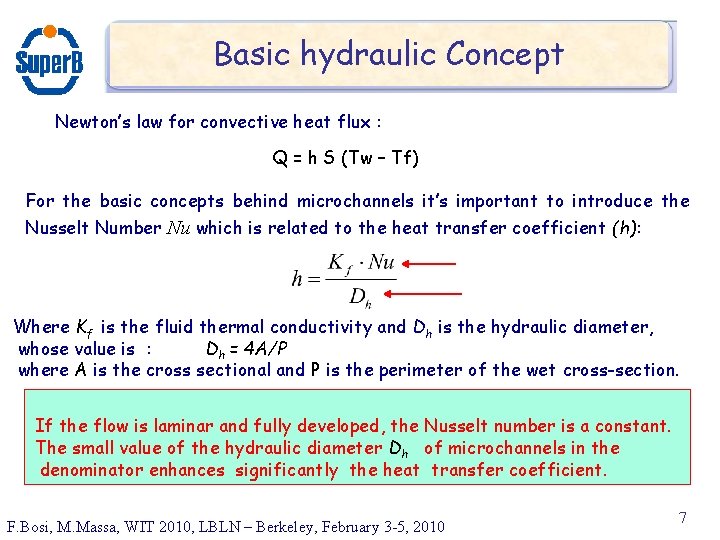
Basic hydraulic Concept Newton’s law for convective heat flux : Q = h S (Tw – Tf) For the basic concepts behind microchannels it’s important to introduce the Nusselt Number Nu which is related to the heat transfer coefficient (h): Where Kf is the fluid thermal conductivity and Dh is the hydraulic diameter, whose value is : Dh = 4 A/P where A is the cross sectional and P is the perimeter of the wet cross-section. If the flow is laminar and fully developed, the Nusselt number is a constant. The small value of the hydraulic diameter Dh of microchannels in the denominator enhances significantly the heat transfer coefficient. F. Bosi, M. Massa, WIT 2010, LBLN – Berkeley, February 3 -5, 2010 7
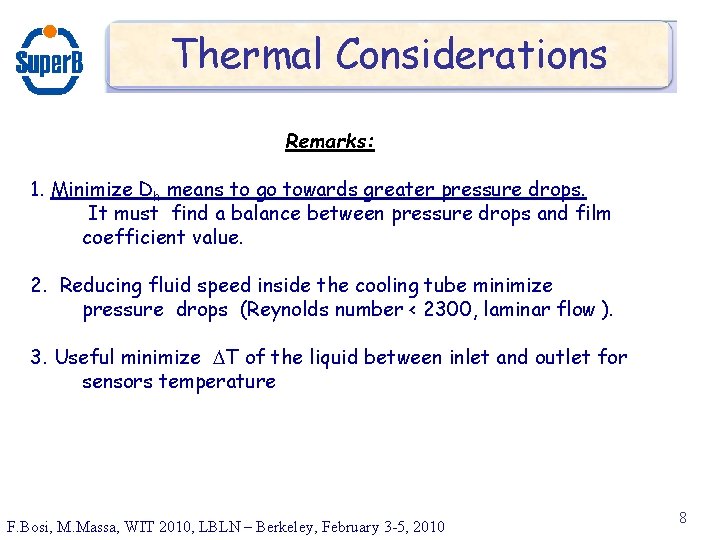
Thermal Considerations Remarks: 1. Minimize Dh means to go towards greater pressure drops. It must find a balance between pressure drops and film coefficient value. 2. Reducing fluid speed inside the cooling tube minimize pressure drops (Reynolds number < 2300, laminar flow ). 3. Useful minimize DT of the liquid between inlet and outlet for sensors temperature F. Bosi, M. Massa, WIT 2010, LBLN – Berkeley, February 3 -5, 2010 8
Support Characteristic Merging Super-B experiment specifications with thermal and hydraulic concepts, we focused our attention on a CFRP supports with microchannel technology for an heat evacuation through a single phase liquid forced convection. Several prototypes with different geometries and material have been realized; miniaturization of composites structures have been developed through close collaboration with companies. Prototypes have been submitted to test at the TFD laboratory of the INFN-Pisa. In particular, by subtractive method or additive method two kinds of module in CFRP have been produced and tested. F. Bosi, M. Massa, WIT 2010, LBLN – Berkeley, February 3 -5, 2010 9
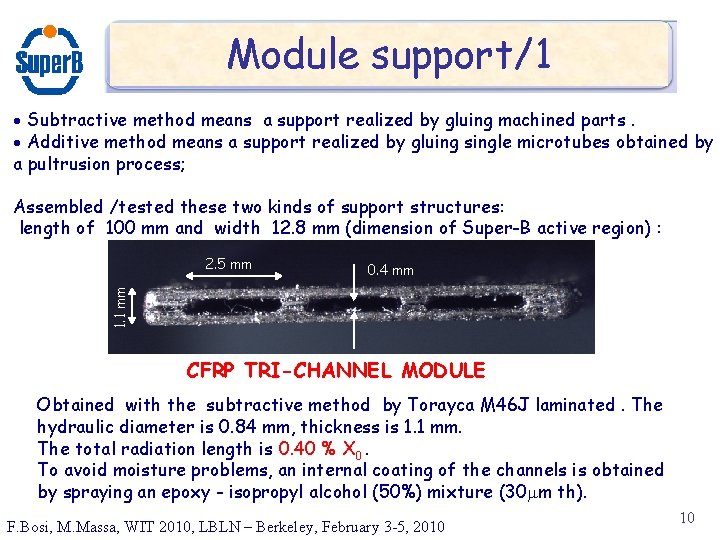
Module support/1 Subtractive method means a support realized by gluing machined parts. Additive method means a support realized by gluing single microtubes obtained by a pultrusion process; Assembled /tested these two kinds of support structures: length of 100 mm and width 12. 8 mm (dimension of Super-B active region) : 0. 4 mm 1. 1 mm 2. 5 mm CFRP TRI-CHANNEL MODULE Obtained with the subtractive method by Torayca M 46 J laminated. The hydraulic diameter is 0. 84 mm, thickness is 1. 1 mm. The total radiation length is 0. 40 % X 0. To avoid moisture problems, an internal coating of the channels is obtained by spraying an epoxy - isopropyl alcohol (50%) mixture (30 mm th). F. Bosi, M. Massa, WIT 2010, LBLN – Berkeley, February 3 -5, 2010 10
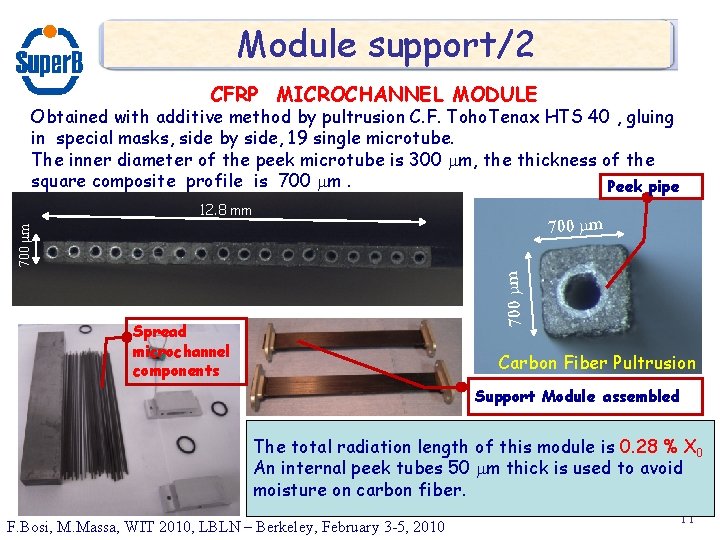
Module support/2 CFRP MICROCHANNEL MODULE Obtained with additive method by pultrusion C. F. Toho. Tenax HTS 40 , gluing in special masks, side by side, 19 single microtube. The inner diameter of the peek microtube is 300 mm, the thickness of the square composite profile is 700 mm. Peek pipe 12. 8 mm 700 mm Spread microchannel components Carbon Fiber Pultrusion Support Module assembled The total radiation length of this module is 0. 28 % X 0 An internal peek tubes 50 mm thick is used to avoid moisture on carbon fiber. F. Bosi, M. Massa, WIT 2010, LBLN – Berkeley, February 3 -5, 2010 11
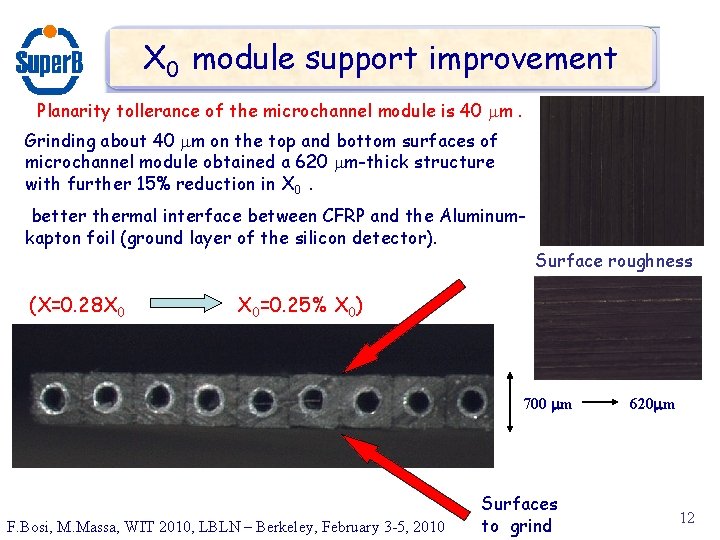
X 0 module support improvement Planarity tollerance of the microchannel module is 40 mm. Grinding about 40 mm on the top and bottom surfaces of microchannel module obtained a 620 mm-thick structure with further 15% reduction in X 0. better thermal interface between CFRP and the Aluminumkapton foil (ground layer of the silicon detector). (X=0. 28 X 0 Surface roughness X 0=0. 25% X 0) 700 mm F. Bosi, M. Massa, WIT 2010, LBLN – Berkeley, February 3 -5, 2010 Surfaces to grind 620 mm 12
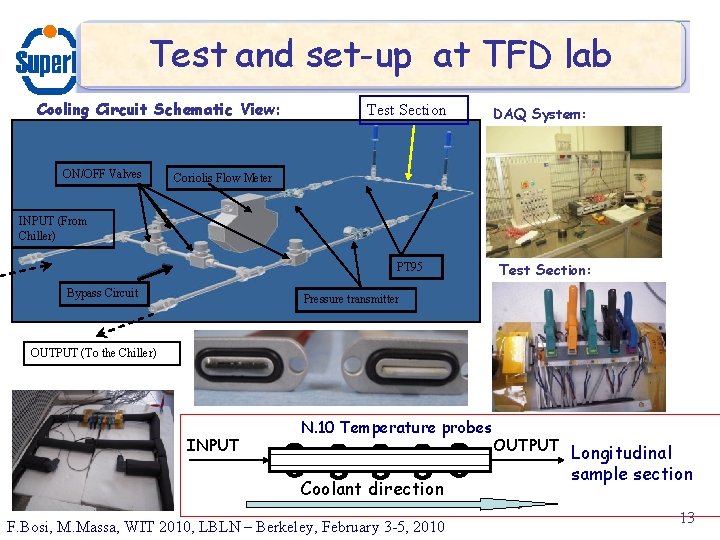
Test and set-up at TFD lab Cooling Circuit Schematic View: ON/OFF Valves Test Section DAQ System: Coriolis Flow Meter INPUT (From Chiller) PT 95 Bypass Circuit Test Section: Pressure transmitter OUTPUT (To the Chiller) INPUT N. 10 Temperature probes Coolant direction F. Bosi, M. Massa, WIT 2010, LBLN – Berkeley, February 3 -5, 2010 OUTPUT Longitudinal sample section 13
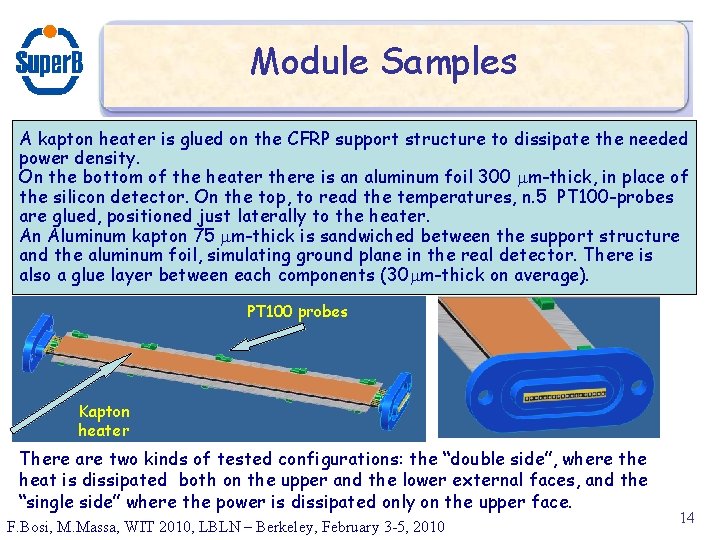
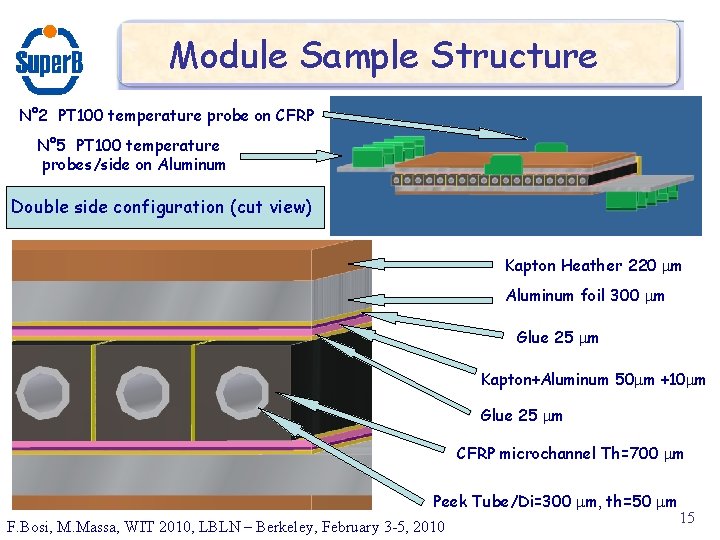
Module Samples A kapton heater is glued on the CFRP support structure to dissipate the needed power density. On the bottom of the heater there is an aluminum foil 300 mm-thick, in place of the silicon detector. On the top, to read the temperatures, n. 5 PT 100 -probes are glued, positioned just laterally to the heater. An Aluminum kapton 75 mm-thick is sandwiched between the support structure and the aluminum foil, simulating ground plane in the real detector. There is also a glue layer between each components (30 mm-thick on average). PT 100 probes Kapton heater There are two kinds of tested configurations: the “double side”, where the heat is dissipated both on the upper and the lower external faces, and the “single side” where the power is dissipated only on the upper face. F. Bosi, M. Massa, WIT 2010, LBLN – Berkeley, February 3 -5, 2010 14
Module Sample Structure N° 2 PT 100 temperature probe on CFRP N° 5 PT 100 temperature probes/side on Aluminum Double side configuration (cut view) Kapton Heather 220 mm Aluminum foil 300 mm Glue 25 mm Kapton+Aluminum 50 mm +10 mm Glue 25 mm CFRP microchannel Th=700 mm Peek Tube/Di=300 mm, th=50 mm F. Bosi, M. Massa, WIT 2010, LBLN – Berkeley, February 3 -5, 2010 15
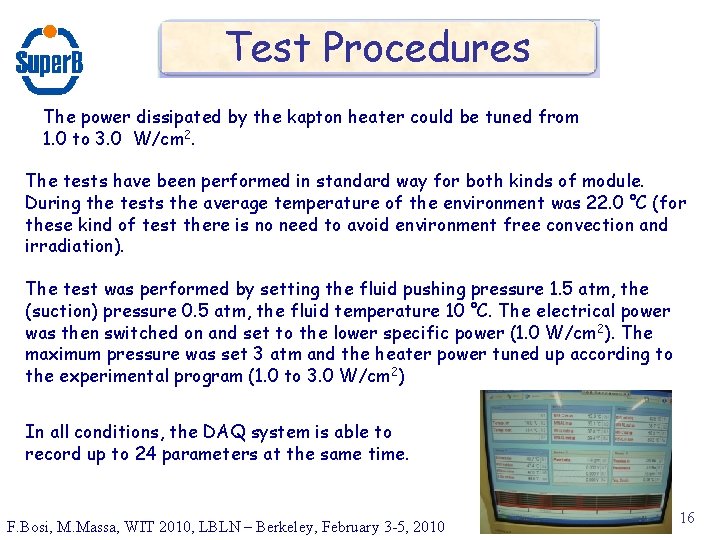
Test Procedures The power dissipated by the kapton heater could be tuned from 1. 0 to 3. 0 W/cm 2. The tests have been performed in standard way for both kinds of module. During the tests the average temperature of the environment was 22. 0 °C (for these kind of test there is no need to avoid environment free convection and irradiation). The test was performed by setting the fluid pushing pressure 1. 5 atm, the (suction) pressure 0. 5 atm, the fluid temperature 10 °C. The electrical power was then switched on and set to the lower specific power (1. 0 W/cm 2). The maximum pressure was set 3 atm and the heater power tuned up according to the experimental program (1. 0 to 3. 0 W/cm 2) In all conditions, the DAQ system is able to record up to 24 parameters at the same time. F. Bosi, M. Massa, WIT 2010, LBLN – Berkeley, February 3 -5, 2010 16
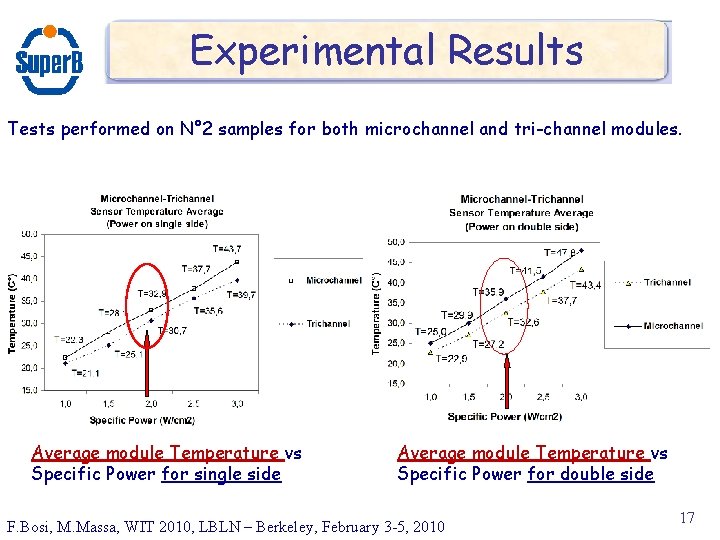
Experimental Results Tests performed on N° 2 samples for both microchannel and tri-channel modules. Average module Temperature vs Specific Power for single side Average module Temperature vs Specific Power for double side F. Bosi, M. Massa, WIT 2010, LBLN – Berkeley, February 3 -5, 2010 17
Test Results Temperature along the module (DT = 5 °C ) F. Bosi, M. Massa, WIT 2010, LBLN – Berkeley, February 3 -5, 2010 18
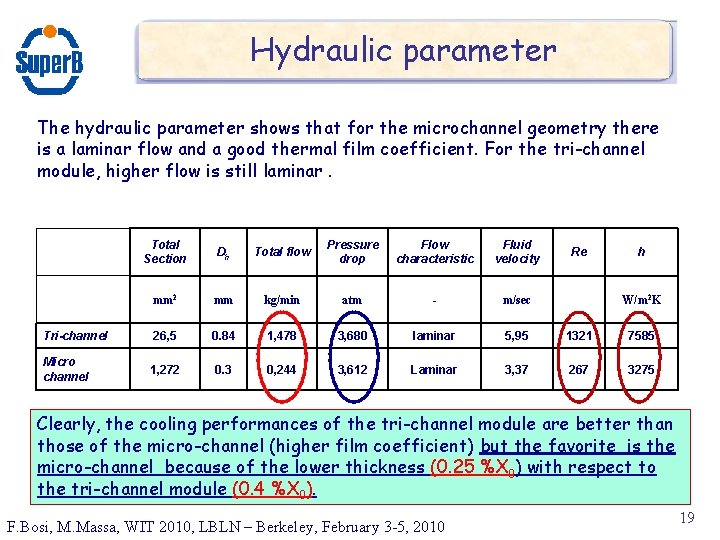
Hydraulic parameter The hydraulic parameter shows that for the microchannel geometry there is a laminar flow and a good thermal film coefficient. For the tri-channel module, higher flow is still laminar. Total Section Dh Total flow Pressure drop Flow characteristic Fluid velocity mm 2 mm kg/min atm - m/sec Tri-channel 26, 5 0. 84 1, 478 3, 680 laminar 5, 95 1321 7585 Micro channel 1, 272 0. 3 0, 244 3, 612 Laminar 3, 37 267 3275 Re h W/m 2 K Clearly, the cooling performances of the tri-channel module are better than those of the micro-channel (higher film coefficient) but the favorite is the micro-channel because of the lower thickness (0. 25 %X 0) with respect to the tri-channel module (0. 4 %X 0). F. Bosi, M. Massa, WIT 2010, LBLN – Berkeley, February 3 -5, 2010 19
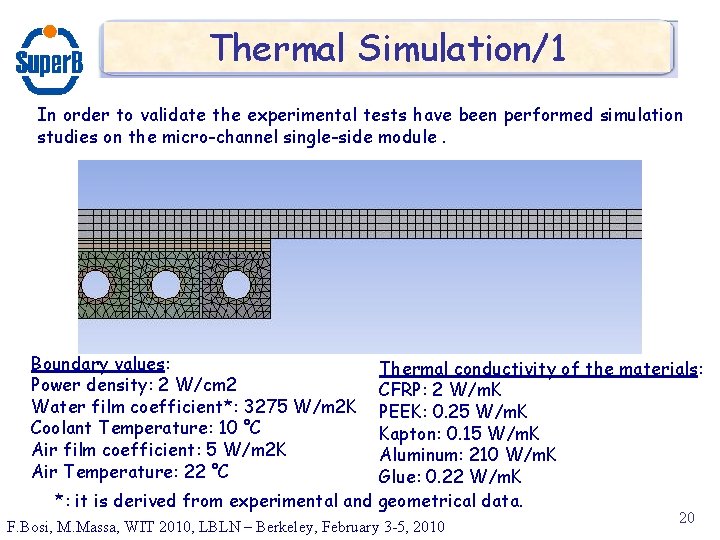
Thermal Simulation/1 In order to validate the experimental tests have been performed simulation studies on the micro-channel single-side module. Here, we considered the case study of the micro-channel module. Boundary values: Power density: 2 W/cm 2 Water film coefficient*: 3275 W/m 2 K Coolant Temperature: 10 °C Air film coefficient: 5 W/m 2 K Air Temperature: 22 °C Thermal conductivity of the materials: CFRP: 2 W/m. K PEEK: 0. 25 W/m. K Kapton: 0. 15 W/m. K Aluminum: 210 W/m. K Glue: 0. 22 W/m. K *: it is derived from experimental and geometrical data. F. Bosi, M. Massa, WIT 2010, LBLN – Berkeley, February 3 -5, 2010 20
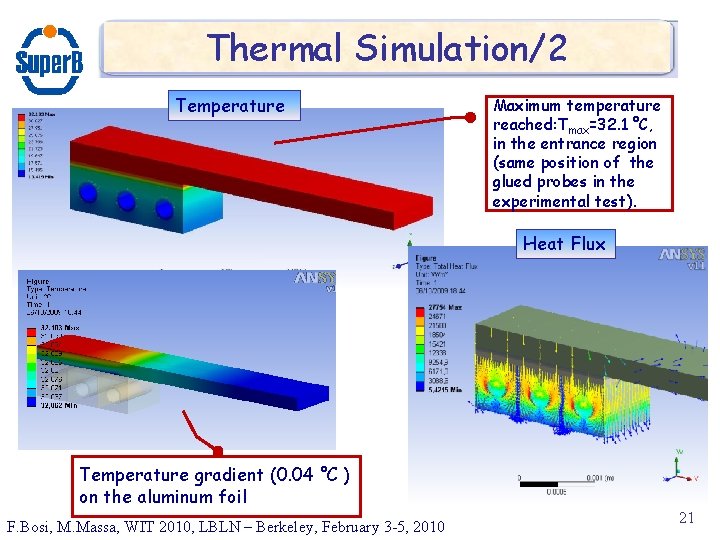
Thermal Simulation/2 Temperature Maximum temperature reached: Tmax=32. 1 °C, in the entrance region (same position of the glued probes in the experimental test). Heat Flux Temperature gradient (0. 04 °C ) on the aluminum foil F. Bosi, M. Massa, WIT 2010, LBLN – Berkeley, February 3 -5, 2010 21
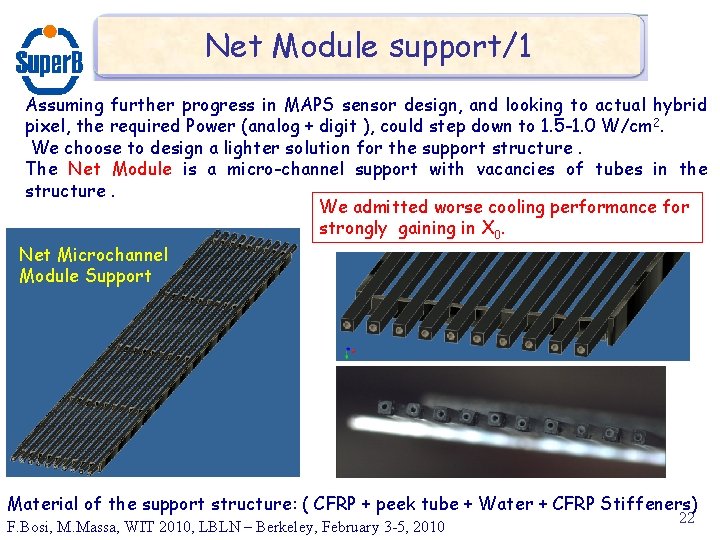
Net Module support/1 Assuming further progress in MAPS sensor design, and looking to actual hybrid pixel, the required Power (analog + digit ), could step down to 1. 5 -1. 0 W/cm 2. We choose to design a lighter solution for the support structure. The Net Module is a micro-channel support with vacancies of tubes in the structure. We admitted worse cooling performance for strongly gaining in X 0. Net Microchannel Module Support Material of the support structure: ( CFRP + peek tube + Water + CFRP Stiffeners) F. Bosi, M. Massa, WIT 2010, LBLN – Berkeley, February 3 -5, 2010 22
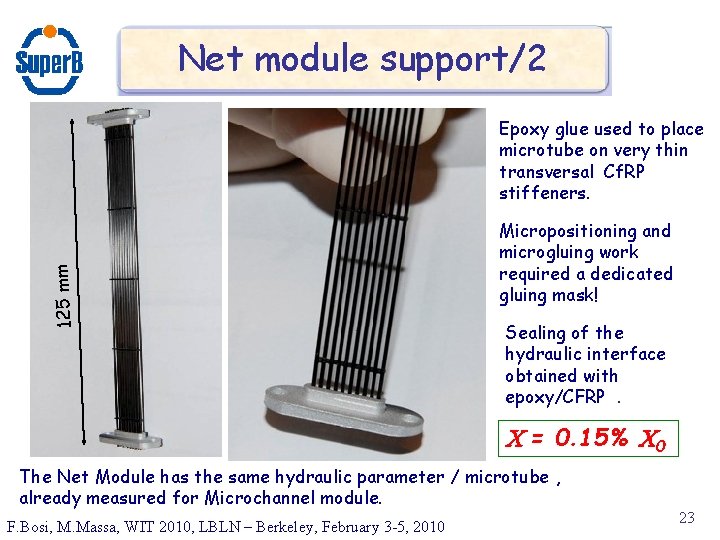
Net module support/2 125 mm Epoxy glue used to place microtube on very thin transversal Cf. RP stiffeners. Micropositioning and microgluing work required a dedicated gluing mask! Sealing of the hydraulic interface obtained with epoxy/CFRP. C = 0. 15% C 0 The Net Module has the same hydraulic parameter / microtube , already measured for Microchannel module. F. Bosi, M. Massa, WIT 2010, LBLN – Berkeley, February 3 -5, 2010 23
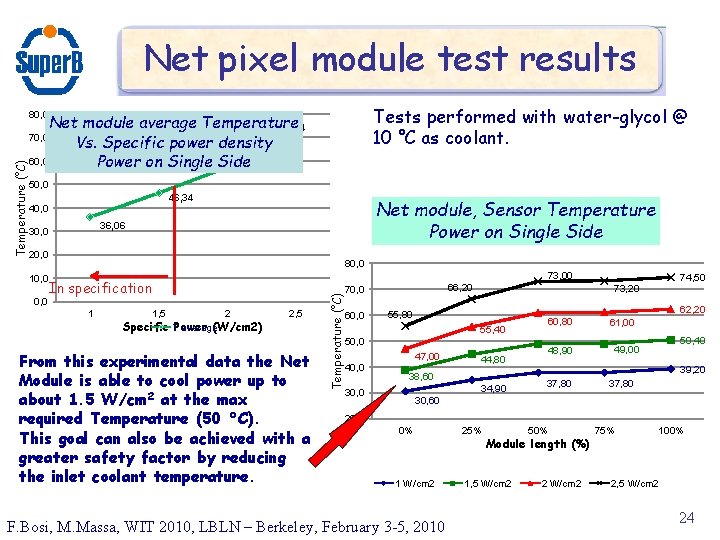
Net pixel module test results Tests performed with water-glycol @ 10 °C as coolant. Net module average Temperature 68, 54 70, 0 Vs. Specific power density 60, 0 Power on Single 57, 28 Side 50, 0 46, 34 40, 0 Net module, Sensor Temperature Power on Single Side 36, 06 30, 0 20, 0 10, 0 80, 0 73, 00 In specification 1 1, 5 2 Specific TPower average(W/cm 2) 2, 5 From this experimental data the Net Module is able to cool power up to about 1. 5 W/cm 2 at the max required Temperature (50 °C). This goal can also be achieved with a greater safety factor by reducing the inlet coolant temperature. Temperature (°C) 80, 0 66, 20 70, 0 62, 20 55, 80 55, 40 50, 0 47, 00 44, 80 38, 60 34, 90 30, 0 74, 50 73, 20 60, 80 48, 90 61, 00 50, 40 49, 00 39, 20 37, 80 30, 60 20, 0 0% 1 W/cm 2 F. Bosi, M. Massa, WIT 2010, LBLN – Berkeley, February 3 -5, 2010 25% 50% Module length (%) 1, 5 W/cm 2 2 W/cm 2 75% 100% 2, 5 W/cm 2 24
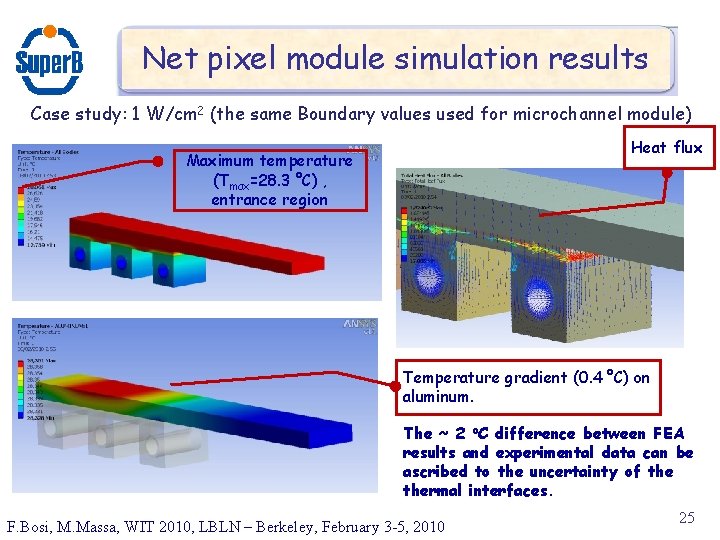
Net pixel module simulation results Case study: 1 W/cm 2 (the same Boundary values used for microchannel module) Heat flux Maximum temperature (Tmax=28. 3 °C) , entrance region Temperature gradient (0. 4 °C) on aluminum. The ~ 2 o. C difference between FEA results and experimental data can be ascribed to the uncertainty of thermal interfaces. F. Bosi, M. Massa, WIT 2010, LBLN – Berkeley, February 3 -5, 2010 25
Module Support performance improvement There are several lines to follow for further enhancing the performance of the microchannel support: 1) Further miniaturization of the base microtube profile: CFRP thickness = 500 mm, peek tube inner diameter = 200/50 th mm. (in progress prototype manufacturing). 2) Use of thermoplastic technology and/or composite material with higher conductive thermal coefficient. 3) Opposite flow directions of the coolant in the module in order to minimize the temperature variation along the module (it requires a special design of the hydraulic interfaces) 4) Use of nano-carbon tube doping mixed in the coolant (5 -6 %) to get a more efficient thermal exchange (200% better film coefficient). F. Bosi, M. Massa, WIT 2010, LBLN – Berkeley, February 3 -5, 2010 26
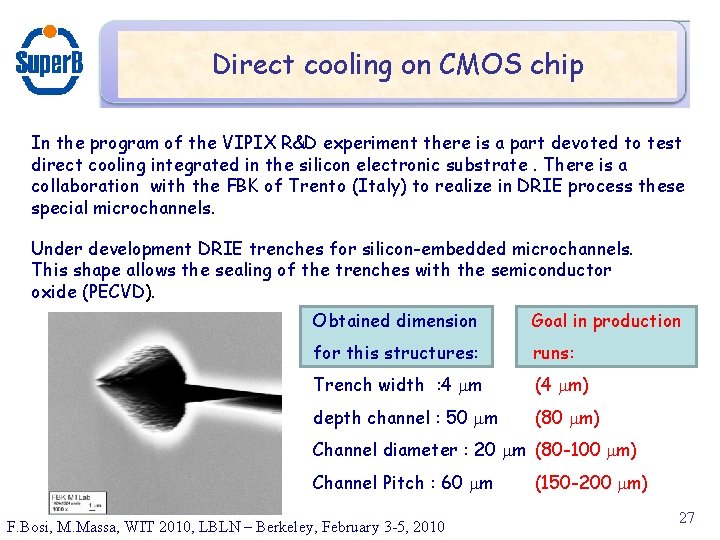
Direct cooling on CMOS chip In the program of the VIPIX R&D experiment there is a part devoted to test direct cooling integrated in the silicon electronic substrate. There is a collaboration with the FBK of Trento (Italy) to realize in DRIE process these special microchannels. Under development DRIE trenches for silicon-embedded microchannels. This shape allows the sealing of the trenches with the semiconductor oxide (PECVD). Obtained dimension Goal in production for this structures: runs: Trench width : 4 mm (4 mm) depth channel : 50 mm (80 mm) Channel diameter : 20 mm (80 -100 mm) Channel Pitch : 60 mm F. Bosi, M. Massa, WIT 2010, LBLN – Berkeley, February 3 -5, 2010 (150 -200 mm) 27
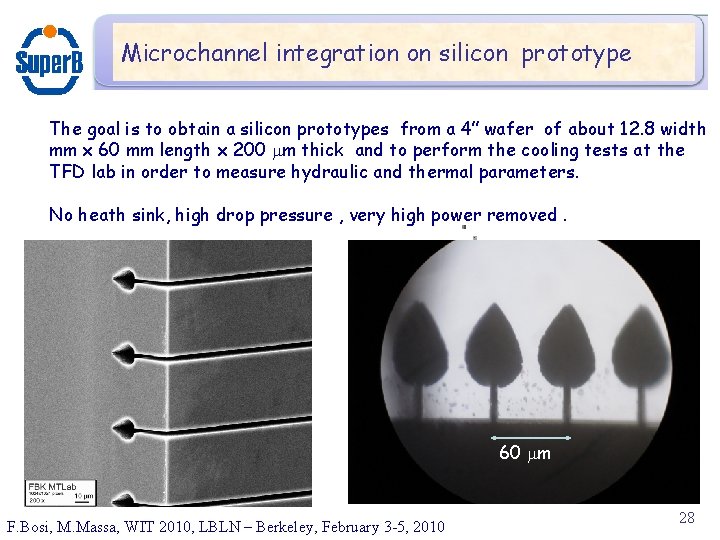
Microchannel integration on silicon prototype The goal is to obtain a silicon prototypes from a 4” wafer of about 12. 8 width mm x 60 mm length x 200 mm thick and to perform the cooling tests at the TFD lab in order to measure hydraulic and thermal parameters. No heath sink, high drop pressure , very high power removed. 60 mm F. Bosi, M. Massa, WIT 2010, LBLN – Berkeley, February 3 -5, 2010 28
Conclusion • We performed studies for a light mechanical/cooling support structure suited for the L 0 of the Super-B experiment and in general also for detectors with high power dissipation in the active region (order of 2 W/cm 2). • There is at the INFN-Pisa a test-facility to perform experimental analysis of cooling circuits in single phase thermal exchange. In future it is plan to test microchannel technology in change-phase cooling (higher thermal performance). • Our prototypes design for the L 0 Super-B detector, based on microchannel technology ins ingle phase forced convection, matches the requirements for pixel MAPS (P= 2 W/cm 2, X 0= 0. 25%) and for pixel hybrid sensors (P= 1. 5 -1, 0 W/cm 2, X 0= 0. 15% ). • Further enhancement are still possible within this technology, gaining in X 0 and thermal efficiency. F. Bosi, M. Massa, WIT 2010, LBLN – Berkeley, February 3 -5, 2010 29
BACK UP F. Bosi, M. Massa, WIT 2010, LBLN – Berkeley, February 3 -5, 2010 30
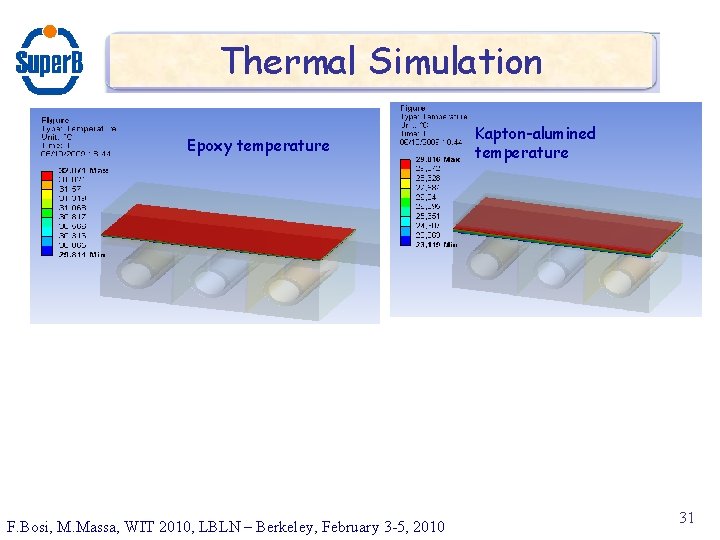
Thermal Simulation Epoxy temperature F. Bosi, M. Massa, WIT 2010, LBLN – Berkeley, February 3 -5, 2010 Kapton-alumined temperature 31
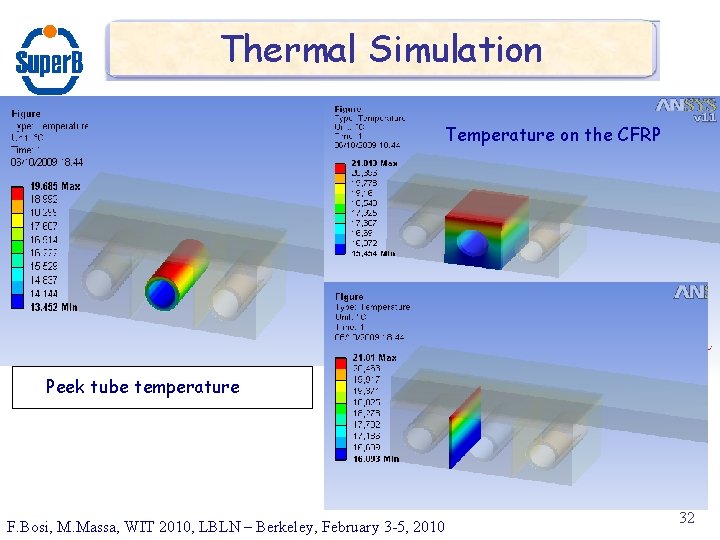
Thermal Simulation Temperature on the CFRP Peek tube temperature F. Bosi, M. Massa, WIT 2010, LBLN – Berkeley, February 3 -5, 2010 32
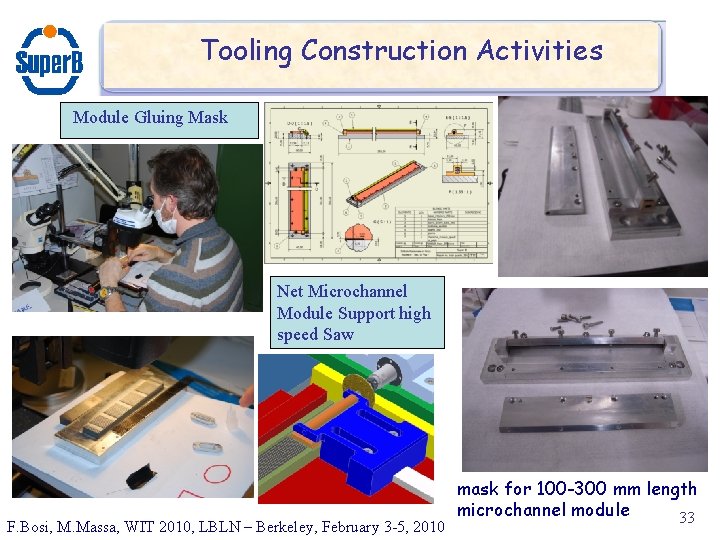
Tooling Construction Activities Module Gluing Mask Net Microchannel Module Support high speed Saw F. Bosi, M. Massa, WIT 2010, LBLN – Berkeley, February 3 -5, 2010 mask for 100 -300 mm length microchannel module 33
Net Module The Net Module is well suited for the new specific power request. Building a structure by adding single microtubes allows matching the module specifications with a lower material budget. (The radiation lenght for each microchannel tube is about X=0. 011 % X 0) F. Bosi, M. Massa, WIT 2010, LBLN – Berkeley, February 3 -5, 2010 34