
LIGHT POLLUTION EFFECTS CONTROL Submitted By Swati Srivastava
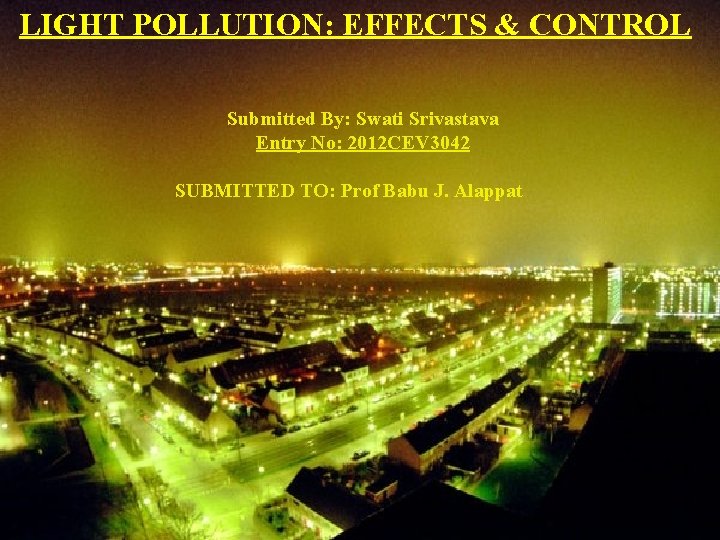
LIGHT POLLUTION: EFFECTS & CONTROL Submitted By: Swati Srivastava Entry No: 2012 CEV 3042 SUBMITTED TO: Prof Babu J. Alappat
INTRODUCTION § Light Pollution, also known as Photopollution or Luminous Pollution, is excessive, misdirected, or obtrusive artificial light. § Artificial light is introduced by humans, directly or indirectly into the environment to increase the efficiency of human activities like production, transportation, construction, city beautification etc. § Light pollution competes with starlight in the night sky. § It interferes with astronomical observations and like any other form of pollution disrupts ecosystems and has adverse health effects.
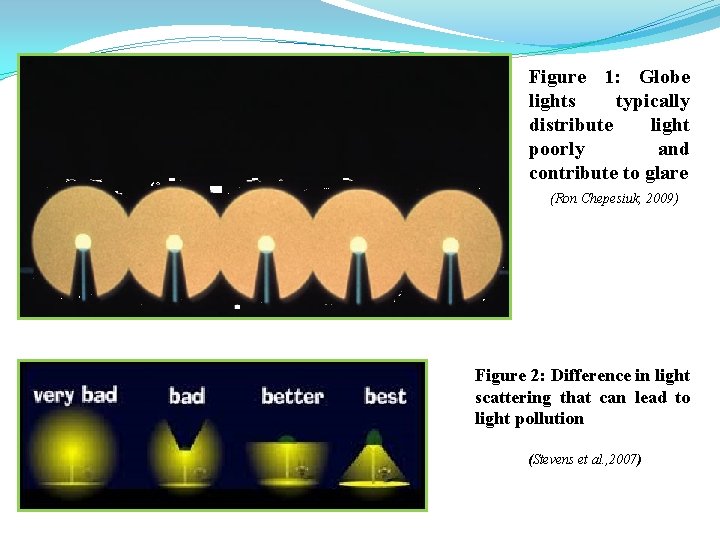
Figure 1: Globe lights typically distribute light poorly and contribute to glare (Ron Chepesiuk, 2009) Figure 2: Difference in light scattering that can lead to light pollution (Stevens et al. , 2007)

TYPES OF LIGHT POLLUTION (1) Light Trespass: � Unwanted light that enters one's property from outside � For e. g. street lights entering inside from windows etc. � Leads to sleep deprivation or the blocking of an evening view (2) Over illumination: � Excessive use of light � Leads to excessive energy wastage (3) Glare: � Light that gives a blinding effect to eyes. For e. g. oncoming car lights � Leads to temporary or permanent vision deficiency, reduces contrast (4) Skyglow: � Glow effect that can be seen over populated areas. � Combination of all light escaping up into the sky from all the badly directed light in that area � Leads to disturbances in astronomical observations
CAUSES OF LIGHT POLLUTION � Light pollution is a disadvantage of industrial civilization � SOURCES: Interior lightings Advertising Commercial properties Offices, factories Streetlights Illuminated sporting venues � Lack of public awareness to the possible harmful effects of light pollution � It is not only the number of lights that has increased nowadays, but also the luminous output per lamp.
CLASSIFICATION OF LIGHT POLLUTION Two major types based on their side effects: (1) Ecological light pollution: � Animals can experience increased disorientation from additional illumination � Animals are attracted to or repulsed by glare � Affects foraging, reproduction, communication, and other critical behaviours. � The more subtle influences of artificial night lighting on the behaviour and community ecology of species are less well recognized (2) Astronomical Light Pollution: � Skyglow (the scattering of light in the atmosphere) reduces the contrast between stars and galaxies, making it much harder to see fainter objects. � This is one factor that has caused newer telescopes to be built in increasingly remote areas
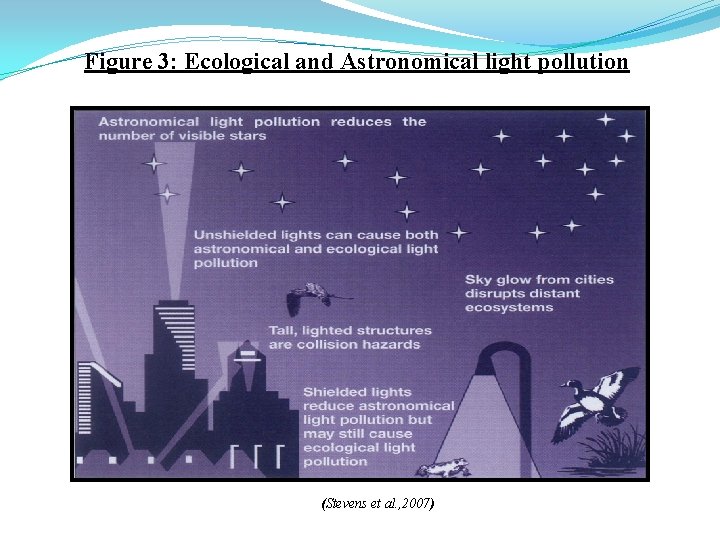
Figure 3: Ecological and Astronomical light pollution (Stevens et al. , 2007)

EFFECTS OF LIGHT POLLUTION Energy Wastage: � Lighting is responsible for one-fourth of all electricity consumption worldwide Human Health: � Increased headache incidence, worker fatigue, medically defined stress, � Increase in anxiety, sleep disruption � Melatonin suppression (leading to cancer) Disturbances in Ecosystems: � Threat to nocturnal wildlife � Disorientation of migrating birds � Algal blooms (due to inhibition of zooplanktons) � Disturbance in breeding of sea turtles, sea birds, reptiles etc. Effects Astronomy
MEASUREMENT OF LIGHT POLLUTION � Often involves determination of illumination at a given place. Illumination is the amount of light incident per unit area � Light varies in intensity (the number of photons per unit area) and spectral content (expressed by wavelength) � Few technological advancements in the area of measurement of light pollution are- 1. Using geographical information systems (GIS) and remote sensing (RS) Technology. 2. Development of high resolution mosaic images of concerned area through use of satellites. 3. Use of hyperspectral sensors, namely, the Multispectral Infrared and Visible Imaging Spectrometer and the Visible Infrared Scanner-200, which give images that can be processed into data. 4. Light Pollution Index: analyze the interaction between street lighting, facade lighting, and light pollution.
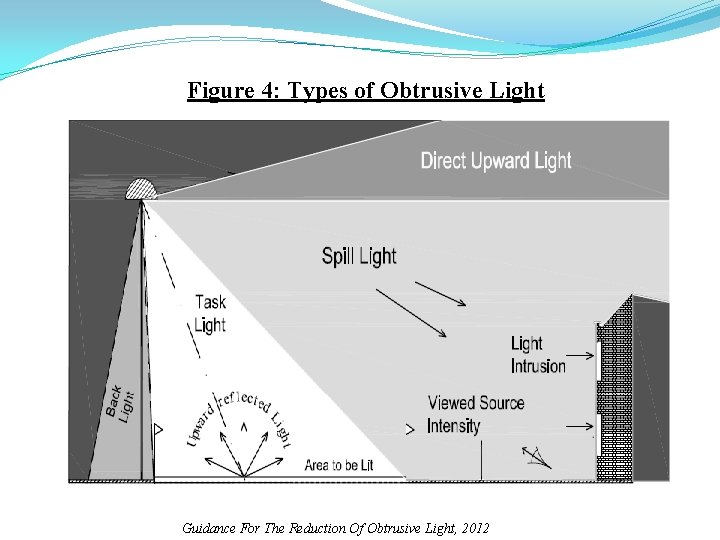
Figure 4: Types of Obtrusive Light Guidance For The Reduction Of Obtrusive Light, 2012
CONTROL OF LIGHT POLLUTION: SUGGESTIONS The configuration, direction, shielding, filtering, location and timing of illumination sources affect light pollution levels. � Use of luminaries in which the amount of light that can be directed skyward (more than 80°) should be minimum � Energy-efficient lighting sources such as light-emitting diodes have been developed. � Use of sodium lamps producing less disturbing light � Infrared detectors within vehicles reduce the need of street lighting. � Street lighting can be adjusted to the traffic volume and to weather conditions through light sensors, instead of keeping streets constantly illuminated
� Trees and bushes planted because of aesthetic reasons can reduce light � Turning lights off using a timer or sensor or manually when not needed � Adjusting the type of lights used, so that the light waves emitted are those that are less likely to cause severe light pollution � Evaluating existing lighting plans, and re-designing some or all of the plans depending on whether existing light is actually needed. � Using lights to illuminate trees, houses and land should be strongly discouraged if done just for decorative purposes
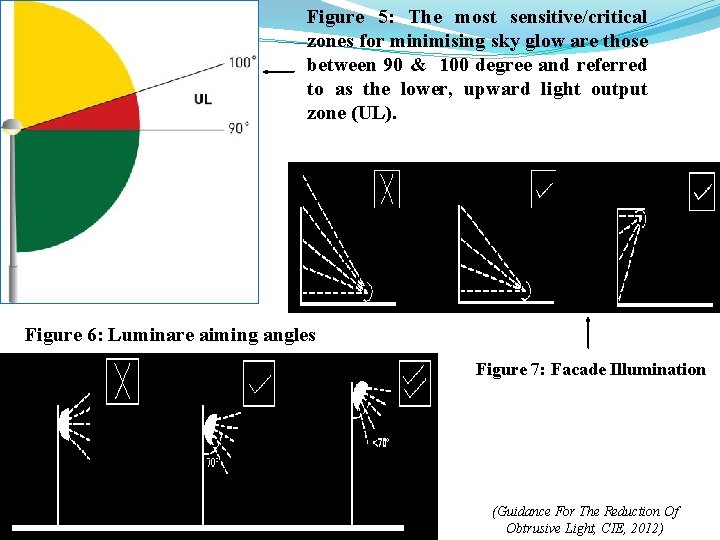
Figure 5: The most sensitive/critical zones for minimising sky glow are those between 90 & 100 degree and referred to as the lower, upward light output zone (UL). Figure 6: Luminare aiming angles Figure 7: Facade Illumination (Guidance For The Reduction Of Obtrusive Light, CIE, 2012)
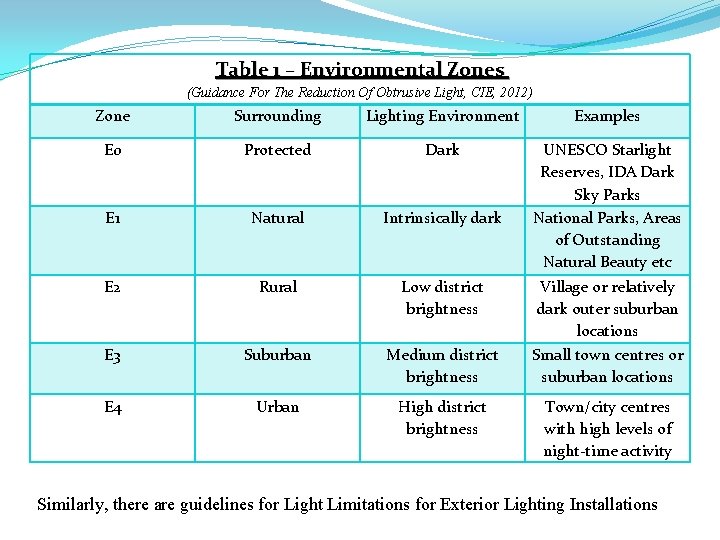
Table 1 – Environmental Zones (Guidance For The Reduction Of Obtrusive Light, CIE, 2012) Zone Surrounding Lighting Environment Examples E 0 Protected Dark E 1 Natural Intrinsically dark UNESCO Starlight Reserves, IDA Dark Sky Parks National Parks, Areas of Outstanding Natural Beauty etc E 2 Rural Low district brightness E 3 Suburban Medium district brightness E 4 Urban High district brightness Village or relatively dark outer suburban locations Small town centres or suburban locations Town/city centres with high levels of night-time activity Similarly, there are guidelines for Light Limitations for Exterior Lighting Installations
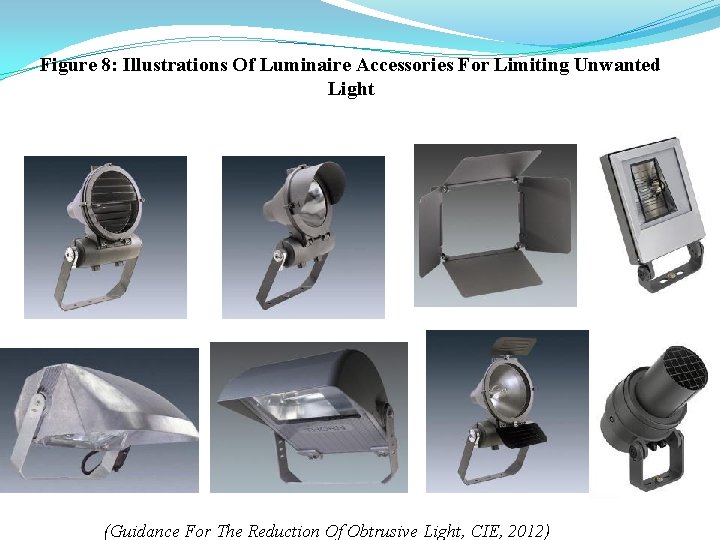
Figure 8: Illustrations Of Luminaire Accessories For Limiting Unwanted Light (Guidance For The Reduction Of Obtrusive Light, CIE, 2012)
ORGANIZATIONS INVOLVED… v International Dark-Sky Association (IDA): non-profit advocacy group involved in this movement. (Arizona) v International Commission on Illumination (CIE): is devoted to worldwide cooperation and the exchange of information on all matters relating to the science and art of light and lighting, colour and vision. (Vienna) v Illuminating Engineering Society Of North America (IESNA): non profit organization that develops and publishes standards regarding lighting. IESNA standards are in effect throughout all of North America. (New York) v Indian Society of Lighting Engineers (ISLE): Promoting the science and practice of illumination engineering services, affiliated to CIE. (New Delhi)
REFERENCES � Gal G, Loew ER, Rudstam LG, and Mohammadian AM. 1999. Light and diel vertical migration: spectral sensitivity and light avoidance by Mysis relicta. Can] Fish Aquat Sci 56: 311 -22. � Rydell J. 1992. Exploitation of insects around streetlamps by bats in Sweden. Funct Ecol 6: 744 -50. � Chepesiuk. R. , 2009, “Health effects of light pollution. ” Environmental Health Perspectives, Vol. 117 No. 1 � Longcore, T. , Rich, C. , Gauthreaux Jr, S. A. , 2008. Height, guy wires, and steady- burning lights increase hazard of communication towers to nocturnal migrants: a review and meta-analysis. Auk 125, 486– 493. � Horva´ th, G. , Kriska, G. , Malik, P. , Robertson, B. , 2009. Polarized light pollution: a new kind of ecological photopollution. Frontiers in Ecology and the Environment 7, 317– 325. � Kyba, C. C. M. , Ruhtz, T. , Fischer, J. , H¨ olker, F. , 2011. Cloud coverage acts as an amplifier for ecological light pollution in urban ecosystems. PLo. S One 6, e 17307. � Summers, J. K. , Smith, L. M. , Case, J. L. , Linthurst, R. A. , 2012. A review of the elements of human well-being with an emphasis on the contribution of ecosystem services. � Martinell, M. C. , Dotterl, S. , Blanche , C. , Rovira, A. , Masso, S. , Bosch, M. , 2010. Nocturnal pollination of the endemic Silenesennenii (Caryophyllaceae): an endangered mutualism � Verheijen, F. , 1985. Photopollution: artificial light optic spatial control systems fail to cope with. Incidents, causation, remedies. Experimental Biology 44, 1– 18. � Navara, K. J. , Nelson, R. J. , 2007. The dark side of light at night: physiological, epidemiological, and ecological consequences. Journal of Pineal Research 43, 215– 224. � Stevens, R. G. , Blask, D. E. , Brainard, G. C. , Hansen, J. , Lockley, S. W. , Provencio, I. , Rea, M. S. , Reinlib, L. , 2007. Meeting report: the role of environmental lighting and circadian disruption in cancer and other diseases. Environmental Health Perspectives 115, 1357– 1362. � Kloog, I. , Haim, A. , Stevens, R. G. , Portnov, B. A. , 2009. Global co-distribution of light at night (LAN) and cancers of prostate, colon, and lung in men. Chronobiology International 26, 108– 125. � Fox, R. , 2012. The decline of moths in Great Britain: a review of possible causes. Insect Conservation and Diversity � Golden, R. N. , Gaynes, B. N. , Ekstrom, R. D. , Hamer, R. M. , Jacobsen, F. M. , Suppes, T. , Wisner, K. L. , Nemeroff, C. B. , 2005. The efficacy of light therapy in the treatment of mood disorders: a review and meta-analysis of the evidence. American Journal of Psychiatry 162, 656– 662. � Bocetti, C. I. , 2011. Cruise ships as a source of svian mortality during fall migration. Wilson Journal of Ornithology 123, 176– 178. � Johnson, P. N. , Bouchard, K. , Goetz, F. A. , 2005. Effectiveness of strobe lights for reducing juvenile salmonid entrainment into a navigation lock. North Amer- ican Journal of Fisheries Management 25, 491– 501. � Merkel, F. R. , Johansen, K. L. , 2011. Light-induced bird strikes on vessels in South- west Greenland. Marine Pollution Bulletin 62, 2330– 2336.
THANK YOU
- Slides: 18