
LIGHT INTERACTIONS Unit 5 Benchmark Objectives Students should
LIGHT INTERACTIONS Unit 5
Benchmark Objectives Students should be able to: • Observe and explain that light can be reflected, refracted, and/or absorbed. • Recognize that light waves, sound waves, and other waves move at different speeds in different materials
How can waves interact with a medium? Reflection Diffraction Absorption
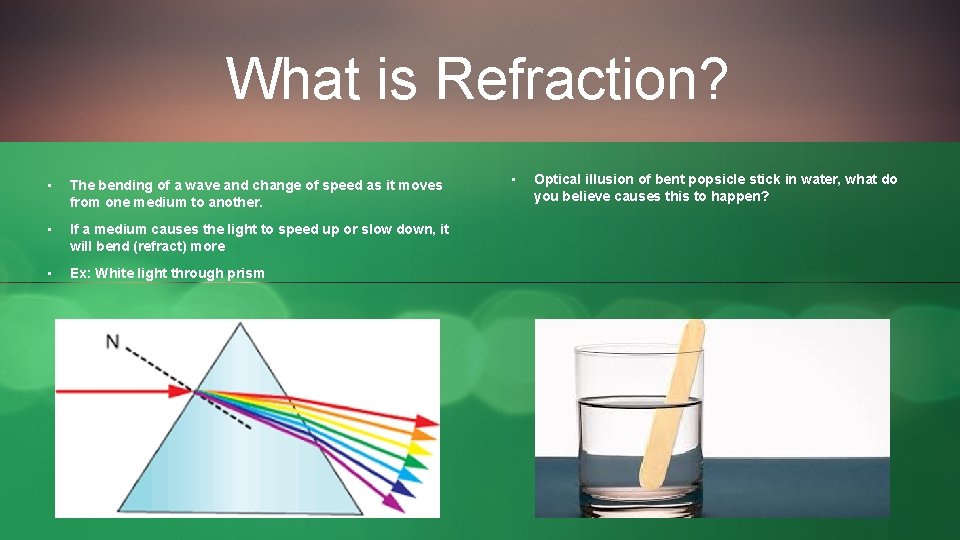
What is Refraction? • The bending of a wave and change of speed as it moves from one medium to another. • If a medium causes the light to speed up or slow down, it will bend (refract) more • Ex: White light through prism • Optical illusion of bent popsicle stick in water, what do you believe causes this to happen?
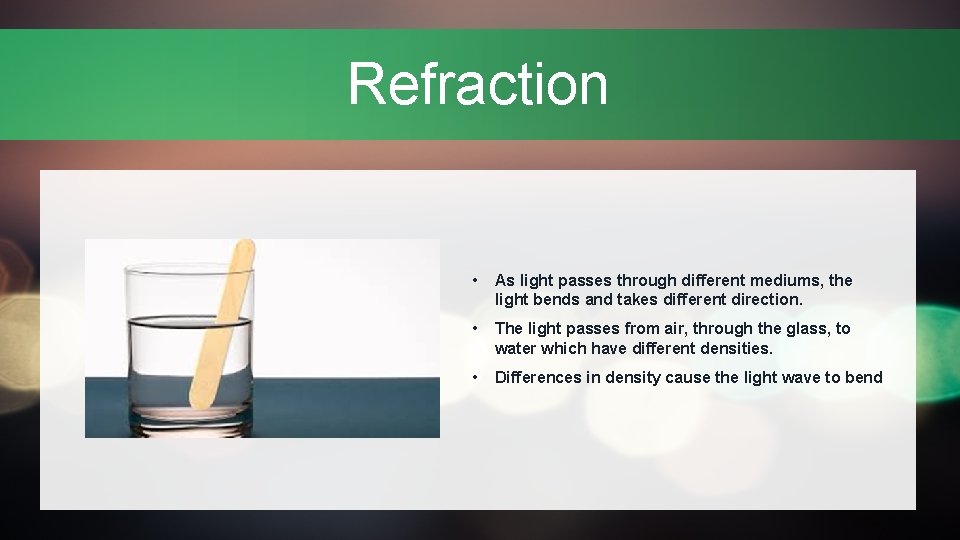
Refraction • As light passes through different mediums, the light bends and takes different direction. • The light passes from air, through the glass, to water which have different densities. • Differences in density cause the light wave to bend
Speed of Waves Electromagnetic Waves: • Travel at the speed of light ~ 300, 000 m/s • They slow down when they travel through a medium • • • Solid: Glass (slowest) Liquid: Water Gas: Air (fastest) Mechanical Waves (Ex; sound waves) • Also slow down depending on the medium • • • Solid: Glass (fastest) Liquid: Water Gas: Air (slowest)
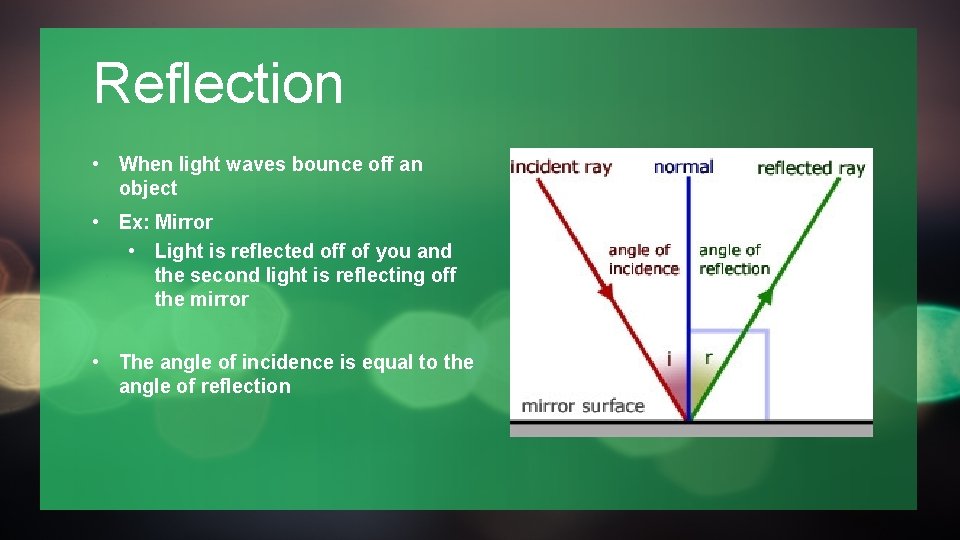
Reflection • When light waves bounce off an object • Ex: Mirror • Light is reflected off of you and the second light is reflecting off the mirror • The angle of incidence is equal to the angle of reflection
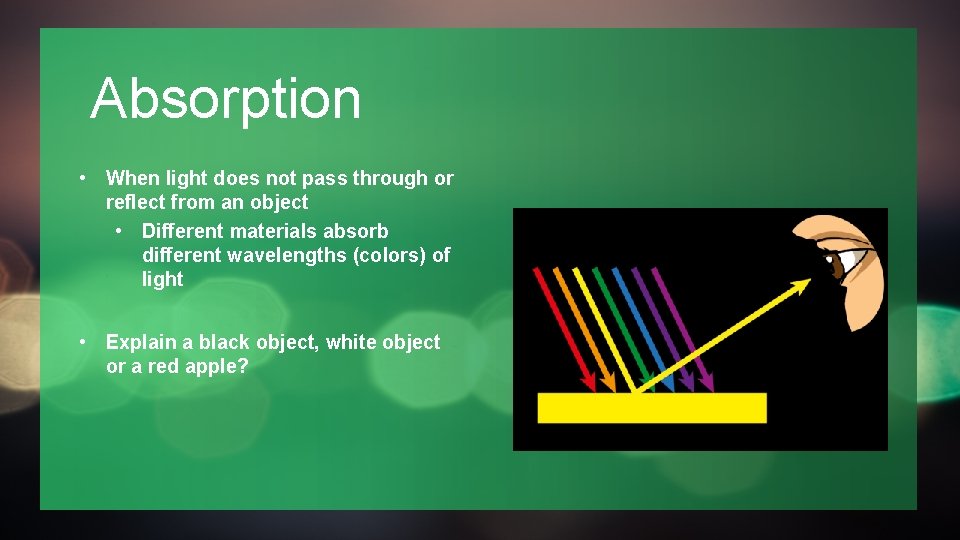
Absorption • When light does not pass through or reflect from an object • Different materials absorb different wavelengths (colors) of light • Explain a black object, white object or a red apple?
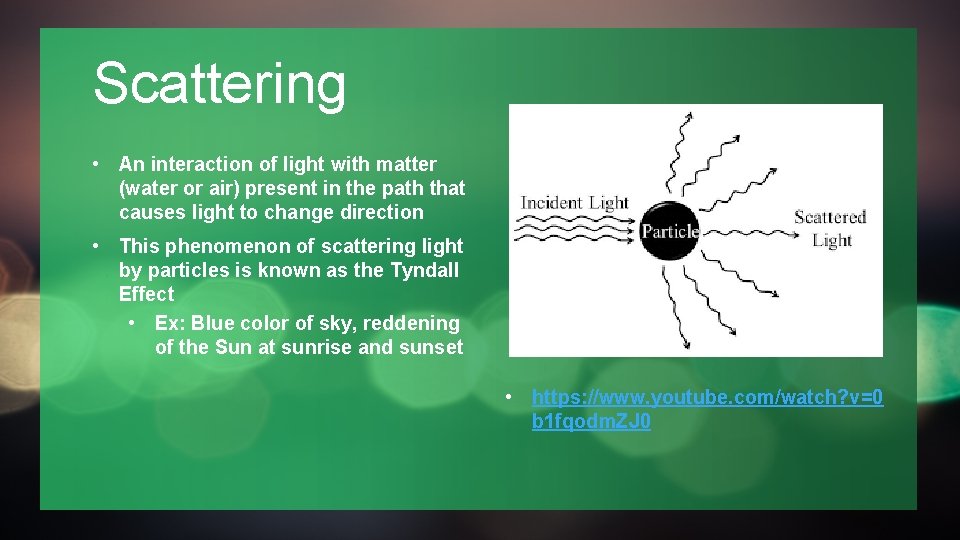
Scattering • An interaction of light with matter (water or air) present in the path that causes light to change direction • This phenomenon of scattering light by particles is known as the Tyndall Effect • Ex: Blue color of sky, reddening of the Sun at sunrise and sunset • https: //www. youtube. com/watch? v=0 b 1 fqodm. ZJ 0
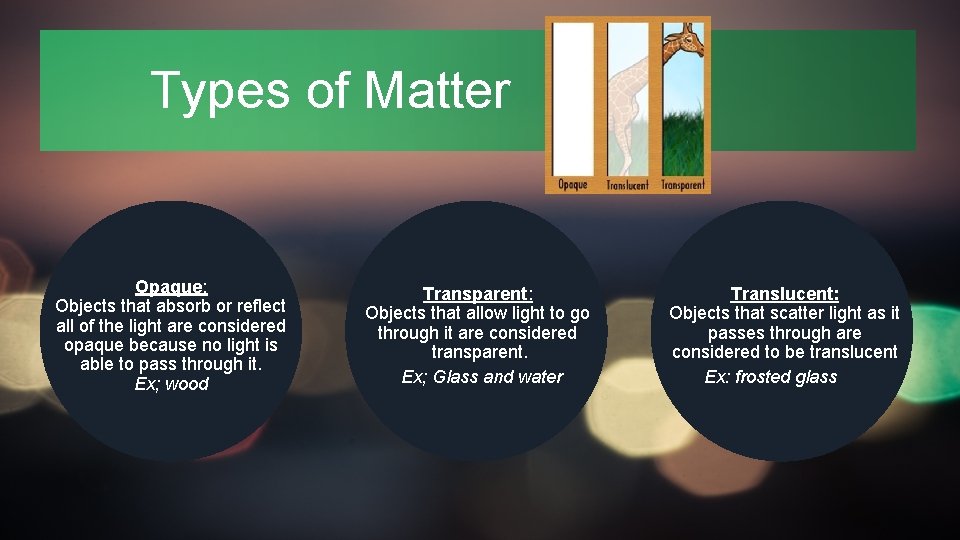
Types of Matter Opaque: Objects that absorb or reflect all of the light are considered opaque because no light is able to pass through it. Ex; wood Transparent: Objects that allow light to go through it are considered transparent. Ex; Glass and water Translucent: Objects that scatter light as it passes through are considered to be translucent Ex: frosted glass
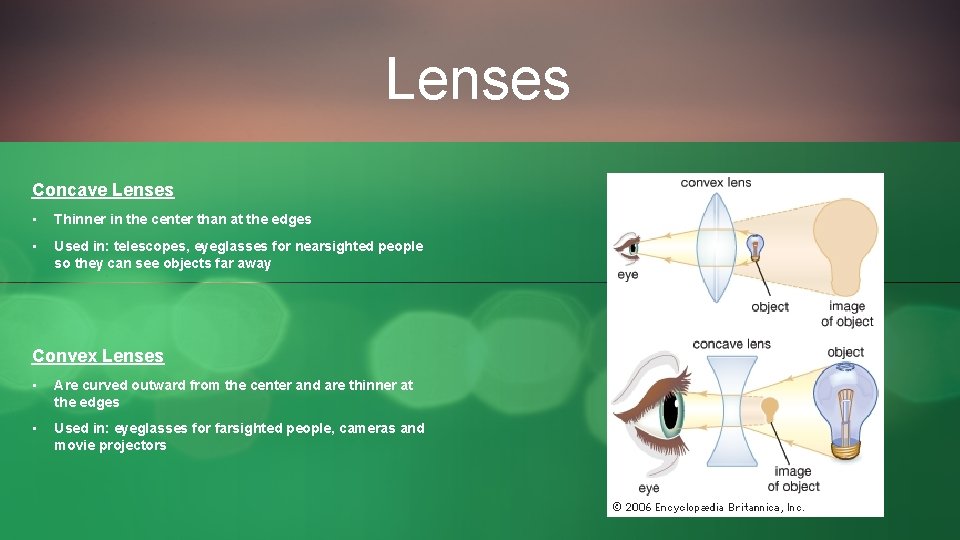
Lenses Concave Lenses • Thinner in the center than at the edges • Used in: telescopes, eyeglasses for nearsighted people so they can see objects far away Convex Lenses • Are curved outward from the center and are thinner at the edges • Used in: eyeglasses for farsighted people, cameras and movie projectors

Refrences: HMH Florida science 2019 Di. Spezio, Micheal A. , et al.
- Slides: 13