
Light Identify opaque translucent and transparent materials Year
- Slides: 8
Light Identify opaque, translucent and transparent materials Year 3 / Key Stage 2 Age 7 -8 For parents and carers Thank you for supporting your child’s learning in science. Before the session: • Please read slide 2 so you know what your child learning and what you need to get ready. • As an alternative to lined paper, slide 5 may be printed for your child to record on. During the session: • Share the learning intentions on slide 2. • Support your child with the main activities on slides 3 & 4, as needed. • Slide 6 is a further, optional activity. • Slide 7 has a glossary of key terms. Reviewing with your child: • Slide 8 gives an idea of what your child may produce.
Logo for section to sit inside roundel Light Identify opaque, translucent and transparent materials Key Learning Activities (pages 3 -5): approx. 30 -40 mins • Shadows are formed on a surface when an opaque or translucent object is between a light source and the surface and blocks some of the light. • Use lined paper, ruler and pencil. • Alternatively, print page 5 as a worksheet. Find out more… (page 6): approx. 10 mins I can… • identify materials that are opaque, translucent or transparent. 2
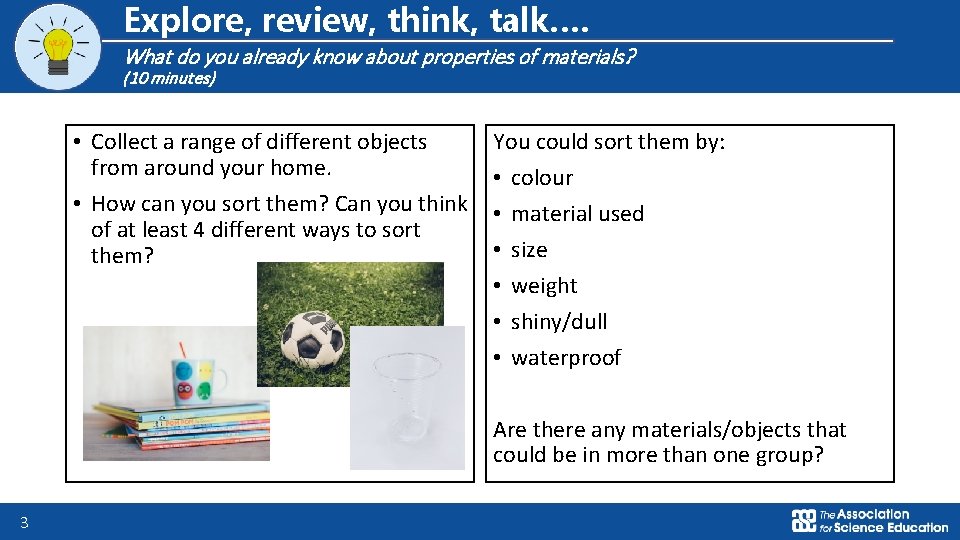
Logo for section to sit inside roundel Explore, review, think, talk…. What do you already know about properties of materials? (10 minutes) • Collect a range of different objects from around your home. • How can you sort them? Can you think of at least 4 different ways to sort them? You could sort them by: • colour • material used • size • weight • shiny/dull • waterproof Are there any materials/objects that could be in more than one group? 3 3
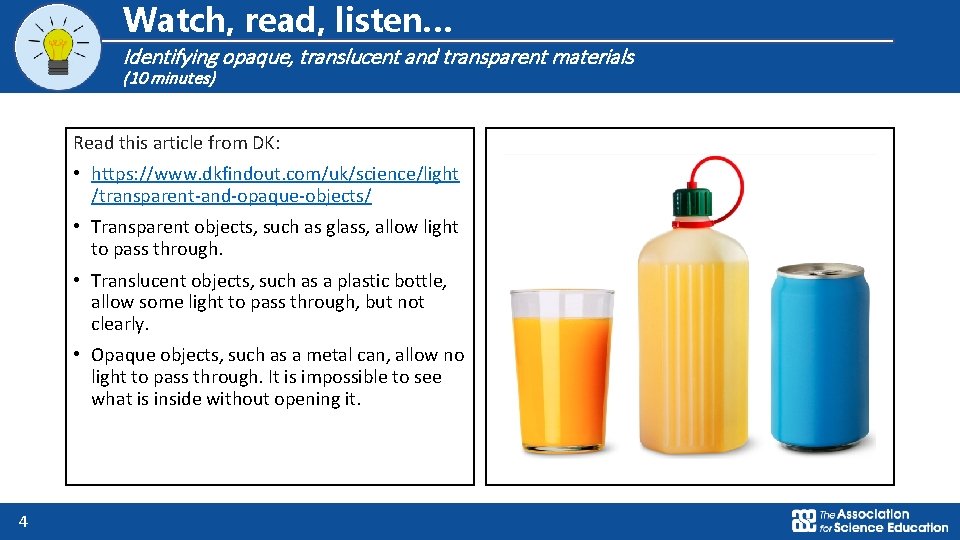
Logo for section to sit inside roundel Watch, read, listen… Identifying opaque, translucent and transparent materials (10 minutes) Read this article from DK: • https: //www. dkfindout. com/uk/science/light /transparent-and-opaque-objects/ • Transparent objects, such as glass, allow light to pass through. • Translucent objects, such as a plastic bottle, allow some light to pass through, but not clearly. • Opaque objects, such as a metal can, allow no light to pass through. It is impossible to see what is inside without opening it. 4
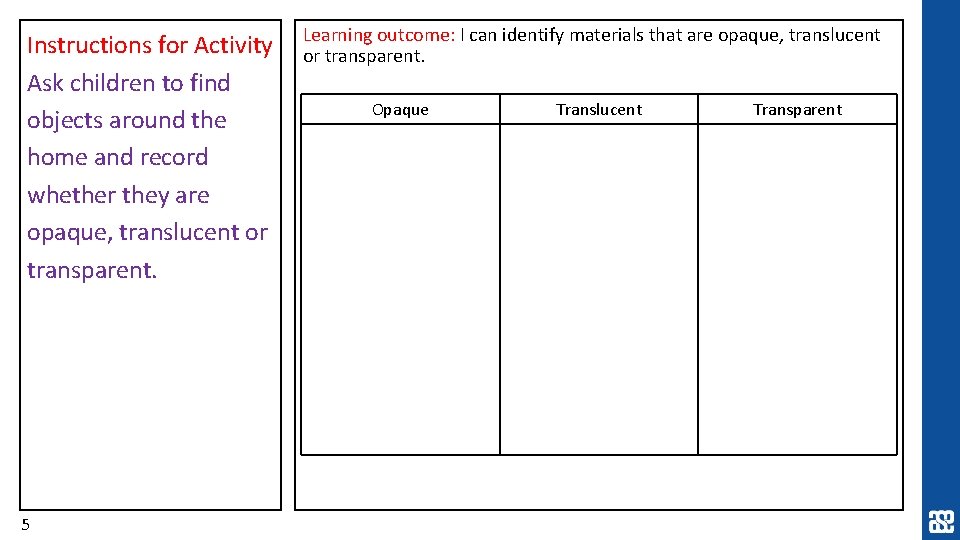
Instructions for Activity Ask children to find objects around the home and record whether they are opaque, translucent or transparent. 5 Learning outcome: I can identify materials that are opaque, translucent or transparent. Opaque Translucent Transparent
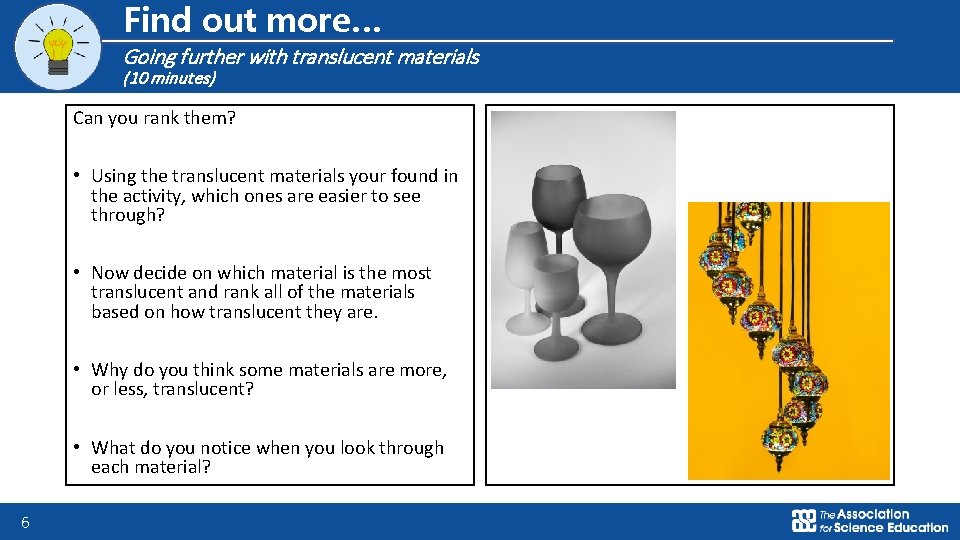
Logo for section to sit inside roundel Find out more… Going further with translucent materials (10 minutes) Can you rank them? • Using the translucent materials your found in the activity, which ones are easier to see through? • Now decide on which material is the most translucent and rank all of the materials based on how translucent they are. • Why do you think some materials are more, or less, translucent? • What do you notice when you look through each material? 6
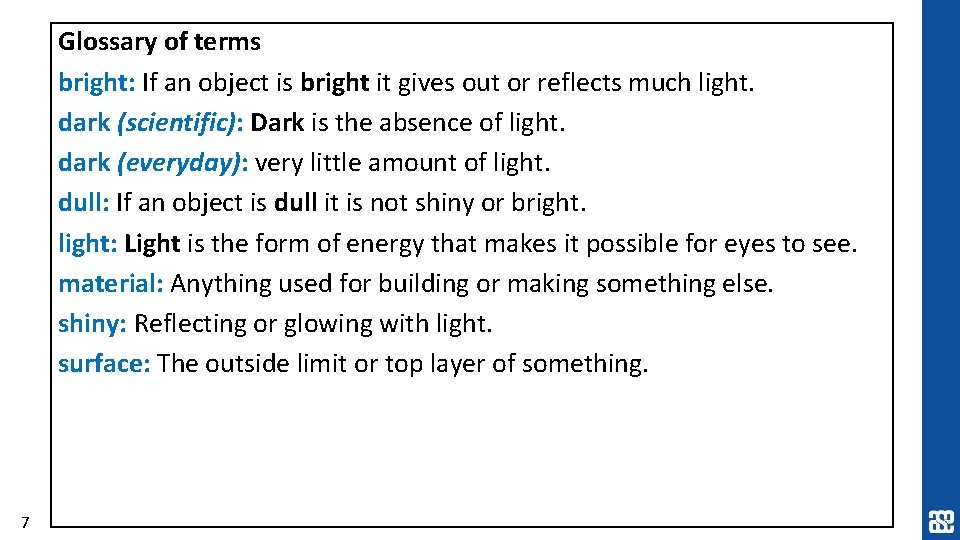
Glossary of terms bright: If an object is bright it gives out or reflects much light. dark (scientific): Dark is the absence of light. dark (everyday): very little amount of light. dull: If an object is dull it is not shiny or bright. light: Light is the form of energy that makes it possible for eyes to see. material: Anything used for building or making something else. shiny: Reflecting or glowing with light. surface: The outside limit or top layer of something. 7
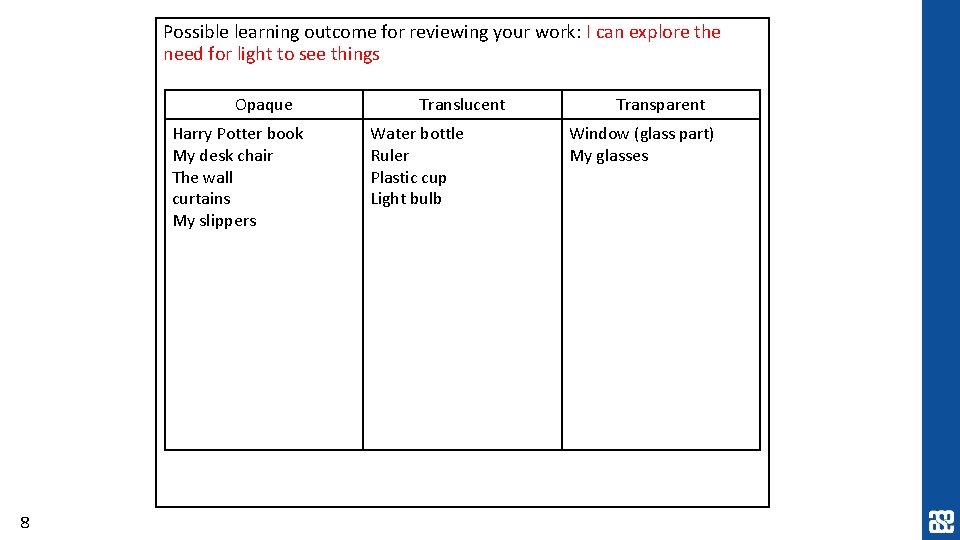
Possible learning outcome for reviewing your work: I can explore the need for light to see things Opaque Harry Potter book My desk chair The wall curtains My slippers 8 Translucent Water bottle Ruler Plastic cup Light bulb Transparent Window (glass part) My glasses