
Light Harvesting in Photosynthesis Gabriela SchlauCohen Fleming Group
Light Harvesting in Photosynthesis Gabriela Schlau-Cohen Fleming Group
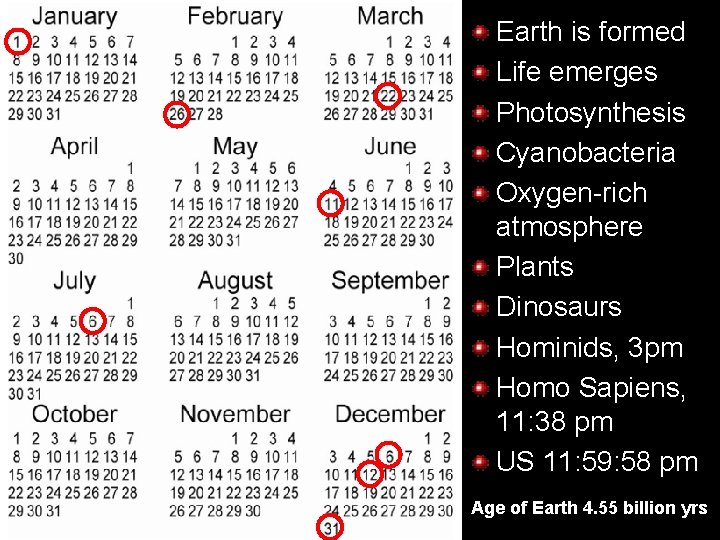
Earth is formed Life emerges Photosynthesis Cyanobacteria Oxygen-rich atmosphere Plants Dinosaurs Hominids, 3 pm Homo Sapiens, 11: 38 pm US 11: 59: 58 pm Age of Earth 4. 55 billion yrs
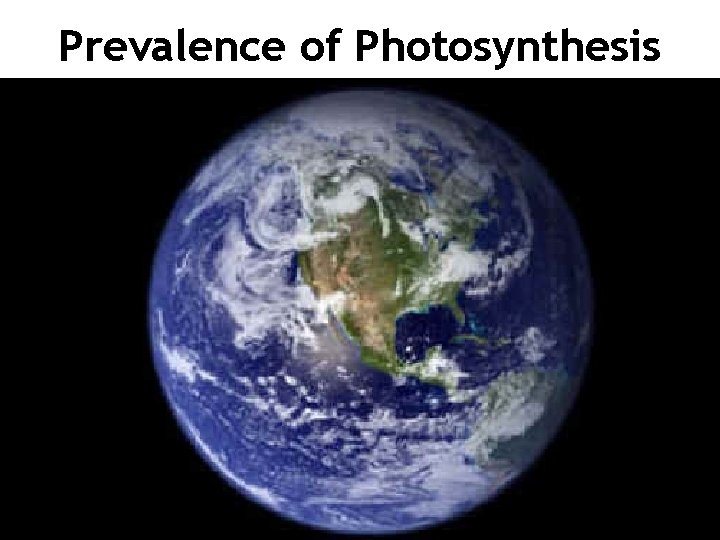
Prevalence of Photosynthesis
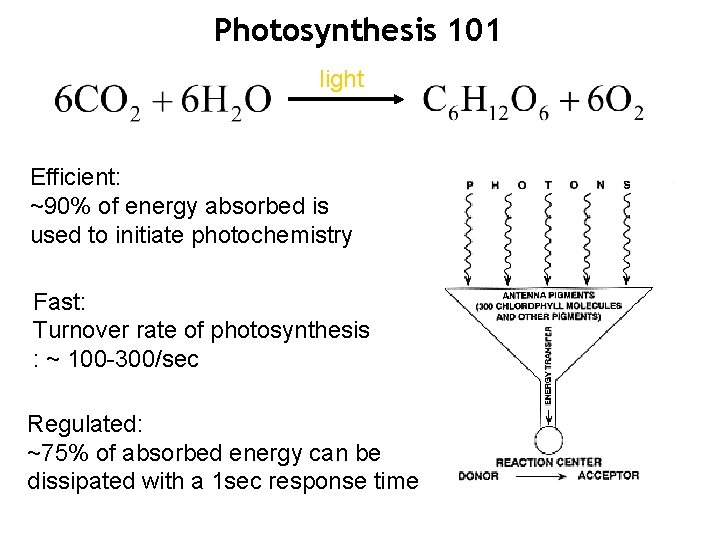
Photosynthesis 101 light Efficient: ~90% of energy absorbed is used to initiate photochemistry Fast: Turnover rate of photosynthesis : ~ 100 -300/sec Regulated: ~75% of absorbed energy can be dissipated with a 1 sec response time

Architecture of Photosynthesis is Optimized to: Cover the solar spectrum Protect against photochemical damage Separate energy and electron transfer Transmit excitation to the reaction center with near unit efficiency Regulate the efficiency of light harvesting and repair damage (PSII)
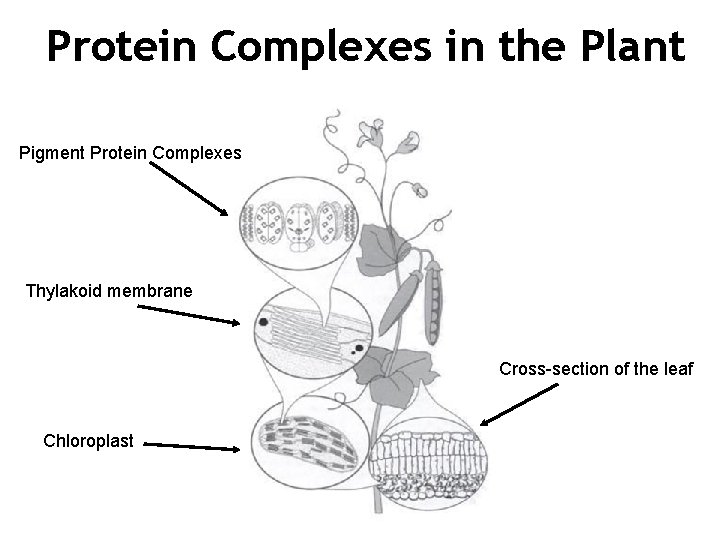
Protein Complexes in the Plant Pigment Protein Complexes Thylakoid membrane Cross-section of the leaf Chloroplast

Overview of photosynthetic LHCII supercomplex CP 26 CP 43 in plants D 1 LHCII Core Complex CP 29 CP 24 CP 47 D 2 Core Complex Peripheral antennas CP 47 CP 24 D 1 CP 43 CP 29 CP 26 LHCII Peripheral antennas
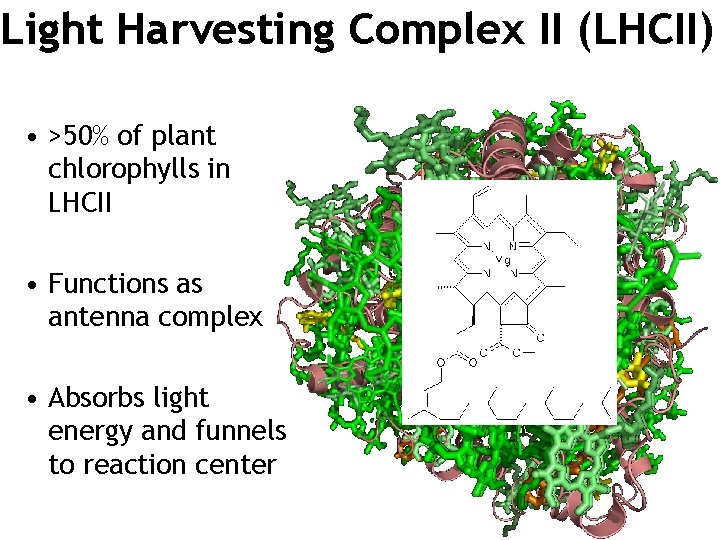
Light Harvesting Complex II (LHCII) • >50% of plant chlorophylls in LHCII • Functions as antenna complex • Absorbs light energy and funnels to reaction center
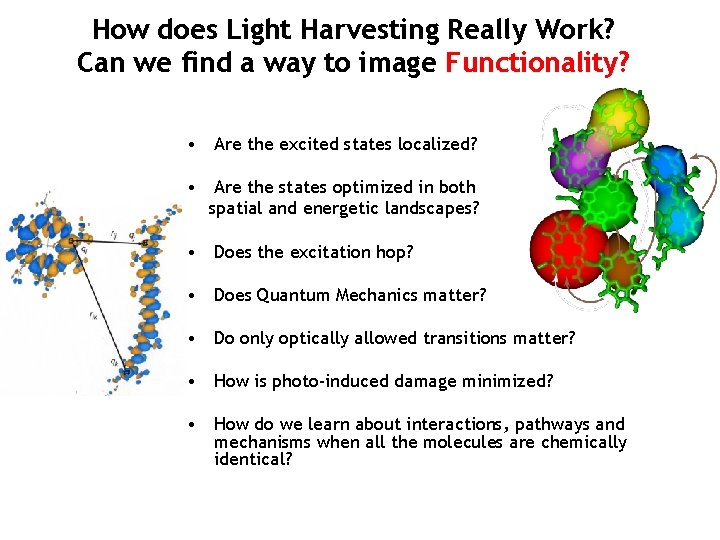
How does Light Harvesting Really Work? Can we find a way to image Functionality? • Are the excited states localized? • Are the states optimized in both spatial and energetic landscapes? • Does the excitation hop? • Does Quantum Mechanics matter? • Do only optically allowed transitions matter? • How is photo-induced damage minimized? • How do we learn about interactions, pathways and mechanisms when all the molecules are chemically identical?
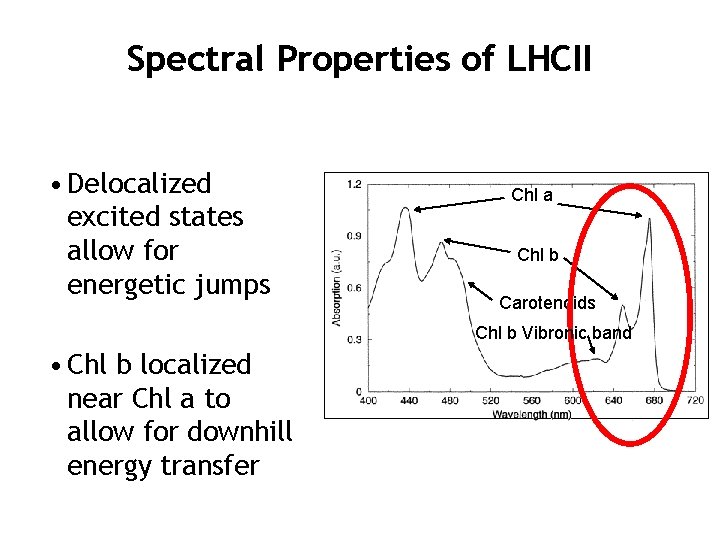
Spectral Properties of LHCII • Delocalized excited states allow for energetic jumps Chl a Chl b Carotenoids Chl b Vibronic band • Chl b localized near Chl a to allow for downhill energy transfer
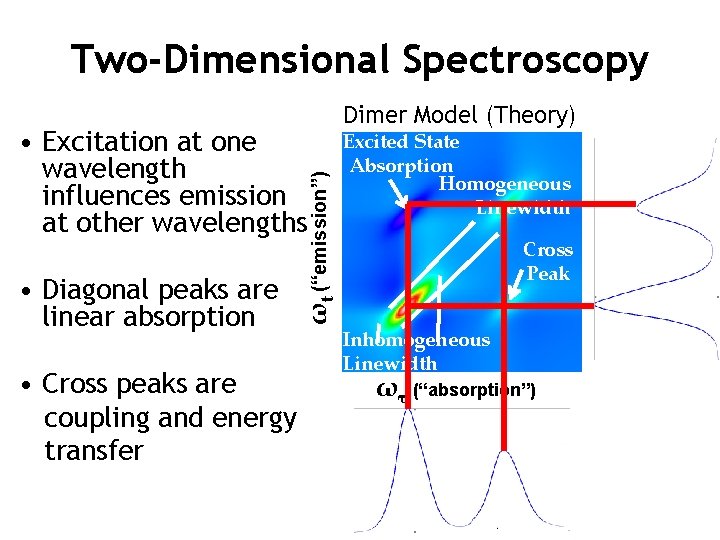
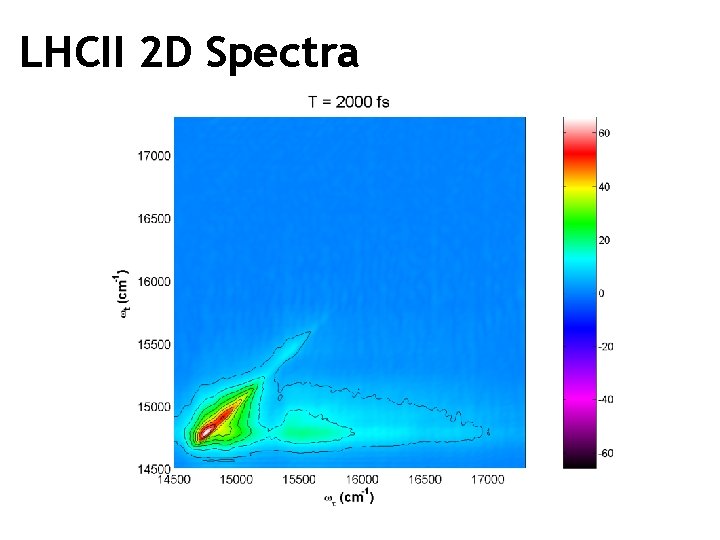
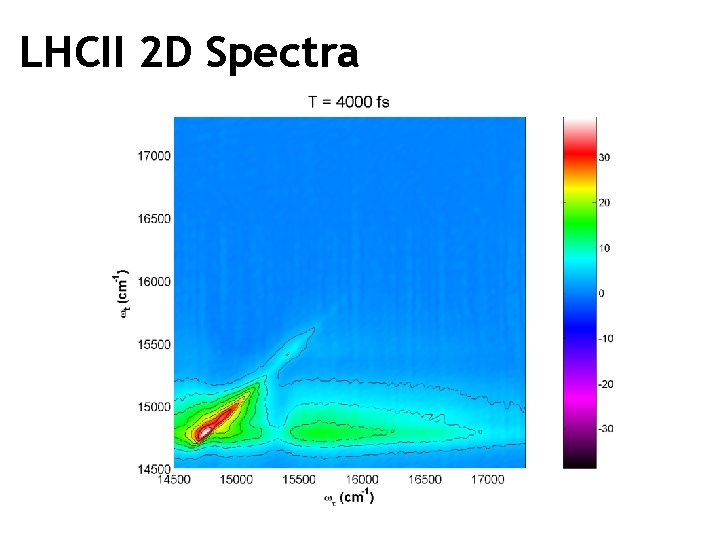
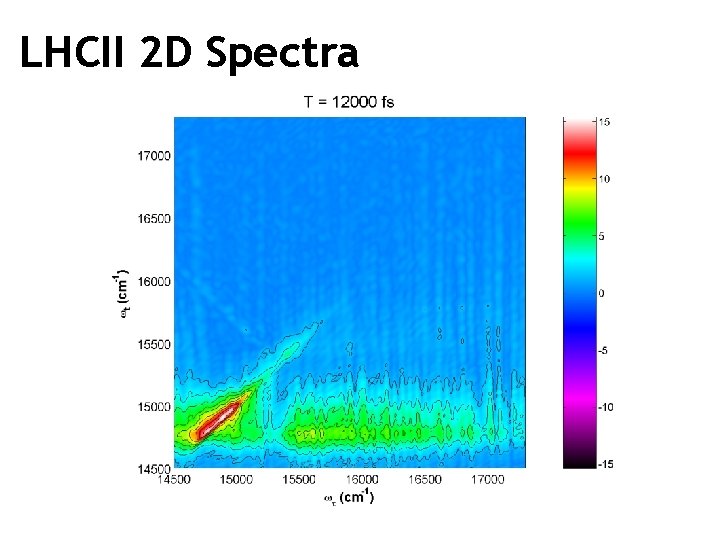
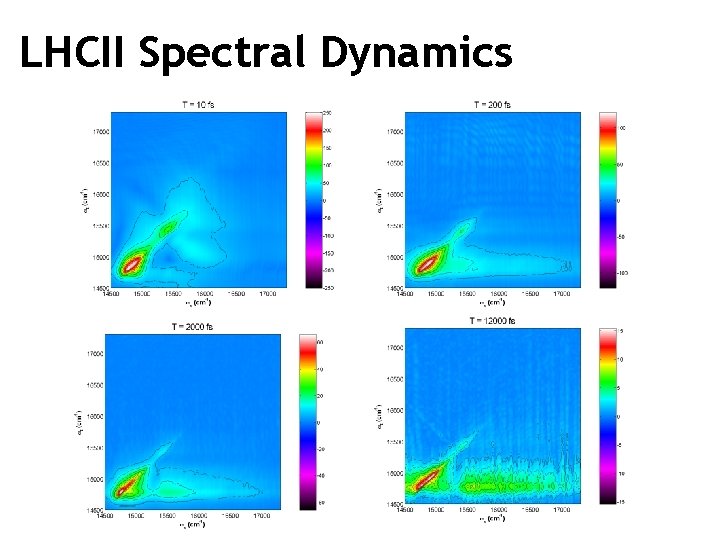
Two-Dimensional Spectroscopy • Diagonal peaks are linear absorption ωt (“emission”) • Excitation at one wavelength influences emission at other wavelengths • Cross peaks are coupling and energy transfer Dimer Model (Theory) Excited State Absorption Homogeneous Linewidth Cross Peak Inhomogeneous Linewidth ωτ (“absorption”)
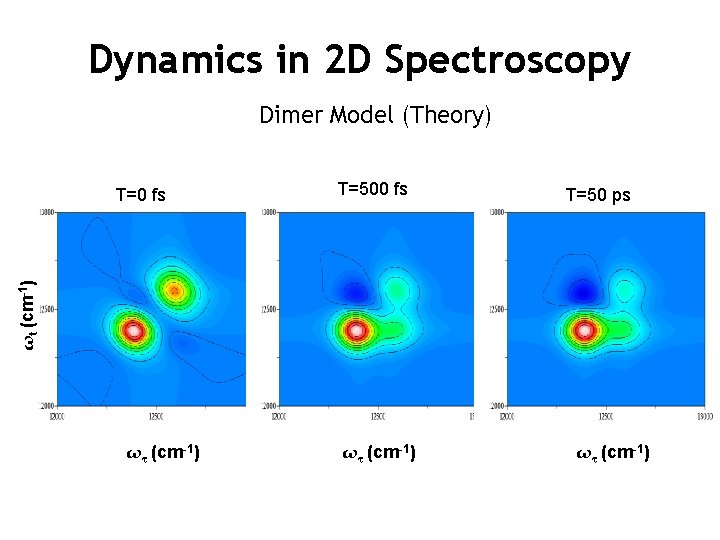
Dynamics in 2 D Spectroscopy Dimer Model (Theory) T=500 fs T=50 ps ωt (cm-1) T=0 fs ωτ (cm-1)
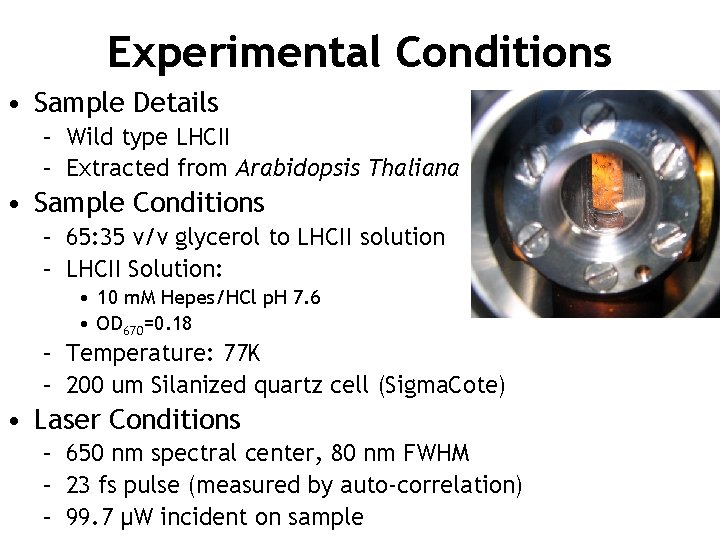
Experimental Conditions • Sample Details – Wild type LHCII – Extracted from Arabidopsis Thaliana • Sample Conditions – 65: 35 v/v glycerol to LHCII solution – LHCII Solution: • 10 m. M Hepes/HCl p. H 7. 6 • OD 670=0. 18 – Temperature: 77 K – 200 um Silanized quartz cell (Sigma. Cote) • Laser Conditions – 650 nm spectral center, 80 nm FWHM – 23 fs pulse (measured by auto-correlation) – 99. 7 μW incident on sample
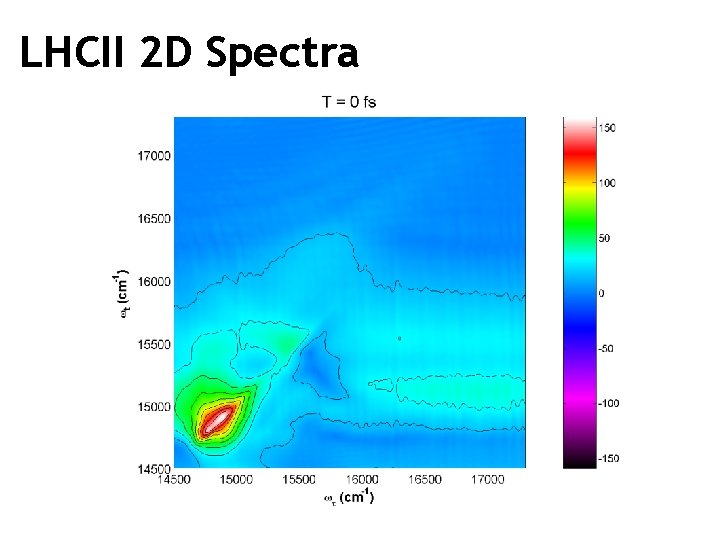
LHCII 2 D Spectra
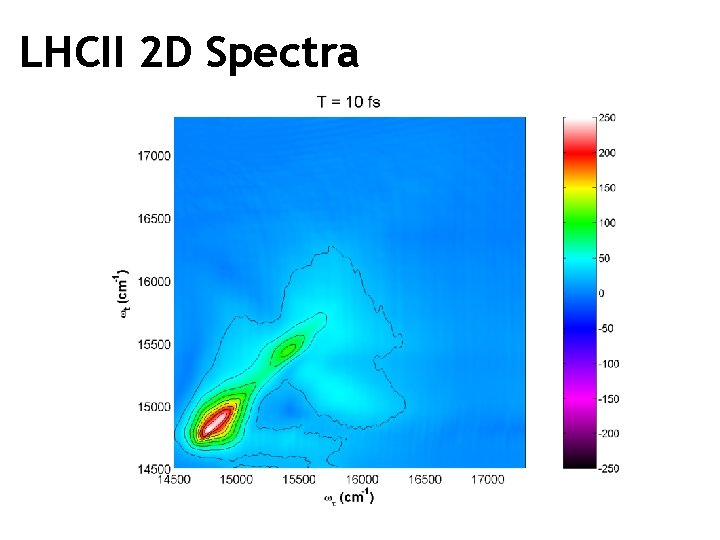
LHCII 2 D Spectra
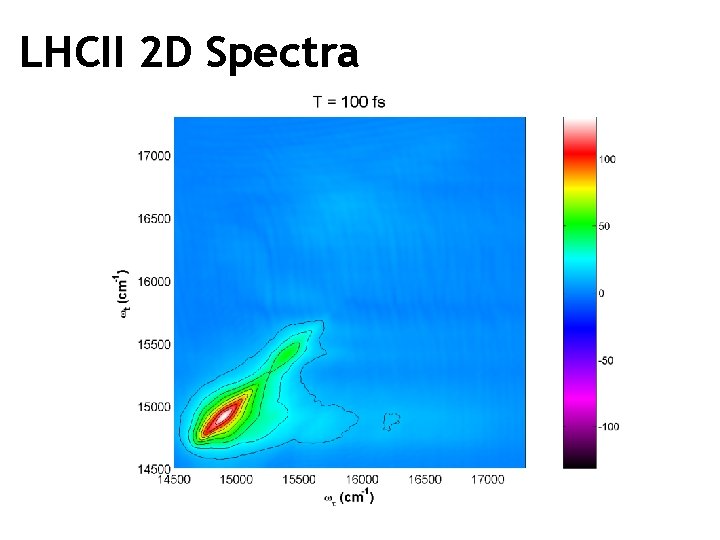
LHCII 2 D Spectra
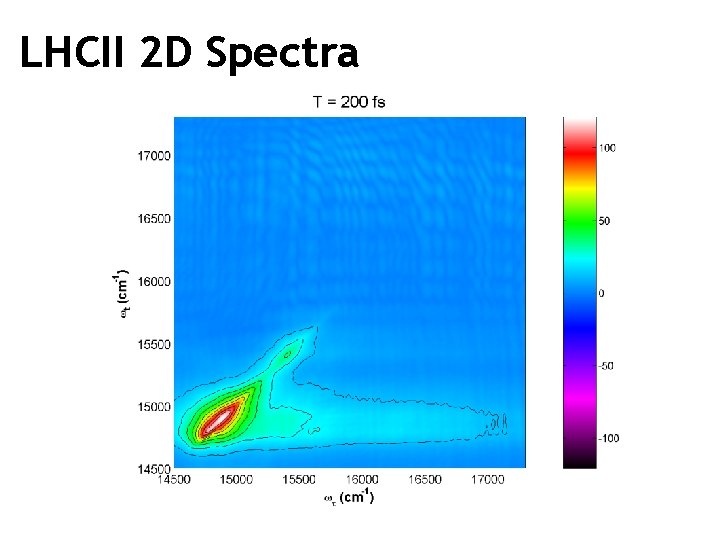
LHCII 2 D Spectra
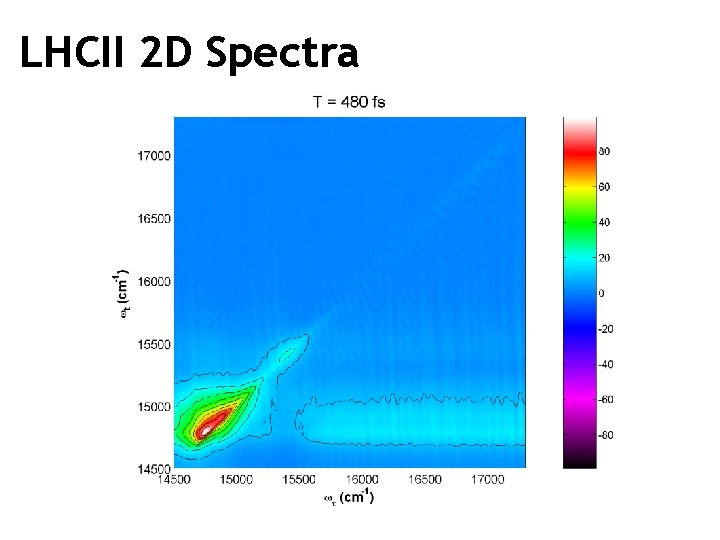
LHCII 2 D Spectra
LHCII 2 D Spectra
LHCII 2 D Spectra
LHCII 2 D Spectra
LHCII Spectral Dynamics
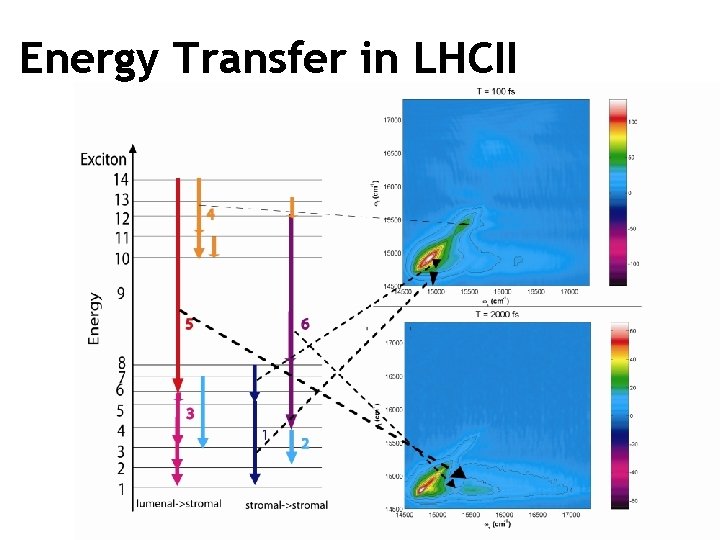
Energy Transfer in LHCII
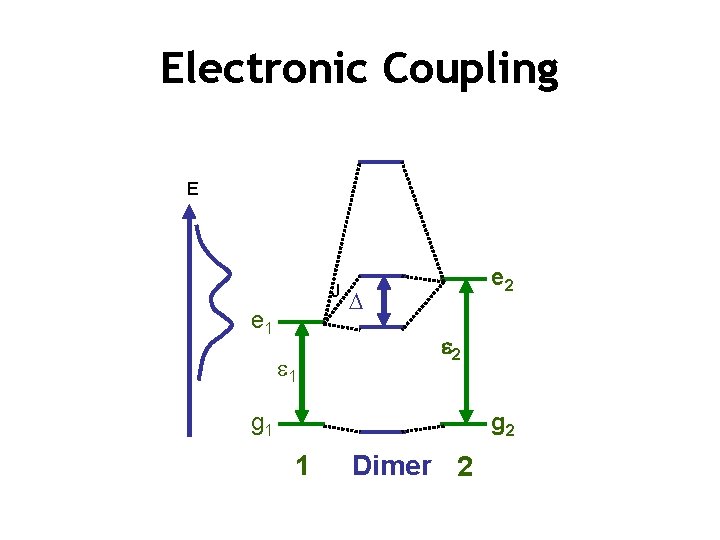
Electronic Coupling E E JJ e 1 e 2 D e 2 g 1 g 2 1 Dimer 2
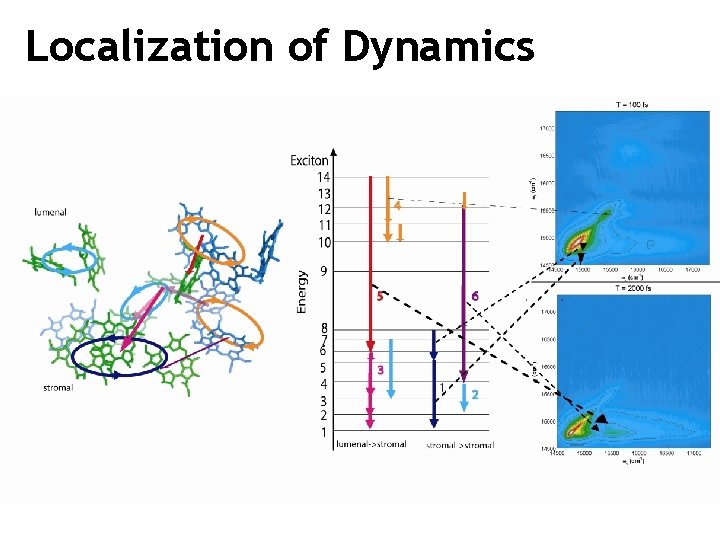
Localization of Dynamics
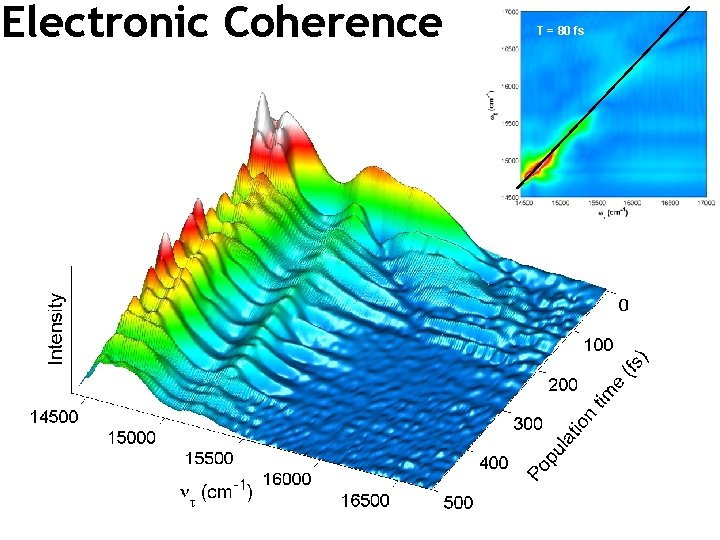
Electronic Coherence T = 80 fs
Conclusions & Future Directions • Coupling creates delocalized excited states over multiple chromophores • Delocalization means spatial overlap of energetically separate chromophores which allows large energetic jumps • Chl-b arranged near Chl-a for interband energy transfer • What specific mechanisms give rise to these energy transfer processes? • What role does quantum coherence play and how does it change at room temperature?
Acknowledgements Graham Fleming Tessa Calhoun Elizabeth Read Greg Engel Naomi Ginsberg References: Rick Trebino, Georgia Tech http: //www. physics. gatech. edu/gcuo/Ultrafast. Optics/index. html Blankenship, R. E. Molecular Mechanisms of Photosynthesis, 2004.
- Slides: 28