
LIGHT EMISSION DETECTION Lasers and LED Passive Elements
![Wavelength range of optical transmission Fiber optic transmission range Wavelength [nm] 1800 1600 1400](https://slidetodoc.com/presentation_image_h2/4547e1aa5af48f9a4d6c20e523d0b6bf/image-3.jpg "Wavelength range of optical transmission Fiber optic transmission range Wavelength [nm] 1800 1600 1400")
- Slides: 31
LIGHT EMISSION / DETECTION Lasers and LED Passive Elements Piotr Turowicz Poznan Supercomputing and Networking Center piotrek@man. poznan. pl Training Session 9 -10 October 2006 . http: //www. porta-optica. org 1
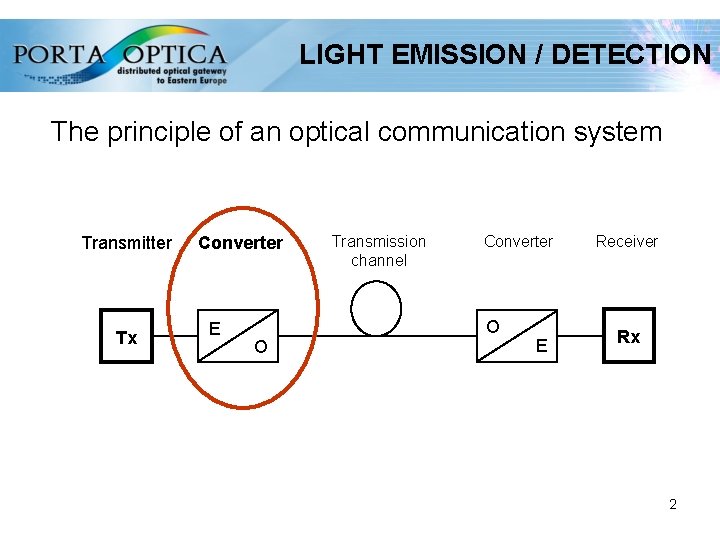
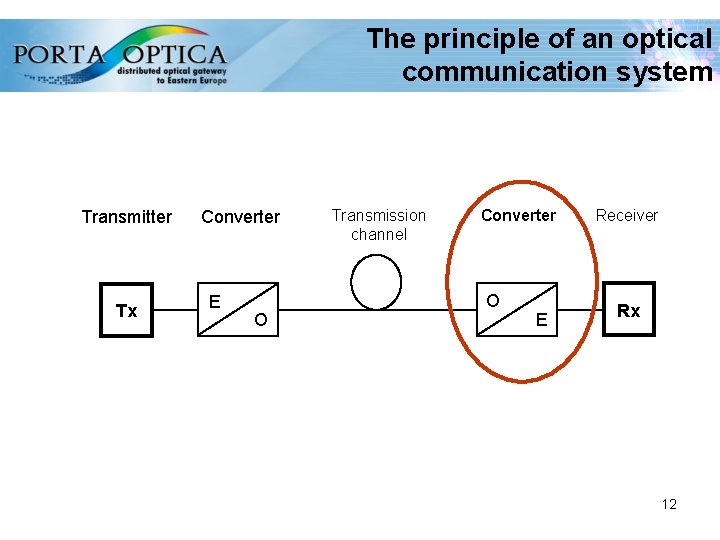
LIGHT EMISSION / DETECTION The principle of an optical communication system Transmitter Tx Converter E O Transmission channel Converter O E Receiver Rx 2
Wavelength range of optical transmission Fiber optic transmission range Wavelength [nm] 1800 1600 1400 2 x 10¹⁴ Glass Plastic 850 -1630 nm 520 -850 nm 1200 1000 3 x 10¹⁴ Infrared range 800 600 5 x 10¹⁴ Visible range 400 1 x 10¹⁵ 200 Frequency [Hz] Ultraviolet range 3
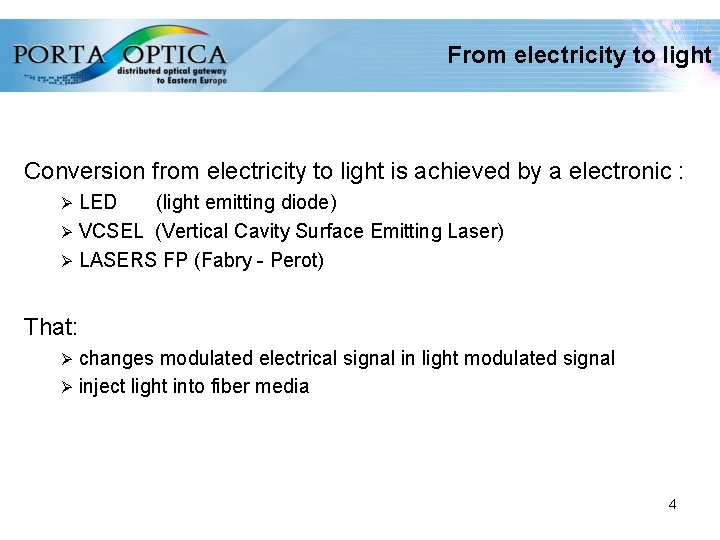
From electricity to light Conversion from electricity to light is achieved by a electronic : LED (light emitting diode) Ø VCSEL (Vertical Cavity Surface Emitting Laser) Ø LASERS FP (Fabry - Perot) Ø That: changes modulated electrical signal in light modulated signal Ø inject light into fiber media Ø 4
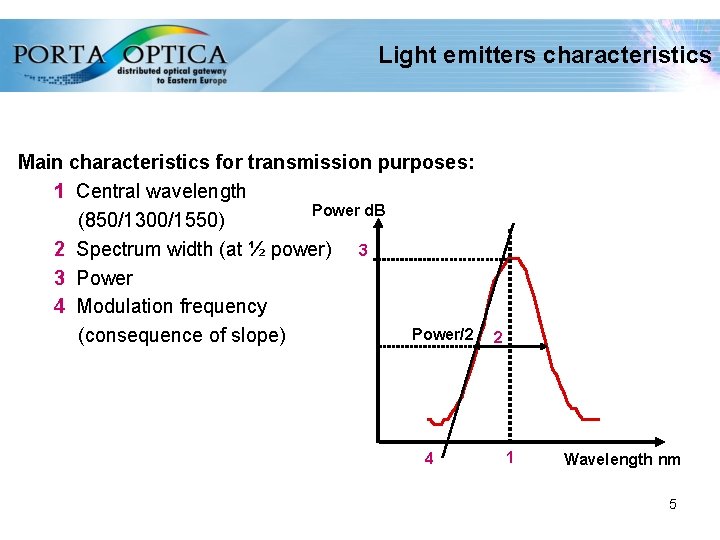
Light emitters characteristics Main characteristics for transmission purposes: 1 Central wavelength Power d. B (850/1300/1550) 2 Spectrum width (at ½ power) 3 3 Power 4 Modulation frequency Power/2 (consequence of slope) 4 2 1 Wavelength nm 5
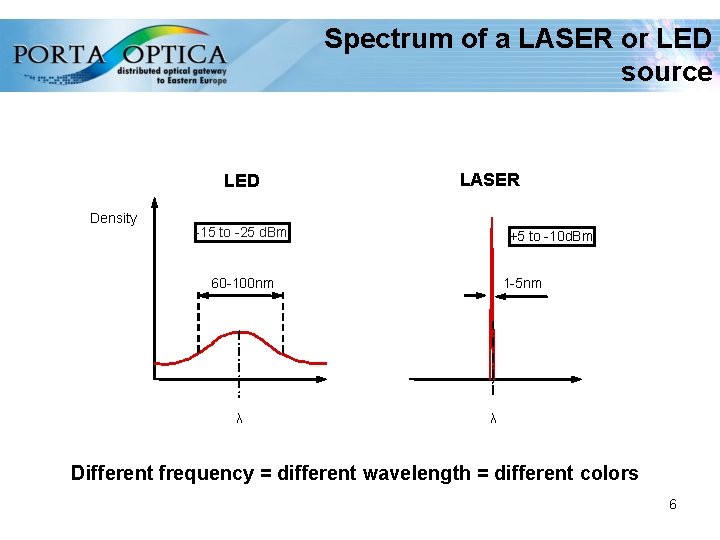
Spectrum of a LASER or LED source LED Density LASER -15 to -25 d. Bm +5 to -10 d. Bm 60 -100 nm λ 1 -5 nm λ Different frequency = different wavelength = different colors 6
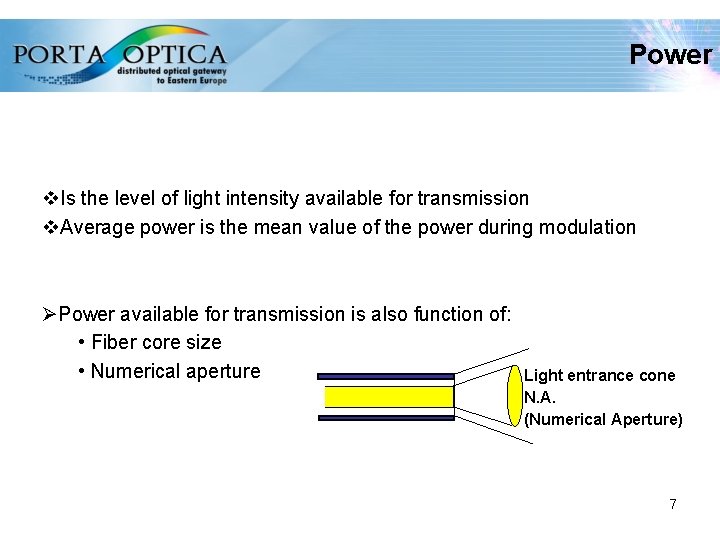
Power v. Is the level of light intensity available for transmission v. Average power is the mean value of the power during modulation ØPower available for transmission is also function of: • Fiber core size • Numerical aperture Light entrance cone N. A. (Numerical Aperture) 7
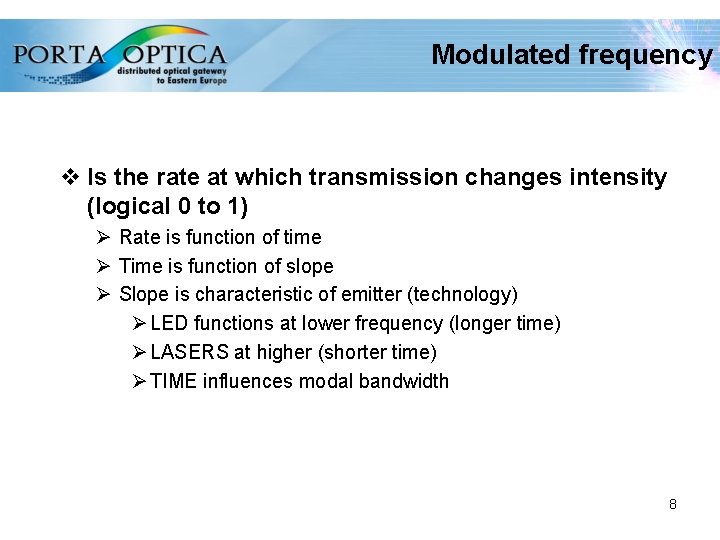
Modulated frequency v Is the rate at which transmission changes intensity (logical 0 to 1) Ø Rate is function of time Ø Time is function of slope Ø Slope is characteristic of emitter (technology) Ø LED functions at lower frequency (longer time) Ø LASERS at higher (shorter time) Ø TIME influences modal bandwidth 8
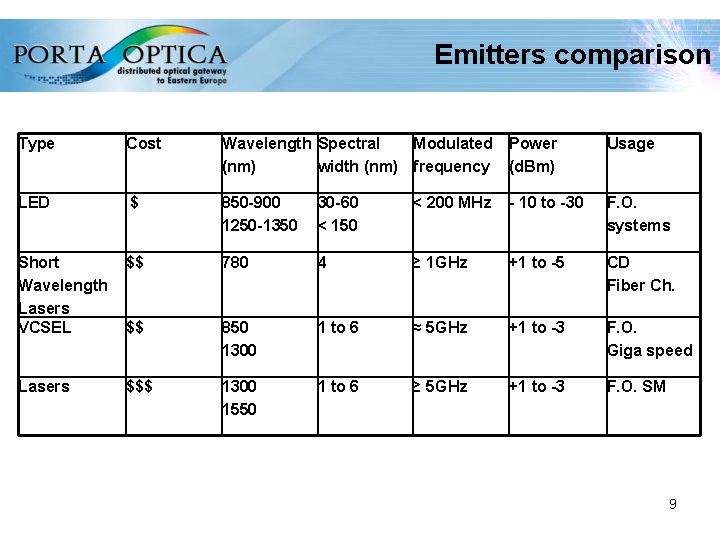
Emitters comparison Type Cost Wavelength Spectral Modulated Power (nm) width (nm) frequency (d. Bm) Usage LED $ 850 -900 1250 -1350 30 -60 < 150 < 200 MHz - 10 to -30 F. O. systems Short Wavelength Lasers VCSEL $$ 780 4 ≥ 1 GHz +1 to -5 CD Fiber Ch. $$ 850 1300 1 to 6 ≈ 5 GHz +1 to -3 F. O. Giga speed Lasers $$$ 1300 1550 1 to 6 ≥ 5 GHz +1 to -3 F. O. SM 9
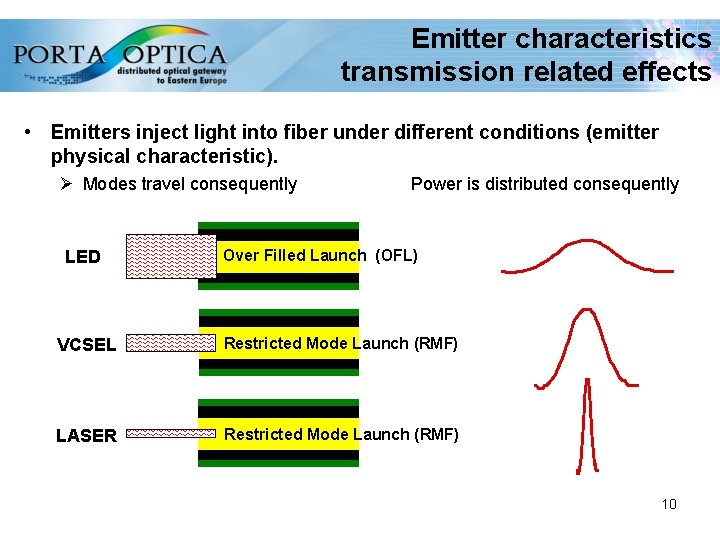
Emitter characteristics transmission related effects • Emitters inject light into fiber under different conditions (emitter physical characteristic). Ø Modes travel consequently LED Power is distributed consequently Over Filled Launch (OFL) VCSEL Restricted Mode Launch (RMF) LASER Restricted Mode Launch (RMF) 10
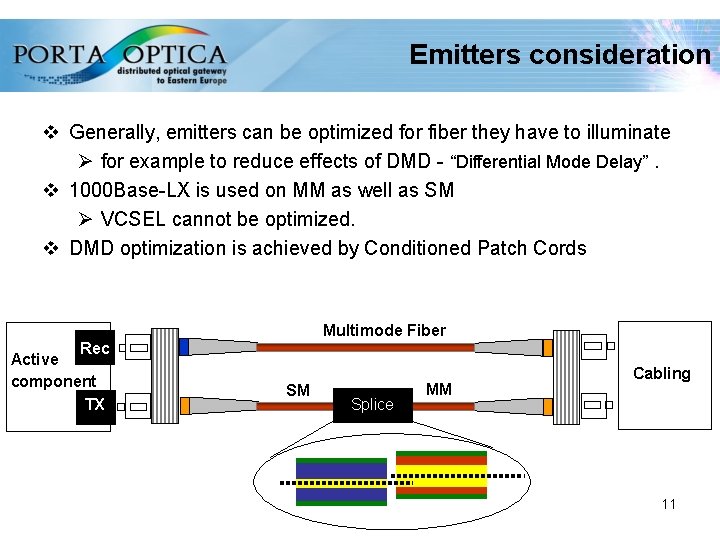
Emitters consideration v Generally, emitters can be optimized for fiber they have to illuminate Ø for example to reduce effects of DMD - “Differential Mode Delay”. v 1000 Base-LX is used on MM as well as SM Ø VCSEL cannot be optimized. v DMD optimization is achieved by Conditioned Patch Cords Multimode Fiber Rec Active component TX TX SM Splice MM Cabling 11
The principle of an optical communication system Transmitter Tx Converter E O Transmission channel Converter O E Receiver Rx 12
From light to electricity • Conversion from light to electricity is achieved by photodetector/receiver that: Ø is triggered by modulated light Ø transforms modulated light into modulated electrical signal • Transmission characteristics are: Ø Sensitivity Ø Dynamic range Ø BER 13
Receiver characteristic v Sensitivity Ø is the minimum power that is detected by the receiver with BER level v BER Ø is the max allowed error counted in bit in error/bit transmitted Ø BER is function of sensitivity among others characteristics v Dynamic range Ø Is the maximum average power received to maintain BER Ø Too much power causes distortion and saturation Ø Too less power causes no bit received Ø Both causes BER in excess of specified limit Ø Dynamic range is expressed as difference between min. and max. 14
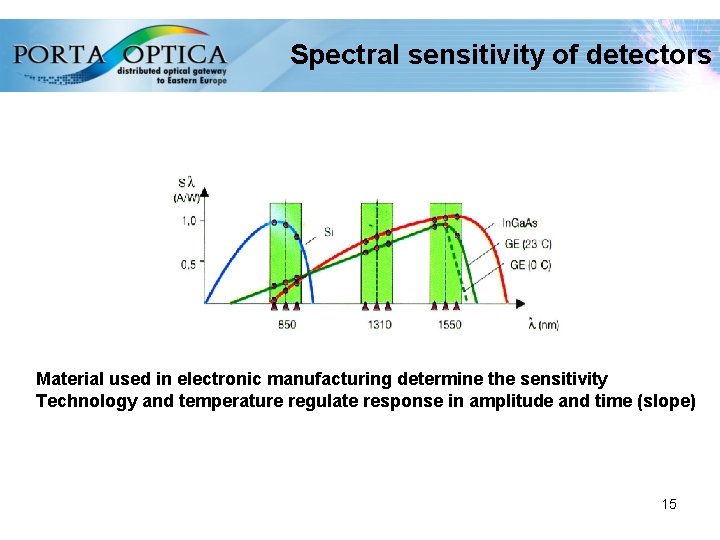
Spectral sensitivity of detectors Material used in electronic manufacturing determine the sensitivity Technology and temperature regulate response in amplitude and time (slope) 15
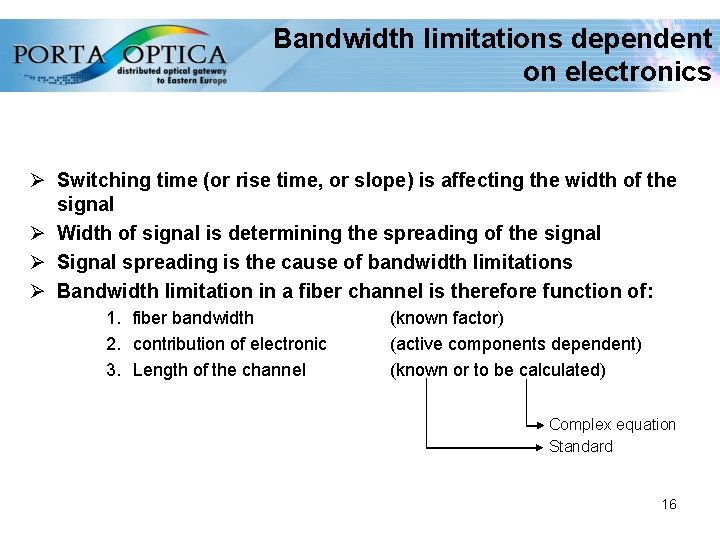
Bandwidth limitations dependent on electronics Ø Switching time (or rise time, or slope) is affecting the width of the signal Ø Width of signal is determining the spreading of the signal Ø Signal spreading is the cause of bandwidth limitations Ø Bandwidth limitation in a fiber channel is therefore function of: 1. fiber bandwidth 2. contribution of electronic 3. Length of the channel (known factor) (active components dependent) (known or to be calculated) Complex equation Standard 16
Passive FO elements http: //www. porta-optica. org 17
Passive elements in Optical Network: Ø Optical fiber Ø Spliter/combiner Ø MUX/DMUX Ø Add MUX Ø Fiber Bragg grating based devices Ø Circulator Ø Isolator Ø Lens ØAttenuator 18
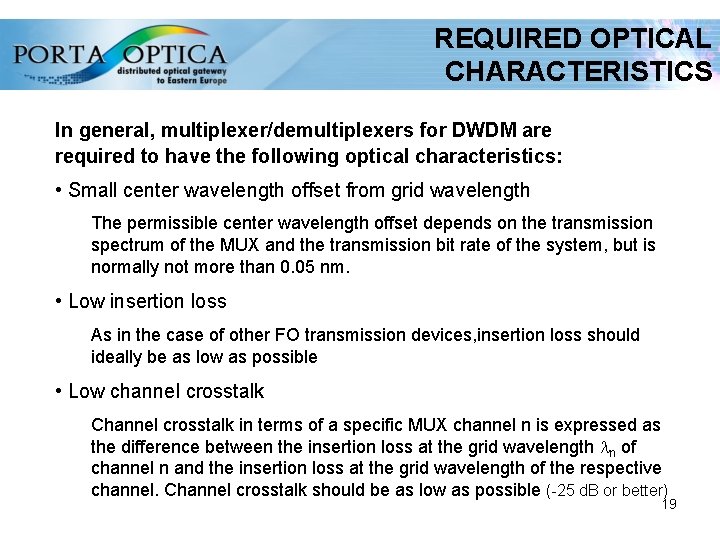
REQUIRED OPTICAL CHARACTERISTICS In general, multiplexer/demultiplexers for DWDM are required to have the following optical characteristics: • Small center wavelength offset from grid wavelength The permissible center wavelength offset depends on the transmission spectrum of the MUX and the transmission bit rate of the system, but is normally not more than 0. 05 nm. • Low insertion loss As in the case of other FO transmission devices, insertion loss should ideally be as low as possible • Low channel crosstalk Channel crosstalk in terms of a specific MUX channel n is expressed as the difference between the insertion loss at the grid wavelength n of channel n and the insertion loss at the grid wavelength of the respective channel. Channel crosstalk should be as low as possible (-25 d. B or better) 19
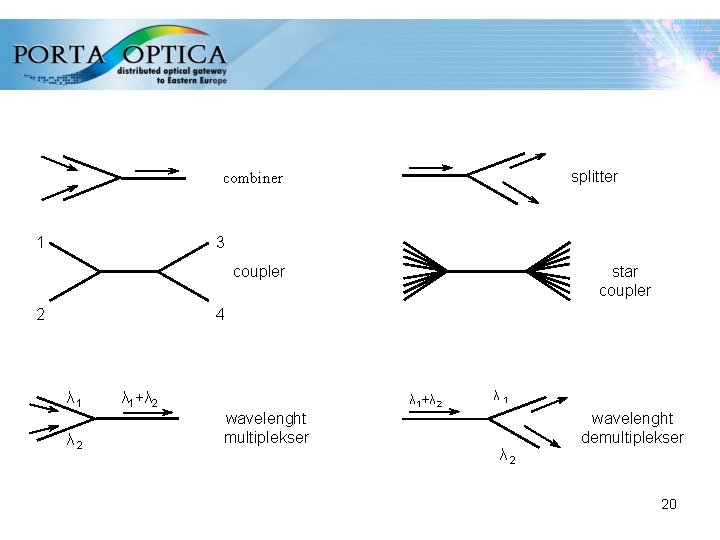
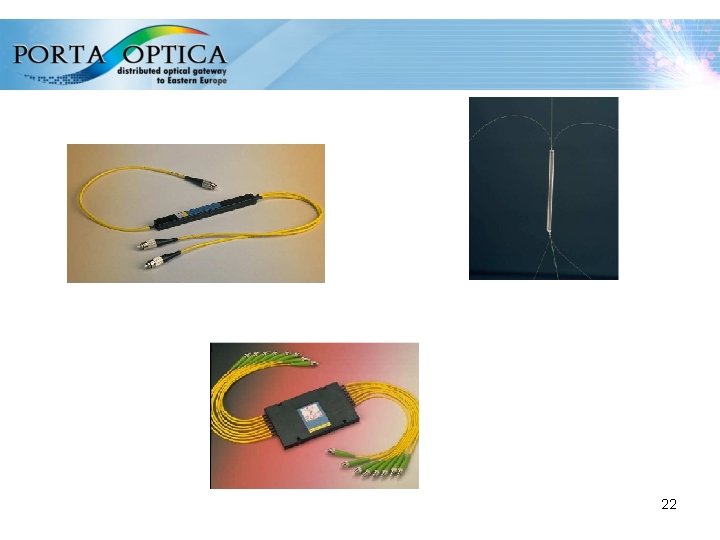
splitter combiner 1 3 coupler 2 star coupler 4 λ 1 λ 2 λ 1+λ 2 wavelenght multiplekser λ 1 λ 2 wavelenght demultiplekser 20
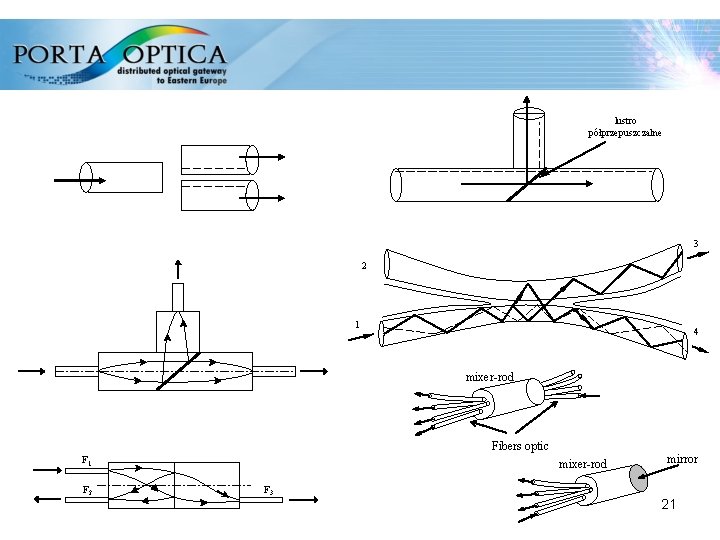
lustro półprzepuszczalne 3 2 1 4 mixer-rod Fibers optic F 1 F 2 mixer-rod F 3 mirror 21
22
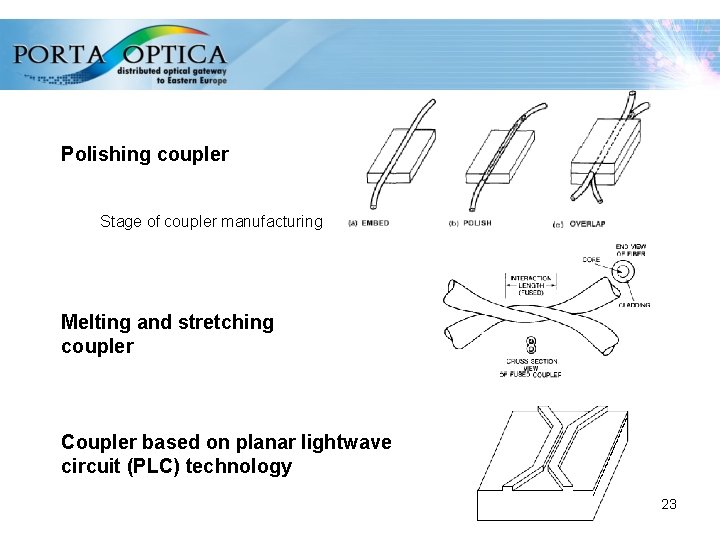
Polishing coupler Stage of coupler manufacturing Melting and stretching coupler Coupler based on planar lightwave circuit (PLC) technology 23
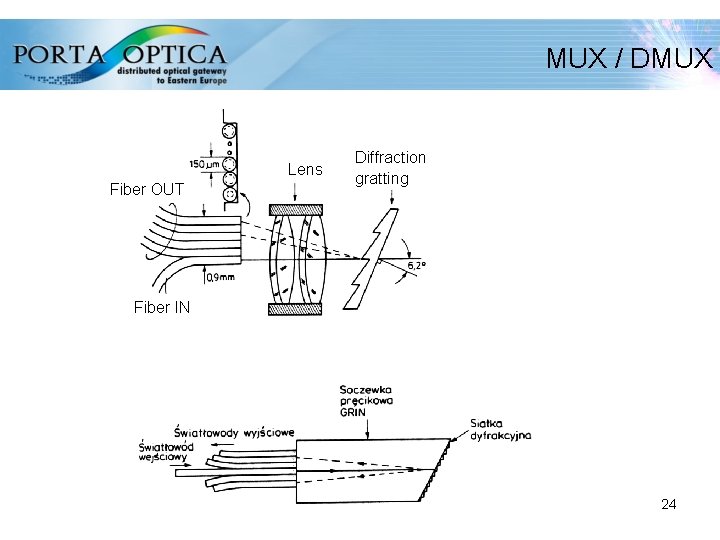
MUX / DMUX Lens Fiber OUT Diffraction gratting Fiber IN 24
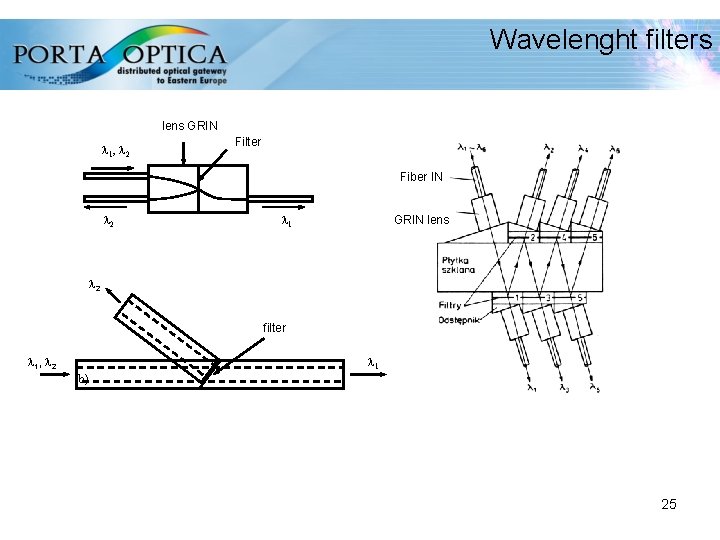
Wavelenght filters lens GRIN 1, 2 Filter Fiber IN 2 1 GRIN lens 2 filter 1, 2 1 b) 25
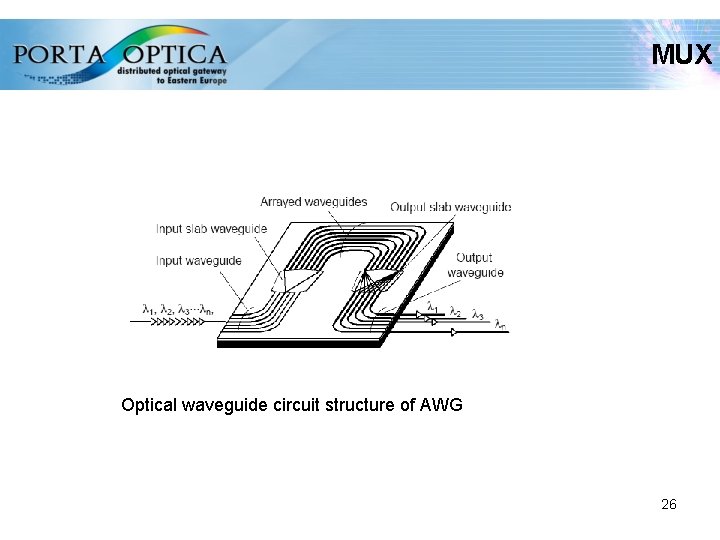
MUX Optical waveguide circuit structure of AWG 26
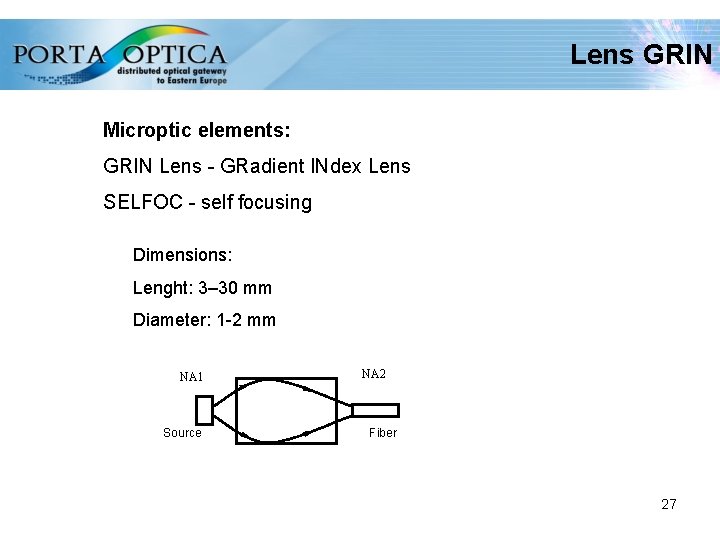
Lens GRIN Microptic elements: GRIN Lens - GRadient INdex Lens SELFOC - self focusing Dimensions: Lenght: 3– 30 mm Diameter: 1 -2 mm NA 1 Source NA 2 Fiber 27
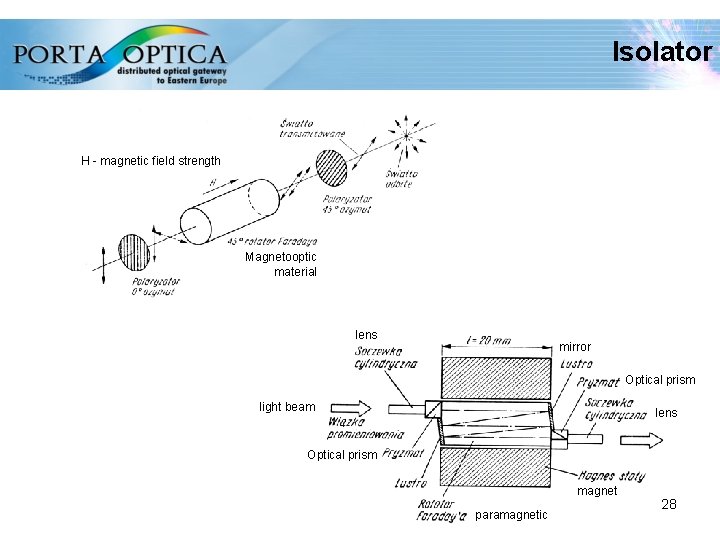
Isolator H - magnetic field strength Magnetooptic material lens mirror Optical prism light beam lens Optical prism magnet paramagnetic 28
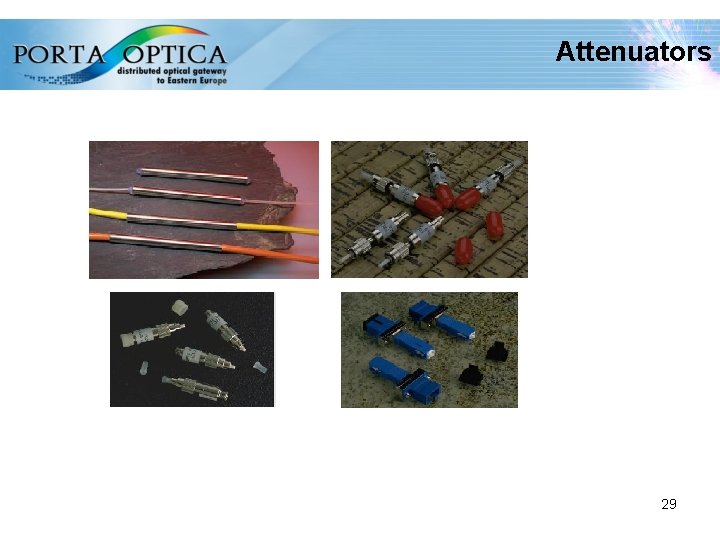
Attenuators 29
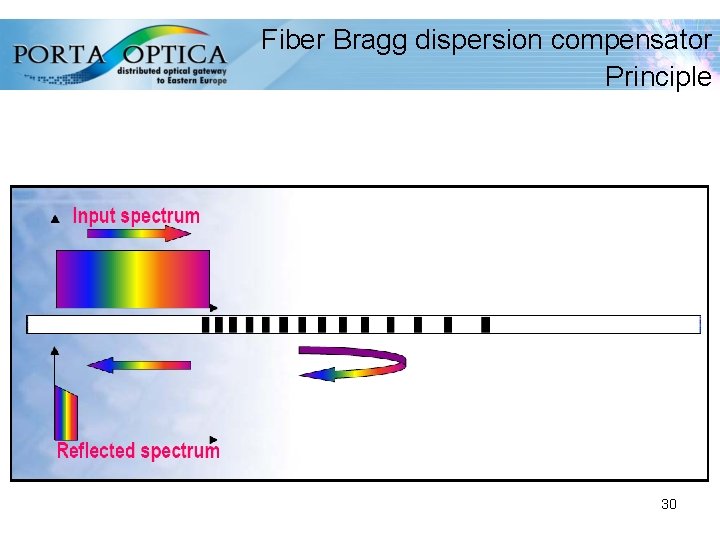
Fiber Bragg dispersion compensator Principle 30
References Reichle & De-Massari 31