
LIGHT DRAWINGS HOW PHOTOGRAPHY WORKS Intro to Graphics
- Slides: 13
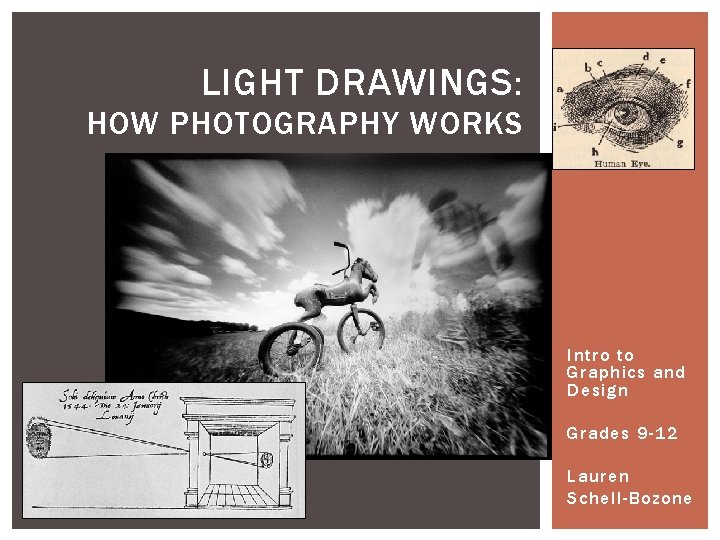
LIGHT DRAWINGS: HOW PHOTOGRAPHY WORKS Intro to Graphics and Design Grades 9 -12 Lauren Schell-Bozone
INTRODUCTION What is photography to you? Taking photos of your vacation or prom to upload to a Facebook album? Experimenting with creative shots for Flickr or a class project? Snapping quick pics to send to your friends on Snap. Chat or Instagram? Or are you an old-school film camera photographer? Regardless of how you use it, have you ever wondered how photography works? In this Web. Quest you will explore photography in its simplest form. (and build a camera that works!)
TASK Your task is to explore how photography works…how an image on the outside of a camera is projected to the inside of a camera. Once you discover the physics of photography, you will build a simple working camera out of everyday objects.
PROCESS 1. Break out into teams of three (no more) students. Your tasks will involve research, note taking, traditional and digital illustration, engineering, and building. Decide how you will divide or share these responsibilities. Everyone should be actively involved! 2. Visit the following websites and take notes on the following three subjects using the following link as a note taking guide. You may print this guide or use BYOT to record your information. https: //docs. google. com/document/d/1 Tuy 2 ULRq 1 u. DXb 2 PSv. Kz. HIsgf 96 Q N 1 z 0 Eb. Mrzd. Lv 6 bqg/pub THE HUMAN EYE http: //www. youtube. com/watch? v=c. FVb. Ln. XWn 6 A http: //www. pasadenaeye. com/faq 15/faq 15_text. html CAMERA OBSCURA http: //bit. ly/ql. Qa 4 w http: //en. wikipedia. org/wiki/Camera_obscura http: //bit. ly/o. Sl. W 1 V PINHOLE CAMERA http: //www. howstuffworks. com/question 131. htm http: //www. curriculumbits. com/prodimages/details/physics/how-pinholecamera-work. html
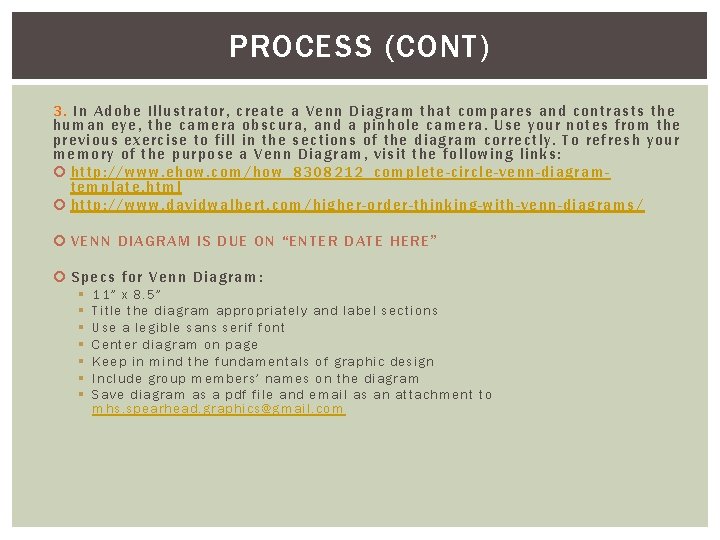
PROCESS (CONT) 3. I n Ado be Illustrator, creat e a Venn Diagram that compares and contrasts the huma n e ye , the came ra obscur a, and a pinhole camera. Use yo ur notes from the previo us exe rcise to fill in t he sections of the diagram correctly. To refresh your memory of the purpose a Venn Diagram, visit the following li nks: http: //www. ehow. com/how_8308212_complete-circle-venn-di agramtem plate. html http: //www. davidwalbert. com/higher-order-thinking-with-v enn-diagrams / VENN DIAGRAM IS DUE ON “ENTER DATE HERE” Spe cs for Ve nn Diagram : § § § § 11” x 8. 5” Title the diagram appropriately and label sections Use a legible sans serif font Center diagram on page Keep in mind the fundamentals of graphic design Include group members’ names on the diagram Save diagram as a pdf file and email as an attachment to mhs. spearhead. graphics@gmail. com
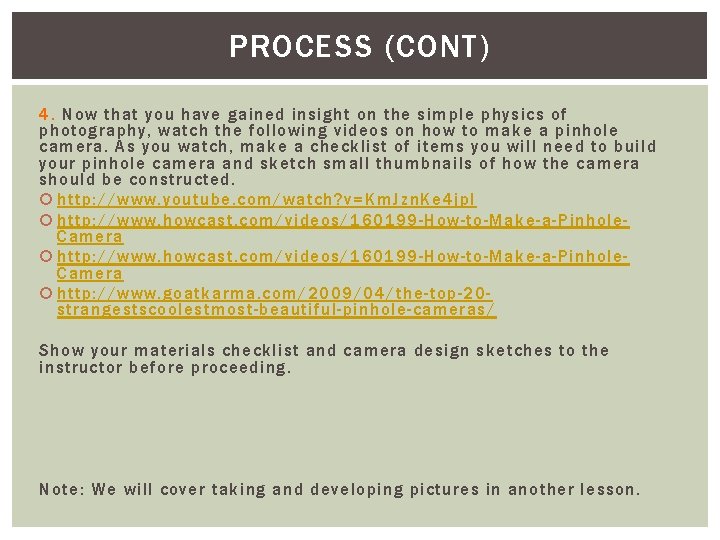
PROCESS (CONT) 4. Now that you have gained insight on the simple physics of photography, watch the following videos on how to make a pinhole camera. As you watch, make a checklist of items you will need to build your pinhole camera and sketch small thumbnails of how the camera should be constructed. http: //www. youtube. com/watch? v= Km. Jzn. Ke 4 jp. I http: //www. howcast. com/videos/160199 -How-to-Make-a-Pinhole. Camera http: //www. goatkarma. com/2009/04/the-top-20 strangestscoolestmost-beautiful-pinhole-cameras / Show your materials checklist and camera design sketches to the instructor before proceeding. Note: We will cover taking and developing pictures in another lesson.
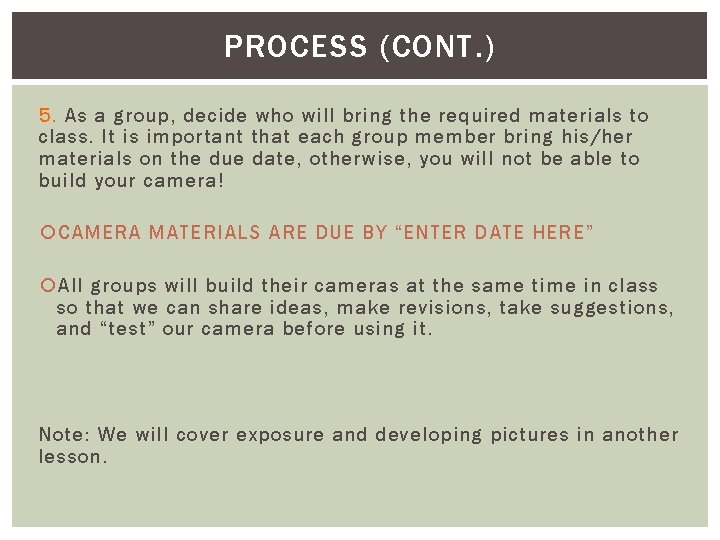
PROCESS (CONT. ) 5. As a group, decide who will bring the required materials to class. It is important that each group member bring his/her materials on the due date, otherwise, you will not be able to build your camera! CAMERA MATERIALS ARE DUE BY “ENTER DATE HERE” All groups will build their cameras at the same time in class so that we can share ideas, make revisions, take suggestions, and “test” our camera before using it. Note: We will cover exposure and developing pictures in another lesson.
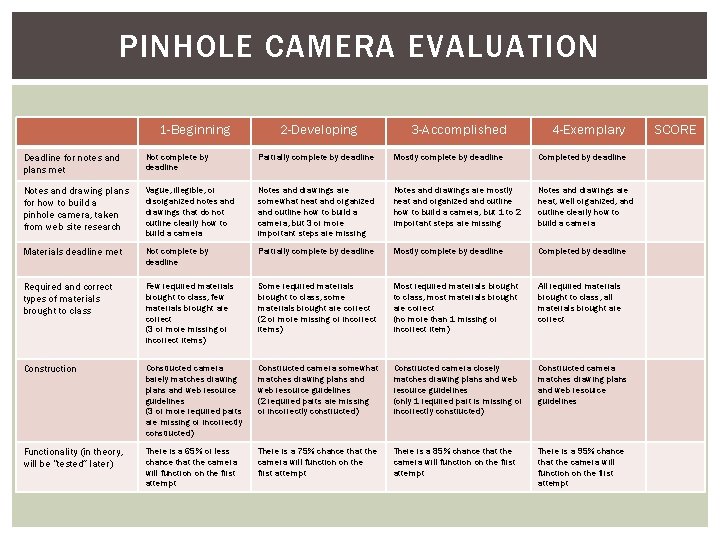
PINHOLE CAMERA EVALUATION 1 -Beginning 2 -Developing 3 -Accomplished 4 -Exemplary Deadline for notes and plans met Not complete by deadline Partially complete by deadline Mostly complete by deadline Completed by deadline Notes and drawing plans for how to build a pinhole camera, taken from web site research Vague, illegible, or disorganized notes and drawings that do not outline clearly how to build a camera Notes and drawings are somewhat neat and organized and outline how to build a camera, but 3 or more important steps are missing Notes and drawings are mostly neat and organized and outline how to build a camera, but 1 to 2 important steps are missing Notes and drawings are neat, well organized, and outline clearly how to build a camera Materials deadline met Not complete by deadline Partially complete by deadline Mostly complete by deadline Completed by deadline Required and correct types of materials brought to class Few required materials brought to class, few materials brought are correct (3 or more missing or incorrect items) Some required materials brought to class, some materials brought are correct (2 or more missing or incorrect items) Most required materials brought to class, most materials brought are correct (no more than 1 missing or incorrect item) All required materials brought to class, all materials brought are correct Construction Constructed camera barely matches drawing plans and web resource guidelines (3 or more required parts are missing or incorrectly constructed) Constructed camera somewhat matches drawing plans and web resource guidelines (2 required parts are missing or incorrectly constructed) Constructed camera closely matches drawing plans and web resource guidelines (only 1 required part is missing or incorrectly constructed) Constructed camera matches drawing plans and web resource guidelines Functionality (in theory, will be “tested” later) There is a 65% or less chance that the camera will function on the first attempt There is a 75% chance that the camera will function on the first attempt There is a 85% chance that the camera will function on the first attempt There is a 95% chance that the camera will function on the first attempt SCORE
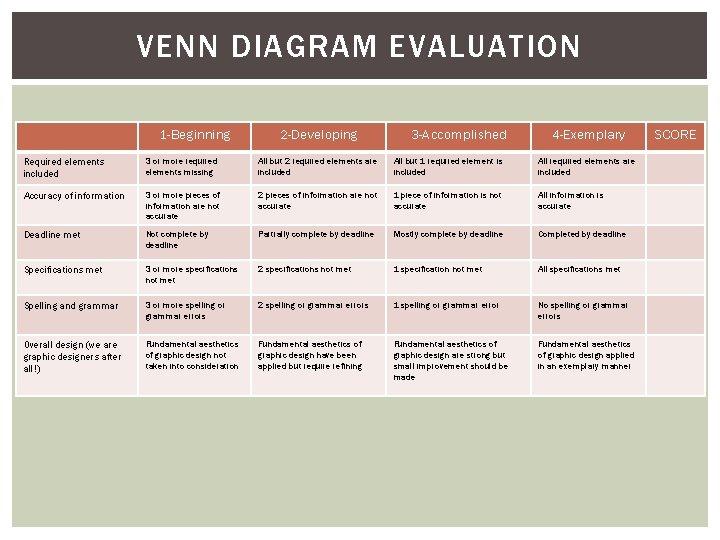
VENN DIAGRAM EVALUATION 1 -Beginning 2 -Developing 3 -Accomplished 4 -Exemplary Required elements included 3 or more required elements missing All but 2 required elements are included All but 1 required element is included All required elements are included Accuracy of information 3 or more pieces of information are not accurate 2 pieces of information are not accurate 1 piece of information is not accurate All information is accurate Deadline met Not complete by deadline Partially complete by deadline Mostly complete by deadline Completed by deadline Specifications met 3 or more specifications not met 2 specifications not met 1 specification not met All specifications met Spelling and grammar 3 or more spelling or grammar errors 2 spelling or grammar errors 1 spelling or grammar error No spelling or grammar errors Overall design (we are graphic designers after all!) Fundamental aesthetics of graphic design not taken into consideration Fundamental aesthetics of graphic design have been applied but require refining Fundamental aesthetics of graphic design are strong but small improvement should be made Fundamental aesthetics of graphic design applied in an exemplary manner SCORE
CONCLUSION You now have a pretty good understanding of how photography works. You will see what you have learned in action when we learn about exposures and how to use the darkroom in the next unit. This is where the real fun begins! Intrigued with pinhole photography? Check out these web sites for some great pinhole pics and other cool pinhole information: http: //www. pinholeday. org/ http: //www. smashingmagazine. com/2010/07/25/theshowcase-of-beautiful-pinhole-photography /
CREDITS AND REFERENCES CREDITS § Designed by Lauren Bozone, University of West Georgia, Masters in Ed, Instructional Technology student, Mc. Intosh High School CTAE graphic design teacher IMAGES John Fobes pinhole photo § http: //chriskeeney. com/blog/2009/09/john-a-fobes-september-2009 -–-featuredpinhole-photographer Eye diagram § http: //graphicsfairy. blogspot. com/2008/08/vintage-clip-art-eye- diagram. html Camera obscura room § http: //fstopspot. com/main/wp-content/gallery/post-images/renaissance-cameraobscura-room. jpg i. Phone icons § http: //www. google. com/images
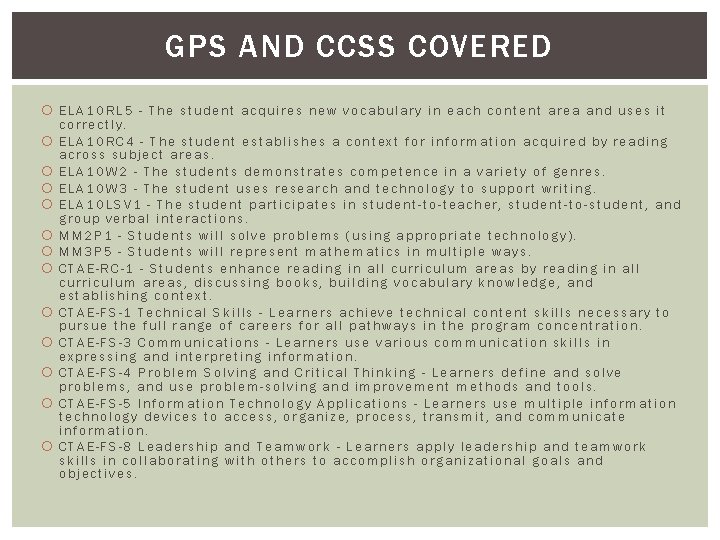
GPS AND CCSS COVERED ELA 10 RL 5 - The student acquires new vocabulary in each content area and uses it correctly. ELA 10 RC 4 - The student establishes a context for information acquired by reading across subject areas. ELA 10 W 2 - The students demonstrates competence in a variety of genres. ELA 10 W 3 - The student uses research and technology to support writing. ELA 10 LSV 1 - The student participates in student-to-teacher, student-to-student, and group verbal interactions. MM 2 P 1 - Students will solve problems (using appropriate technology). MM 3 P 5 - Students will represent mathematics in multiple ways. CTAE-RC-1 - Students enhance reading in all curriculum areas by reading in all curriculum areas, discussing books, building vocabulary knowledge, and establishing context. CTAE-FS-1 Technical Skills - Learners achieve technical content skills necessary to pursue the full range of careers for all pathways in the program concentration. CTAE-FS-3 Communications - Learners use various communication skills in expressing and interpreting information. CTAE-FS-4 Problem Solving and Critical Thinking - Learners define and solve problems, and use problem-solving and improvement methods and tools. CTAE-FS-5 Information Technology Applications - Learners use multiple information technology devices to access, organize, process, transmit, and communicate information. CTAE-FS-8 Leadership and Teamwork - Learners apply leadership and teamwork skills in collaborating with others to accomplish organizational goals and objectives.
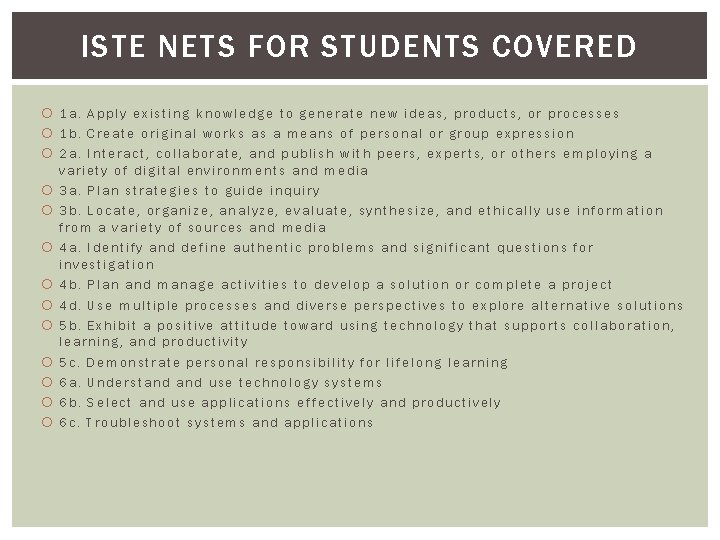
ISTE NETS FOR STUDENTS COVERED 1 a. Apply existing knowledge to generate new ideas, products, or processes 1 b. Create original works as a means of personal or group expression 2 a. Interact, collaborate, and publish with peers, experts, or others employing a variety of digital environments and media 3 a. Plan strategies to guide inquiry 3 b. Locate, organize, analyze, evaluate, synthesize, and ethically use information from a variety of sources and media 4 a. Identify and define authentic problems and significant questions for investigation 4 b. Plan and manage activities to develop a solution or complete a project 4 d. Use multiple processes and diverse perspectives to explore alternative solutions 5 b. Exhibit a positive attitude toward using technology that supports collaboration, learning, and productivity 5 c. Demonstrate personal responsibility for lifelong learning 6 a. Understand use technology systems 6 b. Select and use applications effectively and productively 6 c. Troubleshoot systems and applications