
Light Behavior History of Light James Clerk Maxwell
Light Behavior
History of Light � James Clerk Maxwell (1860’s) studied electrostatics and estimated the speed of light to be 299, 792, 458 m/s � Physicist Albert Michelson/Edward Morley determined the speed of light in 1887. He wanted to determine the speed of the “ether” through which light traveled. � His experiment showed that the speed of light is about 300, 000 m/s

Nature of Light ◦ Light has a dual nature: it behaves as both a particle (Photons, Quanta or Photoelectric Effect) and a wave (Reflection, Refraction, Diffraction & Polarization) ◦ Photons are bundles of electromagnetic energy that do not have mass

Light Facts v Visible light is an electromagnetic wave that the human eye can detect. v Light travels in straight lines (RAY) v Light bounces (reflects) & bends (refracts) v Different light wavelengths are seen as different colors & has different intensities v Speed of Light (c) 3. 0 x 108 m/s v Equation: c=fx
Example #1 �How long does it take for light to reach Earth if the Sun is 1. 5 x 10¹¹ m away?
Example #2 �Microwave ovens emit waves of about 2450 MHz. What is the wavelength of this light?
Light Intensity � The amount of energy per second falling on a surface , using the units of Watts per meter squared �I = P/A 2 (Where A = 4 r 2)
Electromagnetic waves � An electromagnetic wave is (simplified) a self propagating wave that is part electric and part magnetic. It is caused by a moving charge. ◦ A more thorough definition: A magnetic field will be produced in empty space if a changing electric field is present. This changing electric field will produce a changing magnetic field which will produce a changing electric field. This process will repeat itself, and thus an electromagnetic wave can self propagate through space. �A range of electromagnetic waves can be seen in the electromagnetic spectrum. ◦ Notice the small portion that is visible light
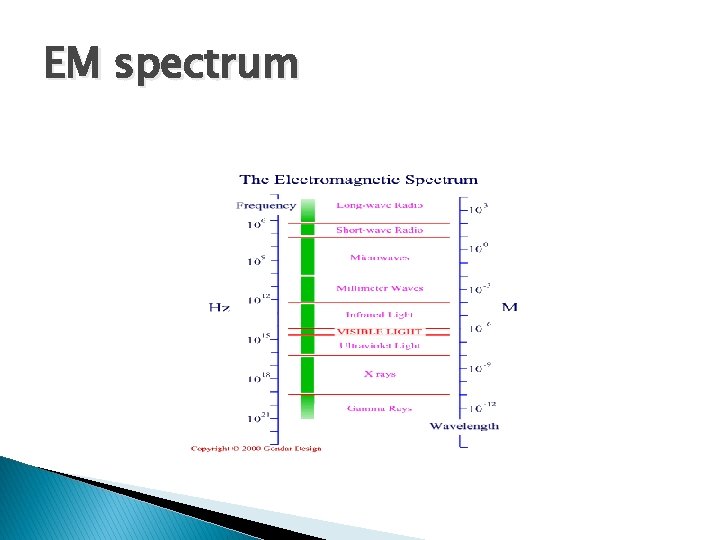
EM spectrum
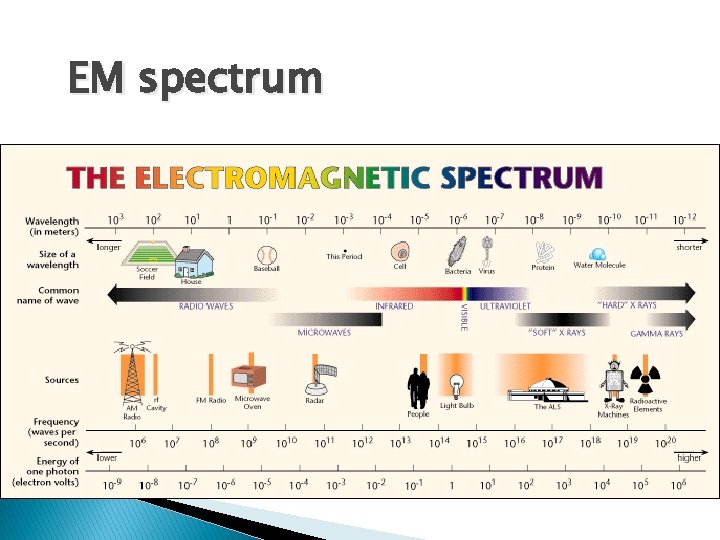
EM spectrum
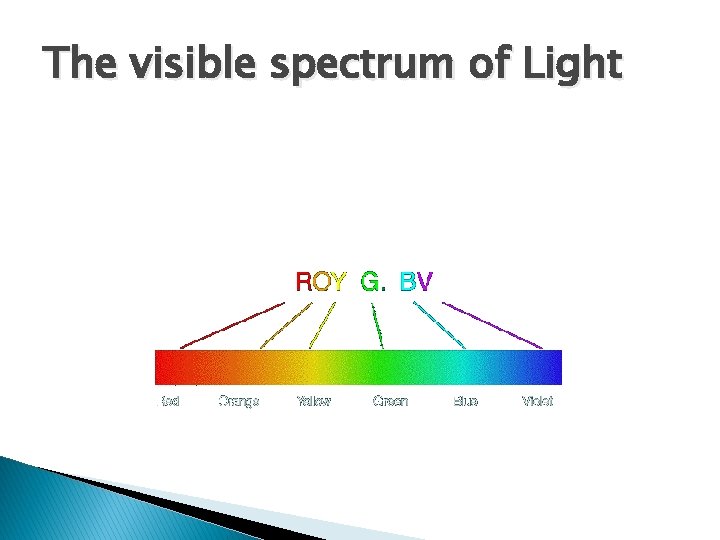
The visible spectrum of Light
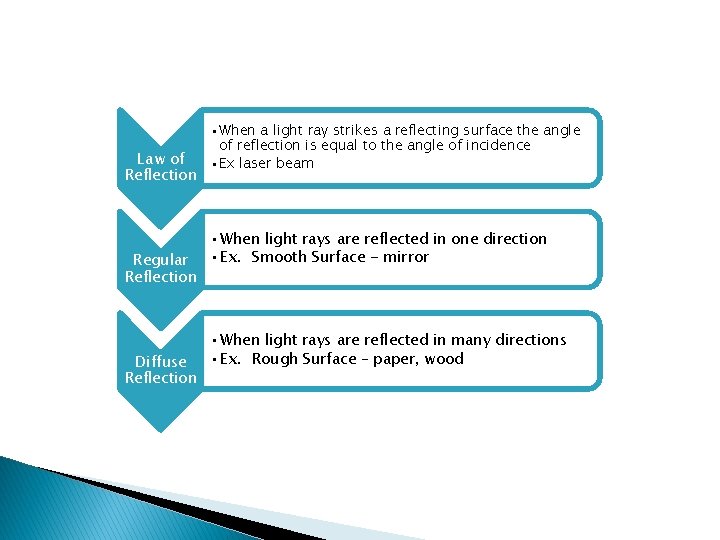
Law of Reflection Regular Reflection Diffuse Reflection • When a light ray strikes a reflecting surface the angle of reflection is equal to the angle of incidence • Ex laser beam • When light rays are reflected in one direction • Ex. Smooth Surface - mirror • When light rays are reflected in many directions • Ex. Rough Surface – paper, wood
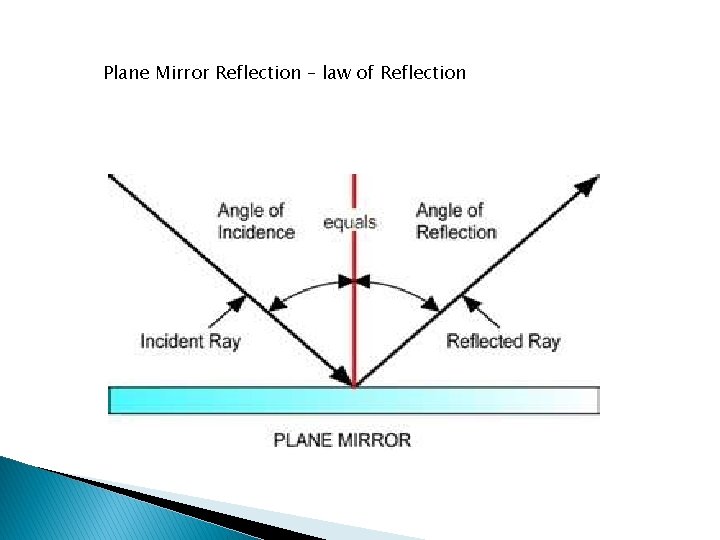
Plane Mirror Reflection – law of Reflection
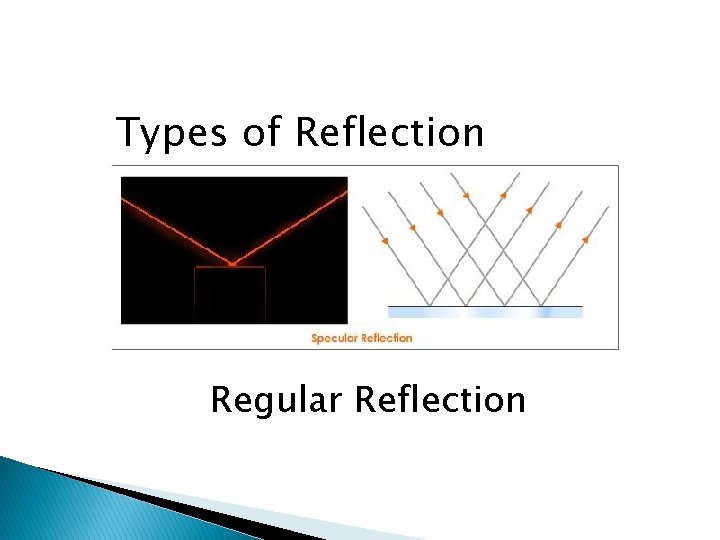
Types of Reflection Regular Reflection
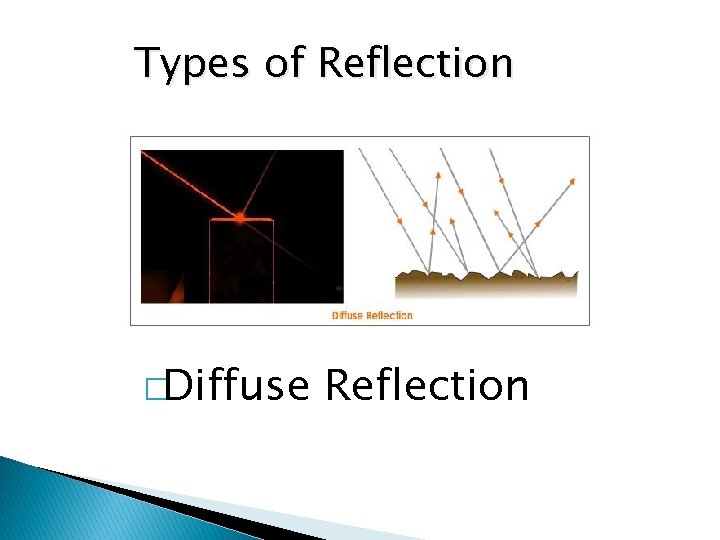
Types of Reflection �Diffuse Reflection
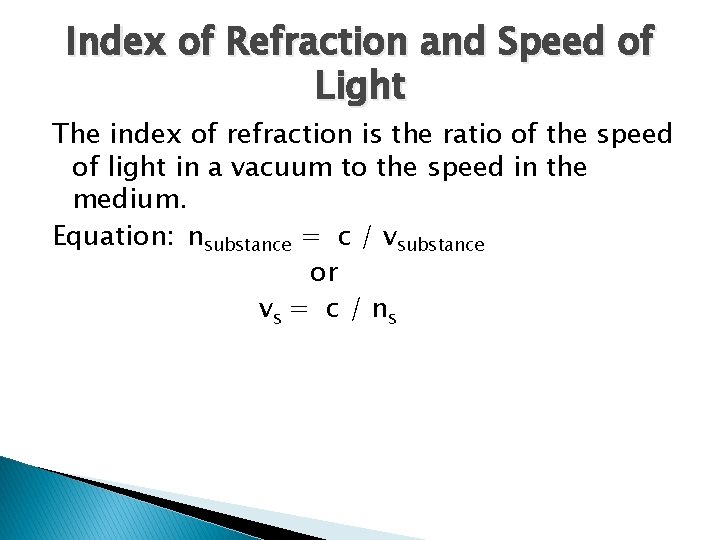
Index of Refraction and Speed of Light The index of refraction is the ratio of the speed of light in a vacuum to the speed in the medium. Equation: nsubstance = c / vsubstance or vs = c / n s
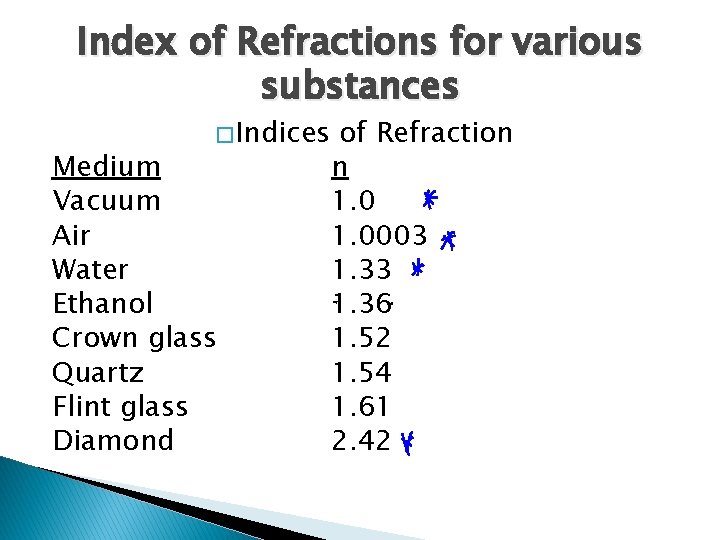
Index of Refractions for various substances � Indices Medium Vacuum Air Water Ethanol Crown glass Quartz Flint glass Diamond of Refraction n 1. 0003 1. 36 1. 52 1. 54 1. 61 2. 42
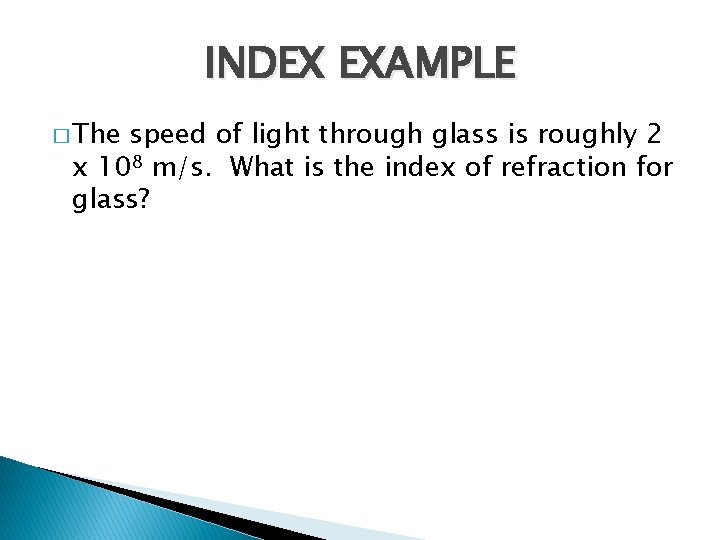
INDEX EXAMPLE � The speed of light through glass is roughly 2 x 10⁸ m/s. What is the index of refraction for glass?
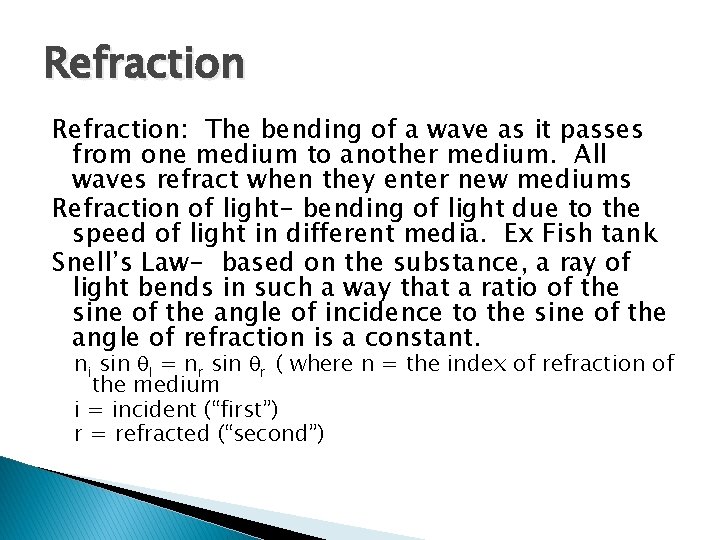
Refraction: The bending of a wave as it passes from one medium to another medium. All waves refract when they enter new mediums Refraction of light- bending of light due to the speed of light in different media. Ex Fish tank Snell’s Law- based on the substance, a ray of light bends in such a way that a ratio of the sine of the angle of incidence to the sine of the angle of refraction is a constant. ni sin I = nr sin r ( where n = the index of refraction of the medium i = incident (“first”) r = refracted (“second”)
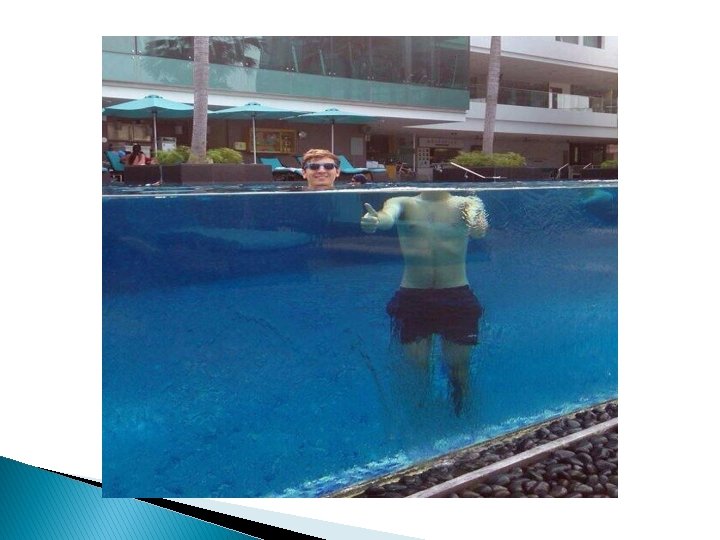
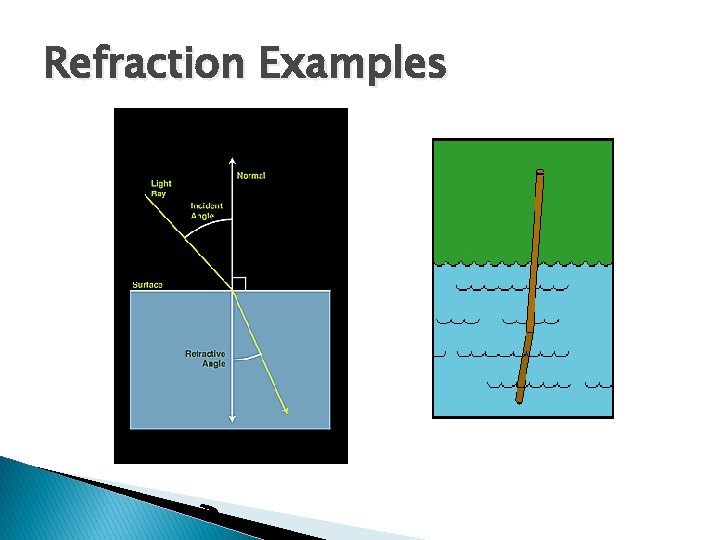
Refraction Examples
Snell’s Law Example I �A beam of light in a vacuum tube hits a diamond barrier at an angle of 30 degrees (this is the angle of incidence). What is the angle of refraction? � Make sure your calculator is in degree mode!
Snell’s Law Example II � Awesome Guy makes his girlfriend a romantic candlelight dinner and tops it off with some strawberry JELLO dessert. If the strawberry appears to be at an angle of 42 o to the normal in air is really located at 29 o to the normal in the JELLO, what is the index of refraction of the JELLO?
Total Internal Reflection � When light rays no longer emerge into air but are reflected back into the incident medium ◦ The light rays no longer emerge at the critical angle, they simply skim the surface. ◦ Critical angle = smallest angle that causes total internal reflection ◦ At angle greater than the critical angle, the light is reflected back into the medium
Real DEAL �A jeweler must decide whether the stone in Mrs. Drechsel’s ring is a real diamond or a precious zircon. He measures the critical angle of the gem and finds that it is 31. 3˚. Is the stone really a diamond or just a good immitation? (ndiamond = 2. 42, nzircon = 1. 92)
Diamond Cut � If the Diamond had been real, What is the critical angle of a diamond that Mr. Drechsel should have got for his wife so that it “shines bright like a diamond”?
Real DEAL �A jeweler must decide whether the stone in Mrs. Drechsel’s ring is a real diamond or a precious zircon. He measures the critical angle of the gem and finds that it is 31. 3˚. Is the stone really a diamond or just a good immitation? (ndiamond = 2. 41, nzircon = 1. 92)
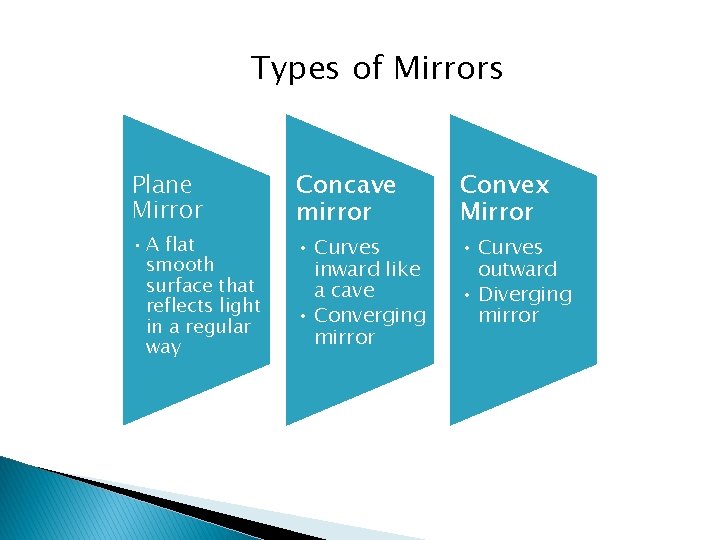
Types of Mirrors Plane Mirror • A flat smooth surface that reflects light in a regular way Concave mirror Convex Mirror • Curves inward like a cave • Converging mirror • Curves outward • Diverging mirror
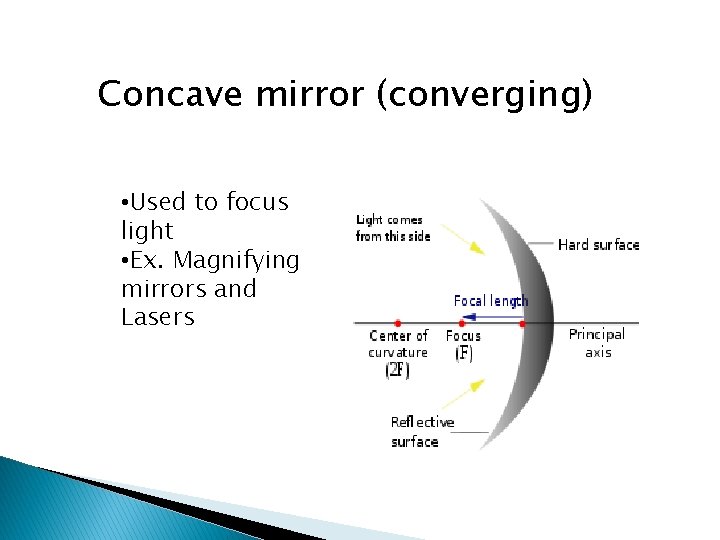
Concave mirror (converging) • Used to focus light • Ex. Magnifying mirrors and Lasers
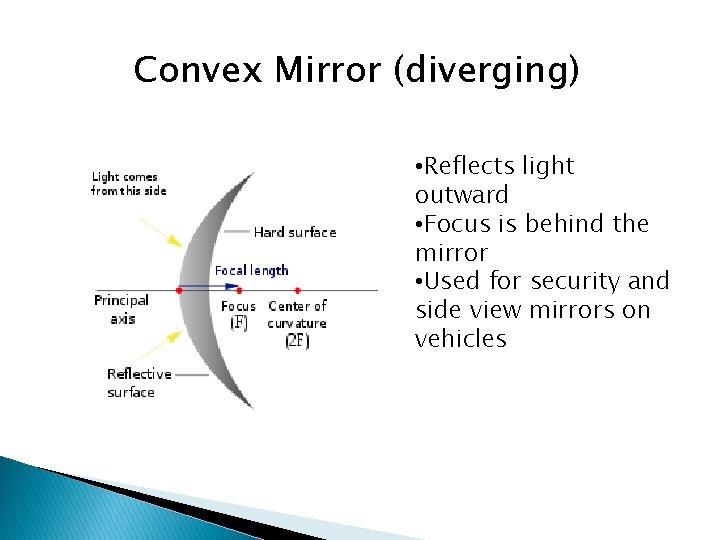
Convex Mirror (diverging) • Reflects light outward • Focus is behind the mirror • Used for security and side view mirrors on vehicles
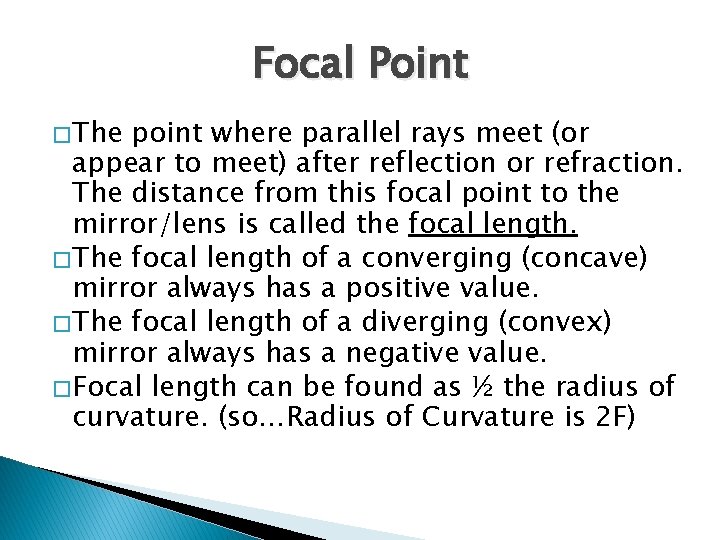
Focal Point � The point where parallel rays meet (or appear to meet) after reflection or refraction. The distance from this focal point to the mirror/lens is called the focal length. � The focal length of a converging (concave) mirror always has a positive value. � The focal length of a diverging (convex) mirror always has a negative value. � Focal length can be found as ½ the radius of curvature. (so…Radius of Curvature is 2 F)
Mirror Terminology � Object distance–distance from the mirror to the object(always positive) � Image distance- distance from the mirror to the image. ◦ An image can be real �able to be projected on a screen �reflected rays cross ◦ An image can be virtual �not able to be projected on a screen �reflected rays do not cross �To locate the virtual image you must extend the reflected rays
Ray Diagrams 2 rays are useful for Ray Diagrams: 1. 2. 3. § Any incident ray traveling parallel to the principal axis on the way to the mirror will pass through the focal point upon reflection Any incident ray traveling through the focal point on the way to the mirror will travel parallel to the principal axis upon reflection. Draw the image from the principal axis to where the rays cross. A 3 rd ray can be drawn through the center of the mirror/lens that does not change direction.
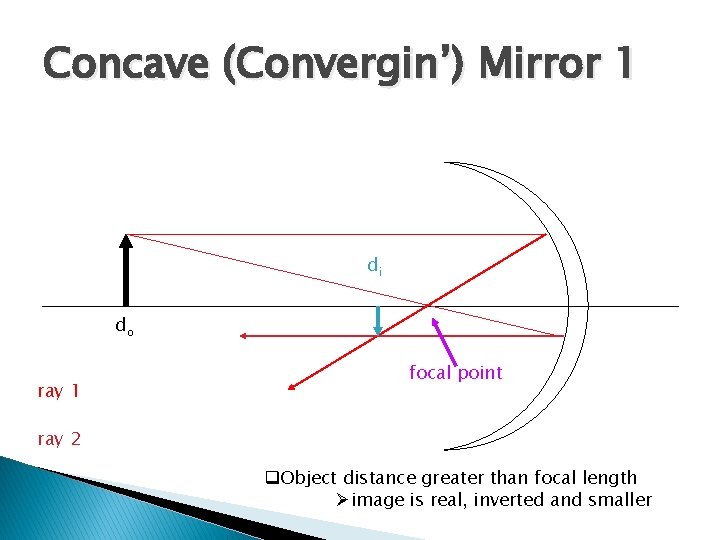
Concave (Convergin’) Mirror 1 di do ray 1 focal point ray 2 q. Object distance greater than focal length Øimage is real, inverted and smaller
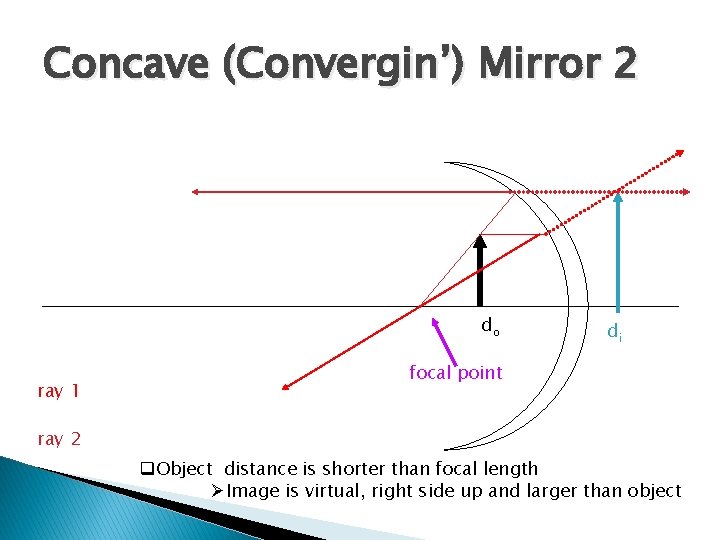
Concave (Convergin’) Mirror 2 do ray 1 di focal point ray 2 q. Object distance is shorter than focal length ØImage is virtual, right side up and larger than object
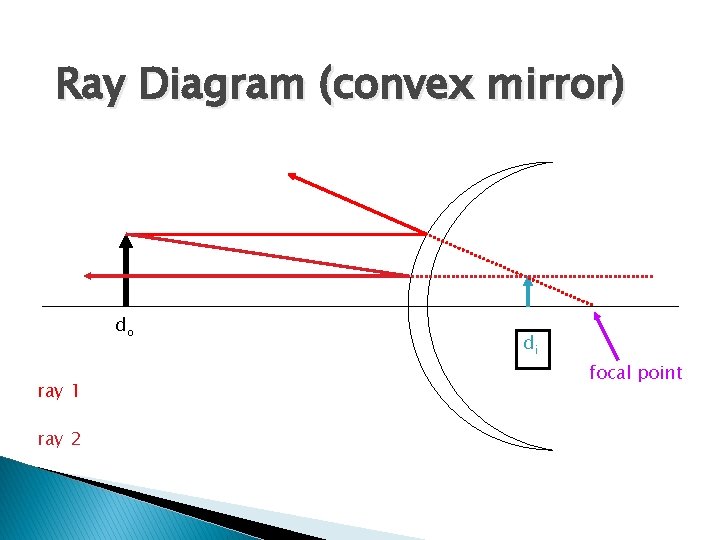
Ray Diagram (convex mirror) do ray 1 ray 2 di focal point
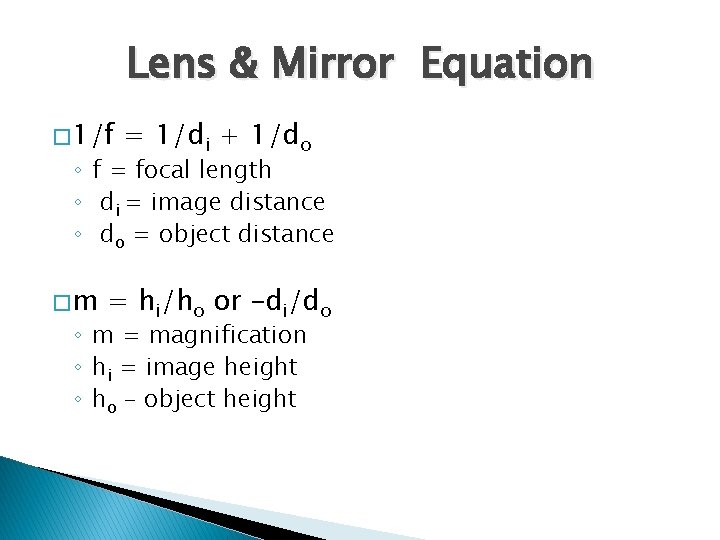
Lens & Mirror Equation � 1/f = 1/di + 1/do ◦ f = focal length ◦ di = image distance ◦ do = object distance �m = hi/ho or –di/do ◦ m = magnification ◦ hi = image height ◦ ho – object height
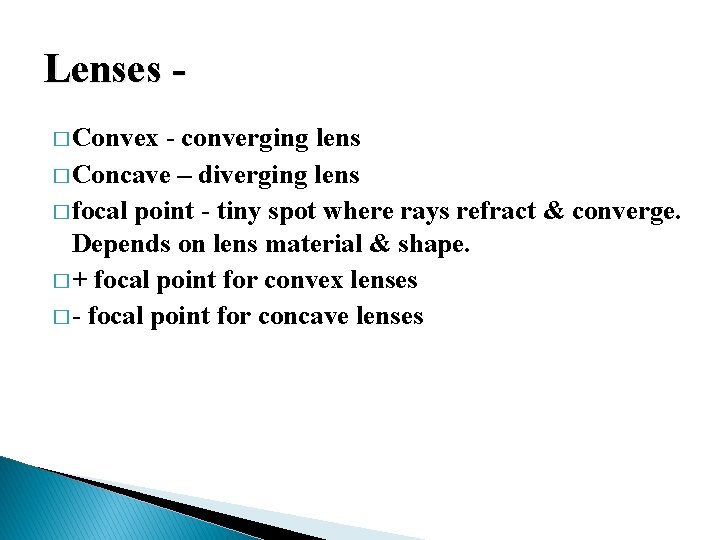
Lenses � Convex - converging lens � Concave – diverging lens � focal point - tiny spot where rays refract & converge. Depends on lens material & shape. � + focal point for convex lenses � - focal point for concave lenses
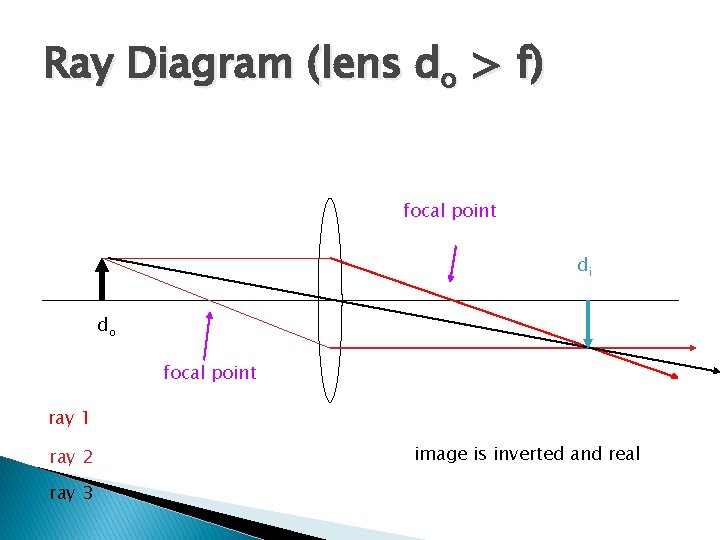
Ray Diagram (lens do > f) focal point di do focal point ray 1 ray 2 ray 3 image is inverted and real
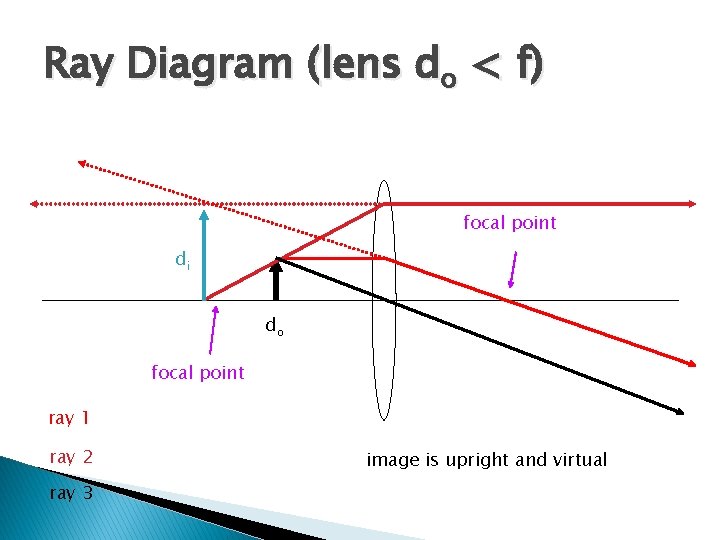
Ray Diagram (lens do < f) focal point di do focal point ray 1 ray 2 ray 3 image is upright and virtual
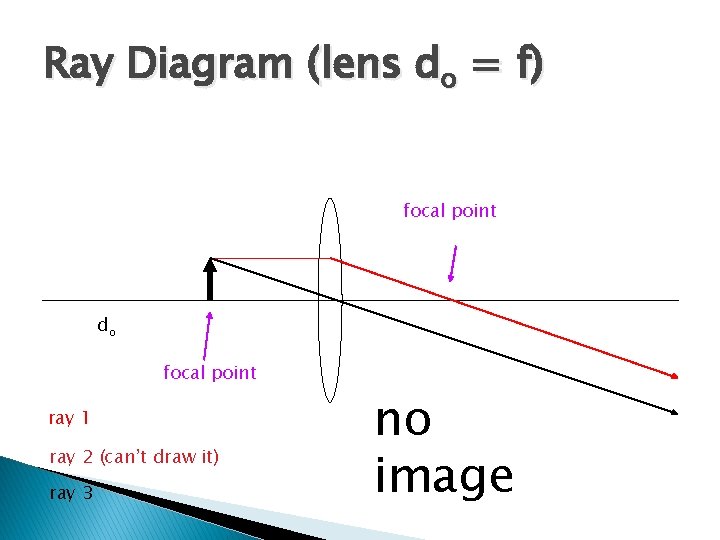
Ray Diagram (lens do = f) focal point do focal point ray 1 ray 2 (can’t draw it) ray 3 no image
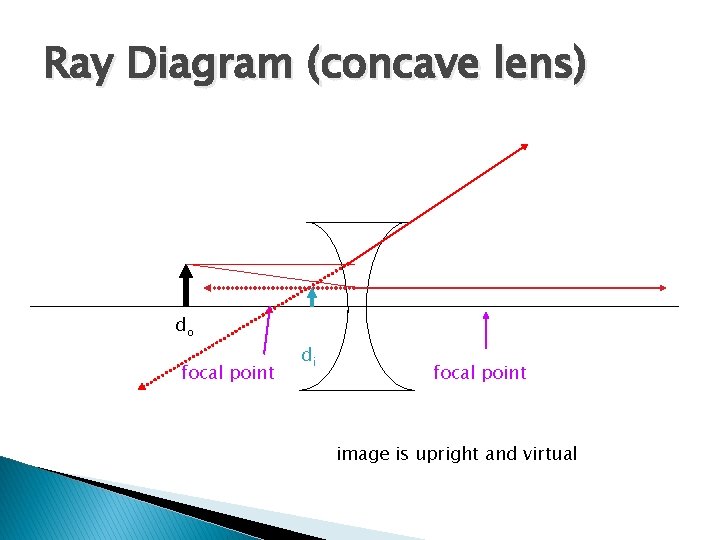
Ray Diagram (concave lens) do focal point di focal point image is upright and virtual
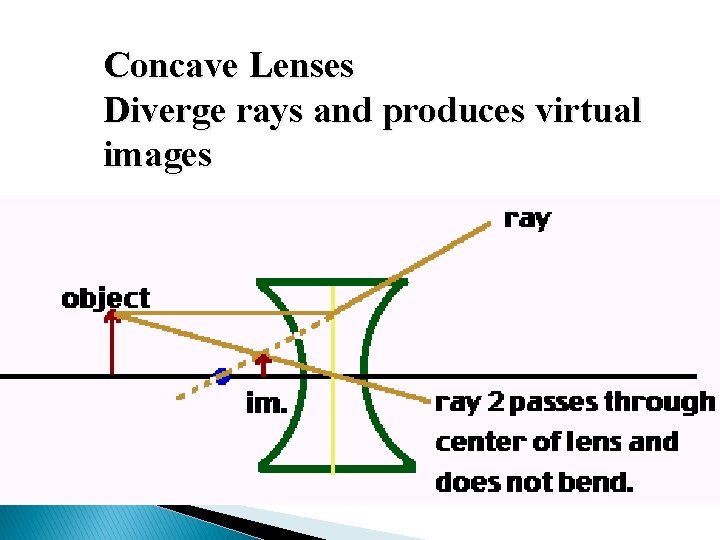
Concave Lenses Diverge rays and produces virtual images

Optics rules � If do > f the image is real & inverted � If do < f the image is upright, virtual, and larger � If do = f there is no image � If di is + the image is real � If di is – the image is virtual � If m is + the image is upright � If m is – the image is inverted � If m is > 1 the image is larger � If m is < 1 the image is smaller � If m = 1 the image is the same size
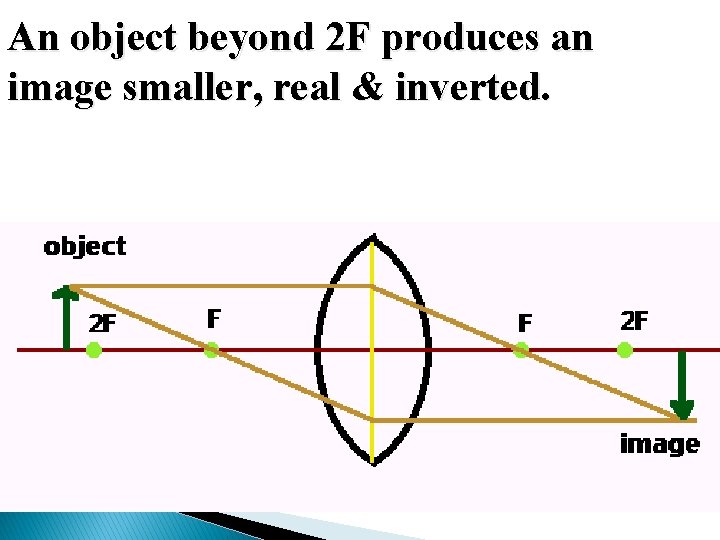
An object beyond 2 F produces an image smaller, real & inverted.
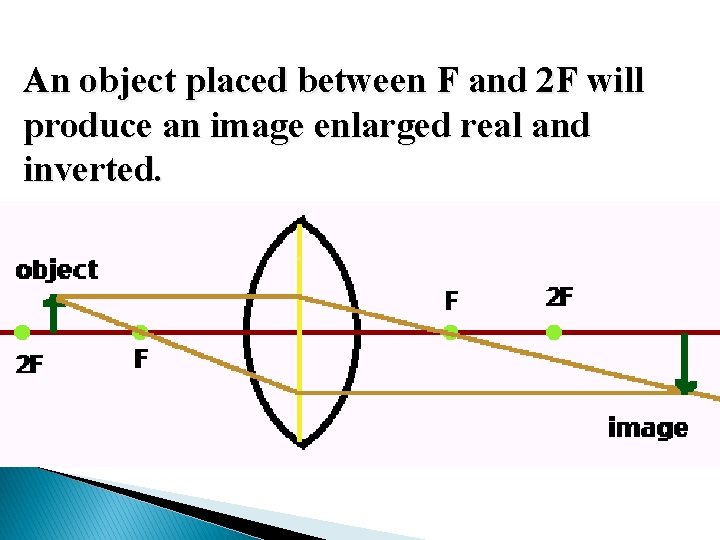
An object placed between F and 2 F will produce an image enlarged real and inverted.
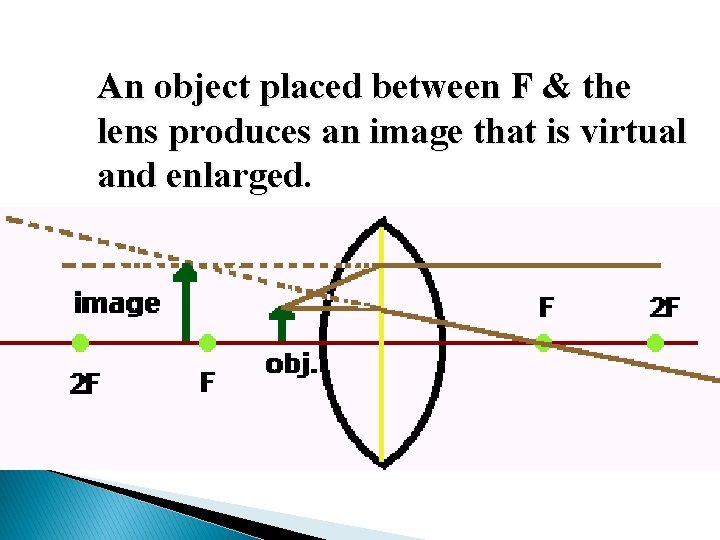
An object placed between F & the lens produces an image that is virtual and enlarged.
Lenses Lens – made of a transparent material with a refractive index larger than air. Ex: Glass, Plastic, Polycarbonite. Convex Lens- thicker at the center (converging lens) Concave Lens – thinner at center (diverging lens)

Converging lens
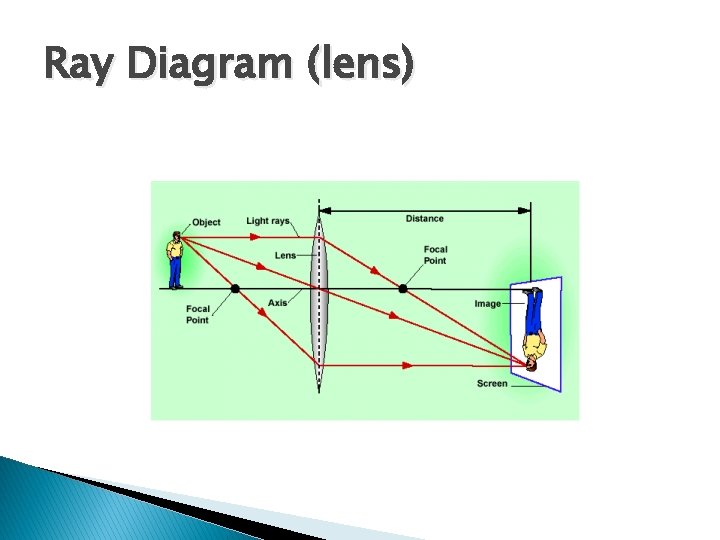
Ray Diagram (lens)
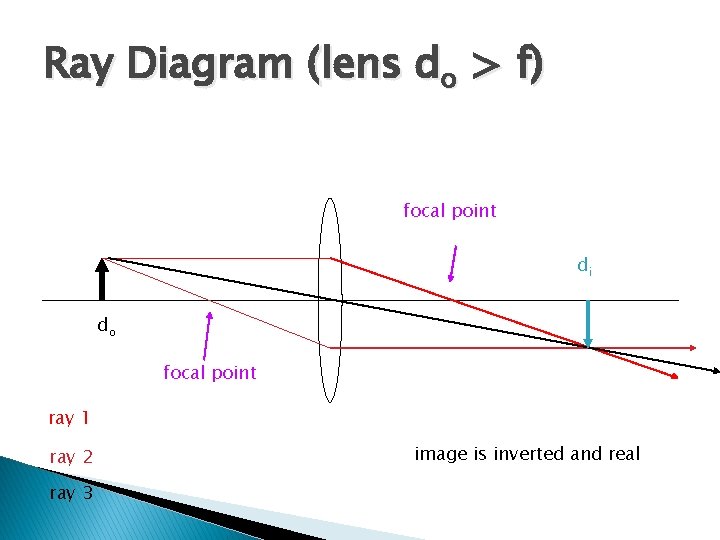
Ray Diagram (lens do > f) focal point di do focal point ray 1 ray 2 ray 3 image is inverted and real
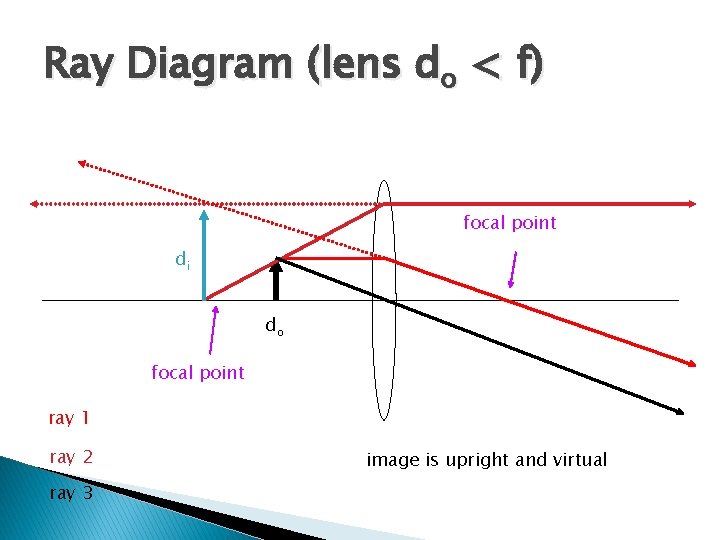
Ray Diagram (lens do < f) focal point di do focal point ray 1 ray 2 ray 3 image is upright and virtual
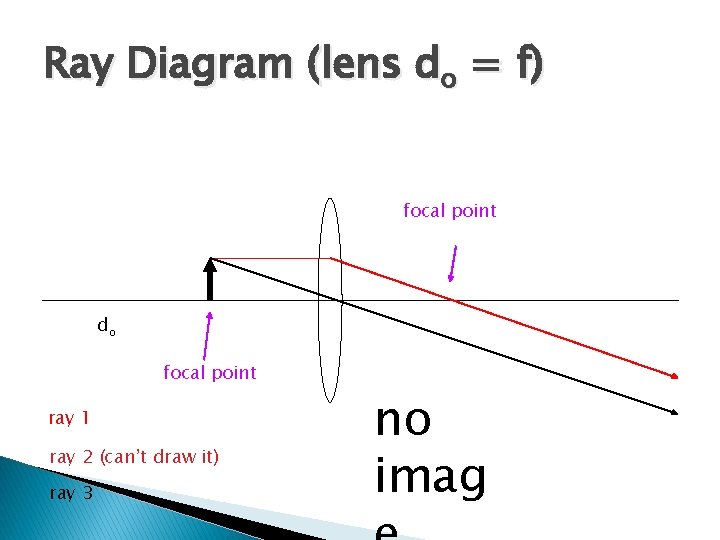
Ray Diagram (lens do = f) focal point do focal point ray 1 ray 2 (can’t draw it) ray 3 no imag
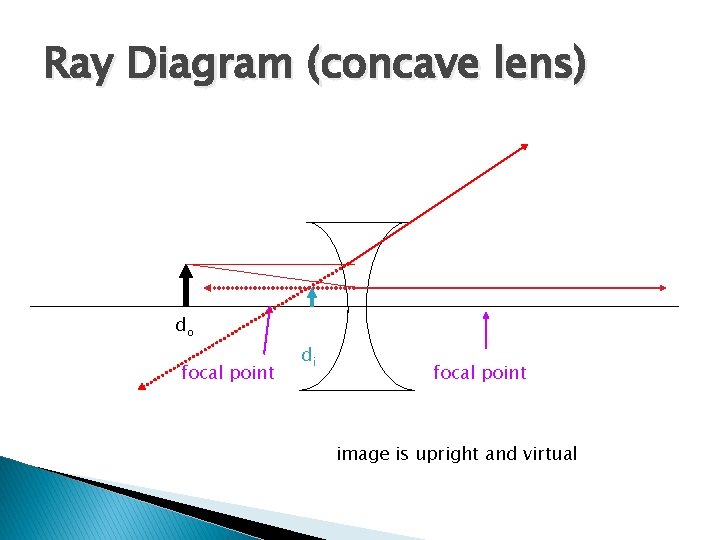
Ray Diagram (concave lens) do focal point di focal point image is upright and virtual
Vision
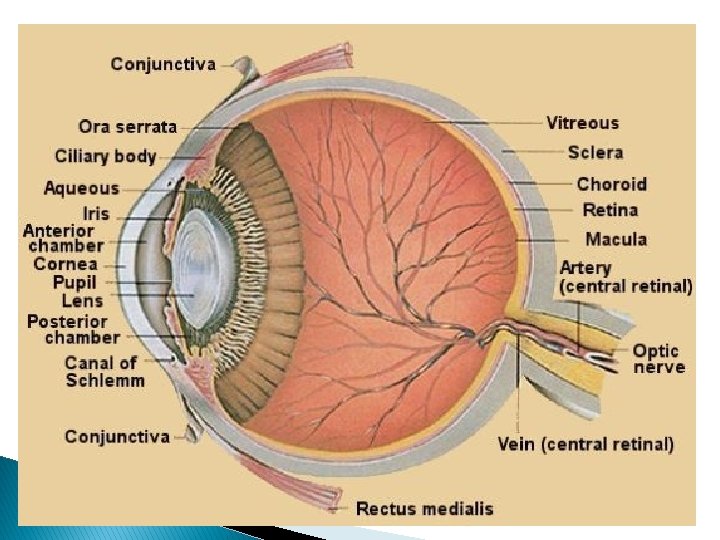
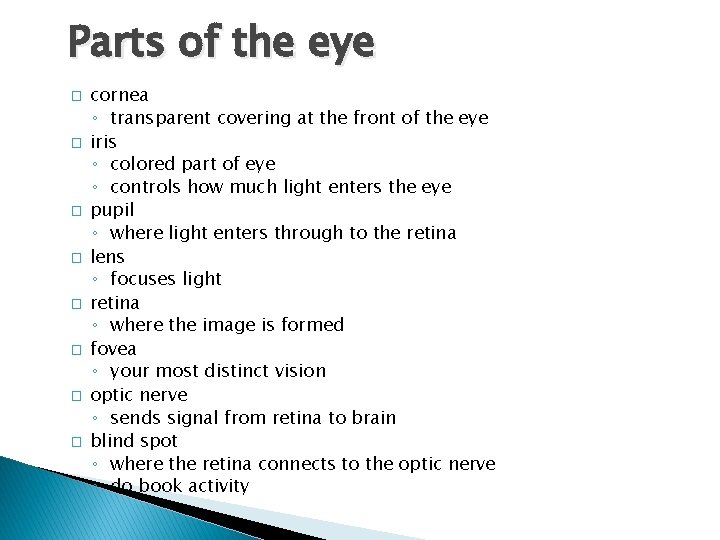
Parts of the eye � � � � cornea ◦ transparent covering at the front of the eye iris ◦ colored part of eye ◦ controls how much light enters the eye pupil ◦ where light enters through to the retina lens ◦ focuses light retina ◦ where the image is formed fovea ◦ your most distinct vision optic nerve ◦ sends signal from retina to brain blind spot ◦ where the retina connects to the optic nerve ◦ do book activity
Vision defects � near sighted ◦ can see up close, but not far away ◦ the eye is too long ◦ the image is focused in front of the retina �use a concave lens to correct � far sighted ◦ can see far away, but not up close ◦ the eye is too short ◦ the image is focused behind the retina ◦ use convex lens to correct astigmatism ◦ misshaped eye ◦ trouble with focusing glaucoma � macular degeneration � � ◦ optic nerve damage due to high intraocular pressure ◦ deterioration of the central part of the retina (macula)
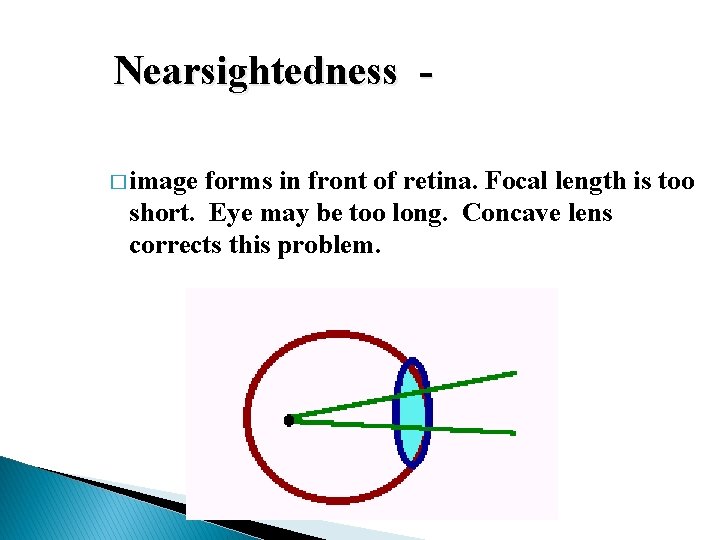
Nearsightedness � image forms in front of retina. Focal length is too short. Eye may be too long. Concave lens corrects this problem.
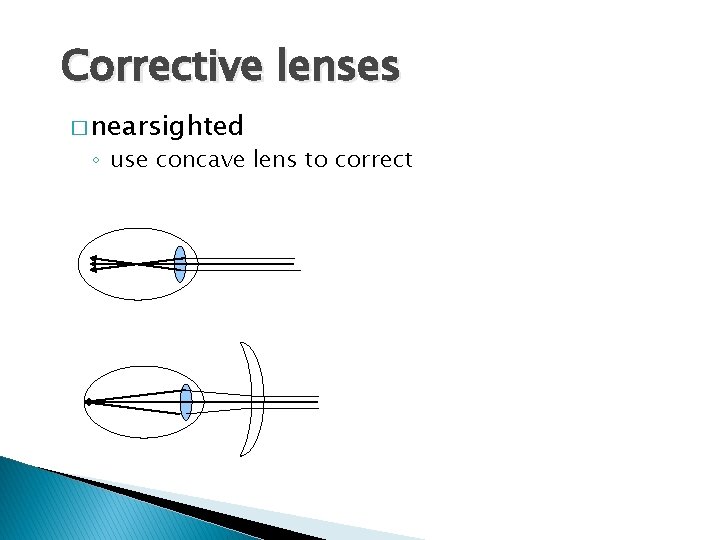
Corrective lenses � nearsighted ◦ use concave lens to correct
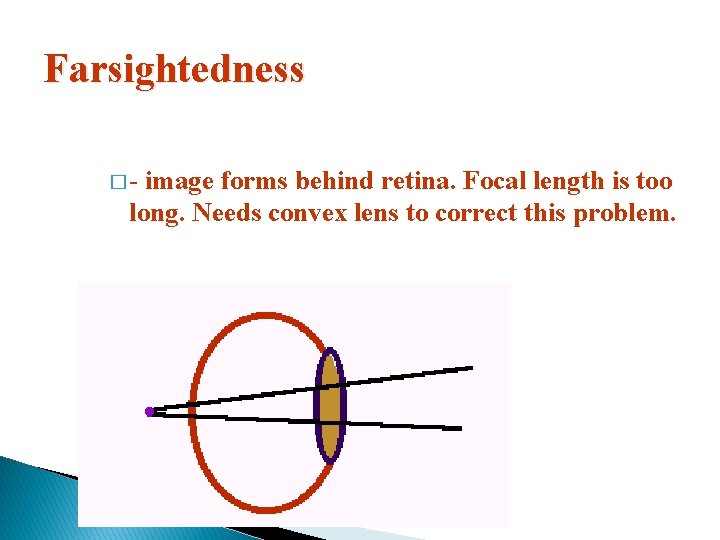
Farsightedness �- image forms behind retina. Focal length is too long. Needs convex lens to correct this problem.
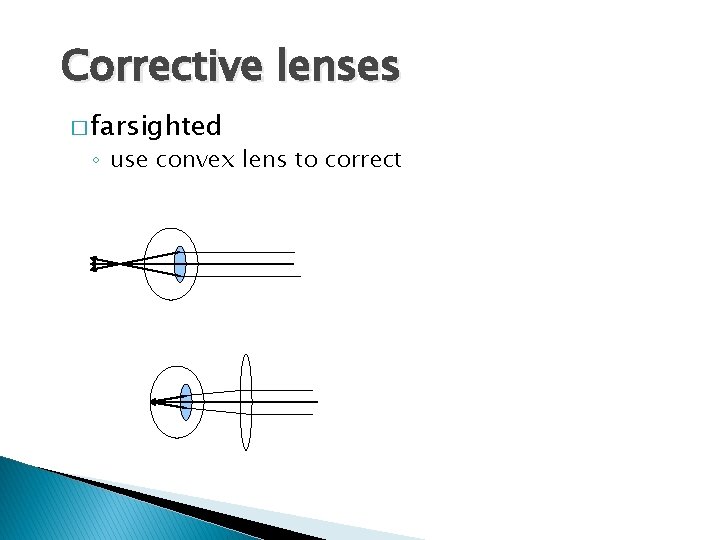
Corrective lenses � farsighted ◦ use convex lens to correct
Lenses Lens – made of a transparent material with a refractive index larger than air. Ex: Glass, Plastic, Polycarbonite. Convex Lens- thicker at the center (converging lens) Concave Lens – thinner at center (diverging lens)
- Slides: 65