
Light as a wave Waves transfer energy A

- Slides: 23
Light as a wave
Waves transfer energy A disturbance in one part of the substance travels via collision or elasticity to other parts of the substance. After the pulse of energy passes, the parts of the substance return to their original position due to some sort of restoring force Examples of restoring force: • Particles of water fall back due to gravity • Links in a slinky are pulled back due to elasticity
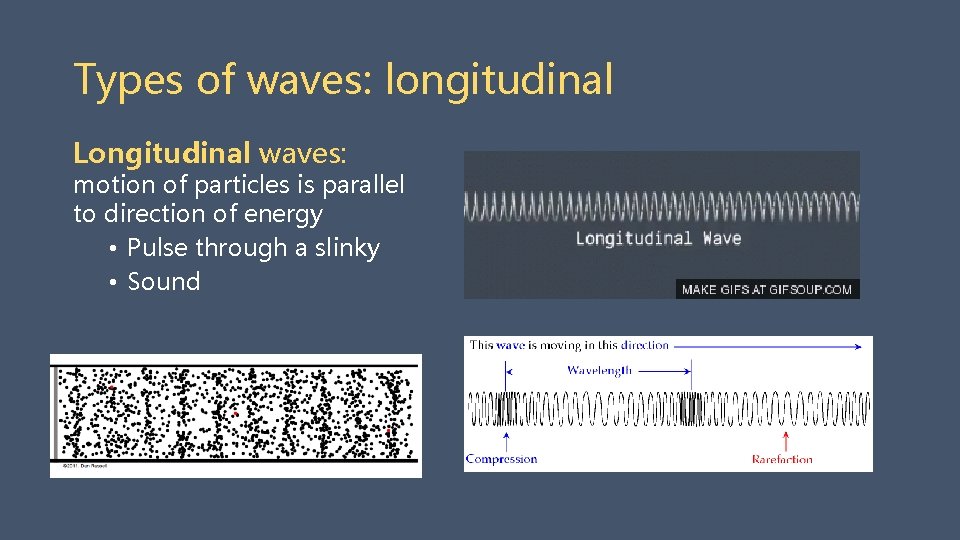
Types of waves: longitudinal Longitudinal waves: motion of particles is parallel to direction of energy • Pulse through a slinky • Sound
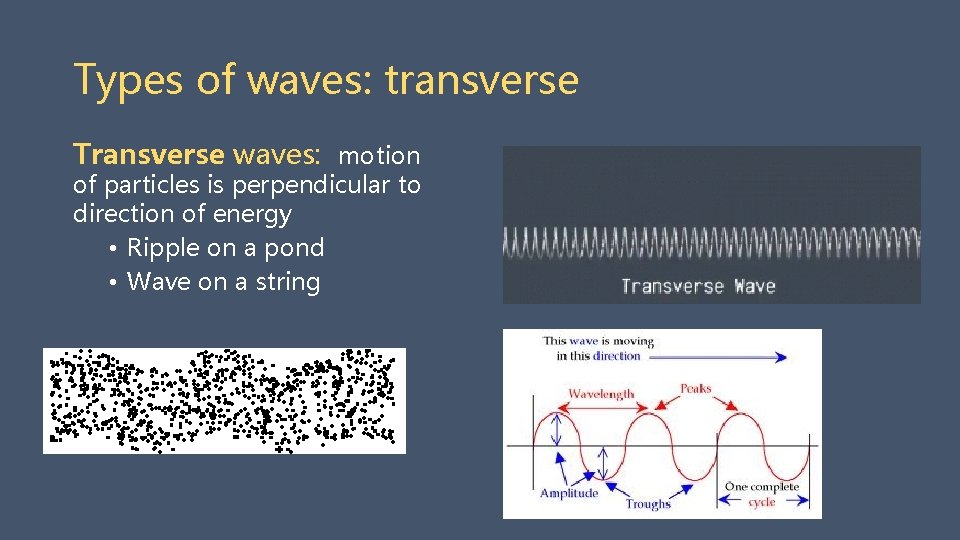
Types of waves: transverse Transverse waves: motion of particles is perpendicular to direction of energy • Ripple on a pond • Wave on a string
Light: transverse or longitudinal? • How could we tell the difference? • Why would it make a difference?
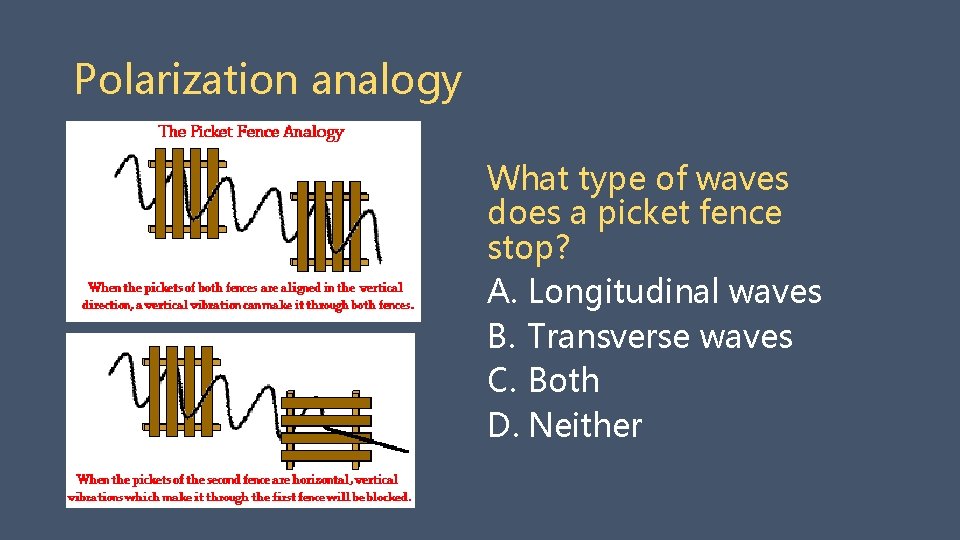
Polarization analogy What type of waves does a picket fence stop? A. Longitudinal waves B. Transverse waves C. Both D. Neither
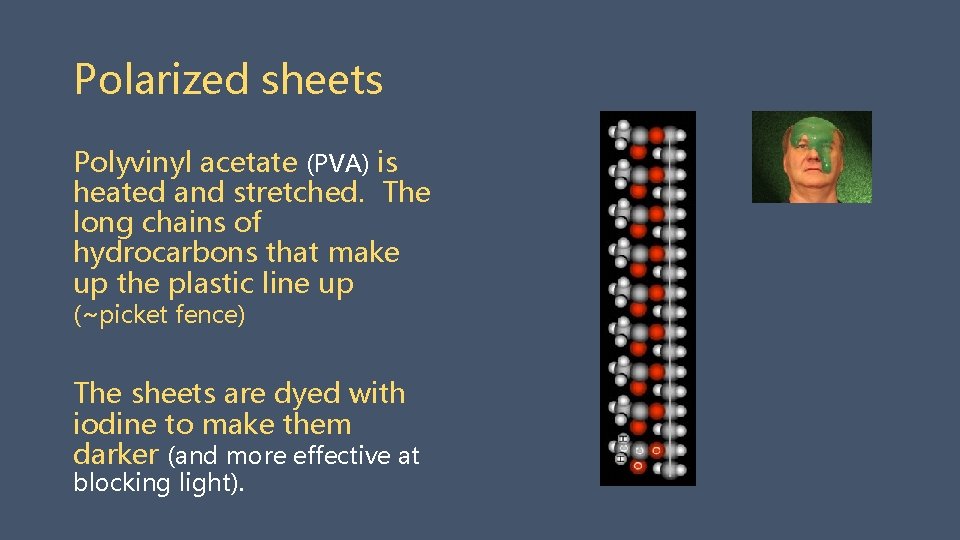
Polarized sheets Polyvinyl acetate (PVA) is heated and stretched. The long chains of hydrocarbons that make up the plastic line up (~picket fence) The sheets are dyed with iodine to make them darker (and more effective at blocking light).
Polarizing Light Demo 1: Demo 2: Demo 3: Hold a polarizing filter about arm’s length. Look at a television, digital watch, computer screen, or calculator through a polarized filter. Rotate the filter. Look a bright light reflecting off a table through a polarizing filter. Rotate the filter. Overlap several pieces of cheap cellophane tape in a fun pattern. Hold one polarizing filter behind the tape and one in front. View a bright light source through the filters and tape. Rotate the filters.
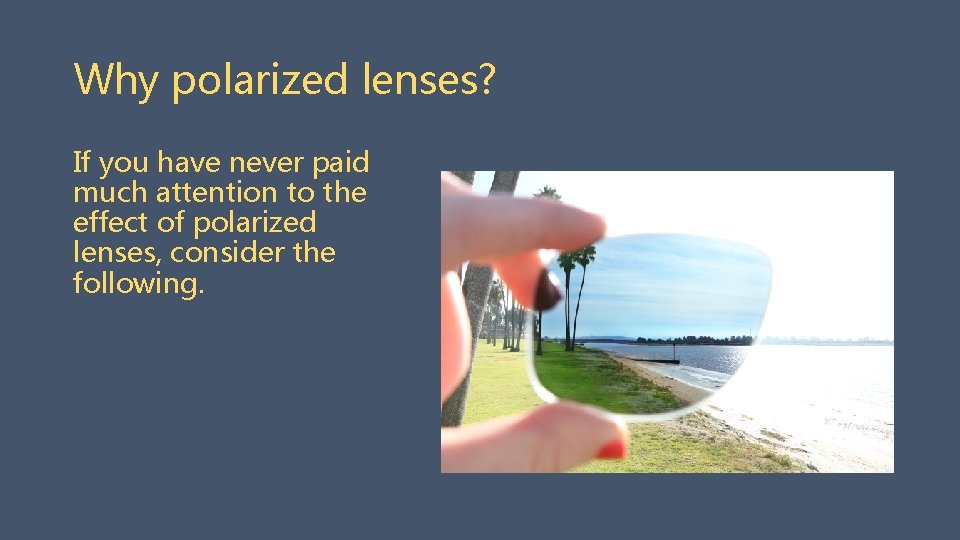
Why polarized lenses? If you have never paid much attention to the effect of polarized lenses, consider the following.
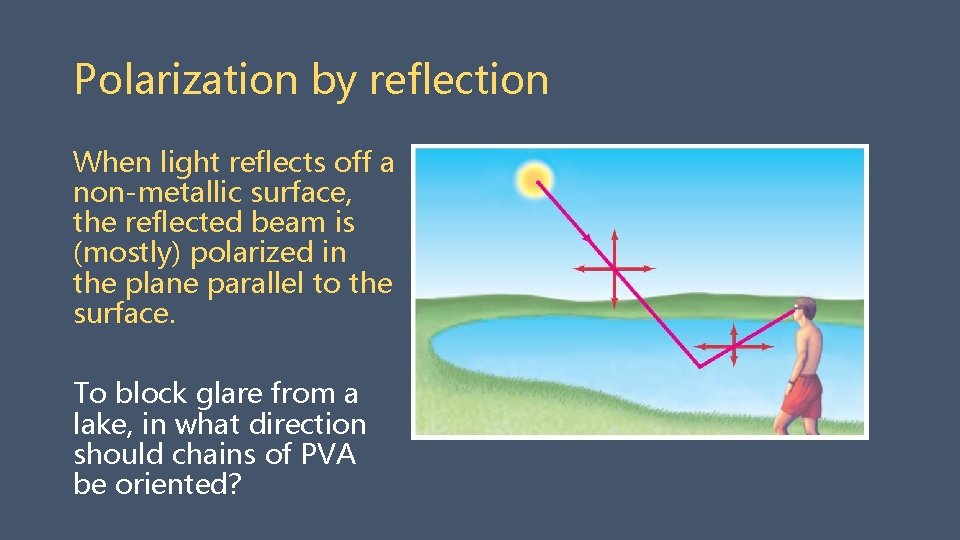
Polarization by reflection When light reflects off a non-metallic surface, the reflected beam is (mostly) polarized in the plane parallel to the surface. To block glare from a lake, in what direction should chains of PVA be oriented?
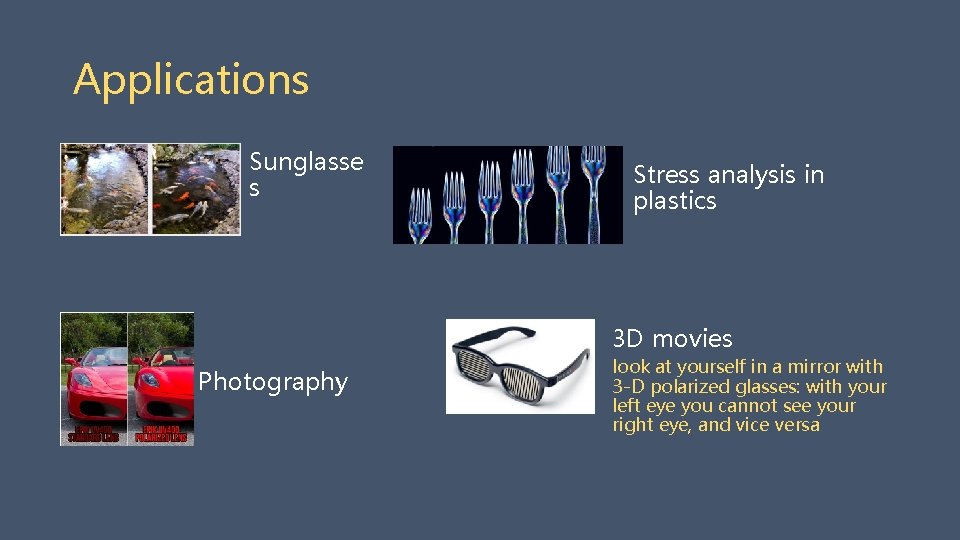
Applications Sunglasse s Stress analysis in plastics 3 D movies Photography look at yourself in a mirror with 3 -D polarized glasses: with your left eye you cannot see your right eye, and vice versa
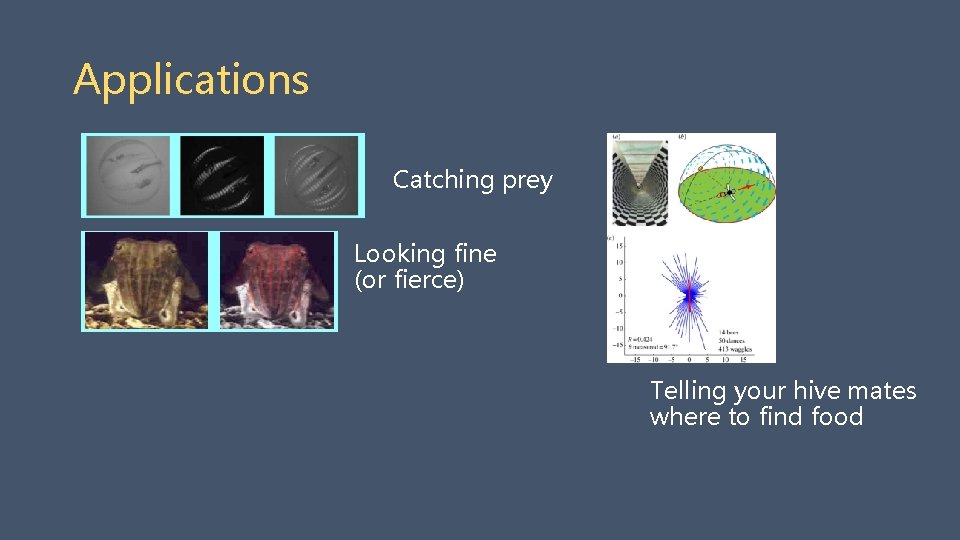
Applications Catching prey Looking fine (or fierce) Telling your hive mates where to find food
A problem with light as a wave All the waves we know require a medium through which they transfer the energy. If waves transfer energy through colliding particles, there must be colliding particles to collide. • Water molecules • String • Air We have seen that light’s behavior can be described if we think of light as a wave, but… • Through what medium does it travel? • How does energy from the sun travel through space?
Early answers Hypothesis 1: Mechanical vibration that travels through a completely transparent, massless, and elastic medium. For fun, let’s call it luminiferous ether. Hypothesis 2: Light wave is new type of vibration • Does NOT involve physical particles vibrating around equilibrium positions • Does NOT have “restoring forces” acting upon it.
Hypothesis 1: Ether It’s wrong. More about this later.
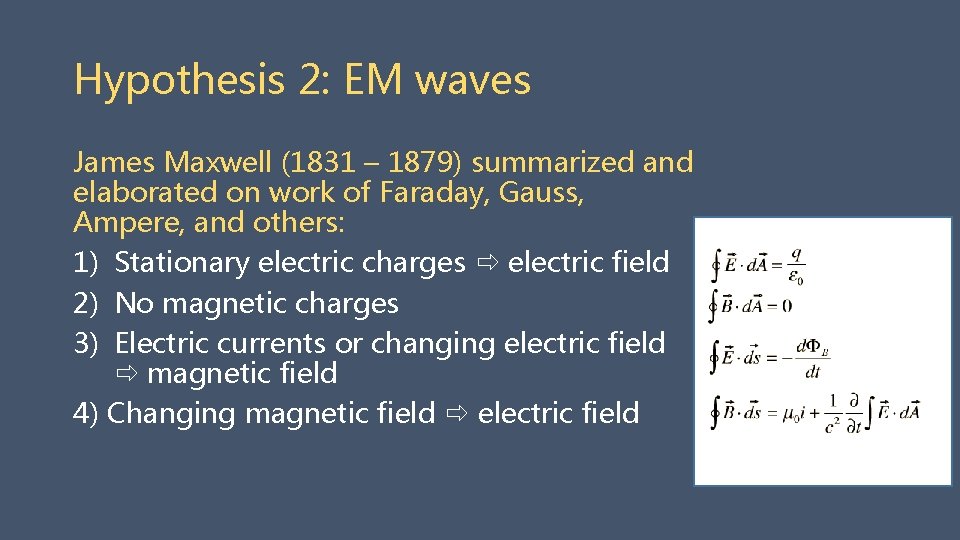
Hypothesis 2: EM waves James Maxwell (1831 – 1879) summarized and elaborated on work of Faraday, Gauss, Ampere, and others: 1) Stationary electric charges electric field 2) No magnetic charges 3) Electric currents or changing electric field magnetic field 4) Changing magnetic field electric field
Feedback loop Changing electric field magnetic field Changing magnetic field electric field Experiment with this applet: http: //phet. colorado. edu/en/simulation/radio-waves
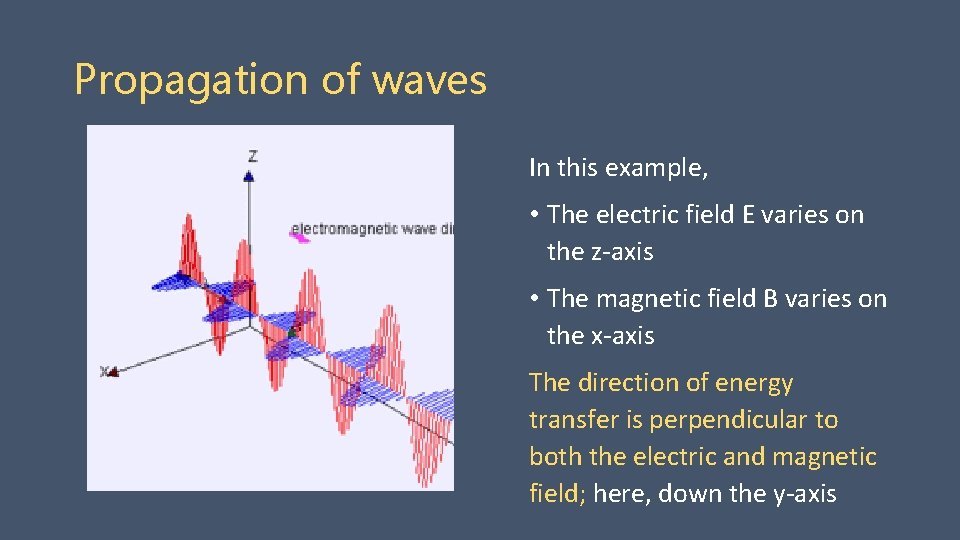
Propagation of waves In this example, • The electric field E varies on the z-axis • The magnetic field B varies on the x-axis The direction of energy transfer is perpendicular to both the electric and magnetic field; here, down the y-axis
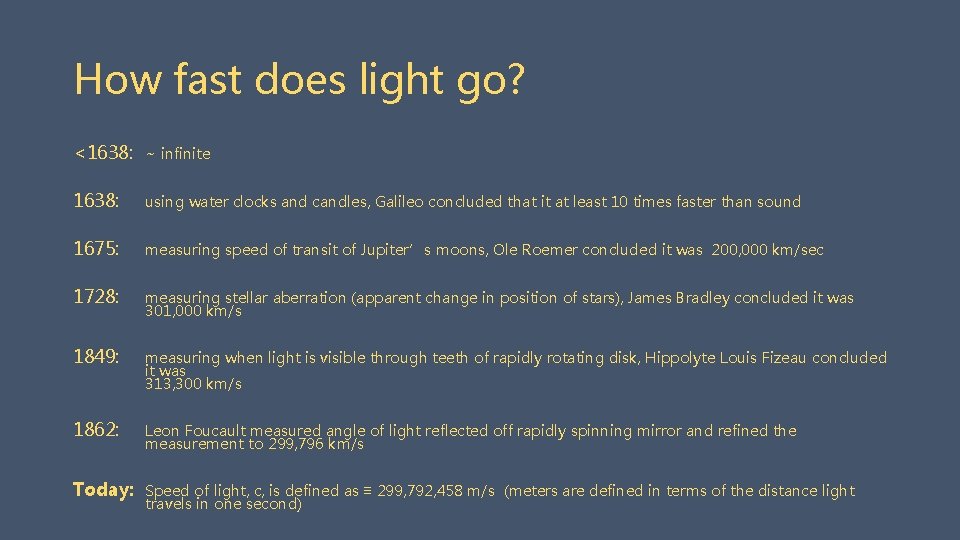
How fast does light go? <1638: ~ infinite 1638: using water clocks and candles, Galileo concluded that it at least 10 times faster than sound 1675: measuring speed of transit of Jupiter’s moons, Ole Roemer concluded it was 200, 000 km/sec 1728: measuring stellar aberration (apparent change in position of stars), James Bradley concluded it was 301, 000 km/s 1849: measuring when light is visible through teeth of rapidly rotating disk, Hippolyte Louis Fizeau concluded it was 313, 300 km/s 1862: Leon Foucault measured angle of light reflected off rapidly spinning mirror and refined the measurement to 299, 796 km/s Today: Speed of light, c, is defined as ≡ 299, 792, 458 m/s (meters are defined in terms of the distance light travels in one second)
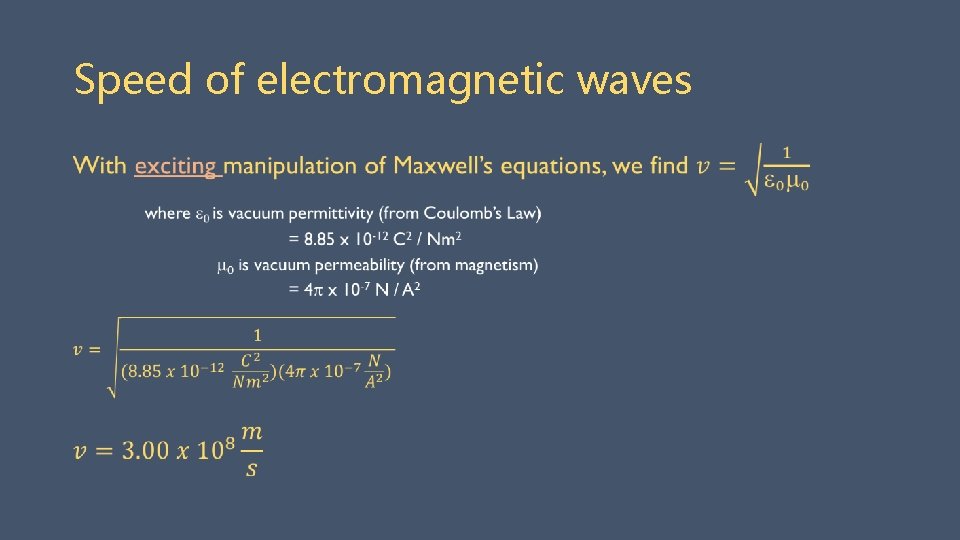
Speed of electromagnetic waves
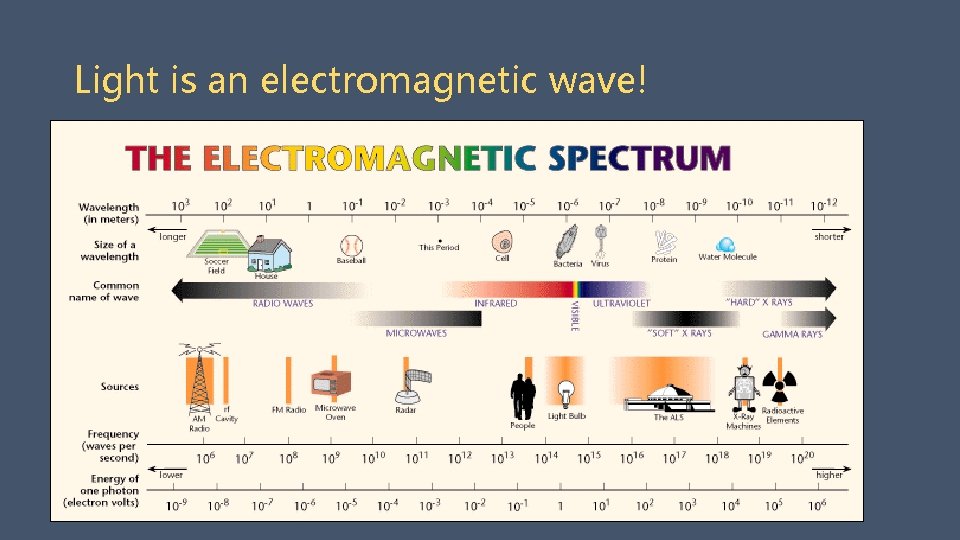
Light is an electromagnetic wave!
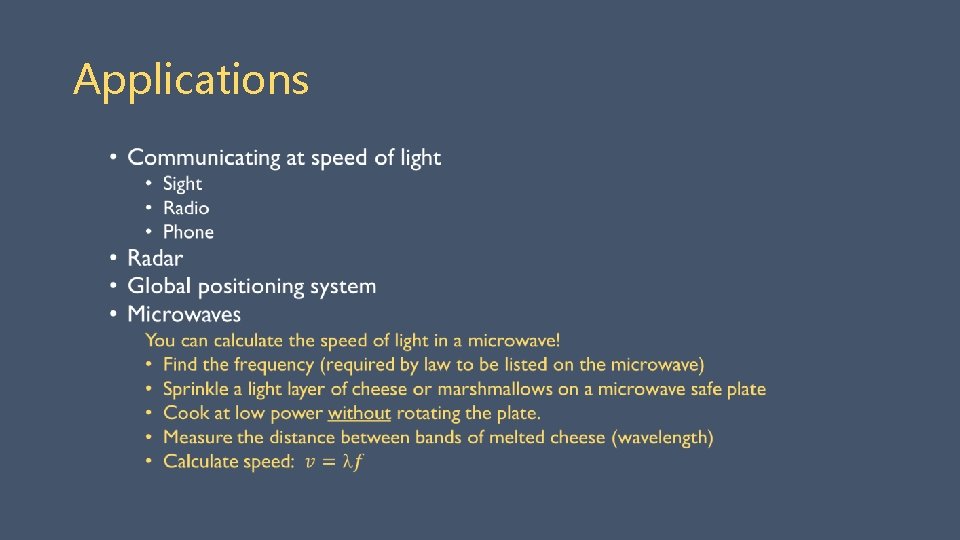
Applications
For more information Doc Physics re: Maxwell’s Equations: https: //www. youtube. com/watch? v=8 PE 5 GEXqm. T 8 Physics Classroom re: polarization: http: //www. physicsclassroom. com/class/light/Lesson 1/Polarization Olympus microscopy re: polarization http: //www. olympusmicro. com/primer/lightandcolor/polariz ation. html