
Ligands that FavorForce the Formation of Tetrahedral Complexes

- Slides: 9
Ligands that Favor/Force the Formation of Tetrahedral Complexes with an Application in Bioinorganic Chemistry Marion E. Cass, Carleton College Michael J. Stevenson, Dartmouth College Molly L. Croteau, Dartmouth College Created by Michael J. Stevenson, Dartmouth College (Michael. J. Stevenson. GR@Dartmouth. edu) Molly L. Croteau, Dartmouth College (Molly. L. Croteau. GR@Dartmouth. edu) and Marion E. Cass, Carleton College (mcass@. carleton. edu), and posted on VIPEr on April 18, 2016. Copyright Michael J. Stevenson, Molly L. Croteau, and Marion E. Cass. This work is licensed under the Creative Commons Attribution Non-commercial Share Alike License. To view a copy of this license visit http: //creativecommons. org/about/license/.
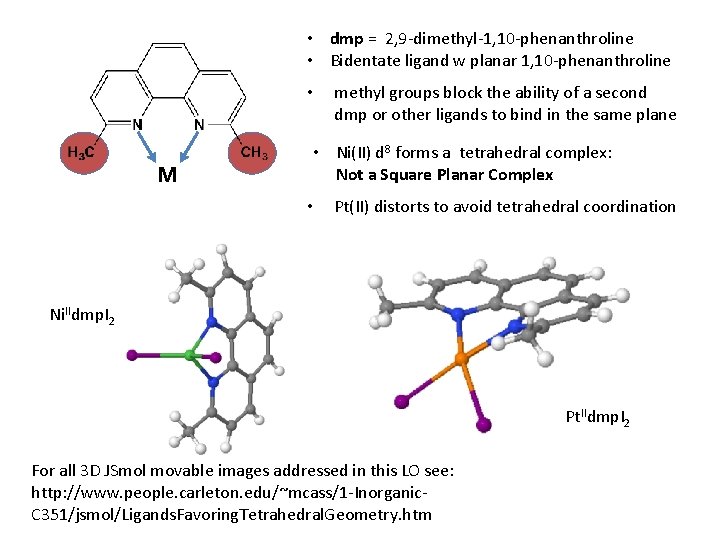
• dmp = 2, 9 -dimethyl-1, 10 -phenanthroline • Bidentate ligand w planar 1, 10 -phenanthroline • M methyl groups block the ability of a second dmp or other ligands to bind in the same plane • Ni(II) d 8 forms a tetrahedral complex: Not a Square Planar Complex • Pt(II) distorts to avoid tetrahedral coordination Ni. IIdmp. I 2 Pt. IIdmp. I 2 For all 3 D JSmol movable images addressed in this LO see: http: //www. people. carleton. edu/~mcass/1 -Inorganic. C 351/jsmol/Ligands. Favoring. Tetrahedral. Geometry. htm
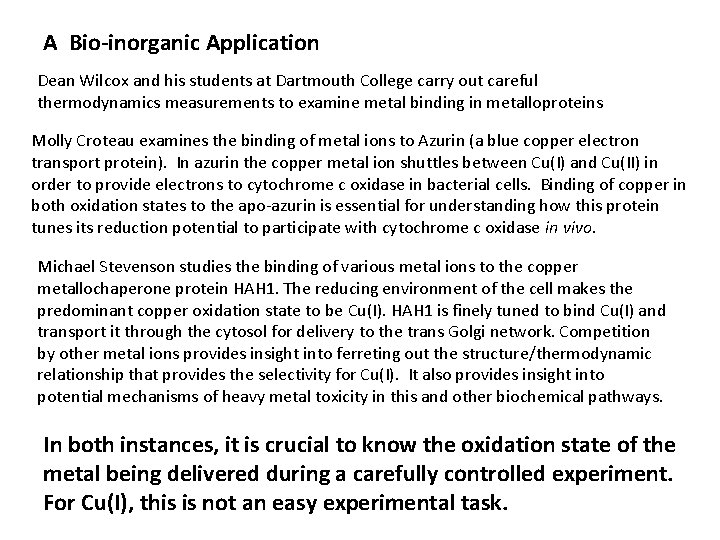
A Bio-inorganic Application Dean Wilcox and his students at Dartmouth College carry out careful thermodynamics measurements to examine metal binding in metalloproteins Molly Croteau examines the binding of metal ions to Azurin (a blue copper electron transport protein). In azurin the copper metal ion shuttles between Cu(I) and Cu(II) in order to provide electrons to cytochrome c oxidase in bacterial cells. Binding of copper in both oxidation states to the apo-azurin is essential for understanding how this protein tunes its reduction potential to participate with cytochrome c oxidase in vivo. Michael Stevenson studies the binding of various metal ions to the copper metallochaperone protein HAH 1. The reducing environment of the cell makes the predominant copper oxidation state to be Cu(I). HAH 1 is finely tuned to bind Cu(I) and transport it through the cytosol for delivery to the trans Golgi network. Competition by other metal ions provides insight into ferreting out the structure/thermodynamic relationship that provides the selectivity for Cu(I). It also provides insight into potential mechanisms of heavy metal toxicity in this and other biochemical pathways. In both instances, it is crucial to know the oxidation state of the metal being delivered during a carefully controlled experiment. For Cu(I), this is not an easy experimental task.
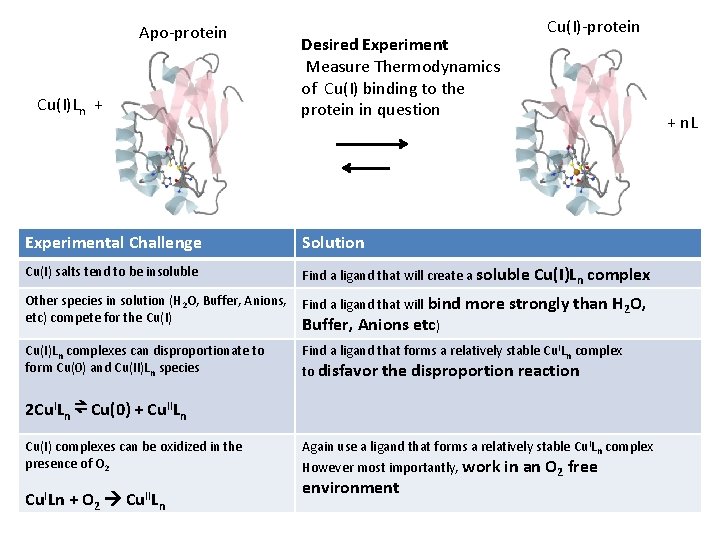
Apo-protein Cu(I)Ln + Desired Experiment Measure Thermodynamics of Cu(I) binding to the protein in question Cu(I)-protein Experimental Challenge Solution Cu(I) salts tend to be insoluble Find a ligand that will create a soluble Cu(I)Ln complex Other species in solution (H 2 O, Buffer, Anions, Find a ligand that will bind more strongly than H O, 2 etc) compete for the Cu(I) Buffer, Anions etc) Cu(I)Ln complexes can disproportionate to form Cu(0) and Cu(II)Ln species Find a ligand that forms a relatively stable Cu. ILn complex to disfavor the disproportion reaction 2 Cu. ILn ⇌ Cu(0) + Cu. IILn Cu(I) complexes can be oxidized in the presence of O 2 Cu. ILn + O 2 Cu. IILn Again use a ligand that forms a relatively stable Cu. ILn complex However most importantly, work in an O 2 free environment + n. L
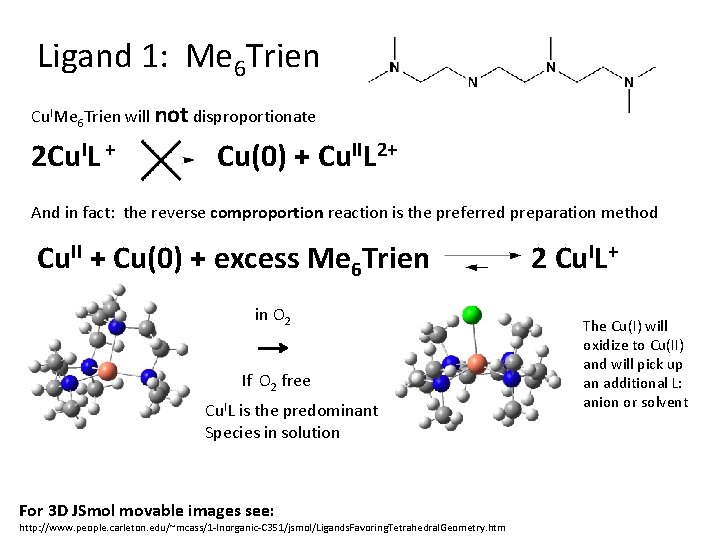
Ligand 1: Me 6 Trien Cu. IMe 6 Trien will not disproportionate 2 Cu. IL + Cu(0) + Cu. IIL 2+ And in fact: the reverse comproportion reaction is the preferred preparation method Cu. II + Cu(0) + excess Me 6 Trien in O 2 If O 2 free Cu. IL is the predominant Species in solution For 3 D JSmol movable images see: http: //www. people. carleton. edu/~mcass/1 -Inorganic-C 351/jsmol/Ligands. Favoring. Tetrahedral. Geometry. htm 2 Cu. IL+ The Cu(I) will oxidize to Cu(II) and will pick up an additional L: anion or solvent
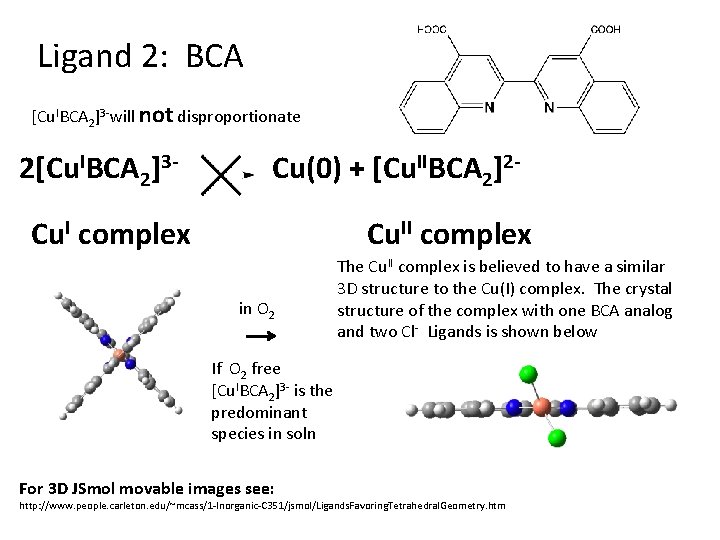
Ligand 2: BCA [Cu. IBCA 2]3 -will not disproportionate 2[Cu. IBCA 2]3 - Cu(0) + [Cu. IIBCA 2]2 - Cu. I complex Cu. II complex in O 2 The Cu. II complex is believed to have a similar 3 D structure to the Cu(I) complex. The crystal structure of the complex with one BCA analog and two Cl- Ligands is shown below If O 2 free [Cu. IBCA 2]3 - is the predominant species in soln For 3 D JSmol movable images see: http: //www. people. carleton. edu/~mcass/1 -Inorganic-C 351/jsmol/Ligands. Favoring. Tetrahedral. Geometry. htm
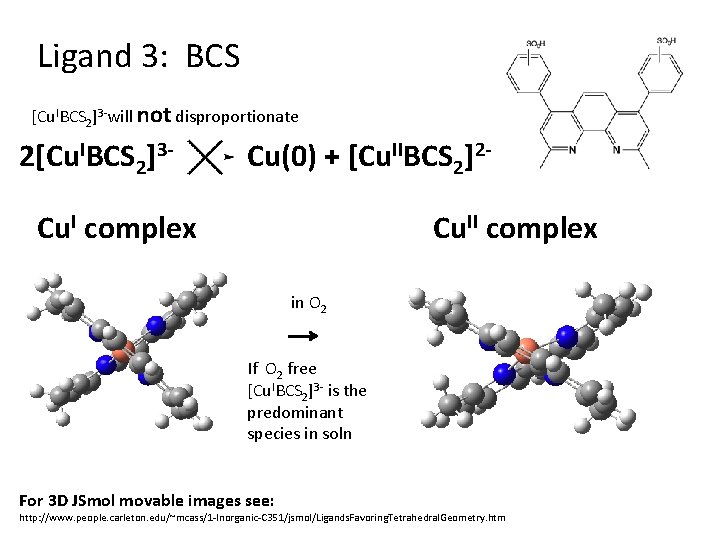
Ligand 3: BCS [Cu. IBCS 2]3 -will not disproportionate 2[Cu. IBCS 2]3 - Cu(0) + [Cu. IIBCS 2]2 - Cu. I complex Cu. II complex in O 2 If O 2 free [Cu. IBCS 2]3 - is the predominant species in soln For 3 D JSmol movable images see: http: //www. people. carleton. edu/~mcass/1 -Inorganic-C 351/jsmol/Ligands. Favoring. Tetrahedral. Geometry. htm
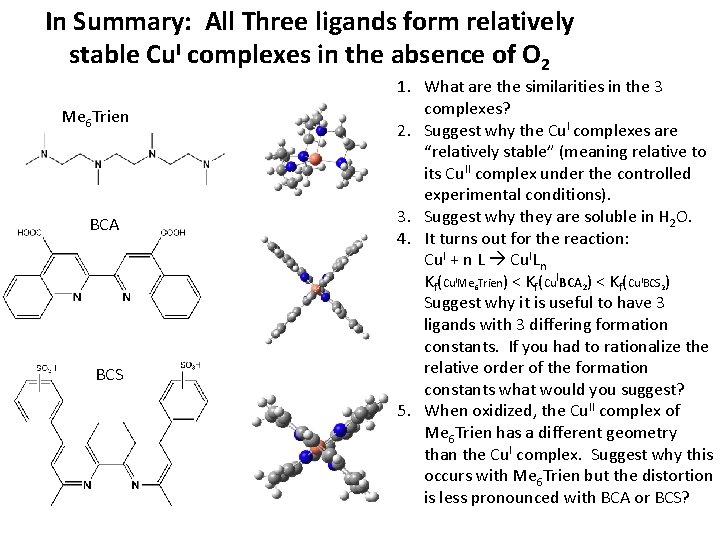
In Summary: All Three ligands form relatively stable Cu. I complexes in the absence of O 2 Me 6 Trien BCA BCS 1. What are the similarities in the 3 complexes? 2. Suggest why the Cu. I complexes are “relatively stable” (meaning relative to its Cu. II complex under the controlled experimental conditions). 3. Suggest why they are soluble in H 2 O. 4. It turns out for the reaction: Cu. I + n L Cu. ILn Kf(Cu. IMe 6 Trien) < Kf(Cu. IBCA 2) < Kf(Cu. IBCS 2) Suggest why it is useful to have 3 ligands with 3 differing formation constants. If you had to rationalize the relative order of the formation constants what would you suggest? 5. When oxidized, the Cu. II complex of Me 6 Trien has a different geometry than the Cu. I complex. Suggest why this occurs with Me 6 Trien but the distortion is less pronounced with BCA or BCS?
References and Resources • D. K. Johnson, M. J. Stevenson, Z. A. Almadidy, S. E. Jenkins, D. E. Wilcox, N. E. Grossoeheme; “Stabilization of Cu(I) for binding and calorimetric measurements in aqueous solution” Dalton Transactions, 2015, Vol 44, Issue 37, p. 16494 -16505 (DOI 10. 1039/c 5 dt 02689) • A very neat application of the shuttling of the Cu. I/Cu. II complexes with Me 6 Trien and other ligands is for use in radical polymerization reactions: See G. Kickelbick, T. Pintauerb and K. Matyjaszewski; “Structural comparison of Cu. II complexes in atom transfer radical polymerization” New J. Chem, 2002, 26, p. 462 -468 (DOI 10. 1039/b 105454 f)