
LifeSpan Development Thirteenth Edition Chapter 20 Death Dying
- Slides: 28
Life-Span Development Thirteenth Edition Chapter 20: Death, Dying, and Grieving © 2011 The Mc. Graw-Hill Companies, Inc. All rights reserved
The Death System and Cultural Contexts § The Death System and Its Cultural Variations § Components comprising the death system: § People § Places or contexts § Times § Objects § Symbols © 2011 The Mc. Graw-Hill Companies, Inc. All rights reserved. 2
The Death System and Cultural Contexts § The Death System and Its Cultural Variations § Cultural variations in the death system § Ancient Greeks – to live a full life and die with glory § Most societies have a ritual that deals with death § In most societies, death is not viewed as the end of existence as the spiritual body is believed to live on © 2011 The Mc. Graw-Hill Companies, Inc. All rights reserved. 3
The Death System and Cultural Contexts § Changing Historical Circumstances: § The age group in which death most often occurs, most often among older adults § Life expectancy has increased from 47 years for a person born in 1900 to 78 years for someone born today § Location of death; 80% of deaths in the U. S. today occur in institutions or hospitals © 2011 The Mc. Graw-Hill Companies, Inc. All rights reserved. 4
Defining Death and Life/Death Issues § Issues in Determining Death § Brain Death: a person is brain dead when all electrical activity of the brain has ceased for a specified period of time § A flat EEG § Includes both the higher cortical functions and the lower brainstem functions © 2011 The Mc. Graw-Hill Companies, Inc. All rights reserved. 5
Defining Death and Life/Death Issues § Decisions Regarding Life, Death, and Health Care § Natural Death Act and Advance Directive § Living Will is designed to be filled in while the individual can still think clearly § Advance directive: states that life-sustaining procedures shall not be used to prolong their lives when death is imminent © 2011 The Mc. Graw-Hill Companies, Inc. All rights reserved. 6
Defining Death and Life/Death Issues § Decisions Regarding Life, Death, and Health Care § Euthanasia: the act of painlessly ending the lives of individuals who are suffering from an incurable disease or severe disability § Passive euthanasia: treatment is withheld § Active euthanasia: death deliberately induced § Recent cases: Terri Schiavo and Jack Kevorkian © 2011 The Mc. Graw-Hill Companies, Inc. All rights reserved. 7
Defining Death and Life/Death Issues § Decisions Regarding Life, Death, and Health Care § Needed: Better Care for Dying Individuals § Death in America is often lonely, prolonged, and painful § A “good death” involves physical comfort, support from loved ones, acceptance, and appropriate medical care © 2011 The Mc. Graw-Hill Companies, Inc. All rights reserved. 8
Defining Death and Life/Death Issues § Decisions Regarding Life, Death, and Health Care § Fail-safe measures for avoiding pain at the end of life § Make a living will § Give someone power of attorney § Give doctors specific instructions such as “Do not resuscitate” or “Do everything possible” § Discuss with the family whether or not you want to die at home § Check insurance to see if it covers home care or hospice care © 2011 The Mc. Graw-Hill Companies, Inc. All rights reserved. 9
Defining Death and Life/Death Issues § Decisions Regarding Life, Death, and Health Care § Hospice: a program committed to making the end of life as free from pain, anxiety, and depression as possible § Emphasizes palliative care: reducing pain and suffering, helping individuals die with dignity § 90% of hospice care is in patients’ homes © 2011 The Mc. Graw-Hill Companies, Inc. All rights reserved. 10
A Developmental Perspective On Death § Causes of death vary across the life span: § Prenatal death through miscarriage § SIDS is the leading cause of infant death in the U. S. § Accidents or illness cause most childhood deaths § Most adolescent and young adult deaths result from suicide, homicide, or motor vehicle accidents § Middle-age and older adult deaths usually result from chronic diseases © 2011 The Mc. Graw-Hill Companies, Inc. All rights reserved. 11
A Developmental Perspective On Death § Attitudes Toward Death at Different Points in the Life Span § Childhood § Young children believe the dead can be brought back to life § Around 9 years of age, children view death as universal and irreversible § Honesty is the best strategy in discussing death with children © 2011 The Mc. Graw-Hill Companies, Inc. All rights reserved. 12
A Developmental Perspective On Death § Attitudes Toward Death at Different Points in the Life Span § Adolescence § Death regarded as remote and may be avoided, glossed over, or kidded about. § Death of friends, siblings, parents, or grandparents bring death to the forefront of adolescents’ lives § Develop more abstract conceptions about death than children © 2011 The Mc. Graw-Hill Companies, Inc. All rights reserved. 13
A Developmental Perspective On Death § Attitudes Toward Death at Different Points in the Life Span § Adulthood § Middle-aged adults actually fear death more than young adults § Older adults are forced to examine the meanings of life and death more frequently than younger adults © 2011 The Mc. Graw-Hill Companies, Inc. All rights reserved. 14
Facing One’s Own Death § Knowledge of death’s inevitability permits us to establish priorities and structure our time § Three areas of concern: § Privacy and autonomy in regard to their families § Inadequate information about physical changes and medication as death approached § Motivation to shorten their life © 2011 The Mc. Graw-Hill Companies, Inc. All rights reserved. 15
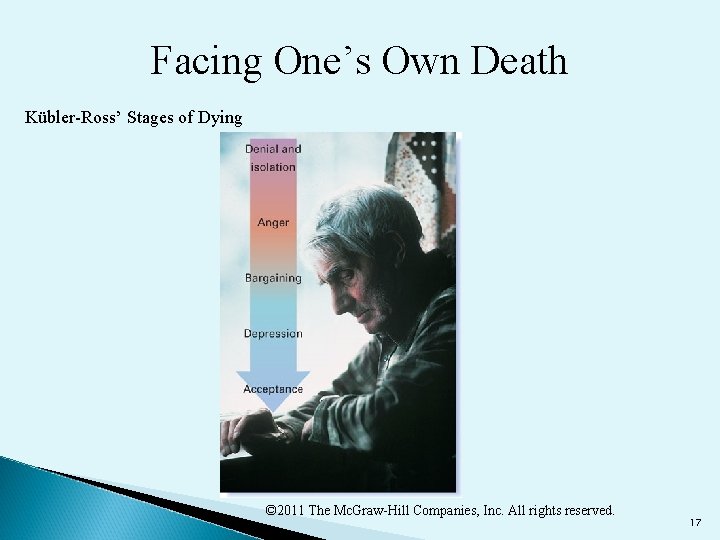
Facing One’s Own Death § Kübler-Ross’ Stages of Dying: § Denial and Isolation: “It can’t be!” § Anger: “Why me? ” § Bargaining: “Just let me do this first!” § Depression: withdrawal, crying, and grieving § Acceptance: a sense of peace comes © 2011 The Mc. Graw-Hill Companies, Inc. All rights reserved. 16
Facing One’s Own Death Kübler-Ross’ Stages of Dying © 2011 The Mc. Graw-Hill Companies, Inc. All rights reserved. 17
Facing One’s Own Death § Perceived Control and Denial § Perceived control may be an adaptive strategy for remaining alert and cheerful § Denial insulates and allows one to avoid coping with intense feelings of anger and hurt § Can be maladaptive depending on extent © 2011 The Mc. Graw-Hill Companies, Inc. All rights reserved. 18
Facing One’s Own Death § The Contexts in Which People Die § More than 50% of Americans die in hospitals and nearly 20% die in nursing homes § Hospitals offer many important advantages: § Professional staff members § Technology may prolong life © 2011 The Mc. Graw-Hill Companies, Inc. All rights reserved. 19
Coping With The Death Of Someone Else § Communicating with a Dying Person § Open communication with a dying person is very important because: § They can close their lives in accord with their own ideas about proper dying § They may be able to complete plans and projects, and make arrangements and decisions § They have the opportunity to reminisce and converse with others § They have more understanding of what is happening to them © 2011 The Mc. Graw-Hill Companies, Inc. All rights reserved. 20
Coping With The Death Of Someone Else § Grieving § Dimensions of Grieving § Grief: emotional numbness, disbelief, separation anxiety, despair, sadness, and loneliness that accompany the loss of someone we love § Pining or yearning reflects an intermittent, recurrent wish or need o recover the lost person § Cognitive factors are involved in the severity of grief © 2011 The Mc. Graw-Hill Companies, Inc. All rights reserved. 21
Coping With The Death Of Someone Else § Grieving § Good family communications can help reduce the incidence of depression and suicidal thoughts § Prolonged Grief: difficulty moving on with their life § Disenfranchised Grief: an individual’s grief involving a deceased person that is a socially ambiguous loss that can’t be openly mourned or supported § Examples: ex-spouse, abortion, stigmatized death (such as AIDS) © 2011 The Mc. Graw-Hill Companies, Inc. All rights reserved. 22
Coping With The Death Of Someone Else § Grieving § Dual-Process Model of Coping and Bereavement § Two Main Dimensions § Loss-oriented stressors: focus on the deceased individual § Restoration-oriented stressors: secondary stressors that emerge as indirect outcomes of bereavement § Effective coping involves oscillation between coping with loss and coping with restoration © 2011 The Mc. Graw-Hill Companies, Inc. All rights reserved. 23
Coping With The Death Of Someone Else § Grieving § Coping and Type of Death § Impact of death on surviving individuals is strongly influenced by the circumstances under which the death occurs § Sudden deaths are likely to have more intense and prolonged effects on surviving individuals © 2011 The Mc. Graw-Hill Companies, Inc. All rights reserved. 24
Coping With The Death Of Someone Else § Grieving § Cultural Diversity in Healthy Grieving § Some cultures emphasize the importance of breaking bonds with the deceased and returning quickly to autonomous lifestyles § Non-Western cultures suggest that beliefs about continuing bonds with the deceased vary extensively § There is no one right, ideal way to grieve © 2011 The Mc. Graw-Hill Companies, Inc. All rights reserved. 25
Coping With The Death Of Someone Else § Making Sense of the World § Grieving often stimulates individuals to try to make sense of their world § A reliving of the events leading to the death is common § When a death is caused by an accident or a disaster, the effort to make sense of it is often pursued more vigorously © 2011 The Mc. Graw-Hill Companies, Inc. All rights reserved. 26
Coping With The Death Of Someone Else § Losing a Life Partner § The death of an intimate partner often brings profound grief § Widows outnumber widowers because women live longer than men § Widowed women are probably the poorest group in America § Many widows are lonely © 2011 The Mc. Graw-Hill Companies, Inc. All rights reserved. 27
Coping With The Death Of Someone Else § Forms of Mourning § Approximately two-thirds are buried and one-third are cremated § Funerals are an important aspect of mourning in many cultures § Cultures vary in how they practice mourning © 2011 The Mc. Graw-Hill Companies, Inc. All rights reserved. 28