
LIFEsavers Introduction Focus on LIFE CONFIDENTIAL This document

- Slides: 16
LIFEsavers Introduction Focus on LIFE CONFIDENTIAL. This document contains trade secret information. Disclosure, use or reproduction outside Cargill or inside Cargill, to or by those employees who do not have a need to know is prohibited except as authorized by Cargill in writing.
Contents • Focus On LIFE Strategy • LIFEsaver Introduction • LIFEsaver Example • Communication and Promotion • FAQ 2 Lifesavers Introduction CONFIDENTIAL. This document contains trade secret information. Disclosure, use or reproduction outside Cargill or inside Cargill, to or by those employees who do not have a need to know is prohibited except as authorized by Cargill in writing.
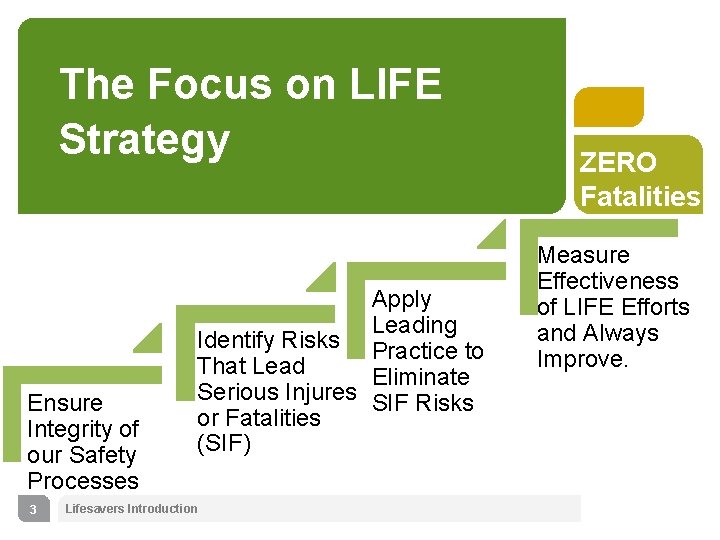
The Focus on LIFE Strategy Ensure Integrity of our Safety Processes 3 Apply Leading Identify Risks Practice to That Lead Eliminate Serious Injures SIF Risks or Fatalities (SIF) Lifesavers Introduction ZERO Fatalities Measure Effectiveness of LIFE Efforts and Always Improve.
In support of Focus on LIFE we introduced LIFEsavers, and have defined the necessary behaviors and requirements to prevent serious injuries or fatalities for 12 high risk activities 4 Lifesavers Introduction
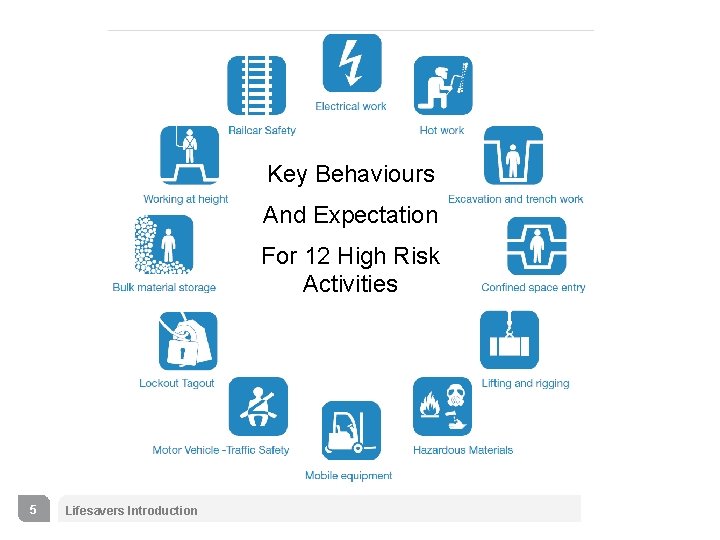
Key Behaviours And Expectation For 12 High Risk Activities 5 Lifesavers Introduction
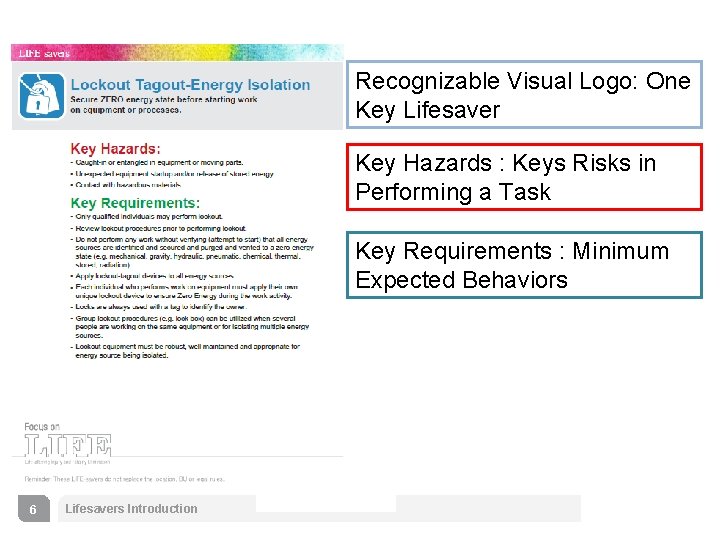
Recognizable Visual Logo: One Key Lifesaver Key Hazards : Keys Risks in Performing a Task Key Requirements : Minimum Expected Behaviors 6 Lifesavers Introduction
EXAMPLE 7 Lifesavers Introduction
8 Lifesavers Introduction
LIFEsavers Working at Height Follow all safety precautions for activities with the risk of falling more than 1. 2 m (4 ft) CONFIDENTIAL. This document contains trade secret information. Disclosure, use or reproduction outside Cargill or inside Cargill, to or by those employees who do not have a need to know is prohibited except as authorized by Cargill in writing.
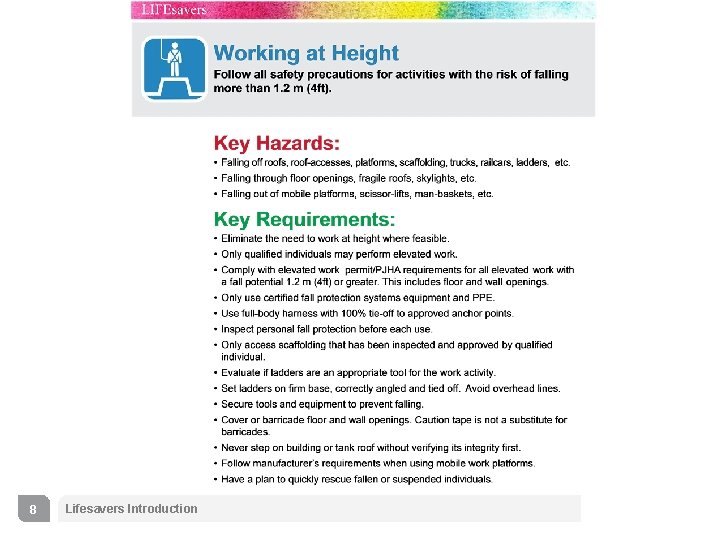
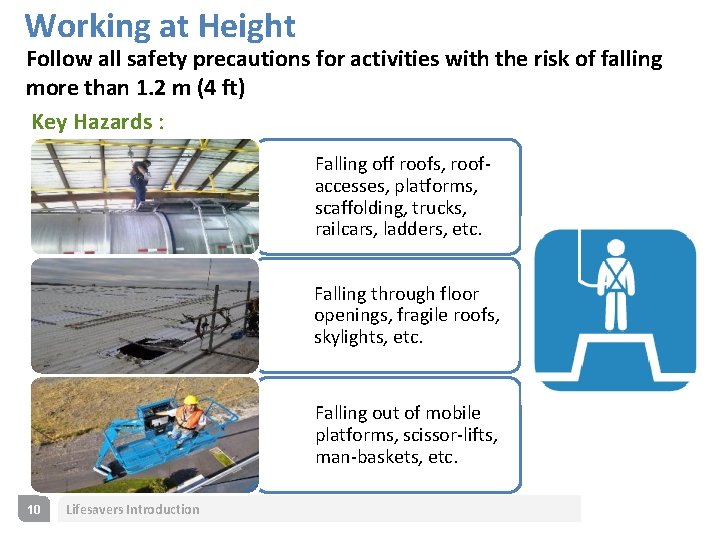
Working at Height Follow all safety precautions for activities with the risk of falling more than 1. 2 m (4 ft) Key Hazards : Falling off roofs, roofaccesses, platforms, scaffolding, trucks, railcars, ladders, etc. Falling through floor openings, fragile roofs, skylights, etc. Falling out of mobile platforms, scissor-lifts, man-baskets, etc. 10 Lifesavers Introduction
Working at Height Follow all safety precautions for activities with the risk of falling more than 1. 2 m (4 ft) Key Requirements : § Eliminate the need to work at height where feasible § Only qualified individuals may perform elevated work § Comply with elevated work permit/PJHA requirements for all elevated work with a fall potential 1. 2 m (4 ft) or greater. This includes floor and wall openings § Only use certified fall protection systems equipment and PPE § Use full-body harness with 100% tie-off to approved anchor points § Inspect personal fall protection before each use § Only access scaffolding that has been inspected and approved by qualified individual 11 Lifesavers Introduction
Working at Height Follow all safety precautions for activities with the risk of falling more than 1. 2 m (4 ft) Key Requirements : § Evaluate if ladders are an appropriate tool for the work activity § Set ladders on firm base, correctly angled and tied off. Avoid overhead lines § Secure tools and equipment to prevent falling § Cover or barricade floor and wall openings. Caution tape is not a substitute for barricades § Never step on building or tank roof without verifying its integrity first § Follow manufacturer’s requirements when using mobile work platforms § Have a plan to quickly rescue fallen or suspended individuals 12 Lifesavers Introduction
13 Lifesavers Introduction
PROMOTION AND EFFECTIVE USE AT PLANTS 14 Lifesavers Introduction
Remember, a strong safety culture requires us to actively watch out for the safety of others. 15 Lifesavers Introduction
With your support, we can eliminate fatalities and serious injuries 16 Lifesavers Introduction