
Life was hard for the industrial age worker
- Slides: 16
• Life was hard for the industrial age worker. • Industrialization caused many skilled workers to lose their jobs. • These workers not had to work at jobs in factories for unskilled labor which caused the to work for poor wages. • Child labor also led to a decrease in wages for workers. • Many workers took jobs in dangerous factories called sweatshops. • These workers had to endure low wages, long hours, and dangerous working conditions.
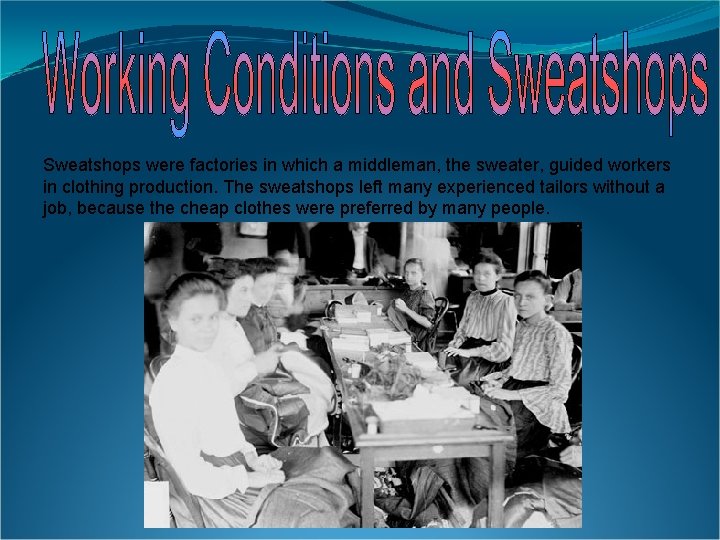
Sweatshops were factories in which a middleman, the sweater, guided workers in clothing production. The sweatshops left many experienced tailors without a job, because the cheap clothes were preferred by many people.
• During the Industrial Revolution families migrated from the rural farm areas to the newly industrialized cities to find work. • Once they got there, things did not look as bright as they did. To survive in even the lowest level of poverty, families had to have every able member of the family go to work. • This led to the high rise in child labor in factories. • Children worked up to 19 hours a day with only one, one hour break. • Many children were killed or injured in accidents involving industrial machinery
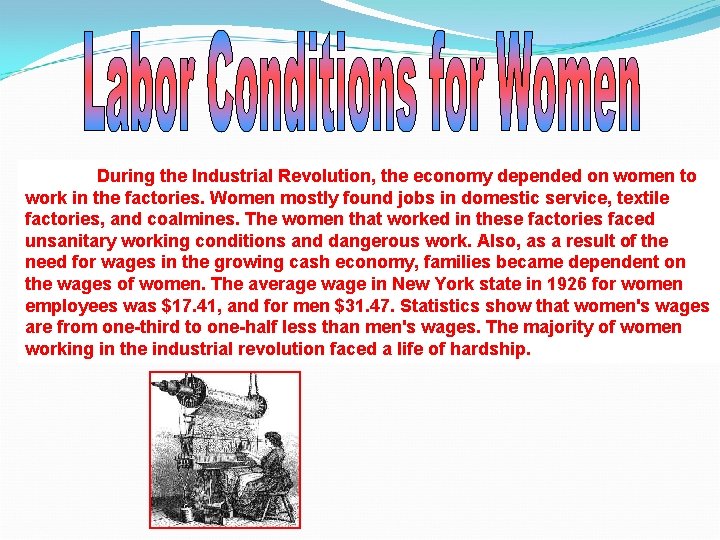
During the Industrial Revolution, the economy depended on women to work in the factories. Women mostly found jobs in domestic service, textile factories, and coalmines. The women that worked in these factories faced unsanitary working conditions and dangerous work. Also, as a result of the need for wages in the growing cash economy, families became dependent on the wages of women. The average wage in New York state in 1926 for women employees was $17. 41, and for men $31. 47. Statistics show that women's wages are from one-third to one-half less than men's wages. The majority of women working in the industrial revolution faced a life of hardship.
Labor unions were formed when dissatisfied workers formed in to groups demand better pay and working conditions. In to 1869 garment cutters formed the Noble and Holy Order of the Knights Labor. The members ofof the laborwas union met secretly and In 1886, of the American Federation Labor officially formed. It had handshakes thatskilled their employers out. The about them. of the representedso many workers inwouldn’t various find crafts. President Something that was unique about labor Gompers. union was. The thatorganization its members American Federation of Labor wasthis Samuel included African Americans, women, and better unskilled laborers. The Knights worked for higher wages, shorter hours, working conditions, and of Labor had more than 700, 000 members at its peak. the right to bargain collectively with employers.
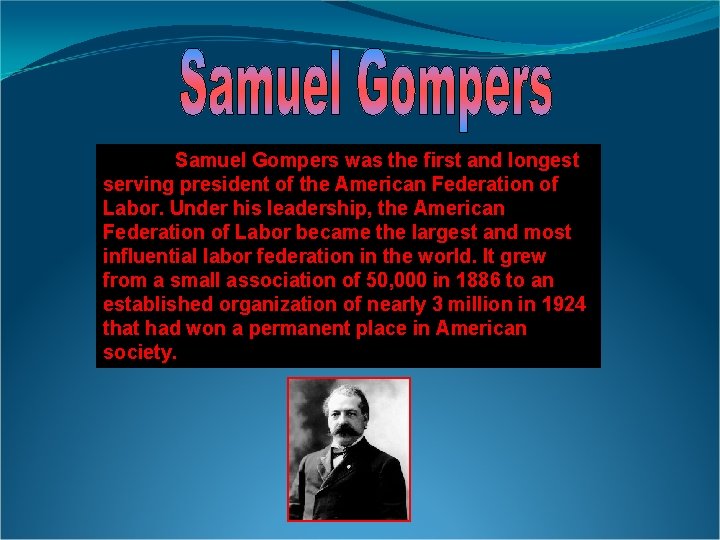
Samuel Gompers was the first and longest serving president of the American Federation of Labor. Under his leadership, the American Federation of Labor became the largest and most influential labor federation in the world. It grew from a small association of 50, 000 in 1886 to an established organization of nearly 3 million in 1924 that had won a permanent place in American society.
Collective Bargaining is a negotiation between organized workers and their employer or employers to determine wages, hours, rules, and working conditions. The American Federation of Labor pressed for this right.
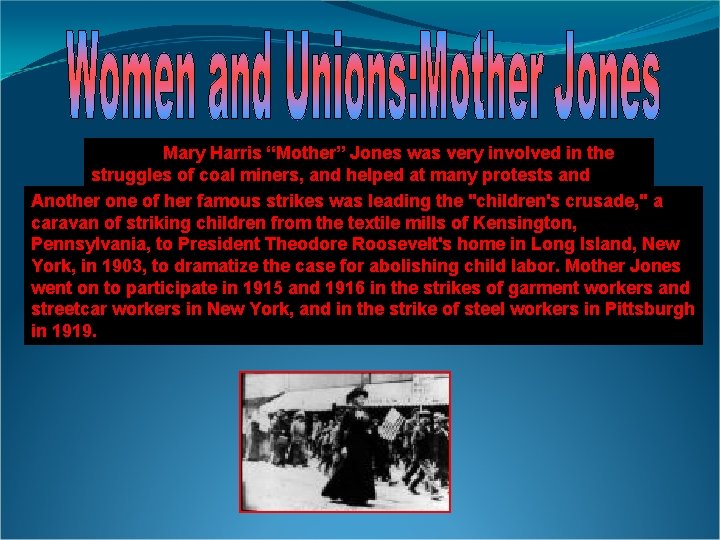
Mary Harris “Mother” Jones was very involved in the struggles of coal miners, and helped at many protests and was a very persuasive speaker, and she had a fiery a Anotherstrikes. one of. She her famous strikes was leading the "children's crusade, " One of her best-known was leading a caravanpersonality. of striking children from the textile activities mills of Kensington, march of wives "who routed strikebreakers with brooms Pennsylvania, tominers' President Theodore Roosevelt's home in Long Island, New mops in the Pennsylvania coalfields in 1902. " York, inand 1903, to dramatize the case for abolishing child labor. Mother Jones went on to participate in 1915 and 1916 in the strikes of garment workers and streetcar workers in New York, and in the strike of steel workers in Pittsburgh in 1919.
The International Ladies Garment Workers Union was one of the most important and progressive unions in the 1930’s. It was also once one of the largest Labor Unions of the United States, and it also contained mostly female members. In 1909, 20, 000 New York shirtwaist makers, mostly women, launched a fourteen-week strike, called “The Uprising, ” followed several months later by a strike of 60, 000 cloak makers. In the negotiations that followed, the ILGWU was recognized by the industry and won higher wages as well as important new benefits for its members, such as health examinations.
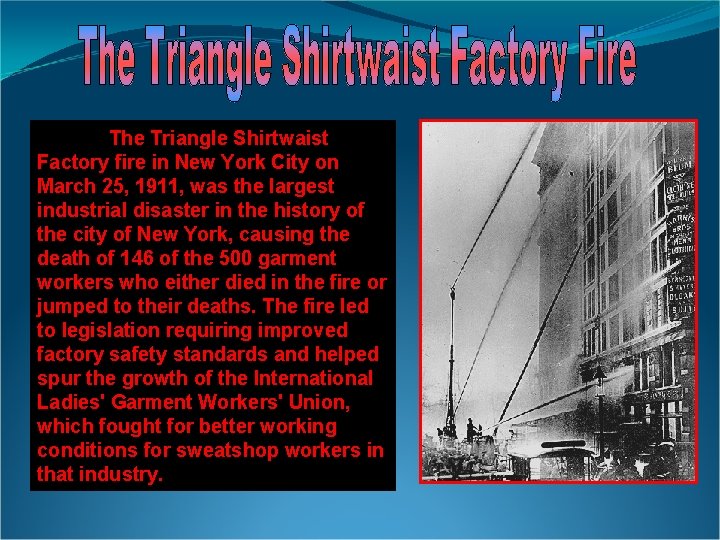
The Triangle Shirtwaist Factory fire in New York City on March 25, 1911, was the largest industrial disaster in the history of the city of New York, causing the death of 146 of the 500 garment workers who either died in the fire or jumped to their deaths. The fire led to legislation requiring improved factory safety standards and helped spur the growth of the International Ladies' Garment Workers' Union, which fought for better working conditions for sweatshop workers in that industry.
Many strikes took place when Unions responded to low wages and fired employees. Many of these strikes ended in violence. Many of the companies hired strikebreakers to replace the striking workers. During a strike, if violence occurred, the federal troops would restore order.
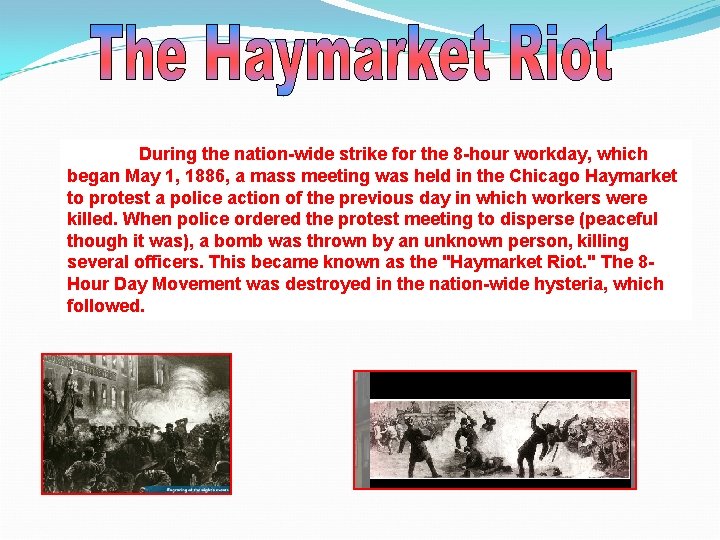
During the nation-wide strike for the 8 -hour workday, which began May 1, 1886, a mass meeting was held in the Chicago Haymarket to protest a police action of the previous day in which workers were killed. When police ordered the protest meeting to disperse (peaceful though it was), a bomb was thrown by an unknown person, killing several officers. This became known as the "Haymarket Riot. " The 8 Hour Day Movement was destroyed in the nation-wide hysteria, which followed.
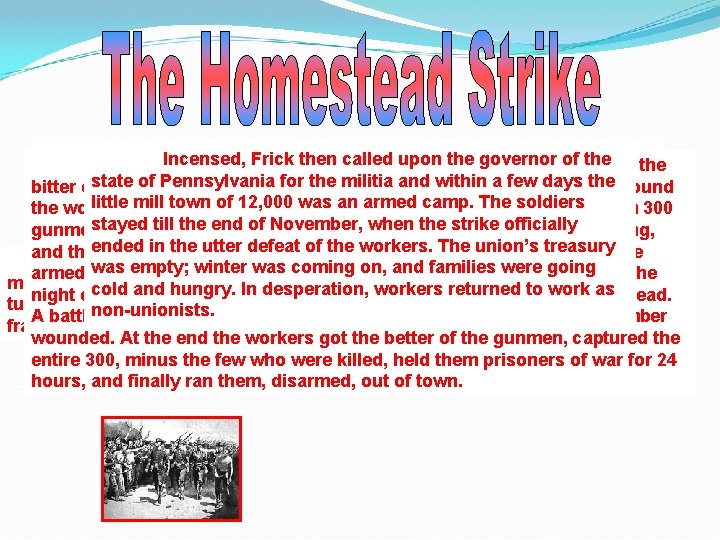
In 1892 Incensed, there burst outthen the fury of the so-called Homestead Frick called governor of war the to the Frick immediately indicated by his upon actionthe that he meant strike, state whichofwas really a lockout, involving onwithin the one hand the iron Pennsylvania for thethree militia and a few days bitter end. He erected a wire fence miles long and 15 feet high around and steel workers, who, with a was membership ofcamp. nearly. The 25, 000, were one of littleand millcalled town of 12, 000 an armed soldiers the works upon the Pinkerton Detective Agency to send him 300 the strongest unions in the country, and on the other Carnegie Steel stayed till the end of November, the. Pinkertons strikethe officially gunmen. The locked-out workers heard when that the were coming, Company. Three years previously the union had been recognized by the ended in the of They the workers. The union’s treasury and they watched forutter theirdefeat arrival. knew that the gunmen would be Before that occurred, however, Carnegie, already famous company; indeed, had entered with it. Andrew into a three-year contract, at the as a was prepared empty; winter was coming on, them and families were going armed and themselves to meet on their own terms. On the major prophet of American ‘democracy’, anticipating violence, had hurriedly expiration of which Carnegie wanted the men to take a reduction of In desperation, workers returned to work as night ofcold Julyand 5 th , hungry. a boatload of Pinkertons attempted to land in Homestead. st turned the command to the company’s superintendent, Henrythey C Frick, a wages. The union over declined these terms and on July 1 , before A battlenon-unionists. followed, in which 10 men were killed and three times that number frank and declare brutal union-hater, departed Europe. locked out. could a strike, theand workers werefor suddenly wounded. At the end the workers got the better of the gunmen, captured the entire 300, minus the few who were killed, held them prisoners of war for 24 hours, and finally ran them, disarmed, out of town.
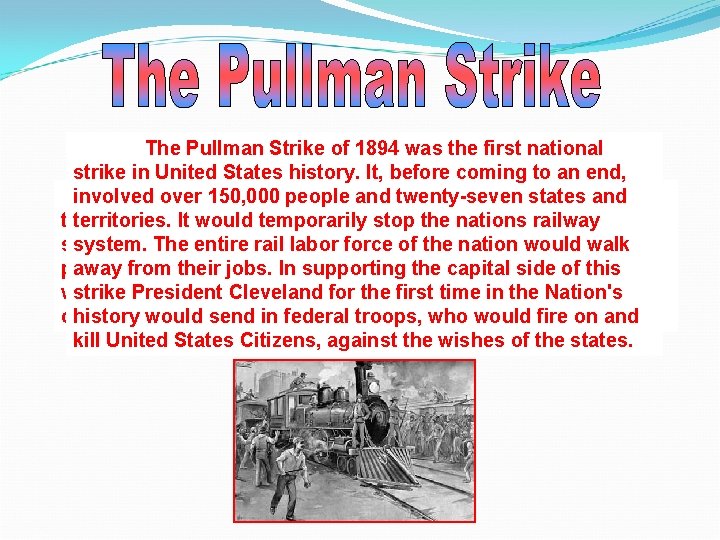
The Pullman Strike of 1894 was the first national strike in United States history. It, before coming to an end, involved 150, 000 and states and Theover problem thatpeople caused thetwenty-seven Pullman Strike arose after territories. would temporarily stopofthe nations railway the panic of It 1893, when the workers Pullman received system. The cuts entire railon labor of the nation would walk several wage that the force average added up to twenty-five away from their jobs. In supporting the capital of added this percent. These cuts were bad in themselves, butside when strike President Cleveland the firstthe time in the with Pullman's actions of notfor lowering rents for. Nation's company historyhomes wouldinsend in federal troops, whoto would owned Pullman, the labor began unite. fire on and kill United States Citizens, against the wishes of the states.
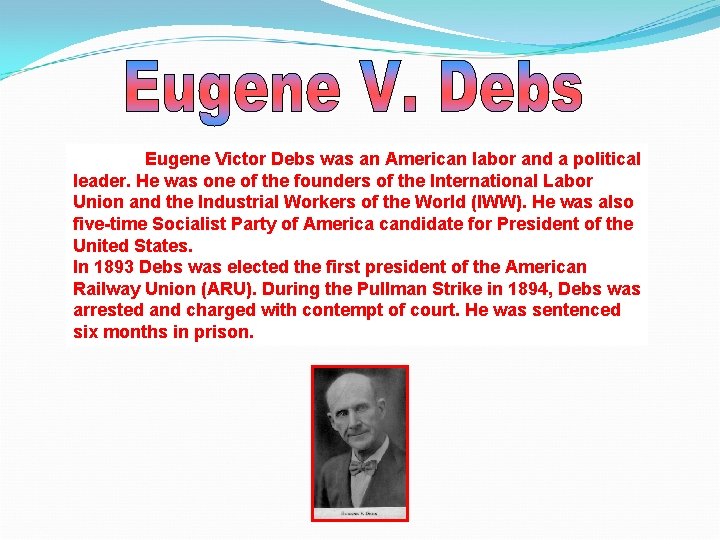
Eugene Victor Debs was an American labor and a political leader. He was one of the founders of the International Labor Union and the Industrial Workers of the World (IWW). He was also five-time Socialist Party of America candidate for President of the United States. In 1893 Debs was elected the first president of the American Railway Union (ARU). During the Pullman Strike in 1894, Debs was arrested and charged with contempt of court. He was sentenced six months in prison.