
LIFE SPAN DEVELOPMENT JEAN PIAGET COGNITIVE DEVELOPMENTAL THEORY
- Slides: 22
LIFE SPAN DEVELOPMENT JEAN PIAGET COGNITIVE DEVELOPMENTAL THEORY KOHLBERG’S THEORY OF MORAL DEVELOPMENT ERIKSONS PSYCHOSOCIAL DEVELOPMENT
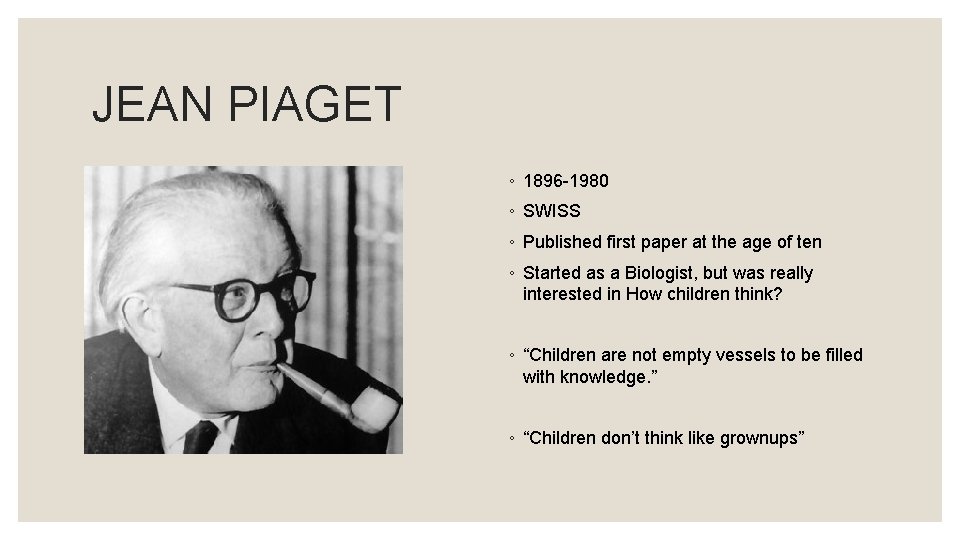
JEAN PIAGET ◦ 1896 -1980 ◦ SWISS ◦ Published first paper at the age of ten ◦ Started as a Biologist, but was really interested in How children think? ◦ “Children are not empty vessels to be filled with knowledge. ” ◦ “Children don’t think like grownups”
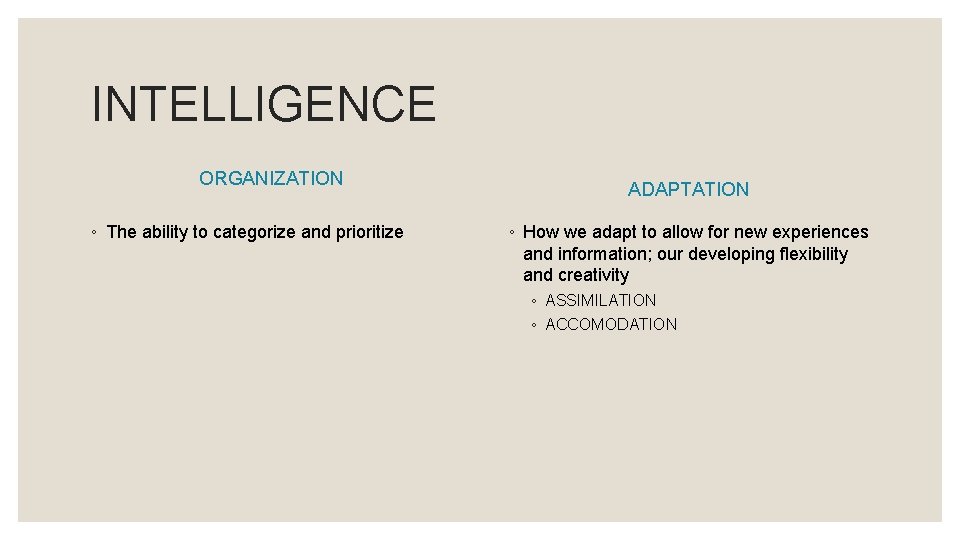
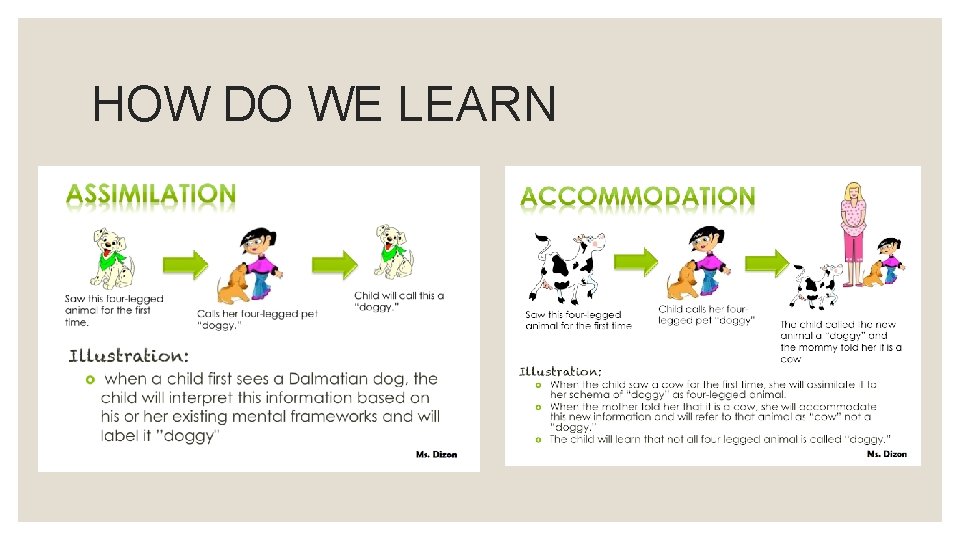
INTELLIGENCE ORGANIZATION ◦ The ability to categorize and prioritize ADAPTATION ◦ How we adapt to allow for new experiences and information; our developing flexibility and creativity ◦ ASSIMILATION ◦ ACCOMODATION
HOW DO WE LEARN
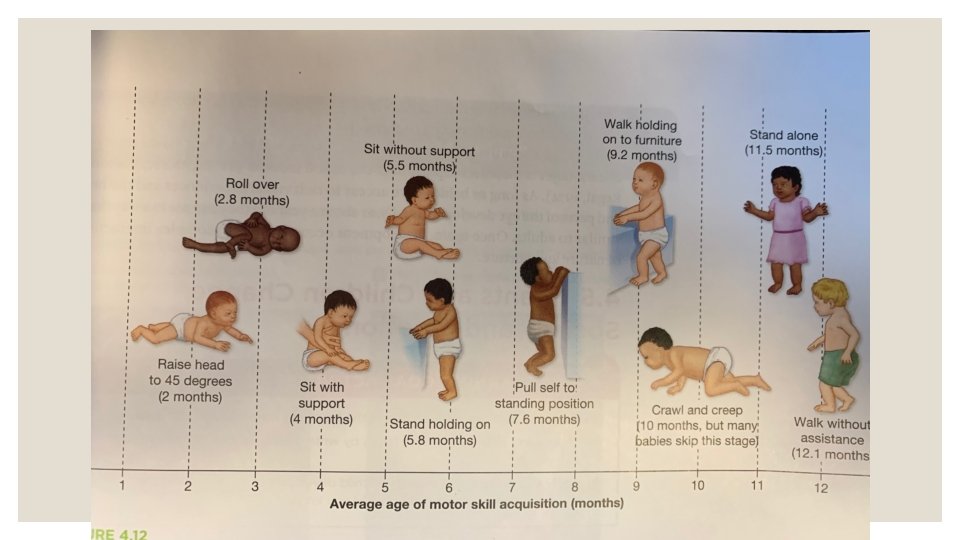
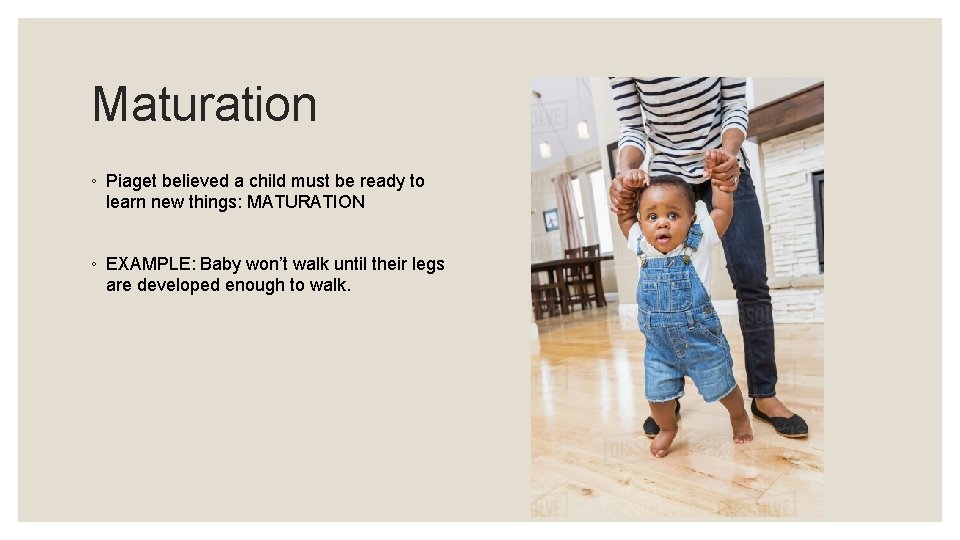
Maturation ◦ Piaget believed a child must be ready to learn new things: MATURATION ◦ EXAMPLE: Baby won’t walk until their legs are developed enough to walk.
STAGES OF COGNITIVE DEVELOPMENT ◦ Stage 1: Sensorimotor ◦ Stage 2: Preoperational ◦ Stage 3: Concrete Operational ◦ Stage 4: Formal Operational
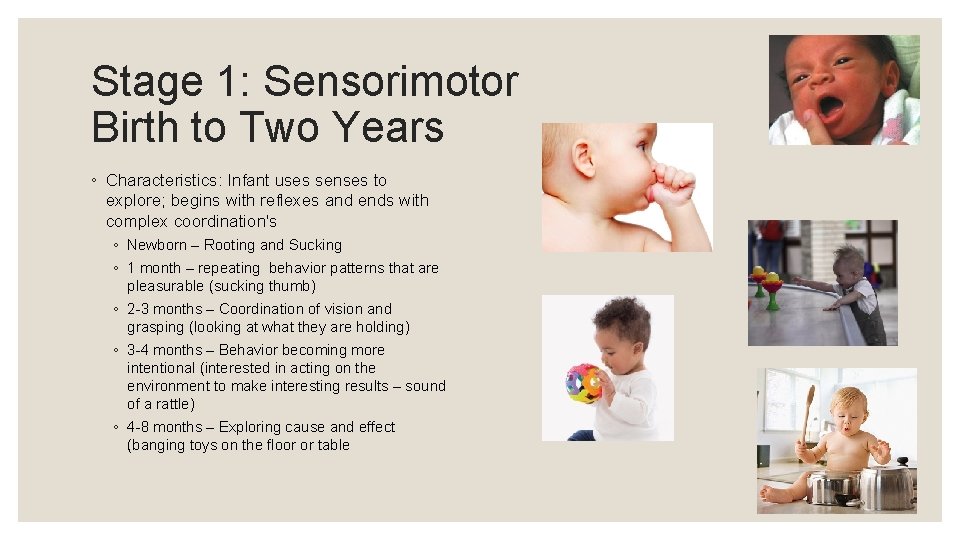
Stage 1: Sensorimotor Birth to Two Years ◦ Characteristics: Infant uses senses to explore; begins with reflexes and ends with complex coordination's ◦ Newborn – Rooting and Sucking ◦ 1 month – repeating behavior patterns that are pleasurable (sucking thumb) ◦ 2 -3 months – Coordination of vision and grasping (looking at what they are holding) ◦ 3 -4 months – Behavior becoming more intentional (interested in acting on the environment to make interesting results – sound of a rattle) ◦ 4 -8 months – Exploring cause and effect (banging toys on the floor or table
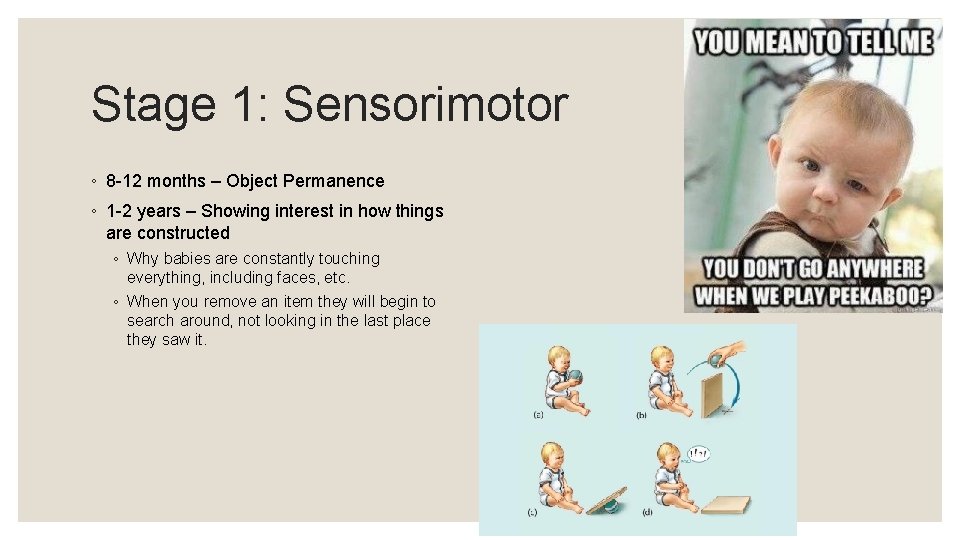
Stage 1: Sensorimotor ◦ 8 -12 months – Object Permanence ◦ 1 -2 years – Showing interest in how things are constructed ◦ Why babies are constantly touching everything, including faces, etc. ◦ When you remove an item they will begin to search around, not looking in the last place they saw it.
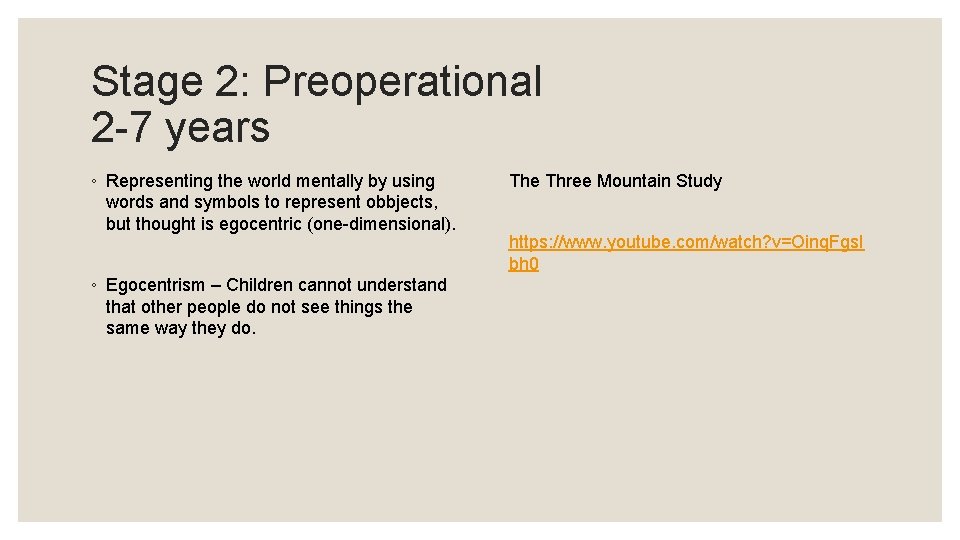
Stage 2: Preoperational 2 -7 years ◦ Representing the world mentally by using words and symbols to represent obbjects, but thought is egocentric (one-dimensional). ◦ Egocentrism – Children cannot understand that other people do not see things the same way they do. The Three Mountain Study https: //www. youtube. com/watch? v=Oinq. Fgs. I bh 0
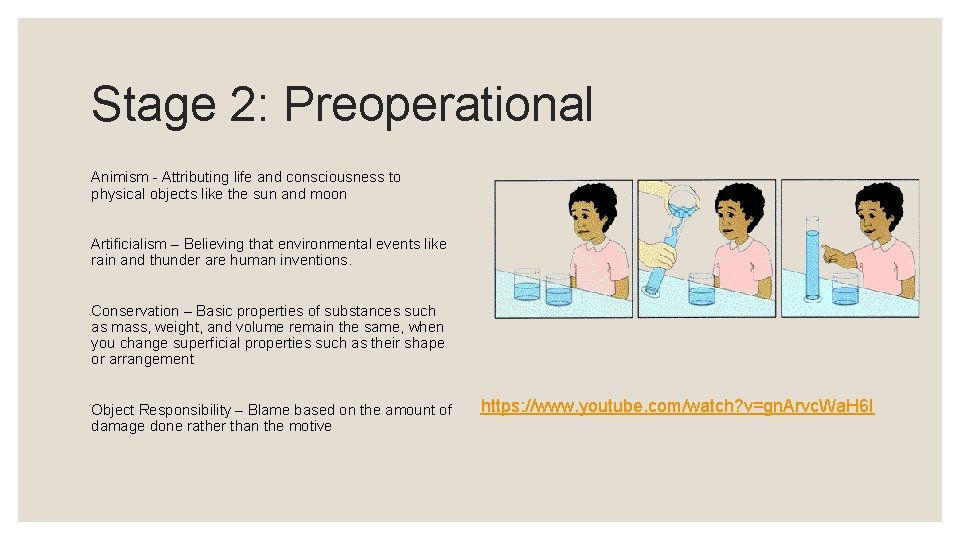
Stage 2: Preoperational Animism - Attributing life and consciousness to physical objects like the sun and moon Artificialism – Believing that environmental events like rain and thunder are human inventions. Conservation – Basic properties of substances such as mass, weight, and volume remain the same, when you change superficial properties such as their shape or arrangement Object Responsibility – Blame based on the amount of damage done rather than the motive https: //www. youtube. com/watch? v=gn. Arvc. Wa. H 6 I
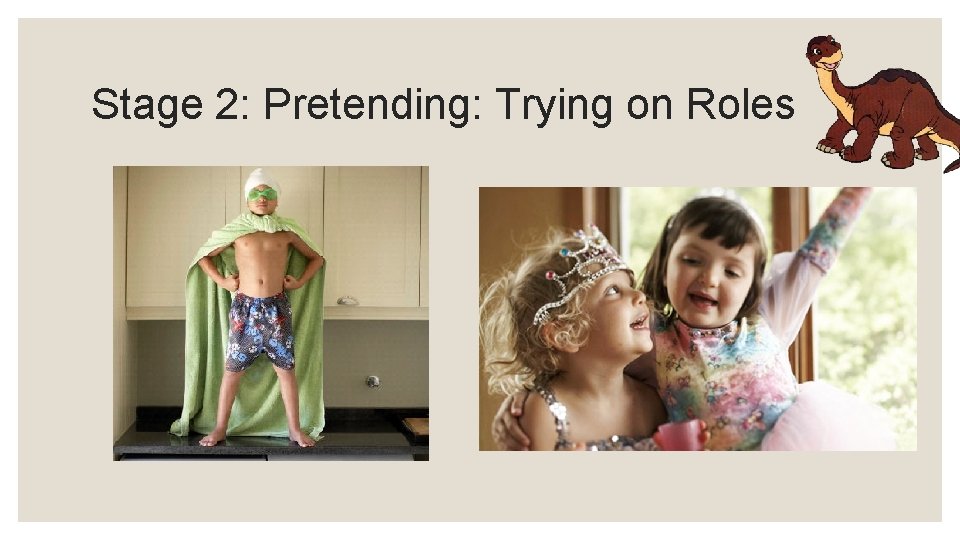
Stage 2: Pretending: Trying on Roles
Preoperational Play ◦ Involves pretending and imagination ◦ Slowly expands our understanding of ourselves and others as we involve ourselves more and more in group play ◦ House: “you be the mommy and I’ll be the daddy…” ◦ More exploration of the physical world: climbing, jumping, swinging…
Stage 3: Concrete Operational 7 -12 years ◦ Characteristics: Child understands and applies logical operations. Typically involving tangible objects and not abstract ideas. ◦ Skills: ◦ Conservation ◦ Decentration - Focusing on more than one dimension of a problem, so that flexible, reversible thought becomes possible. (Moral judgement) ◦ Reversibility – Recognition that processes can be undone, that things can be made as they were.
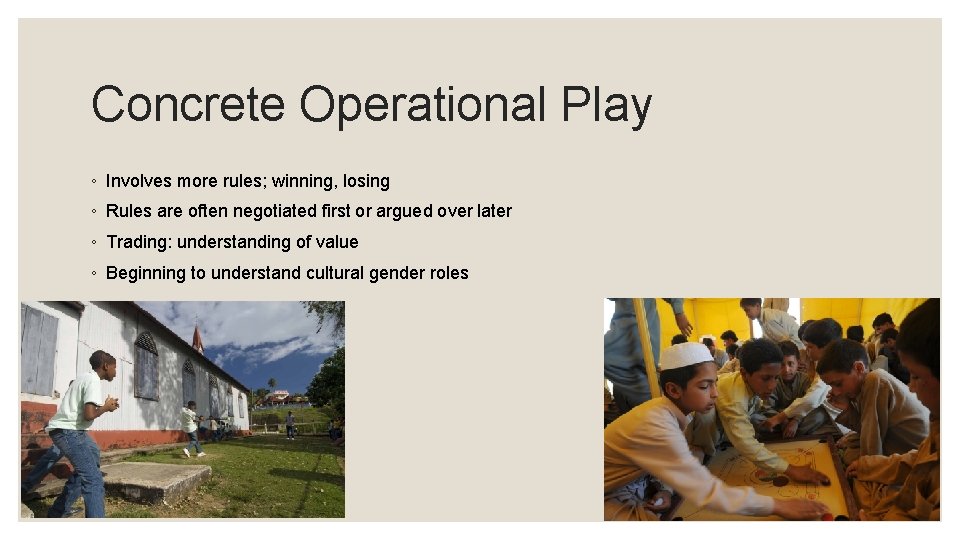
Concrete Operational Play ◦ Involves more rules; winning, losing ◦ Rules are often negotiated first or argued over later ◦ Trading: understanding of value ◦ Beginning to understand cultural gender roles
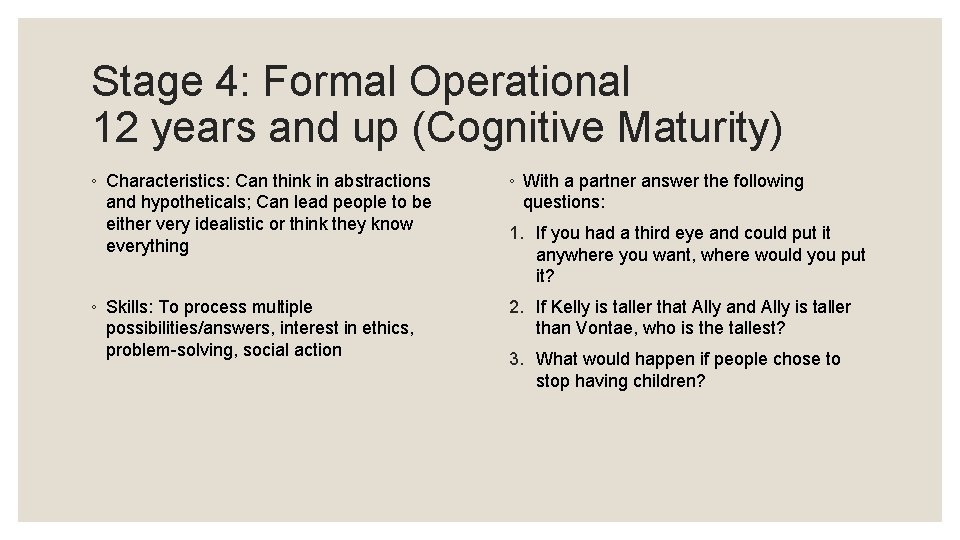
Stage 4: Formal Operational 12 years and up (Cognitive Maturity) ◦ Characteristics: Can think in abstractions and hypotheticals; Can lead people to be either very idealistic or think they know everything ◦ With a partner answer the following questions: ◦ Skills: To process multiple possibilities/answers, interest in ethics, problem-solving, social action 2. If Kelly is taller that Ally and Ally is taller than Vontae, who is the tallest? 1. If you had a third eye and could put it anywhere you want, where would you put it? 3. What would happen if people chose to stop having children?
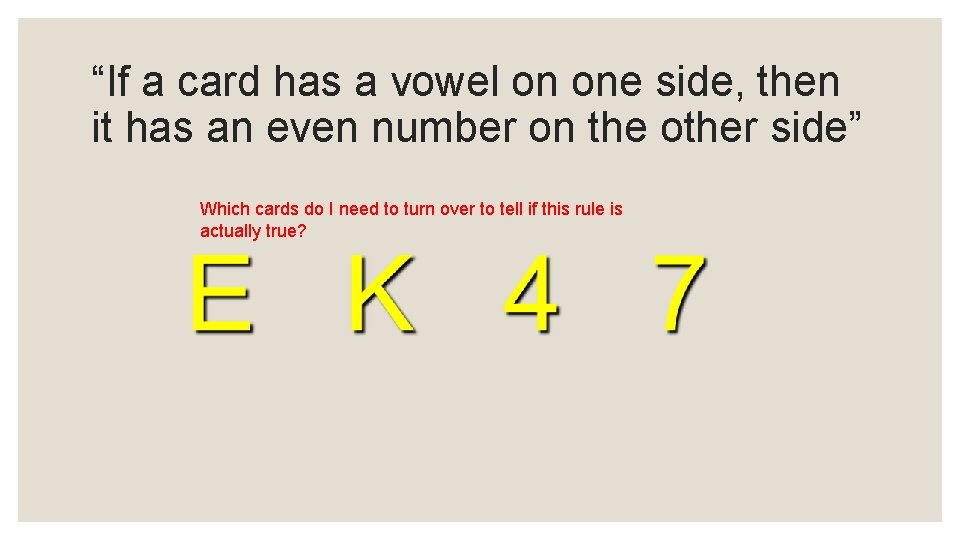
“If a card has a vowel on one side, then it has an even number on the other side” Which cards do I need to turn over to tell if this rule is actually true?
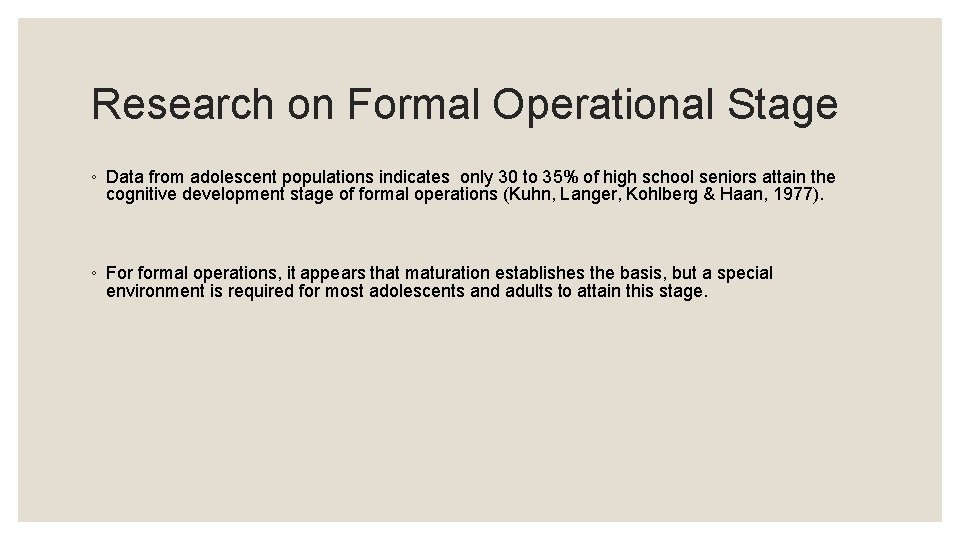
Research on Formal Operational Stage ◦ Data from adolescent populations indicates only 30 to 35% of high school seniors attain the cognitive development stage of formal operations (Kuhn, Langer, Kohlberg & Haan, 1977). ◦ For formal operations, it appears that maturation establishes the basis, but a special environment is required for most adolescents and adults to attain this stage.
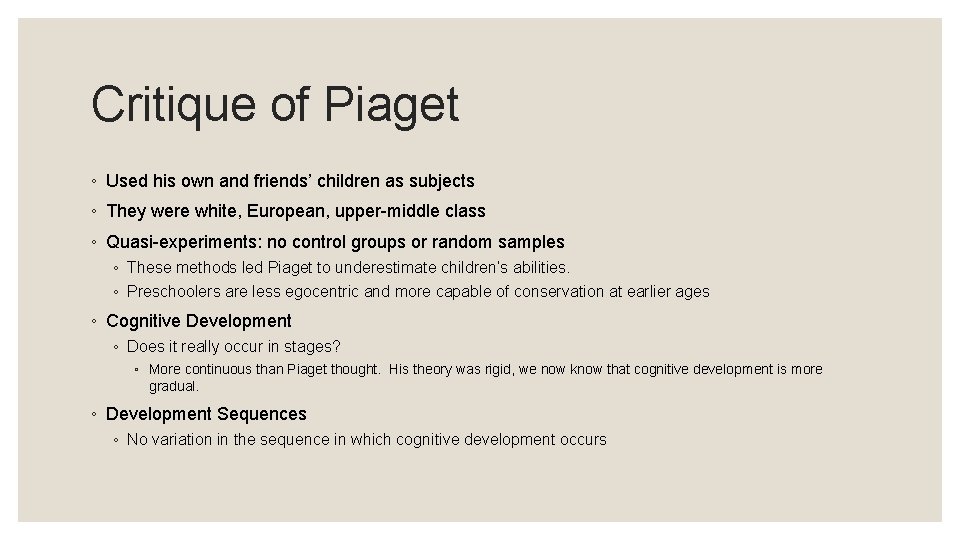
Critique of Piaget ◦ Used his own and friends’ children as subjects ◦ They were white, European, upper-middle class ◦ Quasi-experiments: no control groups or random samples ◦ These methods led Piaget to underestimate children’s abilities. ◦ Preschoolers are less egocentric and more capable of conservation at earlier ages ◦ Cognitive Development ◦ Does it really occur in stages? ◦ More continuous than Piaget thought. His theory was rigid, we now know that cognitive development is more gradual. ◦ Development Sequences ◦ No variation in the sequence in which cognitive development occurs
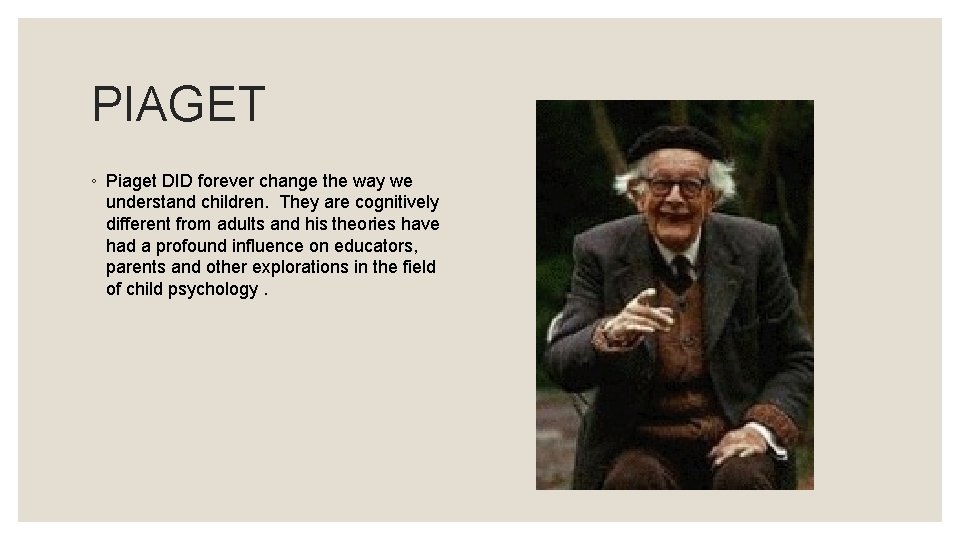
PIAGET ◦ Piaget DID forever change the way we understand children. They are cognitively different from adults and his theories have had a profound influence on educators, parents and other explorations in the field of child psychology.
Role of Adults in Child Development ◦ Don’t be fooled! The emphasis on maturation does not mean that adults are not vital. ◦ Adults need to provide wonderful, rich, exciting opportunities for children to play and explore and grow and learn. But they should be age appropriate! ◦ If we push children to do activities that are beyond their maturity, not only is it a waste of time, but they will miss the fun, beauty, excitement of all the activities that are appropriate for their natural growth