
LIFE SCIENCES GRADE 12 CAPS STRUCTURED CLEAR PRACTICAL
- Slides: 98
LIFE SCIENCES GRADE 12 CAPS STRUCTURED, CLEAR, PRACTICAL - HELPING TEACHERS UNLOCK THE POWER OF NCS KNOWLEDGE AREA: Environmental Studies TOPIC 5: Human Impact on the Environment The Atmosphere and Climate Change
SUMMARY OF PRESENTATION Introduction Greenhouse Effect Reasons for the increase in GHG Emissions Sectors that Produce the most GHGs Effects of Global Warming SA and its Efforts in controlling Global Warming
INTRODUCTION � The atmosphere as you know is a mixture of gases. � Among these gases of the atmosphere are those that bring about the greenhouse effect. � These gases are… water vapour carbon dioxide methane nitrous oxide ozone � These greenhouse gases are responsible for the greenhouse effect, which leads to an increase in the average temperature.
TERMINOLOGY: TERM: GHG DEFINITION: USE IN SENTENCE: Greenhouse gases Methane and nitrous oxide are also examples of GHG’s
INTRODUCTION � This increase in the average global temperature is called. global warming � Global warming leads to climate change. � Before we look at climate change we must understand the word climate. �Climate refers to the long term prevalent weather conditions of an area. � Climate change is the ongoing change of the earth’s weather patterns. � Climate change is usually a very slow process. � It occurs over tens of thousands and sometimes millions of years.
INTRODUCTION: � This gives the organisms enough time to adapt to the new climate. � Currently climate change is occurring very quickly. � Therefore organisms do not have enough time to adapt to the change in climate.
TERMINOLOGY: TERM: Global Warming DEFINITION: USE IN SENTENCE: Refers to an increase in The enhanced greenhouse average global temperature. effect leads to global warming.
TERMINOLOGY: TERM: Climate DEFINITION: USE IN SENTENCE: refers to the long term prevalent weather conditions of an area South Africa has a warm and sunny climate compared to the UK which has a wet climate
INTRODUCTION Evidence for rapid climate change: 1. Average global temperature has increased. The hottest temperatures were recorded in the last decade. 2. The average global sea level has risen. 3. Average annual rainfall patterns have changed. Some areas becoming drier, while others becoming wetter. 4. Most land areas experience very heavy rainfall and extreme weather events. 5. Tropics and subtropics experience more intense and longer periods of drought.
INTRODUCTION � Recent events have shown that human activities are the single greatest reason for global warming and climate change.
GREENHOUSE EFFECT What is the Green House Effect? �A Swedish scientist called Svante Arrhenius first used the term greenhouse effect in 1896. � He compared the earth’s atmosphere to the glass of the greenhouse. Lets look at how the greenhouse effect works…
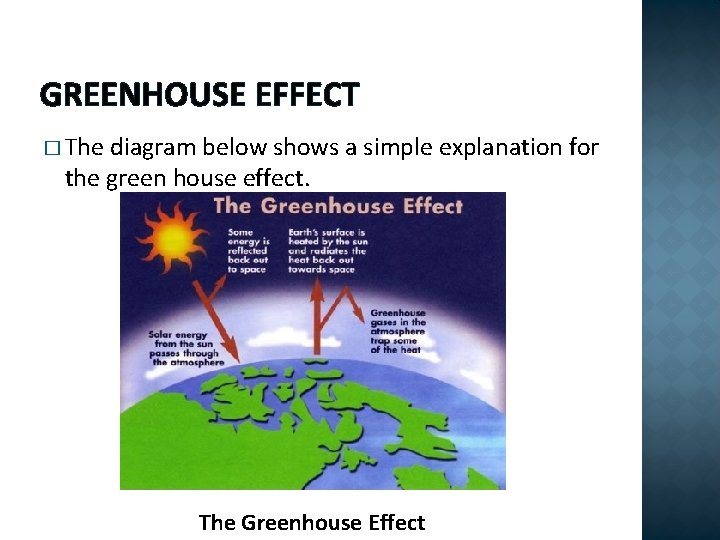
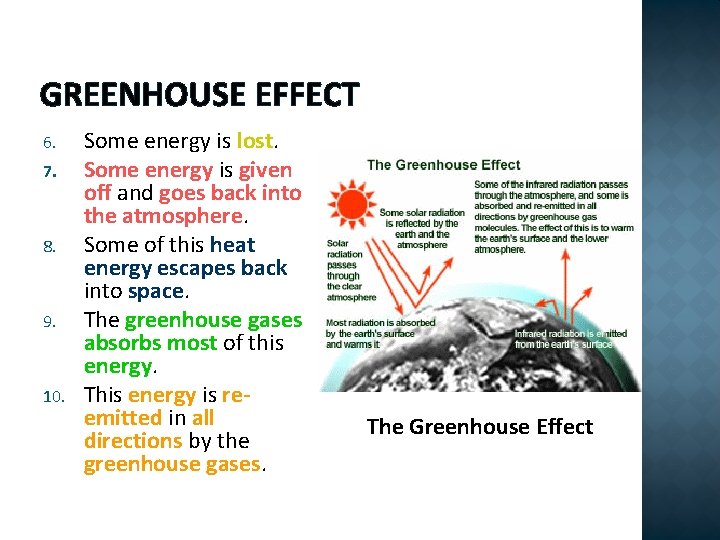
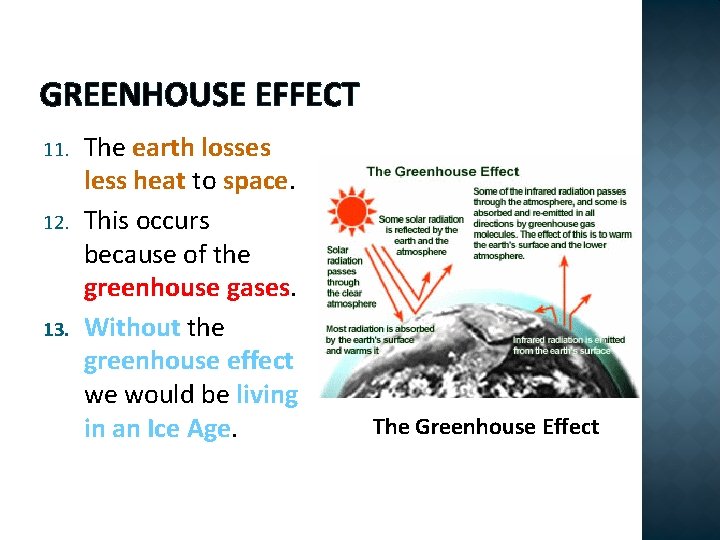
GREENHOUSE EFFECT � The diagram below shows a simple explanation for the green house effect. The Greenhouse Effect
GREENHOUSE EFFECT � The greenhouse effect is a natural phenomena. � It is very important because it keeps the earth warm. It occurs in the following way… 1. The short wavelength of the sun’s rays reaches the earth’s surface. 2. These short wavelengths have a lot of energy. 3. Most of the heat is absorbed by the earth’s surface. 4. This keeps the earth warm. 5. But not all the energy that reaches the earth’s surface is absorbed.
GREENHOUSE EFFECT 6. 7. 8. 9. 10. Some energy is lost. Some energy is given off and goes back into the atmosphere. Some of this heat energy escapes back into space. The greenhouse gases absorbs most of this energy. This energy is reemitted in all directions by the greenhouse gases. The Greenhouse Effect
GREENHOUSE EFFECT 11. 12. 13. The earth losses less heat to space. This occurs because of the greenhouse gases. Without the greenhouse effect we would be living in an Ice Age. The Greenhouse Effect
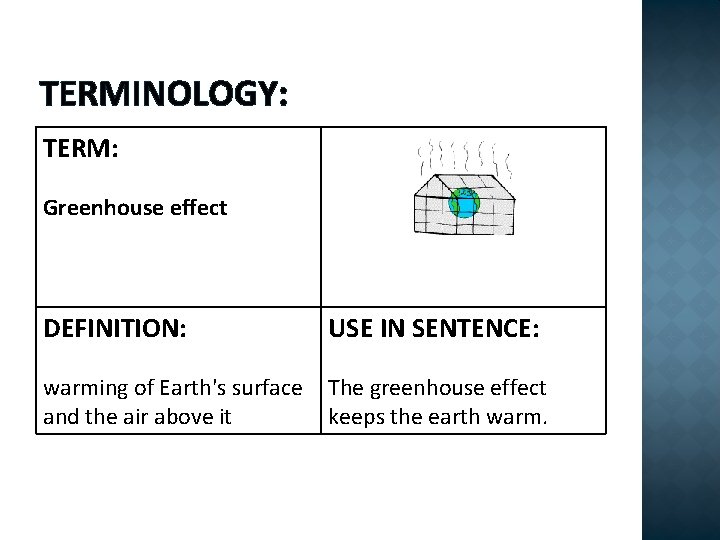
TERMINOLOGY: TERM: Greenhouse effect DEFINITION: USE IN SENTENCE: warming of Earth's surface and the air above it The greenhouse effect keeps the earth warm.
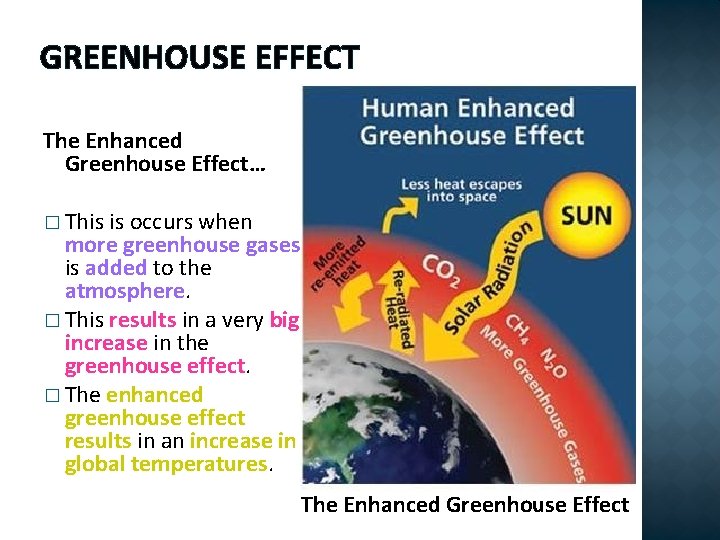
GREENHOUSE EFFECT The Enhanced Greenhouse Effect… � This is occurs when more greenhouse gases is added to the atmosphere. � This results in a very big increase in the greenhouse effect. � The enhanced greenhouse effect results in an increase in global temperatures. The Enhanced Greenhouse Effect
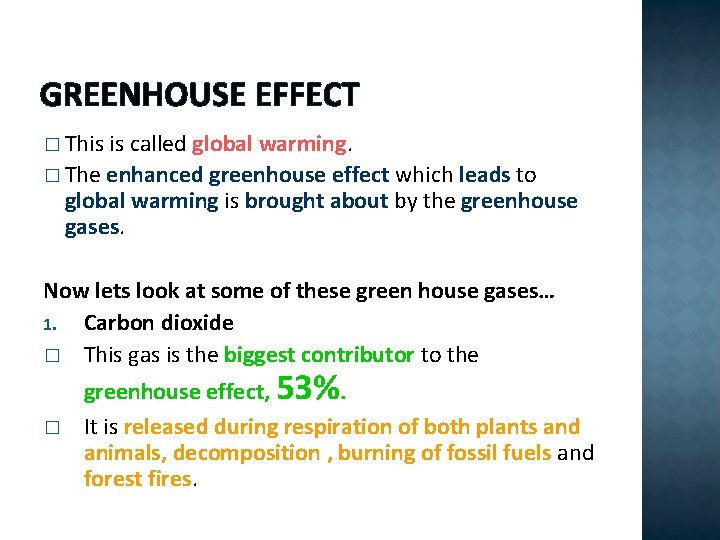
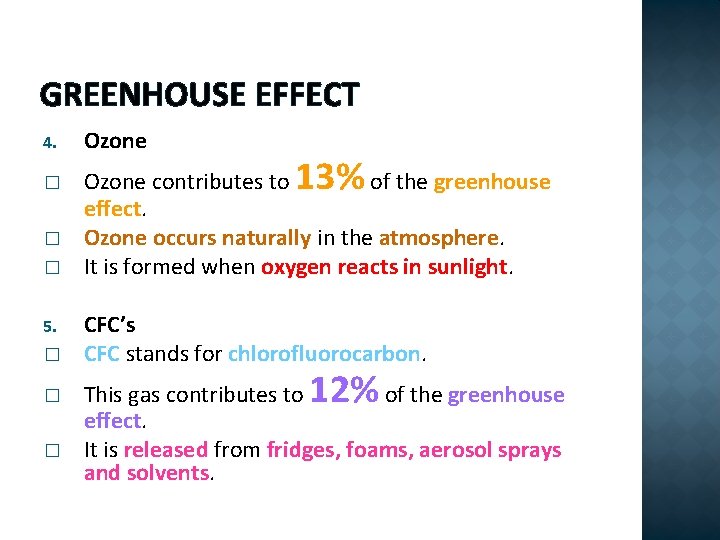
GREENHOUSE EFFECT � This is called global warming. � The enhanced greenhouse effect which leads to global warming is brought about by the greenhouse gases. Now lets look at some of these green house gases… 1. Carbon dioxide � This gas is the biggest contributor to the � greenhouse effect, 53%. It is released during respiration of both plants and animals, decomposition , burning of fossil fuels and forest fires.
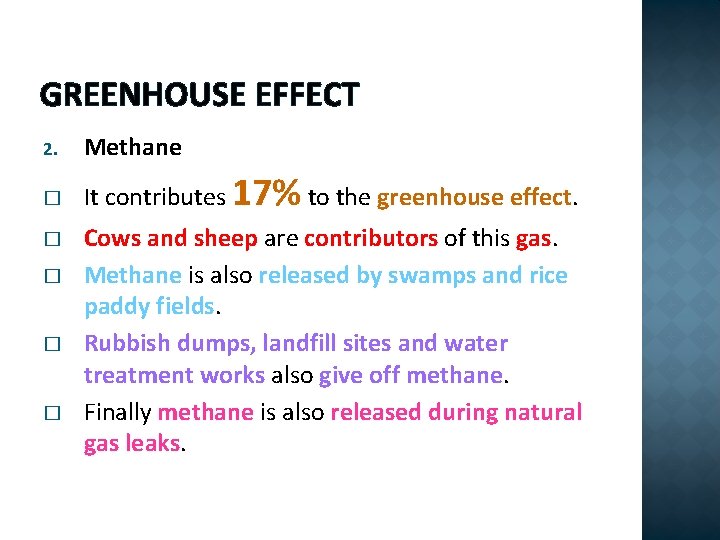
GREENHOUSE EFFECT 2. Methane � It contributes 17% to the greenhouse effect. � � Cows and sheep are contributors of this gas. Methane is also released by swamps and rice paddy fields. Rubbish dumps, landfill sites and water treatment works also give off methane. Finally methane is also released during natural gas leaks.
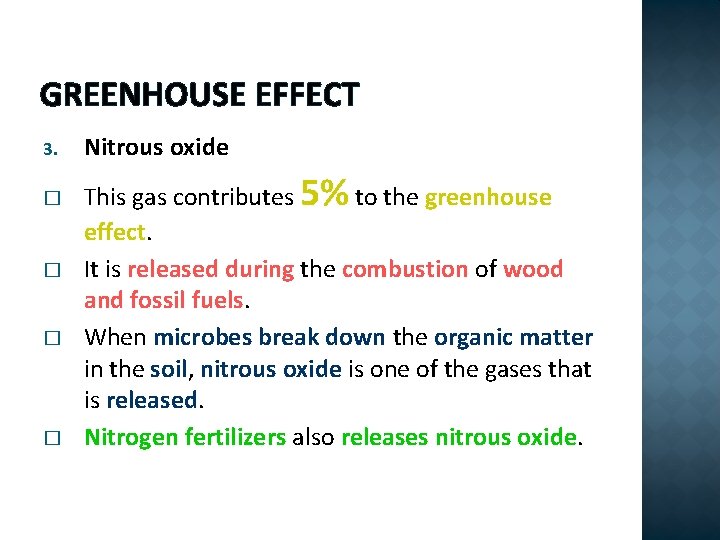
GREENHOUSE EFFECT 3. � � Nitrous oxide This gas contributes 5% to the greenhouse effect. It is released during the combustion of wood and fossil fuels. When microbes break down the organic matter in the soil, nitrous oxide is one of the gases that is released. Nitrogen fertilizers also releases nitrous oxide.
GREENHOUSE EFFECT 4. Ozone � Ozone contributes to of the greenhouse effect. Ozone occurs naturally in the atmosphere. It is formed when oxygen reacts in sunlight. � � 5. � � � 13% CFC’s CFC stands for chlorofluorocarbon. 12% This gas contributes to of the greenhouse effect. It is released from fridges, foams, aerosol sprays and solvents.
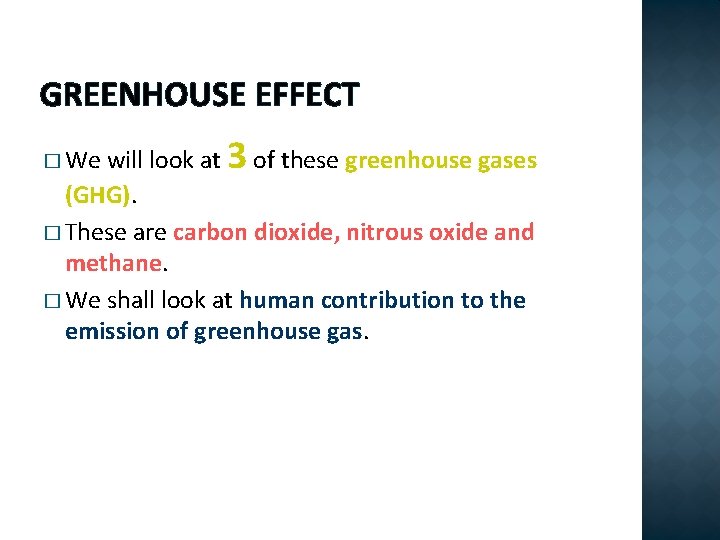
GREENHOUSE EFFECT will look at 3 of these greenhouse gases (GHG). � These are carbon dioxide, nitrous oxide and methane. � We shall look at human contribution to the emission of greenhouse gas. � We
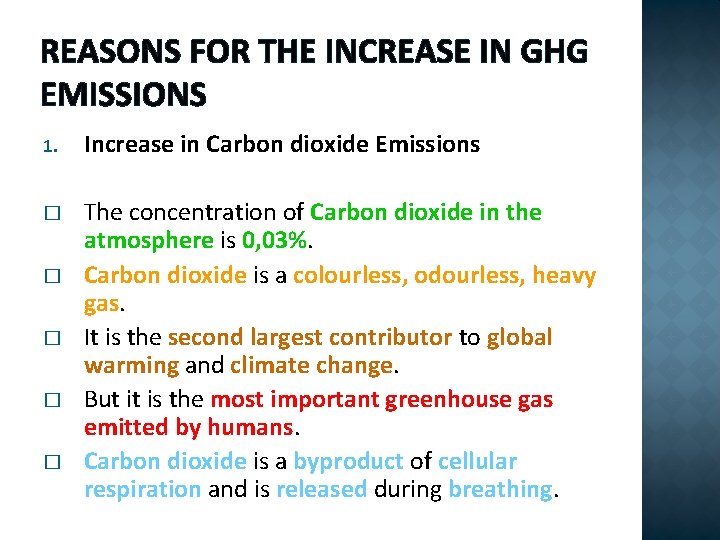
REASONS FOR THE INCREASE IN GHG EMISSIONS 1. Increase in Carbon dioxide Emissions � The concentration of Carbon dioxide in the atmosphere is 0, 03%. Carbon dioxide is a colourless, odourless, heavy gas. It is the second largest contributor to global warming and climate change. But it is the most important greenhouse gas emitted by humans. Carbon dioxide is a byproduct of cellular respiration and is released during breathing. � �
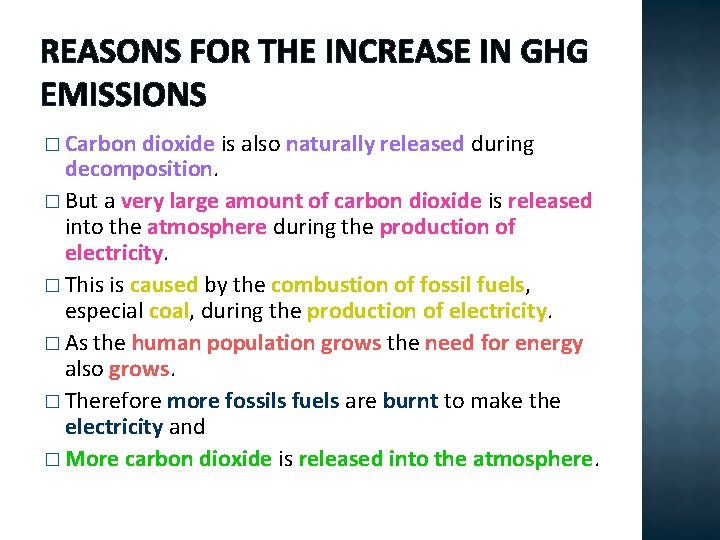
REASONS FOR THE INCREASE IN GHG EMISSIONS � Carbon dioxide is also naturally released during decomposition. � But a very large amount of carbon dioxide is released into the atmosphere during the production of electricity. � This is caused by the combustion of fossil fuels, especial coal, during the production of electricity. � As the human population grows the need for energy also grows. � Therefore more fossils fuels are burnt to make the electricity and � More carbon dioxide is released into the atmosphere.
REASONS FOR THE INCREASE IN GHG EMISSIONS � Large amounts of carbon dioxide is released into the atmosphere during transportation of people or goods. � When goods and people are transported carbon dioxide is released into the atmosphere during the combustion of petrol or diesel. � From this we can see that as the population increases more energy is required and more people have to be transported form place to place. � This drastically increases the carbon dioxide emissions into the atmosphere. � Therefore we can deduce that human activities are the greatest contributor of carbon dioxide emissions into the atmosphere.
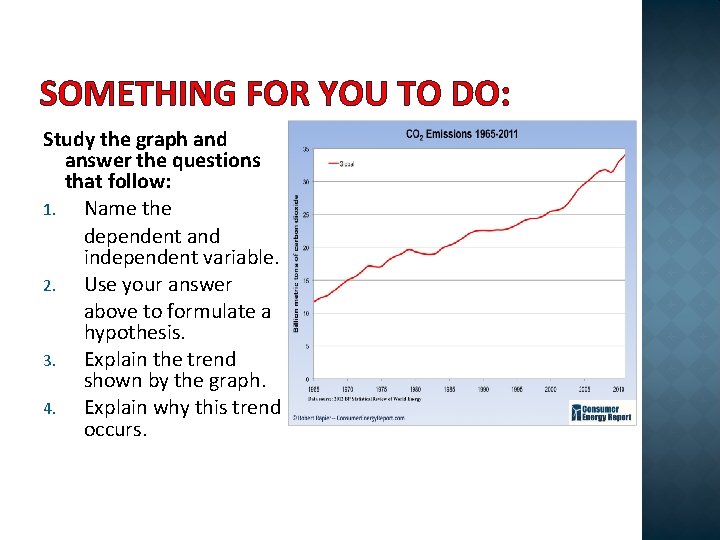
SOMETHING FOR YOU TO DO: Study the graph and answer the questions that follow: 1. Name the dependent and independent variable. 2. Use your answer above to formulate a hypothesis. 3. Explain the trend shown by the graph. 4. Explain why this trend occurs.
SOLUTION: 1. 2. 3. 4. Dependent variable: carbon dioxide emissions independent variable- time. The carbon dioxide emissions should increase over time Carbon dioxide emissions are continually increasing from 1995 to 2010. This occurs because the human population has increased. Therefore there is greater demand for energy and transport. Therefore the combustion of fossil fuels for gasoline and electricity leads to an increase in carbon dioxide concentration in the atmosphere.
REASONS FOR THE INCREASE IN GHG EMISSIONS Carbon Footprint: � Carbon footprint refers to the total amount of carbon dioxide released by a person, population or company. Humans release carbon dioxide into the atmosphere when… 1. Petrol or diesel is burnt as fuel to power their cars. 2. Fossil fuels like coal undergoes combustion to release energy which is used to create electricity. 3. Wood or coal is burnt. 4. Other fossil fuels like paraffin or gas is used.
REASONS FOR THE INCREASE IN GHG EMISSIONS � The activities mentioned in the previous slide releases a set amount of CO 2 into the atmosphere. � This emission factor is called its. � The emission factor can be used to calculate the amount of CO 2 released by a single person. � Therefore if the emission factor is high then the carbon footprint is heavy. � This means that your activities releases a high amount of CO 2 into the atmosphere. � Therefore your activities can do much damage to the environment. � If your emission factor is low then the carbon footprint is low.
TERMINOLOGY: TERM: Carbon footprint DEFINITION: USE IN SENTENCE: refers to the total amount of carbon dioxide released by a person, population or company. When fossil fuels are burned to released heat for our homes, our carbon footprint increases.
TERMINOLOGY: TERM: Emission factor DEFINITION: USE IN SENTENCE: Refers to the set amount of The emission factor of CO 2 released by a certain petrol is 2, 68 per liter, this activity. means that when 1 liter of petrol is burnt it releases 2. 68 units of CO 2 into the atmosphere.
TERMINOLOGY: TERM: Heavy carbon footprint DEFINITION: Occurs when a large quantity of CO 2 is released into the atmosphere as a result of one’s activities. USE IN SENTENCE: A heavy carbon footprint can cause massive environmental damage.
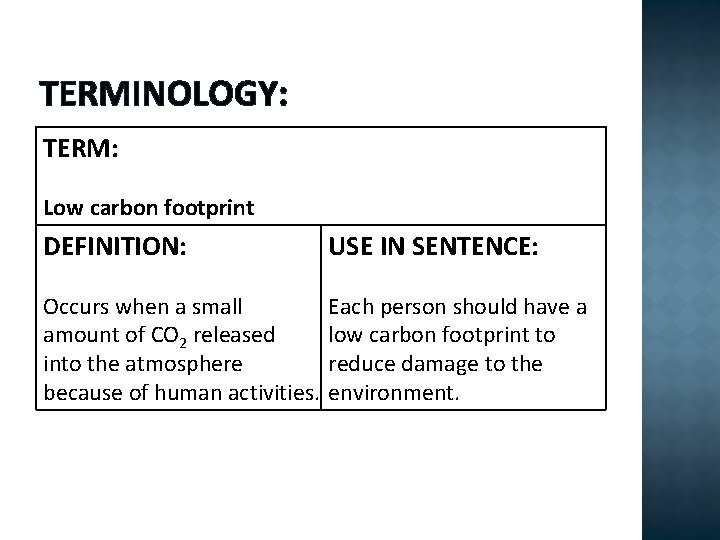
TERMINOLOGY: TERM: Low carbon footprint DEFINITION: USE IN SENTENCE: Occurs when a small amount of CO 2 released into the atmosphere because of human activities. Each person should have a low carbon footprint to reduce damage to the environment.
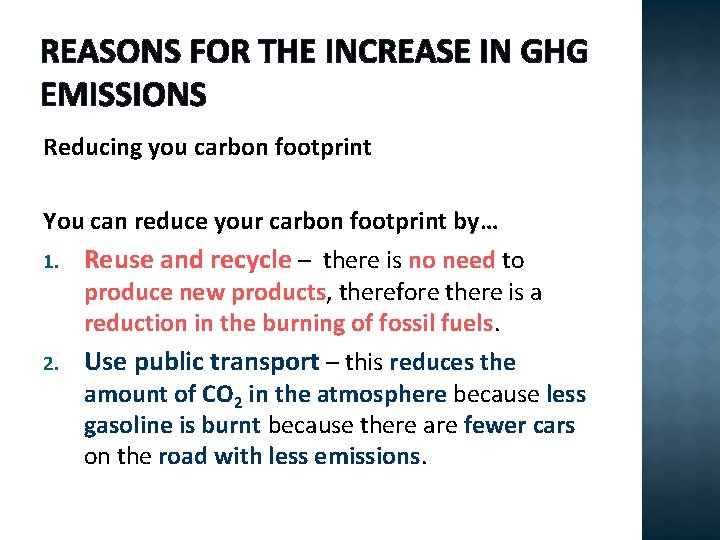
REASONS FOR THE INCREASE IN GHG EMISSIONS Reducing you carbon footprint You can reduce your carbon footprint by… 1. Reuse and recycle – there is no need to produce new products, therefore there is a reduction in the burning of fossil fuels. 2. Use public transport – this reduces the amount of CO 2 in the atmosphere because less gasoline is burnt because there are fewer cars on the road with less emissions.
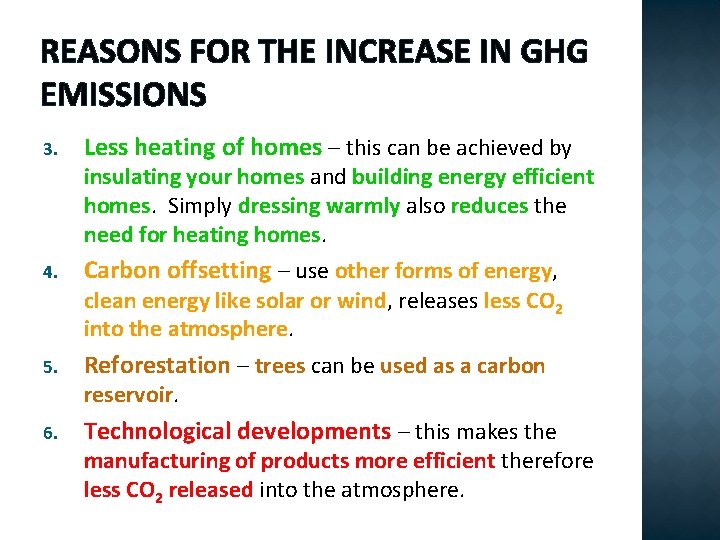
REASONS FOR THE INCREASE IN GHG EMISSIONS 3. Less heating of homes – this can be achieved by insulating your homes and building energy efficient homes. Simply dressing warmly also reduces the need for heating homes. 4. Carbon offsetting – use other forms of energy, clean energy like solar or wind, releases less CO 2 into the atmosphere. 5. Reforestation – trees can be used as a carbon reservoir. 6. Technological developments – this makes the manufacturing of products more efficient therefore less CO 2 released into the atmosphere.
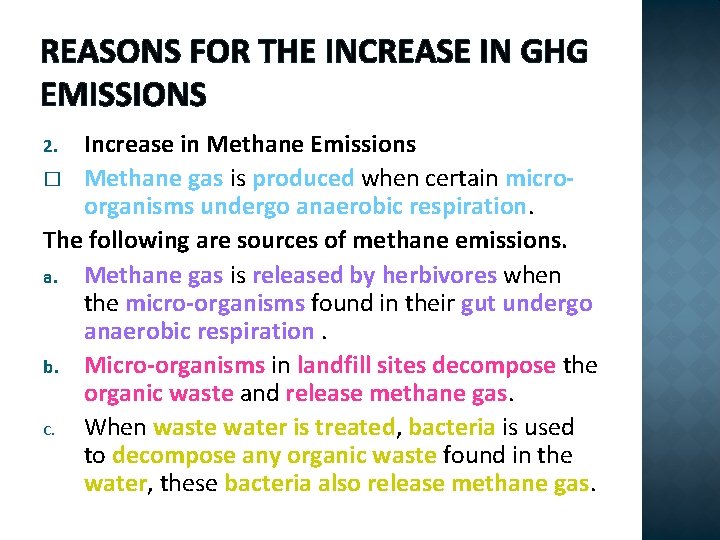
REASONS FOR THE INCREASE IN GHG EMISSIONS Increase in Methane Emissions � Methane gas is produced when certain microorganisms undergo anaerobic respiration. The following are sources of methane emissions. a. Methane gas is released by herbivores when the micro-organisms found in their gut undergo anaerobic respiration. b. Micro-organisms in landfill sites decompose the organic waste and release methane gas. c. When waste water is treated, bacteria is used to decompose any organic waste found in the water, these bacteria also release methane gas. 2.
REASONS FOR THE INCREASE IN GHG EMISSIONS d. e. f. � Methane gas is also released by mining activities. Ice contains methane in its crystal structure. When ice melts methane gas is released. Production, handling, transmission and combustion of fossil fuels releases methane gas. Methane gas has a much higher impact on global warming than CO 2.
REASONS FOR THE INCREASE IN GHG EMISSIONS 3. � � � 4. � � Increase in Nitrous Oxide Emissions Fertilizers contain nitrogen. These fertilizers release nitrous oxide into the atmosphere. Nitrous oxide has a greater heat trapping capacity than CO 2. Deforestation and Increase GHGs Deforestation refers to the process of changing land use from forestry to non-forest use, for example housing or mining. Forests are important because they have a large amount of trees, these trees use up the carbon dioxide for photosynthesis.
REASONS FOR THE INCREASE IN GHG EMISSIONS a) � � � Reasons for Deforestation: Trees are chopped down for fuel. Trees are chopped and are used to make wood and paper products. Trees are cleared to provide grazing land for farm animals like sheep and cows. Forests are cleared to built roads to transport people to and from the homes. Trees are cleared to make way for mining activities. Indigenous forest have been cleared to make way for agricultural crops or plantations that have a higher economic value like soya bean.
REASONS FOR THE INCREASE IN GHG EMISSIONS Ways in which deforestation leads to an increase in GHGs � Deforestation increases the levels of GHGs in 4 ways. These are… 1. Since there are fewer plants less CO 2 is absorbed by the plants for photosynthesis. 2. When trees are cleared for grazing land, the trees are replaced by the grazing animals. These animals release methane into the atmosphere. 3. Production of wood and paper products uses fossil fuels and releases CO 2. b)
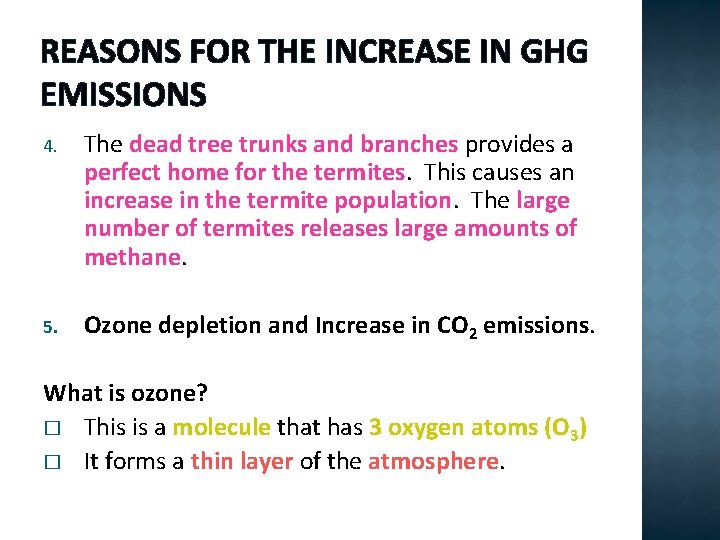
REASONS FOR THE INCREASE IN GHG EMISSIONS 4. The dead tree trunks and branches provides a perfect home for the termites. This causes an increase in the termite population. The large number of termites releases large amounts of methane. 5. Ozone depletion and Increase in CO 2 emissions. What is ozone? � This is a molecule that has 3 oxygen atoms (O 3) � It forms a thin layer of the atmosphere.
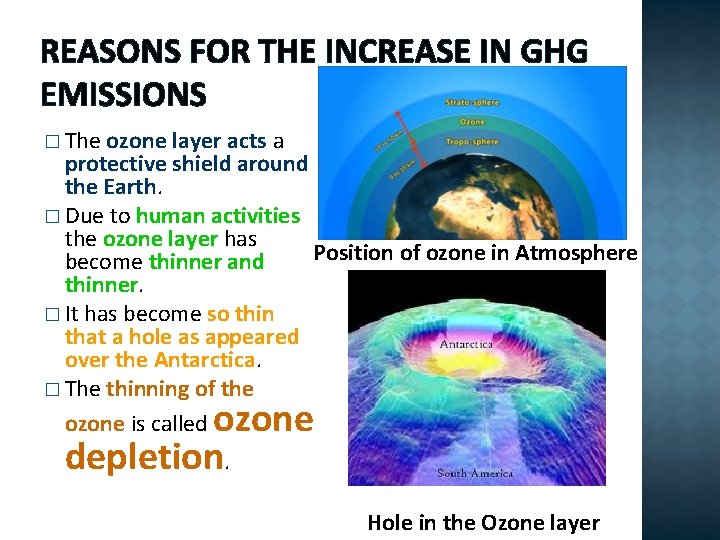
REASONS FOR THE INCREASE IN GHG EMISSIONS � The ozone layer acts a protective shield around the Earth. � Due to human activities the ozone layer has Position of ozone in Atmosphere become thinner and thinner. � It has become so thin that a hole as appeared over the Antarctica. � The thinning of the ozone is called ozone depletion. Hole in the Ozone layer
TERMINOLOGY: TERM: Deforestation DEFINITION: USE IN SENTENCE: refers to the process of changing land use from forestry to non-forest use, for example housing or mining. An example of deforestation is when forests are cleared away so that the land can be used for farming.
TERMINOLOGY: TERM: Ozone DEFINITION: USE IN SENTENCE: This is a molecule that has 3 oxygen atoms (O 3) The ozone forms the ozone layer that prevents the harmful UV rays from reaching the Earth’s surface.
TERMINOLOGY: TERM: Ozone depletion. DEFINITION: USE IN SENTENCE: Refers to the thinning of the ozone layer. As a result of ozone depletion there is a hole in the ozone layer.
REASONS FOR THE INCREASE IN GHG EMISSIONS Causes of Ozone Depletion: � Caused mainly by the use of CFCs. � CFCs are chlorofluorocarbons that are used in refrigerators and as propellants in aerosols. � However in accordance with the Montreal Protocol many countries have banned the use of CFCs. Role played by Ozone in increasing the CO 2 levels � Because of the hole in ozone layer more UV light reaches the earth’s surface. � This affects the plants.
REASONS FOR THE INCREASE IN GHG EMISSIONS � Some plants die and others can no longer photosynthesize at the same rate. � This causes the CO 2 to collect in the atmosphere. � Therefore the levels of CO 2 in the atmosphere increases. Other Effects of Ozone – Depletion � More UV rays reach the earth’s surface, this can cause skin cancer. � Research has shown that high levels of UV rays may affect the normal functioning of the immune system.
REASONS FOR THE INCREASE IN GHG EMISSIONS Solutions to Ozone –Depletion � The Montreal Protocol was an agreement signed by 30 nations. � It attempts to reduce the use of CFC’s. � It is one of the most successful conservation stories. � It is predicted that the ozone layer could be restored by 2060 -2065.
REASONS FOR THE INCREASE IN GHG EMISSIONS � Other 1. 2. 3. 4. ways to reduce ozone – depletion is… Monitor the emissions of CFC’s in the aerosols Monitor skin cancer on a national level Increase public awareness Development of ozone friendly propellants
TERMINOLOGY: TERM: CFCs DEFINITION: USE IN SENTENCE: are chlorofluorocarbons that are used in refrigerators and as propellants in aerosols. CFCs are responsible for the hole in the ozone layer
SECTORS THAT PRODUCE THE MOST GHGS � The following sectors of the economy contribute to the GHGs… a. Energy supply b. Industry c. Forestry d. Agriculture e. Transport f. Residential and commercial buildings g. Waste and waste water � With energy supply contributing the most and waste water the least.
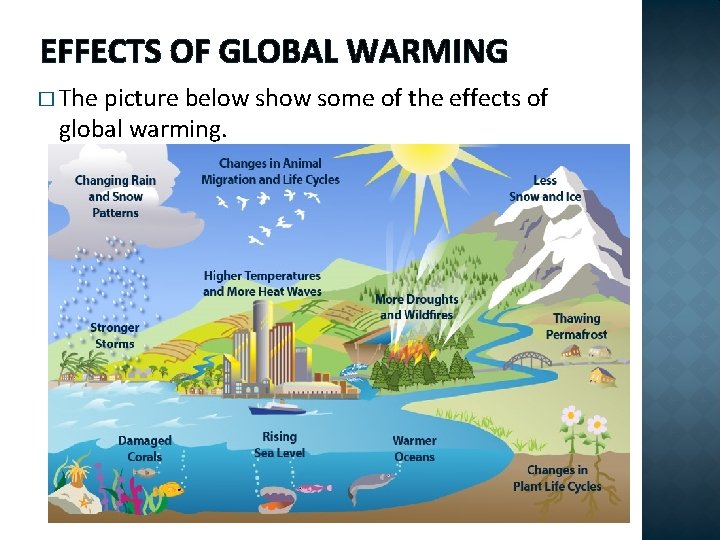
EFFECTS OF GLOBAL WARMING � The picture below show some of the effects of global warming.
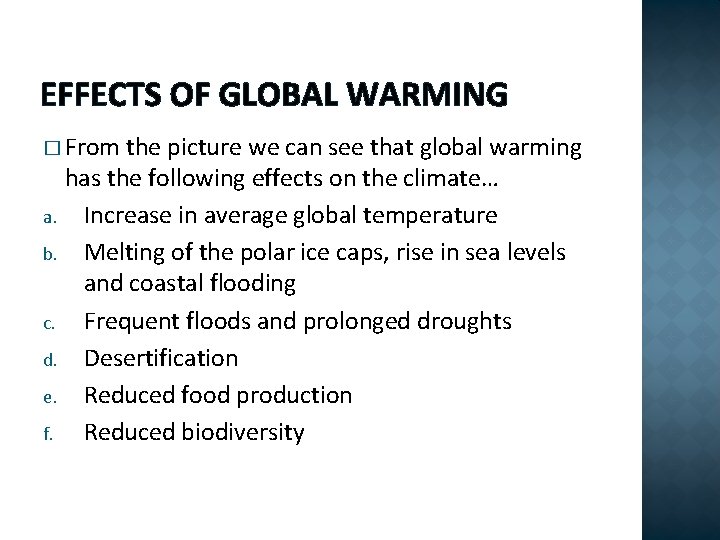
EFFECTS OF GLOBAL WARMING � From the picture we can see that global warming has the following effects on the climate… a. Increase in average global temperature b. Melting of the polar ice caps, rise in sea levels and coastal flooding c. Frequent floods and prolonged droughts d. Desertification e. Reduced food production f. Reduced biodiversity
EFFECTS OF GLOBAL WARMING a. � � b. � � � Increase in Average Global Temperature In the past 10 years the temperatures have been the warmest recorded. Many countries experienced heat waves. Melting of the Polar Ice Caps With the increase in global temperatures the polar ice caps have started to melt. This in turn causes the sea levels to increase. The rise in sea levels leads to flooding of low lying coastal areas.
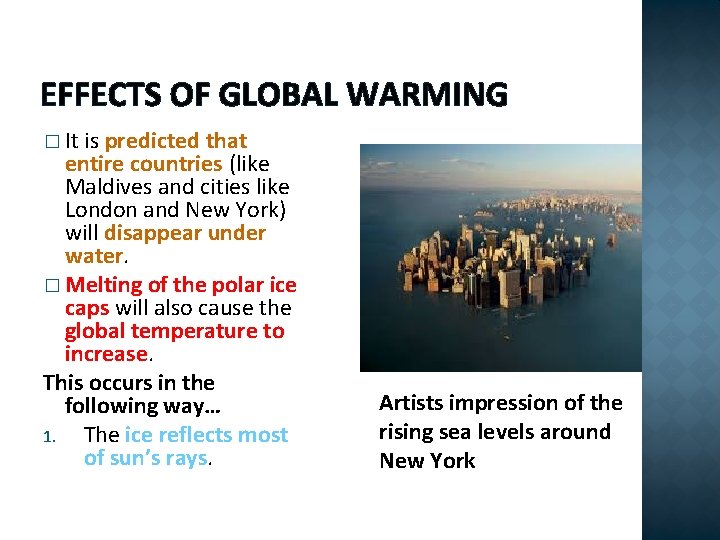
EFFECTS OF GLOBAL WARMING � It is predicted that entire countries (like Maldives and cities like London and New York) will disappear under water. � Melting of the polar ice caps will also cause the global temperature to increase. This occurs in the following way… 1. The ice reflects most of sun’s rays. Artists impression of the rising sea levels around New York
EFFECTS OF GLOBAL WARMING 2. 3. 4. 5. 6. But water absorbs more of the sun’s rays than ice. Therefore because of the melting of the polar ice caps there is more water on earth more sun’s rays are absorbed, increasing the temperature. Then remember that ice stores methane in its crystal structure, when the ice melts methane is released. Methane is a GHG which in turn will cause an increase in temperature. Then as the earth’s temperature increases further, more ice melts and the temperature increases even further. The process continues in a cyclic fashion.
EFFECTS OF GLOBAL WARMING 7. 8. c. � � � This is an example of a positive feedback. This positive feedback is a runaway process. Frequent floods and Prolonged droughts It is thought that global warming will lead to changes in average rainfall patterns. Some areas will experience higher than normal rainfall for example countries in northern Europe. Other areas will experience less rainfall and become dry for example countries in Southern Africa.
EFFECTS OF GLOBAL WARMING � The changes in the rainfall patterns can lead to frequent flooding in areas that were not accustomed to very heavy rainfall. � Other areas becomes dry and arid where they once received good rainfall. � Flooding will affecting housing in the low lying areas, coastal areas and along the river banks. � Informal settlements are usually found along the river banks. � The flood can also be very dangerous and spread disease. � Especially if the storm water is connected to the waste water.
EFFECTS OF GLOBAL WARMING � The floods can cause a flooding of the sewer lines. � Faeces will spill into the human settlement areas. � This leads to an increase in water borne disease such as cholera. d. � � Desertification: Long periods of drought will lead to the top soil becoming dry and loose. If heavy rainfall follows then the dry loose top soil is washed away. If this occurs often, the soil will no longer be able to support plant life. The area will then change into a desert.
EFFECTS OF GLOBAL WARMING e. Reduced Food Production � Global warming will lead to a decrease in food production. The reasons for this are as follows… 1. Some food producing areas will become drier and will not be able to support plant life. 2. Other food producing areas will become flooded by the rising sea levels. 3. Crops may be. destroyed by hurricanes and tornadoes 4. Soil erosion will reduce the fertility of the soil.
EFFECTS OF GLOBAL WARMING 5. High levels of CO 2 may not be conducive to crop production, but the high CO 2 promotes the growth of weeds. This will further decrease crop production. f. Reduced biodiversity � Because of the speed at which global warming occurs many species will not be able to adapt to the climate change. Therefore these species would become extinct. �
EFFECTS OF GLOBAL WARMING The Effects of Global Warming on South Africa According to National White Paper on Climate Change Response South Africa will experience the following changes because of global warming. 1. The South African coast will experience an increase temperature of about 1 to 2 ˚C and the interior will be warmer by 2 to 3˚C. 2. Water availability would decrease because of increased evaporation and parts of the country would be drier. This would affect human health, agriculture, mining, electricity generation and the environment.
EFFECTS OF GLOBAL WARMING 3. 4. 5. Due to the increased dryness, veld fires and forest fires will occur more often. There will also be an increase in extreme weather events and droughts and floods. There would be a rise in sea-level which will affect the people living at the coast. The mass extinction of the endemic plants and animals species will lead to a loss of biodiversity.
EFFECTS OF GLOBAL WARMING Ways to Reduce Global Warming � Reduce the use of fossil fuels, this will lead to a decrease in the levels of CO 2 � Renewable energy such as solar energy and wind power must be used. Cash incentives should be provided to those who use this energy. This would encourage more people to use this type of energy. � Nuclear energy should be used, because this type of energy does not release CO 2 into the atmosphere. But it creates the problem of the nuclear waste , which radioactive.
EFFECTS OF GLOBAL WARMING � Reduce deforestation because the trees absorb CO 2 for photosynthesis, this will decrease the amount of GHGs. � Re-plant the forests to increase the number of trees so that more CO 2 can be absorbed by the plants, reducing the GHGs. � Reduce GHGs emissions from various sources. This is helped along by Kyoto Protocol and COP. This would help to reduce greenhouse gases all over the world. Your teacher will tell you more about these committees and Protocols.
SA AND ITS EFFORTS IN CONTROLLING GLOBAL WARMING � South Africa has made the following efforts to play a role in decreasing global warming. 1. � National Climate Change Response White Paper This paper outline the government's vision and its attempt to control climate change.
SA AND ITS EFFORTS IN CONTROLLING GLOBAL WARMING According to this paper South Africa has a two fold approach… a. South Africa intends to adapt. This means it accepts that global warming is inevitable, that it is real and will happen. Then it intends to adapt and manage the situation. The country will ensure that it is able to respond to emergencies and manage the climate change in a such a way that its social, economic and environmental capacities are maintained.
SA AND ITS EFFORTS IN CONTROLLING GLOBAL WARMING South Africa intends to accept its moral and legal obligations under the UNFCCC. � It also intends to keep its agreement according to the Kyoto Protocol and that is to reduce its GHGs and keep global warming to under 2˚C. South Africa attempts to achieve this by doing the following… 1. Allow GHG emissions to peak between 2020 and 2025. 2. Then level off for the next 10 years. 3. Then GHG emissions must decrease. � This attempt to decrease GHG emissions and control global warming is called mitigation. b.
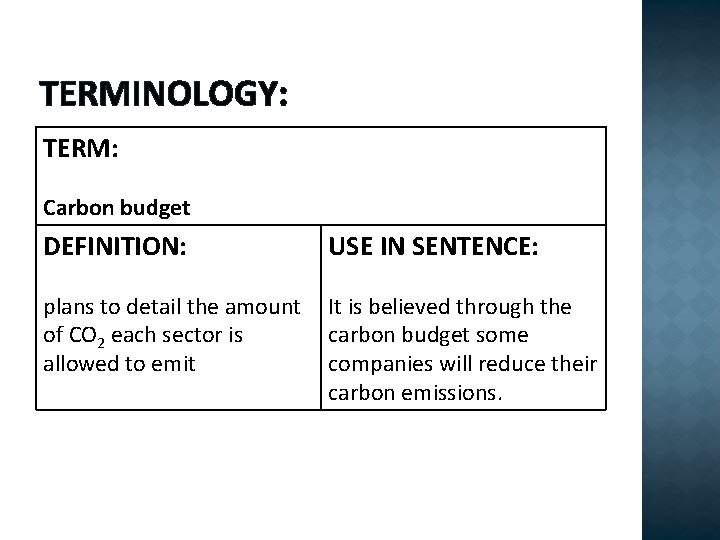
SA AND ITS EFFORTS IN CONTROLLING GLOBAL WARMING � The country plans to use different approaches, policies etc to achieve the above. Here are some of these plans. Defining Carbon Budgets for Different GHG Emitting Sectors. � The carbon budget plans to detail the amount of CO 2 each sector is allowed to emit. Then it plans to introduce carbon budgets for the different countries once the carbon budget is set.
SA AND ITS EFFORTS IN CONTROLLING GLOBAL WARMING Carbon Tax � The carbon tax will be calculated at between R 75 to R 200 a ton of CO 2 released. � It is hoped that the tax will make the users drop to a lower CO 2 emission levels. � Or that they will use renewable sources of energy such as wind or solar power. � There are 3 main arguments against the carbon tax. These are…
SA AND ITS EFFORTS IN CONTROLLING GLOBAL WARMING 1. 2. 3. Tax collected may not go towards developing a green economy, because the tax is not reserved for developing alternative energy sources. The price of electricity will go up to make up for the tax. It may lead to job losses because many companies will cut their work force so that they are able to pay the tax. Green Economy Accord � This is a new agreement signed between the South African government, business and labour.
SA AND ITS EFFORTS IN CONTROLLING GLOBAL WARMING According to this agreement the following commitments have been made… 1. The government commits to obtain renewable energy from solar or wind power or bio- fuels such as sorghum, sugar beet and jatropha. 2. Eskom commits to develop new technologies to increase the efficiency of its coal fired power stations. 3. The transport industry intends to upgrade the rail system to improve the public transport so that more South Africans will use public transport. � It is believed that the implementation of this agreement will lead to job creation.
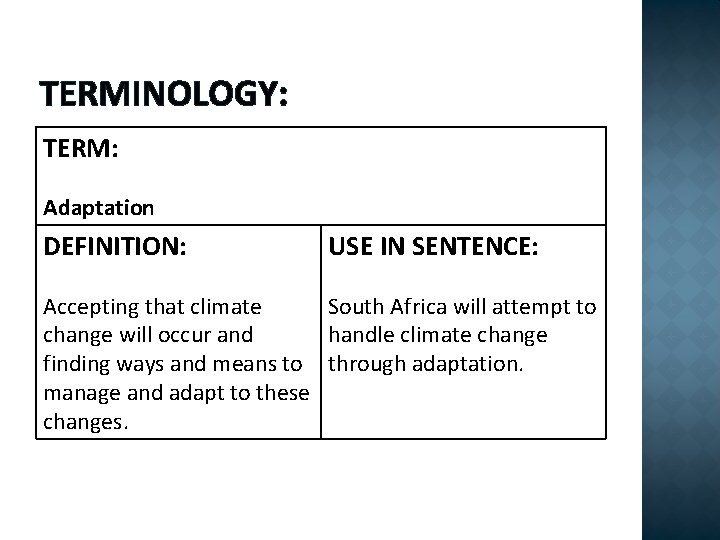
TERMINOLOGY: TERM: Adaptation DEFINITION: USE IN SENTENCE: Accepting that climate South Africa will attempt to change will occur and handle climate change finding ways and means to through adaptation. manage and adapt to these changes.
TERMINOLOGY: TERM: Carbon budget DEFINITION: USE IN SENTENCE: plans to detail the amount of CO 2 each sector is allowed to emit It is believed through the carbon budget some companies will reduce their carbon emissions.
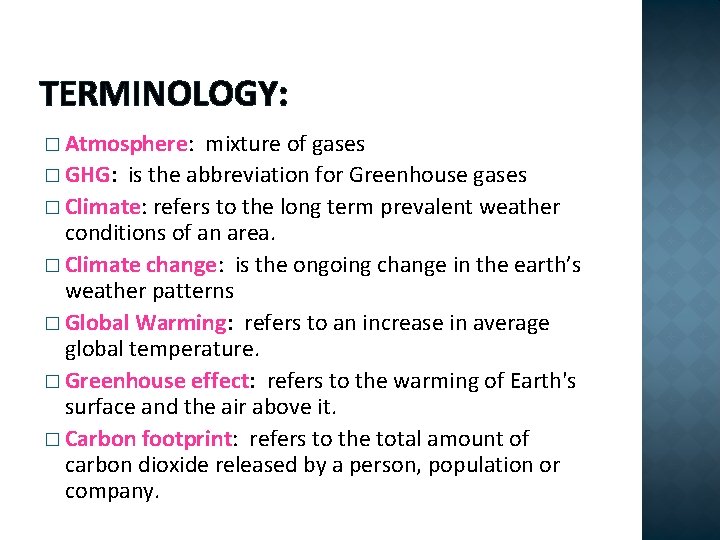
TERMINOLOGY: � Atmosphere: mixture of gases � GHG: is the abbreviation for Greenhouse gases � Climate: refers to the long term prevalent weather conditions of an area. � Climate change: is the ongoing change in the earth’s weather patterns � Global Warming: refers to an increase in average global temperature. � Greenhouse effect: refers to the warming of Earth's surface and the air above it. � Carbon footprint: refers to the total amount of carbon dioxide released by a person, population or company.
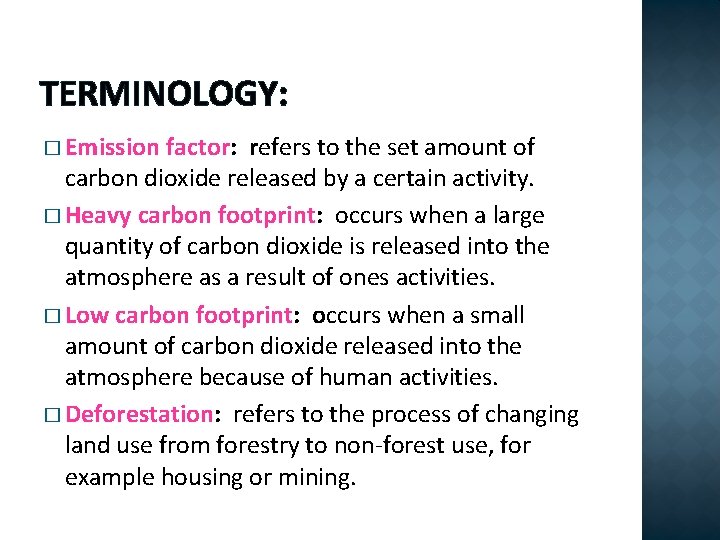
TERMINOLOGY: � Emission factor: refers to the set amount of carbon dioxide released by a certain activity. � Heavy carbon footprint: occurs when a large quantity of carbon dioxide is released into the atmosphere as a result of ones activities. � Low carbon footprint: occurs when a small amount of carbon dioxide released into the atmosphere because of human activities. � Deforestation: refers to the process of changing land use from forestry to non-forest use, for example housing or mining.
TERMINOLOGY � Ozone: refers a molecule that is made up of 3 oxygen atoms. � Ozone depletion: refers to the thinning of the ozone layer. � CFCs: are chlorofluorocarbons that are used in refrigerators and as propellants in aerosols. � Mitigation: refers to attempt to decrease GHG emissions and control global warming. � Adaptation: accepting that climate change will occur and finding ways and means to manage and adapt to these changes. � Carbon budget: plans to detail the amount of carbon dioxide each sector is allowed to emit
QUESTION 1 1. The accord that was signed by government, business and labour is called… A. Montreal Protocol B. Green Economy C. National climate change response white paper D. Kyoto Protocol
QUESTION 2 2. The agreement that attempts to reduce the use of CFCs is… A. Montreal Protocol B. Green Economy C. National climate change response white paper D. Kyoto Protocol
QUESTION 3 3. An agreement that was made by many countries to reduce GHGs is… A. Montreal Protocol B. Green Economy C. National climate change response white paper D. Kyoto Protocol
QUESTION 4 4. The document in which South Africa attempts to deal with climate change by adaptation and management is called… A. Montreal Protocol B. Green Economy C. National climate change response white paper D. Kyoto Protocol
QUESTION 5 5. South Africa’s view on climate change is… A. It exists and is inevitable B. It exists but will never effect South Africa C. It exists but will affect South Africa only in the distant future D. It does not exist, it a lie created by developed countries to hold back our advancement.
QUESTION 6 6. The main argument against carbon tax is that… A. Price of electricity will go up to make up for the tax. B. It will lead to increased deforestation. C. It may cause increased soil erosion. D. Both B and C
QUESTION 7 7. Global warming can be reduced by… A. Reducing the use of fossil fuel B. Use nuclear power C. Preventing the use of nuclear power D. Both A and B
QUESTION 8 8. The following are some effects of global warming. 1. Melting of polar ice caps 2. Increased flooding 3. Total loss of water 4. The earth becoming a desert A. 1, 2, 3 & 4 B. 1 & 2 only C. 3 and 4 only D. 2, 3 and 4
QUESTION 9 9. Global warming can lead to a reduction in biodiversity because… A. The change in climate will destroy some species. B. The mass extinction of endemic plant and animal species may occur C. Both A and B D. A only
QUESTION 10 10. The melting of the polar ice caps can cause an increase in temperature because… A. Ice stores methane gas in its crystal structure. B. As the ice melts methane gas is released C. Methane gas is a GHG D. A, B and C
QUESTION 11 11. Ozone is a molecule that contains… A. 1 oxygen atom B. 2 oxygen atoms C. 3 oxygen atoms D. 1 or 3 oxygen atoms
QUESTION 12 12. The thinning of the ozone layer is called… A. Ozone thinning B. Global warming C. Climate change D. Ozone depletion
QUESTION 13 13. Methane gas is released when micro- organisms undergo… A. Cellular respiration B. Anaerobic respiration C. Aerobic respiration D. Gaseous exchange
QUESTION 14 14. The gas that has a higher impact on global warming is… A. Methane B. Carbon dioxide C. Nitrous oxide D. Oxygen
QUESTION 15 15. Most important greenhouse gas emitted by humans is… A. Methane B. Carbon dioxide C. Nitrous oxide D. Oxygen
QUESTION 16 16. The greenhouse gas that has the smallest contribution to the greenhouse effect is… A. Methane B. Carbon dioxide C. Nitrous oxide D. Oxygen
QUESTION 17 17. The GHG that is present naturally in the atmosphere is… A. Methane B. Nitrous oxide C. Ozone D. Oxygen
QUESTION 18 18. The natural phenomena that keeps the earth warm… A. The green house effect B. The enhanced greenhouse effect C. Global warming D. Decomposition
QUESTION 19 19. The phenomon that leads to climate change is… A. The green house effect B. The enhanced greenhouse effect C. Both A and B D. None of the above
QUESTION 20 20. Deforestation leads to climate change because… A. There are no longer enough tree to absorb carbon dioxide B. Dead tree trunks attract termites which release large amounts of methane C. The trees are replaced by grazing animals which release methane gas D. All of the above
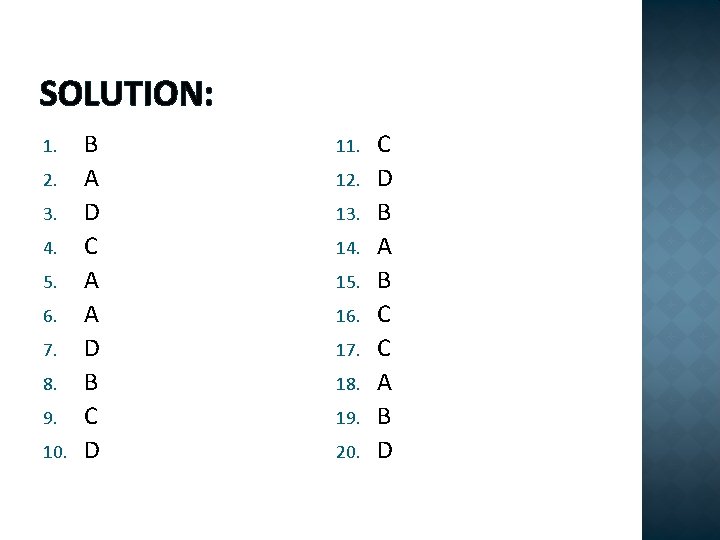
SOLUTION: 1. 2. 3. 4. 5. 6. 7. 8. 9. 10. B A D C A A D B C D 11. 12. 13. 14. 15. 16. 17. 18. 19. 20. C D B A B C C A B D